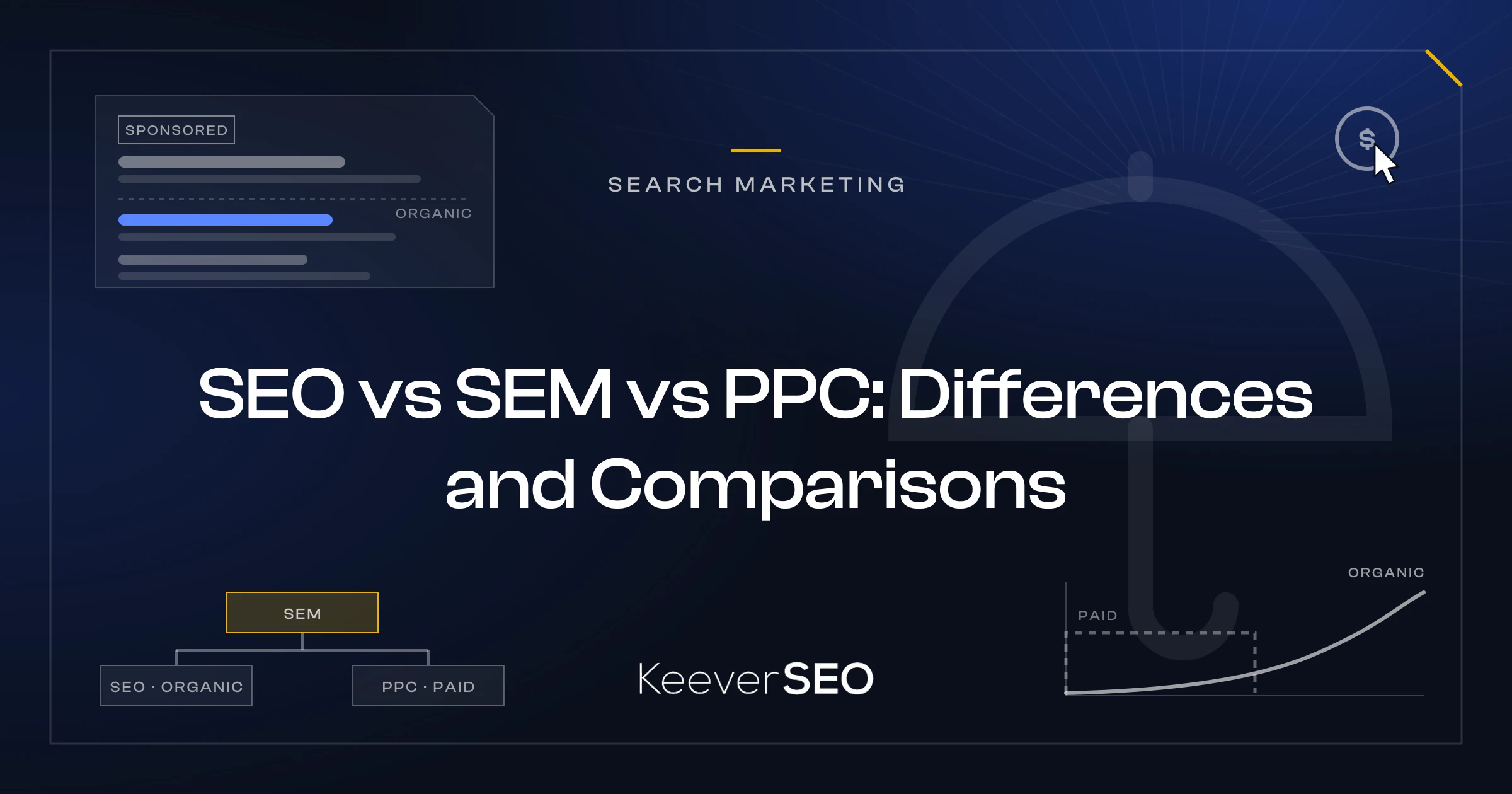
Search Engine Marketing (SEM) is the umbrella category that covers both Search Engine Optimization (SEO) and Pay-Per-Click (PPC) advertising. SEO is the organic discipline that raises a website's visibility in unpaid search results through on-page, off-page, and technical optimization. PPC is paid advertising in which businesses bid on keywords to gain immediate visibility on search engine results pages (SERPs). The primary axes that separate the three are organic versus paid placement, cost structure, speed of results, and longevity.
SEO is a long-term investment in content creation, link building, and technical improvement. SEO needs several months to show meaningful results, but the benefits last, because organic traffic keeps arriving without a cost per click. PPC delivers instant visibility and traffic through paid ads but requires ongoing spend, because traffic stops when the ad budget runs out. SEO and PPC overlap in keyword targeting and search intent, and they often complement each other in a unified strategy.
Businesses should choose between SEO, SEM, and PPC by their goals, budget, and timeline. SEO suits long-term growth and brand building, PPC suits immediate visibility and market testing, and SEM, which combines both, gives the fullest search engine presence. Keywords and search intent connect SEO and PPC, because both channels draw on shared keyword research and audience data. SEO and PPC work together when high-performing organic content is promoted through paid ads, non-converting visitors are retargeted, and messaging is tested in ads before an SEO commitment. A unified search strategy aligns organic and paid efforts with business objectives and budget, which balances sustainable organic growth against immediate paid visibility.
SEO vs SEM vs PPC at a glance
SEO, SEM, and PPC differ across six dimensions, which are compared in the table below:
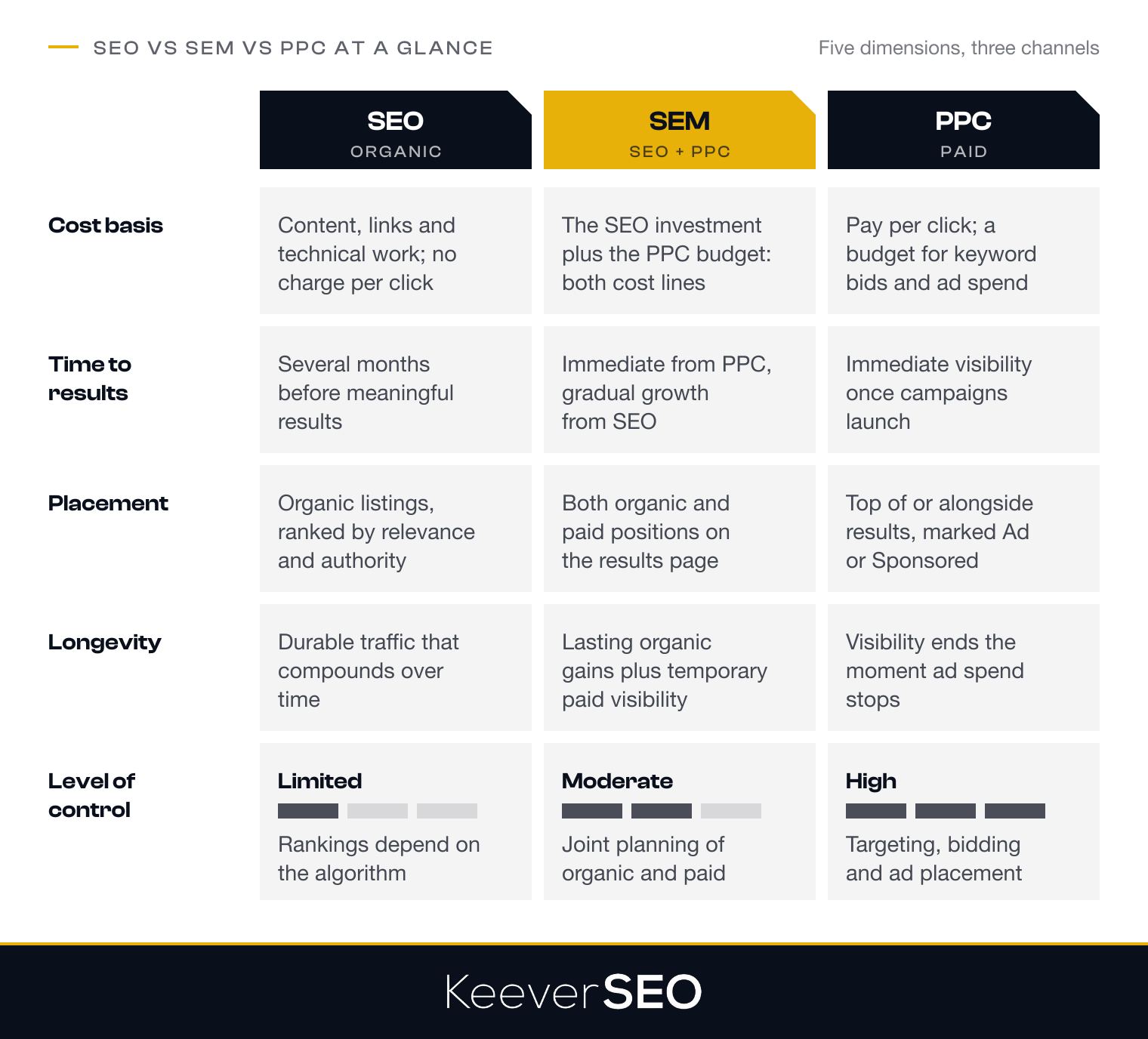
| Dimension | SEO | SEM | PPC |
|---|---|---|---|
| Definition | SEO (Search Engine Optimization) improves organic search rankings through on-page, off-page, and technical optimization. | SEM (Search Engine Marketing) is an umbrella strategy that includes both SEO and PPC to raise search engine visibility. | PPC (Pay-Per-Click) is a paid advertising model in which advertisers pay for each click on their ads. |
| Cost Basis | SEO costs cover content creation, technical optimization, and link building, with no per-click charge. | SEM combines the SEO investment with the PPC budget, so it carries both organic and paid costs. | PPC runs on a pay-per-click model that needs a budget for keyword bidding and ad spend management. |
| Time to Results | SEO is a long-term strategy that often takes several months to show meaningful results. | SEM mixes timelines: immediate results from PPC and gradual growth from SEO. | PPC delivers immediate visibility and traffic once campaigns launch. |
| Placement | SEO results appear in organic search listings, ranked by relevance and authority. | SEM occupies both organic and paid positions on search engine results pages. | PPC ads appear at the top of or alongside search results, marked "Ad" or "Sponsored." |
| Longevity/Duration | SEO delivers durable traffic that compounds over time. | SEM combines lasting organic benefits with temporary paid visibility. | PPC visibility ends when ad spend stops. |
| Level of Control | SEO offers limited direct control over rankings, which depend on search engine algorithms. | SEM allows moderate control through joint planning of organic and paid elements. | PPC offers high control over targeting, bidding, and ad placement. |
The table sets out the distinct roles of SEO, SEM, and PPC in search marketing, and the sections below define each one.
What is the difference between SEO, SEM, and PPC?
The difference between SEO, SEM, and PPC is that SEM is the umbrella term, SEO is its unpaid organic component, and PPC is its paid advertising component. SEO raises organic search visibility through content optimization, backlinks, and technical improvements. PPC places paid advertisements in search results, with businesses bidding on keywords and paying each time a user clicks the ad.
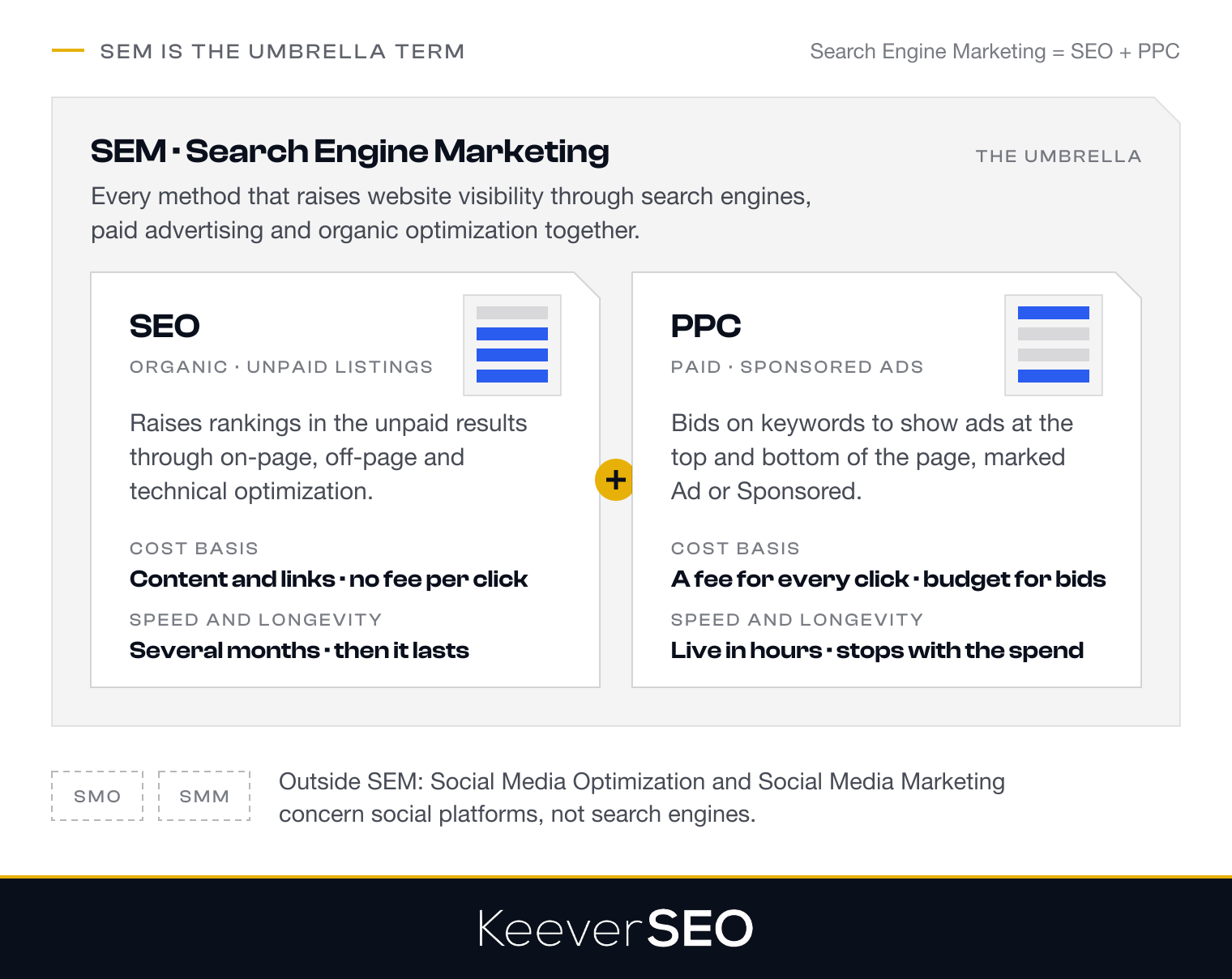
The core distinction lies in the approach: SEO is an unpaid strategy that lifts organic rankings, while PPC is a paid strategy that buys immediate visibility, and SEM combines the two for the widest search engine presence. The framework helps businesses pick the right strategy for their goals, budget, and timeline, and each component is defined in detail below, beginning with SEO.
What is SEO?
SEO, or Search Engine Optimization, is the practice of raising a website's visibility in unpaid search engine results. SEO has three main components: on-page SEO, off-page SEO, and technical SEO. On-page SEO optimizes content, keywords, and meta tags to match user search intent. Off-page SEO builds credibility through high-quality backlinks from authoritative sites. Technical SEO keeps search engine crawling and indexing efficient by addressing site speed, mobile-friendliness, and structured data.
On-page SEO covers elements such as title tags, header tags, and internal links that sharpen relevance. Off-page SEO strengthens authority through backlinks and brand mentions. Technical SEO improves site infrastructure across crawlability, indexing, and security. SEO relies on relevance and authority rather than paid placement, which produces sustainable organic traffic growth. SEO takes time and resources, but it delivers higher click-through rates and lasting brand credibility.
What is SEM?
SEM, or Search Engine Marketing, is the full set of methods that raise website visibility through search engines, covering both paid advertising like Pay-Per-Click (PPC) and organic optimization through Search Engine Optimization (SEO). The two methods combine to strengthen a website's presence on search engine results pages (SERPs).
Paid placements in SEM appear at the top and bottom of SERPs, marked "sponsored" or "ads," while organic results fill the middle. The split lets SEM deliver instant visibility through paid ads while SEO builds long-term organic growth. SEM uses tactics such as text-based search ads, visual shopping ads, and keyword bidding to reach specific audiences.
The primary advantage of SEM is immediate, measurable results with flexible targeting. Businesses can reach audience segments by demographics, location, and search intent. Sustaining SEM requires ongoing financial investment and skilled management to balance immediate exposure against cost.
Does SEM include both SEO and PPC?
Yes, SEM (Search Engine Marketing) includes both SEO and PPC as its two components. SEM is the overarching strategy that raises website visibility on search engines through organic and paid methods together. SEO, or Search Engine Optimization, improves organic search results through content, technical work, and authority building. PPC, or Pay-Per-Click, is a paid advertising model in which advertisers bid on keywords to show ads in search results and pay only when the ad is clicked.
The relationship is hierarchical: SEM contains SEO and PPC as subsets. SEO relies on unpaid techniques to improve rankings, while PPC buys immediate visibility. Adjacent terms like SMO (Social Media Optimization) and SMM (Social Media Marketing) sit outside SEM because they concern social media platforms rather than search engines. PPC can extend to social media advertising, but within SEM the term refers to paid search placements on search engine results pages.
What is PPC?
PPC, or Pay-Per-Click, is a digital advertising model in which advertisers pay a fee each time a user clicks their ad. The model lets businesses buy visits to their sites rather than earn them organically. PPC runs on an auction in which advertisers bid on keywords, and the cost per click varies with keyword competition and ad quality. When users search for terms that match the advertiser's keywords, the ads enter an automated auction, and placement depends on bid amount and ad relevance.
PPC covers several ad types. Search ads appear at the top or bottom of search engine results pages when users query relevant keywords. Display ads are images, videos, and text shown across websites. Retargeting ads follow users who visited a website before and show relevant ads as they browse elsewhere. The core mechanics involve setting a maximum cost-per-click (CPC) bid and managing campaigns through platforms like Google Ads, Microsoft Advertising, or social media channels. Quality Score, a metric built from expected click-through rate, ad relevance, and landing page experience, shapes ad position.
PPC delivers immediate visibility and targeted traffic with measurable ROI, along with flexibility in budget allocation and campaign adjustment. PPC requires ongoing spend and continual management so clicks turn into business outcomes. PPC suits time-sensitive offers and competitive keywords but can grow expensive depending on industry and keyword competition, so it needs both an ad budget and skilled oversight.
What are the key differences between SEO and PPC?
The key differences between SEO and PPC lie in placement, longevity, control, and traffic durability. The four differences are set out below:
Placement (Organic vs Paid) SEO earns organic rankings on search engine results pages (SERPs) through optimization, and the results appear in the unpaid listings below paid advertisements. PPC secures paid ad placements at the top and bottom of SERPs, marked as advertisements.
Longevity and Sustainability SEO provides long-term visibility through compounding, durable traffic that continues as long as rankings hold, which makes it a sustainable source of visibility. PPC traffic stops the moment ad spend stops, so the visibility boost is short-term and needs continuous funding.
Level of Control PPC offers precise control over targeting, budget allocation, ad copy, and timing, and advertisers can adjust campaigns in real time to market conditions and audience behavior. SEO offers less direct control, because rankings depend on how algorithms interpret optimization efforts, on competitor activity, and on evolving search engine criteria.
Traffic Durability SEO traffic is more resilient, because strong pages keep attracting visits for months or years with ongoing maintenance. PPC traffic fluctuates with budget availability and bid competitiveness, which leaves it exposed to market conditions and budget cuts.
How do SEO and PPC differ in cost?
SEO and PPC differ in cost because SEO is a continuous management investment while PPC charges per click. SEO requires ongoing spend on management, content creation, and technical optimization, structured as a monthly retainer or in-house resource allocation. Monthly SEO management most often runs from $501 to $2,000, with an average retainer of about $3,209 across the 439 providers in Ahrefs' SEO pricing survey, depending on scope and market competitiveness. PPC charges advertisers each time an ad is clicked, with costs that vary by keyword competition, industry, and ad quality. PPC carries both platform spend and management fees, with cost-per-click bids from under $1 to over $50 in competitive industries like legal or finance. The average cost per click on Google Ads across industries reached $5.26 in 2025, according to WordStream's Google Ads Benchmarks report. SEO is a long-term investment that builds sustainable traffic, while PPC delivers immediate visibility at a recurring cost.
How do SEO and PPC differ in time to results?
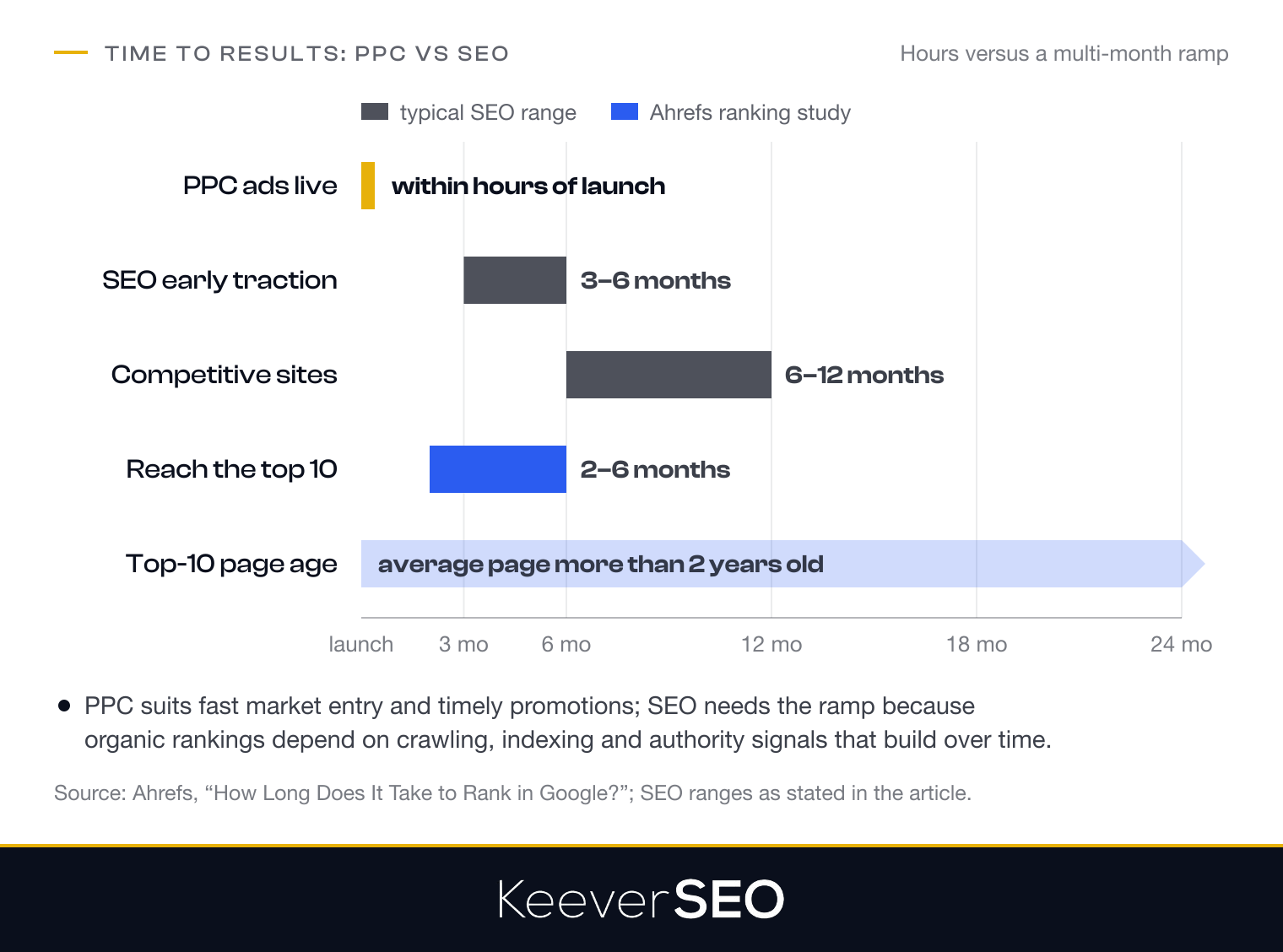
SEO and PPC differ in time to results because PPC delivers visibility within hours while SEO needs a multi-month ramp. PPC ads can appear at the top of search results within hours of a campaign launch, which suits businesses that need fast market entry or timely promotions. SEO takes about three to six months to show early traction, and competitive sites need six to twelve months for meaningful impact, because organic rankings depend on crawling, indexing, and authority signals that build over time. Ahrefs' study "How Long Does It Take to Rank in Google?" found that the pages that reached the top 10 within a year took two to six months to get there, and that the average top-10 page was more than two years old. Top-ranking pages tend to be years old, which shows the patience organic growth demands. The two timelines tell businesses when to use PPC for immediate gains and when to invest in SEO for sustainable growth.
Where do SEO and PPC overlap?
SEO and PPC overlap in keyword targeting, SERP real estate, and audience data. The three areas of overlap are listed below:
- Shared Keyword Targeting: Both SEO and PPC target the same high-value keywords, so PPC data refines SEO strategy by showing which keywords drive traffic and conversions, and SEO performance guides PPC bidding.
- Shared SERP Real Estate: A business that appears in both organic listings and paid ads holds more of the search engine results page (SERP), which raises brand visibility and credibility because users trust a brand that appears more than once on a page.
- Shared Audience and Intent Data: PPC campaigns supply immediate data on user behavior, such as click-through and conversion rates, which shows which keywords and content resonate and informs SEO, while SEO insights direct PPC spend toward high-converting keywords.
The three overlaps show how SEO and PPC reinforce each other within one search marketing effort.
When should businesses choose SEO, SEM, or PPC?
Businesses should choose SEO, SEM, or PPC by weighing goals, budget, timeline, current site performance, and market competitiveness. SEO suits businesses that want sustainable, long-term growth and brand credibility; it demands time and ongoing investment but returns compounding traffic and lower long-term acquisition costs. PPC suits businesses that need immediate visibility, such as for a product launch or a time-sensitive offer, and it delivers fast results at the price of continuous budget allocation.
SEM, which combines SEO and PPC, suits businesses with flexible budgets and aggressive growth targets, because it allows immediate market penetration through PPC while SEO builds long-term organic visibility. Market conditions weigh on the choice as well: in competitive markets, PPC gives an entry point while SEO efforts mature, whereas in less saturated niches SEO alone may suffice. Pairing SEO for sustained traffic with PPC for immediate results fits most business objectives, because it balances short-term and long-term goals, and First Page Sage's SEO ROI research, which puts the average return on SEO at 748%, shows why the organic side of the pairing earns the long-term investment.
How do keywords and search intent connect SEO and PPC?
Keywords and search intent connect SEO and PPC by giving both channels the same foundation of keyword research and intent classification. Both SEO and PPC start with keyword research that identifies user queries and the intent behind them, whether informational, navigational, transactional, or commercial. The shared keyword intelligence lets businesses align organic content and paid ads with user expectations. The three connection points are set out below:
Shared Keyword Research SEO uses keywords to shape content for organic rankings, with a focus on user intent to answer questions or supply information. PPC uses the same keywords to build targeted ads that capture immediate interest and drive conversions.
Intent-to-Keyword Mapping Informational queries often favor SEO, because they match users who seek knowledge or answers. Transactional queries suit PPC, because they signal purchase intent and higher conversion potential.
PPC Data Validation PPC campaigns supply real-time data on keyword performance, including click-through rates and conversions. The data confirms which keywords deserve long-term organic investment and which are too costly or ineffective.
Integrating keyword research and search intent across both channels keeps SEO and PPC aligned with user needs and business goals.
How are SEO, SEM, and PPC measured?
SEO, SEM, and PPC are measured through distinct metrics that reflect each channel's role in search marketing. The metrics are listed below:
SEO Metrics
- Organic Traffic: The number of visitors who arrive through unpaid search results, which shows how well SEO attracts users.
- Keyword Rankings: The position of web pages in search results for targeted keywords, which shows the effect of SEO on visibility.
- Search Visibility: A composite metric of how often and how prominently a site appears in search results across all tracked keywords, which gives a broad view of organic presence.
PPC and SEM Metrics
- Impressions: The number of times an ad appears in search results, which measures potential reach before any interaction.
- Click-Through Rate (CTR): The percentage of people who click an ad after seeing it, which shows how well the ad attracts attention.
- Cost-Per-Click (CPC): The average cost of each click on an ad, which governs PPC budget management.
- Conversions and Conversion Rate: The number and percentage of ad clicks that lead to desired actions, such as purchases or sign-ups, which shows campaign success.
- Return on Ad Spend (ROAS): The revenue generated for every dollar spent on ads, which guides investment decisions in PPC and SEM campaigns.
Tracking the metrics lets businesses measure the impact of SEO, SEM, and PPC against their marketing goals and refine each strategy.
Can SEO and PPC work together?
Yes, SEO and PPC work together to maximize search visibility and performance. The five ways to combine them are listed below:
- Promoting top organic content via ads: High-performing organic content identified through SEO analytics can be promoted through PPC campaigns, which extends the reach of content that already resonates and drives more qualified traffic while the organic ranking keeps building authority.
- Retargeting organic visitors: PPC retargeting campaigns re-engage users who found the site through organic search but did not convert, with targeted ads across the Google Display Network or social platforms that add touchpoints and build on the trust established through organic discovery.
- Dominating the full SERP: A brand that appears in both organic results and paid placements for the same keyword occupies more of the search results page, which raises visibility, builds authority, and captures clicks from users who prefer either paid or organic listings.
- Testing copy with PPC before committing to SEO: PPC campaigns give rapid feedback on which headlines, descriptions, and value propositions earn the highest click-through rates, and the winning messaging then feeds meta titles, descriptions, and on-page content, which cuts the risk of months of organic work on unproven messaging.
- Feeding CTR data back into SEO: PPC platforms report click-through and conversion data by keyword, device, location, and time of day, which reveals the keywords that drive business results and lets SEO focus on terms with proven commercial intent.
The combined approach creates a unified search marketing strategy that draws on the strengths of both channels.
How should businesses build a search strategy?
Businesses should build a search strategy by folding organic SEO and paid PPC into one SEM plan that matches their goals and budget. The plan begins with clear, measurable objectives, such as immediate lead generation, brand awareness, or sustainable traffic growth. The two planning areas are set out below:
Aligning Goals and Budget
- Immediate Visibility Needs: Allocate more budget to PPC for fast market entry or product testing.
- Long-term Growth Objectives: Invest more in SEO to build sustainable organic traffic.
- Market Competitiveness: Weigh the competition to set the balance between organic and paid effort.
Integrating SEO and PPC
- Data Sharing: Use PPC campaigns to test keyword effectiveness and messaging before committing to long-term SEO content investment.
- Unified Measurement: Track how both channels work together to cover the full SERP and reach users at different stages of intent.
- Budget Allocation: Treat budgeting as an operating decision that funds PPC for immediate demand and SEO for compounding returns.
Shared goals and data-driven insight produce a search strategy that maximizes visibility and conversion opportunities across organic and paid channels.
Should search strategy match business goals and available budget?
Yes, a search strategy should match both business goals and the available budget. Goals decide whether the focus falls on immediate visibility or long-term growth: a company that needs fast visibility leans toward PPC and its instant paid placements, while a business that wants sustainable growth invests more in SEO and its organic traffic. The budget sets the mix of organic and paid work, because it dictates how much each channel can receive. A limited budget favors cost-effective SEO, while a larger budget supports a balanced approach across SEO and PPC. The alignment keeps the search strategy in step with business objectives and financial limits.
Once goals and budget are defined, the decision on specialist search support becomes clearer. Businesses may need expert help when in-house capabilities are limited or when complex organic and paid strategies must be coordinated.
When should businesses use specialist search support?
Businesses should use specialist search support when internal capabilities cannot meet the demands of search marketing. The need arises when in-house resources are limited and technical SEO and PPC campaigns cannot both be managed well. Growth that plateaus despite continuous optimization signals that external expertise is needed to find and apply advanced strategies.
Technical complexity, such as restructuring site architecture or optimizing Core Web Vitals, points to specialist help as well. Businesses that face such work gain from external support with the technical depth and strategic oversight required. Coordinating organic and paid search into one approach matters when SEO keyword targets must align with PPC bidding strategies, so both efforts reinforce each other.
The decision to seek specialist support follows operational constraints and business objectives rather than desperation. When internal teams struggle with consistent execution, or when search performance stays flat despite effort, external support supplies the structure and specialist knowledge for improvement, from technical SEO to paid search optimization to a strategy that fits goals and budget.
What SEO, SEM, and PPC services do agencies offer?
Agencies offer technical SEO, on-page and content, link building, paid search management, keyword strategy, and analytics services across SEO, SEM, and PPC. The six service lines are set out below:
Technical SEO Services Technical SEO services tune the backend of a website for crawlability and indexability. The work covers site architecture audits, page speed optimization, mobile-friendliness, and structured data implementation, which removes the technical barriers that keep search engines from accessing and ranking content.
On-page SEO and Content Services On-page SEO and content services improve individual web pages to rank higher in search results. Agencies conduct keyword research and mapping, optimize title tags and meta descriptions, and create search-aligned content that meets ranking factors while serving users.
Link Building and Off-page SEO Services Link building and off-page SEO services raise a website's authority and credibility through high-quality backlinks. Agencies run outreach campaigns, digital PR, guest posting, and broken link building to earn editorial links from authoritative sources.
Paid Search Management Services Paid search management services cover the planning, execution, and optimization of PPC campaigns on platforms like Google Ads and Bing Ads. Agencies handle account setup, keyword bidding, ad copywriting, and campaign structure, with a focus on Quality Score and return on ad spend.
Keyword Research and Strategy Services Keyword research and strategy services bridge organic and paid channels by identifying high-value search opportunities. Agencies analyze search intent, map keywords to landing pages and ad groups, and run competitive analysis, so one keyword strategy informs both SEO content and PPC targeting.
Analytics and Reporting Services Analytics and reporting services supply the measurement frameworks that track performance across SEO and PPC. Agencies set up conversion tracking, build custom dashboards, and deliver regular performance reports on organic rankings, traffic, and paid campaign data to guide optimization and budget allocation.
When should you hire an SEO agency?
You should hire an SEO agency when the cost of building and maintaining an in-house SEO team exceeds the cost of outsourcing. Businesses turn to an agency when they lack the technical expertise for complex work such as technical audits or large-scale link-building campaigns. Agencies supply a team of specialists who cover technical, content, and analytics work at once.
Plateaued organic growth, or the need to scale results fast, is a second reason to hire an SEO agency. Agencies bring specialized tools and proprietary data, which matter for businesses with aggressive growth targets or competitive markets, and they can deploy coordinated SEO and PPC strategies faster than an internal team can be built.
Coordinating organic and paid search is a third reason. Businesses that struggle to integrate SEO and PPC insights gain from an agency that unifies both disciplines under one strategy, so organic content development draws on paid conversion data and PPC budgets reinforce organic wins.
Can an SEO agency support organic growth and coordinate SEO with PPC?
Yes, an SEO agency can support organic growth and coordinate it with PPC for full search engine results page (SERP) coverage. Our search marketing agency integrates technical SEO, content optimization, and link building with paid search, so a business occupies both organic and paid placements on the SERP. PPC data informs SEO strategy, which aligns keyword targeting across channels and raises search marketing effectiveness. The coordination lifts immediate visibility through PPC and builds sustainable traffic through SEO within one search strategy.
What should you ask an SEO agency?
You should ask an SEO agency about its reporting, technical SEO handling, use of PPC insights, cadence, track record, and organic-paid coordination. The six questions are listed below:
- Reporting and KPIs: Ask which metrics the agency tracks and how it measures success, because its approach to organic traffic growth, ranking improvement, and conversion metrics decides how ROI is assessed.
- Technical SEO Handling: Ask how the agency handles site speed, mobile-friendliness, crawlability, and indexation, since technical foundations shape the ability to rank.
- Use of PPC Insights: Ask how the agency folds paid search data into the organic strategy, because PPC campaigns generate keyword performance data and audience insight that confirm and speed up SEO decisions.
- Reporting Cadence: Ask how often the agency reports and in what format, since regular, clear reporting keeps it accountable and lets progress be tracked against benchmarks.
- Track Record and Case Studies: Ask for specific results delivered for similar businesses or industries, because past performance with comparable clients shows the agency understands the market.
- Coordination Between Organic and Paid: Ask how the agency keeps SEO and PPC working together rather than in silos, since a unified search strategy draws on both channels for maximum visibility and conversion opportunity.
Each question tests whether the agency can meet the business's specific needs and objectives.
How will the agency measure growth, manage technical SEO, and use PPC insights?
The agency will measure growth through organic and paid performance metrics, manage technical SEO through regular audits, and use PPC insights to sharpen the organic strategy. For organic growth, the agency reports on organic traffic volume, keyword rankings, search visibility, and organic conversions. For technical SEO, the agency runs regular site audits to find and fix crawl errors, speed problems, and mobile-friendliness issues, and it reports technical health scores that show continuous improvement in Core Web Vitals and other benchmarks.
PPC insights feed the organic strategy through data from paid campaigns. The agency analyzes click-through rates, conversion rates, and cost-per-acquisition to confirm which keywords and messaging resonate with the target audience. The intelligence flows back into organic content strategy and identifies high-converting keywords worth targeting organically. Integrating PPC insight refines content targeting and intent mapping, so both channels work together to cover search engine results pages.
What SEO and PPC tools support search marketing?
The SEO and PPC tools that support search marketing cover keyword research, rank tracking, technical auditing, analytics, and bid management. The five tool categories are listed below:
- Keyword Research Tools: Keyword research tools identify high-value search terms by search volume, competition, and user intent, which lets both SEO and PPC prioritize keywords by relevance and commercial value.
- Rank Tracking Tools: Rank tracking tools monitor keyword performance in organic search over time, which shows SEO trends and the impact of algorithm updates and confirms optimization efforts.
- Technical SEO Auditing Tools: Technical SEO auditing tools diagnose issues that hurt indexing and ranking, such as broken links and slow page speed, and automate the identification of technical problems for prioritized fixes.
- Analytics Platforms: Analytics platforms track user behavior, traffic sources, and conversions across organic and paid channels, which measures ROI, maps the customer journey, and supports data-driven budget allocation.
- PPC Bid Management and Analytics Platforms: PPC bid management platforms automate keyword bidding, track ad performance, and report metrics like CTR and CPC in real time, which optimizes campaigns and keeps budget use efficient.
The five categories together support the planning and execution of search marketing so SEO and PPC stay aligned with business goals.
What is the best SEO, SEM, and PPC strategy?
The best SEO, SEM, and PPC strategy combines organic and paid search into one plan aligned with business goals and budget. The integrated approach uses SEO to build sustainable organic visibility and PPC for immediate reach and testing, so short-term and long-term objectives are met without silos.
A strong strategy begins with shared intent mapping and joint keyword research. PPC captures demand and tests messaging fast, while SEO compounds authority over time and reduces reliance on paid traffic. The balance between organic and paid effort should reflect current priorities, competition, and available budget. We deliver the integrated approach by coordinating technical SEO, content optimization, and PPC campaigns for maximum visibility across search engine results pages (SERPs).
Businesses that want both immediate lead flow and sustainable growth should adopt the unified model, above all in competitive markets where a single channel falls short. Aligning organic and paid strategies maximizes return on investment and reaches search marketing objectives faster.
Should SEO support sustainable traffic growth?
Yes, SEO should support sustainable traffic growth, because organic visibility compounds and keeps delivering after the work is done. Paid advertising stops the moment spending stops, whereas organic SEO builds visibility that continues to return results over time. Organic search drives 53.3% of all trackable website visits, according to BrightEdge Research, which shows its weight in sustainable traffic. SEO requires time and resources up front, and top-ranking pages tend to be years old, but the benefits it delivers do not depend on continuous spend.
The compounding nature of organic traffic makes SEO the foundation of any unified search strategy that balances immediate results against long-term growth.
How do SEO vs SEM vs PPC fit one unified search strategy?
SEO, SEM, and PPC fit one unified search strategy by combining their distinct strengths to cover the full spectrum of search visibility. SEO builds long-term organic visibility through content optimization, technical improvement, and link building, which supports sustainable traffic growth and brand credibility. PPC delivers immediate visibility through paid ads at the top of search results, which captures market attention fast and tests keyword effectiveness. SEM is the overarching strategy that holds both, so organic and paid efforts stay aligned.
Within the unified strategy, SEO and PPC work together for broader search engine results page (SERP) coverage. Shared keyword research informs both organic content and paid ads, so the most relevant terms are targeted in both. PPC data such as click-through rates and conversion metrics confirms and refines SEO, while SEO insight improves PPC campaigns. The integrated approach allocates resources across immediate results from PPC and the compounding benefits of SEO, and a company that treats search marketing as one system earns a more efficient and effective presence in search engines.