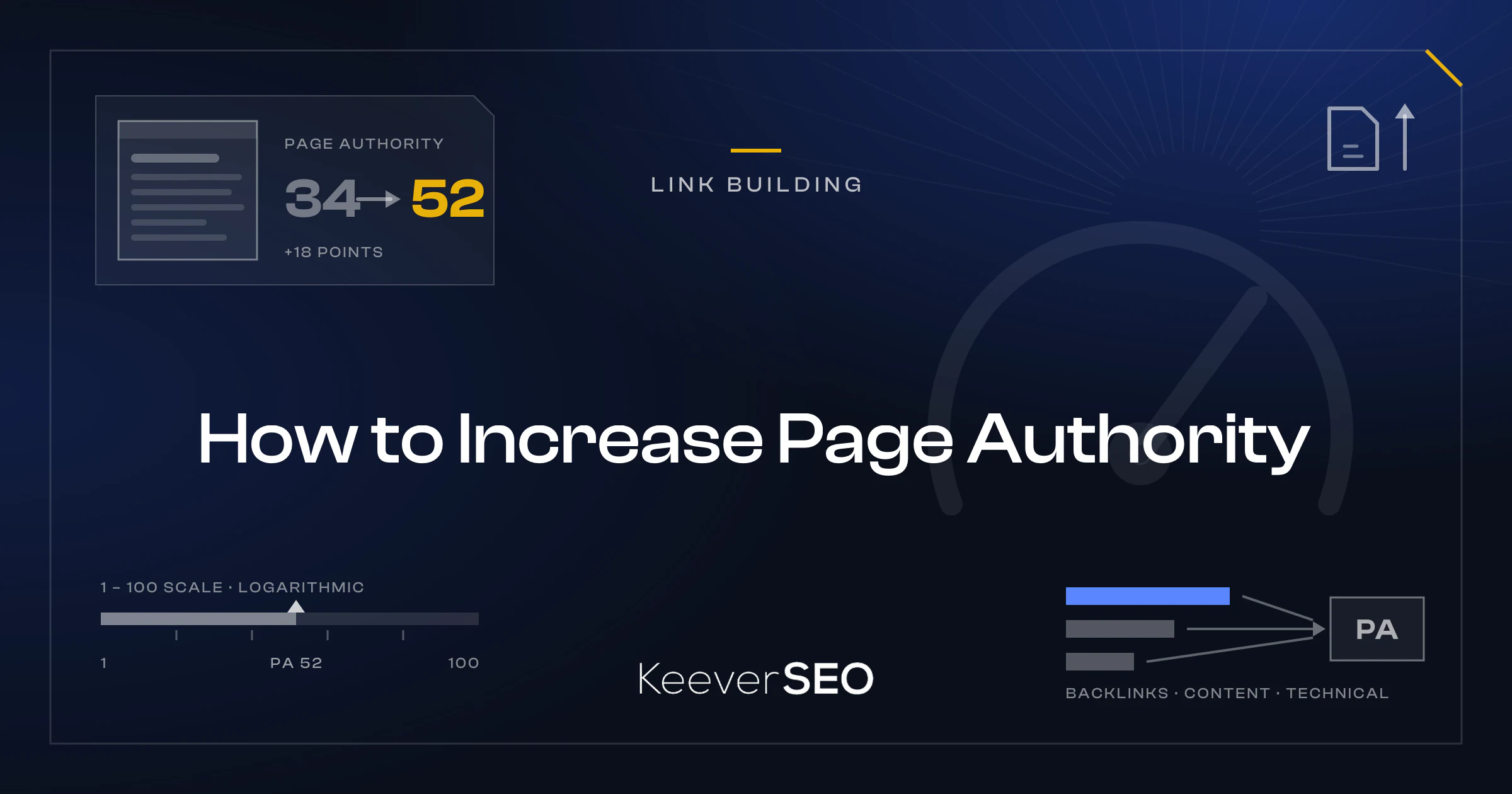
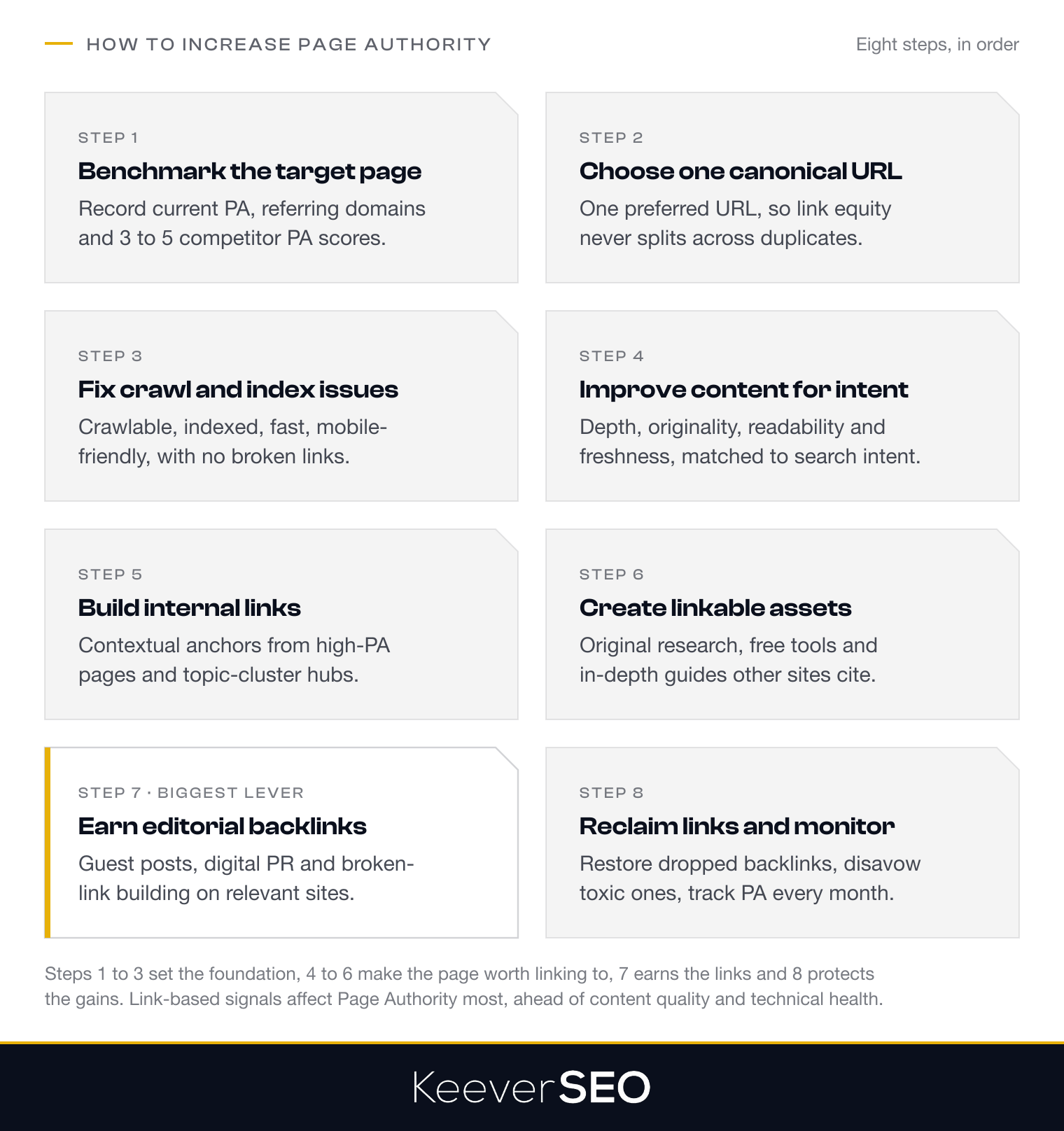
To increase Page Authority, benchmark the page, consolidate its link equity, and earn authoritative links through a systematic eight-step method. Page Authority (PA) is a Moz metric that predicts how well a specific webpage will rank on search engine results pages, scored on a logarithmic scale from 1 to 100. The eight steps are listed below:
- Benchmark the Target Page: Capture the page's baseline Page Authority, its current referring domains, and a competitor Page Authority benchmark to set a realistic target and a base for measuring progress.
- Choose One Canonical Target URL: Select a single canonical URL to consolidate link equity so duplicate or competing versions do not split authority, which directs every link value to the intended page.
- Fix Indexability and Crawl Issues: Resolve crawlability and indexation status, improve site speed, confirm mobile-friendliness, and fix broken links so search engines can access and rank the page.
- Improve Content for Search Intent: Raise the content's depth, originality, readability, and freshness and align it with the dominant search intent, which makes the page more relevant to users and search engines.
- Build Relevant Internal Links: Add internal links from high-authority pages with contextual anchor text and topic-cluster or hub linking, which distributes link equity across the site.
- Create Linkable Page Assets: Develop original research, data, tools, and in-depth guides, the asset types that attract links and give editorial backlinks a foundation.
- Earn Editorial Backlinks: Acquire backlinks from relevant, authoritative domains through editorial and earned links rather than low-quality ones, with outreach through guest posts, digital PR, and broken-link building.
- Reclaim Lost Links and Monitor Growth: Identify and reclaim dropped or broken backlinks, audit the backlink profile, and track Page Authority over time for sustained growth.
Page Authority differs from Website Authority, which measures site-wide strength. Link-based signals affect PA most, including the quality and quantity of inbound links and linking root domains, followed by content quality and technical health. Common mistakes that stall authority growth include low-quality links, unresolved technical issues, and the misconception that PA is a Google ranking factor. When in-house efforts plateau, an SEO specialist or agency keeps momentum through technical fixes and link-building strategy, and sustained growth comes from regular benchmarking of the target page, which is where the method begins.
1. Benchmark the target page
To benchmark the target page, capture three baseline metrics: the page's current Page Authority score, its number of referring domains, and a competitor Page Authority benchmark. The Page Authority score, developed by Moz, runs from 1 to 100 and predicts a webpage's ranking potential from its link profile. Moz's Link Explorer reports the current score and the number of unique root domains that link to the page. Identifying three to five competing pages that rank for the target keywords and recording their Page Authority scores gives a competitive snapshot of the authority threshold needed to compete in search results.
The baseline shows whether later growth comes from link equity or from competitive positioning. Once the baseline is documented, the next step selects one canonical URL to consolidate link equity so every later effort builds on a single page version.
2. Choose one canonical target URL
To choose one canonical target URL, select a single preferred URL and point every authority signal at it. A canonical tag tells search engines to treat the chosen URL as the primary version, which keeps link equity from splitting across duplicate or competing versions.
When the same content is reachable through several URLs, such as HTTP and HTTPS versions or parameterized URLs, the authority signals fragment. A canonical tag consolidates the signals so the chosen URL accumulates authority faster, and the consolidation lets every backlink and internal link count in full toward the page's ranking potential.
A canonical URL strategy aligns internal links, sitemaps, and redirects with the chosen URL, which prevents the common stagnation caused by dispersed link equity. With every authority signal focused on one canonical page, the foundation for sustained authority growth is in place.
3. Fix indexability and crawl issues
To fix indexability and crawl issues, confirm that search engines can access, crawl, and index the page and its links, because without indexation no content or backlink can raise its authority.
Crawlability comes first. Search engine bots must reach the page through internal links and sitemaps, without robots.txt directives or restrictive meta tags in the way. Google Search Console confirms accessibility and flags server errors or redirect chains that disrupt the crawl path.
Indexation status decides whether authority can accrue at all. The URL Inspection tool in Search Console verifies indexation, and when a page is not indexed the cause is usually a noindex tag, an incorrect canonical tag, or a soft 404 response. Only indexed pages accumulate authority signals.
Site speed and mobile-friendliness shape a page's ability to hold authority, because pages that load slowly or fail mobile-friendly tests may be deprioritized. PageSpeed Insights guides the fixes: compressed images, caching, and responsive design.
Finally, audit for broken links. Broken links interrupt the flow of link equity and signal poor maintenance, so a crawler like Screaming Frog should find and fix 404 errors and restore lost link destinations so every pathway to the page works.
4. Improve content for search intent
To improve content for search intent, raise the page's depth, originality, readability, and freshness and align it with the dominant intent behind the target queries. High-quality content that covers a topic in full attracts backlinks, the core driver of Page Authority, and thorough guides and in-depth resources are the formats that earn links at scale.
Originality comes from unique insight, proprietary data, or a perspective that sets the page apart from competitors, which gives other sites a reason to reference it. Readability matters as well: clear headings, short paragraphs, and bullet points keep the content accessible to a wide audience. Regular updates keep the content fresh and authoritative. Aligning content with the dominant search intent means analyzing the top-ranking pages to see whether users want informational guides, comparison tools, or other resources. Once the content is optimized, internal links can direct equity from high-authority pages to it.
5. Build relevant internal links
To build relevant internal links, pass equity from high-authority pages to the target page through contextual anchor text that tells search engines what the linked page covers. The four steps of effective internal linking are listed below:
- Identify High-Authority Pages: Find the pages on the site with the highest Page Authority, often the homepage, popular blog posts, or evergreen resources.
- Use Contextual Anchor Text: Write descriptive anchor text that reflects the topic and search intent of the target page, with keyword-rich terms in place of generic phrases like "click here."
- Implement Topic-Cluster or Hub Linking: Organize content into pillar pages, the full guides on broad topics, and cluster pages, the detailed pieces on subtopics, and interlink them to reinforce topical authority and crawlability.
- Link from Core Hub Pages: Pass value from pages close to the site's core hub to weaker or newer URLs, which spreads link equity across the domain.
Internal links guide users deeper into the site and raise site authority as a whole. Once the internal links are in place, the next step creates linkable page assets that attract external backlinks.
6. Create linkable page assets
To create linkable page assets, build content formats that offer unique value or high utility, which makes them reference material for other websites and publishers. The three most effective asset types are set out below:
Original Research and Data Original research and data, such as industry surveys, proprietary statistics, or analytical studies, earn links by giving journalists, bloggers, and other content creators an authoritative source to cite. A research study with novel, relevant findings can draw links from hundreds of referring domains.
Free Tools and Calculators Free tools and calculators solve specific user problems and become recurring resources that gather links over time as users discover and share them.
In-Depth Guides In-depth guides that cover a topic in full with fresh insight, clear structure, and practical value become the reference within their niche and draw links from writers, bloggers, and industry pages that need a credible source to recommend.
The three asset types form the foundation for earning editorial backlinks, because they give outreach campaigns and digital PR credible material that link prospects want to reference.
7. Earn editorial backlinks
To earn editorial backlinks, win links that other websites place inside their content because the page deserves the reference. Editorial backlinks signal trust and relevance to search engines, and unlike paid or manipulated links they raise credibility and authority.
The most valuable editorial backlinks come from referring domains that are topically relevant and carry high authority. A link from a respected industry publication or educational institution lifts Page Authority more than many links from unrelated sites, because quality outweighs quantity.
The outreach methods that earn such links deliver real value. Guest posting on reputable industry blogs offers expert content with a contextual backlink. Digital PR campaigns create newsworthy content, such as original research or data studies, that draws links from journalists and influencers. Broken-link building finds dead links on relevant websites and offers the page as a high-quality replacement. Each method earns links on merit and relationships, in line with authority-building goals.
8. Reclaim lost links and monitor growth
To reclaim lost links and monitor growth, recover the backlinks that have dropped and audit the profile on a schedule. Backlinks decay over time through content removal, site redesigns, or changes in link architecture, and reclaiming lost or broken backlinks matters because they have already proven their editorial value. Moz Link Explorer, Ahrefs, or Semrush's Backlink Analytics filter the backlink profile by "lost" status so high-authority referring domains can be restored first.
Monitoring growth means auditing the backlink profile at regular intervals so harmful links do not undermine authority, with toxic links disavowed through Google Search Console and low-quality directories or comment spam removed. Tracking the Page Authority score each month in Moz's Link Explorer measures the effect of reclamation and confirms new gains, so Page Authority keeps growing in step with the wider SEO strategy.
What is Page Authority?
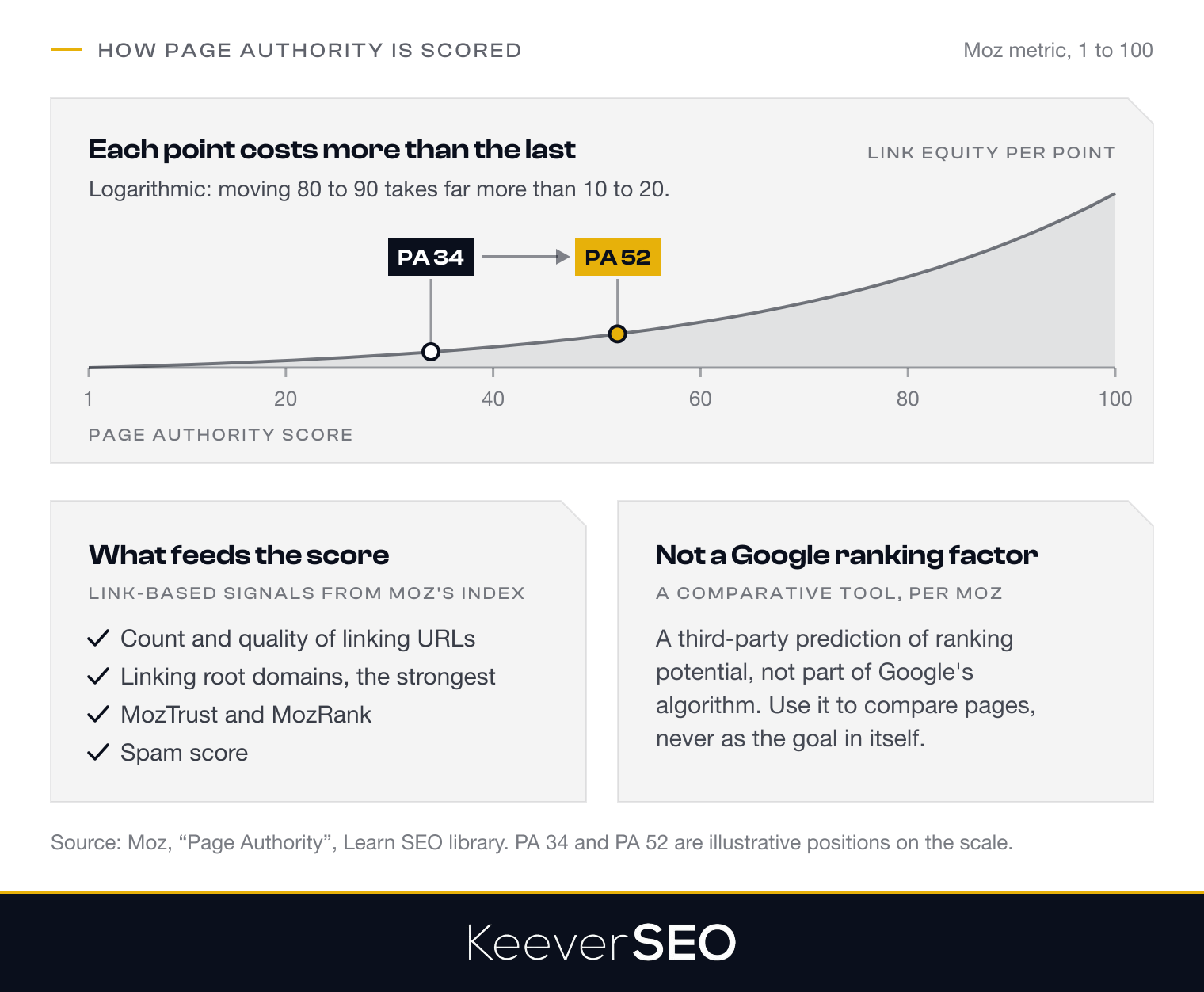
Page Authority (PA) is a predictive metric developed by Moz that scores how likely a specific webpage is to rank in search engine results, as Moz's "Page Authority" guide in its Learn SEO library defines it. The score runs from 1 to 100, with higher scores signaling more ranking potential, on a logarithmic scale that makes gains progressively harder at the top. PA is a third-party metric calculated from Moz's web index through link-based signals such as the number and quality of linking URLs, MozTrust, MozRank, and spam scores. Domain Authority scores an entire website, whereas Page Authority scores an individual page. Moz states that PA is not a Google ranking factor and serves instead as a comparative tool for the link strength and ranking potential of different webpages.
What is Website Authority?
Website Authority is a domain-level metric that scores the strength and credibility of an entire website. Page Authority scores an individual page, whereas Website Authority covers the whole domain or subdomain, and several tools express it: Moz's Domain Authority (DA), Ahrefs' Domain Rating (DR), and Semrush's Authority Score.
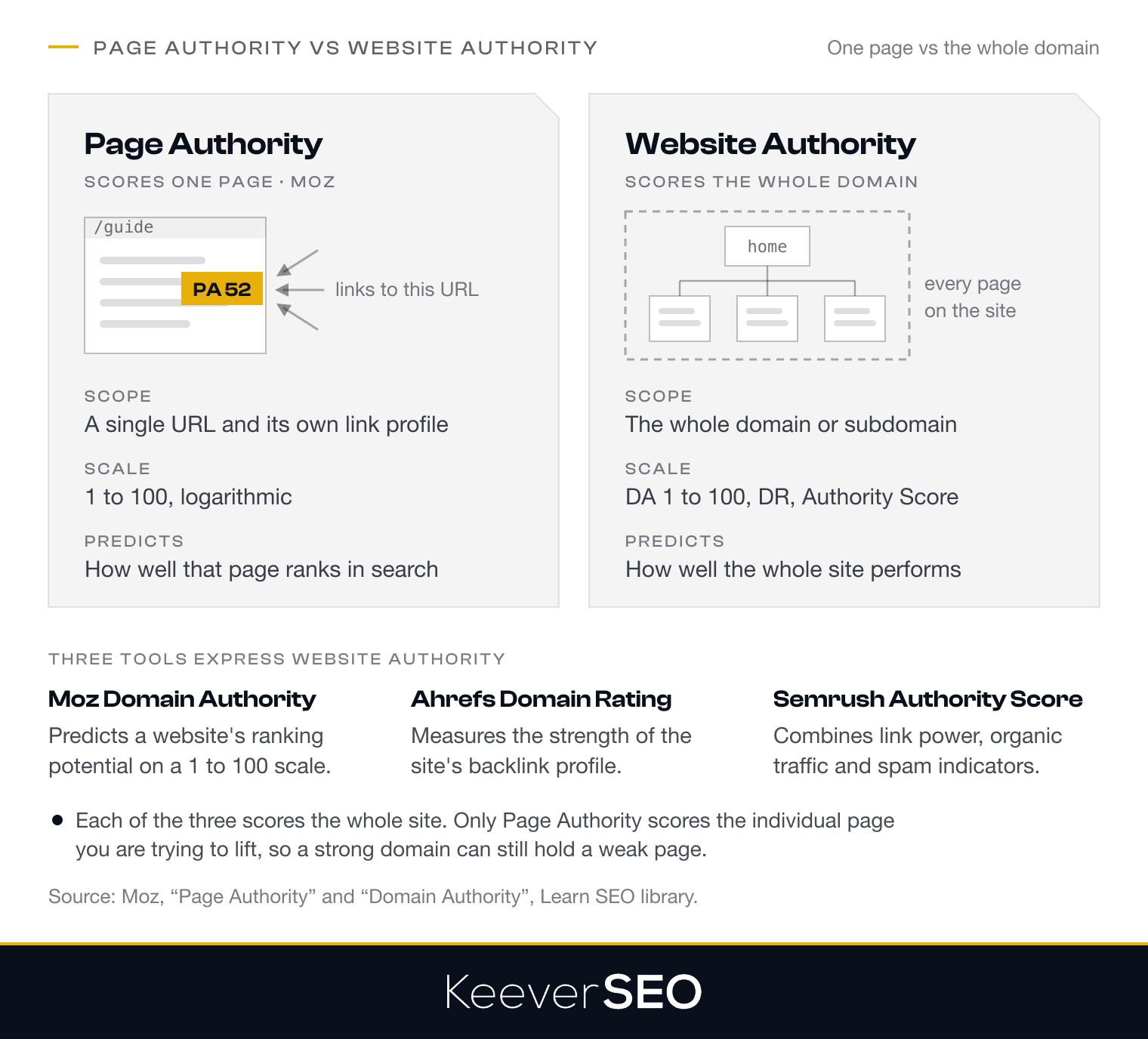
Domain Authority from Moz predicts a website's ranking potential on a 1 to 100 scale, Ahrefs' Domain Rating measures the strength of a website's backlink profile, and Semrush's Authority Score combines link power, organic traffic, and spam indicators into one quality score. Each tool offers its own view of how well a domain may perform in search, and each reflects the authority of the whole site rather than a single page.
What affects Page Authority most?
Backlink signals affect Page Authority most, ahead of content quality and technical health. The quality and quantity of inbound links, above all from unique linking root domains, carry the most weight, because a wide-ranging backlink profile from high-authority, relevant domains signals trust and value. Content quality comes second, since it decides whether a page attracts and holds links. Technical health, including crawlability, indexation status, and site speed, supports authority by keeping the page accessible and functional. Moz's Page Authority model rests on link-based signals, and linking root domains are the strongest single predictor of a page's ranking strength; Backlinko's analysis of 11.8 million Google search results found the #1 result holds 3.8 times more backlinks than positions 2 through 10.
What should you measure before building Page Authority?
Before building Page Authority, you should measure the baseline metrics that later show whether the work is paying off. The seven metrics are listed below:
- Current Page Authority Score: The existing score of the target page in Moz's Link Explorer, on the 1 to 100 scale, as the starting point for growth.
- Referring Domains: The number of unique root domains that link to the page, a strong indicator of link profile strength and Page Authority potential.
- Competitor Page Authority Benchmark: The Page Authority scores of three to five competitor pages that rank for similar keywords, which set realistic targets.
- Current Organic Rankings: The page's positions for its primary target keywords, which show how authority gains translate into search visibility.
- Baseline Organic Traffic: The page's monthly organic sessions and users in analytics tools like Google Analytics, which measure the business impact of higher Page Authority.
- Existing Backlink Profile Quality: The quality and relevance of the current backlinks, with any toxic or low-quality links marked for disavowal.
- Indexation Status: Whether the page is indexed and free of crawl errors that could block authority growth.
The seven baseline metrics let you measure incremental gains, justify resource investment, and adjust strategy as the data comes in.
How do canonical URLs protect Page Authority?
Canonical URLs protect Page Authority by consolidating link equity on a single preferred version of a webpage, so backlinks and other signals never split across duplicate or near-duplicate pages. When search engines meet several versions of the same content, such as HTTP and HTTPS or www and non-www, they may spread link value across the versions unless a canonical tag names the version that should receive credit for every external and internal link.
The consolidation matters because Page Authority rests on the quality and quantity of linking root domains and backlinks. Without a declared canonical, search engines might index several competing versions and weaken the link signals that would otherwise strengthen one target page. Canonical protection also prevents self-inflicted authority loss from site architecture issues such as pagination or dynamically generated URLs that reference the same content.
How does indexability affect Page Authority?
Indexability affects Page Authority because a page must be discoverable, crawlable, and indexable before it can accumulate authority at all. A page that is not indexed gains nothing from its backlinks and cannot build a Page Authority score.
Crawlability issues such as blocked resources or server errors keep search engines from accessing and evaluating a page. Indexation status decides whether the page can appear in search results and receive link equity. Technical factors like site speed and mobile-friendliness shape how well search engines process a page, and broken links disrupt the flow of equity. Until the issues are resolved, even high-quality content cannot build Page Authority, because the infrastructure is blocked or impaired.
How does content quality increase Page Authority?
Content quality increases Page Authority by attracting high-value backlinks and signaling relevance to search engines. Pages with full coverage, originality, readability, freshness, and alignment with search intent earn more backlinks. Full coverage makes a page a resource worth linking to. Originality, through unique insight or proprietary data, sets the content apart and draws more references. Readability keeps content accessible and holds visitors longer, which raises shares. Fresh content signals ongoing relevance, above all in fast-moving industries. Alignment with search intent meets user expectations and raises the odds of being featured and linked. The qualities make content linkable, and linkable content builds the strong link profile behind Page Authority.
How do you create content that attracts links to increase Page Authority?
You create content that attracts links by building the asset types that other sites cite by choice. The three linkable asset types are listed below:
- Original Research and Data: Proprietary studies, surveys, or data analyses position the page as a credible source and attract citations from journalists, bloggers, and researchers who need reliable data.
- Free Tools and Calculators: Interactive resources like calculators, templates, or diagnostic tools give practical value, get recommended and shared, and drive repeat visits that signal relevance to search engines.
- In-depth Guides: Long-form content that covers a topic in full becomes the go-to resource, and by answering user questions with detailed instruction it draws links from content creators who need an authoritative reference.
How do internal links increase Page Authority?
Internal links increase Page Authority by distributing link equity from high-authority pages to the target page. Contextual anchor text carries the relevance and topic of the linked page to search engines, and links from strong pages to weaker ones pass part of the accumulated equity, which raises the target page's authority.
A well-structured internal linking strategy runs on a topic-cluster or hub-and-spoke model, where a central pillar page links to supporting subtopic pages that link back to the pillar and to each other. The network concentrates authority around the main page while it reinforces topical relevance across the cluster, which lifts the Page Authority of individual pages and strengthens the site's authority architecture as a whole.
How do you use your highest-authority pages strategically to increase Page Authority?
You use your highest-authority pages strategically by channeling their link equity to the target or weaker pages that need a lift. The approach draws on the strength already inside the site. An audit identifies the pages with the highest Page Authority scores, most often cornerstone content, popular blog posts, or pages with strong backlink profiles.
Once identified, the high-authority pages carry contextual internal links to the target pages with relevant anchor text. The funneling creates a hierarchical flow of authority, so target pages inherit the trust and ranking power of the strongest content, which redistributes authority and raises the visibility and rankability of less authoritative pages.
Which backlinks are most valuable for Page Authority?
The backlinks most valuable for Page Authority are topically relevant, come from high-authority referring domains, and are editorial or earned rather than manufactured. The backlink types and their quality criteria are listed below:
- Topical Relevance: Links from websites and pages close to the industry or subject carry far more weight than links from unrelated domains; a backlink from a marketing blog to an SEO guide passes more authority than one from an unrelated food website.
- Referring-Domain Authority: Links from high-authority domains with established trust and strong backlink profiles transfer far more Page Authority than links from new or low-authority sites, and a single link from an industry-leading publication can outweigh dozens from obscure directories.
- Editorial and Earned Links: Links that publishers give by choice because the content offers real value carry the strongest signals and represent the gold standard against manufactured or low-quality alternatives, because Moz's model weighs the quality and authority of linking domains above volume.
- Guest Posts: Guest posts on authoritative, topically relevant sites within the niche lift Page Authority when the publishing site holds authority, the topic fits, and the link reads as natural rather than promotional.
- Digital PR Links: Coverage earned through newsworthy stories, original research, or data attracts authoritative editorial backlinks with strong context and referring-domain authority.
- Broken-Link Building: Replacing a dead reference with a relevant, useful resource earns a contextual editorial link and turns a webmaster's maintenance task into a shared win.
Page Authority is driven by the quality of a page's link profile, so stronger links from trusted sources matter more than sheer volume, and Ahrefs' study of search traffic found that the number of referring domains correlates with organic traffic more strongly than almost any other factor.
What common mistakes lower Page Authority instead of raising it?
The common mistakes that lower Page Authority instead of raising it are bought links, toxic backlinks, ignored technical issues, and the belief that Page Authority is a Google ranking factor. The four mistakes are listed below:
- Black-Hat or Bought Links: Purchased links and black-hat tactics break search engine guidelines and bring penalties rather than gains.
- Toxic Backlinks: Links from spammy, irrelevant, or low-quality domains devalue the backlink profile and weaken the trust signals behind authority metrics.
- Ignoring Technical Issues: Broken links, slow page speed, crawl errors, or mobile-unfriendliness keep a page from accruing authority and from benefiting from the links it earns.
- Misunderstanding Page Authority as a Google Ranking Factor: Page Authority is a Moz metric that predicts ranking potential, not a factor in Google's algorithm, as Moz's own "Page Authority" documentation states, so optimizing for the score alone without the actual ranking signals leads to misplaced priorities.
The four mistakes show why authority growth depends on quality link building and a technically sound website.
Why is Page Authority not increasing despite link building efforts?
Page Authority is not increasing despite link building when the links are irrelevant or low quality, when competitors gain authority faster, or when technical issues block indexation. Links from unrelated niches or low-authority domains add little to the score. Page Authority is a relative metric as well, so the score can stall when competitors accumulate authority faster. Unresolved technical issues such as crawl errors, broken links, or poor mobile-friendliness keep search engines from crediting the links at all. Clearing the technical barriers and focusing on high-quality, relevant backlinks is what restarts growth.
When should you hire help for Page Authority?
You should hire help for Page Authority when in-house efforts hit hurdles they cannot clear. A plateau despite ongoing work signals that internal strategy has reached its limit. Limited link-building capacity is a second signal, and technical complexity such as unresolved crawl issues or persistent indexation problems is a third.
An SEO agency brings the specialized skills and resources to diagnose the underlying issues, prioritize the fixes with the most impact, and build a targeted plan for content optimization and link acquisition. When the internal team lacks the bandwidth to execute, our authority-building SEO agency speeds progress and keeps Page Authority growing through external expertise.
What should an SEO specialist do for Page Authority?
An SEO specialist should run the baseline audit, technical fixes, content and internal-link optimization, link acquisition, and link reclamation for Page Authority. The five responsibilities are listed below:
- Baseline Audit: A full audit of the target page that captures the current Page Authority score, referring domains, backlink profile quality, and indexation status against a competitive benchmark, which sets the starting point and reveals immediate opportunities.
- Technical Fixes: Resolution of crawlability barriers, proper indexation in Google Search Console, canonical tags that consolidate link equity, better site speed and mobile-friendliness, and repaired broken links, so search engines can access and evaluate the page.
- Content and Internal-Link Optimization: Content aligned with search intent and improved in originality, readability, and freshness, plus contextual internal links from high-authority pages with relevant anchor text that funnel equity to the target page.
- Link-Acquisition Plan: A focused plan for high-quality editorial backlinks built on linkable assets such as original research, data studies, free tools, or full guides, promoted through guest posts, digital PR, broken-link building, and journalist outreach.
- Reclaim Lost Links and Monitor Growth: Recovery of lost or broken backlinks and ongoing audits that find and disavow toxic links, with Page Authority tracked over time to catch drops, restore equity, and measure compounding gains.
What should an SEO agency audit for Page Authority?
An SEO agency should audit five areas for Page Authority: the backlink profile, indexation and crawl health, content quality, internal link structure, and canonical setup. The five areas are listed below:
- Backlink Profile and Toxic Links: The quality, quantity, and relevance of inbound links, with toxic or spammy backlinks identified and disavowed, because a wide, editorially sound set of referring domains drives positive link equity.
- Indexation and Crawl Health: Whether the page is crawlable and indexed, with checks for robots.txt blocks, noindex tags, server errors, site speed, mobile-friendliness, and broken links that could keep search engines from evaluating it.
- Content Quality: The depth, coverage, originality, and freshness of the content, and whether it matches the dominant search intent for the target keywords with substantive value and topical expertise that attract links.
- Internal Link Structure: How link equity flows through the site, whether high-authority pages link to the target with contextual anchor text, and where the topic-cluster or hub architecture can channel more authority to the page.
- Canonical Setup: Whether link equity is consolidated on a single URL, with duplicate or competing versions found and canonical tags implemented so authority is not split across several URLs.
The five audit areas decide how fast a page can grow its authority and its visibility in search results.
How can you hire an SEO agency for Page Authority?
You can hire an SEO agency for Page Authority by scoping the goal, granting access, and agreeing on reporting before the engagement starts. Scope the goal first, such as raising the Page Authority of a specific target URL, and define the pages, markets, and timeline. Grant the agency access to Google Search Console for indexation, the CMS for technical fixes, and analytics platforms for performance tracking. Agree on a reporting cadence that covers Page Authority, referring domains, and progress notes for transparency and accountability. With the three elements in place, contact us to begin the engagement.
How can you connect with us for Page Authority help?
You can connect with us today for expert guidance on increasing Page Authority through strategic link building, technical optimization, and sustained growth.
What access does an SEO agency need?
An SEO agency needs access to Google Search Console, the content management system, analytics platforms, and backlink analysis tools to increase Page Authority. Google Search Console supplies the crawl, indexation, and backlink data. CMS access lets the agency implement on-page and technical optimization. Analytics access tracks traffic, user behavior, and the effect of SEO changes, and backlink analysis tools manage and improve the link profile. The two access requirements that matter most are covered below.
Does an agency need Google Search Console access?
Yes, an SEO agency needs Google Search Console access to manage Page Authority. Search Console reports indexation status, which lets the agency find and fix the issues that keep pages from being crawled and indexed, and its link reports show which external domains link to the target page, so earned links are recognized and counted toward the page's authority.
Does an agency need CMS access?
Yes, an SEO agency needs CMS (Content Management System) access to implement on-page and technical fixes. CMS access lets the agency update title tags, meta descriptions, and header structures, the elements that shape search visibility, and it is required for technical work such as fixing broken links, implementing canonical tags, improving page load speed, and confirming mobile-friendliness. Without CMS access, the agency's ability to execute improvements and raise Page Authority is limited.
How should an SEO agency report results?
An SEO agency should report results through structured, recurring reports with clear metrics and transparent progress tracking. The reports, delivered monthly or bi-weekly, should carry the current Page Authority score, month-over-month change, total referring domains, new backlinks acquired, and any shift in indexation or technical health. Contextual notes explain score movement, which matters given Page Authority's logarithmic scale and relative nature, and trend graphs plus competitor benchmarks make progress visible.
Effective reporting places results in strategic context: the quality and relevance of newly earned links, the technical improvements implemented, and where possible the correlation between authority gains and organic traffic or rankings. The agency should be transparent about link-building methods, separate editorial and earned placements from lower-quality sources, and set out actions for the next period. Page Authority reporting rests on comparative analysis and industry context rather than absolute thresholds, so clients see how growth compounds through the cycle of content publishing, link acquisition, and periodic audits.
Should reports include referring-domain growth?
Yes, reports should include referring-domain growth as a core Page Authority metric. Referring domains count the unique websites that link to a page, which correlates with Page Authority gains. Tracking the growth shows link-building momentum and the diversity of the backlink profile, and it confirms that the authority score reflects endorsements from many sources rather than repeated links from the same few.
How should you evaluate an SEO agency’s link building?
You should evaluate an SEO agency's link building on relevance and authority, editorial quality, and transparency of reporting. The three criteria are listed below:
- Relevance and Authority: Whether the backlinks come from domains that are topically related to the page and hold strong authority scores, because links from high-authority sites within the niche pass more equity.
- Editorial Quality: Whether the links are earned, editorial placements from reputable publications and industry blogs rather than low-quality links that can harm the profile.
- Transparency of Reporting: Whether the agency documents each acquired link's source domain, authority metrics, and placement context, so the work can be verified and progress tracked.
How do you sustain Page Authority growth over time?
You sustain Page Authority growth over time through continuous publishing, ongoing link acquisition, and periodic backlink audits. Fresh, relevant content published on a schedule signals ongoing value to search engines and potential linkers and keeps attracting backlinks. Ongoing link acquisition through outreach, digital PR, and guest contributions adds new backlinks, and relationships with authoritative sites in the niche keep the flow steady.
Periodic backlink audits protect the gains by finding and disavowing toxic links, reclaiming lost or broken backlinks, and surfacing new opportunities. Tools like Semrush's Backlink Analytics and Moz's Link Explorer monitor the health of the backlink profile and track authority trends. Fresh content, strategic link acquisition, and vigilant backlink maintenance together compound Page Authority into a durable online presence.
Can regular publishing compound Page Authority?
Yes, regular publishing can compound Page Authority over time. A consistent publishing cadence adds new, high-quality content that attracts links, and each new page serves as a potential link magnet that expands the link profile. As the assets accumulate, they raise topical relevance and strengthen the internal linking structure, so the compounding effect of content and link growth serves the overarching goal of increasing Page Authority.