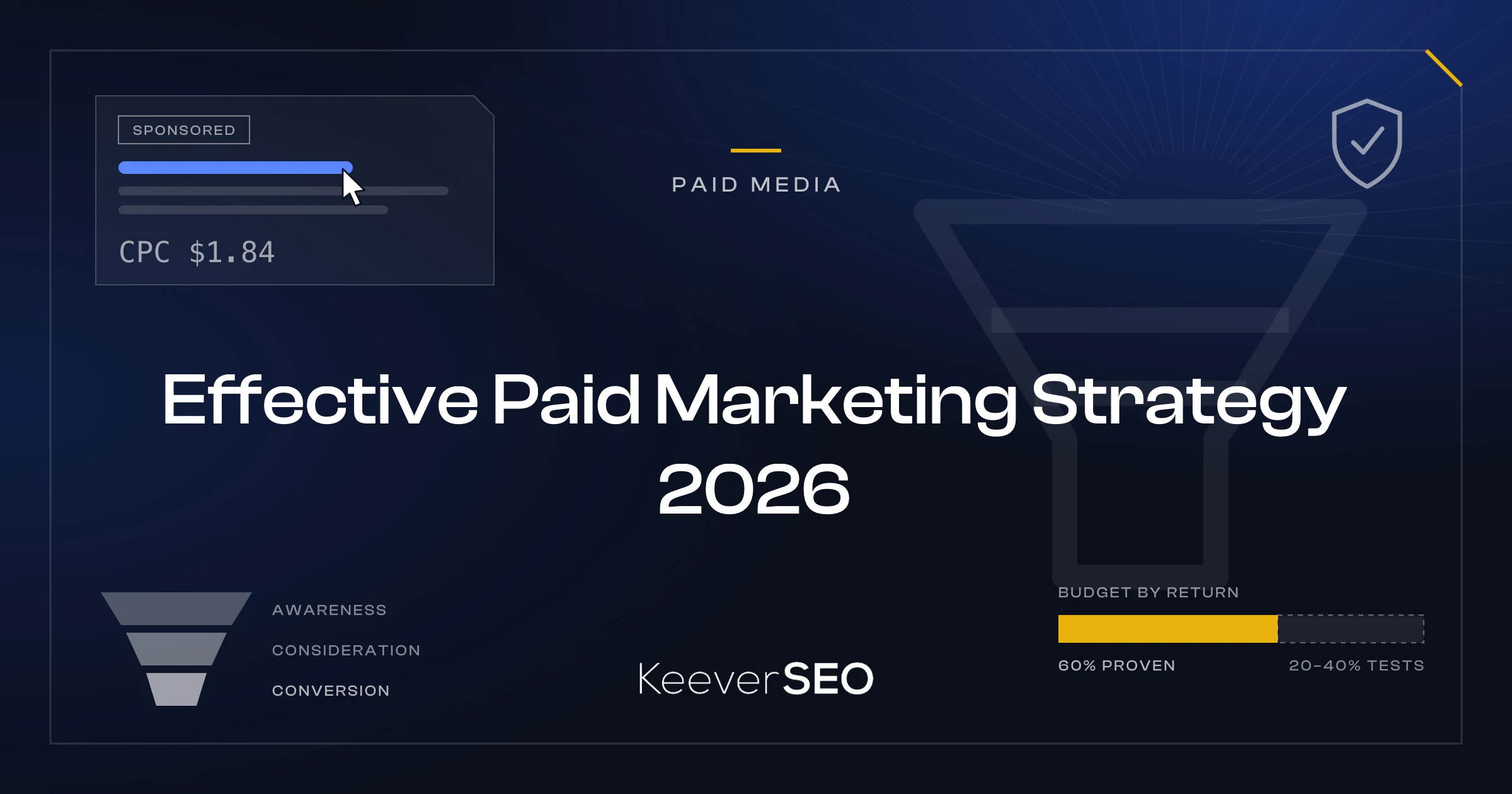
An effective paid marketing strategy for 2026 is a structured, profit-focused approach that ties advertising spend to measurable business outcomes. The strategy begins with profit-based goals over vanity metrics, centered on revenue, margin, and customer lifetime value. Audiences are defined through consent-based first-party and zero-party data, with behavioral signals that show purchase intent. Channels are selected by funnel stage, matched to customer journey phases, and budgets are allocated by expected return so resources flow to the highest-performing opportunities.
The strategy builds platform-native creative and landing pages for each channel's specifications and sets up privacy-safe tracking through consent mode, server-side tagging, and cookieless solutions before controlled campaigns launch. The campaigns limit initial spend until validation signals appear, then testing reallocates budget toward the winning combinations. In 2026 the channels and formats that perform best are Google Ads and Microsoft Ads for high-intent search, Meta for broad audiences, TikTok for short-form video, LinkedIn for B2B, and Amazon for ecommerce.
AI and automation run under guardrails, with smart bidding and dynamic creative optimization kept under human oversight. Effectiveness is measured through KPIs such as click-through rate (CTR), cost per acquisition (CPA), return on ad spend (ROAS), and the customer lifetime value to customer acquisition cost ratio (LTV:CAC). Attribution models, incrementality testing, and marketing mix modeling (MMM) supply insight beyond last-click attribution. Paid search and SEO reinforce each other through shared keyword data and conversion insight, and both evolve toward Generative Engine Optimization (GEO). When internal expertise or scale runs short, a business may engage an agency for technical execution and channel expertise that stays aligned with profit-based goals, and the eight steps begin with those goals.
1. Set profit-based paid marketing goals
To set profit-based paid marketing goals, put revenue and profitability metrics ahead of vanity metrics like impressions and clicks. The metrics that matter are revenue, profit margin, customer lifetime value (LTV), and customer acquisition cost (CAC) payback period, which tie marketing to business outcomes rather than surface engagement.
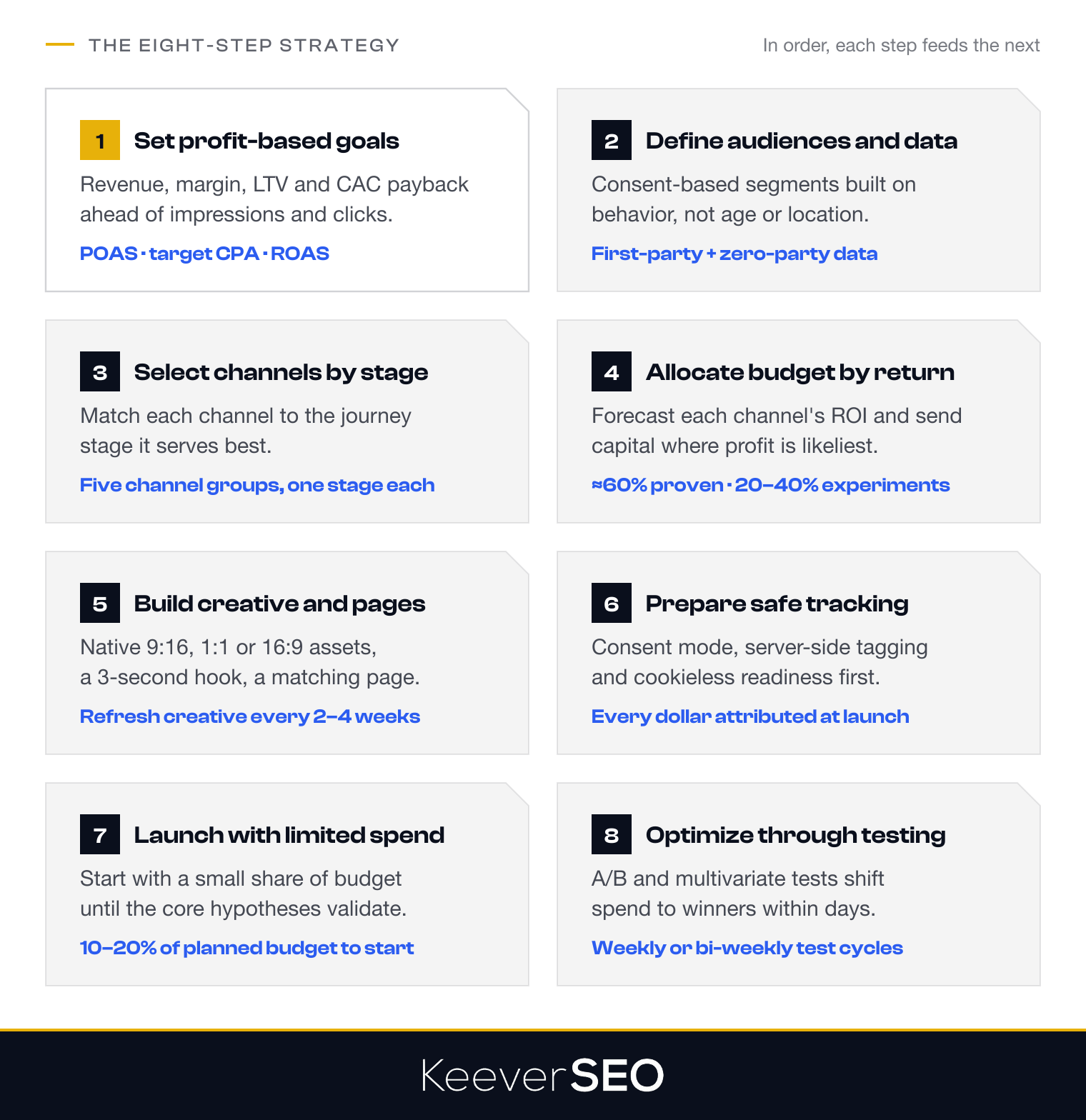
The key performance indicators (KPIs) for the goals include Profit on Ad Spend (POAS), which measures the profit generated per dollar of advertising, and target Cost Per Acquisition (CPA), which sets the maximum acceptable cost to win a customer at a profit. Return on Ad Spend (ROAS) measures total revenue against ad spend. Clear targets for the three metrics align campaigns with growth objectives and keep scaling profitable, and they sharpen budget allocation, because channels and campaigns are judged on their contribution to LTV:CAC ratios and payback timelines rather than engagement counts.
2. Define audiences and first-party data
To define audiences and first-party data, build segments from consent-based information rather than broad demographics. The work prioritizes behavioral signals, such as purchase history and engagement patterns, over age or location. First-party data comes from interactions on owned channels, while zero-party data is information customers share on purpose, like preferences or purchase intent. The two data types produce audience segments that update in real time and allow personalized messaging within privacy boundaries.
The approach keeps marketing relevant and privacy-safe because it rests on accurate, consented data. Platforms and tools now support predictive modeling and behavioral triggers, which let brands anticipate customer needs and shape campaigns to them. Once audiences are defined, channel selection follows from observed behavior and intent, so media spend goes where each segment is most likely to engage and convert.
3. Select channels by funnel stage
To select channels by funnel stage, match each channel's strengths to the stage of the buyer's journey it serves best, which keeps conversion efficient and spend focused. The five channel groups are set out below:
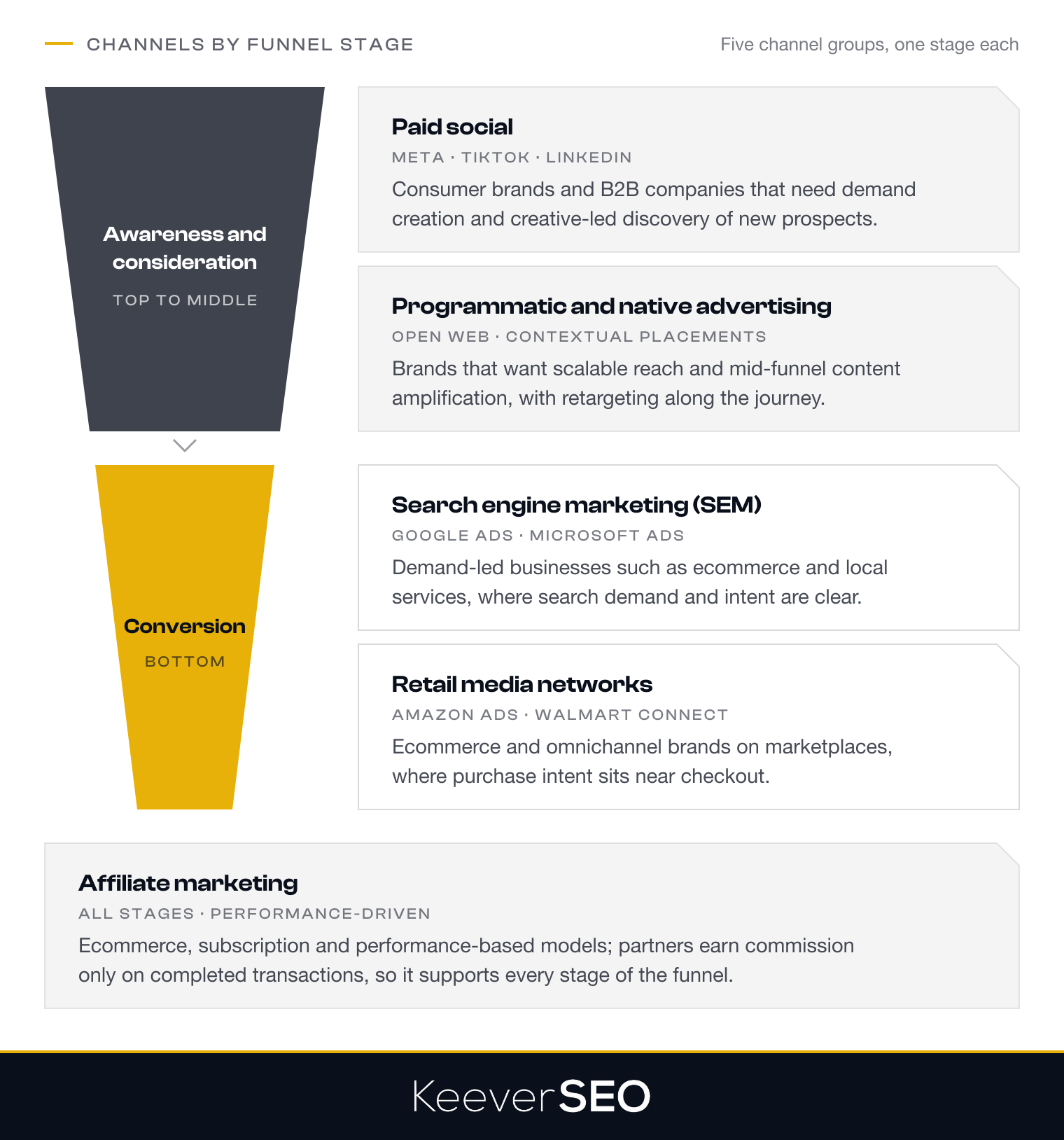
Search Engine Marketing (SEM) SEM on platforms like Google Ads and Microsoft Ads captures high-intent demand at the bottom of the funnel, from users who search for solutions and stand ready to convert.
Paid Social Platforms Meta, TikTok, and LinkedIn lead the awareness and consideration stages, with audience targeting by demographics, interests, and behavior that introduces brands to new prospects and nurtures mid-funnel engagement.
Retail Media Networks Networks such as Amazon Ads and Walmart Connect reach purchase-ready shoppers inside ecommerce environments and convert at high rates because they meet demand at the point of sale.
Programmatic and Native Advertising Programmatic and native channels extend reach across the open web through contextually relevant placements that support retargeting and brand awareness and keep brands visible along the customer journey.
Affiliate Marketing Affiliate marketing drives conversions through performance-based partnerships and trusted third-party endorsement, with partners paid only on completed transactions, which suits ecommerce and subscription models.
Matching each channel's strengths to the stage of buyer readiness keeps budget allocation tied to real customer behavior and builds a funnel that carries prospects from discovery to conversion with measurable return at every stage.
4. Allocate budgets by expected return
To allocate budgets by expected return, tie budget distribution to the forecast return on investment (ROI) of each channel. Instead of even splits or legacy spending habits, forecast each channel's ROI potential and direct resources where the strongest profit outcomes are most likely. The method depends on continuous analysis of performance data, including Profit on Ad Spend (POAS), Return on Ad Spend (ROAS), and incremental contribution by channel, which informs reallocation.
A data-driven framework balances proven performance against strategic testing. A common split places about 60% of budget with validated channels that meet profit-based goals and reserves the remaining 20% to 40% for emerging opportunities and controlled experiments in new platforms or formats, which keeps revenue stable while leaving room to test channels like retail media networks or AI-powered creative formats. Review cadences run weekly for tactical shifts and monthly or quarterly for strategic rebalancing, supported by real-time dashboards that track cost per acquisition, customer lifetime value, and payback periods. Anchoring every budget decision to measurable expected return rather than channel preference sends capital to the highest-value opportunities and keeps it away from underperforming tactics.
5. Build creative and landing pages
To build creative and landing pages, design platform-native assets that capture attention at once. Each platform has its own technical specifications, such as 9:16 for TikTok and Instagram Reels, 1:1 for feed posts, and 16:9 for YouTube, so creative must be built for each format rather than reused across channels. The hook in the first three seconds decides the outcome, because short-form video and user-generated content (UGC) outperform static ads by stopping the scroll and reading as native to the feed.
Dynamic creative optimization (DCO) automates the assembly and testing of ad variations, combining headlines, images, calls-to-action, and body copy to find the highest-performing combinations at scale. The method limits creative fatigue and keeps campaigns fresh without constant manual work, and a refresh cadence of every two to four weeks holds performance as audience attention shifts and platforms reward new content.
Each ad must pair with a landing page that continues the message, visual style, and offer of the creative, because a gap between ad promise and landing page experience destroys conversion rates however strong the creative. Landing pages should load fast, work on mobile, and guide visitors toward one clear conversion action. In 2026, with attention fragmented and platform algorithms rewarding relevance, platform-native creative plus aligned landing pages decide whether paid campaigns generate profit or waste budget.
6. Prepare privacy-safe tracking
To prepare privacy-safe tracking, put consent mode, server-side tagging, and cookieless readiness in place before any campaign launches. Consent mode respects user privacy preferences while it collects campaign data, server-side tagging cuts reliance on browser cookies and improves data accuracy, and cookieless readiness matters as third-party cookies keep disappearing across browsers. The attribution infrastructure, including conversion tracking and cross-platform measurement, must be configured and tested to capture the customer journey from first click to conversion.
Brands prioritize zero-party data, which users share on purpose, and first-party data collected through owned channels, so every tracking mechanism complies with privacy regulations like GDPR and CCPA. A privacy-first approach protects businesses from compliance risk and builds consumer trust, which now shapes purchasing decisions. Once the tracking setup is verified and the measurement infrastructure is ready, campaigns can launch with every dollar attributed and optimized.
7. Launch controlled campaigns
To launch controlled campaigns, run a staged, risk-managed rollout that limits spend until audience targeting, creative performance, and channel efficiency are validated. Starting with a small share of the planned budget, about 10% to 20%, tests the core hypotheses and gathers early performance signals such as click-through rates and first conversions.
A controlled launch exposes technical issues, creative misalignment, or targeting problems while financial exposure stays small. The phase sets spend caps and holds off broad scaling until early indicators confirm the campaign works. Once validated, the campaign moves into structured optimization, with budget allocated with confidence to the effective combinations of creative, targeting, and channel mix, so marketing stays efficient and adapts to real performance data.
8. Optimize budgets through testing
To optimize budgets through testing, run a continuous, agile process that moves resources to the most effective campaigns. The process relies on structured A/B and multivariate testing that compares ad copy, creative formats, audience segments, bidding strategies, and landing page variants in real time. Budgets adjust on early performance signals, so spend shifts away from underperforming ads and toward high performers within days or even hours.
Agile testing in 2026 runs weekly or bi-weekly test cycles across platforms on the privacy-safe tracking built in the earlier steps. Brands use platform-native experiment frameworks, such as Google Ads campaign experiments, Meta's A/B test tool, and TikTok's split testing, to isolate variables and measure incremental lift. The feedback loop informs creative refreshes, audience refinements, and bid adjustments, which generate new data for the next round. Testing extends beyond individual ads to budget reallocation across channels, with unified dashboards and marketing mix modeling (MMM) insight deciding whether to move budget from paid social to retail media or from programmatic display to search. The goal is continuous improvement anchored to profit-based KPIs like ROAS, POAS, and contribution margin.
What is an effective paid marketing strategy for 2026?
An effective paid marketing strategy for 2026 is a profit-driven framework that pairs AI-powered automation with human oversight to deliver measurable growth across integrated digital channels. The strategy sets profit-based goals rather than vanity metrics, defines audiences through consent-based first-party and zero-party data, selects channels by funnel stage, and allocates budgets by expected return to maximize ROI.
The strategy builds platform-native creative and landing pages for each channel, prepares privacy-safe tracking before controlled campaigns launch, and runs across Google and Microsoft search, Meta, TikTok, and LinkedIn social, and Amazon and retail media, with user-generated content and short-form video as the leading formats. AI and automation operate under guardrails, key performance indicators (KPIs) measure effectiveness, and attribution, incrementality, and marketing mix modeling (MMM) guide budgets. Paid search and SEO work together and evolve toward Generative Engine Optimization (GEO), with an agency brought in when needed to tie integrated search back to profit-based marketing goals.
What goals should paid marketing support in 2026?
Paid marketing in 2026 should support profit and revenue goals rather than vanity metrics like impressions or clicks. The financial goals are revenue growth, profit margin expansion, and customer lifetime value (LTV), and the target metrics the field agrees on are Profit on Ad Spend (POAS), Cost Per Acquisition (CPA), and Return on Ad Spend (ROAS), which allocate budgets by expected profitability rather than engagement counts.
Revenue-focused objectives take the form of specific, quantifiable targets, such as a 25% rise in qualified leads or a 15% improvement in customer retention. Organizations should watch the LTV:CAC ratio to keep customer acquisition economics sustainable and set CAC payback periods that match cash flow requirements. The approach turns paid marketing from a cost center into a revenue driver, with every campaign measured against its contribution to bottom-line growth.
The move from traffic-driving methods toward conversion-focused metrics and durable brand authority defines the successful brands of 2026. Business goals over vanity metrics, combined with advanced analytics and attribution modeling, let marketers deliver measurable value at every stage of the customer journey and justify marketing investment through clear financial return.
Which paid marketing channels suit each business model and funnel stage?
The paid marketing channels that suit each business model and funnel stage are matched in the table below:
| Channel | Best-fit Business Model | Funnel Stage |
|---|---|---|
| SEM (Search Engine Marketing) | Demand-led businesses, including ecommerce and local services, where search demand is clear and conversion potential is high | Bottom of funnel / Conversion |
| Paid Social | Consumer brands and B2B companies that need demand creation and audience building, above all where creative-led discovery matters | Top to middle of funnel / Awareness and Consideration |
| Retail Media | Ecommerce and omnichannel brands on marketplaces or retailer sites, where purchase intent sits near checkout | Bottom of funnel / Conversion |
| Programmatic/Native Advertising | Brands that want scalable reach and mid-funnel content amplification across broad or niche audiences | Top to middle of funnel / Awareness and Consideration |
| Affiliate Marketing | Ecommerce, subscription, and performance-based businesses built on commission-driven acquisition and partner-led sales | All stages / Performance-driven |
Search Engine Marketing (SEM) captures high-intent demand, which suits direct response and lead generation. Paid social channels like Meta and TikTok excel at awareness and consideration. Retail media networks such as Amazon Ads convert at the point of purchase. Programmatic and native advertising cover broad reach and retargeting, and affiliate marketing supports performance-based models at every stage.
How should Google Ads and Microsoft Ads fit a 2026 paid marketing strategy?
Google Ads and Microsoft Ads should fit a 2026 paid marketing strategy as the search-intent channels that capture users at the bottom of the funnel. Google Ads brings the widest reach and captures high-intent searches across a broad audience, with machine learning features like Performance Max and smart bidding that convert users who seek solutions. Microsoft Ads, on the Bing network, complements it with a distinct demographic of older, more affluent users, and its lower cost-per-click and strong reach into professional audiences suit B2B marketers.
Both platforms now combine automation and AI-driven audience targeting with their core strength of connecting brands to users with explicit purchase or research intent. In 2026 the platforms integrate with consent-based first-party data, which refines audience signals while server-side tagging and improved conversion tracking keep the measurement privacy-safe. The split between Google and Microsoft should reflect budget size, audience demographics, and competition, with Google holding the larger share for reach and Microsoft adding incremental volume and, in some verticals, better efficiency.
The role of Google Ads and Microsoft Ads is to turn existing awareness into consideration and purchase, which makes them demand-capture rather than demand-generation channels. The search-intent focus lets paid search work alongside upper-funnel channels like paid social and retail media while it surfaces the high-converting keyword opportunities that inform organic SEO content priorities.
How should Meta Ads, TikTok Ads, and LinkedIn Ads be planned for 2026?
Meta Ads, TikTok Ads, and LinkedIn Ads should be planned for 2026 around each platform's audience and creative requirements. The three platform plans are set out below:
Meta Ads (Facebook & Instagram) Meta Ads should target broad-to-mid funnel consumer audiences with bold, mobile-optimized creative, AI-powered targeting, and dynamic creative optimization. The content should lead with human-centered storytelling in short-form video formats like Reels at 9:16, with minimal on-image text and a clear focal point, while user-generated content and micro-influencer partnerships add authenticity and engagement.
TikTok Ads TikTok Ads reach younger audiences, above all Gen Z and Millennials, through discovery and demand generation. Creative should be entertainment-first, with native, trend-driven short-form video at 9:16 that captures attention within the first second through fast edits, captions, and platform features like sounds and effects. Micro-influencer collaborations keep the content authentic, and a rapid refresh cadence keeps pace with TikTok's trends.
LinkedIn Ads LinkedIn Ads target B2B audiences of decision-makers and professionals. Creative should balance professional authority with human-centered messaging through thought leadership and demonstrations of industry expertise, in single image, carousel, and video formats at 1:1 or 16:9. LinkedIn's higher cost-per-click pays off through audience quality, so campaigns should aim at lead generation and the engagement metrics that signal real professional interest.
How does short-form video dominate effective paid marketing strategy in 2026?
Short-form video dominates effective paid marketing strategy in 2026 because it captures attention fast and converts across the funnel. The format delivers high engagement and conversion potential, which suits awareness and lower-funnel campaigns alike, and Wyzowl's "Video Marketing Statistics 2026" report found that 82% of marketers say video marketing has given them a good ROI.
Short-form video runs across Meta, TikTok, and LinkedIn and inside search and retail media placements. The reach lets brands build platform-native content that can be tested fast, refreshed often, and scaled on performance metrics like completion rate and cost per result, which keeps the format effective from first impression to purchase.
How should Amazon Ads and retail media support ecommerce growth?
Amazon Ads and retail media should support ecommerce growth by reaching high-intent shoppers at the point of purchase. Retail media networks such as Amazon, Walmart Connect, and Target Roundel let brands reach consumers inside the shopping experience, through Sponsored Products, Sponsored Brands, display ads, and video placed where attention turns into conversion.
Retail media networks work because they offer closed-loop measurement and strong attribution, which ties advertising spend to sales outcomes and lets brands tune campaigns on actual purchase data. Allocating about a quarter of the advertising budget to retail media networks lets ecommerce brands capture demand where purchase intent runs highest. Retail media has become one of the largest paid channels in the United States, with US spending forecast at $71.09 billion for 2026 in eMarketer's December 2025 retail media forecast.
Beyond Amazon, the wider retail media ecosystem keeps expanding as major retailers launch ad platforms built on first-party shopper data. The expansion gives ecommerce brands touchpoints across the shopping journey, from product discovery to final purchase, and ties advertising to measurable outcomes that support sustainable growth in the digital marketplace.
What creative strategy and UGC formats improve paid ad performance?
The creative strategy and UGC formats that improve paid ad performance are short-form video, UGC ads, creator partnerships, dynamic creative optimization, and platform-specific aspect ratios. The five formats are listed below:
- Short-form video: Vertical videos under 60 seconds with quick hooks and fast pacing, built for mobile-first consumption on platforms like TikTok and Instagram Reels, which drive awareness and mid-funnel performance.
- UGC ads: Customer-style testimonials and "real user" demonstrations that read as native to social feeds, which build trust and relatability and often cut acquisition costs against polished brand creative.
- Creator/influencer partnerships: Collaborations with creators who bring audience trust and a personal voice, which lift clicks, conversions, and cost efficiency through authentic social proof.
- Dynamic creative optimization (DCO): Automated creative assembly that tailors ad variations to audience segments in real time and tests headlines, images, and calls-to-action for the best-performing combinations.
- Platform-specific aspect ratios: Creative adapted to each platform's specifications, such as 9:16 for Stories and Reels, which displays as intended, aligns with platform algorithms, and raises engagement.
The formats work because people trust other people more than brand messaging: Nielsen's 2021 "Trust in Advertising" study of 40,000 consumers across 56 countries found that 88% trust recommendations from people they know above every other form of marketing, and personalization through dynamic content pushes engagement higher still, which is how the five formats deliver measurable results in paid campaigns.
How should AI and automation be controlled in paid marketing?
AI and automation should be controlled in paid marketing through guardrails that keep automated decisions aligned with business goals. Predictive audiences, smart bidding, and dynamic creative optimization sit at the center of automation, and the guardrails around them are budget caps, performance thresholds, and approval workflows. The three control areas are set out below:
Predictive Audiences Predictive audiences use AI to identify and target potential customers from data patterns, which lets marketers anticipate consumer behavior and shape campaigns to it. Human oversight keeps the targeting aligned with brand values and legal standards.
Bid Management Smart bidding algorithms adjust bids in real time to maximize campaign performance and cut manual workload. The algorithms must run within defined parameters that prevent budget overruns, with clear cost and efficiency benchmarks that keep them profitable.
Guardrails Implementation Guardrails set budget limits, define performance metrics, and create approval processes for major changes, so automation serves strategic objectives without compromising brand integrity. Regular audits and performance reviews catch deviations and adjust strategy.
In 2026, effective paid marketing treats AI as a tool that sharpens human decision-making, with machine efficiency and strategic oversight combined for predictable, profitable growth.
Which KPIs measure paid marketing effectiveness?
The KPIs that measure paid marketing effectiveness are click-through rate, cost per acquisition, return on ad spend, the LTV:CAC ratio, and conversion rate. The five KPIs are listed below:
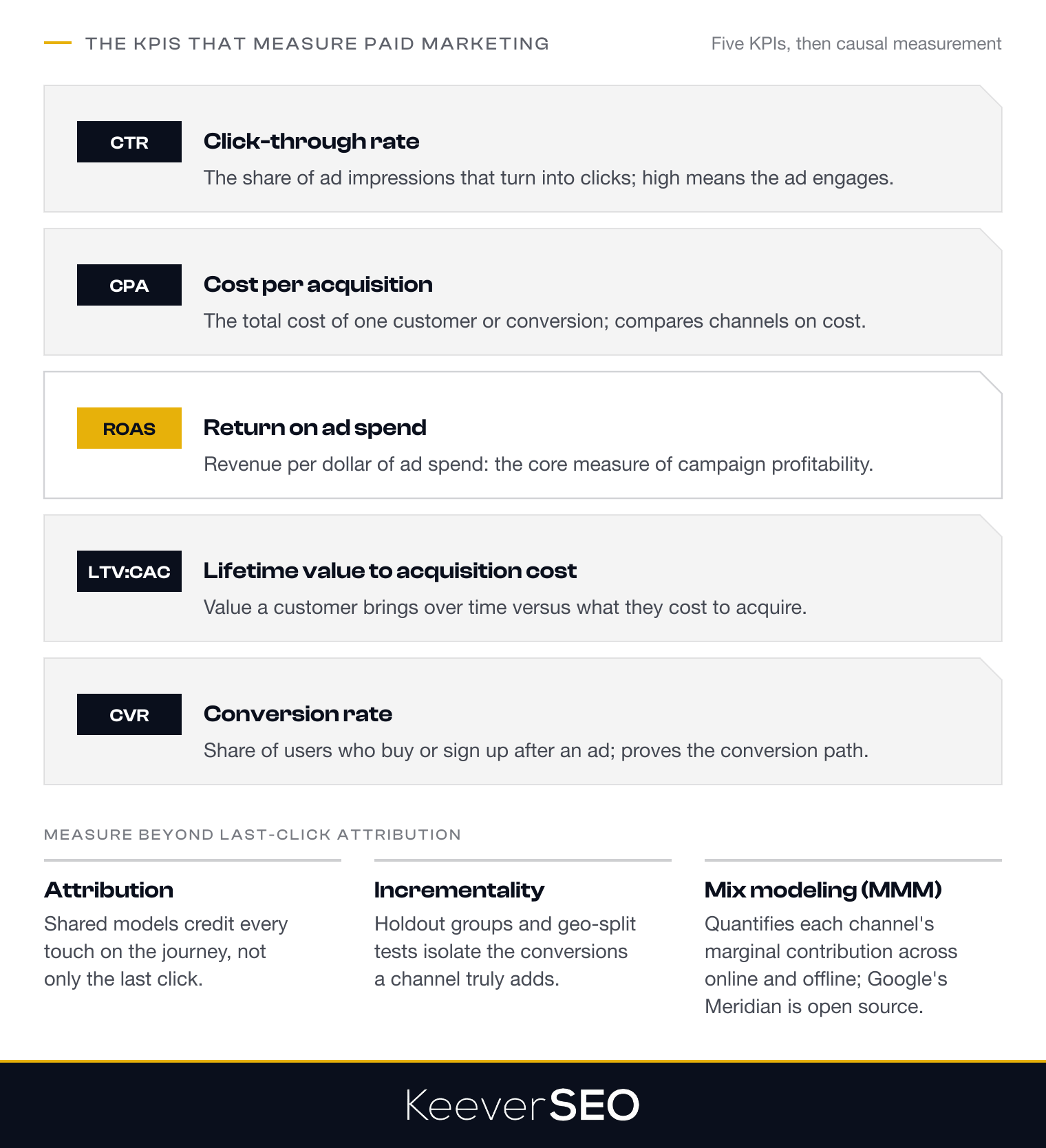
- Click-Through Rate (CTR): The percentage of ad impressions that result in clicks, where a high CTR shows the ad engages the target audience.
- Cost Per Acquisition (CPA): The total cost of acquiring a single customer or conversion, which compares cost-effectiveness across channels.
- Return on Ad Spend (ROAS): The revenue generated for every dollar spent on advertising, the core measure of campaign profitability.
- Lifetime Value to Customer Acquisition Cost Ratio (LTV:CAC): The total value a customer brings over time against the cost of acquiring them, where a healthy ratio signals sustainable growth.
- Conversion Rate: The percentage of users who complete a desired action, such as a purchase or sign-up, after interacting with an ad, which shows the strength of the conversion path and user experience.
How should attribution, incrementality, and MMM guide paid marketing budgets?
Attribution, incrementality, and MMM should guide paid marketing budgets by revealing campaign effectiveness beyond last-click attribution. Incrementality testing isolates the true impact of each channel by measuring the additional conversions it generates, which separates demand capture from demand creation. The tests run as controlled experiments, such as holdout groups or geo-split tests, that confirm whether extra budget in a channel produces new revenue rather than cannibalizing existing traffic.
Marketing mix modeling (MMM) extends the picture by analyzing historical performance across every channel and quantifying each channel's marginal contribution to revenue. MMM covers online and offline touchpoints, which shows the best distribution of marketing resources, and it lets marketers model scenarios, forecast outcomes, and allocate budgets on statistical evidence rather than platform-reported attribution alone. MMM has returned to the center of budget planning as privacy rules limit user-level tracking, and Google's Meridian, the open-source marketing mix model it released to everyone in January 2025, now puts the method within reach of more teams.
Together the three methods give a full view of paid marketing effectiveness that accounts for cross-channel interaction and diminishing returns. Budget planning anchored in causal measurement rather than correlation sends every dollar to the channels and campaigns that drive profitable growth.
What are the key takeaways for an effective paid marketing strategy in 2026?
The key takeaways for an effective paid marketing strategy in 2026 are the ten elements that turn spend into profitable growth. The ten takeaways are listed below:
- Profit-Based Goals: Revenue, profit margin, and customer lifetime value (LTV) over vanity metrics like clicks or impressions, with POAS, target CPA, and ROAS guiding decisions.
- Consent-Based Audience Definition: First-party and zero-party data that define audiences on behavioral signals and consumer consent, which sharpens personalization and targeting.
- Strategic Channel Selection: Channels matched to customer journey stages, with budgets allocated across Google, Meta, TikTok, and Amazon by expected return.
- Platform-Native Creative: Ad creative built to each platform's specifications, including aspect ratios and dynamic creative optimization, for maximum engagement and conversion.
- Privacy-Safe Tracking: Consent modes and server-side tagging in place before launch for reliable attribution and measurement in a privacy-first environment.
- Controlled Campaign Launches: Risk-managed rollouts that limit initial spend and scale budget on early performance signals and validation.
- Agile Budget Optimization: Continuous testing and budget adjustment that reallocates resources to high-performing campaigns through A/B testing.
- AI and Automation Control: AI for predictive audiences and smart bidding under human oversight that keeps automation aligned with brand goals.
- Integrated Search Strategy: Paid search and SEO insight combined to inform keyword strategy and evolve toward Generative and Answer Engine Optimization (GEO and AEO).
- Creative Formats and UGC: Short-form video and user-generated content with creator partnerships for authenticity and engagement.
The ten elements form a cohesive strategy that balances innovation with control for measurable outcomes and sustainable growth in 2026.
How can paid search reveal organic keyword opportunities?
Paid search can reveal organic keyword opportunities by showing which queries convert before organic rankings exist. Paid search query reports and conversion data identify the keywords that drive qualified traffic and conversions, and the data exposes user intent patterns that organic methods would take longer to uncover. High-converting paid keywords with strong quality scores and low cost-per-acquisition signal real search demand and commercial intent that SEO should prioritize.
Paid campaigns serve as a testing ground for keyword validation. The campaigns uncover long-tail variations, question-based queries, and seasonal search patterns that users rely on to find solutions, and click-through rates, conversion rates, and engagement signals from paid landing pages show which keywords match user expectations and business outcomes. Keywords that perform well in paid campaigns but rank low in organic search are high-value SEO opportunities, because they have already proven their revenue potential under paid conditions.
Paid search intelligence therefore reveals which converting keywords should guide SEO content creation and optimization, so SEO effort follows proven revenue-generating demand, and the keywords that matter most are set out below.
Which paid keywords should inform SEO content priorities?
The paid keywords that should inform SEO content priorities are the ones with proven conversion potential and commercial intent. Keywords that generate qualified leads with consistency and hold a healthy return on ad spend (ROAS) come first. High-performing search terms that convert across funnel stages, from informational to transactional queries, deserve SEO focus, and branded and high-intent long-tail keywords that prove cost-effective in paid campaigns offer strong opportunities for organic content. Folding the keywords into SEO strategy captures the traffic organically and lowers total customer acquisition cost over time.
How should SEO and paid marketing work together?
SEO and paid marketing should work together as complementary parts of one integrated search strategy that shares data, insight, and measurement. Paid search campaigns supply immediate conversion data and keyword performance signals that inform organic content priorities, while SEO builds sustainable, long-term visibility that reduces reliance on paid spend over time.
The integration requires shared attribution models that recognize how the two channels influence each other across the customer journey, which prevents siloed reporting that separates their contributions to conversions. Paid search query data identifies high-intent keywords for organic content development, and SEO ranking performance shows where paid budgets can be cut or reallocated.
As both disciplines evolve toward generative engine optimization (GEO), the integration matters more, because visibility in AI-powered search experiences depends on structured data, authority signals, and conversational content that raise both paid ad quality scores and organic discoverability. The SEO-and-paid integration is the base for the evolution set out next.
How does effective paid marketing strategy evolve from SEO to GEO in 2026?
Effective paid marketing strategy evolves from SEO to GEO in 2026 by extending search optimization to Generative Engine Optimization (GEO) and Answer Engine Optimization (AEO) for AI-driven search. As search behavior shifts toward conversational queries and AI-generated summaries, marketers must build for visibility in both traditional search results and AI interfaces, through structured data, schema markup, and E-E-A-T (Experience, Expertise, Authoritativeness, and Trustworthiness) signals that raise discoverability across AI platforms.
The shift from SEO to GEO changes how brands appear in AI-curated results. Paid marketing teams coordinate with organic strategy so landing pages and content satisfy both human users and AI systems, which keeps the brand visible and relevant as AI and generative search engines shape the results page.
When should a business hire an SEO agency?
A business should hire an SEO agency when internal resources cannot meet the demands of a full SEO strategy. The signals include stagnant organic traffic, competitors that outrank the site, and the need for specialized technical skills. Engaging our organic search agency before a website launch or redesign builds SEO in from the start. Consistent optimization, technical fixes, and content scalability are further signals that call for professional SEO support, and the decision leads straight to the deliverables an agency should provide.
What should an SEO agency deliver for paid marketing teams?
An SEO agency should deliver reporting, transparency, expertise, shared intelligence, attribution insight, structured data work, and joint strategy sessions for paid marketing teams. The seven deliverables are listed below:
- Regular Reporting Cadence: Monthly reports with clear, actionable insight aligned with paid campaign cycles and business objectives, which explain changes, their causes, and the actions that follow.
- Full Transparency: Open methodologies, data sources, and the reasoning behind strategic recommendations, with documentation of completed work such as technical fixes and content updates.
- Combined Technical and Industry Expertise: Deep technical SEO knowledge across crawlability, indexation, site architecture, and structured data, paired with an understanding of the client's market and competition.
- Shared Keyword and Conversion Intelligence: Organic search terms and content themes that should inform paid keyword selection and creative messaging, which tightens the link between SEO and paid work.
- Integrated Attribution Insights: Insight into how organic and paid efforts influence each other across the customer journey, which guides budget allocation and creative development.
- Structured Data Implementation and E-E-A-T Optimization: Structured data and E-E-A-T (Experience, Expertise, Authoritativeness, and Trustworthiness) work that raises visibility in both traditional search and generative AI platforms.
- Collaborative Strategy Sessions: Sessions that unite paid and organic planning so both strategies draw on cross-channel insight and serve the business's goals.
How should SEO insights improve paid channel decisions?
SEO insights should improve paid channel decisions by supplying the data that refines keyword and channel strategy. Organic search data identifies the keywords and content themes that resonate with audiences, so paid media resources go where they count. When SEO analysis shows high-engagement keywords with strong organic traffic, paid teams can bid on the terms with confidence that they match user intent and conversion potential, and when organic data flags low-converting keywords, paid campaigns can skip them, which protects budget and lifts ROI.
SEO insight shapes creative and strategic decisions in paid marketing as well. Data from tools like Google Search Console reveals user queries, featured snippets, and click-through rates that guide ad copy, extensions, and landing page messaging, and knowing which content formats, such as videos or guides, engage specific segments lets paid campaigns fit their content to the audience. Competitor analysis from SEO work exposes gaps where rivals spend heavily on paid search without organic support, which opens integrated opportunities. Paid channel performance improves when it aligns with proven search demand and conversion metrics.
How does integrated search improve paid marketing strategy in 2026?
Integrated search improves paid marketing strategy in 2026 by aligning paid and organic search to maximize visibility and conversion. The approach shares keyword data, creative messaging, and landing-page insight between paid and organic teams, so businesses capture immediate demand through paid search while organic search builds long-term visibility and authority.
The compound effect of integrated search grows in 2026 as search visibility extends beyond traditional rankings into AI-assisted search experiences that reward authority, structure, and trust signals, all strengthened by E-E-A-T-aligned content and consistent brand messaging. A brand that appears in both paid and organic results earns higher click-through rates and reinforces its credibility.
Integrated search serves the overarching goal of the 2026 paid marketing strategy, profit-based outcomes: every dollar spent on paid ads is amplified by organic authority, and every piece of content optimized for search draws on real conversion data from paid campaigns.