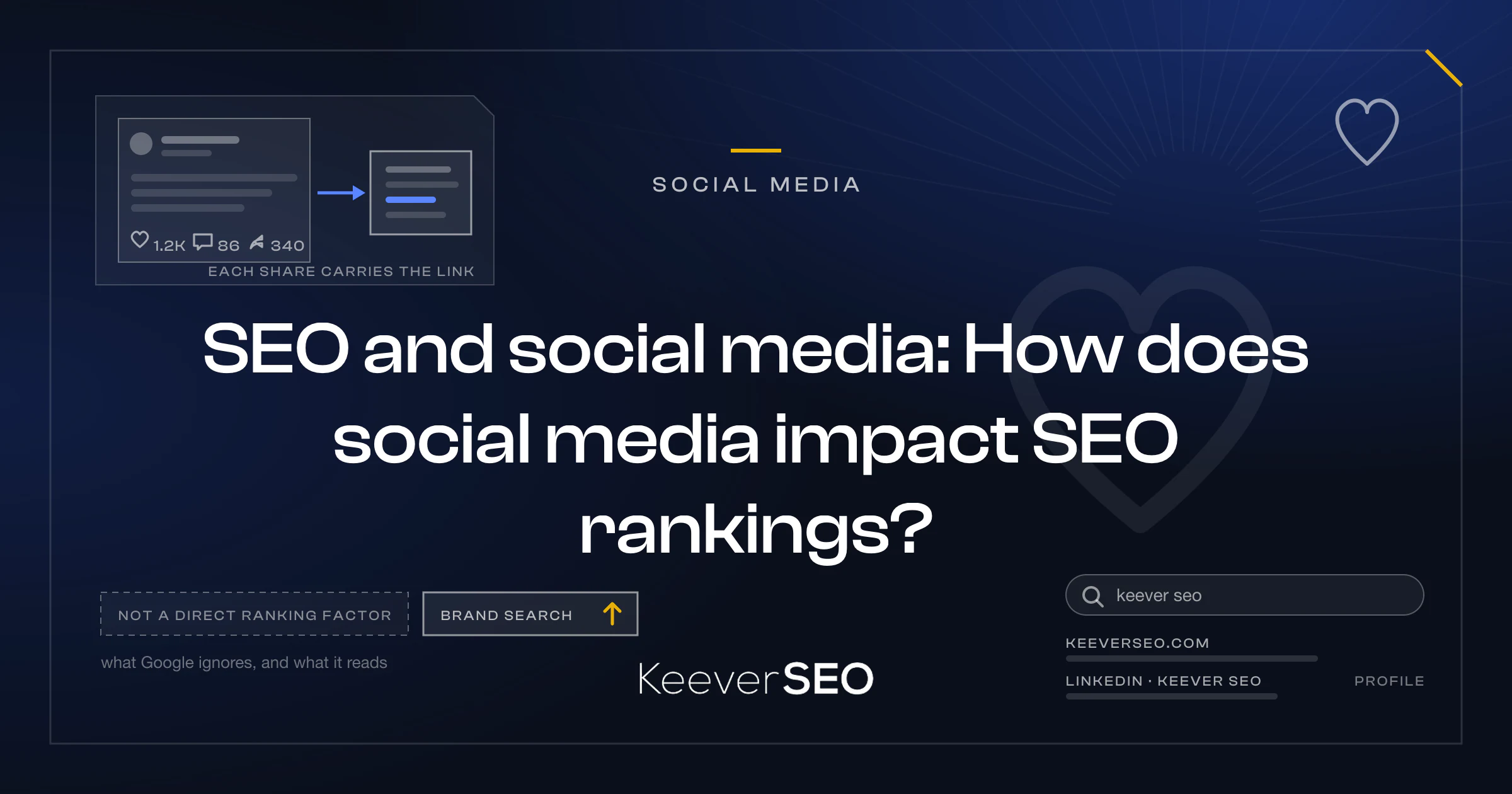
Social media impacts SEO rankings indirectly, because social signals are not a direct Google ranking factor. SEO and social media are two connected but distinct disciplines: SEO pursues search visibility, while social media distributes content and builds audience engagement. Google does not treat likes, shares, or comments as ranking factors, so the value to SEO comes through indirect mechanisms.
Social shares improve content discovery and indexing by widening reach and opening pathways for search engines to find new content faster. Referral traffic from social platforms adds SEO value when visitors engage with landing pages, and social exposure creates backlink opportunities by putting content in front of journalists and bloggers who link to it editorially. Brand mentions and social visibility raise branded search volume, which strengthens topical authority and long-term search performance.
Social media SEO carries a dual meaning: optimizing content for in-platform search and getting profiles and content to surface in Google and AI results. The practical tactics are optimizing social profiles with target keywords, publishing shareable content with consistency, and earning backlinks through engagement, while social listening uncovers audience language for keyword research and content planning. Social media's SEO contribution is measured through referral traffic, assisted conversions, and branded-search lift, with the limits of attribution acknowledged. A sound strategy aligns social activity with website goals and long-term visibility, businesses need a dedicated social SEO strategy once measurable traffic and link opportunities appear, and platforms like YouTube and LinkedIn deliver the most SEO value. The impact compounds over time, and the relationship between the two disciplines is defined below.
What is the relationship between SEO and social media?
The relationship between SEO and social media is indirect: the two disciplines reinforce each other without one feeding the other's ranking algorithm. SEO (Search Engine Optimization) optimizes websites to rank in search engine results through keyword use, content quality, and backlinks, while social media builds audience engagement and brand visibility on platforms like Facebook, X, and Instagram.
Social media does not change search rankings on its own, because Google does not count social signals such as likes and shares as ranking factors. Social media supports SEO instead by raising content visibility, driving referral traffic, and generating brand mentions, which lead to backlinks, more branded search demand, and stronger topical authority. The indirect relationship raises the question of whether Google counts social signals at all, which is answered below.
Does Google use social signals as a direct ranking factor?
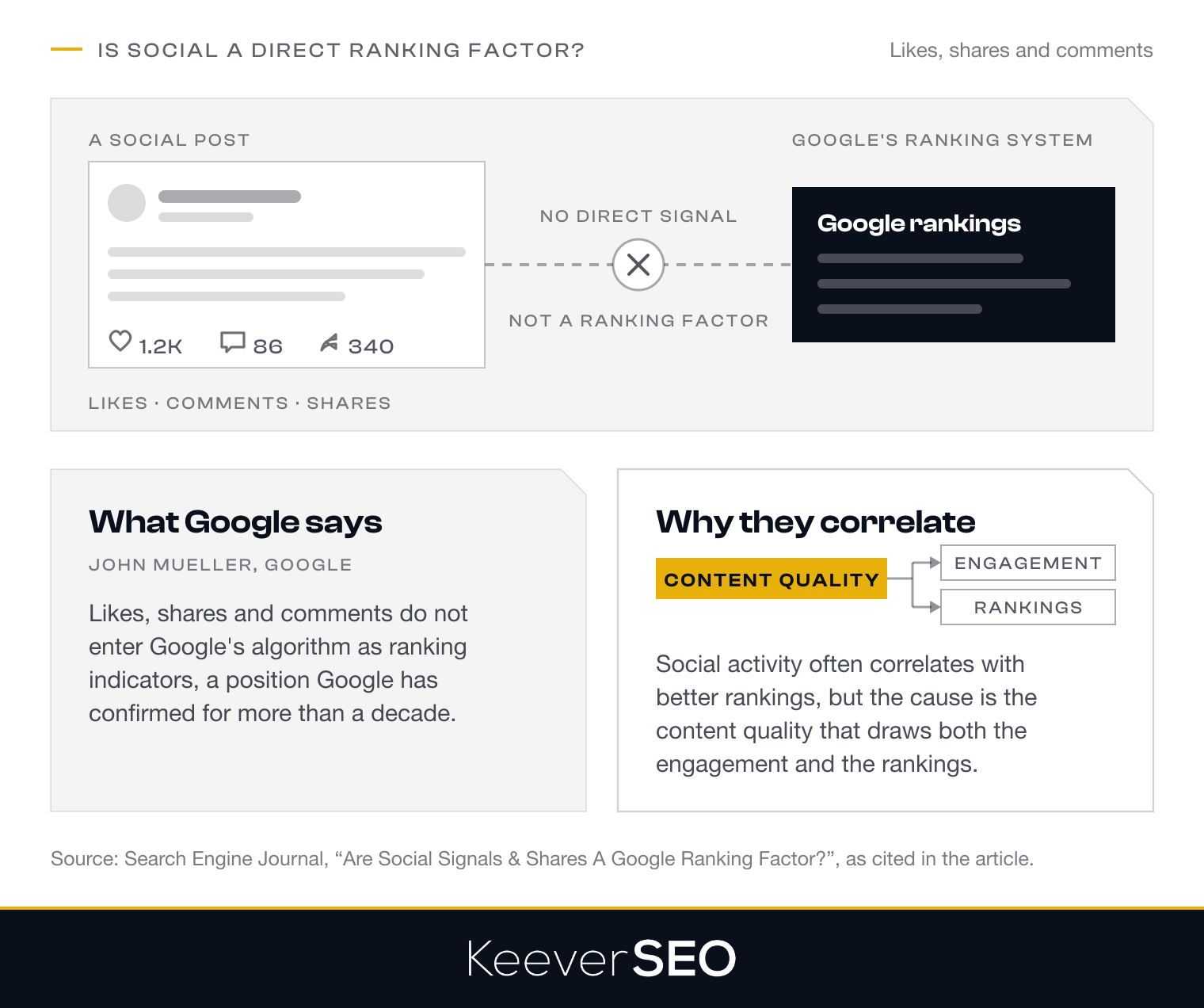
No, Google does not use social signals as a direct ranking factor. Likes, shares, and comments do not enter Google's algorithm as indicators of page ranking, a position Google representatives have confirmed for more than a decade, as Search Engine Journal's ranking-factors guide "Are Social Signals & Shares A Google Ranking Factor?" documents with John Mueller's statement that Google does not use likes as a ranking factor. Social activity often correlates with better rankings, but the correlation comes from content quality, which draws both engagement and rankings, rather than from the activity itself. The distinction matters because it directs attention to the indirect mechanisms through which social media shapes SEO, such as wider visibility and backlink opportunities.
How does social media impact SEO rankings indirectly?
Social media impacts SEO rankings indirectly through discovery, referral traffic, backlinks, and brand demand. Content shared on platforms like Facebook and X reaches more people and more crawl paths, which speeds discovery and indexing. Social referral traffic brings engaged visitors whose behavior, such as time on site and pages per session, confirms the content meets its intent.
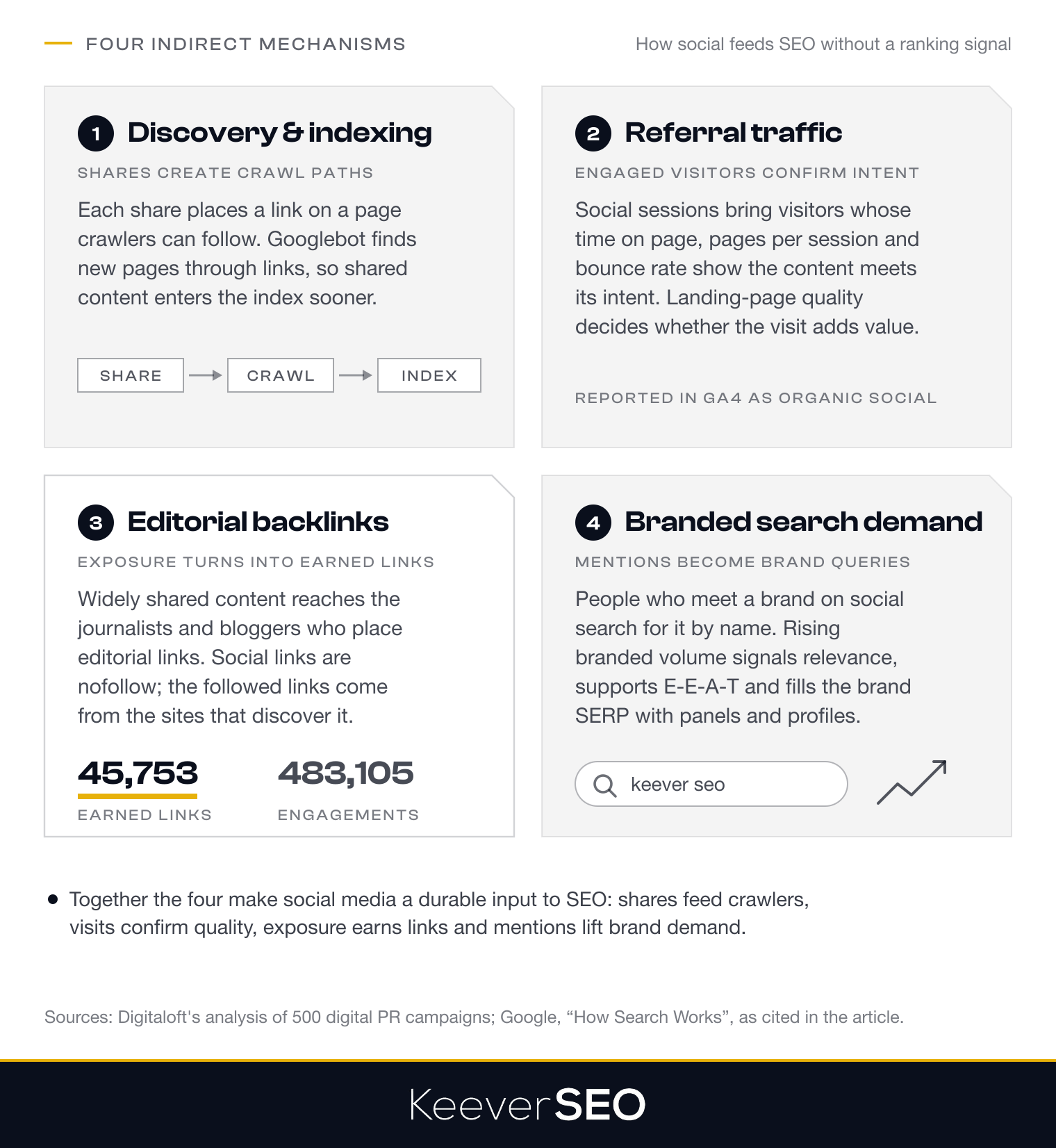
Social exposure creates backlink opportunities, because widely shared content reaches the journalists and bloggers who place editorial links, and backlinks remain a core ranking input. A consistent social presence raises brand awareness as well, which lifts branded search queries and signals authority to search engines. The four mechanisms together make social media a durable input to SEO, and each is broken down below.
How do social shares improve content discovery and indexing?
Social shares improve content discovery and indexing by widening reach and creating new paths for search engine crawlers. Shared content gains immediate visibility through impressions and reach, and each share places a link to the content on a page crawlers can follow, which broadcasts the content's existence across many touchpoints and raises the odds of an early crawl.
The speed-to-index benefit matters most for time-sensitive content. When a piece gathers shares and impressions on LinkedIn, X, or Facebook, the linked mentions give search engines fresh paths to it, and the content enters the index sooner than a routine crawl schedule would allow, because Googlebot discovers new pages by following links from pages it already knows, as Google's "How Search Works" guide explains. The shares do not move rankings on their own, but earlier indexing lets the content compete during its window of peak relevance.
How do referral traffic and landing-page quality affect SEO value?
Referral traffic and landing-page quality affect SEO value through the engagement they produce. Social referral sessions bring visitors from platforms like X and LinkedIn to a website, where time on page, pages per session, and bounce rate show whether the content satisfies the visitor's intent and confirm the site's quality and relevance.
Landing-page quality decides whether a social referral turns into value. A page that loads fast, works on mobile, and reads with clear navigation holds visitors and invites further interaction, and a page that delivers what the social post promised raises the odds of a conversion, such as a newsletter signup or a purchase. The positive interaction strengthens the page's relevance and supports its search performance.
How does social media create backlink opportunities?
Social media creates backlink opportunities by placing content in front of journalists, bloggers, and digital influencers. When content gains traction on X or LinkedIn, it reaches the people who write articles and run websites and who look for authoritative sources to cite, which produces editorial backlinks through the digital PR mechanism, where social exposure turns into earned links from reputable sites; Digitaloft's analysis of 500 digital PR campaigns tracked 45,753 earned links alongside 483,105 social engagements, which shows how far the two channels move together.
Links posted on social platforms carry the nofollow attribute and pass no direct ranking value, but the visibility they create leads to followed links from other sources. The real SEO value arrives when third-party site owners discover content through social media and link to it from their own pages, which builds links, brand recognition, and authority and feeds the branded search demand covered next.
How does social media increase branded search demand and topical authority?
Social media increases branded search demand and topical authority by multiplying brand mentions and engagement. Users who meet a brand across social platforms search for it by name more often, and the rise in branded search volume signals brand relevance to search engines and supports E-E-A-T (Experience, Expertise, Authoritativeness, and Trustworthiness), the framework behind Google's content quality evaluation. As branded queries grow, the brand SERP fills with knowledge panels and social profiles that reinforce credibility.
A consistent social presence builds topical authority as well by positioning a brand as an industry voice. Brands that share expert content and join industry discussions on social platforms signal subject-matter expertise, and Google's Search Quality Rater Guidelines direct raters to research a site's reputation through independent sources, where mentions count even without links. The accumulated visibility turns into brand recognition that search engines read as trust, which supports rankings for branded and non-branded queries alike.
What is social media SEO?
Social media SEO is a dual-discipline practice that optimizes content for in-platform search and for external search visibility. On social platforms like TikTok, Instagram, and YouTube, social media SEO places relevant keywords in profiles, posts, captions, and hashtags so content surfaces in app searches and algorithmic feeds.
Externally, social media SEO structures social profiles and content to appear in Google search results and AI-generated overviews. The work covers profiles that rank in traditional results and content that AI tools like Google's AI Overviews and ChatGPT draw on to describe brands and answer queries. Covering both the in-platform and external sides widens reach across every search experience the audience uses.
Effective social media SEO integrates keyword strategy into social content and profiles through regular updates with relevant keywords, engaging visuals, and consistent branding that raise in-app discoverability and external search presence together.
How can you use social media to support SEO performance?
You can use social media to support SEO performance through three tactics that link social engagement to organic search goals. Social media does not move rankings on its own, but it widens content reach, sends quality traffic, and opens opportunities for backlinks and brand visibility. The three tactics are listed below:
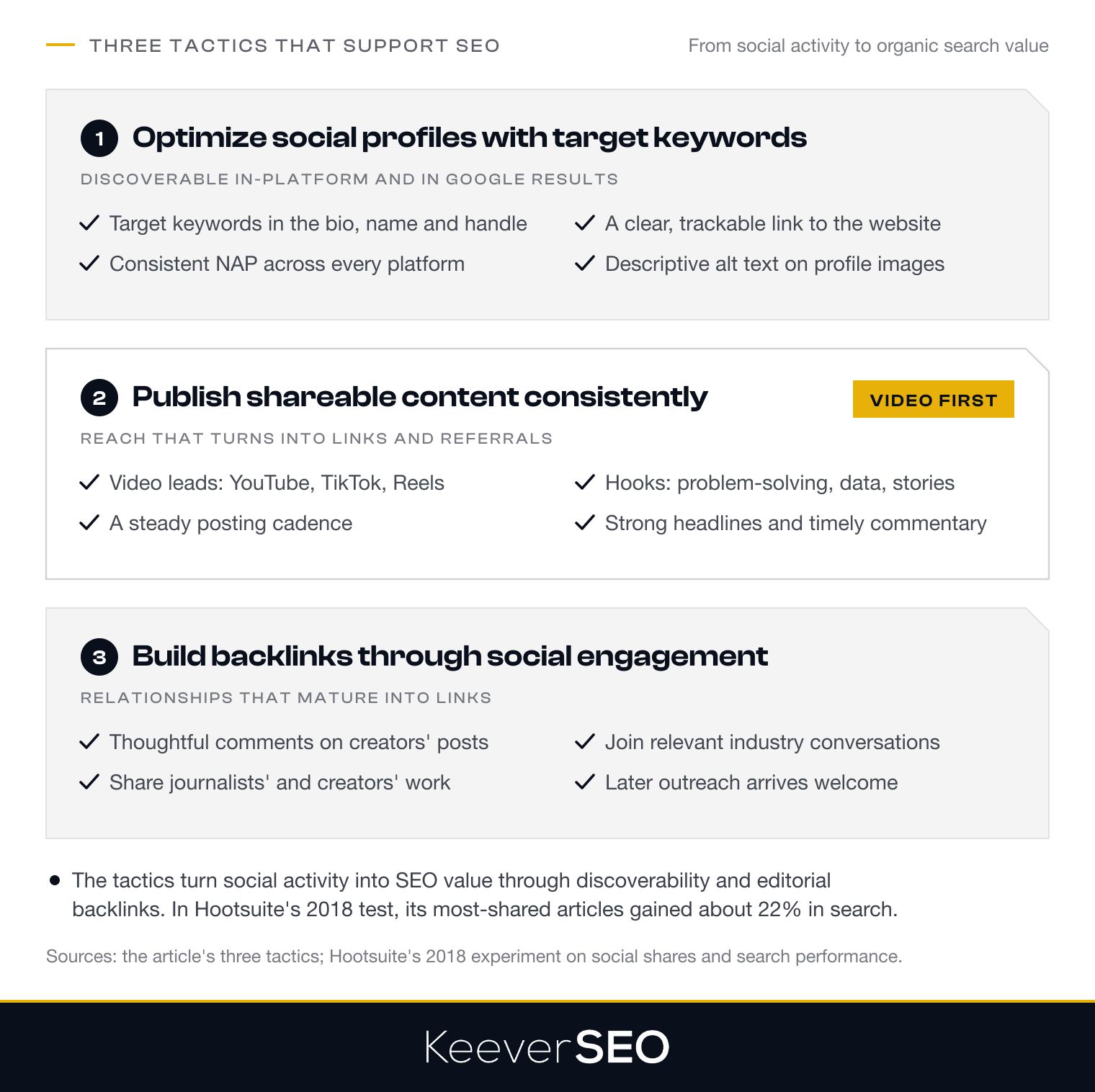
- Optimize social profiles with target keywords: Work target keywords into the bio, display name, and handle where the platform allows, keep NAP (name, address, phone) information consistent across platforms for local SEO and brand coherence, add a clear, trackable website link, and give profile and cover images descriptive file names and alt text where supported.
- Publish shareable content consistently: Content that earns shares extends reach and raises the odds of backlinks and referral traffic, with video as the strongest lever on YouTube, TikTok, and Instagram Reels, a steady posting cadence, and hooks such as problem-solving education, data-driven insight, or emotionally resonant stories.
- Build backlinks through social engagement: Social platforms build the relationships that mature into backlinks, through thoughtful comments on the posts of influencers, journalists, creators, and industry authorities, shared content, and participation in relevant conversations that make later outreach welcome.
The three tactics turn social activity into SEO value through discoverability and authoritative backlinks, and each is detailed below.
1. Optimize social profiles with target keywords
Optimizing social profiles with target keywords is the first tactic, and it makes profiles discoverable inside platforms and in Google results. A keyword-rich bio and handle secure search relevance, with primary keywords worked into a bio that states the brand's value proposition. Consistent Name, Address, and Phone (NAP) information across platforms strengthens local SEO by helping search engines verify business identity for location-based searches. The profile link should point to the website or a specific landing page as a direct referral channel, and descriptive alt text on images gives platform algorithms and search engines context for visual content. The tactic reinforces brand clarity and raises searchability inside platforms and on external search engines alike.
2. Publish shareable content consistently
Publishing shareable content consistently is the second tactic, and it feeds SEO through the reach that shares create. Format shapes shareability, and video leads: short clips on TikTok and Instagram Reels and longer formats on YouTube draw more engagement and shares than static posts, which widens reach and raises the odds that new audiences, including journalists and potential linkers, discover and link to the content.
A consistent posting schedule matters as much as format. Regular distribution tells platform algorithms the account is active and valuable, which lifts visibility in feeds and in-platform search, and it keeps the brand in front of the audience for repeat shares. Hooks that earn shares, such as strong headlines, emotional triggers, practical value, or timely commentary, push content past immediate followers and open paths to referral traffic and backlinks.
3. Build backlinks through social engagement
Building backlinks through social engagement is the third tactic, and it uses social platforms to build the relationships and visibility that produce links. The work centers on influencers, content creators, journalists, and bloggers who can link from their websites, and active participation in conversations, shared content, and thoughtful comments build the relationships that get content discovered, trusted, and referenced.
Social engagement doubles as a discovery channel for digital PR outreach. An active social presence keeps a brand visible to journalists and publishers who look for expert sources or trending topics, and content that gains shares and comments signals the quality that makes others cite and link to it. Digital PR professionals watch social platforms for content worth featuring, so consistent insight and thought leadership on social media raise the odds of followed backlinks from authoritative domains.
The condition for success is content that demonstrates expertise and delivers real value, so it deserves a link when the PR opportunity arrives.
How does social listening improve keyword research and content planning?
Social listening improves keyword research and content planning by drawing authentic query ideas and search intent from real audience conversations. Monitoring discussions on platforms like Reddit and LinkedIn reveals the exact language the target audience uses and surfaces long-tail keywords and content angles that reflect real needs rather than tool-generated lists.
Tracking trending questions and themes exposes keyword opportunities and topics with proven demand. Reddit threads and TikTok comments reveal the specific problems users face, and the phrases they use feed blog posts, video scripts, and landing pages that match topical relevance and search intent with more precision.
Social listening confirms keyword research as well by showing which topics draw engagement and discussion volume, a feedback loop that keeps content strategy aligned with evolving search behavior. Topics, headlines, and formats shaped by the insight resonate with audience interests and support wider organic visibility.
How should social media be measured for SEO, and what are its limitations?
Social media should be measured for SEO through proxies rather than direct ranking metrics, and its limitations must be acknowledged. The proxies are referral traffic from social platforms, assisted conversions, and branded-search lift, tracked in GA4, whose default channel grouping reports Organic Social as its own channel according to Google Analytics Help, and in Search Console, which together report social referral sessions and the downstream conversions social interactions start. A rise in branded query volume after a social campaign serves as a further measure of social media's effect on organic performance.
The limitations are real. No direct ranking metric ties social activity to search position, which complicates attribution and often calls for multi-touch analysis to read social's role in the conversion path. Likes and shares do not move rankings, so social media's effect on SEO stays indirect and hard to separate from other marketing, and the lag between social engagement and SEO results can run weeks or months, which makes immediate ROI hard to show.
What is the best social-media strategy for SEO?
The best social-media strategy for SEO treats social platforms as channels for distribution and authority building rather than as a ranking lever. The strategy publishes high-quality, shareable content with consistency, optimizes profiles and posts for discoverability, and uses social engagement to earn branded searches, referral traffic, and editorial links, and the compounding value of sustained social engagement shows in the correlation between social shares and search performance: Hootsuite's 2018 experiment "Does Social Media Impact SEO? We Ran an Experiment to Find Out" found that its most-shared articles gained about 22% in search performance over the test period.
A sound strategy ties social topics to the core SEO keyword themes, repurposes strong content into platform-native formats, and measures its contribution in referral traffic, assisted conversions, and branded search lift. The role of social media is discovery and authority building, which supports long-term SEO through higher branded search volume and quality referral traffic, as the next question confirms.
Should social content support website goals and long-term visibility?
Yes, social content should support website goals and long-term visibility. Social media content aligned with website objectives lets both efforts reinforce each other in one digital presence, which drives traffic, raises brand awareness, and lifts search visibility by directing social audiences to relevant website content. Consistent messaging and shared keywords across platforms build sustained audience engagement and authority, which feeds organic growth over time.
When does social media need an SEO strategy?
Social media needs an SEO strategy when it moves from casual posting to a core part of a business's online presence. The shift arrives when social channels generate real traffic and brand visibility yet fail to turn the activity into measurable organic growth: the business posts with regularity, holds a large audience, and earns engagement, but rankings and referral conversions stay flat.
A social SEO strategy then optimizes profiles with target keywords, aligns social content with website content pillars, and tracks referral behavior in tools like GA4, so social activity joins the wider organic growth system instead of running in isolation. When a business invests in paid social, influencer partnerships, or platforms like YouTube and LinkedIn, the strategy maximizes the long-term return by turning social shares into discoverable content and mentions into branded queries.
When should social promotion support content marketing and link earning?
Social promotion should support content marketing and link earning from the moment high-quality content is published. The content in question covers strategic assets such as original research, thorough guides, and data-driven reports built to attract editorial coverage and backlinks. Social media acts as the amplifier that carries the content beyond owned channels to the journalists, bloggers, and industry influencers who supply valuable links, so promotion at publication gets the content discovered, shared, and linked while its SEO value and reach are highest.
When should a business hire an SEO agency for social SEO?
A business should hire an SEO agency for social SEO when its social media efforts need strategic coordination to deliver SEO benefit. The moment tends to arrive when the business publishes content across several platforms and earns engagement but lacks the internal expertise to connect social data with search performance. Our integrated SEO agency bridges social media management and technical SEO by linking social listening insight to keyword strategy, mapping social referral pathways, and optimizing profiles for external search visibility, and the investment pays off most when a company wants to scale content distribution, earn editorial backlinks through digital PR, or dedicate resources to platform-specific optimization.
Can an SEO agency connect social data, keyword strategy, and organic-growth measurement?
Yes, an SEO agency can connect social data, keyword strategy, and organic-growth measurement. We integrate social media analytics with keyword research and performance tracking, which shows a business how social media activity shapes search visibility and conversion metrics.
Which social platforms best support SEO?
The social platforms that best support SEO are YouTube and LinkedIn, with the rest of the field serving reach and referral traffic according to audience and format. YouTube leads video SEO with visibility inside Google search results, and LinkedIn supports B2B SEO through industry authority and thought leadership. TikTok and Instagram suit visual storytelling and drive referral traffic through engagement. Reddit and Quora serve informational queries and often surface in Google results. Pinterest supports product discovery and visual search, above all for e-commerce and lifestyle niches. X and Facebook mostly raise brand awareness and referral traffic. Matching each platform to business goals decides the SEO impact, as the comparison below shows.
How does platform selection affect social media's impact on SEO rankings?
Platform selection affects social media's impact on SEO rankings because each platform differs in content indexing, audience reach, and search visibility. The SEO role and best-fit format of each platform are compared in the table below:
| Platform | Primary SEO Contribution | Best-Fit Content Format |
|---|---|---|
| YouTube | Strongest for video SEO, Google video results, and long-tail search visibility; videos surface in both YouTube and Google search. | Tutorials, explainers, demos, reviews, Shorts |
| Best for B2B authority, industry thought leadership, and branded search growth; posts and profiles rank for professional topics. | Thought-leadership posts, articles, carousels, case studies | |
| TikTok | Strong for discovery, trend-driven search, and fast topical visibility, above all for younger audiences and short queries. | Short-form video, quick tips, product clips |
| Strong for question-based discovery, community discussion, and Google results for informational queries. | Discussion threads, answers, niche community posts | |
| Best for visual search, evergreen discovery, and long-tail traffic from inspiration-led queries. | Pins, boards, infographics, step-by-step visuals | |
| X | Useful for fast amplification, news discovery, and link exposure, but weaker as a direct SEO driver than YouTube or LinkedIn. | Short posts, commentary, thread-style updates |
| Helpful for brand visibility, visual discovery, and creator-led reach; some public content is indexed and found in search. | Reels, carousels, captions, creator content | |
| Best for local discovery, community reach, and referral traffic through pages and groups. | Page posts, group discussions, community updates |
The impact varies by platform because search behavior, content format, and audience intent differ. YouTube and Pinterest serve evergreen discovery best, LinkedIn leads B2B authority, and TikTok, Instagram, X, and Facebook deliver reach, engagement, and referral traffic more than durable search visibility.
How does YouTube support video SEO and Google search visibility?
YouTube supports video SEO and Google search visibility by placing videos in both YouTube and Google results. Videos hosted on YouTube appear in Google's video carousels and dedicated video sections, which gives them dual visibility. The ranking factors include video length, engagement such as comments, likes, and shares, and high-definition quality. Backlinko's analysis of 1.3 million YouTube videos found that the average first-page video runs 14 minutes 50 seconds, a length that signals thorough content and holds attention. Thumbnails shape click-through rates, a major engagement indicator, so a well-optimized YouTube video earns exposure that lifts its position in both search systems.
How does LinkedIn support B2B SEO and industry authority?
LinkedIn supports B2B SEO and industry authority through thought leadership and content visibility on its professional network. LinkedIn profiles often appear in branded search results, so optimization matters: keyword-rich profile sections, detailed experience descriptions, and consistent NAP (Name, Address, Phone) information.
The LinkedIn publishing platform hosts long-form articles that search engines index, and the articles appear in Google results for industry queries, which extends a brand's footprint beyond its own website. Regular educational content and industry insight position executives and brands as subject-matter experts, which feeds E-E-A-T (Experience, Expertise, Authoritativeness, Trustworthiness) signals, drives branded search volume, and builds industry authority.
How does social media SEO vary across industries?
Social media SEO varies across industries with audience behavior and content type. Visual industries such as fashion, beauty, travel, and food gain the most from Instagram, Pinterest, and TikTok, where engagement and shares open backlink opportunities.
B2B sectors and professional services draw more SEO value from LinkedIn and YouTube, which carry thought-leadership content and long-form video tutorials that build topical authority and branded search demand. Local businesses such as restaurants and salons gain from platforms with strong local signals, like Facebook and Instagram, which lift local SEO metrics.
E-commerce and retail brands see direct referral traffic from Pinterest and TikTok, where product discovery meets purchase intent. Regulated industries like legal, healthcare, and finance face limits on social media's SEO contribution, because compliance rules restrict shareability and virality.
How do influencer marketing and digital PR through social media support SEO?
Influencer marketing and digital PR through social media support SEO by building a structured path from social visibility to authoritative backlinks. The path begins with collaborations with influencers who hold established audiences, and the partnerships carry branded content past engagement metrics into editorial mentions and earned links. A creator who shares content on Instagram or LinkedIn sends an audience to the brand's website, and the visibility prompts bloggers, industry publications, and news outlets to reference or link to the brand.
The digital PR mechanism turns social reach into link equity. Influencers act as multipliers that place the brand in front of link-capable publishers, and PR outreach seeded by social campaigns raises the odds that journalists discover and cover the story on their own. The campaigns aim past likes and shares at followed, editorial backlinks, because social links carry nofollow and pass no direct PageRank while the content they widen reaches environments where followed links are granted.
Beyond single link wins, sustained influencer marketing and digital PR build brand authority and topical signals that strengthen organic rankings over time. Repeated mentions across platforms lift branded search volume, which Google reads as a demand and relevance signal tied to E-E-A-T (Experience, Expertise, Authoritativeness, and Trustworthiness), and the pattern reinforces topical authority for social algorithms and search engines alike. Digital PR campaigns that pair coverage with social amplification earn links at scale, as Digitaloft's study of 500 campaigns and 45,753 earned links shows, which is how the two channels combine.
How does social media impact SEO rankings over time?
Social media impacts SEO rankings over time through a compounding effect. A single viral post brings a short traffic spike, while sustained social activity builds long-term SEO value as consistent engagement strengthens brand authority signals, raises branded search volume, and earns backlinks. The correlation between social shares and search performance grows stronger the longer a brand keeps a quality social presence that engages audiences and produces relevant content.
The long-term benefit rests on content quality and earned authority. Sustainable SEO growth comes from content that keeps drawing attention, mentions, and editorial links rather than from short-lived viral moments, and the approach gets a brand's authority and trust signals recognized by search engines for durable organic growth, as explained below.
Why does sustainable SEO depend on content quality and earned authority?
Sustainable SEO depends on content quality and earned authority because search engines reward long-term signals of expertise and trust over transient traffic bursts. Viral content brings temporary visibility, but consistent high-quality content and the gradual accumulation of earned backlinks build lasting authority. Google's guidance holds that original, thorough, trustworthy content demonstrates E-E-A-T (Experience, Expertise, Authoritativeness, and Trustworthiness), and that foundation lets social media's compounding effects, higher branded search and referral engagement, turn into durable gains in search rankings.