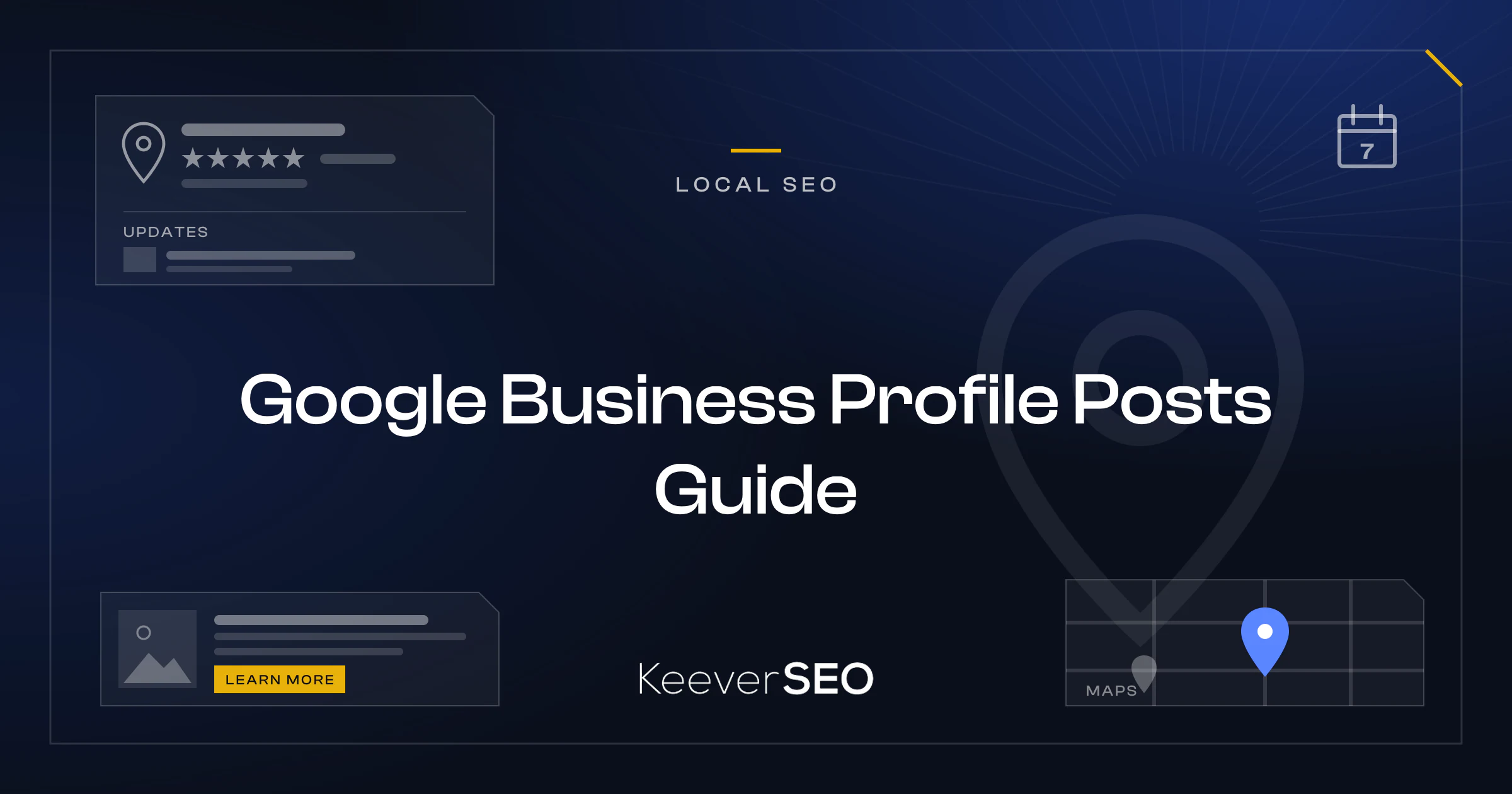
Publishing a Google Business Profile post runs through eight steps: open the post editor, choose a post type, write the message, add a visual, pick a call to action, complete offer or event details, review and publish, then monitor and refresh. Google Business Profile posts are short updates that appear in Google Search and Google Maps, in the Updates and Overview sections of a profile and in the "From the owner" section, and they let a business speak to potential customers with timely information about offers, events, and news.
Verified profile owners and managers with the right access can publish posts. The post types are What's New, Offer, Event, and Product: What's New posts share general updates, Offer posts carry promotions with start and end dates, Event posts cover time-bound happenings, and Product posts present catalog items. Call-to-action options include Book, Order online, Buy, Learn more, Sign up, and Call now, with no button as an option for informational updates.
Effective posts are actionable and intent-driven, with natural keyword placement and real photos or video. What's New posts stay visible for seven days, while Offer and Event posts run for their date ranges, and every post can be edited or deleted at any time and appears newest first. Posts do not move rankings on their own, but they raise engagement, visibility, and customer actions and support local SEO through fresh, relevant content, with performance measured through UTM links in Google Business Profile insights and analytics.
Businesses must follow Google's prohibited and restricted content policies and avoid mistakes like phone-number stuffing and irrelevant promotions. A cadence of at least one post per week, backed by a content calendar, is the recommended rhythm. Businesses with several locations or a need for a repeatable workflow gain from an SEO agency that manages strategy, AI-assisted drafting, and compliant multi-location posting. The workflow starts in the post editor, as the first step shows.
1. Access your Google Business Profile post editor
To access your Google Business Profile post editor, open it from Google Search, Google Maps, or the Business Profile dashboard. Search the business name on Google and select "Edit profile," locate the business on Google Maps and tap "Edit profile," or go to the dashboard at business.google.com. Once logged in with the Google account tied to the verified business profile, the post editor is available.
Verification is the condition for access, because only verified businesses can create and publish posts. Verification runs through postcard, phone, email, or instant methods, and until it is complete the posting function stays locked. Once verified, the editor lets you choose a post type, write the message, add visuals, select a call to action, and publish so the update shows across Google Search and Maps.
2. Choose a Google Business Profile post type
To choose a Google Business Profile post type, match the message to one of four types: What's New, Offer, Event, and Product. Each type serves a different marketing objective.
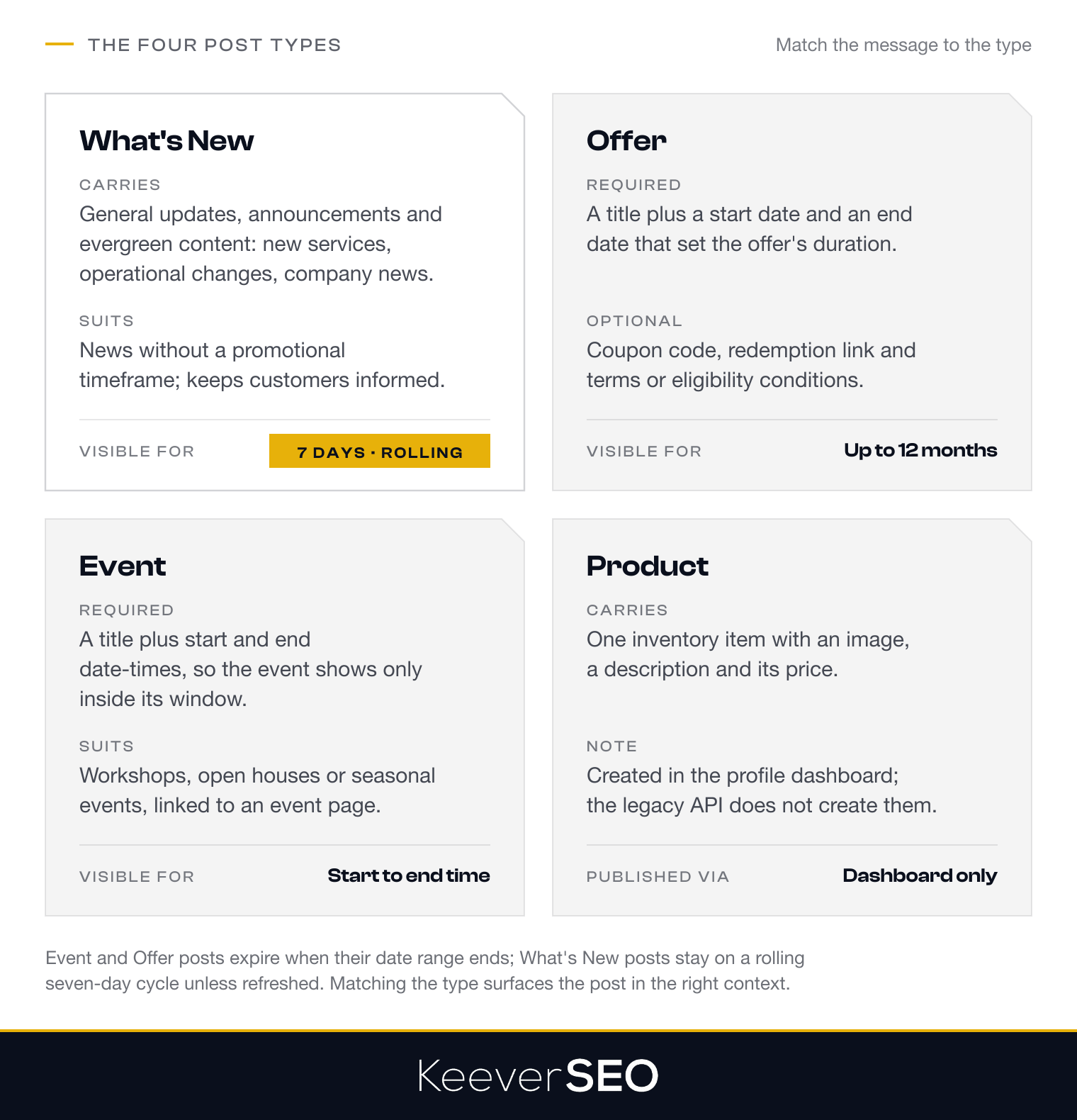
What's New posts share general updates, announcements, and evergreen content such as new services, changes in operations, or company news. Offer posts promote discounts, deals, or special value, with a required start and end date and optional coupon code, redemption link, and terms, which suits time-sensitive promotions. Event posts cover time-bound activities such as workshops, open houses, or seasonal events and require a title plus start and end date-times. Product posts present individual inventory items with images, descriptions, and pricing, and they must be published through the profile dashboard because the legacy API does not create them.
Aligning the message with the right post type gets Google to surface the content in the most relevant context across Search and Maps. Event and Offer posts expire when their date ranges end, which suits time-sensitive campaigns, while What's New posts stay visible on a rolling seven-day cycle unless refreshed. The match improves the user experience and signals the intent behind the update, which supports placement in local results and the "From the owner" section.
3. Write a clear local post message
To write a clear local post message, put the core value in the first 80 to 100 characters, because that part stays visible before truncation in Search and Maps. Each post should carry one concise message rather than several topics, so users grasp it fast and act.
A post can run up to 1,500 characters for detail or a call to action, but only the first 100 characters show in most views, so the opening line must carry the message. Natural keywords raise topical relevance without overloading the text, and a strong opener leaves even users who never expand the post with the core message and a reason to engage.
4. Add an image or video
To add an image or video, choose a visual that strengthens the message and draws attention. Google Business Profile supports images and videos, and the format and quality of the visual shape how the post performs in Search and Maps.
Choose real photos over stock images. Authentic visuals of the storefront, products, team, or event setup build trust and help customers recognize the business, whereas stock images look polished but carry none of that specific value. The image should be right-side up and well framed before upload.
Follow Google's technical specifications. The recommended minimum resolution is 720 by 720 pixels for clarity on mobile and desktop, in JPG or PNG format, with a file size below about 10 MB. Google applies a landscape crop in some placements, so important details belong in the center. Video should follow similar quality and file-size limits and works well for Event and Offer posts, and a preview across devices before publishing confirms the visual supports the call to action.
5. Select a call to action and landing page
To select a call to action and landing page, pair the button that matches the customer's intent with a URL that fulfills its promise. The CTA options are Book, Order online, Buy, Learn more, Sign up, and Call now: "Book" suits appointment-based services, "Order online" suits e-commerce or restaurant orders, "Buy" suits direct purchases, "Learn more" points to informational content, "Sign up" handles registrations, and "Call now" opens a phone call.
The landing page URL must deliver what the button promises. For performance tracking, append UTM parameters to the landing URL before adding it in the post editor, with utm_source=google, utm_medium=business_profile_post, and a descriptive utm_campaign value, so clicks, conversions, and customer actions show in Google Analytics. Each post then engages customers in Search and Maps and returns data that sharpens the local marketing strategy.
6. Add offer or event details
To add offer or event details, complete the fields the post type requires. Offer posts need a title that describes the promotion plus a start date and an end date that set the offer's duration, which can run up to 12 months. Optional fields add a coupon code, a redemption link to a landing page, and terms and conditions that state restrictions or eligibility, so customers have everything they need to act.
Event posts need a title plus start and end date-times so the event shows only within its window. Accurate event details, with a link to a dedicated event page marked up with event schema, help attendees plan. Offer and Event posts expire on their own when the date window closes, and complete, accurate fields get posts moderated correctly and displayed as intended across Search and Maps at the right time.
7. Review and publish your Google Business Profile post
To review and publish your Google Business Profile post, preview it across devices first. The post editor shows how the content appears on desktop Search, Google Maps, and mobile, so the message, image, and call-to-action button render as intended.
After publishing, the post takes one of four statuses. "Published" means the post is live. "Pending review" means Google is checking the post against its content policies, which usually completes fast. "Rejected" marks a violation of the prohibited or restricted content rules, such as a phone number in the text or non-compliant imagery. "Denied" is a final status that calls for a new compliant post, because the original cannot be edited.
A rejected post calls for a check against Google's Business Profile posts content policy. The common causes are a phone number in the text instead of the "Call now" button, promotional language in hotel posts, and imagery below quality standards. A published post appears in the profile's Updates feed for a rolling seven days as a What's New post or until the end date as an Event or Offer post.
8. Monitor and refresh published posts
To monitor and refresh published posts, track their performance and replace them before they expire. After publication, the Google Business Profile dashboard reports views, clicks, and customer actions that show how well a post engages users, and UTM-tagged URLs extend the analysis to conversions and customer journeys in Google Analytics.
Editing or deleting a post takes a moment at any time, so errors or outdated information can be corrected or removed to keep the profile accurate. Regular refreshes matter because posts expire: What's New posts stay visible for about seven days and Offer and Event posts run for their date ranges. A content calendar keeps posting consistent, aligns updates with seasonal campaigns, and prevents gaps in visibility. The eight steps rest on the definition below.
What are Google Business Profile posts?
Google Business Profile posts are business-managed updates that share timely information with potential customers on Google. A post can carry text, images, and links that promote offers, events, and business news, and the feature, launched in 2017, gives businesses a communication channel to the users who search for their services.
Google Business Profile posts appear across Google Search and Google Maps, in the Updates and Overview sections of a business profile and in the "From the owner" section. The placement helps a business stand out in local search results and on its profile page, which raises customer engagement and visibility.
Who can publish Google Business Profile posts?
Verified Google Business Profile owners and managers can publish posts. The users need the right access level on the profile: owners hold full control and can create, edit, and publish posts, and managers granted access by an owner can handle daily tasks including post management, whereas users with read-only or limited access cannot manage or publish posts. Verification of the business profile comes first, because it confirms the business is legitimate and the user holds authority to manage it.
What Google Business Profile post types are available?
The Google Business Profile post types available are What's New, Offer, Event, and Product, each built for a specific marketing objective. The four types are listed below:
- What's New Posts: Versatile updates for company news, product launches, or seasonal messages that keep customers informed without a promotional timeframe.
- Offer Posts: Discounts, special deals, or value-added incentives with a defined start and end date and optional coupon codes and redemption links that drive customer action.
- Event Posts: Time-bound activities like workshops or sales events, with a title and precise start and end dates, which work best linked to event-specific landing pages.
- Product Posts: Individual products or services with descriptions, images, and call-to-action buttons, published through the dashboard because the legacy API does not create them.
Which call-to-action buttons are available for Google Business Profile posts?
The call-to-action buttons available for Google Business Profile posts are Book, Order online, Buy, Learn more, Sign up, Call now, and no button at all. The seven options are listed below:
- Book: For businesses that take appointments or reservations, such as restaurants, salons, and service providers.
- Order online: For online ordering systems used by food delivery services and e-commerce platforms.
- Buy: For product pages or shopping carts at retail businesses that promote specific products.
- Learn more: For informational pages with more detail about services, products, or events.
- Sign up: For registrations to newsletters, memberships, events, or classes.
- Call now: For a direct phone call to the business, useful for service businesses and any case where immediate contact helps.
- No CTA: For purely informational updates that need no user interaction.
Each button should pair with a relevant, UTM-tagged landing URL so performance is tracked and the user journey matches the post's intent.
What should Google Business Profile posts say, and which images or videos work best?
Google Business Profile posts should say something actionable and intent-driven, and the images and videos that work best are authentic photos and clips of the business itself. The text should state a clear value, such as a limited-time offer or a service feature, with location-specific terms and service keywords placed in natural language to match local search intent. The most important information belongs in the first 80 to 100 characters, because posts truncate in many views, and each post should carry one concise call to action.
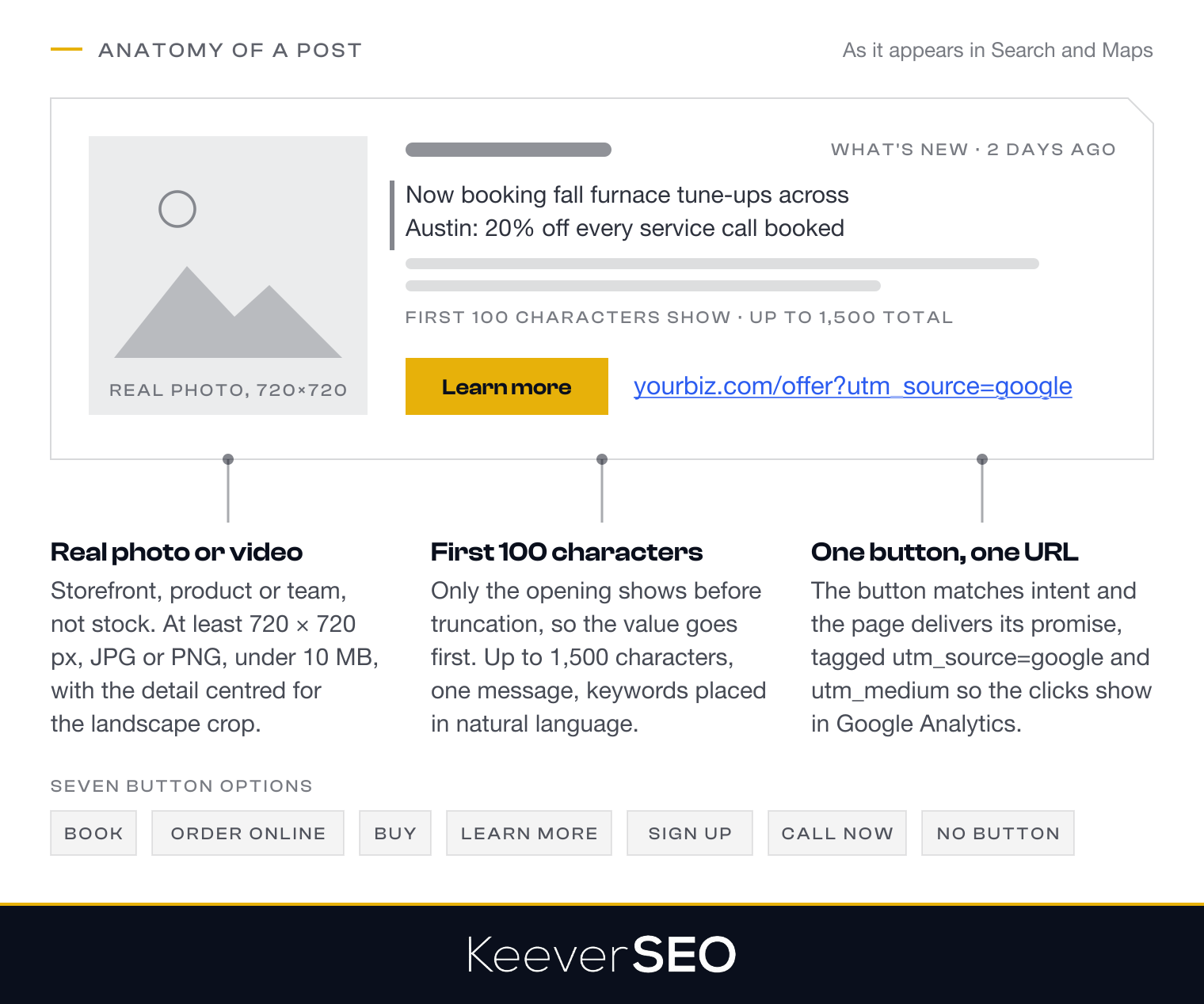
For visuals, high-quality, authentic photos outperform stock imagery with consistency. Real images of the business, products, team, or services build trust and set the profile apart from competitors. Photos should be well lit, oriented correctly, at least 720 by 720 pixels, and under 10 MB in JPG or PNG format. Videos add engagement through behind-the-scenes moments, product demonstrations, or customer testimonials. Generic or hard-sell visuals should give way to images and videos that reflect real customer experiences and reinforce the brand's local presence across Search and Maps.
How long do Google Business Profile posts remain visible, and can businesses edit or delete them?
Google Business Profile posts remain visible for seven days as What's New posts or for their set date windows as Event and Offer posts, and businesses can edit or delete any post at any time. What's New posts expire seven days after publication and stop showing to users, while Event and Offer posts stay active only between the start and end dates set at creation, with Offer posts running up to 12 months.
Businesses hold full control over published posts. The Google Business Profile dashboard lets them edit or delete posts to correct errors, update information, or remove outdated content, and posts display newest first in the profile's Updates section so the most recent content reaches customers on Search and Maps. The flexibility keeps messaging fresh and accurate as promotions, events, and circumstances change.
What are the benefits of Google Business Profile posts?
The benefits of Google Business Profile posts are engagement, visibility, customer actions, AI-search relevance, and indirect support for local SEO. The five benefits are listed below:
- Increased Engagement: Timely updates and promotions inside Search and Maps results invite interaction, which raises click-through rates and customer actions such as website visits and bookings.
- Greater Visibility: Posts appear in a prominent position on the business profile, often above reviews and other sections, which helps a business stand out when the post carries a strong image and a clear call to action.
- Direct Path to Customer Actions: Call-to-action buttons like "Book," "Order online," or "Call now" create a direct path from discovery to conversion.
- Relevance for AI-Powered Search: Fresh, keyword-rich posts signal that a business is active and responsive, which matters as search engines fold AI-driven recommendations into results.
- Indirect Support for Local SEO: Posts are not a direct ranking factor, but consistent posting keeps a profile well maintained, and Whitespark's "Local Search Ranking Factors" survey ranks Google Business Profile signals as the largest single factor in local pack rankings, so an active profile tends to earn better local visibility over time.
The five benefits give Google Business Profile posts their strategic value in local marketing.
What are the limitations of Google Business Profile posts?
The limitations of Google Business Profile posts are a short lifespan, limited reach, moderation delays, and the fact that posts are not a direct ranking factor. The four limitations are listed below:
- Short Lifespan: What's New posts expire after seven days, and Event and Offer posts end with their date ranges, so a business must publish often to hold engagement and visibility.
- Limited Reach: Posts appear mainly to users who already view the business profile on Search and Maps, which makes them better at engaging existing interest than at attracting new audiences, and their prominence has declined since 2018 against profile elements like reviews and photos.
- Moderation Delays: Every post passes a review before it goes live, which can leave it in "Pending review" for hours or days, and a post that breaks content policy is rejected, which wastes the drafting effort.
- Not a Direct Ranking Factor: Posts do not move local search rankings on their own; they can feed engagement signals and support wider SEO, but Google's "How to improve your local ranking on Google" documentation names relevance, distance, and prominence as the local ranking factors, with no weight given to posting frequency or post content, which keeps posts a communication tool rather than a ranking lever.
How can businesses measure Google Business Profile post performance with UTM links?
Businesses can measure Google Business Profile post performance with UTM links by tagging landing URLs and reading the results in Business Profile insights and web analytics. The three steps are listed below:
- Build UTM Parameters: Construct three parameters per post link:
utm_source=googleto name Google Business Profile as the traffic source,utm_medium=gbp_postto categorize the channel, and a descriptiveutm_campaignvalue for the specific post or promotion, such asutm_campaign=holiday_sale. - Apply UTM Tags to Landing URLs: Append the UTM string to the landing page URL when selecting the call-to-action button, so
https://yourbusiness.com/promotionbecomeshttps://yourbusiness.com/promotion?utm_source=google&utm_medium=gbp_post&utm_campaign=winter_offer, and confirm the landing page is live, mobile-ready, and matched to the post's message. - Track Results: Monitor post engagement in the Insights tab of the Google Business Profile dashboard and cross-reference it in Google Analytics through the UTM parameters, with the focus on customer actions such as conversions, form submissions, or phone calls rather than impressions, so messaging, offers, and cadence can be refined on real performance.
What Google Business Profile post policies apply, and which mistakes should businesses avoid?
The Google Business Profile post policies that apply cover prohibited and restricted content, phone numbers in post text, hotel restrictions, and the common causes of rejection. The four policy points, drawn from Google's "Business Profile photos & videos policy and posts content policy," are listed below:
- Prohibited and Restricted Content: Posts must exclude illegal products, dangerous goods, offensive material, and sexually explicit content, and restricted categories like alcohol, gambling, and healthcare call for careful handling.
- Phone Number Stuffing: A phone number in the post text is not allowed; the "Call now" button, which uses the verified profile number, is the compliant route.
- Hotel Post Restrictions: Hotels cannot create Offer posts or any post that mentions or links to deals, promotions, special offers, or discounts, which keeps hotel pricing consistent on the profile.
- Common Causes of Rejection: Low-quality images, irrelevant content, and promotional language that breaks the guidelines are the usual reasons a post is rejected, so quality visuals and relevant content keep posts live.
Following the four policy points keeps posts professional, compliant, and effective.
How often should businesses post on Google, and how can a post calendar support local marketing?
Businesses should post on Google at least once a week, and a post calendar turns the cadence into a local marketing asset. A weekly rhythm keeps fresh content in the "From the owner" section and signals to Google and to customers that the business is active and responsive. Two to three posts a week suit businesses with high customer turnover, seasonal promotions, or fast-changing inventory, though quality and relevance come before volume.
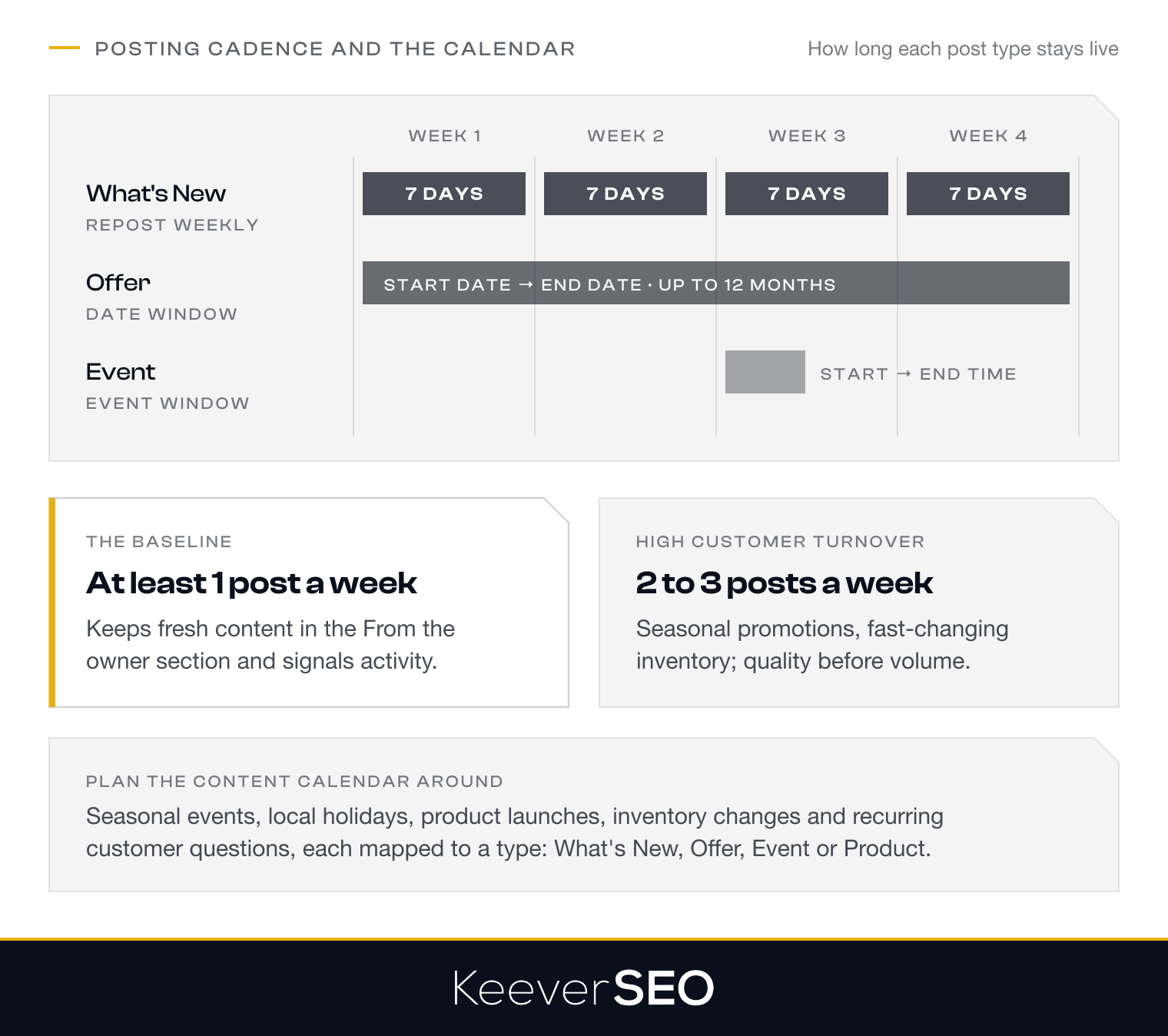
A content calendar turns sporadic posting into a structured system. Posts planned around seasonal events, local holidays, product launches, inventory changes, and recurring customer questions align Google Business Profile activity with the wider marketing campaigns. The calendar maps post types to objectives: What's New for announcements, Offer for time-sensitive promotions, Event for workshops or in-store activities, and Product for featured inventory. Advance planning removes last-minute scrambling, holds brand voice steady, and leaves room for visual preparation and UTM tagging, and for multi-location businesses a central calendar keeps local relevance inside corporate compliance and brand standards.
How do Google Business Profile posts fit local SEO management?
Google Business Profile posts fit local SEO management as a direct communication channel that keeps a profile active and relevant. Regular posts give users fresh content and signal activity to search algorithms, which supports local visibility through better engagement.
Posts target specific, intent-driven queries with keyword-rich content about promotions, events, and updates, which adds indexed touchpoints that follow seasonal trends and local events alongside on-page SEO. Strategic calls to action and UTM-tagged landing pages guide customer actions and gather behavioral data that informs wider marketing decisions.
Posts treated as part of a repeatable local SEO workflow deliver consistency and measurable impact across locations. Planned and analyzed on a structured cadence, they reinforce brand authority and feed ongoing optimization, which turns Google Business Profile management into a reliable driver of local marketing, as the three connections below show.
How can consistent Google Business Profile posts support broader local marketing?
Consistent Google Business Profile posts support broader local marketing by keeping a business visible and relevant across Google Search and Maps. The posts serve as regular touchpoints with timely updates, offers, and events that match the existing marketing strategy, and within a larger local content system they reuse website, email, and social content for local audiences with cohesive messaging.
Over time, the consistency builds a steady stream of engagement that drives clicks, calls, and direction requests and strengthens the business's presence in search results. A content calendar maps the posts to promotions, holidays, and community events, which keeps the business relevant without constant new content.
How do Google Business Profile posts compare with reviews and Questions and Answers?
Google Business Profile posts compare with reviews and Questions and Answers as three features with distinct roles. Posts are business-generated updates that promote timely events, offers, or news, with the business in control of the message and calls to action that drive specific customer actions. Reviews are customer-generated feedback that shapes trust and reputation, stay visible on the profile, and weigh on local search rankings. Questions and Answers form a community knowledge base where customers and the business answer common inquiries such as operating hours or services.
Each feature serves a different part of engagement and visibility. Posts need regular updates to hold visibility and drive immediate action, reviews build long-term credibility and affect rankings through authentic experiences, and Questions and Answers remove friction from practical buyer questions. Together the three combine business-controlled content and user-generated feedback for local search performance.
How can recurring customer questions inform Google Business Profile post topics?
Recurring customer questions can inform Google Business Profile post topics by pointing to the information customers want most, such as pricing, hours, service areas, and booking. Posts that answer the questions match customer intent, raise engagement, and remove friction from the customer journey. The four steps are listed below:
- Identify Common Queries: Monitor the questions that arrive through phone calls, emails, in-person visits, and the profile's Questions and Answers section.
- Group by Theme: Organize similar questions into themes so content creation runs faster.
- Create Informative Posts: Write a post for each theme that gives a clear answer and points to the next step, such as booking or contacting the business.
- Use Seasonal Topics: Turn seasonal questions, like holiday hours or weather-related changes, into posts that show responsiveness.
Posts aligned with customer questions create a feedback loop that sharpens local marketing and reaches searchers who want specific information.
When does Google Business Profile post management need a repeatable workflow?
Google Business Profile post management needs a repeatable workflow when scale, post volume, multi-location operations, or client work arrive. As a business grows to several locations or a large post volume, a standardized process becomes necessary, with steps for content planning, drafting, internal review, scheduling, publishing, and performance tracking. The structure keeps brand consistency, reduces errors, and holds compliance with Google's policies, and it matters most for agencies or franchises that manage many profiles and must balance local relevance against brand standards. The workflow leads to client approvals, which protect the process by confirming content matches brand guidelines before publication.
Why do approvals matter for client Google Business Profile posts?
Approvals matter for client Google Business Profile posts because they protect brand safety and accuracy. An approval step gives the client a final check that the content matches brand voice and current promotions, which prevents errors such as wrong dates or misleading offers, and it keeps content that could break Google's policies, and draw restrictions on the profile, from going live. Client sign-off cuts the risk of costly mistakes and builds trust with the audience.
When should a business hire an SEO agency for Google Business Profile posts?
A business should hire an SEO agency for Google Business Profile posts when internal resources run thin or multi-location posting grows complex. Local SEO agencies like ours supply strategic planning, compliance expertise, and workflow automation that keep posting consistent and policy-compliant. The decision makes sense when post quality and frequency slip, when brand voice needs professional management, or when client approvals and reporting exceed what the internal team can carry.
An agency adds the most value when posts sit inside a broader local SEO strategy that covers reviews, Q&A, citation consistency, and performance analytics. Once the decision is made, the agency's responsibilities, set out next, define the engagement.
What should an SEO agency manage for Google Business Profile posts?
An SEO agency should manage strategy, drafting, visuals, post configuration, calls to action, compliance, multi-location publishing, reporting, and ongoing refresh for Google Business Profile posts. We cover the nine responsibilities, which are set out below:
Strategy and Planning The agency builds a posting calendar aligned with business objectives and local search goals, with the core messages, seasonal opportunities, and customer touchpoints mapped in advance.
Content Drafting and Messaging The agency writes clear, action-oriented post text with the value in the first 80 to 100 characters, natural keyword placement, and respect for the 1,500-character limit.
Visual Asset Selection and Formatting The agency sources or creates images and video that meet the technical specifications, at least 720 by 720 pixels and under 10 MB, with real photos over stock and attention to landscape cropping across devices.
Post Type Selection and Configuration The agency picks the right type, What's New, Offer, Event, or Product, and configures the required fields, including start and end dates for time-bound posts and coupon codes, redemption links, or terms where they apply.
Call-to-Action and Landing Page Optimization The agency pairs each post with the right button, whether Book, Order online, Buy, Learn more, Sign up, or Call now, and appends UTM parameters to the landing URL for tracking in Google Analytics and Business Profile insights.
Compliance and Policy Adherence The agency keeps every post inside Google's content policies, with no phone numbers in the text and no offer posts or promotional language for hotels.
Multi-location Publishing and Local Relevance For multi-location businesses, the agency runs bulk publishing for brand-wide campaigns and per-location customization for local events and inventory, with consistency and local authenticity held together.
Performance Monitoring and Reporting The agency tracks post views, customer actions, and UTM-driven conversions and reports on engagement in terms of customer actions rather than post volume.
Ongoing Optimization and Refresh The agency edits or removes underperforming or outdated posts, refreshes What's New posts on a rolling cadence, and adjusts messaging, visuals, and calls to action on performance data and seasonal trends.
How can agencies use AI for Google Business Profile post drafts?
Agencies can use AI for Google Business Profile post drafts to speed content creation while human review protects quality and compliance. AI tools generate first drafts from business data, seasonal trends, and local customer behavior, which cuts the time needed to produce posts across many client accounts, and they suggest messaging frameworks, promotional copy variations, and keywords matched to the business category and local search intent. The AI output is a starting point rather than a finished post, because human oversight keeps brand voice consistent, facts accurate, and content within Google's policies.
The most effective workflow pairs AI efficiency with human expertise: AI drafts the text and suggests visuals, and local SEO specialists review each piece for tone, compliance, and fit with the client's marketing goals. The hybrid approach lets agencies scale post management across many locations without losing local relevance, and custom models trained on approved client messaging keep AI drafts in each business's voice.
How can agencies maintain compliant multi-location Google Business Profile posts?
Agencies can maintain compliant multi-location Google Business Profile posts through a structured workflow that separates brand-wide messaging from location-specific updates. Each post is reviewed for local accuracy, policy compliance, and timing before publication, and bulk publishing tools built on the Google Business Profile API schedule and distribute posts at scale under central oversight. Automation alone is not enough: messaging must reflect local events, seasonal variation, and market-specific offers so posts stay relevant to each community while they follow Google's content policies on misleading information and restricted categories.
For compliance at scale, agencies use recurring post templates that encode the policy guardrails, such as approved formats and calls to action, while leaving room for location details like store hours or local promotions. Regular audits of published posts catch policy violations before Google flags them, and status monitoring across the whole location portfolio keeps moderation issues from spreading. Scalable workflows, localized content calendars, and compliance checks together keep multi-location posts driving engagement without moderation problems or diluted brand messaging.
What are Google Business Profile Posts best practices?
The Google Business Profile Posts best practices are a consistent cadence, value in the first 100 characters, real visuals, matched calls to action, natural keywords, and content fitted to the business type. The six practices are listed below:
- Post with a consistent cadence: A regular schedule, ideally weekly, keeps the profile active and visible and signals engagement to Google and to customers.
- Lead with value in the first 100 characters: The most compelling information goes first, because posts truncate after about 100 characters in some displays.
- Use high-quality, real images and videos: Authentic photos of the business, products, or team, at least 720 by 720 pixels, under 10 MB, in JPG or PNG, hold quality across platforms.
- Pair clear calls to action with relevant landing pages: The button that matches the post's intent, such as Book, Order online, or Call now, links to a UTM-tagged landing page that delivers on the post.
- Incorporate keywords naturally: Location-specific and service-related keywords belong in the copy in natural language, without stuffing that hurts readability.
- Fit content to your business type: Posts fitted to the industry, such as daily specials for restaurants or new arrivals for retail stores, earn more relevance and engagement.
The six practices maximize the visibility and engagement Google Business Profile Posts can deliver, and the tips below sharpen them further.
What tips can improve your Google Business Profile posts?
The tips that can improve your Google Business Profile posts cover the opening line, visuals, keywords, calls to action, cadence, previews, phone numbers, and tracking. The eight tips are listed below:
- Front-load Value: Put the most important information in the first 100 characters, ahead of truncation.
- Use Authentic Visuals: Choose real photos or videos of the business at the recommended 720 by 720 pixels.
- Incorporate Relevant Keywords: Work location-specific and service-related keywords into the copy in natural language.
- Select Clear Calls-to-Action: Pair each post with a fitting button, such as "Book" or "Learn more," linked to a UTM-tagged landing page.
- Maintain Consistent Posting: Keep a weekly schedule backed by a content calendar so content stays fresh.
- Preview Across Devices: Check how each post displays on desktop and mobile before it goes live.
- Avoid Phone Number Stuffing: Keep phone numbers out of the post body and use the "Call now" button with the verified number.
- Track Performance with UTM Links: Use UTM parameters to follow customer actions and traffic in Google Analytics, with engagement rather than volume as the measure.
How can businesses turn Google Business Profile posts into a recurring local SEO habit?
Businesses can turn Google Business Profile posts into a recurring local SEO habit through a structured, consistent posting routine. A content calendar aligned with seasonal events, promotions, and business milestones keeps posts regular, timely, and relevant.
The habit holds when posting joins the wider marketing workflow, paired with email campaigns, social updates, or inventory changes. Tracking performance through UTM-tagged URLs and Google Business Profile insights shows the engagement and traffic each post earns, which confirms the value of consistency, and over time the routine becomes a standing part of the Google Business Profile posts workflow that sustains visibility and local search relevance.