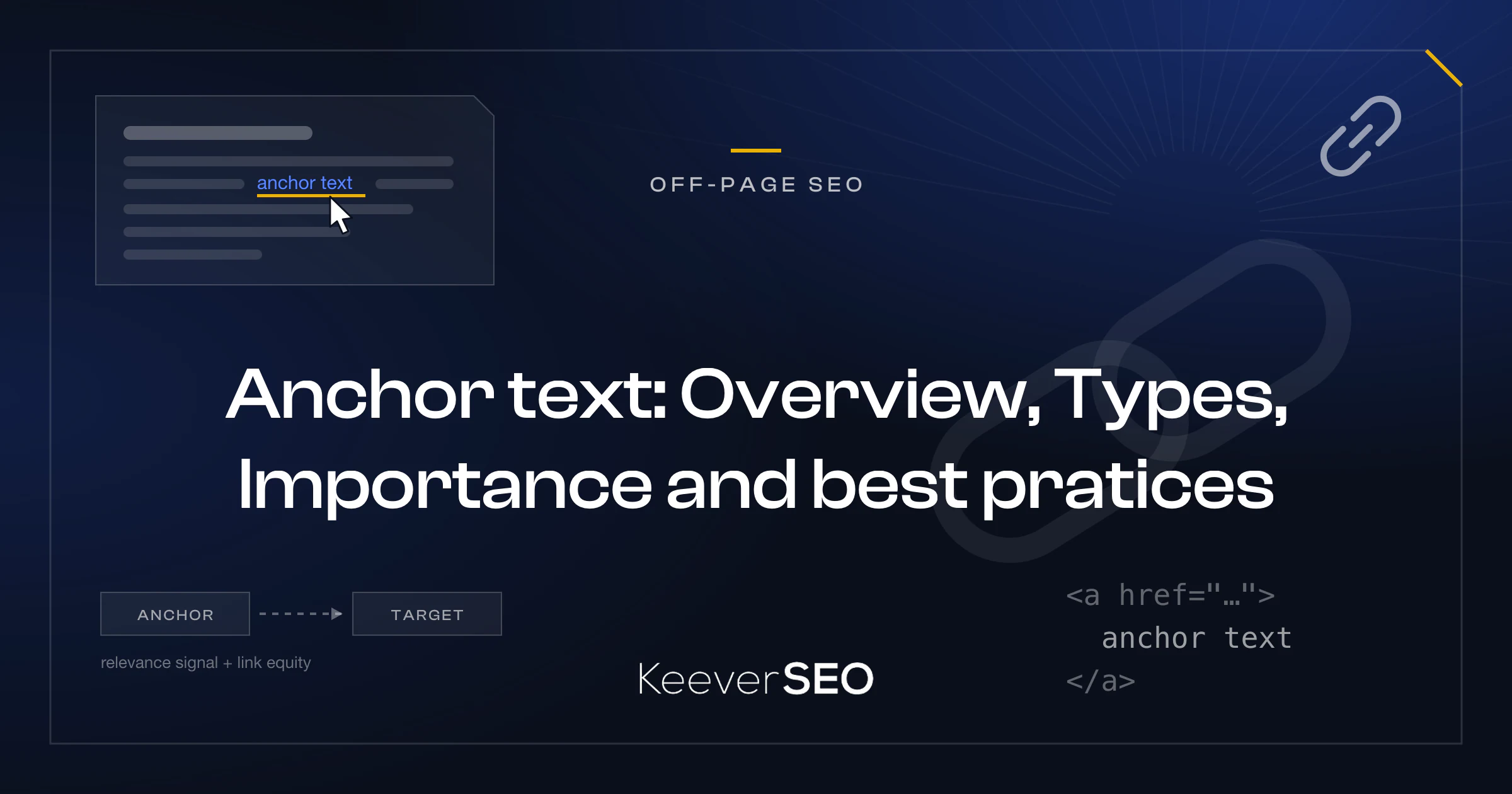
Anchor text is the visible, clickable text of a hyperlink, known as link text. The HTML anchor tag (<a href="URL">anchor text</a>) renders the clickable words, and the words act as a relevance signal that search engines read to understand the context and topic of the linked page. The main types of anchor text are exact match, partial match, branded, generic, naked URL, and related. Each type plays a distinct role in SEO, shaping link relevance and the flow of link equity.
In SEO, anchor text passes context and link equity to linked pages, helping search engines judge relevance and authority. Best practices for anchor text cover choosing relevant, succinct, and varied text that builds a natural link profile. Anchor text audits analyze performance, catch exact-match spikes, and spot over-optimization patterns before they trigger penalties. Anchor text further shapes internal linking structures and site navigation, guiding users and crawlers through a site's hierarchy while distributing authority across pages.
Best practices for anchor text selection, sizing, and diversification form the foundation of link building and site structure. Misusing anchor text through over-optimization, keyword stuffing, or manipulative exact-match patterns invites search engine penalties, above all after algorithm updates like Google Penguin (2012), which targets unnatural link profiles. Choosing descriptive, relevant anchors and keeping a distribution that favors branded and natural variations lets a site collect the SEO benefits of anchor text while avoiding the risks of manipulation and over-optimization.
What is an Anchor text?
Anchor text is the visible, clickable text in a hyperlink, referred to as "link text." Anchor text serves a dual purpose: the words tell users what content to expect after clicking the link, and they give search engines context about the linked page. The HTML <a> tag creates anchor text, with the clickable words sitting between the opening <a> and closing </a> tags. The placement lets the text guide users and search engines alike, indicating the relevance and target of the hyperlink.
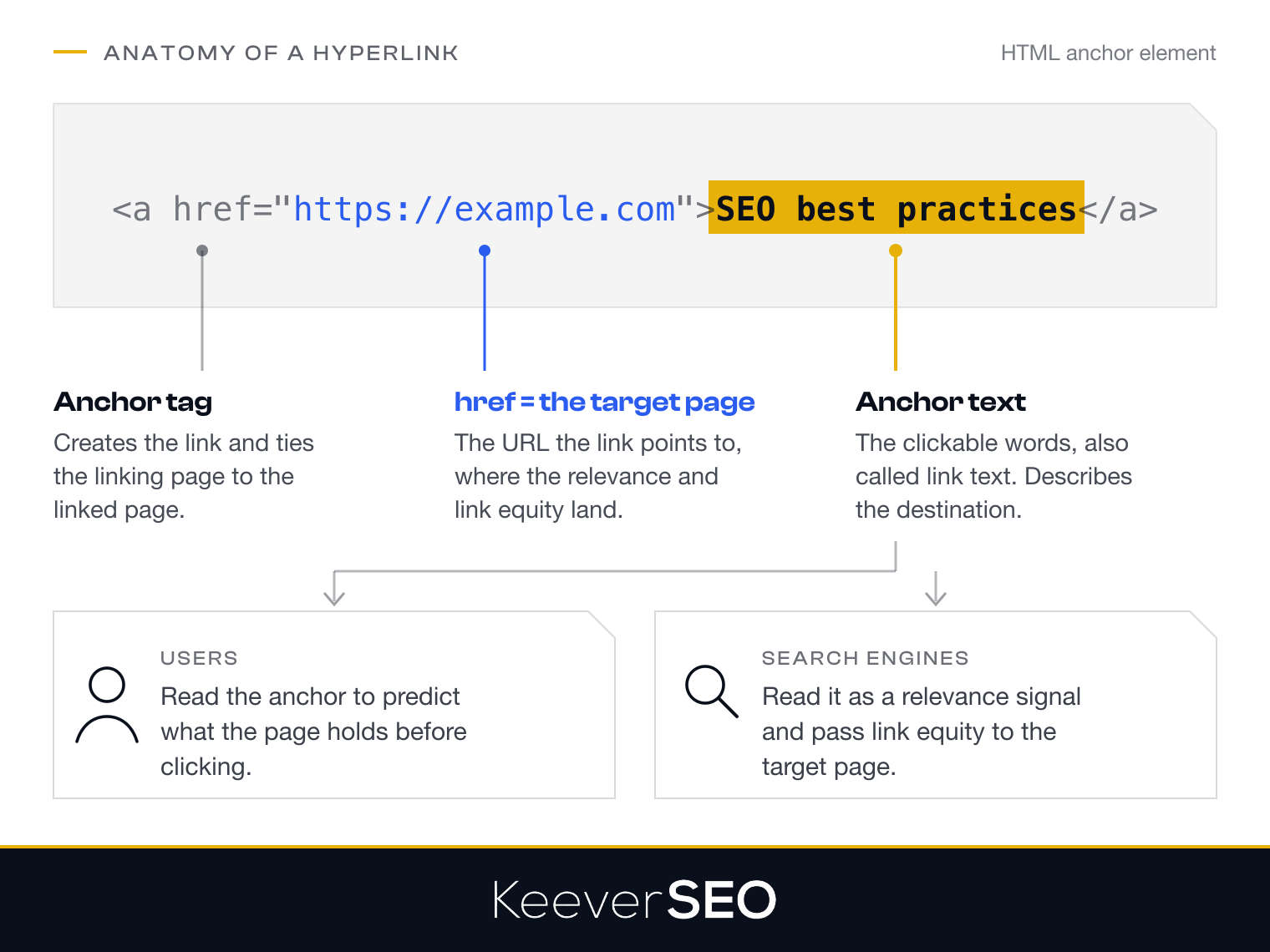
In web development, the way the anchor tag renders the clickable text matters for usability and SEO: the <a> tag defines the link and signals the relationship between the linking page and the linked page. How the anchor tag builds that link is broken down below.
How Does the HTML Anchor Tag Define Anchor Text?
The HTML anchor tag defines anchor text by placing the clickable words between the opening <a href=""> and closing </a> tags. For example, in <a href="https://example.com">Visit Example</a>, "Visit Example" appears as the blue, underlined clickable text. The href attribute sets the target URL, telling users and search engines where the link points. The words between the tags signal the link's purpose to users and the linked page's context to search engines.
How Does Anchor Text Affect SEO (Search Engine Rankings)?
Anchor text affects SEO by acting as a relevance signal that passes context and link equity to search engines. The clickable words help search engines like Google understand the subject matter of the linked page, which shapes its ranking potential through PageRank and link equity. Historical manipulation of anchor text through excessive exact-match keywords led search engines to scrutinize anchor patterns, and Google's Penguin update targeted manipulative link schemes and over-optimized anchor text profiles, according to Google's official April 2012 announcement "Another step to reward high-quality sites" by Matt Cutts of the webspam team. Anchor text remains a ranking signal, but the text must read naturally to avoid algorithmic penalties: effective usage balances relevance and diversity so the link text matches the content's topic without over-optimization.
What Are the Main Types of Anchor Text?
The main types of anchor text are listed below:
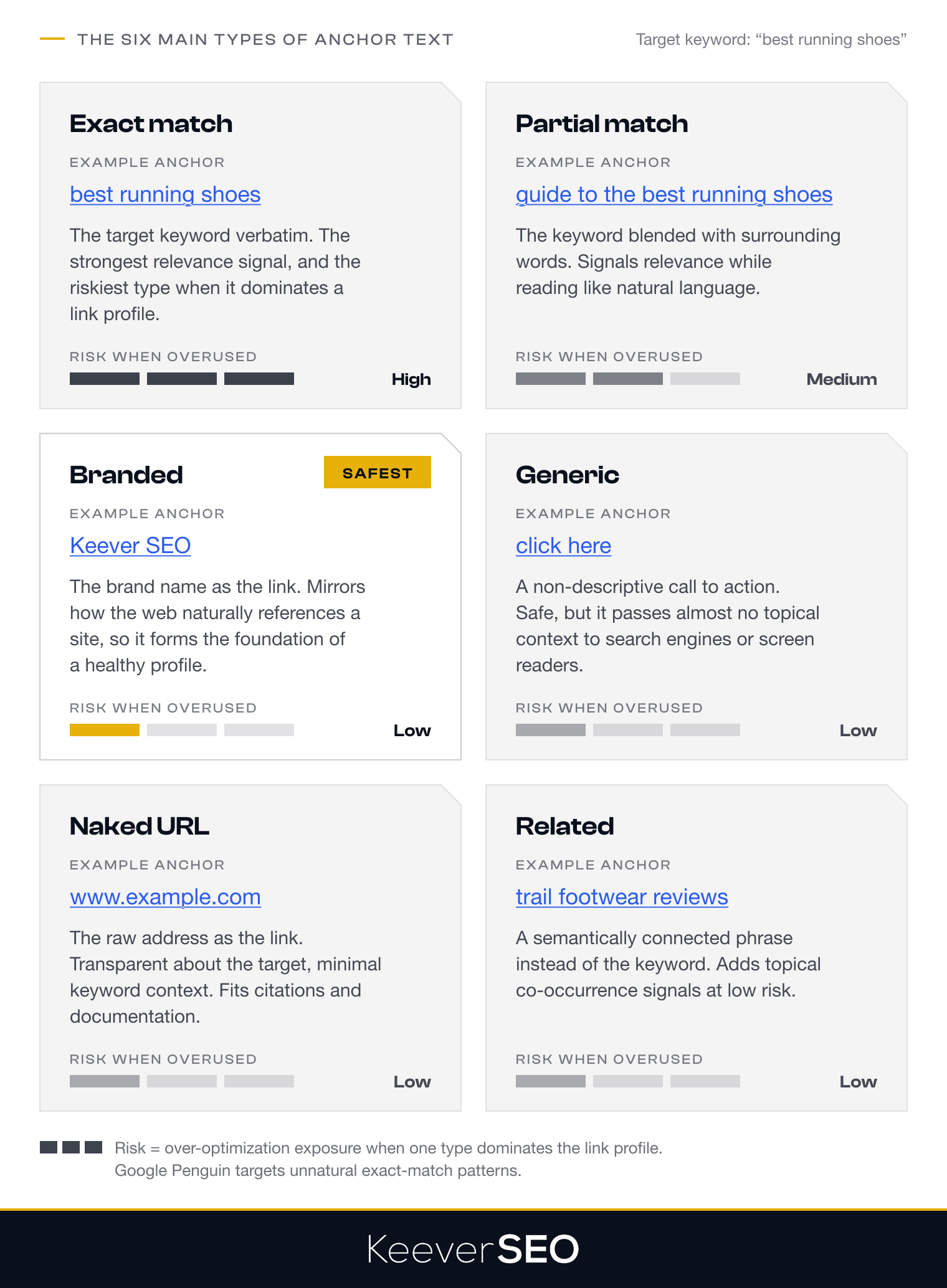
- Exact match: the anchor is the target keyword verbatim, the strongest relevance signal and the riskiest when overused.
- Partial match: the target keyword combined with surrounding words or a variation, balancing relevance with natural language.
- Branded: the brand name as the anchor, the safest and most natural type, with a brand+keyword variant such as "Semrush SEO tools."
- Generic: non-descriptive call-to-action anchors such as "click here" or "read more."
- Naked URL: the raw web address used as the clickable text.
- Related: semantically connected terms rather than the exact keyword, adding topical context.
Image anchors, where the alt text of a linked image serves as the anchor, complete the set alongside the brand+keyword variant.
What is Exact Match Anchor Text?
Exact match anchor text is the clickable text in a hyperlink that matches the target keyword or phrase of the linked page verbatim. A page optimized for "best running shoes" receives an exact match anchor reading "best running shoes."
Exact match anchors historically delivered strong relevance signals to search engines, and they carry the highest risk when overused. Search engines, above all after Google's Penguin update in 2012, scrutinize exact match anchor patterns for manipulation. Overuse can trigger penalties or over-optimization filters, so exact match anchors work best sparingly, balanced with partial match, branded, and generic anchors in a natural link profile.
What is Partial Match Anchor Text?
Partial match anchor text is hyperlink text that combines the target keyword with surrounding words or keyword variations. SEO terminology labels the same pattern phrase match or broad match anchor text. For a target keyword like "SEO tools," a partial match anchor might read "best SEO tools for beginners" or "complete SEO tools guide."
Partial match anchors read more organically than exact match anchors because the target keyword blends with contextual words. The blend keeps the link profile natural while still signaling relevance to search engines, reducing the over-optimization risk that comes with excessive exact-match usage.
What is Branded Anchor Text?
Branded anchor text uses a brand name as the clickable link text. Branded anchors count as the safest and most natural anchor type in SEO because the words reference a company, product, or website name rather than a keyword phrase. "Semrush," "Moz," or "Mediavine" used as anchor text all qualify as branded anchors.
Search engines view branded anchor text favorably because it mirrors how users reference and link to sites across the web. The brand+keyword variant combines the brand name with descriptive words, as in "Semrush SEO tools" or "Moz link building guide," keeping the trustworthy branded signal while adding topical relevance. Branded anchors rarely trigger over-optimization filters, which makes them the foundation of a healthy, diversified anchor text profile.
What is Generic Anchor Text?
Generic anchor text is non-descriptive, call-to-action link text that reveals little about the target page's content. Common generic phrases include "click here," "read more," "learn more," "this website," "this page," and "here."
Generic anchors encourage clicks and fit conversational content, but they offer minimal SEO value compared with descriptive anchor types: search engines cannot extract relevance signals from vague phrases. Screen readers pull anchor text out of context, and a phrase like "click here" confuses when read in isolation. Generic anchors remain among the safest types for over-optimization risk, since they cannot trigger keyword-stuffing penalties, yet they contribute nothing to keyword rankings or topical authority.
How Do Naked URLs Serve as Anchor Text?
Naked URLs serve as anchor text when the raw web address itself becomes the clickable link text, as in https://www.example.com or www.example.com. Naked URLs appear with or without the HTTP/HTTPS prefix and make the link target transparent, but they carry minimal keyword context or relevance signals for search engines.
For cleanup, replacing naked URLs with descriptive anchor text that carries relevant keywords or context strengthens the SEO signal. Naked URL anchors fit best where showing the address serves a purpose, such as citation references, technical documentation, or cases where users need to see and copy the URL.
How Does Related Anchor Text Enhance Context?
Related anchor text enriches context by using semantically connected terms rather than the exact target keyword as the clickable text. Synonyms, topical variations, and contextually relevant phrases signal the same theme and add a topical, co-occurrence signal that helps search engines read the semantic relationship between the linking and linked pages. The pattern strengthens contextual relevance without the over-optimization risk of repeated exact-match anchors, and it mirrors how real users and publishers reference content.
What are some examples of anchor text?
Examples of anchor text for each main type are presented in the table below:
| Anchor Text Type | Example Anchor | Target/Use |
|---|---|---|
| Exact Match | "SEO best practices" | Links to a page targeting the exact keyword "SEO best practices"; highest relevance signal but carries risk when overused |
| Partial Match | "learn about SEO best practices" or "top SEO practices guide" | Links to SEO content using keyword variations or surrounding words; balances relevance with natural language |
| Branded | "Semrush" or "Moz" | Links using only the brand name; safest and most natural type, builds brand recognition |
| Brand + Keyword | "Semrush SEO tools" or "Moz link building guide" | Combines brand with descriptive keywords; provides context while keeping a natural appearance |
| Generic | "click here", "read more", "this website", "learn more" | Non-descriptive call-to-action anchors; minimal SEO value and context |
| Naked URL | https://www.example.com or www.example.com | Uses the raw URL as clickable text; straightforward but less descriptive for SEO |
| Related/LSI | "search engine optimization strategies" (linking to "SEO tips") | Uses semantically related terms rather than exact keywords; adds topical relevance through co-occurrence signals |
| Image | [Alt text: "SEO dashboard screenshot"] | Uses image alt text as anchor when an image is linked; important for accessibility and SEO |
| Article/Page Title | "The Complete Guide to Link Building in 2024" | Uses the exact title of the target page; provides clear context and expectations |
Exact match anchors deliver the strongest keyword relevance signal and demand sparing use. Partial match and related anchors convey topical relevance at lower risk. Branded anchors build the most natural link profile with almost no penalty risk, while generic anchors add minimal SEO value. A healthy link profile mixes the types, with branded and partial match anchors forming the largest share.
What is the Importance of Using Anchor Text in SEO?
The importance of anchor text in SEO lies in its function as a relevance signal that passes context and link equity to the linked page. Search engines crawling a hyperlink analyze the anchor text to judge the content and relevance of the target page, classify its topical focus, and rank it for matching queries. Anchor text works as a descriptor that tells search engines "this link points to a page about X," building associations between keywords and target URLs.
Anchor text further governs the flow of link equity, the ranking power that hyperlinks transfer between pages, a concept rooted in Google's PageRank algorithm. A page that links out with descriptive anchor text passes authority together with thematic context that strengthens the receiving page's topical relevance. Google's "Search Engine Optimization (SEO) Starter Guide," published by Google Search Central, notes that with appropriate anchor text, users and search engines can understand what linked pages contain before visiting them. A well-optimized anchor text strategy builds a network of signals that reinforces topical authority and improves rankings for relevant keywords.
How Does Anchor Text Improve Link Relevance?
Anchor text improves link relevance by aligning the clickable text with the linked page's topic and surrounding context. Alignment between anchor and target page helps search engines read the connection between pages and match the link to search intent. Anchor text that accurately describes the linked page sends a strong relevance signal that strengthens the page's contextual position in search results.
The surrounding content reinforces link relevance further: search engines analyze adjacent sentences and the page theme to confirm the link sits naturally in context. A link that reads as a coherent part of the content, rather than a forced keyword placement, aligns best with search intent.
What are the Best Practices for Anchor Text?
The best practices for anchor text are listed below:
- Relevance-based selection: the anchor describes the target page and matches search intent, so users and search engines both understand the link.
- Optimal length: succinct anchors of five words or fewer stay readable and avoid keyword stuffing.
- Diversification: a mix of branded, naked URL, generic, partial match, and related anchors mimics organic linking patterns.
- Avoiding over-optimization: a low share of exact-match keywords keeps the profile clear of algorithmic penalties like Google Penguin.
How Should Anchor Text Be Chosen?
Anchor text should be chosen for relevance to the target page's content and alignment with search intent. The anchor fits naturally within the sentence, using descriptive keywords that reflect the linked page's topic, so users can predict what they will find after clicking and search engines can read the relationship between linking and linked content.
Natural placement matters: forced keywords disrupt reading flow, while descriptive wording woven into the sentence reflects search intent without repetition. Internal links allow more freedom to use keyword-relevant anchors that support the site's topical structure.
What is the Optimal Length for Anchor Text?
The optimal length for anchor text is two to five words. The range keeps the text succinct and descriptive without stretching into a full sentence. SEMrush and Moz both advise concise, natural phrasing to maintain clarity and relevance, and Google's guidance calls for anchor text that is "short but descriptive," usually "a few words," which signals the target page's topic to users and search engines.
Why Should Anchor Text be Diversified?
Anchor text should be diversified because search engines penalize unnatural anchor patterns, and a varied profile reads as organic. Search engines expect natural variation across anchor types, so a diversified profile lowers the risk of appearing manipulative. The anchor-text ratio, sometimes called the "golden ratio," favors a branded-heavy mix: a large share of branded and URL-based anchors, a moderate share of partial-match and related anchors, and minimal exact-match anchors, a distribution recommended in "Anchor Text Ratios: Why They Still Matter for SEO Strategies" published by The HOTH.
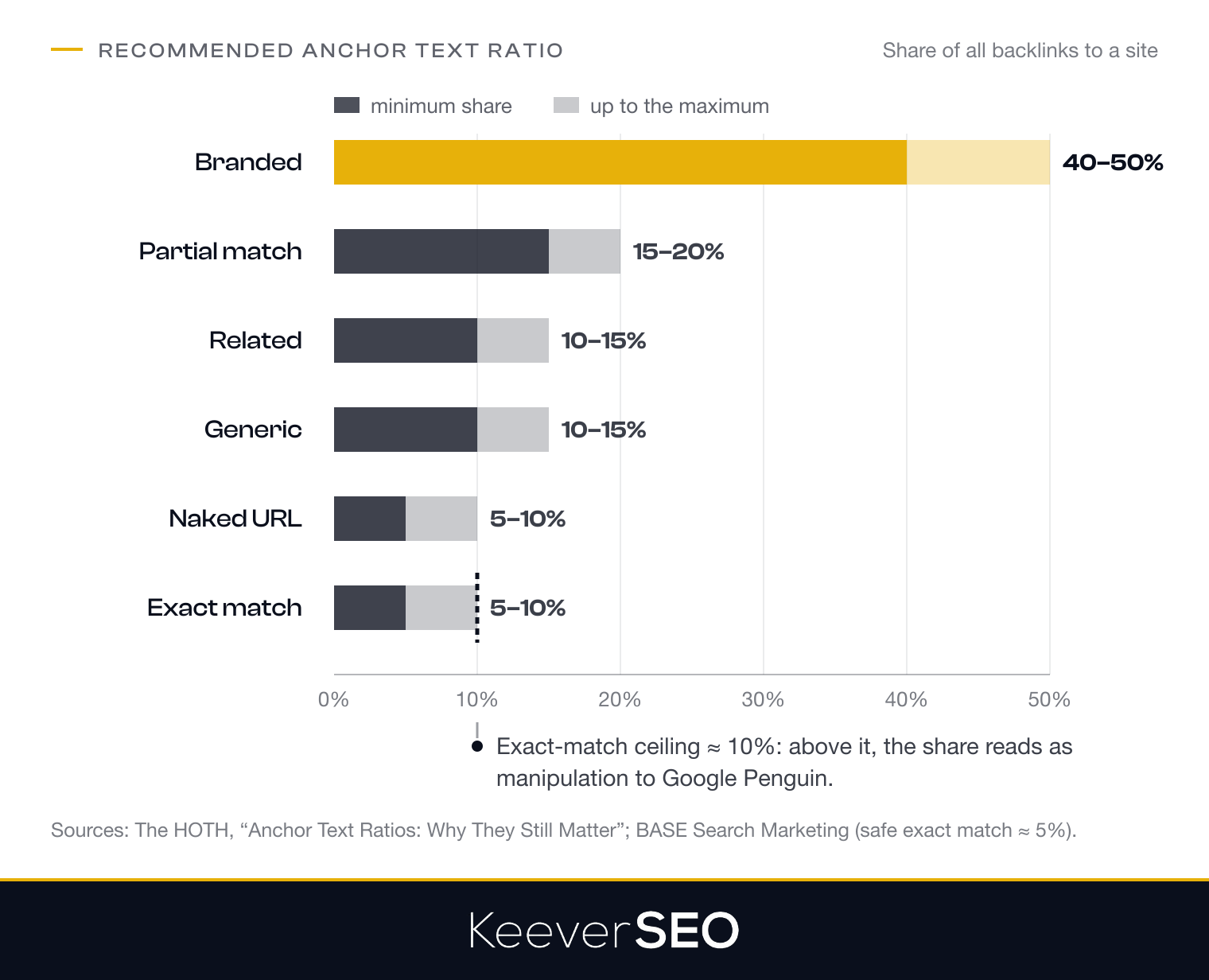
Anchor Text Ratio Distribution Table
| Anchor Type | Recommended Share/Ratio |
|---|---|
| Branded | 40-50% |
| Partial Match | 15-20% |
| Related | 10-15% |
| Generic | 10-15% |
| Naked URL | 5-10% |
| Exact Match | 5-10% |
A balanced mix of anchor types appears more organic and lowers the likelihood of search engine penalties. Google's algorithm updates, above all the Penguin update, target sites with high concentrations of exact-match anchor text. The diversification principle lays the foundation for avoiding over-optimization.
How to Avoid Over-optimization with Anchor Text?
To avoid over-optimization with anchor text, maintain natural variation in the anchor profile, limit exact-match anchors to a small share of total backlinks, and avoid concentrated spikes of keyword-rich anchors pointing at the same page. Over-optimization occurs when manipulative patterns, excessive keyword density, and unnatural exact-match ratios trigger search engine penalties. Keyword stuffing inside a single anchor, cramming several keywords into one link, signals manipulation immediately and belongs nowhere in a link profile.
A branded-heavy mix with partial-match, related, and generic anchors alongside occasional exact matches mirrors organic linking behavior. Industry analysis of healthy link profiles shows top-ranking sites keep branded anchors at 40-60% of their profiles while exact-match anchors stay under 10%; BASE Search Marketing's guide "What is the Right Ratio of Exact Match Anchor Text in Link Building?" puts the safe exact-match share at about 5% of external backlinks. Google's Penguin update, first deployed in 2012, targets exact-match anchor over-optimization and penalizes sites showing unnatural patterns or ratios that suggest link manipulation schemes. Monitoring anchor ratios through backlink analysis tools surfaces warning signs, such as exact-match percentages climbing above safe thresholds or repetitive keyword patterns, before they trigger algorithmic filters or manual penalties. Ratio limits and diversity set up the audit methodology that follows: distribution reports, toxic-pattern checks, and the upkeep of a healthy anchor profile.
How to Analyze the Performance of Anchor Text?
To analyze the performance of anchor text, run a structured audit of inbound and internal links in four steps: audit both link sets, build a distribution report by type, spot exact-match spikes, and run backlink audit tools. A structured audit keeps the anchor distribution healthy and natural and steers the profile away from search engine penalties.
1. Audit Inbound and Internal Anchors Examine inbound backlinks and internal links together. SEO tools like Ahrefs, Semrush, or Moz's Link Explorer gather data on all anchor texts pointing to the site and within its internal structure, exposing patterns and anomalies in anchor usage.
2. Build a Distribution Report by Type Classify each anchor as exact match, partial match, branded, generic, naked URL, related, or image-based, and measure the share of each type across the full link profile. A balanced profile carries a high proportion of branded and natural language anchors and few exact-match commercial anchors.
3. Spot Exact-Match Spikes Identify spikes in exact-match keywords that suggest over-optimization. Concentrations of keyword-rich exact matches historically trigger Google's Penguin algorithm and read as manipulative.
4. Use Backlink/Anchor Audit Tools Semrush's Backlink Analytics and Site Audit or seoClarity's anchor text reports generate detailed reports that highlight over-optimized text and vague anchors needing correction. Ongoing monitoring keeps the link profile supporting search visibility rather than undermining it.
A systematic anchor audit keeps the link profile varied and natural, and the same anchor discipline extends inward to internal linking structures.
How does Anchor Text Influence Internal Linking Structures?
Anchor text influences internal linking structures by guiding users and search engine crawlers through a website's hierarchy. Descriptive anchor text in internal links creates clear pathways for visitors and signals the topical relationships between pages, which sharpens the site architecture search engines perceive.
Internal anchor text distributes page authority across the website. Linking high-authority pages to pages needing visibility passes link equity that lifts the ranking power of less prominent pages, keeps important content reachable, and marks the thematic connections between related topics. Consistent, relevant anchors pointing at cornerstone content reinforce those connections and strengthen the site's topical authority.
Well-written internal anchor text improves accessibility, too, giving screen-reader users meaningful context for each link. Unlike external backlinks, where link text control is out of the site's hands, internal linking permits strategic anchor choices, and search engines treat internal exact-match and partial-match anchors as lower risk. A varied but deliberate internal anchor profile supports search engine discovery and intuitive navigation at once.
What are the Best Practices for Using Anchor Text in Internal Links?
The best practices for using anchor text in internal links are listed below:
- Use descriptive and keyword-relevant anchors: the anchor states the target page's content and carries relevant keywords naturally, for users and search engines alike.
- Use exact-match anchors safely: internal links tolerate exact-match keywords more freely than external backlinks, allowing precise, keyword-focused anchors without over-optimization penalties.
- Avoid identical repeated anchors: the same anchor reused across many internal links reads as unnatural; slight variation with steady relevance adds contextual value.
How Does Anchor Text Facilitate Website Navigation and Structure?
Anchor text supports website navigation and structure by providing clear pathways for users and search engine crawlers. Descriptive anchors guide visitors through related content and state where each link points, so users know what to expect before clicking.
For search engines, anchor text signals the hierarchy and topical relevance of linked pages and steers the distribution of link equity across the site, which defines each page's importance within a coherent architecture. Anchor text supports accessibility as well: screen readers depend on descriptive link text to convey context, letting every visitor move through the site.
How Do Internal Links Differ From External Backlinks in Anchor Text Use?
Internal links differ from external backlinks in anchor text use across control, risk level, and safe anchor choices, as the table below outlines.
| Dimension | Internal Links | External Backlinks |
|---|---|---|
| Control | High control: Site owners choose both the source page and anchor wording. | Low control: Other sites decide how they link, so wording is only partially influenceable. |
| Risk Level | Lower risk: Descriptive and varied anchors are safer; repeated patterns can appear unnatural. | Higher risk: Over-optimization with identical or keyword-heavy anchors can trigger spam signals. |
| Ideal Anchor Type | Descriptive, concise, and context-rich anchors; partial-match and branded variations are safest. | Mostly branded, natural partial-match, generic, and URL-style anchors; exact-match should be rare. |
| Exact-Match Safety | More tolerable: Context is editorially controlled, allowing for more liberal use. | Least safe: Overuse can signal manipulative link building and trigger penalties. |
Internal links give site owners control over anchor wording, which supports navigation and hierarchy. External backlinks leave the wording to other sites, so a diversified, branded-heavy profile protects against penalties.
What are the Risks Associated with Misusing Anchor Text?
The risks associated with misusing anchor text are listed below:
- Over-optimization: excessive exact-match keyword anchors create an unnatural link profile that search engines detect and penalize as manipulative link building.
- Penguin filtering: Google's Penguin algorithm targets manipulative link schemes, including over-optimized anchor text, and affected sites face ranking drops or removal from search results.
- Anchor text spam: keyword stuffing inside anchors and irrelevant anchor text invite penalties or cause search engines to ignore the links, undermining link-building efforts.
- Manual actions: in severe cases Google's webspam team applies manual penalties that demand direct remediation and prolong visibility loss.
Google's spam policies classify links with optimized anchor text placed to manipulate rankings as link spam, and violating sites may rank lower or drop out of results entirely, according to "Spam policies for Google web search" published by Google Search Central. Search Engine Journal's "A Complete Guide to the Google Penguin Algorithm Update" documents how Penguin and its successors reward sites that keep a natural and varied anchor text profile.
Is Over-optimized Anchor Text Penalized by Search Engines?
Yes, over-optimized anchor text is penalized by search engines. Google's Penguin algorithm, introduced in 2012, targets websites with unnatural link patterns, including excessive exact-match anchor text, and filters manipulative sites by devaluing suspicious links or penalizing the whole site. Over-optimization arises when a site accumulates too many backlinks with keyword-rich, exact-match anchors that read as unnatural. Penalties arrive through algorithmic filtering or through manual actions from Google's webspam team; the original Penguin rollout affected about 3.1% of English queries, as Google reported when announcing the update in April 2012. A varied, natural anchor text profile, built on the relevance-based selection and ratio diversification covered above, protects a site from search-engine penalties.