Black hat SEO refers to practices that violate search-engine guidelines to manipulate rankings. Black hat tactics put manipulation ahead of user value, and the label comes from the white-hat/black-hat distinction, where "black hat" marks unethical methods. Common black hat tactics include keyword stuffing, content scraping and spinning, scaled content abuse, doorway pages, cloaking, link schemes, structured data spam, misleading redirects, and negative SEO. Businesses avoid black hat SEO because of the severe penalties, short-lived gains, and damage to brand trust it causes. Search engines like Google detect the tactics using AI systems, algorithmic spam detection, and manual reviews, and respond with penalties ranging from algorithmic demotions to deindexing.
Black hat SEO differs from white and gray hat SEO in intent and compliance. White hat SEO follows ethical guidelines and centers on user experience, while gray hat SEO occupies a risky middle ground. Recovery from black hat penalties runs through auditing the site, removing offending tactics, disavowing toxic links, and submitting reconsideration requests. Spotting a black hat SEO provider means watching for red flags like guaranteed #1 rankings and secrecy about methods. Local businesses, ecommerce sites, and publishers avoid black hat SEO with safeguards matched to their own vulnerabilities. Whether black hat SEO is ever worth it comes down to one question: do temporary visibility gains outweigh the long-term risks to visibility, revenue, and trust?
What Is Black Hat SEO?
Black hat SEO is the set of unethical practices that violate search engine guidelines to manipulate rankings on search engine results pages (SERPs). Black hat tactics put search engine manipulation ahead of user value, exploiting algorithmic loopholes rather than providing genuine content. The term "black hat" originates from old Western movies, where villains wore black hats as a symbol of deception. In SEO, black hat techniques exist to trick search engines, and they invite severe penalties that damage a website's visibility and credibility.
Black hat SEO covers tactics that search engines like Google explicitly prohibit: keyword stuffing, content scraping and spinning, scaled content abuse, doorway pages, cloaking, link schemes, structured data spam, misleading redirects, and negative SEO. Every one of those methods counts as manipulative under Google Search Essentials, because each aims at artificially raising rankings instead of delivering useful content to users.
Businesses avoid black hat SEO because the risks dwarf the payoff. Black hat practices bring search engine penalties, and the gains they produce are unsustainable and corrosive to brand trust. Once a site is flagged, detection systems impose penalties that range from algorithmic demotion to complete deindexing, which is why the risks of black hat SEO matter to any business planning for long-term growth.
What Are the Most Common Black Hat SEO Tactics?
The nine most common black hat SEO tactics are listed below:
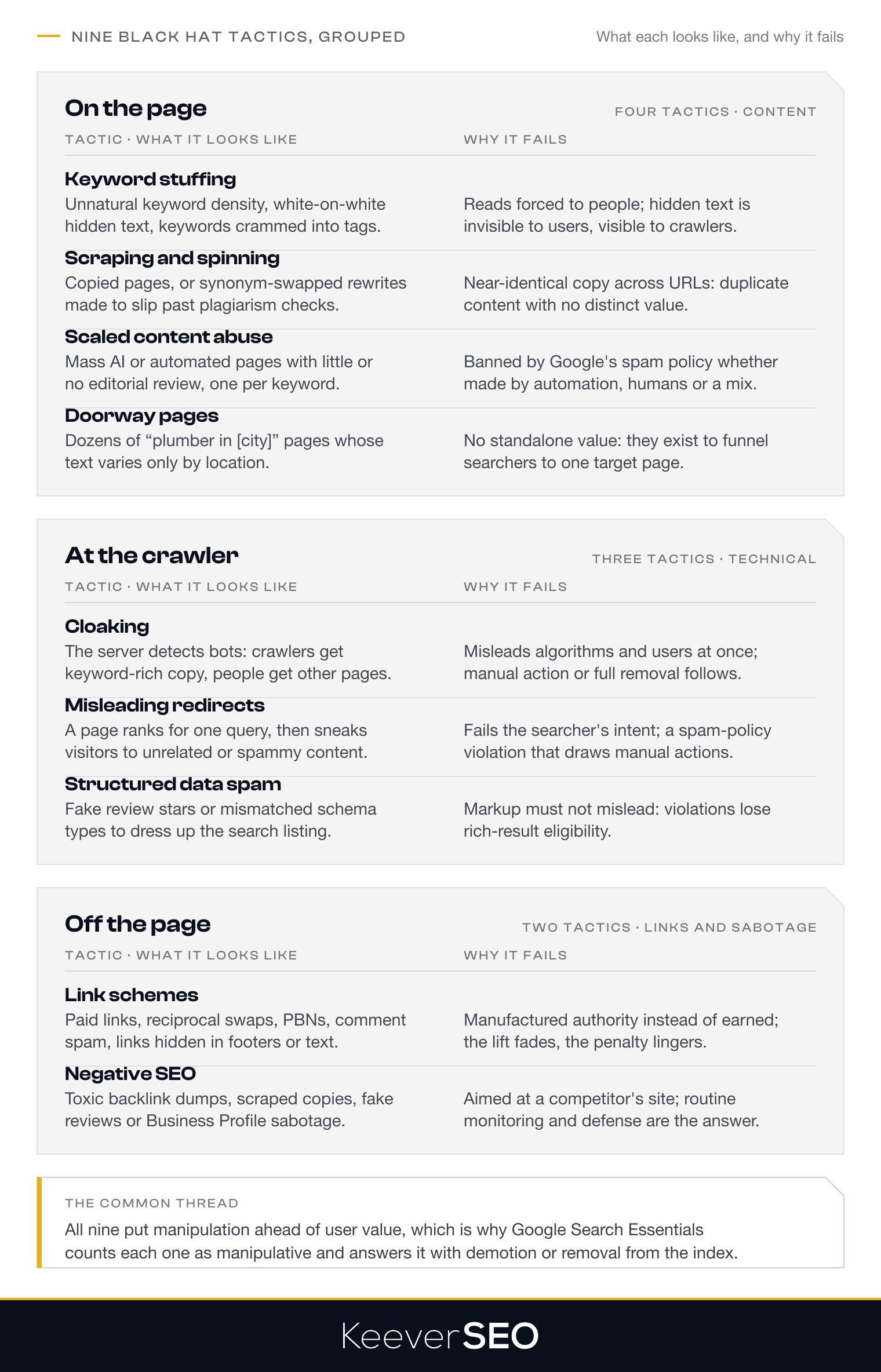
- Keyword Stuffing: overloading webpages with excessive keywords to manipulate search rankings.
- Content Scraping and Article Spinning: duplicating content from other sites and using automated tools to rewrite it.
- Scaled Content Abuse: mass-producing low-quality pages with little or no editorial oversight.
- Doorway Pages: creating thin pages designed solely to funnel users to a single target page.
- Cloaking: serving different content to search engines than to users.
- Link Schemes: manipulating a site's backlink profile through artificial or paid links.
- Structured Data Spam: misusing schema markup to manipulate how a site appears in search results.
- Misleading Redirects: using sneaky redirects to send users to different pages than expected.
- Negative SEO: sabotaging competitors' rankings through unethical tactics like toxic backlink dumps.
1. Keyword Stuffing
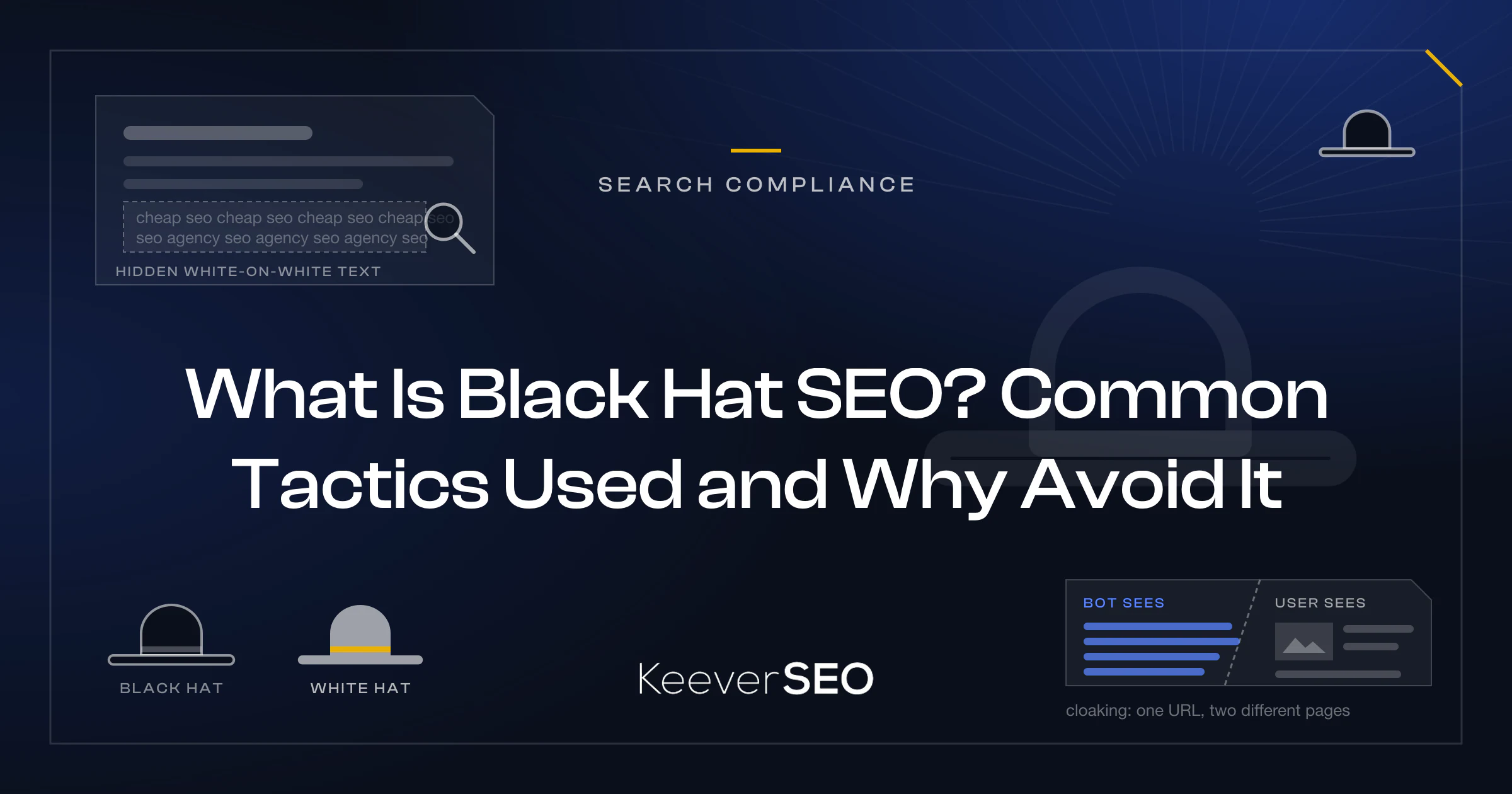
Keyword stuffing is a black hat SEO tactic that overloads a webpage with an excessive number of keywords or phrases to manipulate search rankings. Keyword stuffing produces unnatural keyword density that makes the content read forced and contextually irrelevant. Common methods include embedding hidden text, such as white-on-white copy, invisible to users but detectable by search engines. Stuffing extends to cramming keywords into meta tags, title tags, and alt attributes with no regard for coherence or user experience. Manipulation of that kind puts keyword frequency ahead of quality, violates search engine guidelines, and degrades the user experience.
2. Content Scraping and Article Spinning
Content scraping and article spinning are black hat SEO tactics that compromise content originality and quality. Content scraping copies material from other websites without permission, producing duplicate content with no distinct value. Article spinning takes existing content and rewrites it with synonym swaps or automated tools, producing low-quality variations meant to evade plagiarism detection. Both practices create duplicate content issues, where near-identical material appears across multiple URLs and loses value and relevance. Search engines put original content first, so sites running scraped or spun content face penalties for undermining user value and violating search guidelines.
3. Scaled Content Abuse
Scaled content abuse is the creation of large volumes of low-quality web pages built to manipulate search rankings. The tactic leans on mass AI-generated or automatically produced content, yielding thin pages with little value. Content farms churn out pages with minimal or no editorial review, aiming to target keywords and capture search traffic without genuine user value. Google's scaled content abuse policy prohibits the practice explicitly, as outlined in "Spam policies for Google web search" published by Google Search Central, and the policy targets any site generating content at scale to manipulate rankings, whether the content comes from automation, humans, or a mix. Websites caught in scaled content abuse face ranking demotion or complete removal from Google's search index, which makes the tactic a high-risk gamble.
4. Doorway Pages
Doorway pages are thin gateway pages built to rank for particular search queries and push users toward a single target page. Doorway pages offer minimal original content and exist to capture rankings rather than serve users. A common implementation creates dozens of location-based pages with near-identical content, such as "plumber in [city name]" repeated across cities, with templated text that varies only in geographic terms or keyword phrasing, a pattern search engines identify as manipulative.
Location- and keyword-based doorway pages funnel users to a central landing page or website, and they redirect visitors automatically in many cases. Google's spam policies treat the pattern as doorway abuse, since the pages capture search traffic without standalone value. Pages made solely to target city names, service terms, or keyword variations, with no original content or real local usefulness, read as doorway pages to search engines.
5. Cloaking
Cloaking is a deceptive black hat SEO practice that presents different content to search engine crawlers than to human users. Cloaking relies on server-side detection to determine whether the visitor is a search engine bot or a person. A cloaked website might show search engines keyword-rich, optimized content to raise rankings while users see entirely different material, sometimes unrelated or low-quality pages. Cloaking violates Google Search Essentials because it undermines the integrity of search results by misleading algorithms and users alike, and detected cloaking brings severe penalties: manual actions, algorithmic demotion, or complete removal from search indexes.
6. Link Schemes
Link schemes are black hat SEO tactics that manipulate a website's rankings by artificially inflating the number or quality of its backlinks. Link schemes violate search engine guidelines because they replace earned links with manufactured ones. Common tactics include purchasing backlinks, trading reciprocal links purely for SEO, and running private blog networks (PBNs) to fabricate link profiles. Further methods cover link farm submissions, spam links in blog comments and forum signatures, and links hidden in footers or invisible text.
Link schemes exist to convince search engines that a site holds more authority than it earned. When Google detects manipulative link patterns, site owners can use the Disavow Links tool in Google Search Console to distance the site from toxic backlinks. Prevention beats remediation, though: any ranking lift from link schemes fades quickly, while the lasting cost includes lost trust, wasted budget, and penalties that resist reversal.
7. Structured Data Spam
Structured data spam is the misuse of schema markup to deceive search engines and users. The tactic adds fake or irrelevant schema, such as review or rich-snippet markup, to manipulate how a site appears in search results, producing false displays like fabricated review stars or mismatched schema types. Schema.org provides the vocabulary for the markup, while rich results are the expanded search features spammy markup tries to exploit. Google states that structured data must not mislead users, and violations bring manual actions or the loss of rich result eligibility.
8. Misleading Redirects
Misleading redirects are a black hat SEO tactic built on deceptive redirection. Sneaky redirects send users to a different page than search results imply, showing crawlers one page while routing people to another, with the switch triggered by detecting whether the visitor is a bot or a human. A page may rank for a legitimate query yet redirect users to irrelevant or spammy content. Google treats sneaky redirects as spam policy violations that draw manual actions and ranking penalties. Misleading redirects corrode the integrity of search results and break user trust by delivering an experience that fails the searcher's intent.
9. Negative SEO
Negative SEO is a malicious tactic aimed at harming a competitor's search rankings through sabotage. The common attack methods are listed below:
- Toxic backlink dumps: attackers point masses of low-quality or spammy backlinks at the target site to trigger search engine penalties.
- Content scraping: competitors copy and republish a site's content across platforms, creating duplicate content issues that depress rankings.
- Fake reviews: fraudulent negative reviews posted on platforms like Google Business Profile erode reputation and trust.
- Google Business Profile sabotage: unauthorized edits, false spam reports, or fraudulent ownership claims disrupt a business's online presence.
Attacks of that kind can hit a website's performance hard, which makes routine monitoring and proactive defense part of any SEO program.
Why Should Businesses Avoid Black Hat SEO?
Businesses should avoid black hat SEO because its consequences outweigh any short-term lift. The main consequences are listed below:
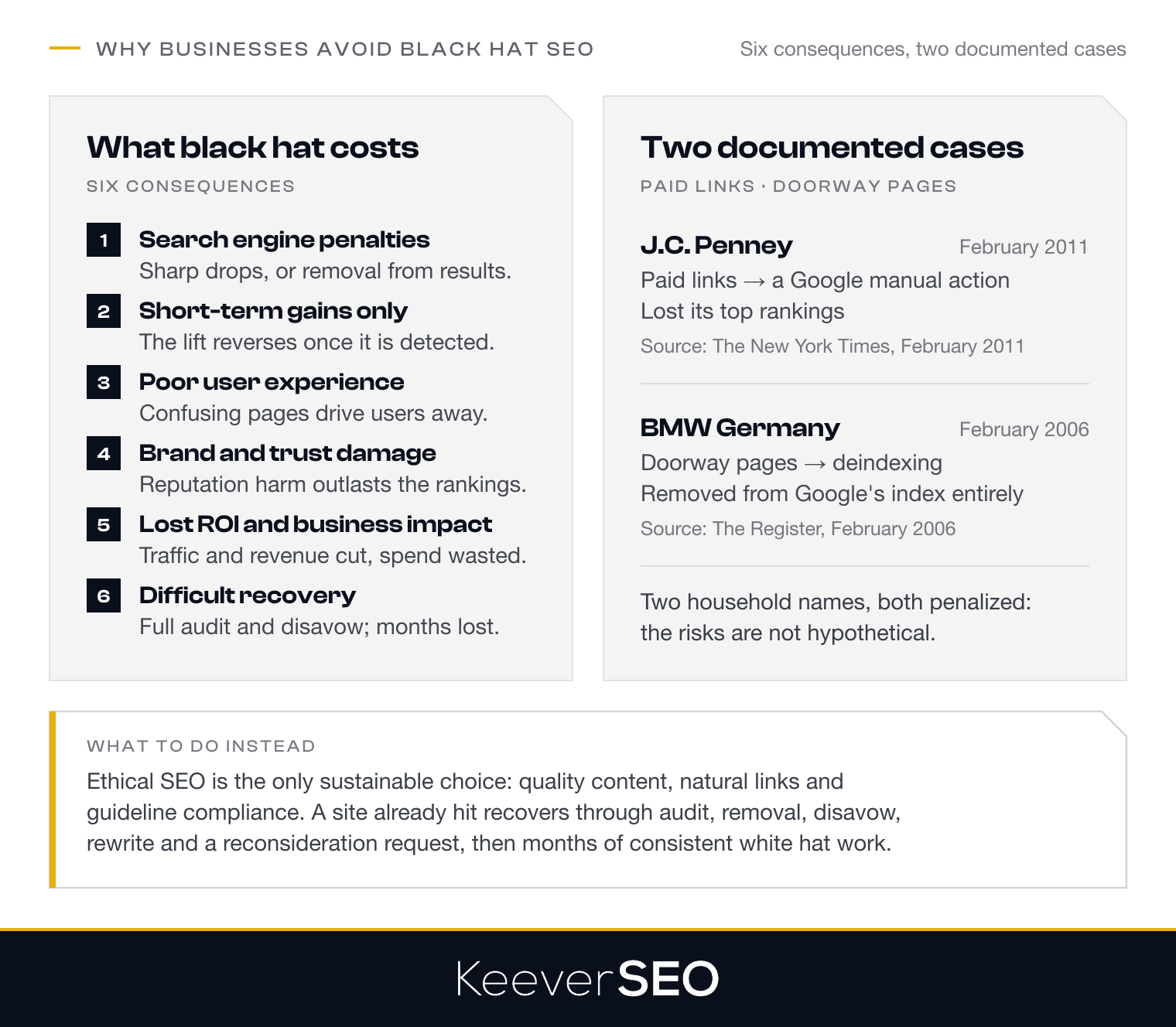
- Search engine penalties: black hat SEO draws manual actions or algorithmic penalties from search engines like Google, dropping rankings sharply or removing the site from results and erasing its organic traffic.
- Short-term gains only: ranking improvements from black hat SEO fade fast; once search engines detect the manipulation, the temporary lift reverses along with visibility and credibility.
- Poor user experience: black hat methods put manipulation ahead of engagement, so tactics like keyword stuffing and cloaking produce confusing, low-quality pages that drive users away.
- Brand and trust damage: association with manipulative SEO erodes customer trust and leaves lasting reputation damage beyond the ranking losses.
- Lost ROI and business impact: penalties cut organic traffic and income, the spend on black hat tactics is wasted, and severe cases threaten the business itself.
- Difficult recovery: climbing out of black hat penalties demands full audits, content removal or replacement, link disavowal, and reconsideration requests, with timelines stretching months while visibility stays depressed.
The risks are not hypothetical: J.C. Penney lost its top rankings to a Google manual action over paid links, as reported in "The Dirty Little Secrets of Search" by David Segal in The New York Times, February 2011, and BMW's German site was removed from Google's index entirely over doorway pages, as documented in "BMW and Ricoh Germany delisted from Google" published by The Register, February 2006. The scale of those risks makes ethical SEO the only sustainable choice for a business that depends on search visibility.
How Do Search Engines Detect Black Hat SEO?
Search engines detect black hat SEO through layered systems that combine AI, algorithms, and human review. Google's SpamBrain, an AI-powered spam-detection system, analyzes websites for unnatural patterns like keyword stuffing and link manipulation; Google's webspam report "How we fought spam on Google Search in 2022" states SpamBrain detected five times more spam sites in 2022 than the year before. Sites showing suspicious patterns get flagged for further review against search policies.
Alongside the AI layer, search engines rely on manual reviewers and user-submitted spam reports to catch violations. Google Search Console notifies webmasters about detected issues, letting them fix violations and request reevaluation. The multi-layered detection stack means a flagged site faces demotion or removal from search results, protecting the integrity of what searchers see.
What Google Penalties Result From Black Hat SEO?
Black hat SEO results in three classes of Google penalty: manual actions, algorithmic demotions, and deindexing. Manual actions are penalties applied by Google's human reviewers for guideline violations such as cloaking or link schemes; they appear in Google Search Console under the "Manual Actions" section, and lifting one requires fixing the issues and submitting a reconsideration request.
Algorithmic demotions fire automatically when Google's algorithms detect manipulative SEO. Demotions arrive without notifications, which makes them harder to identify and resolve: the affected site must remove the offending tactics and wait for a later algorithm update to be reassessed, a process that can run for months while visibility and traffic suffer.
Deindexing, the most severe penalty, removes a site from Google's search index entirely. Google reserves deindexing for sites classified as "pure spam," the ones running aggressive manipulation with no user value. Violations like doorway pages, cloaking, and link schemes can trigger any of the penalty classes, and sites that break the rules "may rank lower in results or not appear in results at all," according to "Spam policies for Google web search" published by Google Search Central.
How Does Black Hat SEO Differ From White Hat and Gray Hat SEO?
Black hat SEO differs from white hat and gray hat SEO in intent, guideline compliance, and risk level. Black hat SEO manipulates rankings through guideline violations such as keyword stuffing and link schemes, and carries a high risk of penalties, deindexing, and reputation damage. White hat SEO builds on ethical practices like quality content creation and natural link building, complies fully with search engine guidelines, and delivers low-risk, sustainable growth. Gray hat SEO sits between the two, using techniques that are not explicitly forbidden but remain risky, like expired domain purchases, with short-term gains and medium risk as search policies evolve.
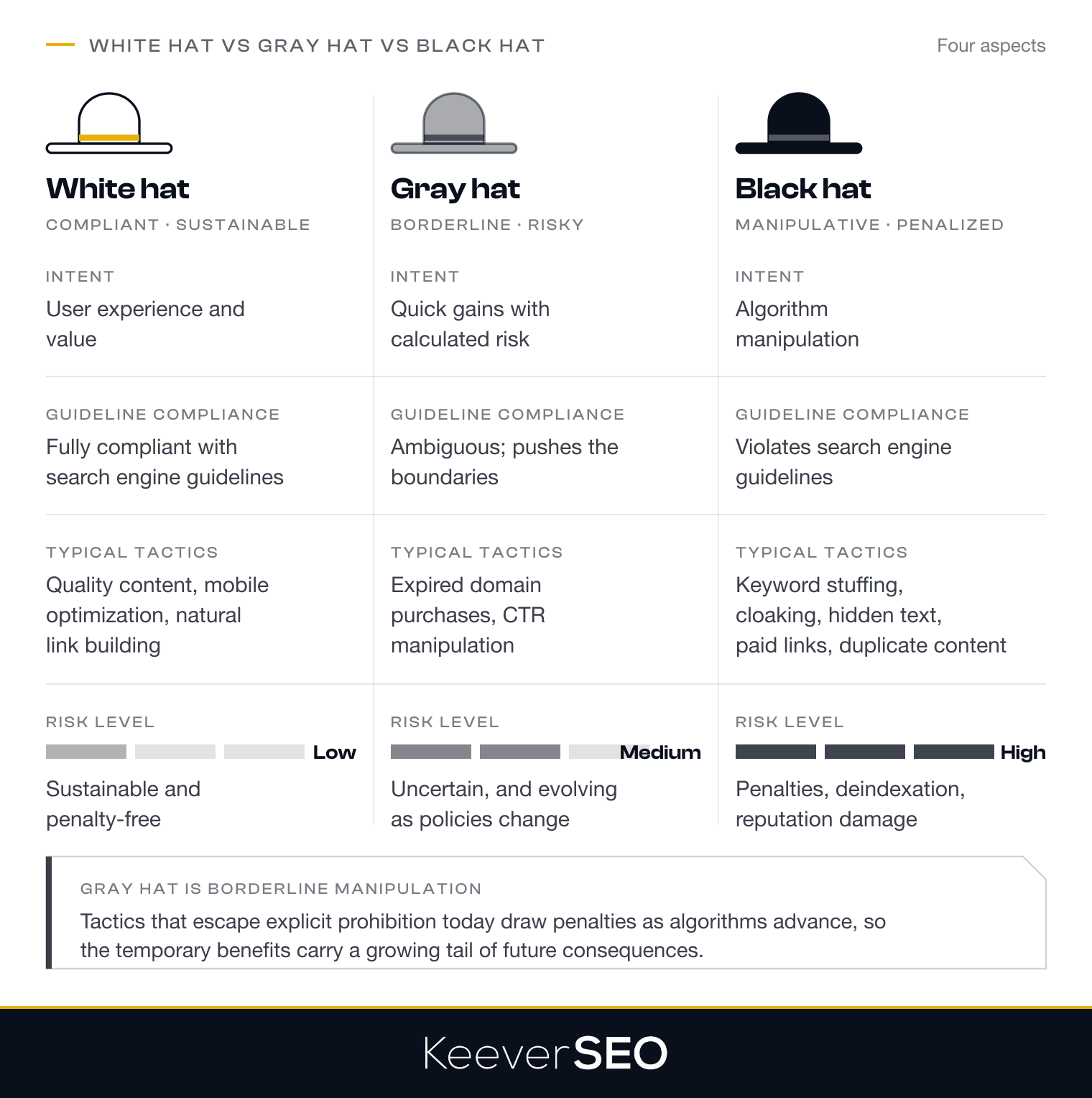
| Aspect | White Hat | Gray Hat | Black Hat |
|---|---|---|---|
| Intent | User experience and value | Quick gains with calculated risk | Algorithm manipulation |
| Guideline Compliance | Fully compliant with search engine guidelines | Ambiguous; pushes boundaries | Violates search engine guidelines |
| Typical Tactics | Quality content, mobile optimization, natural link-building | Expired domain purchases, CTR manipulation | Keyword stuffing, cloaking, hidden text, paid links, duplicate content |
| Risk Level | Low; sustainable and penalty-free | Medium; uncertain and evolving | High; penalties, deindexation, reputation damage |
Gray hat SEO amounts to borderline manipulation: tactics that escape explicit prohibition today may draw penalties as algorithms advance, so the temporary benefits carry a growing tail of future consequences.
How Can Websites Recover From Black Hat SEO?
Websites recover from black hat SEO through a systematic cleanup that restores credibility and search standing. The steps are laid out below.
Audit the Site Run a full audit to surface every black hat tactic in play, examining on-page factors, backlink profiles, and technical configurations for keyword stuffing, cloaked pages, and manipulative link schemes.
Remove Offending Tactics Strip out every identified tactic: delete keyword-stuffed content and doorway pages, dismantle cloaking implementations, and replace spun or scraped content with original material.
Disavow Toxic Links Submit a disavow file so search engines ignore the toxic backlinks that manual outreach cannot remove, above all links from link farms, private blog networks, and spammy directories.
Fix or Replace Content Rewrite or replace low-quality content. Automatically generated, duplicated, or keyword-stuffed pages need rewriting to meet quality standards and serve genuine user needs.
Submit a Reconsideration Request After cleanup, file a reconsideration request through Google Search Console if the site carries a manual action, detailing the violations found, the remediation completed, and the commitment to guideline compliance.
Set Recovery Timeline Expectations Recovery timelines vary: Google's Search Console documentation "Manual actions report" states most reconsideration reviews take several days or weeks, with link-related requests running longer, while broader ranking recovery can take weeks or months. Consistent white hat practice is what rebuilds trust and search visibility.
What Are the Warning Signs of a Black Hat SEO Provider?
The warning signs of a black hat SEO provider are listed below:
- Guaranteed #1 rankings: no agency controls search engine algorithms, so a guaranteed top position is a false promise.
- Secrecy about methods: a provider that will not explain its SEO strategies is hiding practices that violate guidelines in many cases.
- Promises of instant results: rapid ranking improvements point to manipulative tactics that invite penalties.
- Bulk cheap links: large quantities of low-cost backlinks signal link farms or paid links, both of which violate search engine policies.
A business that knows the red flags can verify an agency's methods before the methods put its rankings at risk.
How Can Businesses Audit an SEO Agency’s SEO Methods?
Businesses can audit an SEO agency's methods by verifying its links, content, and reporting against search engine guidelines. The checks are listed below:
- Review the backlink profile: request recent link data and examine referring domains, anchor text patterns, and any signs of low-quality or toxic links, using tools like Google Search Console, Ahrefs, or SEMrush.
- Check content originality: inspect sample pages the agency produced and confirm originality with plagiarism detection tools like Copyscape, watching for scraped, spun, or thin content.
- Confirm reporting transparency: require regular, detailed reports with live link URLs, placement details, and referring-domain metrics, since transparent reporting marks white hat practice.
Once the audit checks out, targeted questions push the verification one layer deeper.
What Questions Should Clients Ask an SEO Agency?
Clients should ask an SEO agency the questions listed below to confirm its methods align with search engine guidelines:
- Link-building sources: where do the agency's backlinks come from, and are they earned through quality content and outreach?
- Content sourcing: does the agency create original content in-house or rely on outsourcing, AI, or scraped material, and what editorial review process stands behind it?
- Penalty history: have the agency's clients faced penalties, and how were they resolved?
- Guideline adherence: what is the agency's commitment to search engine guidelines, and which quality controls prevent violations?
How Can Local Businesses Avoid Black Hat SEO?
Local businesses avoid black hat SEO through the safeguards listed below:
- Google Business Profile monitoring: check for unauthorized changes, suspicious edits, or unusual activity that points to tampering or negative SEO attacks.
- Fake-review detection: watch review platforms for patterns of suspicious reviews, positive or negative, that could distort reputation.
- Negative-SEO defense: watch the backlink profile for sudden spikes in toxic or spammy links and stay alert to unauthorized content scraping.
- Team education: train staff to tell white hat from black hat tactics, know Google's guidelines, and spot red flags in SEO proposals.
Safeguards of that kind keep a local business's online presence strong and compliant.
How Can Ecommerce Sites Avoid Black Hat SEO?
Ecommerce sites avoid black hat SEO through the safeguards listed below:
- Genuine customer reviews: collect authentic reviews and reject fake or incentivized ones, keeping trust and Google compliance intact.
- Accurate schema markup: keep product schema for price, availability, and shipping matched to the actual product information users see.
- Original product descriptions: write distinct descriptions per product instead of copying manufacturer text or spinning content.
- No doorway pages: skip thin, keyword-stuffed category pages that funnel users to a single target page without adding value.
Ecommerce sites that hold to those practices keep their search visibility and their ethical standing at once.
How Can Publishers Avoid Black Hat SEO at Scale?
Publishers avoid black hat SEO at scale through the safeguards listed below:
- Editorial review over AI content farms: keep human editorial oversight on all content, preventing mass production of low-value pages built for ranking manipulation.
- Compliance with the scaled content policy: avoid automated content generation without editorial standards, so content serves user intent rather than algorithms.
- No expired-domain abuse: acquire only domains that match the site's topic and history, and never redirect expired-domain traffic without legitimate original content.
- Controlled syndication and duplication: run syndication with proper canonical tags and clear attribution, so search engines identify the primary source and duplicate content issues never form.
Publishers that build those controls into their workflow sustain high output without crossing into manipulation.
Is Black Hat SEO Worth the Risk for Long-Term Growth?
No, black hat SEO is not worth the risk for long-term growth. Black hat tactics may lift rankings temporarily, but they lead to severe search engine penalties, from demotion to deindexing, that slash organic traffic and damage brand reputation. The recovery from a penalty runs long and expensive, and it outweighs whatever short-term gain the tactics produced. Sustainable, compliant, quality-driven SEO strategies deliver lasting results where manipulation delivers a countdown to a penalty, as the decade of algorithm enforcement documented in Search Engine Journal's "A Complete Guide to the Google Penguin Algorithm Update" makes plain.
Black hat SEO contradicts the core principle of search engine optimization: serving users with content worth ranking. Sustainable optimization aligned with search engine guidelines produces predictable, stable growth and builds trust with search engines and users alike, securing a brand's online presence and credibility. For a business aiming at long-term growth, ethical SEO is the only viable path.