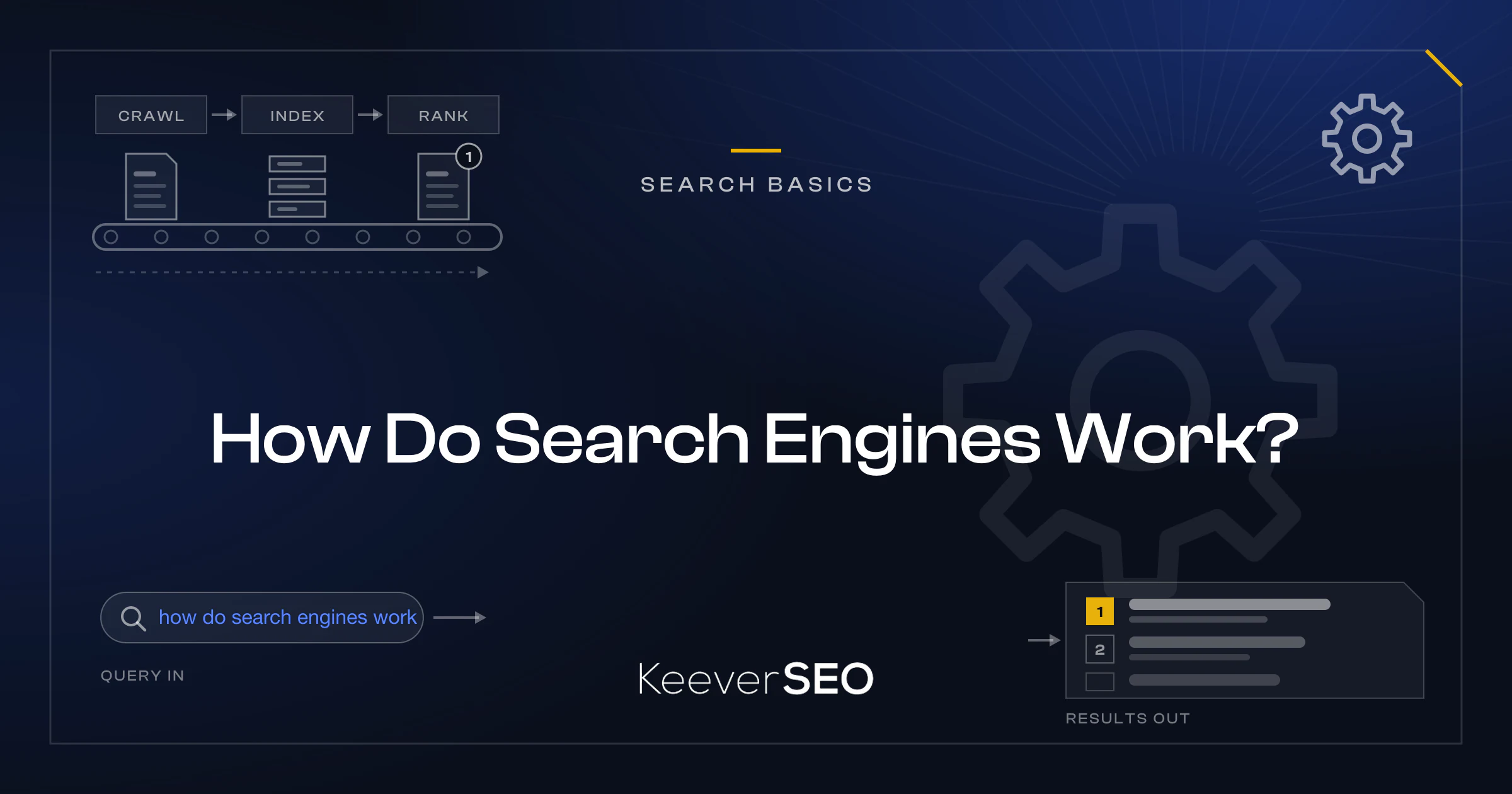
Search engines work through a three-stage process of crawling, indexing, and ranking. A search engine is software that retrieves and ranks results from a pre-built index, so users receive relevant information in an instant. The core mechanism begins with the discovery of web pages through links and sitemaps, followed by crawling of the content with automated bots like Googlebot. The bots render pages, JavaScript-heavy content included, to capture everything on them. After crawling, the engine indexes and interprets the page content by parsing and storing it, handling duplicates through signals like canonicalization.
Search engines fall into two categories: general web search engines and vertical search engines. General web search engines, such as Google, Bing, and DuckDuckGo, index the whole web, while vertical search engines concentrate on one domain like travel, jobs, or shopping. A page's visibility in search results depends on relevance, authority, and page experience. Everyday users rely on search engines for information retrieval, while website owners rely on them for visibility. Pages miss the search results when they go uncrawled, sit blocked behind robots.txt, carry a noindex tag, or hold low-quality content, and an SEO audit checks for visibility problems across crawlability, indexability, and rendering.
Search engine optimization (SEO), technical SEO, and link building are the application layers that make search engines work better for a site. SEO raises a site's visibility within the ranking model, technical SEO secures proper crawling and indexing through robots.txt and XML sitemaps, and link building strengthens rankings by acting as a discovery signal and an authority signal at once, through backlinks and PageRank. All three practices connect back to the core mechanism of crawling, indexing, and ranking, making a site's pages easier to find, interpret, and rank.
What is a search engine?
A search engine is software designed to find, retrieve, and rank web content from a pre-built index in response to user queries. The software processes search terms against a vast database of previously indexed pages rather than scanning the live web in real time. Notable search engines include Google, Bing, Yahoo!, and DuckDuckGo, each maintaining its own index of billions of web pages.
Google dominates the global search market by a wide margin, followed by Bing and smaller engines like Yandex and DuckDuckGo. Every search engine serves the same purpose of connecting users to information, while the algorithms and features differ per engine. Knowing what a search engine is sharpens the contrast with a web browser, the program that displays the results the search engine provides.
How does a search engine differ from a web browser?
A search engine differs from a web browser in its core function: the search engine indexes and ranks web content so users can find relevant information, while the browser renders and displays the URL a user requests. Search engines such as Google and Bing run automated crawlers that find and store web pages in a massive index, then apply algorithms that rank the pages by relevance to each query. Browsers like Chrome and Firefox retrieve and display a page without storing or ranking anything.
Search engines stand apart from web directories, too. Directories organize websites into manually curated categories, while search engines find, process, and rank content automatically, keeping their indexes wide and current. Automation lets search engines deliver relevant results in an instant, where directories stay static and narrow.
How do search engines work?
Search engines work through a three-stage process: crawling, indexing, and ranking. Crawlers, known as bots or spiders, roam the web to find new pages; the index stores and organizes the content; and ranking algorithms decide the order of results by relevance, authority, and page experience. The full mechanism runs from discovery and crawling through rendering, indexing, query processing, and ranking, and it breaks down into seven steps.
What are the crawling, indexing, and ranking stages?
The crawling, indexing, and ranking stages form the foundation of how search engines operate. Crawling is the finding phase, where automated programs, the crawlers, bots, or spiders, work through the web to locate and download page content. Indexing follows, with the search engine analyzing and storing the crawled data in an index built on signals such as keywords, freshness, and engagement. Ranking closes the loop: the algorithm evaluates indexed pages against a user's query and orders the results by relevance, quality, and authority.
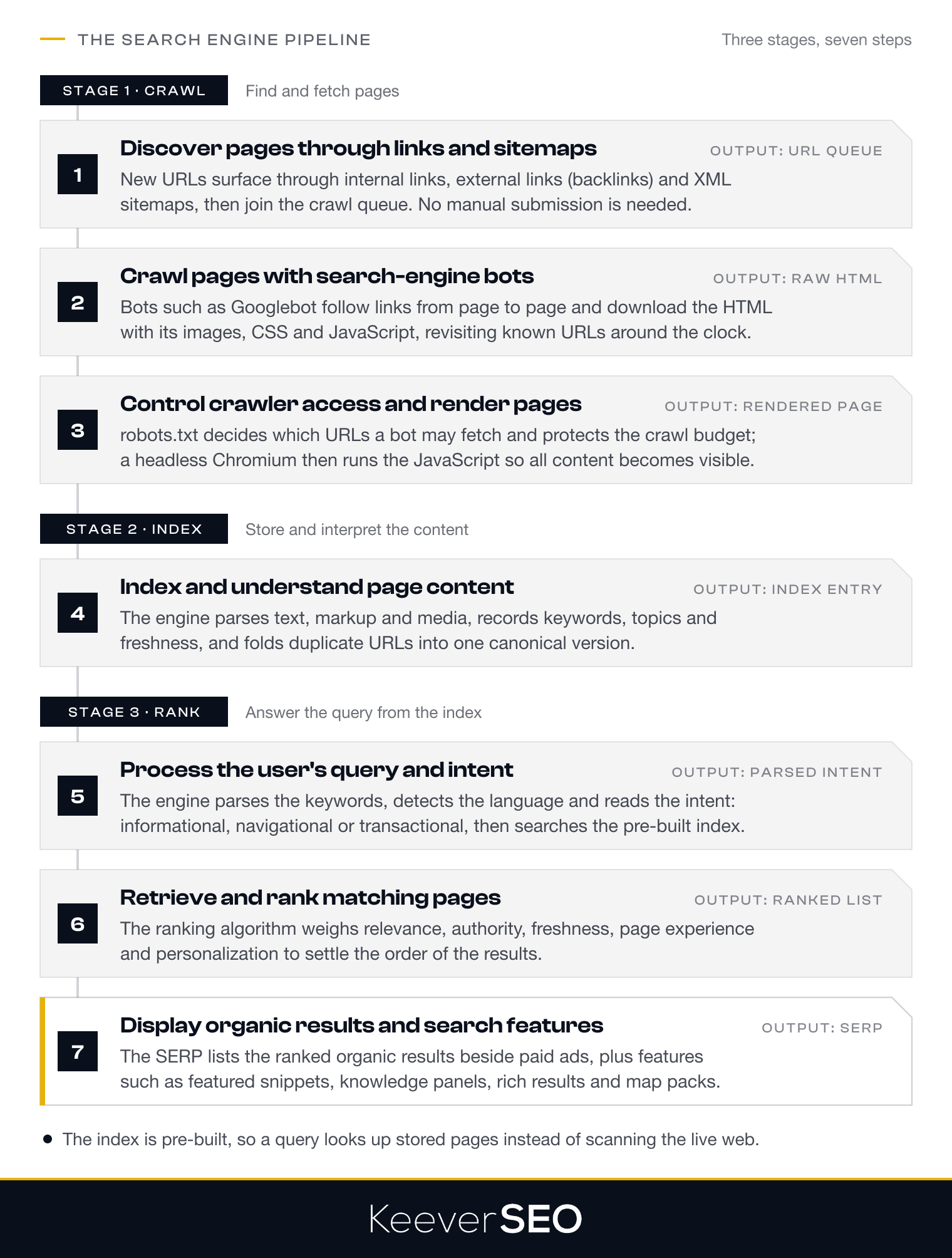
The three stages unfold across seven steps that trace the full search engine process, beginning with the discovery of pages through links and sitemaps.
1. Discover pages through links and sitemaps
Search engines discover new URLs through internal links, external links, and XML sitemaps:
- Internal links: connections between pages on the same website, which help crawlers move through the site and find new content.
- External links (backlinks): links from other websites pointing at a page, which signal to search engines that the content may hold value.
- XML sitemaps: structured lists of the URLs a site owner wants indexed, which surface pages that links alone would miss, from newly published content to pages with few internal links.
Discovery runs automatically, with no manual submission needed, and every URL found through those paths joins the queue for crawling.
2. Crawl pages with search-engine bots
Search-engine bots such as Googlebot fetch and download web pages around the clock. The bots, known as spiders, move from page to page by following links, much as a person browses the web, and their job is to keep the search index current and complete by revisiting known URLs and picking up new or updated content.
When a bot visits a URL, it downloads the page's HTML along with resources like images, CSS files, and JavaScript. Fetching never stops, so fresh content and changes get captured as they appear, with crawl frequency per site set by popularity, update rhythm, and structural quality. Once pages are fetched, the pipeline turns to crawler access control and rendering.
3. Control crawler access and render pages
Controlling crawler access and rendering pages decide what a search engine can actually see. The robots.txt file specifies which parts of a website search engine bots may access, working as a gatekeeper that allows or blocks URLs, directories, and file types. Robots.txt protects crawl efficiency by keeping unneeded pages out of the queue, preserving the crawl budget, the number of pages an engine will crawl on a site in a given window, which follows site popularity and server response times.
After fetching, search engines render pages that depend on JavaScript for their content. Rendering matters because modern websites load much of their content dynamically, and Google runs a headless version of the Chromium browser to execute the scripts so all content becomes visible and indexable. Blocked rendering resources leave a page half-understood, while a fully rendered page passes complete to the next stage: indexing.
4. Index and understand page content
Indexing stores and interprets the rendered page inside the search engine's index. The engine parses the page's text, markup, and media, extracts the meaning of the content, and records signals from keywords and topics to freshness, all organized so the page can be matched against future queries. Duplicate handling runs inside the same stage: when several URLs carry the same or near-identical content, canonicalization signals tell the engine which version to keep as the representative copy, so the index stays clean and one page carries the consolidated ranking signals.
The index becomes the searchable database the whole system depends on, and every stored page waits there to be matched against the next user query.
5. Process the user’s query and intent
Processing a user's query turns the typed words into a machine-readable request. The engine parses the query, breaking it into keywords, detecting the language, and reading the search intent behind it, whether informational, navigational, or transactional.
With the query parsed, the engine matches the interpreted intent against the pre-built index, where signals like keywords, content type, and page relevance already sit organized. The pre-indexed architecture is what makes results near-instant: the engine looks up stored pages instead of scanning the live web, even across billions of documents.
The matched query then moves to the final step, where the engine retrieves and ranks the pages to show.
6. Retrieve and rank matching pages
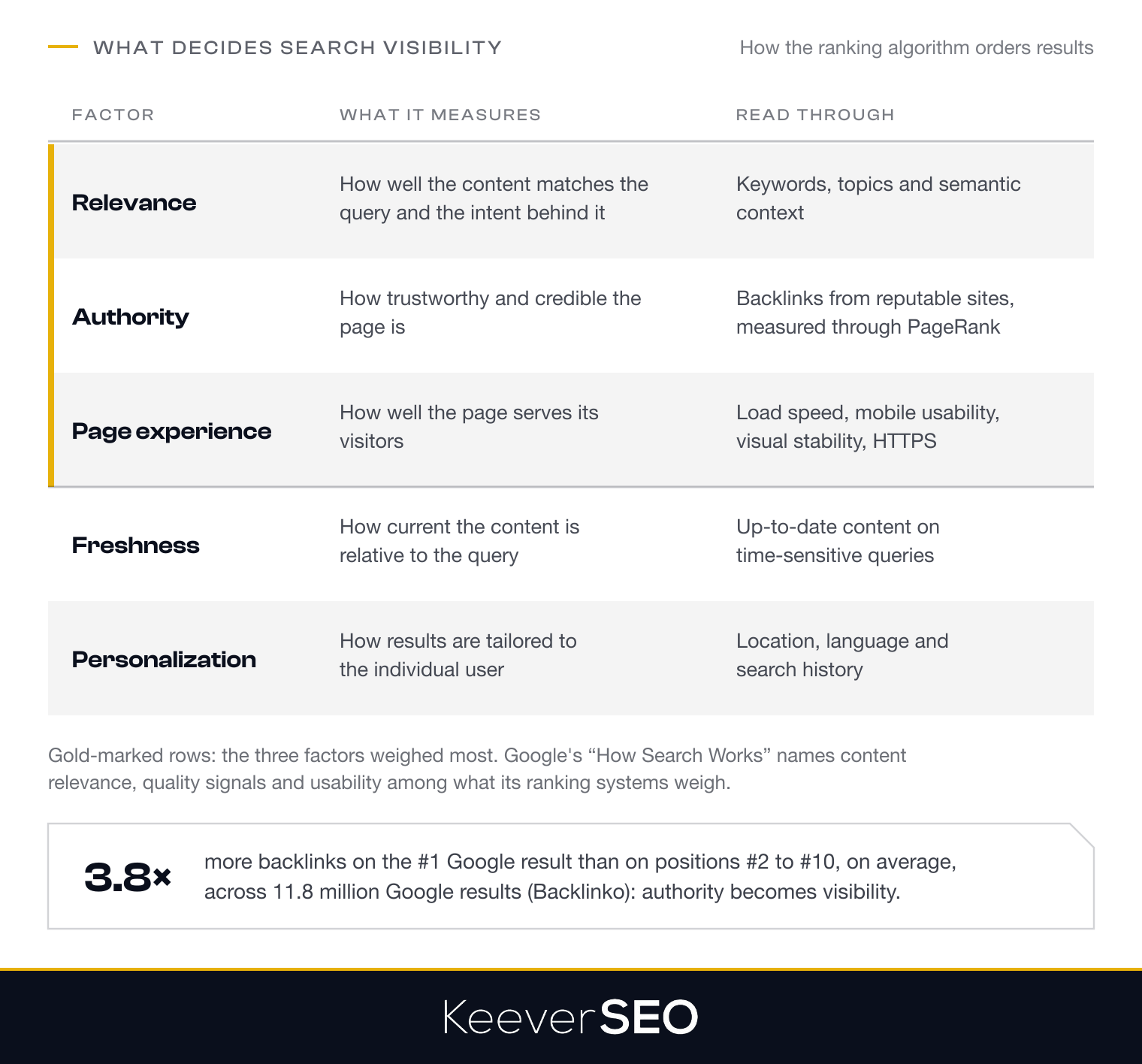
Retrieval and ranking run through the ranking algorithm, which weighs several factors to order the results:
- Relevance: how well a page's content matches the search query and the intent behind it, read through keywords and context.
- Authority: the quality and quantity of links pointing at a page, measured through signals like PageRank; higher authority earns higher positions.
- Freshness: for time-sensitive queries, up-to-date content wins placement.
- Page experience: site speed, mobile-friendliness, and visual stability, reflecting how well the page serves visitors.
- Personalization: location, language, and search history shape the results each user sees.
The weighted factors settle the order of the results page, and the ranked pages move to display.
7. Display organic results and search features
Search engines display the ranked results on a Search Engine Results Page (SERP). The SERP combines organic results, the unpaid listings ordered by the ranking algorithm, with paid ads, the sponsored placements marked as advertisements at the top and bottom of the page.
Beyond the standard listings, SERP features enrich the page: featured snippets answer queries directly above the organic results, knowledge panels summarize entities on the right side, and rich results add images and ratings through structured data markup. Image carousels, video results, local map packs, "People Also Ask" boxes, and sitelinks round out the set.
The growth of SERP features reflects the engines' goal of delivering the most relevant information in the most usable format, from direct answers to visual content to entity summaries, matched to the query's intent and content type.
What types of search engines exist?
Two main types of search engines exist: general web search engines and vertical search engines. General web search engines, like Google and Bing, index and search the whole web, covering every topic and content type without industry limits. Vertical search engines concentrate on a niche, domain, or industry, returning targeted results for narrow queries: travel engines index flights and hotels, job engines index employment listings, shopping engines index product catalogs.
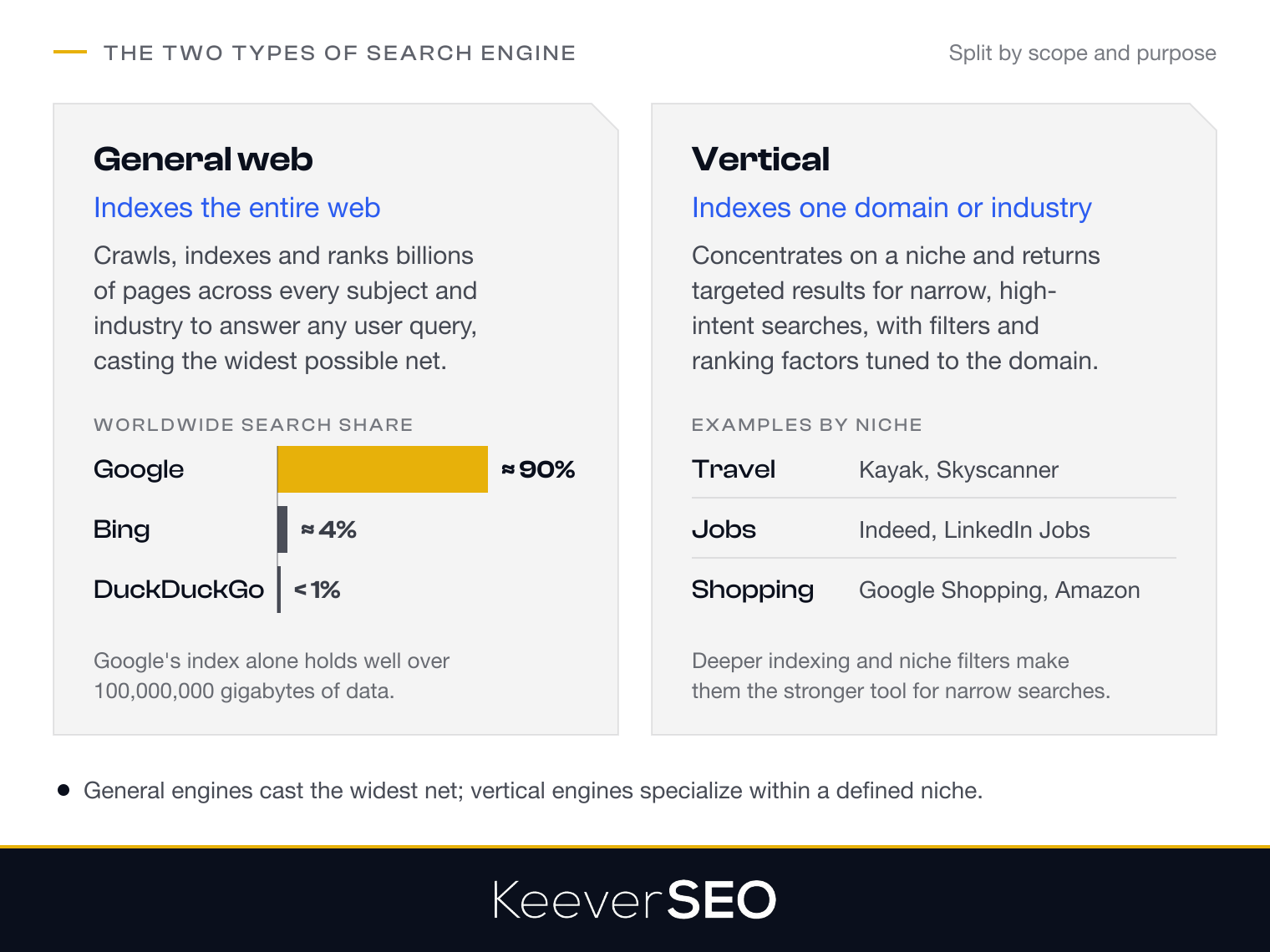
The split comes down to scope and purpose: general engines cast the widest net, vertical engines specialize within a defined niche, and users pick the engine that matches their information need. How the general web search engine covers the whole internet comes first.
What is a general web search engine?
A general web search engine is a general-purpose engine designed to index the entire web. General engines crawl, index, and rank billions of pages across all subjects and industries to answer any user query. Google leads the category with roughly 90% of worldwide search share, ahead of Bing at around 4% and DuckDuckGo below 1%.
Unlike engines that confine themselves to one vertical, general web search engines work as the universal gateway to online information, maintaining massive indexes: Google's index alone holds well over 100,000,000 gigabytes of data. Where the general-purpose engine casts the widest possible net, the vertical search engine narrows its focus to excel within a single specialized domain.
What is a vertical search engine?
A vertical search engine is a specialized engine focused on indexing and retrieving content within one domain or industry. Where general-purpose engines like Google index the whole web, vertical engines concentrate on a niche and return more targeted, relevant results for it, from travel to employment to e-commerce.
Examples of vertical search engines are listed below:
- Travel search engines: Kayak and Skyscanner index flights, hotels, and travel packages.
- Job search engines: Indeed and LinkedIn Jobs specialize in employment listings and career content.
- Shopping search engines: Google Shopping and Amazon index product catalogs and e-commerce listings for product discovery and price comparison.
Vertical engines serve their users through deeper indexing, relevant filters, and ranking factors tuned to the niche, which makes them the stronger tool for narrow, high-intent searches.
Why do search engines matter?
Search engines matter because they serve as the primary gateway for finding information online. Users reach everything from simple facts to complex research in an instant. For businesses, search engines are the channel that delivers visibility: they put websites in front of high-intent searchers, drive traffic, generate leads, and build trust with audiences. Visibility in search ties directly to online success, since it decides how many potential customers a company reaches, which raises the question of what determines which pages become visible.
How do relevance, authority, and page experience determine search visibility?
Relevance, authority, and page experience determine search visibility as the three factors search engines weigh most. Relevance measures how well a page's content aligns with the user's query across keywords, topics, and semantic context. Authority measures the trustworthiness and credibility of a page, read largely through backlinks from reputable sources, which work as endorsements of the page's value. Page experience covers user-centric metrics from page load speed and mobile usability to secure connections (HTTPS). The three factors feed a site's quality and usability as search engines score them; Google's "How Search Works" documentation names content relevance, quality signals, and usability among the factors its ranking systems weigh, and the trio together decides visibility.
Who uses search engines?
Search engines serve two primary groups: everyday users looking for information and website owners looking for visibility. Everyday users, billions of people worldwide, turn to search engines to find answers, research topics, find products, and reach websites, from quick fact checks to major decisions. Website owners, businesses, marketers, and content creators form the second group, treating search as a core channel for reaching audiences, driving traffic, and hitting business goals through organic visibility. The two groups define the search environment: searchers who want relevant, trustworthy results, and publishers working to appear when those searches happen.
How do users and website owners use search engines?
Users and website owners use search engines from opposite sides of the results page. Users enter queries and follow the path from question to answer: type the term, scan the ranked pages, click the most relevant link. Website owners optimize their sites for visibility, making sure pages get found, crawled, indexed, and ranked for the queries that matter, so organic traffic arrives.
Why might a page not appear in search results?
A page might not appear in search results for the technical and content reasons listed below:
- Not crawled: a page with no incoming links and no sitemap entry never gets found, and without discovery there is no crawl.
- Blocked by robots.txt: the robots.txt file can bar bots from URLs entirely, keeping the blocked pages out of the index.
- Noindex directive: a noindex meta tag or HTTP header tells search engines to leave a page out of the index even after crawling it.
- Low-quality content: thin or weak pages that add no distinct value get skipped at indexing.
- Duplicate content: pages matching other URLs get folded into the canonical version, leaving only one copy indexed.
- Crawl budget limits: on large websites the engine crawls only so many pages, and the remainder waits undiscovered.
- Technical errors: a 404 response or server failure during crawling stops a page from being processed.
Every one of those failure points traces back to technical setup or content quality, and an SEO audit is the instrument that finds them.
How can an SEO audit check search visibility?
An SEO audit checks search visibility by evaluating crawlability, indexability, and rendering. Crawlability confirms search engine bots can reach and fetch pages without robots.txt restrictions or server errors. Indexability verifies pages are not kept out of the index by noindex tags, duplicate content, or quality problems. Rendering confirms JavaScript-heavy pages present their content to crawlers so the full page gets analyzed and indexed.
The three checks surface crawl restrictions, content exclusions, duplicates, and rendering failures, and fixing what they find rebuilds search visibility from the foundation. When the findings run past in-house capability, the audit points toward professional help.
When should you hire an SEO agency?
You should hire an SEO agency when in-house capacity, skills, or time cannot carry the search optimization work. Organizations at that point gain from our search engine optimization agency, whose services run from technical audits to link-building campaigns, the work that lifts website visibility and rankings.
When a business lacks the specialist knowledge for tasks like crawl budget optimization or authority building through backlinks, partnering with us pays off doubly: the site's presence gets expert management while the business keeps its focus on core operations.
What is search engine optimization?
Search engine optimization (SEO) is the practice of raising a website's visibility in search engine results. SEO aligns a site's content and structure with the ranking model search engines run on: crawling, indexing, and ranking. The practice improves a site's discoverability and relevance for chosen queries, raising its odds of ranking prominently. SEO works the factors the engines score, relevance, authority, and page experience, through keyword research, content creation, and technical improvements, so the site's content stays accessible to crawlers and matched to the algorithms that rank it.
What is technical search engine optimization?
Technical search engine optimization is the specialized layer of SEO that governs crawlability, indexability, and rendering, so search engines can access, interpret, and store a website's content correctly. Technical SEO runs on robots.txt files that control bot access, XML sitemaps that guide page discovery, and page-experience work covering site speed and mobile usability. The discipline maintains the foundation that lets engines find, fetch, render, and index pages smoothly, keeping the crawling-indexing-ranking pipeline open for the site.
How does link building strengthen search engine rankings?
Link building strengthens search engine rankings by working as a discovery signal and an authority signal at once. When other websites link to a page, crawlers find the page through those backlinks and add it to the index. The same links carry authority: Google's PageRank algorithm treats each link as a vote of confidence, so pages with more high-quality backlinks read as more authoritative and trustworthy.
The role of backlinks in rankings is well documented: Backlinko's analysis of 11.8 million Google search results found the #1 result carries on average 3.8 times more backlinks than positions #2 through #10, and high-quality backlinks from relevant, trusted sites transfer authority that lifts a page's position. The authority gained shows up directly in organic visibility, which keeps link building at the center of any serious SEO program.
How does link building help search engines work for a website?
Link building helps search engines work for a website by improving discovery and authority together. External links give search engine bots pathways to find and reach a site, pulling its pages into the crawling pipeline. Backlinks from reputable sources signal trustworthiness, raising the site's authority and its ranking potential. Working both levers at once, link building plugs the site into the engine's full model of crawling, indexing, and ranking, so its content surfaces for the users searching for it.