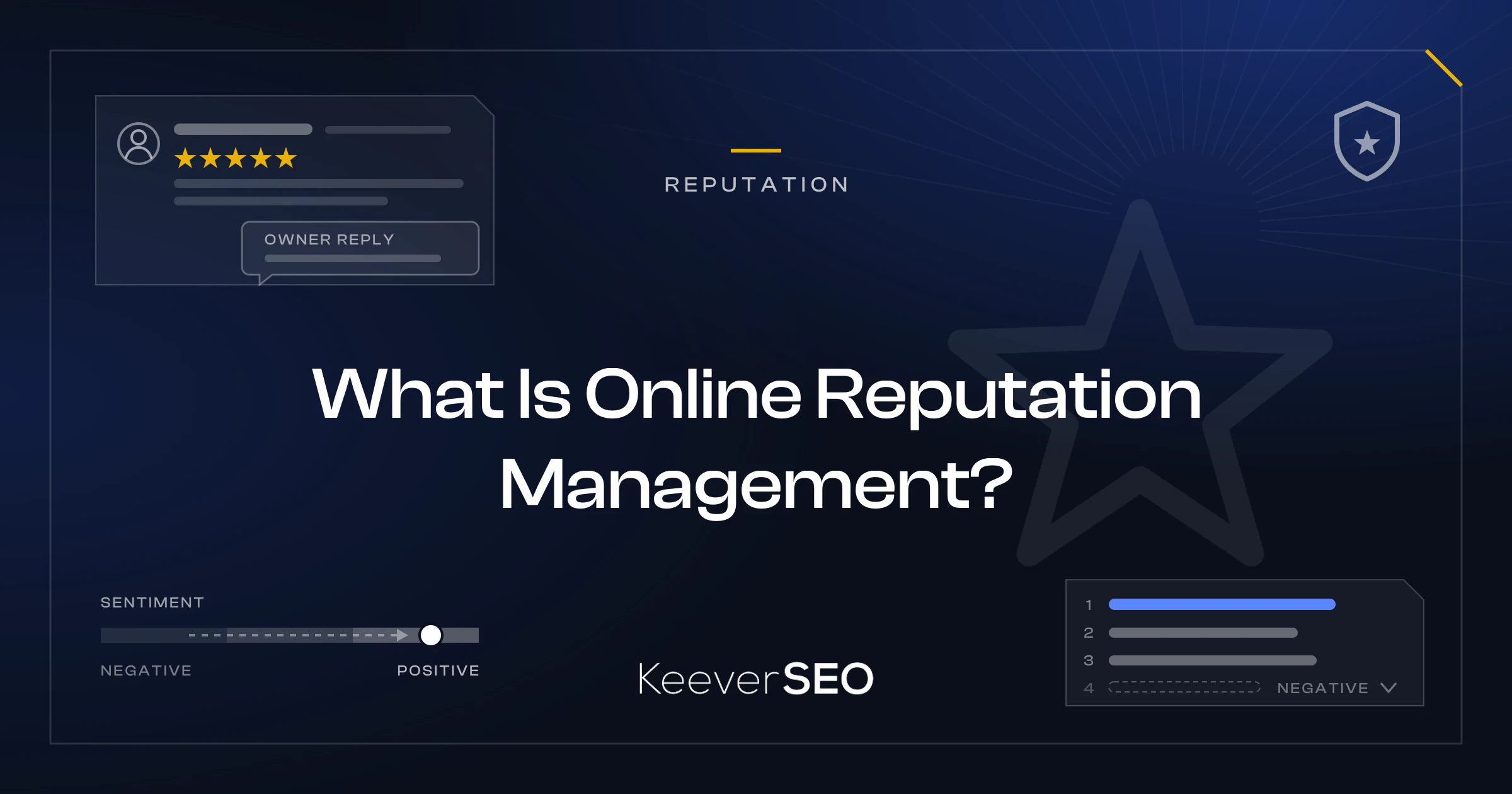
Online reputation management (ORM) is the practice of shaping how individuals or organizations are perceived across digital platforms. The practice manages content and sentiment in search engine results, on review platforms like Yelp and Google Business Profile, and across social media channels, news sites, blogs, and forums. ORM promotes positive, accurate content while addressing or displacing negative or misleading information that could damage credibility.
Traditional public relations works through media relations and messaging by press release and journalist outreach, whereas ORM operates inside the digital ecosystem, where customer reviews, social mentions, and search rankings decide trust. Brand management covers the broader strategy of building and holding brand identity across every touchpoint, while online reputation management targets the immediate, visible digital footprint that prospects meet when they research a brand or person online.
The definition of online reputation management gives the foundation, and the real value lies in how the practice operates as an ongoing, cyclical process that demands continuous attention and strategic action, which begins with the definition below.
Online reputation management (ORM) is the practice of monitoring, influencing, and controlling how a person or business is perceived across digital channels. The channels include search engine results, review platforms like Yelp and Google Business Profile, social media networks, news sites, blogs, and forums. ORM shapes the narrative by promoting positive content, addressing negative feedback, and keeping accurate information at the top of results when someone searches for a name or brand.
ORM shares ground with traditional public relations and brand management but differs in scope and execution. Public relations centers on media relationships and press coverage, and brand management centers on marketing messaging and visual identity, whereas online reputation management sits at the intersection of SEO, customer service, content strategy, and crisis communications, all fitted to the fast, permanent, algorithm-driven nature of the internet. Reputation is never static, so the practice runs on a systematic cycle of monitoring, response, and improvement.
How does online reputation management work?
Online reputation management works as a continuous cycle of proactive and reactive activity across three linked components: monitoring, response, and content creation. Each component supports the others and together they form one approach to managing a brand's online presence.
Monitoring Monitoring tracks brand mentions across digital platforms and surfaces both opportunities for engagement and issues that need attention. Tools like Google Alerts and social media monitoring software supply real-time updates on brand perception, which speeds the identification of positive and negative mentions.
Response Response addresses the feedback and comments found during monitoring. Fast, thoughtful replies to positive and negative feedback alike show care and build trust with the audience, and the phase resolves issues before they spread.
Content Creation Content creation produces and promotes positive, accurate information about the brand. The work fills digital space with content that balances or displaces negative material and keeps the brand's message consistent and trustworthy.
The three activities form the foundation of online reputation management, and a structured framework organizes them into clear, repeatable steps, as set out below.
What is an online reputation management framework?
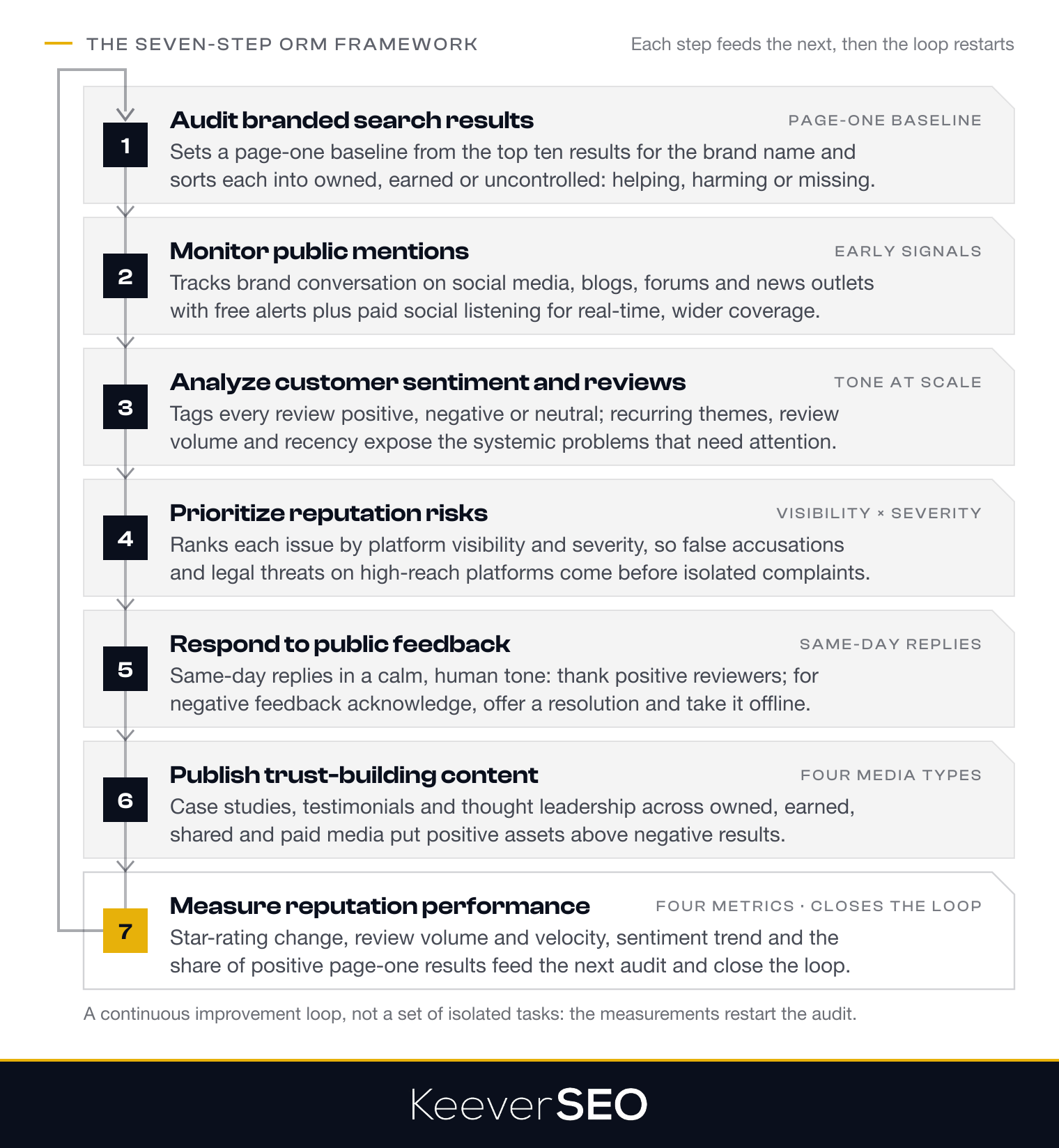
An online reputation management framework is a structured, repeatable system that organizes the ongoing work of monitoring, responding, and improving how a brand or individual is perceived online. The framework runs as a continuous improvement loop rather than a set of isolated tasks, which keeps reputation management consistent across search results, social media, and review platforms. The framework has seven operating steps: audit, monitor, analyze, prioritize, respond, publish, and measure. Each step feeds the next in a cycle that adapts to changes in online perception, and the framework holds quality and accountability across many locations and platforms. The first step sets a baseline of what the digital record shows about the brand.
1. Audit branded search results
Auditing branded search results is the first step of the framework, and it sets a page-one baseline from the top ten results that appear for the brand name. The audit builds an inventory of the results and sorts them into owned, earned, or uncontrolled content, which shows which results help, which harm, and which are missing, such as gaps where positive owned assets should appear. The audit flags vulnerabilities as well, like negative third-party pages or outdated information in prominent positions. The findings shape public perception and guide every later action, and they lead into the continuous monitoring of public mentions.
2. Monitor public mentions
Monitoring public mentions is the second step, and it tracks brand-related conversation across social media, blogs, forums, and news outlets. The layered monitoring catches early signals of praise, complaints, or emerging crises.
Companies combine free and paid tools for the work. Free tools like Google Alerts give basic keyword tracking, while paid social listening software and media monitoring services add real-time alerts and wider coverage that pulls mentions from social networks, news sites, blogs, forums, podcasts, and review platforms into one dashboard.
The goal of monitoring is fast awareness of what was said, where it appeared, and whether the sentiment is positive, neutral, or negative, so teams can decide on a response. Once mentions are captured, the next step interprets them through systematic sentiment analysis.
3. Analyze customer sentiment and reviews
Analyzing customer sentiment and reviews is the third step, and it tags each review as positive, negative, or neutral to read the emotional tone of customer feedback at scale. Recurring themes, such as product quality or customer service issues, expose systemic problems that need attention. Review volume and recency matter as well, because a high number of recent reviews gives a current picture of customer experience. The patterns show which reputation risks need immediate action.
4. Prioritize reputation risks
Prioritizing reputation risks is the fourth step, and it ranks each issue by platform visibility and severity. High-visibility issues on platforms like Google Business Profile or major social networks need immediate attention because of their reach. Severity ranking weighs the nature of each issue, so false accusations or legal threats come before isolated complaints. A risk matrix that combines visibility and severity focuses resources on the issues that could damage trust or revenue, and the prioritized risks move on to the response step.
5. Respond to public feedback
Responding to public feedback is the fifth step, and it addresses positive and negative comments in a timely, professional manner. Best practice calls for same-day responses on high-visibility platforms in a calm, human tone. For positive feedback, thank the reviewer and strengthen the relationship. For negative feedback, acknowledge the issue, offer a resolution, and move the conversation offline where needed. The acknowledge-resolve-take-offline sequence manages public perception while it preserves trust, and once feedback is addressed, the focus shifts to content that builds lasting trust and authority.
6. Publish trust-building content
Publishing trust-building content is the sixth step, and it creates and distributes content across owned, earned, shared, and paid media. Owned media covers the platforms a brand controls, such as websites and blogs. Earned media covers third-party endorsements like press mentions and testimonials. Shared media covers social interaction, and paid media covers advertisements and sponsored content.
The strategy raises brand credibility by promoting positive narratives and displacing negative content. Case studies, customer testimonials, and thought leadership pieces put positive assets at the top of search results, which builds trust with potential customers and gives search engines credible material to rank above negative content. Once the content is published, the next step measures its effect on reputation performance.
7. Measure reputation performance
Measuring reputation performance is the seventh and final step, and it evaluates the whole effort through four metrics. First, track the star-rating change across major review platforms to see whether the average score improves over time. Second, monitor review volume and velocity, the number of new reviews and the rate at which they arrive, to gauge reach and momentum. Third, analyze sentiment trends by tagging feedback as positive, neutral, or negative and watching the shifts over time. Fourth, measure the share of positive results on the first page of branded search to see what percentage reflects well on the brand. The metrics inform the next audit, monitoring priorities, and content decisions, which closes the loop of the online reputation management cycle.
What are the types of online reputation management?
The types of online reputation management are proactive, reactive, personal, corporate, and executive reputation management, each fitted to a different need. The five types are set out below:
Proactive Reputation Management Proactive reputation management builds a positive online presence before any issue arises, through favorable content, optimized search results, and encouraged positive reviews that form a buffer against negative exposure.
Reactive Reputation Management Reactive reputation management addresses existing reputation threats through damage control: responses to negative reviews, displacement of harmful content, and crisis response that repairs reputational harm.
Personal Reputation Management Personal reputation management shapes how individuals are perceived online, through monitored personal search results, managed social media profiles, and responses to negative content that protect a personal brand.
Corporate Reputation Management Corporate reputation management covers the perception of a company or brand as a whole, including customer reviews, feedback responses, and how the business appears across digital platforms.
Executive Reputation Management Executive reputation management targets high-profile business figures like CEOs and board members, with managed search results, press coverage, and public profiles that protect the reputation of company leaders and the stakeholder confidence that rests on it.
Each of the five types holds a favorable public image and reduces the risk that negative online content carries.
Why does online reputation management matter?
Online reputation management matters because reputation shapes revenue, customer trust, talent attraction, and crisis resilience. Consumer behavior shows the weight of reviews: BrightLocal's "Local Consumer Review Survey 2025" found that 93% of consumers read online reviews before visiting a business and that 42% trust the reviews as much as a personal recommendation. The trust turns into revenue, because higher star ratings and positive reviews raise consumer confidence and purchase intent.
Beyond revenue, online reputation management shapes talent attraction and crisis resilience. A credible online presence reduces doubt during hiring, and a brand with accumulated goodwill recovers faster from a negative event because positive sentiment buffers isolated incidents. The compounding nature of reputation turns digital signals into strategic assets that return higher conversion rates and better customer lifetime value.
Which channels affect online reputation?
The channels that affect online reputation are search results, Google Business Profile and Maps, review platforms, social networks, and news and forum channels. The five channels are set out below:
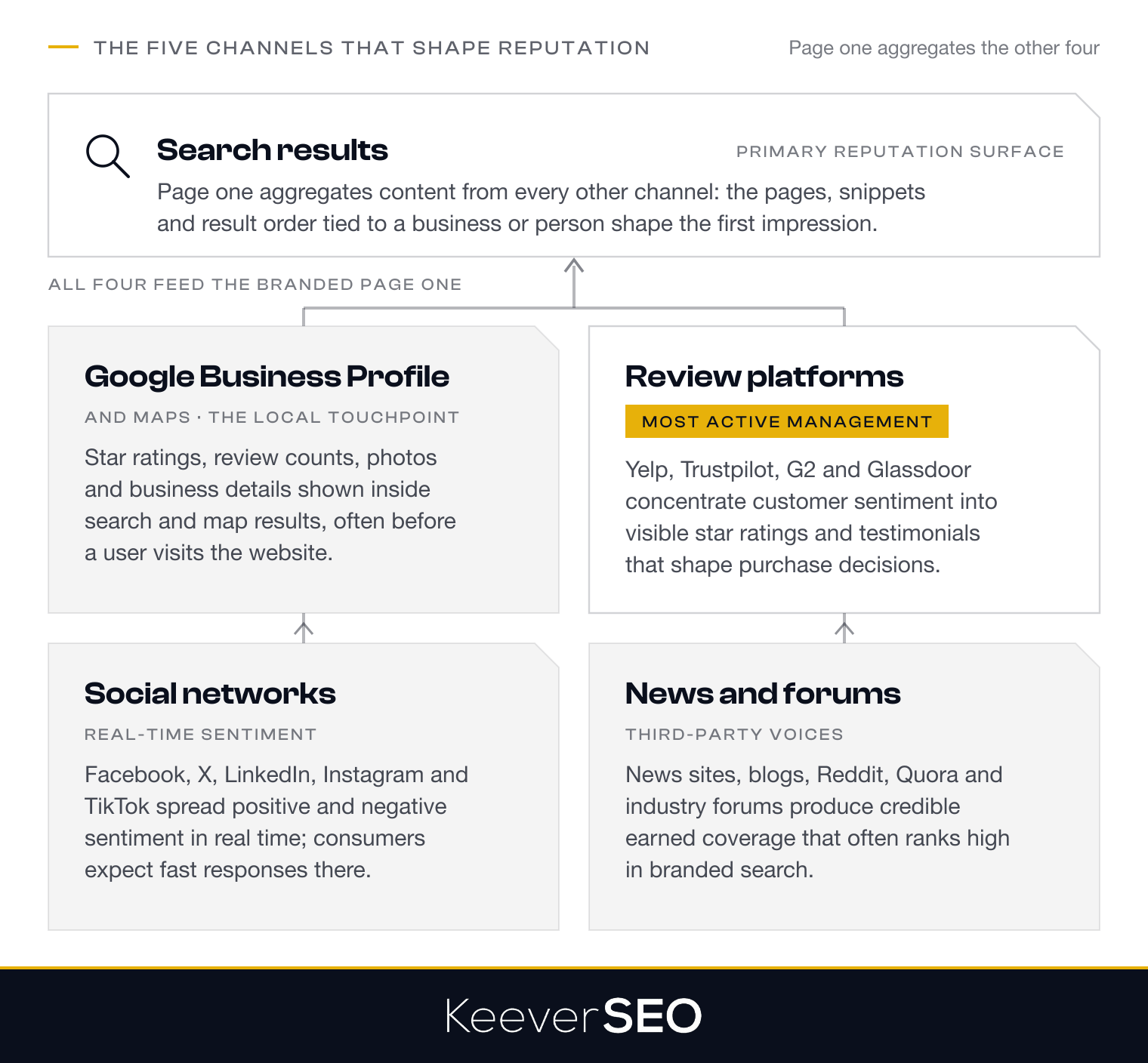
Search Results Search results are the primary reputation surface, because page one aggregates content from every other channel. The pages, snippets, and result order tied to a business or individual shape first impressions.
Google Business Profile and Maps Google Business Profile and Maps are the local reputation touchpoints, with star ratings, review counts, photos, and business information shown inside search results and map interfaces, often before a user visits the website.
Review Platforms Review platforms such as Yelp, Trustpilot, G2, and Glassdoor collect and display the customer feedback and ratings that shape purchase decisions, and most consumers read reviews for local businesses before they choose one, which makes a strong presence on the sites a condition of trust.
Social Networks Social networks like Facebook, X, LinkedIn, Instagram, and TikTok spread positive and negative sentiment in real time, and consumers expect fast responses there, which makes the platforms both drivers of reputation and immediate feedback channels.
News and Forum Channels News sites, blogs, Reddit, Quora, and industry forums produce earned coverage and peer discussion with high credibility, and the pages often rank high in branded search, which shapes perception through third-party voices.
Of the five channels, review platforms demand the most active management, because they concentrate customer sentiment into visible star ratings and testimonials that shape trust and conversion at once.
How should businesses manage reviews?
Businesses should manage reviews by responding to every review with speed and professionalism and by handling disputes through the platform's process. For positive reviews, a short thank-you that names specific details reinforces loyalty. For negative reviews, the acknowledge-resolve-take-offline strategy applies: acknowledge the issue in public with empathy, offer a resolution or next step, and invite the customer to continue by email or phone.
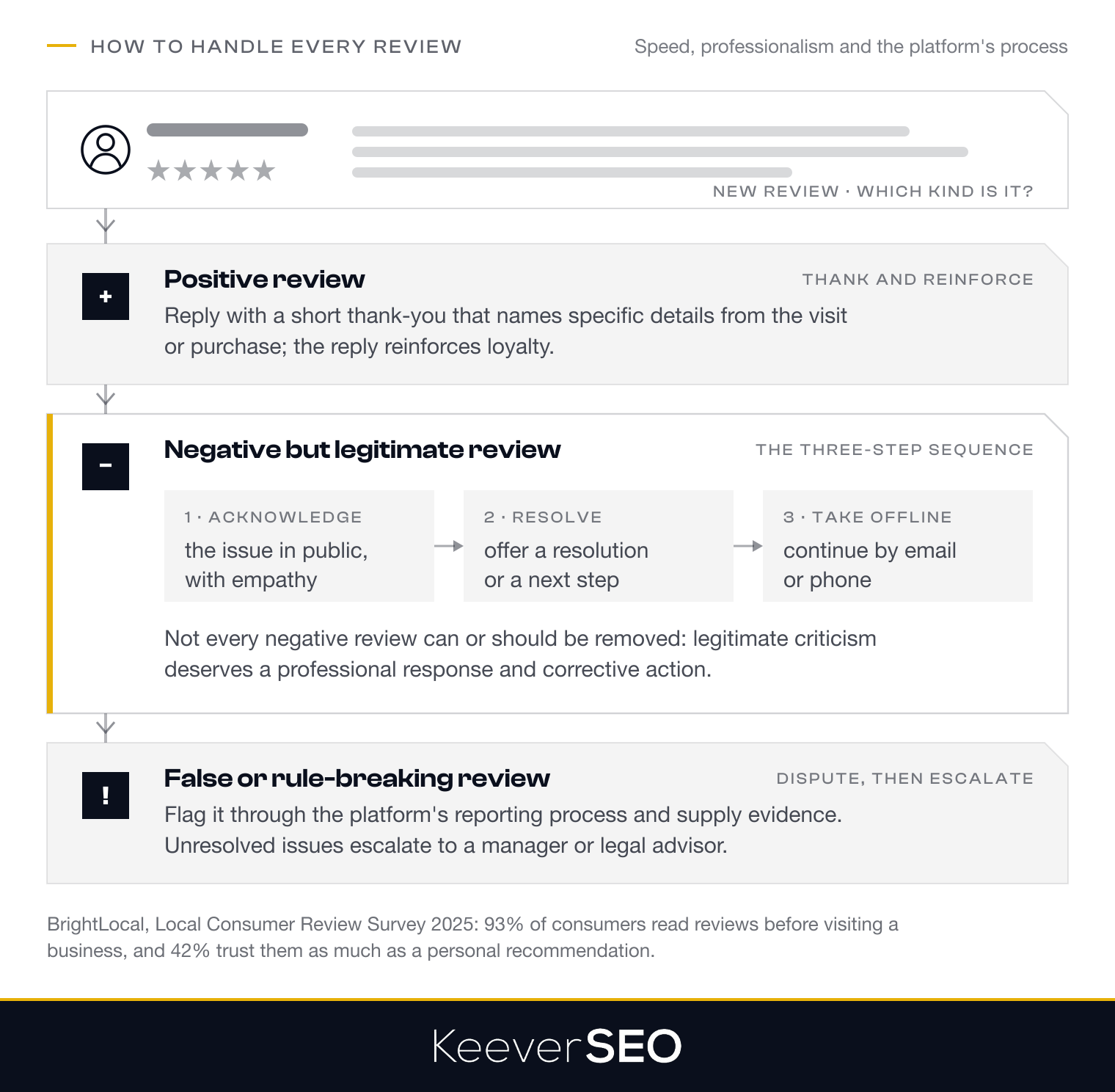
When a review carries a factual error or breaks platform guidelines, the business should use the formal dispute process: flag the content through the platform's reporting mechanism and supply evidence. Not every negative review can or should be removed, so legitimate criticism deserves a professional response and corrective action. For unresolved issues, an escalation protocol routes the matter to a manager or legal advisor before it causes reputational damage.
Effective review management turns the review ecosystem into a trust-building asset that shapes both search visibility and consumer decisions. Once existing reviews are addressed, the focus shifts to generating new, authentic reviews that reflect ongoing improvement in customer experience.
How can businesses encourage customer reviews online?
Businesses can encourage customer reviews online through well-timed requests and ethical solicitation. The three practices are listed below:
- Post-Purchase Review Requests: Send review requests soon after a purchase, while the experience is fresh, by email, SMS, or a thank-you page with direct links to review platforms.
- Review-Booster Workflows: Automate the request process with timed follow-ups and reminders for customers who have not responded, which raises the response rate.
- Ethical Solicitation: Never offer incentives for positive reviews, because incentives bias feedback and break platform policies; ask every customer for honest feedback on equal terms, which shows confidence in the product or service.
The three practices build an authentic review profile that prospective customers can trust.
How does online reputation management handle crises?
Online reputation management handles crises through a structured response built on speed, transparency, accountability, and corrective action. When a crisis breaks, a rapid response keeps negative narratives from spreading across social media, news, and forums, so monitoring tools should trigger alerts that let decision-makers act within hours. Transparency matters as much, because attempts to hide or minimize an issue tend to backfire and erode trust further, while honest acknowledgment shows accountability and respect for the people affected.
A single owner or spokesperson coordinates the response so messaging stays consistent across channels and no conflicting statements add confusion. The response opens with a sincere apology that acknowledges the harm or mistake without defensive language, then sets out the specific corrective actions that will resolve the issue and prevent a repeat. Public follow-through on the commitments rebuilds credibility, and the structured approach turns a crisis from a reputation-destroying event into a demonstration of integrity and operational resilience.
The principles of crisis handling show best in real cases of failure and recovery, starting with United Airlines.
How did United Airlines illustrate an online reputation management crisis?
United Airlines illustrated an online reputation management crisis with the Flight 3411 incident in April 2017. A passenger, Dr. David Dao, was forcibly removed from an overbooked flight, fellow passengers filmed the removal, and the video went viral on social media with widespread public outrage. United's share price fell close to 4% the next trading day, which erased about $1 billion in market value before a partial recovery, as CNN Money reported in "United Airlines shares drop after man dragged off flight" on April 11, 2017. The company's first response, which apologized for having to "re-accommodate" customers and defended employees in an internal letter, read as defensive and lacking in empathy, which deepened the damage and showed how a poor initial response worsens a crisis. The case makes the argument for planning a crisis strategy in advance.
How should online reputation management plan a crisis management strategy?
Online reputation management should plan a crisis management strategy as a structured, proactive protocol prepared before any threat appears. The plan begins with pre-drafted response templates for different scenarios, which allow swift, consistent communication, and monitoring alerts that detect emerging issues in real time.
A designated spokesperson keeps messages consistent and accountable as the single point of contact for public communication. An escalation ladder sets who owns each level of severity, so serious incidents reach leadership or legal support without delay.
The plan sets out the action sequence as well: acknowledge the issue, resolve it, and take the conversation offline where needed, with response-time targets of the same day for social media incidents to limit damage. Regular updates and training keep team members ready to act in their roles when a crisis arrives.
Who needs online reputation management?
The groups that need online reputation management are enterprises, executives and public figures, small and local businesses, brands under criticism, high-trust industries, organizations preparing for major events, companies with little online presence, and high-stakes private individuals. The eight segments are set out below:
Enterprises Large organizations need online reputation management to protect revenue, customer trust, and brand valuation, because a positive reputation supports investor confidence and regulatory relationships.
Executives and Public Figures CEOs, politicians, and celebrities need reputation management to protect personal and professional credibility, because their search results and public image shape company performance, public trust, and career opportunity.
Small and Local Businesses Small and local businesses depend on online reputation for local discovery and consumer trust, because reviews and search results decide purchase decisions and customer acquisition.
Brands Facing Active Criticism Companies under negative press or in crisis need reputation management to counter misinformation and restore trust before the damage spreads.
Industries with High Trust Requirements Healthcare, finance, and legal sectors need reputation management because their services rest on trust, and a positive reputation decides whether customers arrive and stay.
Organizations Preparing for Major Events Firms approaching IPOs, acquisitions, or market expansion need reputation management for favorable due diligence, because a strong reputation shapes stakeholder decisions.
Companies with Limited Online Presence Brands with little visibility in search results risk losing customers to more prominent competitors, and reputation management builds a presence before any crisis.
High-Stakes Private Individuals Individuals with public exposure or large financial interests may need reputation management to control how search results and media coverage affect their professional and personal opportunities.
The eight segments show how wide the need for online reputation management runs across industries and individuals.
How is online reputation management measured?
Online reputation management is measured through four core metrics that reflect a brand's digital perception. The four metrics are listed below:
- Star-rating change: The movement of average review scores over time across platforms such as Google Business Profile and Yelp, a visible indicator of reputation improvement or decline that shapes consumer trust and purchase decisions.
- Review volume and velocity: The total number of reviews and the rate at which new ones arrive, where higher volume signals active customer engagement and steady velocity signals business momentum, relevance, and credibility with algorithms and customers.
- Sentiment trend: The emotional tone, positive, negative, or neutral, across reviews, social mentions, and public feedback over set periods, which shows whether perception is improving and which themes need strategic or operational correction.
- Share of positive results in branded search: The percentage of first-page results for a brand name that is favorable, brand-controlled, or neutral rather than negative, which measures the success of content promotion and displacement and defines the reputation surface prospects meet.
Together the four metrics give a full view of how a brand is perceived online and guide the strategy that keeps or improves it.
How does search visibility affect online reputation management?
Search visibility affects online reputation management because the branded search results page forms the first impression and serves as the primary reputation surface. The page mixes owned pages, review sites, news stories, social profiles, and third-party commentary. When positive content dominates, the page projects credibility, and when negative reviews, outdated information, or hostile articles rank high, the page damages the brand.
The challenge comes from search algorithms that weigh popularity, recency, and relevance and can lift sensational content above balanced material, which creates both a vulnerability and an opportunity. Neglected search visibility lets critics and outdated narratives shape perception, while active management displaces harmful content and promotes authoritative, positive sources. The link between search visibility and reputation moves businesses from reactive damage control to the proactive SEO techniques covered next.
How does SEO support online reputation management?
SEO supports online reputation management by optimizing how a brand appears in search results. The work ranks positive owned assets, such as websites and profiles, higher in search results, which pushes negative or unfavorable content off the first page where few users look. SEO optimizes local listings and business profiles, such as Google Business Profile, as well, so accurate and positive information stays prominent and the branded results page represents the business or person with accuracy.
Beyond displacing negative content, SEO for reputation management builds a full, favorable impression by balancing owned media, positive third-party coverage, review platforms, and social profiles. The work runs on continuous content creation, technical optimization, and strategic link building that hold control of the search presence, and when the volume and complexity grow, outside help from an SEO agency becomes the next step.
When should a business hire an SEO agency for reputation management?
A business should hire an SEO agency for reputation management when the complexity of its online presence exceeds internal capability. The moment arrives when negative content holds a prominent place on page one of branded search results and hurts perception and conversions. Large enterprises and executive-level individuals gain the most from specialized agency expertise, because their reputation surfaces are extensive and the stakes are high, and an agency matters most during active smear campaigns or coordinated negative attacks that need advanced displacement tactics. In such cases, our reputation SEO agency deploys the techniques that restore control over branded search results.
What should an ethical reputation management strategy include?
An ethical reputation management strategy should include a ban on fake reviews, transparent disclosures, honest correction over suppression, and compliance with platform and advertising rules. The four principles are listed below:
- No Astroturfing or Fake Reviews: Businesses must never create or buy fake reviews, because the practice breaks consumer trust and federal regulation; the Federal Trade Commission's "Trade Regulation Rule on the Use of Consumer Reviews and Testimonials," in force since October 21, 2024, bans buying or selling fake reviews and allows civil penalties of up to $51,744 per knowing violation.
- Transparency in Disclosures: Any material connection, such as a review from an employee or a paid influencer, must be disclosed in clear terms to keep consumer trust and satisfy federal guidelines.
- Honest Correction over Suppression: Negative feedback should be answered by fixing the underlying issue rather than hiding or suppressing unfavorable reviews, which shows commitment to improvement and transparency.
- Compliance with Review-Platform and Advertising Rules: The policies of platforms like Google and Yelp bind every reputation effort, because violations erode trust and invite enforcement.
The four principles build a trustworthy online presence and a reputation earned on merit.
How can businesses maintain reputation improvements?
Businesses can maintain reputation improvements through continuous monitoring and steady review generation rather than a one-time cleanup. Ongoing monitoring systems track public mentions and reviews across platforms, and automated workflows plus post-purchase outreach keep new customer reviews flowing. Reputation management works as compounding maintenance, so regular investment in monitoring, feedback response, and positive content keeps the reputation strong and locks in the gains over time.
What are the limits of online reputation management?
The limits of online reputation management are the problems it cannot fix: poor product quality, inadequate service, or unethical practice inside a business. Efforts to suppress or conceal valid negative content tend to fail and can trigger the Streisand effect, where an attempt to hide information draws more attention to it. Effective reputation management addresses the underlying problems with transparency rather than trying to manipulate perception, and the failure examples below show what happens when it does not.
What are online reputation management failure examples?
Online reputation management failure examples stem from mishandled responses and suppression efforts that backfire. The United Airlines Flight 3411 incident is the prominent case, where a viral video of a passenger's forced removal and a defensive first response cost the company about $1 billion in market value in one trading day. Nestlé offers a second case: when Greenpeace published a 2010 campaign video attacking the palm oil in KitKat bars, Nestlé's attempt to have the video removed drew far more attention to it, a textbook Streisand effect. The two cases show how aggressive suppression or poor crisis handling turns a contained issue into a public relations crisis.
How does long-term online reputation management build trust?
Long-term online reputation management builds trust through consistent monitoring and response to digital interactions over time. The consistency keeps a brand's presence reliable across search results, review platforms, and social media, and thoughtful responses to customer feedback plus a steady flow of positive content reinforce credibility. The ongoing effort shows commitment and accountability and turns individual interactions into a durable reputation asset. Unlike a short-term fix, sustained reputation management embeds trust deep enough that the brand withstands occasional negative incidents, which is the proactive core of online reputation management.