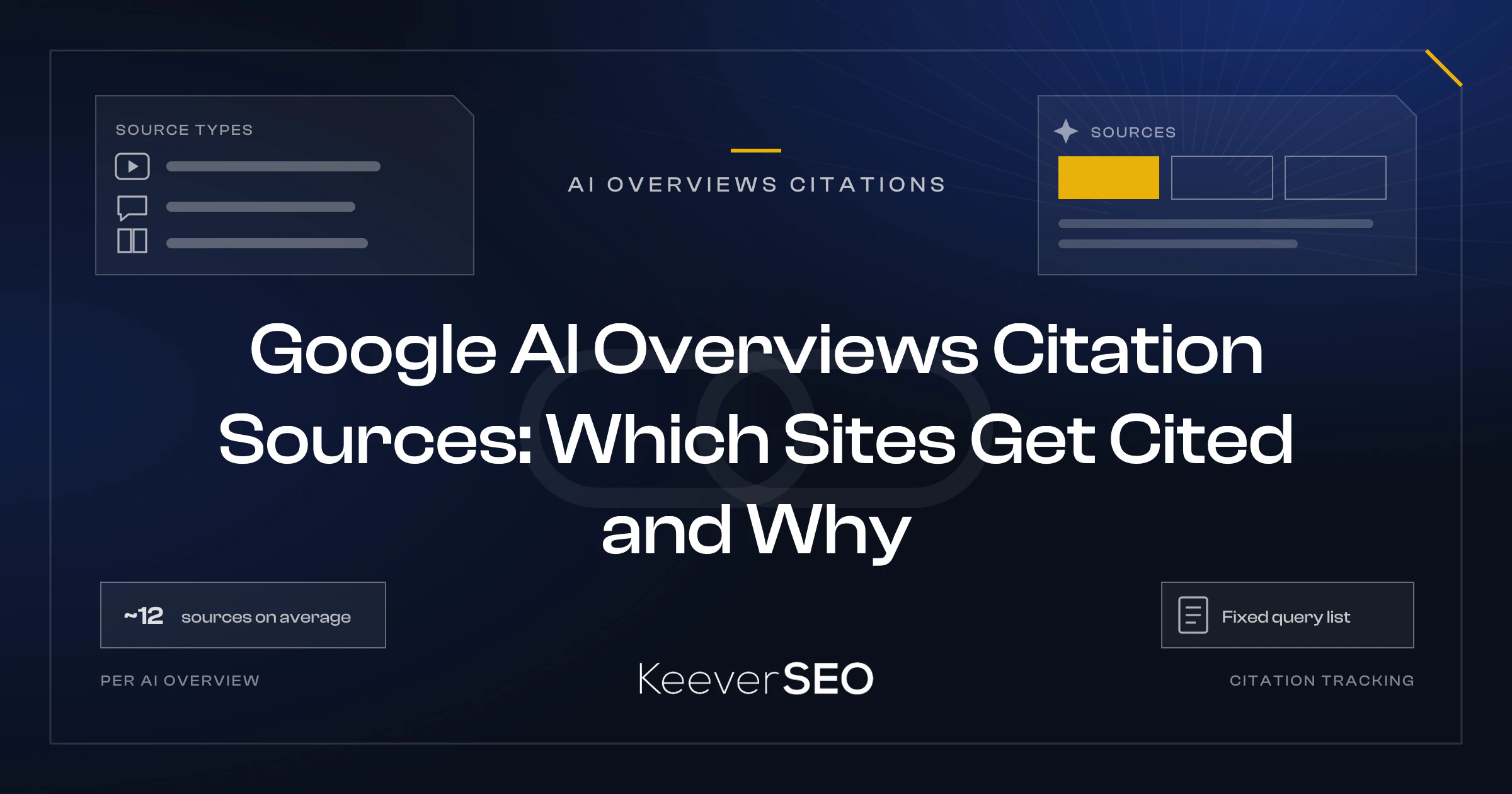
Google AI Overviews citation sources are mostly pages that already rank well, with YouTube, Reddit, Wikipedia, and authoritative publishers among the most cited domains. An AI Overviews citation source is a page Google links beside or inside its generated summary to support the answer, and government and education sites, specialist blogs, forums, review sites, and product pages appear as sources too.
Google AI Overviews draw on indexed web pages and Google's wider information systems, and query fan-out lets a page earn a citation without ranking for the original query. Topical authority, direct-answer paragraphs, organic position, and freshness are the signals linked to citations, and each overview cites a dozen sources on average. Businesses track citations with a fixed query list, rank trackers, and manual checks of the source links, since Search Console reports performance but not the overview itself.
Local service businesses should target their Google Business Profile, service pages, review platforms, local directories, and community sites, and clear answers, current facts, and third-party coverage raise the chance of a citation. The article then connects citation sources to AI Overviews rankings, compares the sources Perplexity and ChatGPT cite, and closes with what the citation pattern reveals about search trust, starting with the sources Google AI Overviews cite most.
Which Sources Do Google AI Overviews Cite Most Often?
The sources Google AI Overviews cite most are YouTube, Reddit, and Facebook, followed by Google's own pages, Instagram, Quora, and Wikipedia. YouTube held a 24.5% mention share, Reddit 18.1%, and Wikipedia 4.4% across more than 3 million US queries, measured as a share of citations among the 50 most-cited sources, according to "The 50 Most-Cited Websites in Google AI Overviews (November 2026)" by Si Quan Ong, Ahrefs, November 2026.
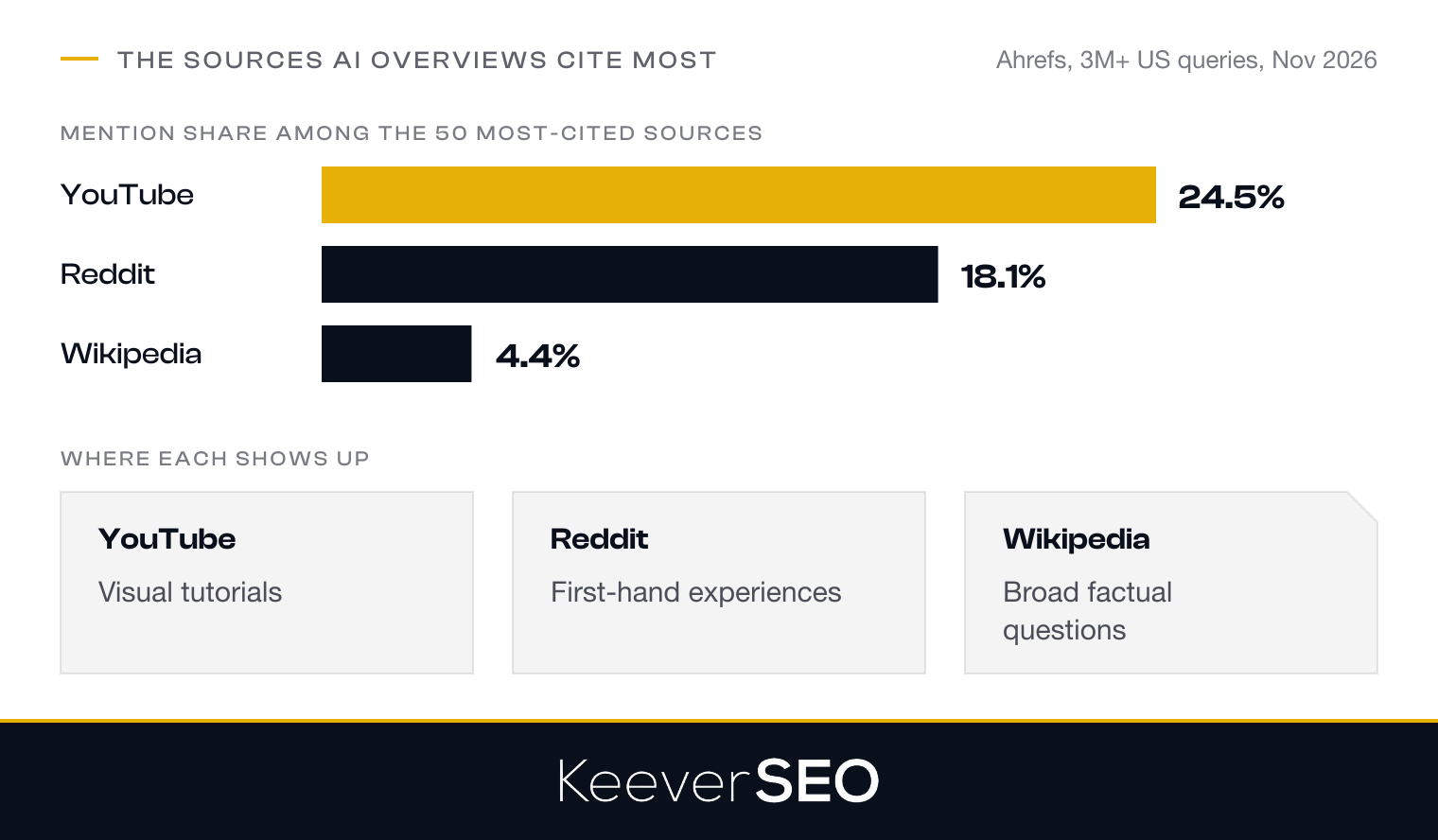
Citation patterns vary by topic, query intent, dataset, and measurement date. YouTube appears for visual tutorials, Reddit for first-hand experiences, and Wikipedia for broad factual questions, while the two questions below cover website types and how the leading platforms' shares differ between studies.
Which Website Types Dominate AI Overviews Citations?
The website types that dominate AI Overviews citations are listed below:
- Government and education sites: agencies, universities, and public institutions provide official guidance, research, and regulations.
- Authority publishers and blogs: news outlets, specialist publications, and expert blogs explain topics and report evidence.
- Forums and user-generated content: Reddit and similar communities supply first-hand experiences and troubleshooting advice.
- Video platforms: YouTube supplies demonstrations, reviews, and tutorials.
- Product and brand sites: company pages and retailer listings give product specifications, pricing, and availability.
How Often Do AI Overviews Cite Reddit, YouTube, and Wikipedia?
AI Overviews cite Reddit, YouTube, and Wikipedia at shares that differ by study and method. Ahrefs' November 2026 ranking puts YouTube at 24.5%, Reddit at 18.1%, and Wikipedia at 4.4% of citations among the top 50 domains, a share of the leading sources rather than of every citation.
A browsing study measured the three platforms together, finding that Wikipedia, YouTube, and Reddit made up 15% of the sources listed in AI summaries, against 17% of standard results, according to "Google users are less likely to click on links when an AI summary appears in the results" by Athena Chapekis and Anna Lieb, Pew Research Center, July 2025. The figures reflect different datasets and methods, so they show variation between studies rather than a confirmed change over time.
Where Does Google AI Overviews Get Its Information?
Google AI Overviews get information from pages in Google's Search index and from Google's wider information systems, such as the Knowledge Graph's facts about entities. A Gemini model works with Google Search systems to write the summary and connect its claims with supporting sources.
The Search index provides web pages that answer the query, while structured entity facts describe people, places, and things and the links between them. The sources Google uses vary with the question and the information needed to answer it.
How Do Google AI Overviews Choose Which Sources to Cite?
Google AI Overviews choose which sources to cite by expanding the query into related searches, then finding indexed pages that support each part of the answer. A page "must be indexed and eligible to be shown in Google Search with a snippet" to qualify as a supporting link, according to "AI features and your website" published by Google Search Central, December 2025, and Google's ranking and quality systems decide which eligible pages appear.
Query fan-out lets Google retrieve pages that answer related sub-questions, even when the pages do not rank for the original query. The overview links passages that support individual claims, so topical authority, direct answers, organic visibility, and freshness help predict a citation.
Which Signals Predict an AI Overviews Citation?
The signals that predict an AI Overviews citation are topical authority, direct-answer paragraphs, organic ranking position, and fresh information. Topical authority reflects a site's depth of coverage and credibility on a subject, and direct-answer paragraphs give Google passages that address individual questions.
Organic rankings make relevant pages easier to retrieve, and current facts keep a page accurate for time-sensitive queries. The four sections below explain how each signal relates to AI Overviews citations.
Domain-Level Topical Authority
Domain-level topical authority describes how consistently a website shows depth on a subject across related pages. A site builds topical authority by covering the main topic and its related questions in depth, then connecting the relevant pages with internal links.
Query fan-out surfaces sub-questions, so broad coverage gives AI Overviews more relevant passages to cite. Original data, clear explanations, and documented methods establish the site as a reliable source on the topic.
Direct-Answer Paragraphs of 40 to 70 Words
Direct-answer paragraphs of 40 to 70 words give the answer in the first sentence and form a self-contained passage beneath a relevant question heading. No published study validates a 40-to-70-word range for AI citations, so the range works as an editorial guideline, not a proven ranking factor.
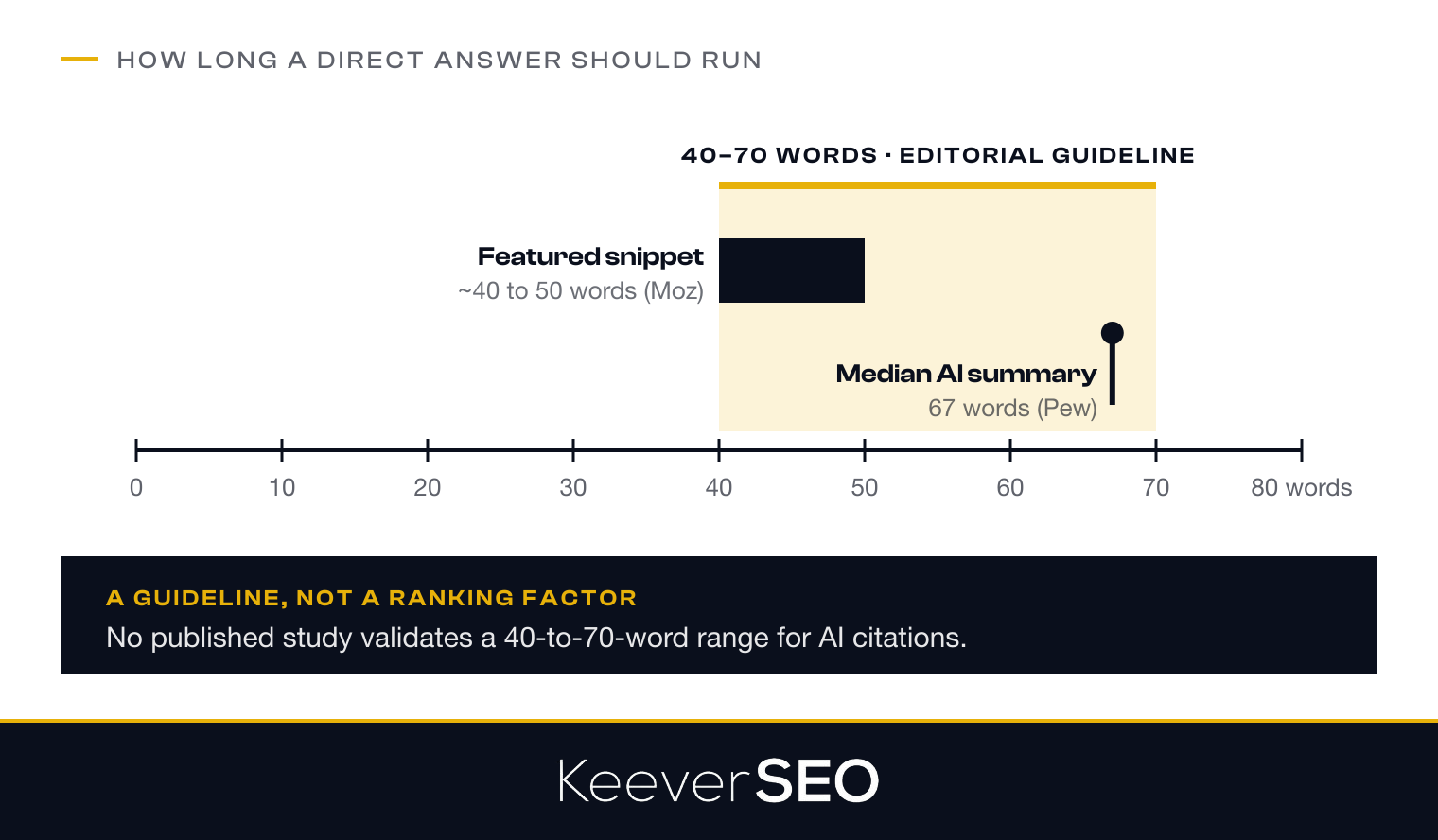
The range sits between two measured lengths: a featured snippet paragraph runs best at "roughly 40 to 50 words, or around 300 characters", according to "What We Learned From Analyzing 1.4 Million Featured Snippets" by A.J. Ghergich, Moz, January 2017, and the median AI summary in Pew Research Center's July 2025 browsing study was 67 words long. Relevance, clarity, and the page's wider authority matter beyond paragraph length.
Organic Ranking Position
Organic ranking position raises a page's chances of an AI Overview citation, but a top ranking does not guarantee inclusion. Only 37.9% of URLs cited in AI Overviews appeared in the first 10 results, while 31.2% sat between positions 11 and 100 and 31.0% beyond the top 100, according to "Update: 38% of AI Overview Citations Pull From The Top 10" by Louise Linehan, Ahrefs, March 2026.
Query fan-out brings citations from pages that answer related sub-questions, even when the pages do not rank for the original query. Strong rankings for the main question and its supporting searches raise citation potential, while AI Overview citations stay separate from conventional organic rankings.
Freshness and Recency
Freshness and recency support an AI Overviews citation, but a recent date alone does not guarantee one. Google AI Overviews and organic results are the surfaces most likely to cite older pages, according to "New Study: AI Assistants Prefer to Cite 'Fresher' Content (17 Million Citations Analyzed)" by Ryan Law, Ahrefs, July 2025.
Current dates, statistics, prices, policies, and product details matter more for time-sensitive queries such as breaking news or changing regulations. Publishers should update pages when facts change and keep dates accurate, while evergreen topics depend more on relevance, authority, and answer quality.
How Many Sources Does a Google AI Overview Cite?
A Google AI Overview cites about 12 sources on average. The average rose from 11.55 to 12.1 sources per answer after Gemini 3 became the default model, while the share of AI Overviews shown without a sources block jumped from 0.11% to 10.63%, according to "Gemini 3 and a Google bug left 1 in 10 AI Overviews without any sources" by Yevheniia Khromova, SE Ranking, February 2026.
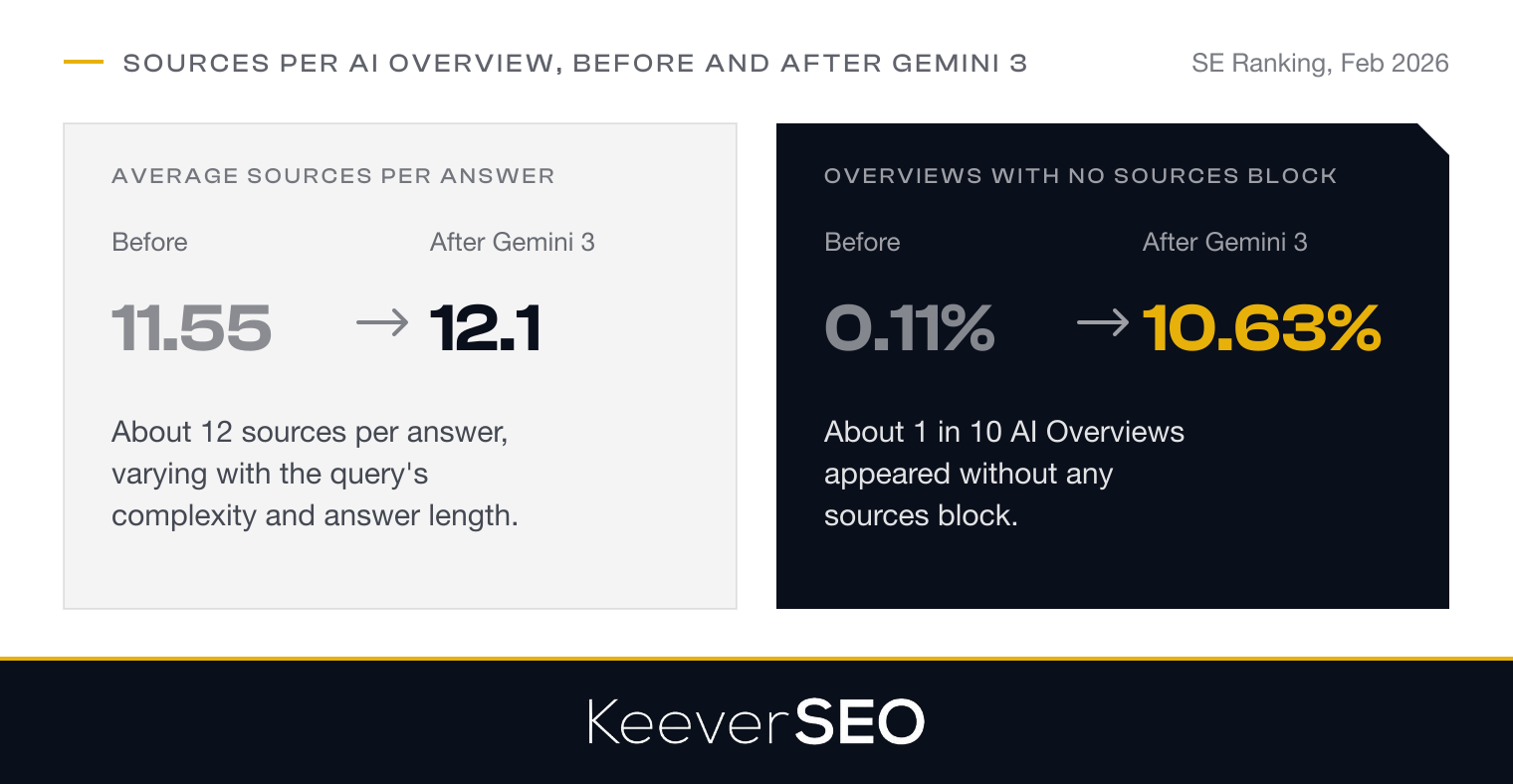
The source count varies with how complex the query is and how long the answer runs, and studies count visible links, expanded source cards, or distinct URLs in different ways.
How Do You Track Your AI Overviews Citations?
To track your AI Overviews citations, use a fixed list of target queries, an AI search rank tracker, and manual checks on a schedule. Keeping the search location, device, and schedule consistent, each check records whether Google shows an overview and which URLs it cites.
Search Console's reports count performance rather than showing the overview, so manual checks fill the reporting gap. The two questions below explain the Search Console blind spot and the manual method.
Why Does Google Search Console Leave a Citation Blind Spot?
Google Search Console leaves a citation blind spot because its reports count impressions and clicks without showing the AI Overview text, the claim a page supports, or the competing sources cited beside it. Google points site owners to the Generative AI performance report "to see how your content is performing in generative AI features on Google Search", according to "Google's Guide to Optimizing for Generative AI Features on Google Search" published by Google Search Central, May 2026.
Performance data shows that pages appear in AI features, while manual checks or rank-tracking tools show the citation itself.
How Do You Track AI Overviews Citations Manually?
To track AI Overviews citations manually, run the same queries under the same search conditions each time, following the steps below:
- List the target queries that matter to your business.
- Search each query in a clean, signed-out browser window.
- Record whether an AI Overview appears and which URLs it cites.
- Repeat the checks on a fixed schedule and log the results in a spreadsheet.
How Do You Check the Sources Behind an AI Overview?
To check the sources behind an AI Overview, open its citation links and verify each cited claim against the original page, following the steps below:
- Click the link icons or source cards beside or inside the AI Overview.
- Select Show more to reveal more cited pages.
- Open each cited page and find the supporting passage.
- Confirm that the source directly supports the AI Overview's claim.
Which Citation Sources Should a Local Service Business Target?
The citation sources a local service business should target are its Google Business Profile, website service pages, reputable review platforms, relevant local directories, and local news or community sites. Profiles and directories hold the business details, service pages hold service information, and reviews and local coverage supply customer feedback and local context.
The business name, address, phone number, hours, service areas, and categories should match across every profile and listing. Service pages should answer customer questions directly, and genuine reviews and legitimate local mentions support the profile, while no source guarantees an AI Overviews citation.
How Can a Business Become a Cited Source in AI Overviews?
A business can become a cited source in AI Overviews by publishing indexed pages that are eligible for search snippets and answer concrete questions in their opening sentences. First-page visibility for question queries helps, and Google finds relevant pages through related searches as well.
Each target page should place a direct, concise answer beneath a descriptive question heading and keep its facts current. Businesses with little website authority can publish useful expert content on reputable third-party sites that Google already cites.
How Does Keever SEO's AI Optimization Service Get Businesses Cited in Google AI Overviews?
Keever SEO's AI optimization service gets businesses cited in Google AI Overviews starting with a citation audit of existing AI Overview mentions, competitor visibility, priority customer questions, and content, technical, and authority gaps. The audit guides direct-answer rewrites, related-question coverage, crawl improvements, and structured data that matches the visible content.
Keever SEO builds topical authority through relevant content and third-party placements on publications, directories, forums, and community sites. The AI optimization service tracks cited URLs, brand mentions, citation frequency, competitors, and share of voice across AI platforms, while Google controls source selection and no service can guarantee inclusion.
How Do Citation Sources Connect to AI Overviews Rankings?
Citation sources connect to AI Overviews rankings because a ranking in Google AI Overviews means appearing as a cited source beside or inside the generated summary. An AI Overview places no cited pages in a fixed numbered list, and with only 37.9% of citations drawn from the top 10 organic results, a high organic ranking does not guarantee a citation. The question below covers how to rank in Google AI Overviews.
How Do You Rank in Google AI Overviews?
To rank in Google AI Overviews, target conversational questions and place a clear answer directly below each question heading. Covering the related sub-questions that query fan-out surfaces, then strengthening topical authority with reliable sources, original information, and relevant pages across the site, completes the approach.
Which Sources Do Other AI Search Engines Cite?
The sources other AI search engines cite differ from Google AI Overviews because each engine's retrieval system, search partnerships, and citation policies differ. Perplexity favors content that ranks well in Google, with 28.6% of its cited URLs in the top 10, while only 12% of links cited by ChatGPT, Gemini, and Copilot appeared in Google's top 10 for the same prompt, according to "Only 12% of AI Cited URLs Rank in Google's Top 10 for the Original Prompt" by Louise Linehan, Ahrefs, August 2025.
Visibility on one platform does not guarantee citations on a different one, as the source preferences of Perplexity and ChatGPT below show.
Which Sources Does Perplexity Cite?
The sources Perplexity cites are Reddit discussions, YouTube videos, independent review sites, comparison pages, and editorial publications. Product and how-to searches surface demonstrations and reviews, while commercial searches favor comparison roundups and niche publishers.
Fresh pages with clear authorship, publication dates, relevant evidence, and focused coverage support Perplexity answers best.
Which Sources Does ChatGPT Cite?
The sources ChatGPT cites are Wikipedia for definitions and entity facts, news outlets and industry publications for current or specialist topics, and review sites for product comparisons. ChatGPT search sends queries to partner search providers such as Bing, so its citations do not follow Google's top-ranked results.
What Do AI Overviews Citation Sources Reveal About Search Trust?
AI Overviews citation sources reveal that search trust combines established authority with first-hand community experience. Authoritative publishers and reference sites supply researched information, while forums such as Reddit and video platforms such as YouTube add practical advice, and organic rank alone does not secure a citation.
For publishers, the citation pattern rewards useful evidence, clear explanations, topical depth, and real-world experience over formatting tricks. Google AI Overviews citation sources reflect that wider picture of trust by drawing on ranked authority pages and first-hand community sources together.