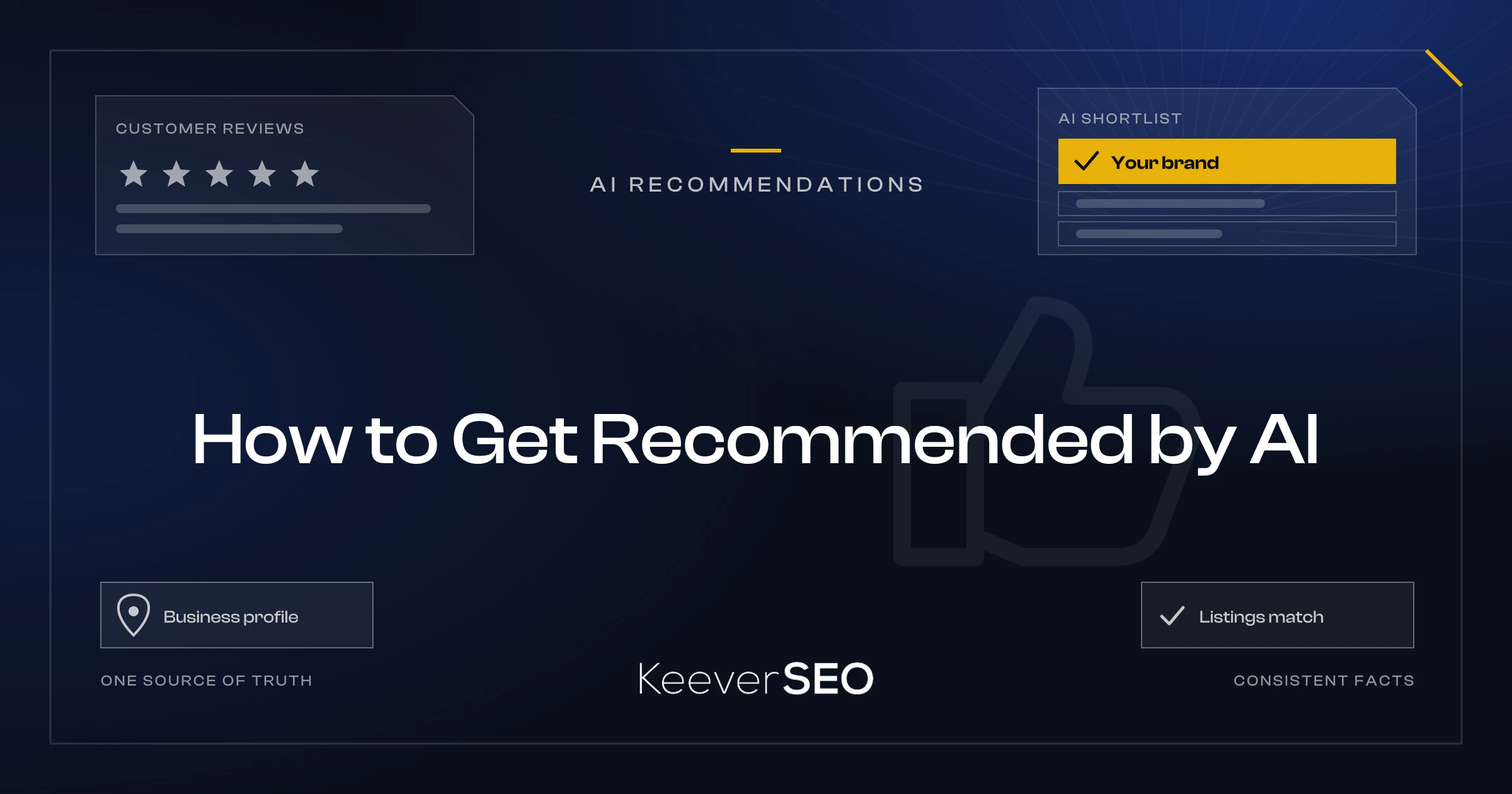
To get recommended by AI, decide what you want to be recommended for, make your website the source of truth for those facts, and back them with evidence, reviews, and a consistent presence across the web. An AI recommendation happens when an assistant names a business, product, or brand as an option in response to a request, and assistants favor clear relevance, consistent information, credible third-party mentions, reviews, and supported claims, found through search indexes, business profiles, review platforms, directories, community discussions, and training data.
The groundwork is a defined offer and audience, a crawlable website, aligned business listings, existing reviews, and a list of the requests buyers put to AI. Seven steps follow: choose a recommendation target, map the information AI needs, make your website the source of truth, support claims with evidence, build a presence beyond your website, keep a complete Google Business Profile with fresh reviews, and make the web tell a consistent story.
An llms.txt file is optional, AI shopping assistants rely on product feeds, structured data, prices, availability, and reviews, and vague positioning, conflicting listings, stale reviews, unsupported claims, blocked crawlers, and fake mentions stop recommendations. Local service businesses should strengthen their Google Business Profile and service pages, and outside help fits when competitors appear instead or wrong facts persist. The article then covers each AI assistant, the link between AI search rankings and recommendations, and how long the process takes, starting with what getting recommended by AI means.
What Does It Mean to Get Recommended by AI?
Getting recommended by AI means an assistant names a business, product, or brand as a suitable option in response to a user's request. The answer explains why the option fits, using details such as services, location, experience, price, reviews, or customer outcomes.
AI recommendations appear as shortlists across ChatGPT, Gemini, Perplexity, and Claude, and a brand can appear in one assistant's answer but not in a second one because each platform uses different sources and retrieval systems. Being found online differs from being recommended, since the assistant must connect the brand to the request and support the choice with credible information.
What Makes AI Recommend One Brand Over Another?
AI recommends one brand over its rivals when the brand matches the buyer's request and carries consistent, verifiable information across sources. Brand web mentions showed the strongest correlation with AI Overview brand visibility (0.664), against 0.218 for backlinks, according to "An Analysis of AI Overview Brand Visibility Factors (75K Brands Studied)" by Louise Linehan, Ahrefs, May 2025, so independent reviews, publications, and comparison pages add context beyond company claims.
Adding cited sources, quotations, and statistics raised visibility in generative-engine responses by 30% to 40% on a position-adjusted word count measure, according to "GEO: Generative Engine Optimization" by Pranjal Aggarwal and colleagues, published at KDD 2024, though the study sets no universal recommendation formula. Recommendations vary between runs as well, with a less than 1 in 100 chance that ChatGPT or Google's AI gives the same list of brands in any two responses, according to "NEW Research: AIs are highly inconsistent when recommending brands or products" by Rand Fishkin, SparkToro, January 2026, so clear positioning and credible evidence raise eligibility without guaranteeing inclusion.
How Do AI Assistants Find Businesses to Recommend?
AI assistants find businesses to recommend through web search indexes, local business data, review platforms, directories, and model training data. Search-enabled assistants retrieve relevant indexed pages, while Google Business Profile and map data supply location, services, and business categories, and review sites and directories add ratings, customer feedback, and independent business information.
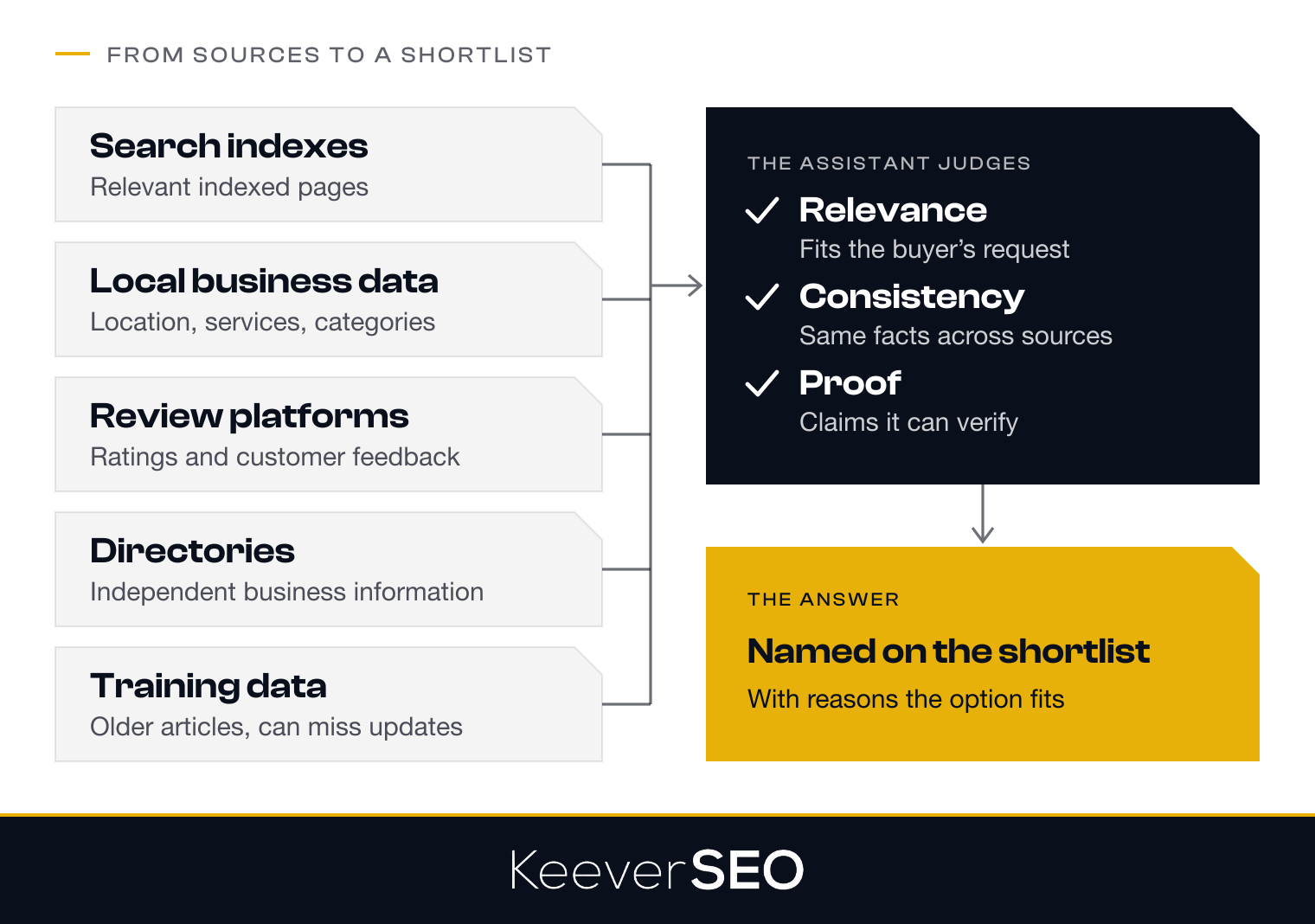
Training data reflects older articles, reviews, and editorial lists, so a model can miss current business details. Accurate information across the website, listings, reviews, and third-party mentions helps assistants identify a business and judge its relevance.
What Do You Need Before Trying to Get Recommended by AI?
The prerequisites for getting recommended by AI are listed below:
- A defined offer: the target audience and the problems your products or services solve.
- A crawlable website: accessible pages with clear descriptions of the business.
- Consistent listings: the same business name, address, phone number, services, and hours everywhere.
- Genuine customer reviews: a record of existing feedback.
- A list of buyer requests: the questions buyers enter into AI tools when comparing providers or products.
With the prerequisites in place, the seven steps below build a clear, verifiable case for AI recommendations.
How Do You Get Recommended by AI?
To get recommended by AI, follow seven steps: decide what you want AI to recommend you for, map the information AI needs, make your website the source of truth, support your claims with evidence, build your presence beyond your website, keep a complete Google Business Profile with fresh reviews, and make the web tell a consistent story.
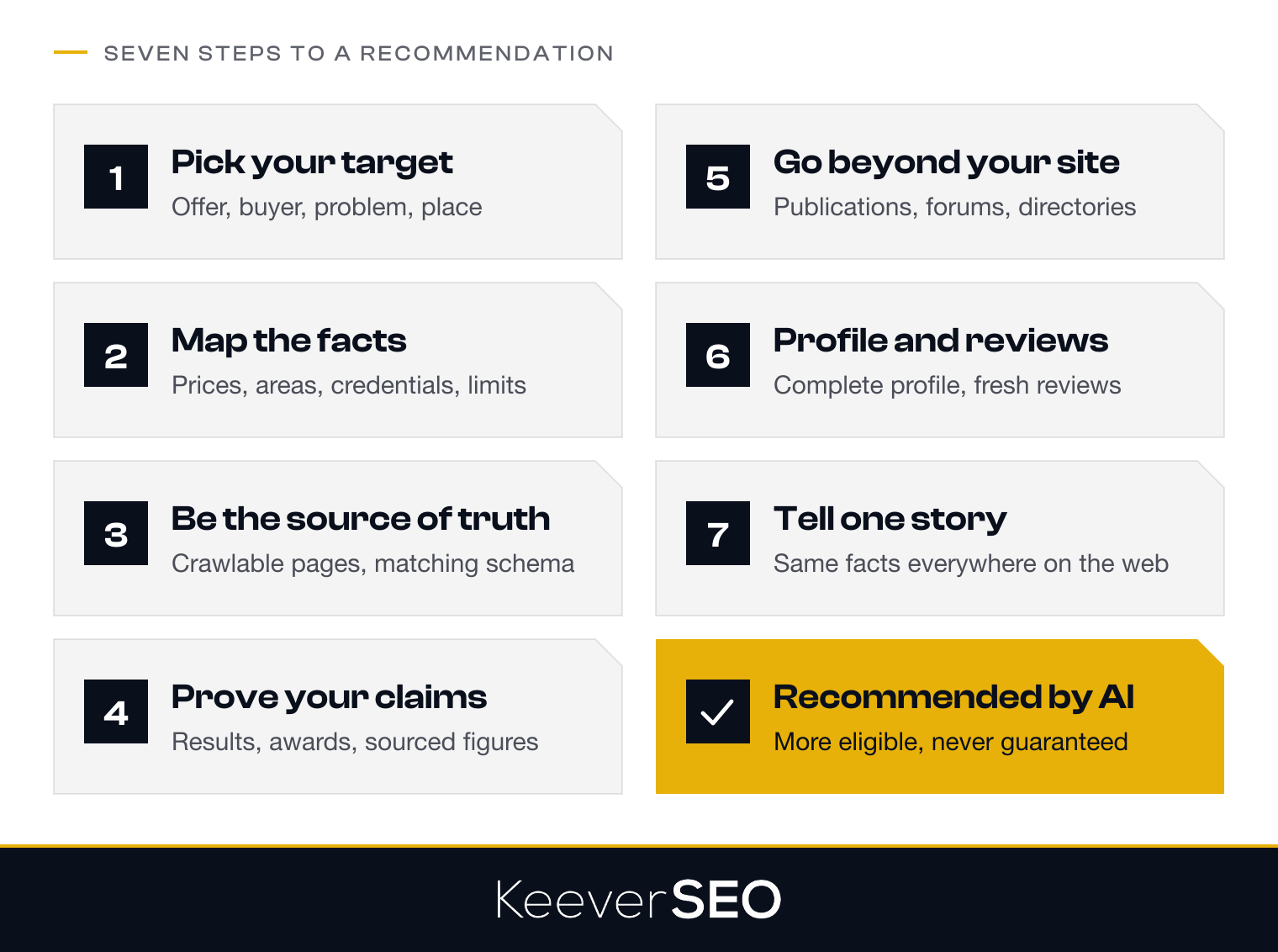
Each step helps AI assistants understand your business, judge its credibility, and match it to a buyer's request. The process begins with the services, products, audiences, and locations you want AI to recommend.
1. Decide What You Want AI to Recommend You For
To get recommended by AI, decide the services, products, audiences, and locations you want assistants to associate with your business. Each target names the offer, the buyers it serves, the problem it solves, and the places you operate, so a marketing agency might target "SEO for dental practices" and a local firm "personal injury lawyer in Phoenix."
The buyer requests behind each target cover budget, urgency, specialty, and use case, such as "Which agency handles B2B SEO for software companies?" or "Who is the best bookkeeper for small restaurants in Denver?" Clear targets and buyer requests show the information AI needs to judge each offer.
2. Map the Information AI Needs to Recommend You
To get recommended by AI, map the facts an assistant needs to match your business to each target: prices or pricing models, service areas, specialties, credentials, ideal customers, delivery options, limits, and differentiators.
Comparisons explain which problems the business solves, how its approach differs, and when a different option suits a buyer better. Each claim links to proof, such as measurable results, certifications, awards, customer examples, ratings, or independently verifiable data, and a shared fact sheet keeps the website and external profiles consistent and checkable.
3. Make Your Website the Source of Truth
To get recommended by AI, make your website the source of truth for the business facts you want assistants to use. Clear, crawlable pages for each service, product, audience, and location carry details about pricing, specialties, and credentials, and an About page identifies the business, its people, and its experience.
Organization schema for the company and LocalBusiness schema for each location help search systems read business details, as long as the markup matches the visible page content. Important facts belong in crawlable, server-rendered text that search crawlers can reach, because accessible, indexable content stays part of AI search visibility.
4. Support Your Claims With Real Evidence
To get recommended by AI, support your claims with real evidence that lets assistants verify the business and separate its record from general marketing language. Case results should describe the client's challenge, the work completed, and measurable outcomes, with dates and methods where relevant.
The forms of evidence that support AI recommendations are listed below:
- Case results: measurable outcomes, such as more leads, lower costs, or faster completion times.
- Certifications: the credential, issuing organization, and current status.
- Awards: the awarding body, category, and year.
- Named clients: client names or testimonials used only with permission.
- Original data: the sample size, collection method, and time period for surveys or benchmarks.
- Sourced figures: statistics attributed to their original sources, with links to the research.
Evidence belongs on accessible website pages, reinforced through credible industry publications and client references. Every result should stay accurate and consistent across the website, LinkedIn profile, and third-party mentions.
5. Build Your Presence Beyond Your Website
To get recommended by AI, build your presence beyond your website so AI systems can verify the business from independent sources. Industry publications, reputable directories, customer review platforms, and comparison articles supply outside information about your services and value.
Useful, accurate answers in relevant community forums and current social profiles with consistent business details, services, and locations extend that presence. Relevant mentions across trusted sources strengthen the brand's footprint and support AI recommendations.
6. Keep a Complete Google Business Profile and Fresh Reviews
To get recommended by AI, keep a complete Google Business Profile and fresh reviews so assistants can verify services, location, and operating details. Primary and secondary categories, service descriptions, service areas, regular and holiday hours, and current photos should all stay accurate.
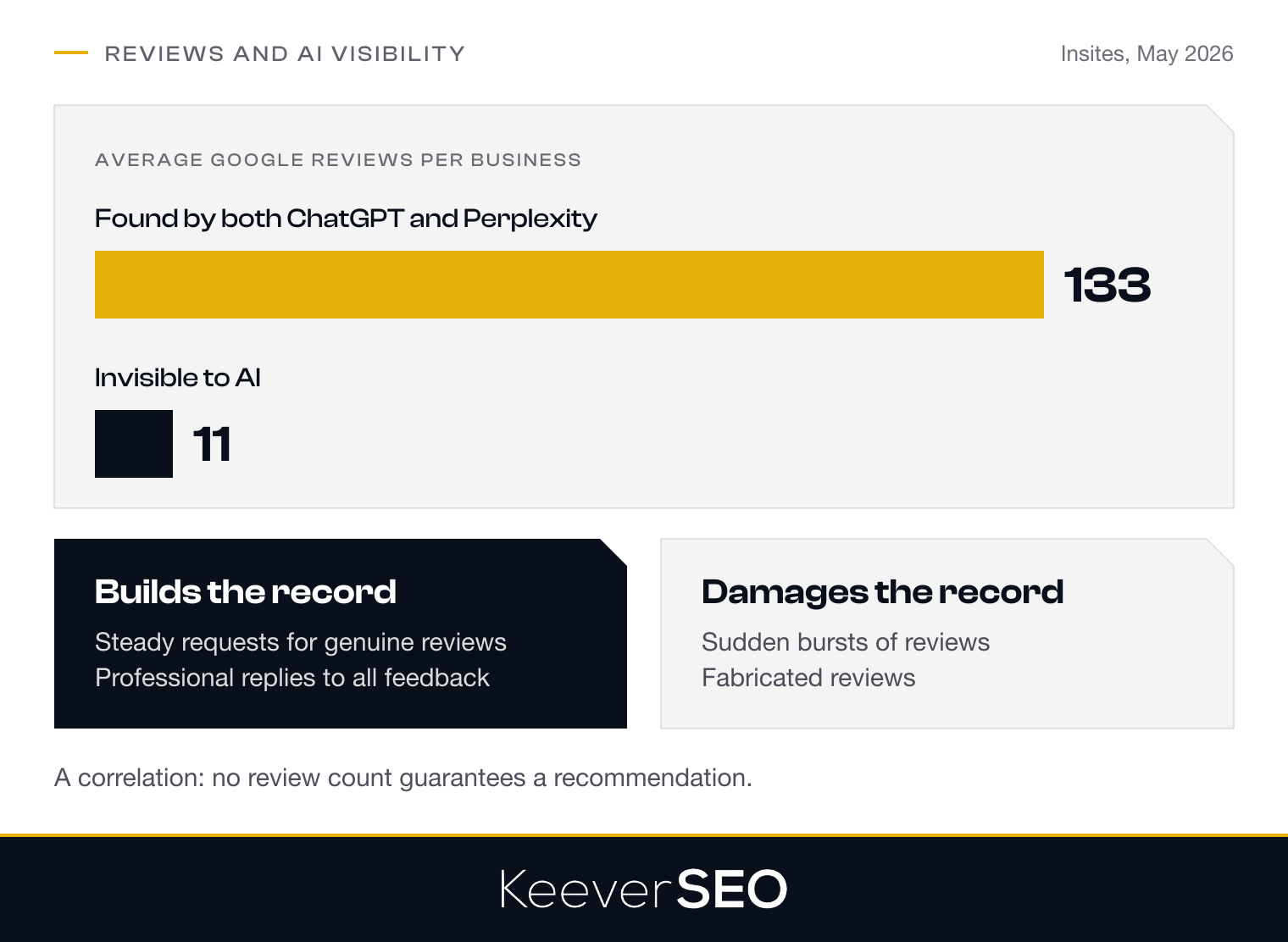
Review volume separates the businesses AI finds from those it ignores, since businesses found by both ChatGPT and Perplexity averaged 133 Google reviews against 11 for businesses invisible to AI, according to "What AI uses to choose local businesses and what It ignores" by Andrew Waite, Insites, May 2026. Steady requests for genuine reviews and professional replies to positive and negative feedback build the record, while sudden bursts or fabricated reviews damage it and no review count guarantees a recommendation.
7. Make Sure the Web Tells a Consistent Story
To get recommended by AI, make sure the web tells a consistent story about your business name, address, services, service areas, and major claims across the website, business listings, social profiles, review platforms, directories, and third-party mentions.
The website serves as the main reference point, with each external profile checked against it. Outdated addresses, service descriptions, and unsupported claims need updating, and legitimate differences such as services offered only at some locations need a clear explanation, so assistants get one account of what the business offers and where it operates.
Do You Need llms.txt to Get Recommended by AI?
No, you do not need llms.txt to get recommended by AI, because AI platforms do not require the file to recommend a business. Google Search ignores llms.txt and similar "special" files for its AI features, according to "Google's Guide to Optimizing for Generative AI Features on Google Search" published by Google Search Central, May 2026.
The proposal has thin adoption, while crawlable pages and trusted third-party mentions give stronger discovery and credibility signals. Clear website information, accurate listings, evidence, and reputable mentions come before an llms.txt file.
How Do AI Shopping Assistants Recommend Products?
AI shopping assistants recommend products by matching a shopper's request with product information from merchant feeds, product pages, retailers, and other sources. The assistants compare relevance, price, availability, product quality, seller identity, and intended use.
Accurate product feeds and structured data help assistants read product titles, descriptions, identifiers, images, prices, stock status, and key features. Product details should match across feeds, inventory systems, and product pages, and clear specifications, shipping information, reviews, and ratings answer comparisons such as best value or lowest price.
Which Mistakes Stop AI From Recommending Your Business?
The mistakes that stop AI from recommending your business are listed below:
- Vague positioning: a business description should state what the company sells, whom it serves, where it operates, and which problems it solves, since broad phrases such as "full-service solutions" give AI assistants little to match against a buyer's request.
- Conflicting facts across listings: mismatched names, addresses, phone numbers, services, and hours across the website, Google Business Profile, directories, and social profiles make the company's identity and offer harder to verify.
- Few or outdated reviews: a thin or stale review record offers weak evidence of customer experience, while recent, steady feedback gives AI assistants current third-party information.
- Claims without evidence: statements such as "award-winning" or "most experienced" need verifiable support from case results, certifications, named clients, credible awards, or sourced data.
- Blocked or inaccessible website content: robots directives, indexing errors, or key facts hidden inside images and scripts stop search systems from using a business's information.
- Buying fake mentions or reviews: fabricated endorsements and artificial reviews create unreliable signals, and manipulative link practices break search-quality policies and weaken credibility.
- Tracking keywords instead of buyer questions: keyword-only strategies miss the detailed requests buyers make to AI assistants, which need pages that answer real questions about services, comparisons, experience, and fit.
How Can a Local Service Business Get Recommended by AI Assistants?
A local service business can get recommended by AI assistants with accurate listings, recent reviews, and clear local information. A complete Google Business Profile carries correct categories, services, service areas, hours, contact details, and photos, backed by genuine reviews requested on a schedule and answered professionally.
Service and location pages should answer buyer questions about pricing, availability, qualifications, and areas served. Mentions in credible local directories, community publications, and industry sources confirm the business's local relevance, and the business name, address, services, and claims should match across the website and external listings.
When Should a Business Get Help Earning AI Recommendations?
A business should get help earning AI recommendations when competitors appear for important buyer questions, wrong facts persist, or internal teams lack time to manage the work. An outside specialist finds why AI assistants omit the business or repeat outdated details about its services, locations, pricing, or capabilities.
Professional support coordinates listing updates, content improvements, review activity, and credible outreach. A specialist tracks buyer prompts across AI assistants, monitors which competitors appear, and checks whether recommendations and cited sources change over time.
How Does Keever SEO's AI Optimization Service Get Businesses Recommended by AI?
Keever SEO's AI optimization service gets businesses recommended by AI starting with a recommendation audit across ChatGPT, Perplexity, Gemini, and Google AI Overviews. The audit reviews priority customer prompts, competitor recommendations, existing citations, crawler access, and gaps in content, technical SEO, and authority signals.
Keever SEO then develops source-of-truth pages with clear information and matching schema while building relevant reviews and third-party mentions. Ongoing prompt tracking monitors brand mentions, citations, sentiment, competitors, and share of voice across AI assistants, refining the strategy as platform answers change.
How Do You Get Recommended by Each AI Assistant?
To get recommended by each AI assistant, follow the same core process everywhere: define what you offer, publish accurate information, support claims with evidence, and build trusted mentions across the web. ChatGPT, Perplexity, and Claude draw on different search systems, crawlers, indexes, and source-selection methods, as the platform guidance below explains.
How Do You Get Your Brand Visible in ChatGPT?
To get your brand visible in ChatGPT, allow OpenAI's OAI-SearchBot to crawl your website and keep your pages indexed in Bing, one of the partner search providers ChatGPT search uses. An About page that identifies the business, its experience, and its services, plus consistent mentions on trusted industry, local, and review websites, completes the base, while crawler access and indexing make pages eligible without guaranteeing a brand mention.
How Do You Get Your Brand Mentioned in Perplexity?
To get your brand mentioned in Perplexity, publish fresh, well-cited pages that describe your business, products, or services, and allow PerplexityBot to crawl them. Relevant mentions in reputable community forums, review platforms, industry publications, and comparison pages give Perplexity more sources when answering buyer questions.
How Do You Get Mentioned in Claude?
To get mentioned in Claude, keep your website crawlable and allow Anthropic's Claude-SearchBot and Claude-User to reach the relevant pages. State the business name, services, locations, credentials, and contact details on the site, then keep those facts consistent across trusted directories, review platforms, and industry sites.
How Does Ranking in AI Search Engines Support AI Recommendations?
Ranking in AI search engines supports AI recommendations because cited pages supply the facts assistants use when naming businesses. Google AI Overviews draw on indexed web pages and link to the sources that support their answers, and strong organic visibility raises a page's chance of retrieval and citation without guaranteeing it.
Clear, evidence-backed pages and access for search crawlers help businesses appear in AI search results and support accurate recommendations.
How Long Does It Take to Get Recommended by AI?
Getting recommended by AI takes a few weeks to several months, depending on the business's existing reputation and visibility. Fixes to crawler access, key pages, or company information can show up within weeks of a recrawl, while recommendations that rest on reviews and independent mentions take months to build, and no published study measures a reliable time to a first AI recommendation.
Competition, reputation, content quality, and assistant refresh schedules shape the pace. Tracking AI answers over 90 days, while building accurate website information and credible evidence, shows whether the business is moving toward long-term recommendations.