The impact of Google AI Overviews on web traffic is fewer clicks on the queries they answer, with research showing lower organic click-through rates and smaller losses for cited pages. The impact is the change in a website's clicks, impressions, and visits when Google shows an AI-generated answer on the results page, and cited pages draw more clicks than uncited ones without bringing traffic back to pre-overview levels.
Click-through studies measure the drop for the top result and for cited pages, and the causes are on-page answers, organic listings pushed lower, and a small set of cited sources. Cited sources, known brands, tools, transactions, and local businesses still win visits, while publishers and informational, non-branded queries lose the most, and the impact is not always negative because the visits that remain are higher quality. Search Console impressions, clicks, and click-through rates, checked against analytics, measure the effect, and stable impressions with falling clicks point to an AI Overview.
Recovery comes from direct answers, original evidence, tools, branded demand, and channels beyond Google, measured with AI citations, share of voice, branded searches, conversions per visit, and AI referrals. Local service businesses lose blog visits while keeping calls and map actions, and a business protects its traffic by earning citations and giving visitors a reason to click. The article then connects the impact to zero-click searches, earning clicks from AI Overviews, the sources they cite, and how AI Overviews change SEO, starting with how Google AI Overviews affect web traffic.
How Do Google AI Overviews Affect Web Traffic?
Google AI Overviews affect web traffic by lowering organic click-through rates on the queries where they appear, while impressions hold steady or rise. Users who saw an AI summary clicked a traditional search result in 8% of visits, against 15% of visits without one, according to "Google users are less likely to click on links when an AI summary appears in the results" by Athena Chapekis and Anna Lieb, Pew Research Center, July 2025.
The decline hits informational queries hardest because AI Overviews answer many questions on the results page. The presence of an AI Overview correlates with a 58% lower average click-through rate for the top-ranking page, according to "Update: AI Overviews Reduce Clicks by 58%" by Ryan Law, Ahrefs, February 2026, so a strong ranking does not preserve website visits.
What Does Research Say About AI Overviews and Click-Through Rates?
Research on AI Overviews and click-through rates finds lower organic click-through rates on searches with Google AI Overviews than on searches without them. Ahrefs measures the drop for the top-ranking page, Pew Research Center measures clicks per visit, and Seer Interactive measures click-through rates across client accounts.
The studies use different samples and methods, so their figures describe separate measurements rather than one universal decline. The findings frame two questions: how much clicks drop when an AI Overview appears, and whether pages cited in the summary receive more clicks.
How Much Do Clicks Drop When an AI Overview Appears?
Clicks drop by about 35% to 60% for the top organic result when an AI Overview appears. Ahrefs measured a 34.5% lower click-through rate in its 2025 analysis and a 58% lower rate in its February 2026 update, and Pew Research Center found users clicked a traditional result on 8% of visits with an AI summary, against 15% without one.
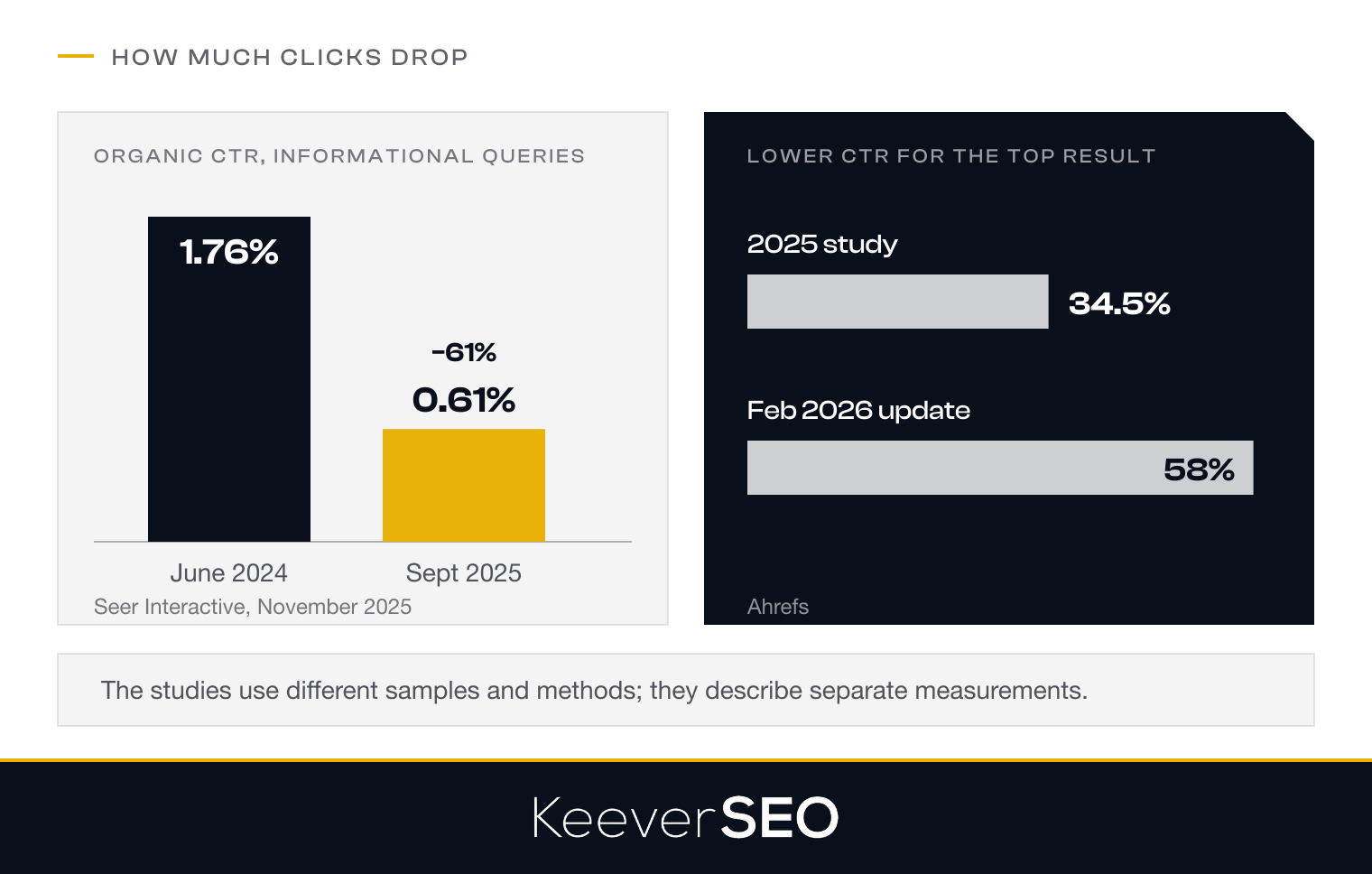
Organic click-through rate on informational queries with AI Overviews fell from 1.76% in June 2024 to 0.61% in September 2025, a 61% decline, according to "AIO Impact on Google CTR: September 2025 Update" by Tracy McDonald, Seer Interactive, November 2025. Results vary by query type, dataset, and study method.
Do Pages Cited in AI Overviews Get More Clicks?
Yes, pages cited in Google AI Overviews get more clicks than uncited pages on the same informational queries, though fewer than results without an AI Overview. Seer Interactive's September 2025 update found that brands cited in an AI Overview earned 35% more organic clicks and 91% more paid clicks than brands not cited at all, with an organic click-through rate of 0.70% against 0.52%.
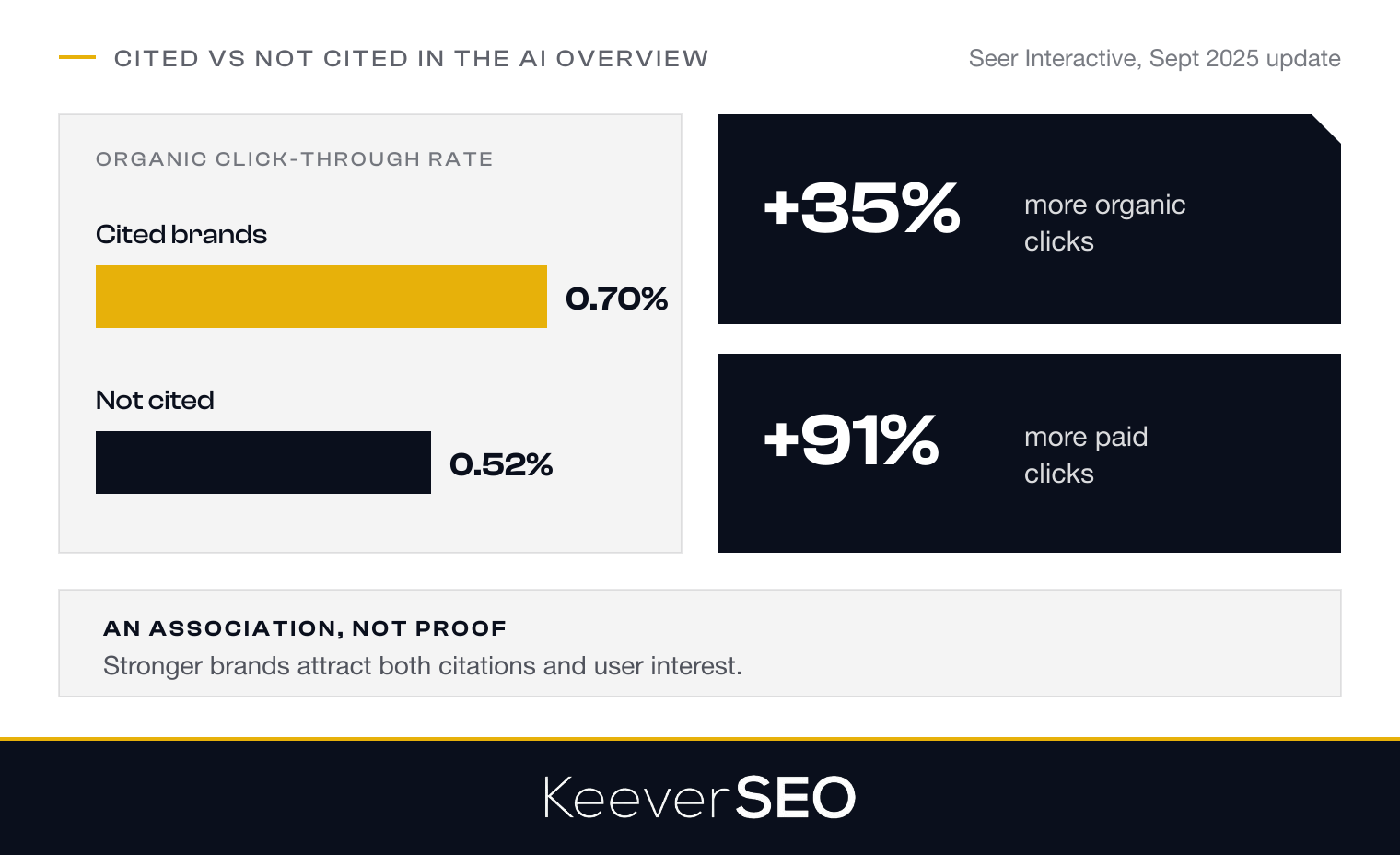
The finding shows an association, not proof that citations alone cause more clicks, since stronger brands attract both citations and user interest.
Why Does Website Traffic Drop After Google AI Overviews?
The reasons website traffic drops after Google AI Overviews are listed below:
- On-page answers: users get the information from the AI summary without visiting a website.
- Lower organic visibility: the overview takes prominent space and pushes standard listings farther down.
- Fewer informational clicks: definitions, explanations, and how-to queries receive complete answers in the summary.
- A small set of citations: AI Overviews cite a selection of sources, leaving uncited pages with less visibility.
- Summary-only searches: some users stop searching after reading the overview and never click through to the cited websites.
Which Websites Still Win Traffic With AI Overviews?
The websites that still win traffic with AI Overviews are listed below:
- Cited sources: pages cited in an overview gain visibility and referral clicks.
- Recognizable brands: known names attract searches from users looking for a particular company, product, or service.
- Websites with tools and transactions: sites serve needs such as booking, calculating, comparing, and purchasing.
- Local businesses: local results still earn calls, directions, and inquiries.
- Websites with original data or first-hand experience: research, testing, and findings give value that generic summaries cannot replace.
Which Industries and Query Types Lose the Most Traffic?
The industries and query types that lose the most traffic are news and lifestyle publishers, health and education sites, and how-to publishers, on informational, non-branded searches. Google organic search traffic to more than 2,500 sites tracked by Chartbeat fell by a third globally and by 38% in the United States between November 2024 and November 2025, according to "Journalism, media, and technology trends and predictions 2026" by Nic Newman, Reuters Institute for the Study of Journalism, January 2026, which notes the share caused by AI Overviews is unclear.
Health topics see heavy exposure, with 44.1% of medical YMYL queries triggering an AI Overview and AI Overviews appearing 1.9 times more on non-branded than branded keywords, according to "What Triggers AI Overviews? 86 Factors and 146 Million SERPs Analyzed" by Ryan Law and Xibeijia Guan, Ahrefs, November 2025. "What is" questions, symptom, procedure, recipe, and instructional queries lose the most clicks.
Is the Impact of AI Overviews Always Negative?
No, the impact of AI Overviews is not always negative, because brands cited in an overview gain visibility and awareness even when fewer users click through. Cited pages earn more clicks than uncited pages for the same query, although both receive fewer clicks than before AI Overviews appeared.
The visits that remain carry more value, since users who click want more detail, a tool, or a transaction. Google reports that "when people click to a website from search results pages with AI Overviews, these clicks are higher quality, where users are more likely to spend more time on the site", according to "Top ways to ensure your content performs well in Google's AI experiences on Search" by John Mueller, Google Search Central Blog, May 2025.
How Do You Measure the Impact of AI Overviews on Your Traffic?
To measure the impact of AI Overviews on your traffic, compare impressions, clicks, and click-through rates in Google Search Console across periods for key queries and pages, and track which target queries show an AI Overview.
Google Analytics or a similar platform shows whether organic visits, engagement, and conversions changed for the affected pages. Comparing those results with query visibility identifies the pages and searches that need diagnosis.
How Do You Diagnose a Traffic Drop After AI Overviews?
To diagnose a traffic drop after AI Overviews, compare Search Console clicks and impressions, then run the checks below to separate AI Overview effects from ranking changes or seasonal demand:
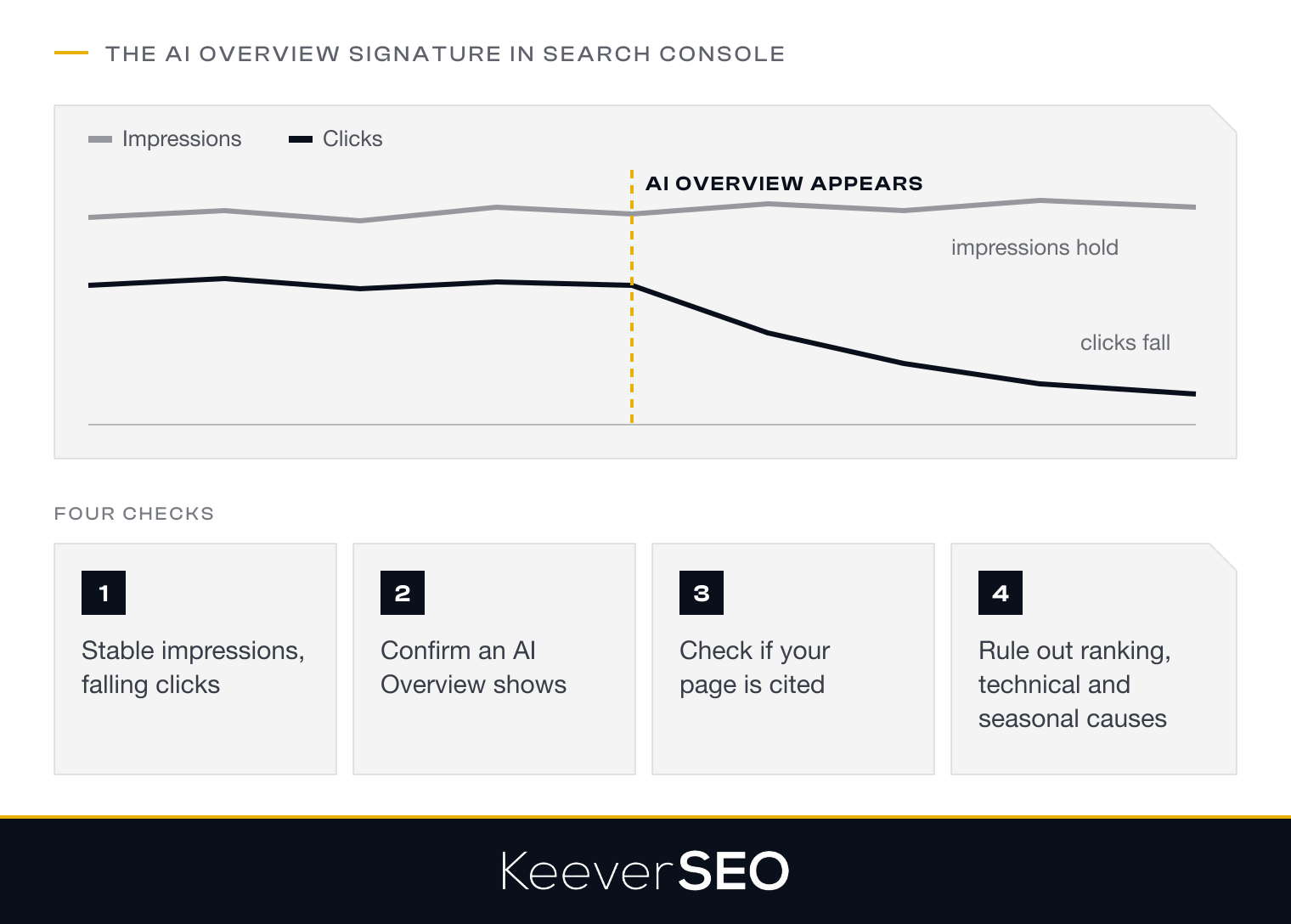
- Find pages with stable impressions but falling clicks or click-through rates.
- Search the affected queries to confirm whether Google shows an AI Overview.
- Check whether Google cites your page in the AI Overview.
- Compare year-over-year performance and review rankings, indexing, and technical issues to rule out seasonality or other causes.
How Do You Recover Traffic Lost to Google AI Overviews?
To recover traffic lost to Google AI Overviews, earn citations, attract useful clicks, and reduce dependence on informational queries, following the steps below:
- Rewrite page openings as direct answers. Place a concise, accurate answer near the start of each relevant page, under a heading that matches the search question, then give evidence, examples, and practical detail that keep readers going. Answer-first content is easier to extract, but it does not guarantee an AI Overview citation.
- Add original research and first-hand evidence. Publish company data, documented case studies, expert analysis, survey findings, or product testing, labeling methods, dates, sample sizes, and limits so readers can judge the evidence. Original information gives visitors value beyond a general AI-generated summary.
- Build useful tools and interactive resources. Create calculators, comparison tables, checklists, templates, estimators, or searchable databases. Interactive resources help users complete a task instead of reading a short answer, giving them a practical reason to visit.
- Target searches with stronger action intent. Expand beyond broad informational queries that AI Overviews answer on the page. Useful pages for local, branded, product, comparison, and transactional searches serve users who need to choose a provider, compare options, or complete an action.
- Cover the next question after the summary. Add content about costs, alternatives, implementation, eligibility, risks, troubleshooting, and provider selection. Follow-up information meets needs a short results-page summary leaves open and gives searchers a reason to click.
- Build branded search demand. Publish distinctive research, expert-led guidance, and recognizable company viewpoints that lead people to search for the business by name. Brand queries attract users looking for a particular company instead of a general answer.
- Improve internal pathways from informational pages. Link relevant articles to services, products, case studies, tools, and contact pages. Clear internal links move visitors from a first answer to a related task or business decision.
- Strengthen citation eligibility and technical access. Use descriptive titles, clear headings, accurate author information, and well-supported claims. Important pages should stay crawlable and organized so search systems can read the content and identify its source.
- Diversify traffic beyond Google organic search. Grow email subscriptions, direct visits, social distribution, referral partnerships, video, and community channels. A wider channel mix reduces reliance on clicks from a single search feature.
- Measure citations and traffic outcomes separately. Track organic clicks, conversions, impressions, branded searches, AI Overview citations, and referral visits from AI platforms. Separate reporting shows whether a content update improves visibility, visits, or business results.
Which Success Metrics Replace Clicks in AI Search?
The success metrics that replace clicks in AI search are listed below:
- AI Overview citations: how many times Google cites your pages as sources.
- Share of voice in AI answers: how frequently AI responses mention or cite your brand against competitors.
- Impressions: search visibility compared with clicks, showing exposure that produces no visits.
- Branded search volume: searches containing your business or product name.
- Conversions per visit: leads, purchases, bookings, or other actions per website visitor.
- AI referral traffic: visits arriving from AI search experiences and other AI platforms.
How Do Google AI Overviews Affect Traffic for Local Service Businesses?
Google AI Overviews affect traffic for local service businesses by cutting clicks to informational blog pages, since the overview answers questions about pricing, timing, and service processes in the search results. Local searches still generate calls, map clicks, direction requests, and bookings through Google Business Profiles, although no research shows that those actions hold steady.
A citation in an AI Overview introduces a business to people comparing providers. Clear answers about costs and service steps, such as roof repair pricing or furnace inspections, help customers judge the business and lead them to make contact.
How Can a Business Protect Its Traffic From AI Overviews?
A business can protect its traffic from AI Overviews by earning citations on important queries and giving visitors reasons to click. Original research, first-hand advice, detailed case studies, pricing information, and useful tools give value beyond an AI summary, and pages must be indexed and eligible for Search snippets to appear as supporting links, which does not guarantee a citation.
Local businesses should keep a complete Google Business Profile with accurate services, hours, contact details, photos, and location information. Branded search demand built through reliable service, customer reviews, partnerships, and consistent marketing reduces dependence on generic informational searches.
How Does Keever SEO's AI Optimization Service Protect Traffic From Google AI Overviews?
Keever SEO's AI optimization service protects traffic from Google AI Overviews starting with an audit of organic performance and AI visibility. The audit reviews rankings, existing citations, competitor presence, crawler access, and gaps in content, technical SEO, and authority signals.
Keever SEO then rewrites priority pages with direct answers, develops original content, and strengthens local business profiles. Ongoing reporting tracks clicks, cited URLs, citation frequency, brand mentions, and AI referral traffic to guide the next changes.
How Do Zero-Click Searches Shape AI Overviews Traffic Loss?
Zero-click searches shape AI Overviews traffic loss because they cut website visits before AI Overviews existed, as users found answers on the results page. A Similarweb-based study found that "in the first four months of 2026, a whopping 68.01% of Google searches ended without a click", up from 60.45% in 2024, according to "In 2026, Less than One Third of Google Searches Still Send a Click" by Rand Fishkin, SparkToro, June 2026.
Google AI Overviews extend the pattern to complex, multi-part informational queries by summarizing the answer in the search results, which reduces the need to visit source websites.
How Do You Earn Clicks From AI Overviews Instead?
To earn clicks from AI Overviews instead, become a cited source and offer information the summary cannot replace. A direct, well-structured answer followed by original data, detailed examples, tools, or practical steps gives readers a reason to visit, and titles and headings built around follow-up needs such as costs, comparisons, or implementation steps draw the click.
A citation raises visibility, but it does not guarantee a website visit. The question below covers which sources Google AI Overviews cite.
Which Sources Do AI Overviews Cite?
The sources AI Overviews cite are top-ranking pages, authoritative publishers, and platforms such as Reddit, YouTube, and Wikipedia. The cited mix varies by query, with how-to searches featuring videos and community discussions and health, finance, and news searches drawing on established publishers and reference sites.
How Are AI Overviews Changing SEO?
AI Overviews are changing SEO from a rankings-only model to a model of visibility and citations. Search rankings still matter, and AI Overview citations give pages a second way to appear in Google results, so answer-first content with clear headings and original, trustworthy information gives AI systems material to summarize and cite.
SEO reporting now tracks AI visibility and citations alongside clicks, which leads to how search traffic is divided between engines, as the question below covers.
How Do AI Search Engines Split Search Traffic?
AI search engines split search traffic with Google sending most referral visits to websites and ChatGPT, Gemini, Perplexity, and other AI platforms contributing a small, growing share. AI platforms account for 0.32% of all website traffic, up from 0.24% in 2025 and 0.02% in 2024, with ChatGPT generating 74.78% of AI referral traffic, according to "Analysis of Top AI Search Engines: Who Is Catching Up to ChatGPT?" by Yulia Deda, SE Ranking, June 2026.
Will Google AI Overviews Keep Reducing Web Traffic?
Yes, Google AI Overviews will keep reducing web traffic on informational queries as Google expands AI Overviews and AI Mode. Direct answers on the results page reduce the need to visit websites for questions that summarize well.
Cited pages, recognizable brands, and transactional websites are best placed to keep their visits because users want trusted sources, named businesses, and actions. The impact of Google AI Overviews on web traffic will depend more and more on citations, brand demand, and content that offers value beyond an AI summary.