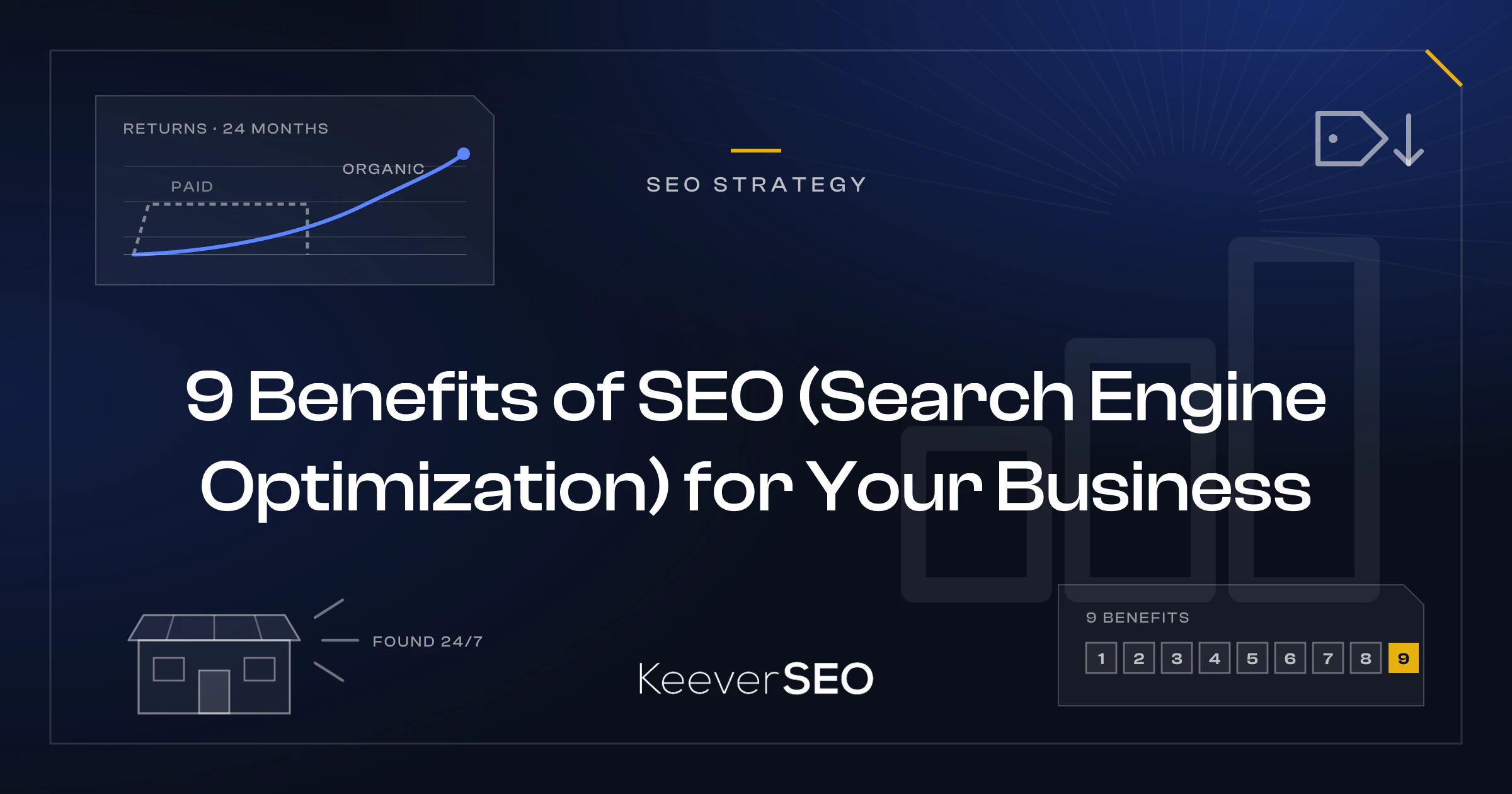
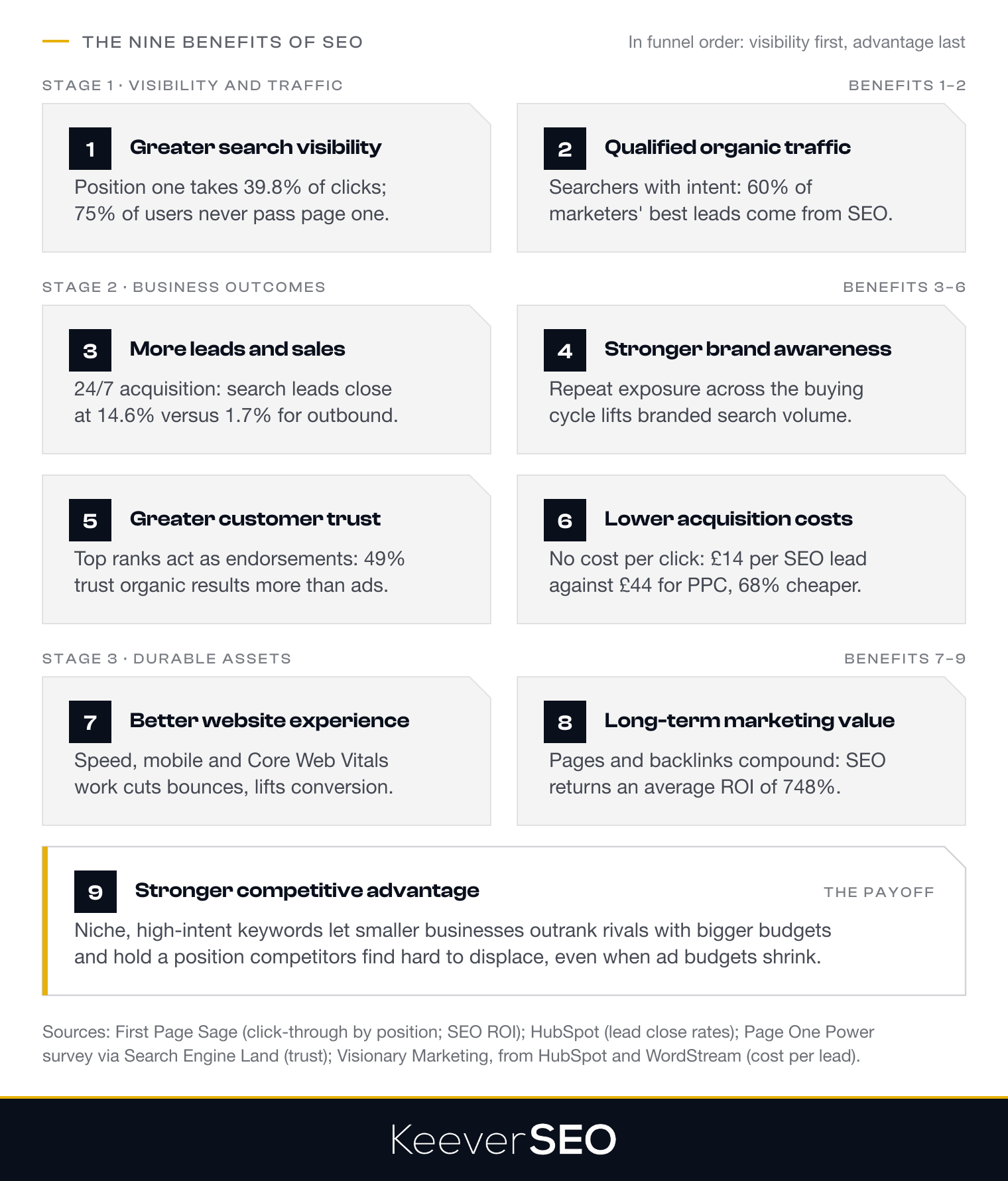
SEO delivers nine core benefits to a business: greater search visibility, more qualified organic traffic, more leads and sales, stronger brand awareness, greater customer trust, lower acquisition costs, a better website experience, long-term marketing value, and a stronger competitive advantage. Search engine optimization is a digital marketing strategy that raises a website's visibility on search engines like Google by optimizing technical aspects of the site, producing high-quality content, and building authority through backlinks. Search engine optimization helps businesses attract relevant audiences actively searching for their products or services.
The nine benefits of SEO follow a strategic funnel that begins with visibility and traffic, then converts attention into tangible business outcomes. Greater search visibility generates more qualified organic traffic, visitors who arrive with genuine intent. Qualified organic traffic converts into more leads and sales because the prospects are already searching for what your business provides. Beyond immediate conversions, SEO builds stronger brand awareness through repeated exposure in search results, establishes greater customer trust through high rankings that act as implicit endorsements, and delivers lower customer acquisition costs than paid advertising. SEO pushes businesses to create a better website experience, generates long-term marketing value that compounds over time, and provides a stronger competitive advantage by letting smaller businesses compete with larger rivals in organic search.
SEO improves organic search visibility by positioning your business where potential customers are looking, and the visibility gained translates into sustainable growth. Unlike paid advertising, which stops delivering results when the budget runs out, organic rankings provide 24/7 promotion, and organic search contributes 53.3% of all web traffic. The first organic Google listing captures 39.8% of all search traffic, while 75% of users never move beyond the first page of results, so top rankings decide how much market share a business captures. The visibility advantage reduces dependence on paid advertising while creating compounding value: content assets and backlinks accumulate over time, so returns grow without proportional increases in investment. SEO suits businesses ready to invest in a long-term strategy, from local service providers using Google Business Profile optimization to e-commerce companies targeting high-intent keywords across the entire marketing funnel.
Whether SEO suits your business depends on your market, timeline expectations, and capacity to invest in quality implementation. When organic growth stalls, technical capacity is lacking in-house, or you're ready to invest for compounding returns rather than immediate results, hiring an SEO agency becomes the strategic move. Choosing the right agency requires evaluating transparency in methodology, reporting quality that demonstrates measurable ROI (search engine leads show close rates of 14.6%, far above traditional marketing), proven case studies and results, fair pricing models, and consistent communication. The right agency partner reconnects your business to the first benefit, greater search visibility, by executing the technical audits, keyword research, content creation, link building, and ongoing optimization that move your website up the rankings and into the view of customers actively searching for what you offer.
1. Greater Search Visibility
Greater search visibility is the first benefit of SEO: higher rankings in Google's organic search results put a business in front of more searchers. Higher positions on search engine results pages (SERPs) lead to higher click-through rates, as users click most on first-page results. The first organic Google listing captures 39.8% of all search traffic, according to the report "Google Click-Through Rates (CTRs) by Ranking Position" published by First Page Sage in 2026, so attaining a high rank pays off directly. A presence on page one matters because 75% of users do not go beyond the first page, and businesses that secure top positions gain the most exposure.
Beyond the standard listings, SEO targets SERP features like featured snippets, local pack results, and knowledge panels to increase visibility. SERP features occupy prominent positions on search results and attract extra attention and clicks. Raising a page's relevance and authority for targeted keywords increases the likelihood of capturing clicks from searchers. Greater search visibility translates into more qualified organic traffic, visitors actively searching for the products or services a business offers.
2. More Qualified Organic Traffic
More qualified organic traffic is the second benefit of SEO: organic search attracts visitors who are actively looking for particular products or services. Unlike paid advertising, which interrupts users, organic search reaches individuals who are already interested, making the traffic more relevant and more likely to convert. The qualification advantage comes from targeting high-intent keywords, such as queries indicating a clear willingness to purchase or ask about pricing. Businesses that rank for high-intent terms draw visitors who are close to a buying decision, which distinguishes organic search as an acquisition channel.
High-intent keywords like "emergency plumbing services near me" or "industrial safety equipment supplier" signal strong purchase intent. Businesses ranking for such queries capture searches from individuals with immediate needs, raising the likelihood of engagement and conversion. 60% of marketers report that their highest quality leads stem from SEO-engaged customers, which confirms the qualification advantage organic search provides.
Qualified organic traffic acts as a bridge between visibility and revenue. Visitors arriving with genuine interest convert at higher rates than visitors from general awareness channels, generating the leads and sales that drive business growth.
3. More Leads and Sales
More leads and sales follow from SEO's role as a continuous, 24/7 acquisition mechanism that captures interest at any time. Unlike paid campaigns that depend on active management and budgets, organic rankings let businesses connect with potential customers day and night. The always-on visibility means a business never misses a chance to engage individuals actively searching for its products or services.
SEO reaches buyers at every stage of the decision-making process, from initial research to final purchase. Targeting high-intent keywords attracts visitors who have already expressed a need for a product or service, and such visitors convert into leads and sales at a higher rate. Inbound marketing research by HubSpot found that search engine leads close at a rate of 14.6%, far above the 1.7% close rate for outbound leads, while SEO-driven traffic converts at about 2.4%.
The conversion power of SEO is well documented: capturing high-intent visitors across the full marketing funnel raises revenue. Each new customer who finds the business through search then feeds stronger brand awareness.
4. Stronger Brand Awareness
Stronger brand awareness comes from repeated visibility in search results, which builds recognition and mindshare across the buying cycle. A business that appears in search results for relevant queries again and again reinforces its presence among potential customers, and users begin to associate the brand with specific products or services.
Brand awareness grows at every stage of the purchase path. Early-stage searchers may encounter the brand through informational content, while buyers in the consideration stage see the brand again in comparison searches. The continuous presence keeps the brand top-of-mind and influences purchase decisions when users are ready to convert. Sustained work on non-branded keywords can increase branded search volume, a sign of growing recognition and recall.
Brand awareness gains from SEO extend beyond recognition. Businesses ranking prominently on search engines are perceived as more credible and trustworthy before users click their websites. The perception builds brand equity over time, as prospects who frequently encounter the brand in search results develop familiarity and trust. Stronger brand awareness through SEO attracts new customers and supports long-term loyalty.
5. Greater Customer Trust
Greater customer trust comes from SEO establishing a business as a credible authority in search results. High rankings on search engines like Google act as an implied endorsement, and users perceive top-ranking sites as more trustworthy. 75% of users never scroll past the first page of search results, so high rankings raise credibility along with visibility.
Trust is reinforced by E-E-A-T signals: Experience, Expertise, Authoritativeness, and Trustworthiness. Google uses E-E-A-T signals to evaluate content quality. Well-researched content demonstrates the Expertise signal, while positive customer reviews and testimonials add credibility. Consumers place more trust in organic results than in paid ads: 49% of Americans trust organic search results more than paid results, while only 5% trust paid results more, according to a 2025 Page One Power survey reported by Search Engine Land.
The trust earned in search carries through the buying process. When potential customers repeatedly encounter a brand in relevant searches, supported by positive reviews and complete information, they gain the confidence to choose the business over competitors, which lowers the perceived risk of the purchase and improves conversion rates.
6. Lower Customer Acquisition Costs
Lower customer acquisition costs (CAC) result from organic clicks carrying no cost-per-click, unlike pay-per-click (PPC) advertising. Businesses attract visitors without ongoing fees by investing in content creation, technical improvements, and authority building. Over time the investment compounds as organic search visibility grows and keeps generating traffic without new costs.
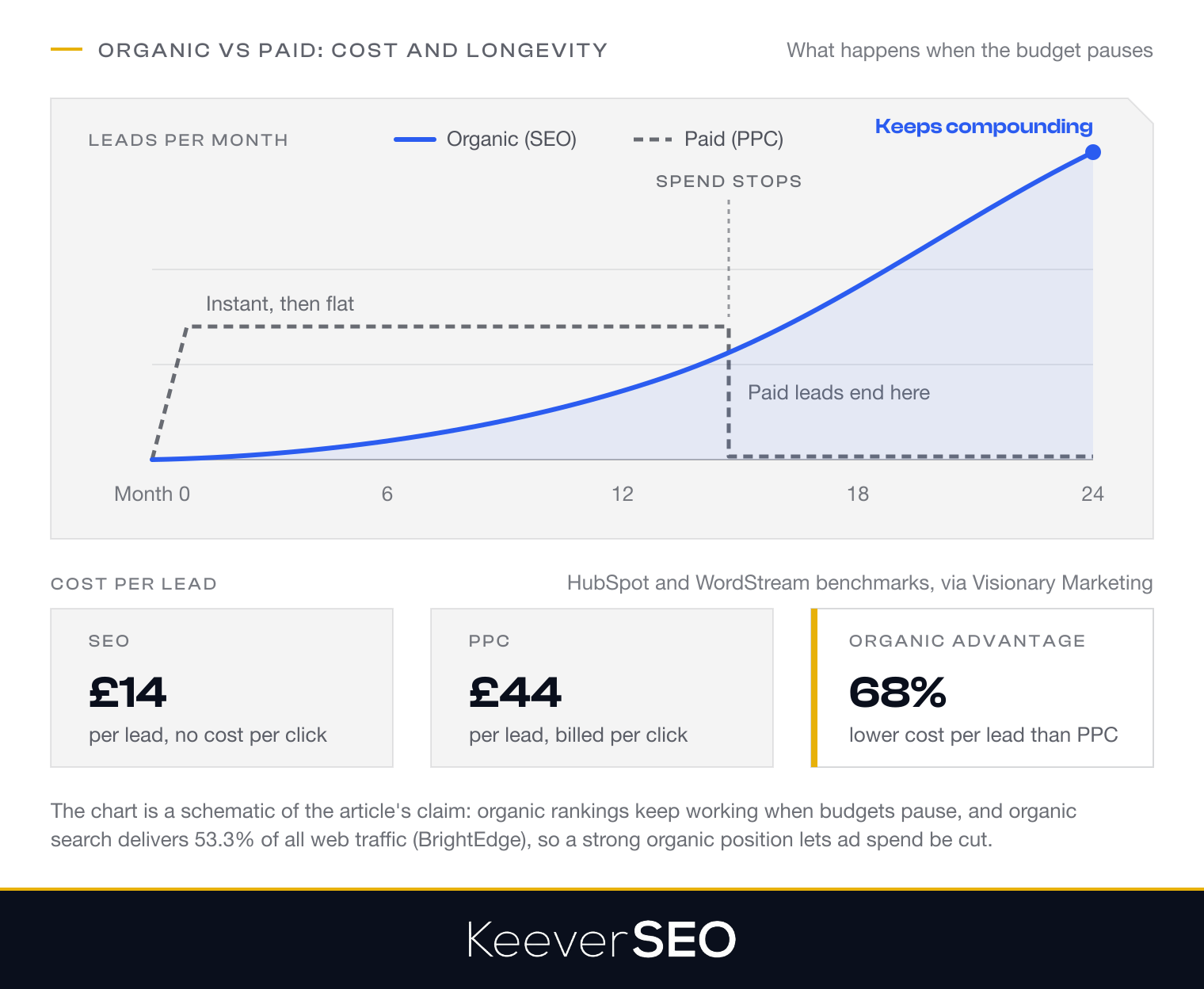
Industry benchmarks confirm the cost advantage of SEO. Data compiled by Visionary Marketing from HubSpot and WordStream benchmarks puts the average cost per lead from SEO at £14, compared with £44 for PPC, a 68% cost advantage for organic search. As organic rankings mature, businesses receive a steady stream of qualified leads at a fraction of the cost of paid advertising channels.
7. Better Website Experience
A better website experience results from SEO work on site speed, mobile-friendliness, and navigation. Google's Core Web Vitals, which measure loading performance, interactivity, and visual stability, influence search rankings, so optimizing them reduces bounce rates, improves engagement, and smooths the path to conversion.
Fast-loading pages and responsive design let visitors access content quickly on any device. Clear structure and intuitive navigation help users find information without friction. SEO work on speed, structure, and navigation improves search rankings and turns the website into a more usable, accessible platform at the same time.
8. Long-Term Marketing Value
Long-term marketing value comes from SEO building a foundation that compounds over time. Search engine optimization acts as a continuous asset, unlike temporary marketing campaigns: each optimized page or earned backlink keeps contributing traffic and leads well beyond the initial effort. Search engine leads close at a rate of 14.6%, far above traditional outbound methods. The ROI from SEO is measurable, since analytics platforms report keyword performance and visitor behavior, and returns strengthen as campaigns mature, as documented in First Page Sage's SEO ROI research. The compounding value shows in growing content assets and backlink equity, which sustain visibility and authority: as more content is published and links are earned, the site's reach expands, while the cost of maintaining rankings stays lower than the cost of paid advertising.
9. Stronger Competitive Advantage
A stronger competitive advantage comes from SEO letting businesses outperform larger rivals in search engine results. Consistent SEO work makes a business appear more frequently and more prominently for high-value keywords, capturing attention before larger competitors do. Search visibility matters beyond traffic because the searchers being reached are actively comparing options and ready to act. Over time, sustained SEO builds a durable presence in search results that competitors find hard to displace, and the business captures demand at the point of need.
Smaller businesses compete with larger, more established rivals by focusing on relevance, content quality, and technical excellence. Targeting high-intent keywords and niche search queries lets a business outrank competitors with bigger budgets and build a defensible moat. As a business accumulates authoritative backlinks and topical authority through complete content coverage, its search dominance compounds.
The strategic advantage of SEO extends beyond individual keyword rankings to market positioning and customer acquisition efficiency. Businesses with strong organic rankings operate with lower customer acquisition costs and greater budget flexibility. The edge grows during economic downturns or budget constraints, when companies dependent on paid traffic must reduce visibility while businesses with a strong organic presence maintain a consistent customer flow.
How Does SEO Improve Organic Search Visibility for a Business Website?
SEO improves organic search visibility by optimizing a business website to meet search engine ranking criteria: relevance, authority, and technical performance. Search engines like Google evaluate those factors to decide which pages best answer user queries. Targeting relevant keywords, creating quality content, building authoritative backlinks, and maintaining technical excellence such as fast page speed and mobile-friendliness raise a website's position in search results step by step.
Authority determines how much visibility a website earns. Search engines read signals like quality backlinks, positive user engagement, and E-E-A-T (Experience, Expertise, Authoritativeness, and Trustworthiness) to validate a website's ranking. A business website that demonstrates relevance and authority together gains better placement on search engine results pages, and the earned visibility supports the core pillars of SEO that keep ranking positions competitive.
What Are the Core Pillars of SEO for Businesses?
The core pillars of SEO for businesses are listed below:
- On-Page SEO: optimizing individual web pages to rank higher and earn more relevant traffic, through relevant keywords, meta tags, and structured content that matches user search intent.
- Technical SEO: improving the technical side of a website, from site speed and mobile-friendliness to crawlability and indexing, so search engines can access and evaluate the website efficiently.
- Content: publishing high-quality, relevant content that answers user queries, aligns with search intent, and establishes authority within the industry.
- Backlinks/Off-Page SEO: building quality backlinks from authoritative websites to raise the site's credibility and trustworthiness, and managing the external signals that shape search engine perception.
- Local SEO: optimizing Google Business Profiles, keeping business information consistent, and gathering local reviews to improve visibility for businesses targeting local markets.
How Does SEO Help Search Engines Understand a Business Website?
SEO helps search engines understand a business website by supporting crawling and indexing, adding structured data markup, and strengthening semantic signals. Crawling means search engine bots fetch pages and follow links; indexing means the engine analyzes content such as titles, text, and images to decide how pages are stored and understood.
Structured data markup gives explicit signals about page content, such as products, services, and business information, so search engines categorize and display the content more accurately in search results. Semantic signals, produced through optimized content structure and relevant keywords, clarify topical relationships and context and help search algorithms match the website to the right user queries.
Why Is SEO Important for Business Growth?
SEO is important for business growth because it enables sustained demand capture and continuous customer engagement. A website optimized for search engines attracts potential customers who are actively searching for its products or services, creating a self-reinforcing cycle: higher rankings bring greater visibility, greater visibility drives more qualified traffic, and qualified traffic produces leads and conversions. The funnel from visibility to traffic to leads becomes a reliable growth engine that runs continuously.
The long-term value of SEO supports growth further. As a website builds authority through quality content and backlinks, its rankings strengthen over time and capture a larger share of high-intent search traffic. The compounding effect means a business investing in SEO generates short-term gains while building a durable asset, one that reduces reliance on paid channels and delivers a return on investment that improves year over year.
Does SEO Reduce Dependence on Paid Advertising?
Yes, SEO reduces dependence on paid advertising by creating a sustainable organic traffic channel. Organic rankings deliver traffic without a cost-per-click, letting businesses lower ongoing ad spend over time. Organic search contributes 53.3% of all web traffic, according to the BrightEdge research report "Organic Channel Share Expands to 53.3% of Traffic," 2019. As businesses win strong organic positions for high-intent keywords, they can cut the paid advertising budget while maintaining or even increasing total traffic and lead generation, and the freed budget can be reallocated to other growth initiatives.
Can SEO Support Sustainable Customer Acquisition?
Yes, SEO supports sustainable customer acquisition by providing a consistent, repeatable channel for attracting visitors, leads, and customers without ongoing media costs. Organic search rankings, unlike paid advertising campaigns, continue to generate traffic even when budgets are paused. Organic search therefore keeps a steady flow of potential customers arriving over time, giving customer acquisition long-term stability.
Can SEO Create Compounding Marketing Value?
Yes, SEO creates compounding marketing value by accumulating content assets and backlinks whose returns grow over time. Each optimized page and earned backlink acts as a permanent asset that keeps attracting traffic and leads. As the library of high-quality content expands and the backlink profile strengthens, domain authority rises and sustained organic traffic follows. A 2026 analysis by First Page Sage found that SEO campaigns yield an average return on investment of 748%, with longer time horizons producing stronger results as visibility builds.
Is SEO Suitable for Every Business?
SEO suits most businesses, and companies that benefit from search-driven discovery gain the most: service-based companies, local businesses, and e-commerce brands see the best results. SEO improves their visibility in search results, putting them in front of customers who are actively searching for their products or services.
SEO does require commitment to a realistic timeline and a steady budget. Meaningful results appear after several months of consistent effort, so a business with a tight budget or a need for immediate results may find SEO a poor fit. Local SEO rewards brick-and-mortar businesses by capturing nearby customers through location-based searches, while a business in a highly regulated industry or one relying solely on referrals may see less value from SEO.
When Should a Business Hire an SEO Agency?
A business should hire an SEO agency when internal efforts fail to achieve the desired search performance. Common signals include stagnating organic traffic, unresolved technical issues, and competitors outperforming the business in search rankings. A lack of in-house capability for advanced work, such as Core Web Vitals optimization and complex site migrations, points the same way.
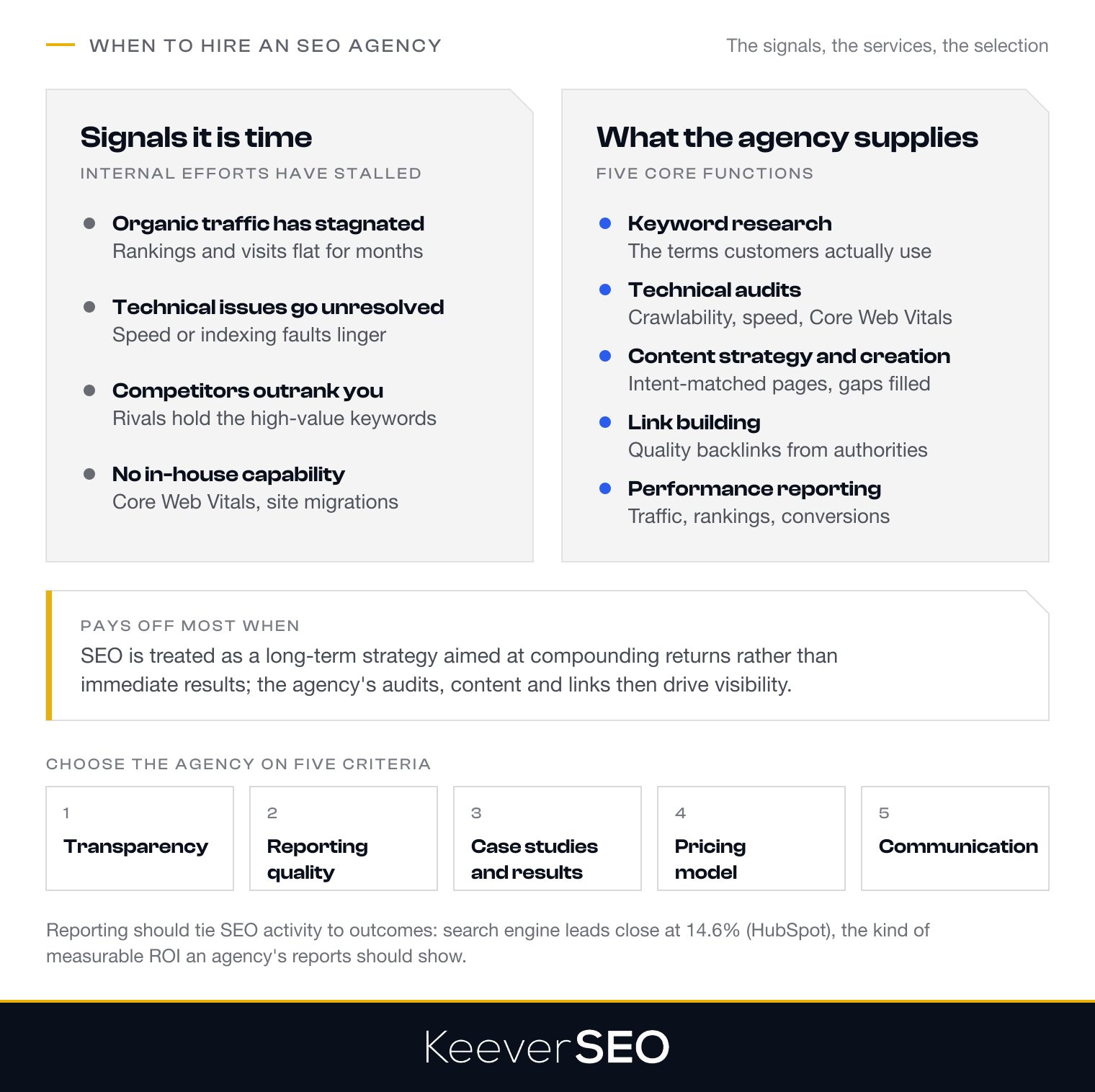
Hiring an SEO agency pays off most when a business is ready to treat SEO as a long-term strategy aimed at compounding returns. An agency supplies technical audits, content development, and link building, the work that raises search visibility and drives sustainable growth.
What Does an SEO Agency Do for a Business?
An SEO agency raises a business's online visibility and search engine performance through specialized services. The core functions of an SEO agency are listed below:
- Keyword Research: identifying the high-value search terms potential customers use, so the business's web pages target the right queries.
- Technical Audits: evaluating a website's technical health, from crawlability and site speed to mobile usability and Core Web Vitals, and fixing the issues that hold rankings back.
- Content Strategy and Creation: developing and optimizing content that aligns with user intent, filling gaps and reducing duplication to strengthen site authority and relevance.
- Link Building: acquiring quality backlinks from authoritative sources to raise the site's credibility and its position in search engine results.
- Performance Reporting: reporting key metrics such as organic traffic, keyword rankings, and conversion rates, and using the data to guide ongoing strategy adjustments.
Each function serves rankings first and broader business goals second, from lead generation to revenue growth.
How Should a Business Choose an SEO Agency?
A business should choose an SEO agency by evaluating the selection criteria listed below:
- Transparency: the agency explains its strategies, methods, and deliverables plainly; vague language or a claimed "secret sauce" is a warning sign.
- Reporting Quality: reports connect SEO activity to business outcomes, going beyond rankings and traffic alone.
- Case Studies and Proven Results: recent case studies demonstrate success in similar markets or business models, with clear baselines, timelines, and measurable outcomes.
- Pricing Model: pricing is itemized and transparent, without hidden fees, and aligns with the budget and expected ROI timeline.
- Communication: the agency responds quickly, provides regular updates, sets realistic timelines, and names who will be responsible for the work.
An agency that meets the five criteria can deliver greater search visibility and sustained organic growth aligned with the business's goals and budget.
Why choose Keever SEO agency?
Businesses choose Keever SEO because the agency delivers proven results and measurable ROI from organic search traffic. Keever SEO optimizes the ranking factors that matter most, including Core Web Vitals and site structure, so websites meet search engine guidelines. The agency's customer-centric strategy anticipates search intent and delivers high-quality content that connects with prospects. Keever SEO builds long-term value through organic strategies that keep the business visible 24/7 without recurring media costs, and transparent reporting and communication quantify every SEO gain.
Working with Keever SEO aligns a business with the wider benefits of SEO, from greater search visibility to a sustained competitive advantage.