Bing and Google Search differ in market reach, ranking algorithms, and use cases. Google dominates with roughly 90% global market share, whereas Bing holds around 3-4%. Bing is Microsoft's search engine, launched in 2009, while Google Search was created in 1998 by Larry Page and Sergey Brin. The key differences cover market reach and index coverage, with Google's index exceeding 100,000,000 gigabytes and Bing's covering 8-14 billion pages; ranking algorithms, where Google leans on mobile-first indexing and semantic NLP while Bing weighs keywords and social signals; AI-powered search, where Bing runs Bing Copilot (GPT-4) and Google runs Gemini and AI Overviews; privacy handling, with Google tied to account-level data across its products and Bing collecting less; result layouts, where Bing offers a better organic-to-ad ratio plus Microsoft Rewards; and platform integration, which ties Bing to Edge, Windows, and Office while Google anchors Chrome, Android, and Workspace.
The two engines overlap in core functionality, handling standard queries, image search, video search, maps and local results, voice search, and autocomplete. Google still commands 90% or more of the global market with over 1 billion daily users, against Bing's roughly 3-5% with about 100 million users. Bing wins when a user sits inside the Microsoft environment, values visual and image search quality, or reaches audiences on Edge, Windows devices, or voice assistants. Google wins for everyday searches on the strength of broader reach, stronger semantic relevance, and better handling of non-English queries. Businesses adjust SEO for both: Bing rewards exact-match keywords and social signals, Google rewards semantic content depth and backlink quality. An SEO agency measures performance with Bing Webmaster Tools and Google Search Console, and Bing optimization earns priority for U.S. enterprise audiences and verticals with higher Bing adoption. The differences mark out Bing's role as a search engine with its own priorities and visibility opportunities.
What is Bing?
Bing is a web search engine developed by Microsoft, launched in June 2009. Bing succeeded earlier search services such as MSN Search and Live Search, carrying forward Microsoft's push to compete in the search market, and it operates as part of the wider Microsoft product family.
As a core Microsoft product, Bing ties tightly into the Windows operating system, the Microsoft Edge browser, and Microsoft Office. The integration extends Bing beyond a standalone search engine, embedding search across the Microsoft experience. Bing's features include web search, image search, video search, and news results, powered by Microsoft's algorithms and AI technology.
Bing's place inside Microsoft's product family gives it strategic weight in delivering one coherent experience across devices and platforms. Ties to Microsoft Rewards and Copilot add incentives and AI functions on top of search. Despite a smaller market share than Google, Bing stays relevant, above all for users and businesses embedded in Microsoft's products.
What is Google Search?
Google Search is the leading global search engine, founded in 1998 by Larry Page and Sergey Brin. First named "BackRub," Google Search introduced the PageRank algorithm, which changed how search engines evaluate web page relevance by analyzing link quality and quantity, and that innovation made Google the preferred choice for most users.
Google Search grew to dominate the market with around 90% share worldwide, serving over one billion daily active users. The Google search index surpasses 100,000,000 gigabytes, the largest search database available. Google has folded in natural language processing, mobile-first indexing, and AI-driven features such as AI Overviews and Gemini.
Google Search reaches beyond the results page, connecting with Chrome, Android, Google Workspace, and specialized surfaces like Google Books and Google Finance. The connections give users one continuous path to information across platforms and cement Google Search as the default tool for everyday searches.
What Are the Key Differences Between Bing and Google Search?
The key differences between Bing and Google Search are listed below:
- Market reach and index coverage: Google commands a global market share of roughly 90% with over 1 billion daily active users, whereas Bing holds around 3-5% with about 100 million users.
- Ranking algorithms: Google prioritizes semantic interpretation and mobile-first indexing, while Bing weighs exact-match keywords and social signals.
- AI-powered search: Bing integrates OpenAI's GPT-4 for conversational search, whereas Google runs its Gemini model and AI Overviews.
- Privacy and personalization: Google collects broad user data for personalized experiences, whereas Bing's data collection stays narrower.
- Result layout and rewards: Bing serves a more visually focused results page with Microsoft Rewards, while Google balances ad placement with organic results.
- Platform integration: Bing plugs into Microsoft products like Windows and Office, while Google anchors Android and Chrome.
How do market reach and index coverage differ between Bing and Google Search?
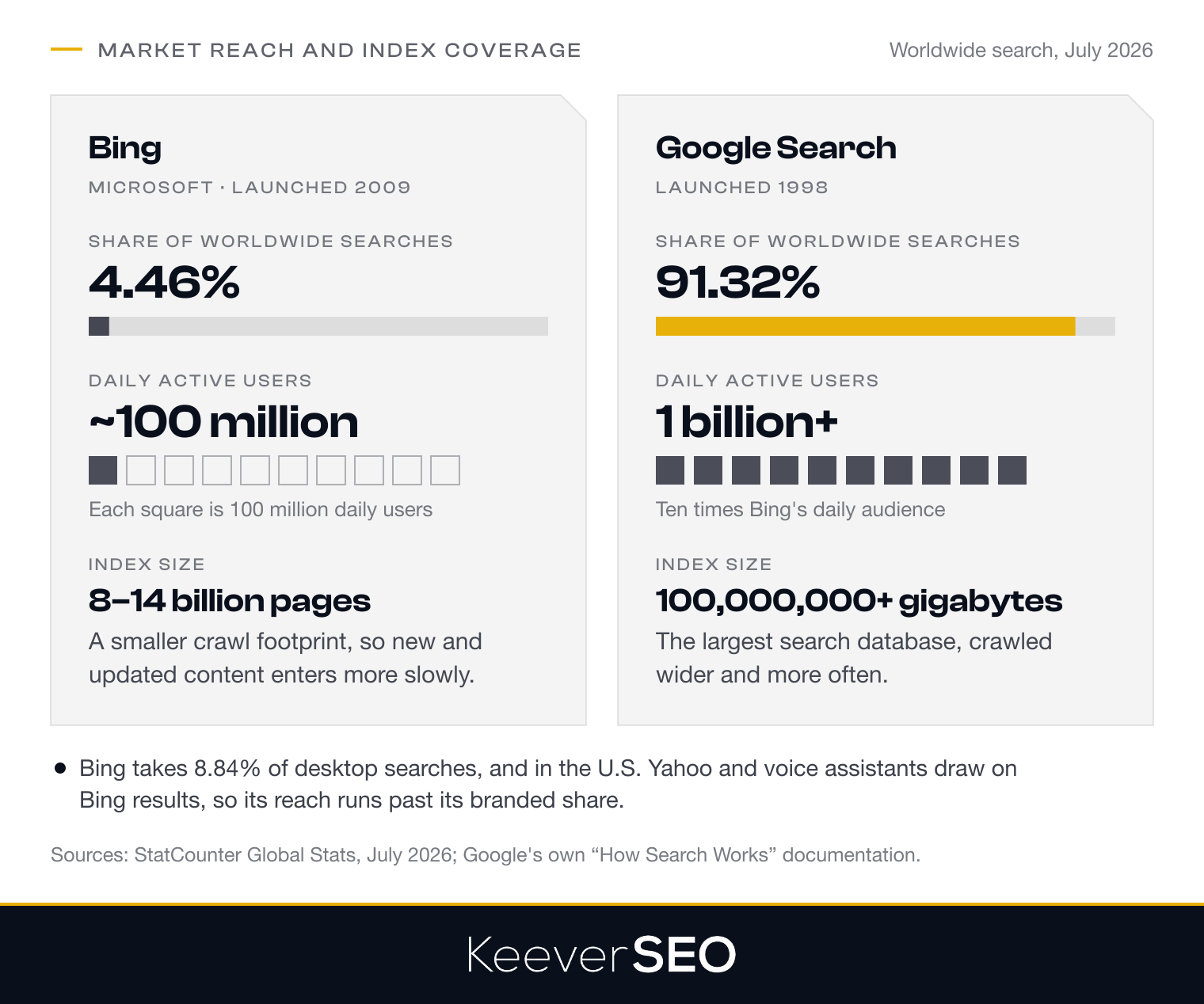
Google Search surpasses Bing in market reach and index coverage by an order of magnitude. Google commands roughly 90-91% of the global search market and serves over 1 billion daily active users, while Bing holds around 3-5% with about 100 million daily active users; StatCounter's Global Stats put Google at 91.32% and Bing at 4.46% of worldwide search as of July 2026. The Google index is well over 100,000,000 gigabytes in size, according to Google's own "How Search Works" documentation, supporting more frequent and wider crawling, so new and updated content enters Google faster than Bing. Bing's index spans an estimated 8 to 14 billion web pages, a smaller crawl footprint. Bing keeps its relevance in certain markets all the same, above all in the United States, where Microsoft properties handle a meaningful share of online queries through Yahoo and voice assistants that draw on Bing results. Google's lead in daily query volume and indexed content decides the breadth and depth of results each engine can deliver.
How do search algorithms and ranking systems differ between Bing and Google Search?
Bing and Google Search rank pages through different systems. Google Search prioritizes semantic interpretation and natural language processing (NLP) through systems like BERT and MUM, weighing semantic relevance over keyword density; Google introduced BERT in the October 2019 announcement "Understanding searches better than ever before" by Pandu Nayak, who called it one of the biggest advances in the history of Search. Bing weighs exact-match keywords in title tags and URLs and leans on social signals from platforms like Twitter and Facebook, signals Google does not use, a weighting documented in SE Ranking's guide "SEO for Bing: Unlocking the Power of Bing's Search Traffic."
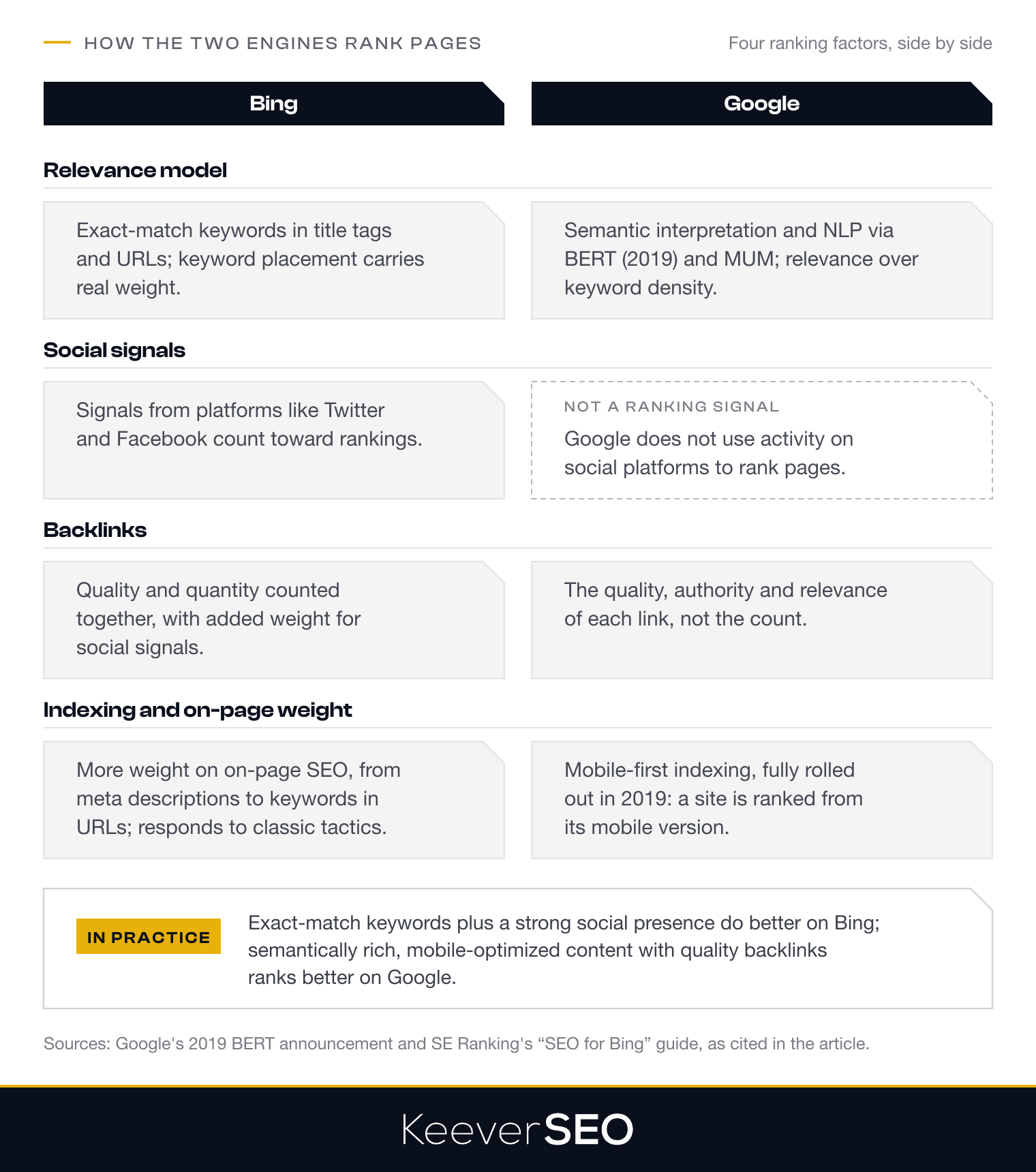
On backlinks, Google Search favors the quality, authority, and relevance of links, while Bing counts quality and quantity together and adds weight for social signals. Google's mobile-first indexing, fully rolled out since 2019, ranks a site from its mobile version. Bing puts more weight on on-page SEO, from meta descriptions to keyword placement in URLs, which makes it more responsive to traditional optimization tactics. In practice, content optimized with exact-match keywords and a strong social presence can perform better on Bing, while semantically rich, mobile-optimized content with high-quality backlinks ranks better on Google.
How do AI-powered search experiences differ between Bing and Google Search?
AI-powered search in Bing and Google differs in design and implementation. Bing integrates AI through Copilot, built on OpenAI's GPT-4, delivering conversational AI-generated summaries directly within search results and synthesizing information from multiple sources, an integration Microsoft announced in its February 2023 post "Reinventing search with a new AI-powered Microsoft Bing and Edge, your copilot for the web." Google runs its own Gemini AI alongside AI Overviews, which place AI-generated summaries at the top of results pages for a growing share of queries in major markets.
The strategic split goes beyond the models. Bing's generative search combines traditional page ranking with AI-driven summaries and positions AI as its lead differentiator against Google's dominance, while Google has folded AI in more cautiously to protect its search advertising revenue. Both engines use large language models to generate contextual answers, with Bing's GPT-4 implementation noted for accuracy on straightforward queries and Google's stack stronger on complex image prompts and multimodal searches through its Multitask Unified Model (MUM).
How do privacy and personalization differ between Bing and Google Search?
Bing and Google Search handle privacy and personalization differently. Google Search collects broad user data across Android, Chrome, YouTube, and Google Workspace, and the data feeds highly personalized experiences built on browsing behavior, location, and cross-device activity. Bing collects data more narrowly, drawing mainly on search history and Microsoft account settings, which leaves a lighter tracking footprint. Both engines offer privacy controls, but Google's defaults collect more, so users must actively disable tracking to limit collection. Surfshark's research on browser data collection found Google's Chrome collects 20 data types against 12 for the Bing app, and the pattern holds for the engines behind them: Google's integration depth makes it the more privacy-invasive engine by default, while Bing's smaller reach across products translates into thinner user profiling.
How do search-result layouts, ads, and rewards differ between Bing and Google Search?
Bing and Google Search differ in result layouts, advertising density, and user rewards. Bing's results pages keep organic listings more prominent, with a lighter organic-to-ad ratio than Google's pages, which give ads growing space. Microsoft Advertising powers Bing's paid search with rich ad formats across right-rail and mainline placements, while Google Ads dominates the global paid search market with a streamlined core experience and no built-in rewards program.
Microsoft Rewards sets Bing apart: users earn points for searches and redeem them for gift cards, subscriptions, and other benefits, a program Google does not match. Bing's result pages lean visual, above all for media content, while Google's layout is tuned for speed and mobile-first efficiency, sometimes at the cost of organic visibility.
How do Microsoft and Google ecosystem integrations differ between Bing and Google Search?
Microsoft and Google integrate their search engines into different product families. Bing sits deep inside Microsoft's products, from the Edge browser and Windows operating system to Office, so search works natively across Microsoft's enterprise and consumer platforms, with voice search and the AI-powered Copilot assistant built in. Google Search runs through Google's own products: the Chrome browser, the Android mobile operating system, and Workspace collaboration tools, with a tilt toward mobile-first experiences and hyper-localized services carried by Android's global reach and Chrome's popularity. The practical outcome: Bing fits users living in Microsoft's products, while Google Search fits users who run on Google's mobile and desktop tools.
Where Do Bing and Google Search Overlap in Core Functionality?
The core functionality where Bing and Google Search overlap is listed below:
- Shared query handling: both engines process standard web searches for keywords, phrases, and informational queries, refining input with autocomplete and spell-check.
- Image search: both provide dedicated image search with filters for size, color, type, and license, plus reverse image lookup.
- Video search: both index and display video with preview playback and filters for duration, quality, and upload date; Bing's video search runs more interactive, while Google features YouTube prominently.
- Maps and local search: Bing Maps and Google Maps both deliver location-based results, business listings, directions, and route planning; Google offers more detailed route planning, Bing broader local area results.
- Voice search: both support voice input, with Bing feeding multiple voice assistants and Google Assistant known for contextual comprehension.
- Autocomplete parity: both predict searches as users type, drawing on popular queries, trending topics, and personalized history.
How Does Market Share Compare Between Google Search and Bing?
Google Search holds roughly 90% of the global search market, while Bing holds about 3-4%, per StatCounter's Global Stats measurement of worldwide search referrals. The gap shows in user counts as well: Google serves over 1 billion daily active users, Bing around 100 million. Google's reach and query volume dwarf Bing's on every global measure.
Bing's share has grown modestly on the back of AI features like Copilot, built on OpenAI's GPT-4. The growth concentrates in the United States, where Bing's relevance extends past its direct share because Microsoft properties, including Yahoo search and voice assistants that draw on Bing results, capture a meaningful slice of U.S. queries. Bing's smaller share therefore hides strategic weight in particular demographics and regions.
Bing's position makes it a secondary but strategically useful platform, above all for businesses targeting Microsoft-centric users or hunting less competitive organic rankings. Google stays the primary optimization target on audience size, while Bing supplies advantages in defined niches.
When Should You Choose Bing Search Over Google Search?
You should choose Bing over Google in a few defined scenarios. Bing pays off for users embedded in Microsoft's products, where it plugs into Windows, Edge, and Office and carries benefits like Microsoft Rewards and Copilot access. Bing excels in visual search, with high-quality image results and detailed metadata, which makes it the pick for users who put weight on visuals.
Bing suits users who want a rewards program and lighter data collection, along with anyone preferring a less personalized experience or keeping a second engine for comparison. Two user scenarios stand out: Microsoft-centric users who gain from Bing's integration, and everyday searchers who stay better served by Google.
When is Bing the better fit for Microsoft ecosystem users?
Bing is the better fit for Microsoft ecosystem users when their work and devices already run on Microsoft products. Bing plugs into Edge, Windows, and Office 365, appearing as the native search option in Edge and the Windows search bar. Microsoft Rewards adds points for every Bing search, redeemable for rewards, which pays users for staying inside the Microsoft environment.
Bing's tie to Copilot strengthens the case for AI-assisted work: Copilot draws on Bing for web search and information retrieval, delivering AI answers inside Microsoft's platforms. The fit is tightest in enterprise settings where Microsoft 365 and Teams are standard and administrators set Bing as the default engine, synchronizing bookmarks, history, and settings across devices. Bing's visual search strength and media-rich results add appeal for image-heavy research.
When is Google the better fit for general everyday searches?
Google is the better fit for general everyday searches because of its reach and language understanding. Google Search serves a global base above 1 billion daily users on the strength of its 90% market share, and its algorithm handles natural language with precision across a huge range of queries. Mobile-first indexing keeps results aligned with how people search today.
Google's semantic interpretation reads user intent more accurately, which returns more relevant results for common, conversational queries. The index, past 100,000,000 gigabytes, covers popular and niche topics alike. Google's connections to Maps and Google Assistant add detailed local information and contextual voice search, rounding out the case for Google as the everyday default.
Which Search Engine Wins the Bing vs Google Comparison Overall?
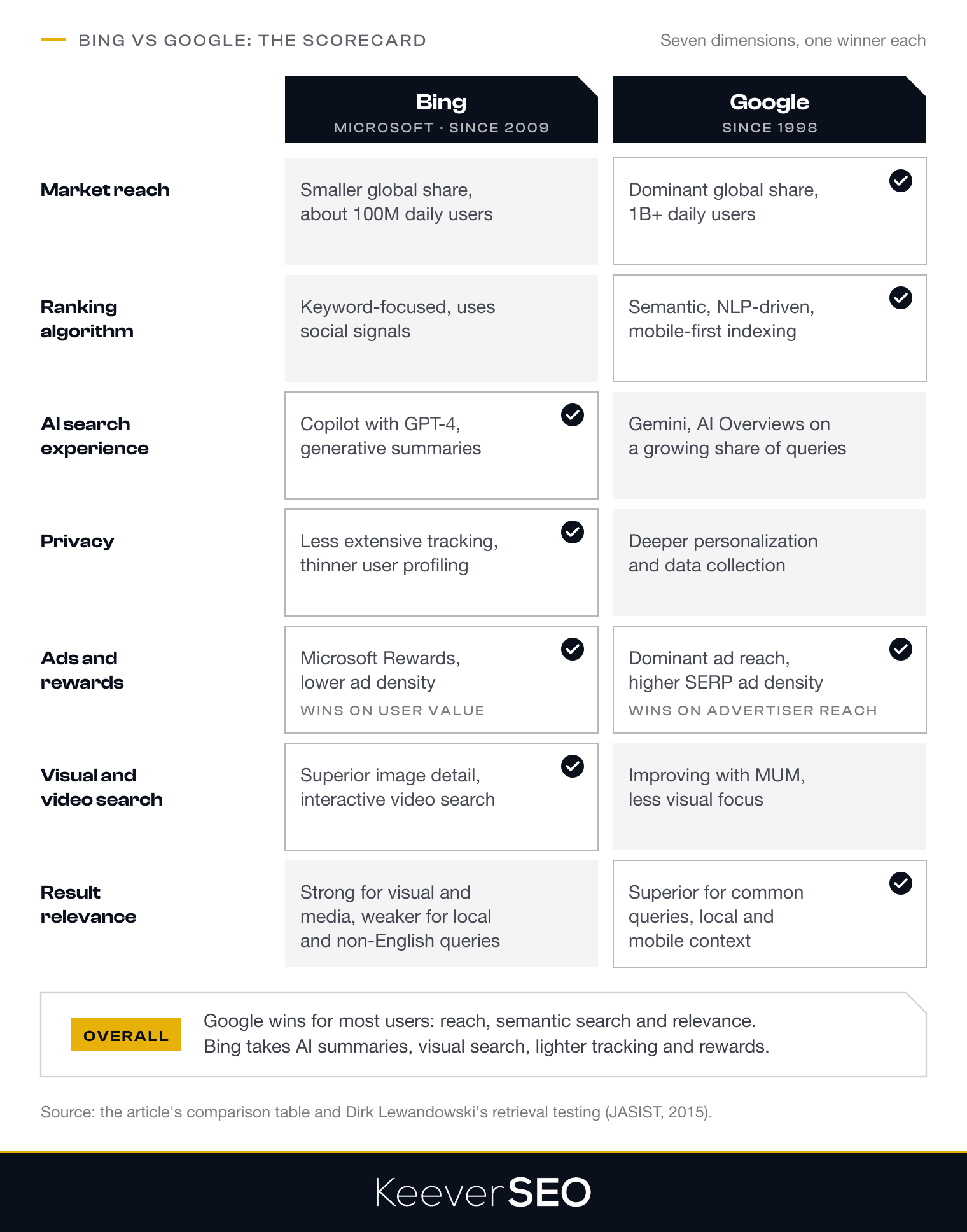
Google wins the Bing vs Google comparison overall for most users and business applications, while Bing takes defined categories. The dimension-by-dimension outcome is shown in the table below.
| Dimension | Bing | Winner | |
|---|---|---|---|
| Market Reach | Smaller global share, ~100M daily users | Dominant global share, 1B+ daily users | |
| Ranking Algorithm | Keyword-focused, uses social signals | Semantic, NLP-driven, mobile-first indexing | |
| AI Search Experience | Copilot with GPT-4, generative summaries | Gemini, AI Overviews on a growing share of queries | Bing |
| Privacy | Less extensive tracking | Deeper personalization and data collection | Bing |
| Ads and Rewards | Microsoft Rewards, lower ad density | Dominant ad reach, higher SERP ad density | Bing (user value) / Google (advertiser reach) |
| Visual and Video Search | Superior image detail and interactive video search | Improving with MUM, less visual focus | Bing |
| Result Relevance | Strong for visual/media, weaker for local/non-English | Superior for common queries, local, mobile context |
Peer-reviewed retrieval testing by Dirk Lewandowski found Google ahead of Bing on informational and navigational queries alike, and Google takes the verdict on market reach, semantic search strength, and result relevance: its 90%+ share and NLP depth make it the default for general search and for businesses chasing maximum visibility. Bing wins on visual search quality, lighter tracking, and rewards, a strong alternative for Microsoft-centric users. The right engine follows from the use case rather than a single absolute ranking.
How Do Bing and Google Compare in Search-Result Relevance?
Bing and Google compare unevenly in search-result relevance, with Google ahead on common queries and Bing ahead on visuals. Google returns more relevant results for informational and navigational queries on the strength of semantic interpretation and its larger index: the study "Evaluating the retrieval effectiveness of web search engines using a representative query sample" by Dirk Lewandowski, published in the Journal of the Association for Information Science and Technology in 2015, found Google identified the correct result for 95.3% of navigational queries against Bing's 76.6%. Bing stands out in image and video search, with higher-quality visuals and richer metadata, the pick for visually intensive searches.
For niche and long-tail queries, Google's broader index and ranking systems surface more relevant results. Bing struggles with local relevance, above all for non-English queries and less-common regional contexts, while Google's hyper-localized results and detailed route information hold the advantage. Bing's Microsoft integration and visual strength keep it competitive whenever those factors lead the requirements.
How Do Bing and Google Differ for Organic Visibility?
Bing and Google differ for organic visibility in how much SERP space organic results receive and how rankings are earned. Bing has historically kept organic listings more prominent, with a lighter organic-to-ad ratio, so sites can win visibility with less dependence on paid placement, though Search Engine Land's report "Bing pushes ad-heavy search results with 7+ sponsored listings" shows Bing testing far heavier ad loads on some result pages. Google's results pages push organic listings further down as advertising space grows, which trims the click-through potential of organic positions.
Ranking difficulty splits the same way. Bing's algorithm rewards exact-match keywords in title tags and URLs plus social signals from platforms like Twitter and Facebook, so a well-optimized page can reach top positions even with a modest backlink profile. Google's semantically driven system reads intent and context through natural language processing and demands a deeper, more authoritative content profile for the same positions.
The split obliges businesses to fit their SEO to each platform: Bing's keyword-matching rewards precise on-page targeting, while Google demands context, depth, and intent coverage.
How Should Businesses Adapt SEO for Bing and Google?
Businesses should adapt SEO for Bing and Google by running a dual-track strategy on one shared foundation. Google rewards semantic search depth, mobile-first indexing, and content that demonstrates authority and contextual relevance. Bing puts higher value on exact-match keywords in title tags and URLs and reads social signals from platforms like Twitter and Facebook. Both engines reward high-quality content, authoritative backlinks, and solid technical health.
The dual-track approach keeps the shared foundation of best practices in place while fitting targeting to each engine's priorities, and the shared technical and content practices that serve both engines follow below.
Which technical SEO and content-targeting practices benefit both engines?
The technical SEO and content-targeting practices that benefit both engines are listed below:
- Exact-match keywords for Bing: placing exact-match keywords in title tags, URLs, and meta descriptions raises relevance and ranking potential on Bing.
- Semantic content depth for Google: content with semantic depth and contextual richness aligns with user intent and lifts visibility on Google.
- Quality backlinks: both engines reward high-quality backlinks from authoritative, relevant sites.
- Structured data: schema markup helps both engines read content context, improving rich-result visibility and engagement.
- Bing Webmaster Tools and Google Search Console: running both consoles tracks site performance on each engine and keeps indexing sharp.
- Bing Places and Google Business Profile: optimized local listings on both platforms secure local search visibility for geographically targeted businesses.
How Should an SEO Agency Measure Bing and Google Performance?
An SEO agency should measure Bing and Google performance through separate tracking frameworks per engine. Bing Webmaster Tools covers Bing and Google Search Console covers Google, giving precise tracking of organic impressions, click-through rates, and keyword rankings on each platform. Microsoft Advertising metrics for Bing and Google Ads metrics for Google then support side-by-side evaluation of cost-per-click (CPC), return on ad spend (ROAS), and conversion rates. Separate frameworks keep performance data clean per platform, and the platform-level metrics worth tracking follow below.
Which organic and paid-search metrics should be tracked by platform?
The organic and paid-search metrics to track per platform are laid out in the table below:
| Platform | Organic Metrics | Paid Metrics |
|---|---|---|
| Bing | Impressions, clicks, click-through rate (CTR), average position, indexed pages (tracked via Bing Webmaster Tools with bi-weekly automated SEO reports and recommendations) | Cost-per-click (CPC), return on ad spend (ROAS), conversion rate, impression share, quality score (tracked via Microsoft Advertising) |
| Impressions, clicks, click-through rate (CTR), average position, Core Web Vitals performance, mobile usability, indexed pages (tracked via Google Search Console) | Cost-per-click (CPC), return on ad spend (ROAS), conversion rate, impression share, quality score, auction insights (tracked via Google Ads) |
Bing Webmaster Tools brings its own advantages for organic tracking, including Google Search Console data import and automatic bi-weekly SEO reports with actionable recommendations that speed up optimization work. Google Search Console stays the standard for organic measurement, above all for mobile-first indexing and Core Web Vitals tracking, given Google's audience scale. Google Ads offers the more sophisticated paid-search tooling and the far larger reach, while Microsoft Advertising's lower competition supports cheaper clicks; both platforms share the foundational metrics, from CPC and ROAS to conversion tracking, that make cross-platform comparison and budget allocation possible.
How Should an SEO Agency Prioritize Bing Optimization?
An SEO agency should prioritize Bing optimization when audience, vertical, and device-fit triggers align with Bing's strengths. Bing optimization earns priority for businesses targeting U.S. audiences, where Microsoft properties, including Yahoo and Bing-powered voice search, capture a meaningful share of queries. Client demographics that skew toward desktop users working inside Microsoft's products strengthen the case further.
Certain verticals, led by finance, technology, and B2B services, see higher Bing engagement than consumer-focused industries, which makes optimization more cost-effective there. Device patterns matter too: Bing holds a stronger position on desktop search, taking 8.84% of worldwide desktop queries per StatCounter, so businesses reached mainly through desktop computers gain more. Companies invested in Microsoft's products, from Edge and Windows to Office and Microsoft Advertising, compound the value through integration and Microsoft Rewards retention.
Bing's 100 million daily active users represent a real audience with thinner organic competition. For agencies running multi-platform strategies, the marginal effort stays small, since quality content, backlinks, technical health, and structured data serve both engines. The prioritization call weighs the client's market position, Microsoft Advertising's lower cost-per-click, and the easier organic gains in a less saturated field.
What Do Bing vs Google Search Differences Mean for SEO?
The Bing vs Google Search differences mean SEO works best as a dual-engine strategy. Google, holding the dominant global share, rewards content depth, semantic relevance, and mobile-first indexing. Bing rewards exact-match keywords, social signals, and quality backlinks, and opens opportunities for businesses targeting U.S. audiences.
Optimizing for both engines widens organic visibility. Google's indexing and AI features like AI Overviews demand content structured for semantic depth and mobile performance, while Bing's ties to Microsoft Advertising and Bing Webmaster Tools supply their own reporting and strength in visual and image search. A business that reads each engine's priorities can tune its SEO with precision.
Bing and Google work as paired channels rather than interchangeable platforms: Google carries semantic relevance and broad reach, Bing carries keyword-focused ranking and visual search strength. A business that fits its SEO to both engines captures the advantages of each, and the differences between them stop being a trade-off and become a wider net for visibility and traffic.