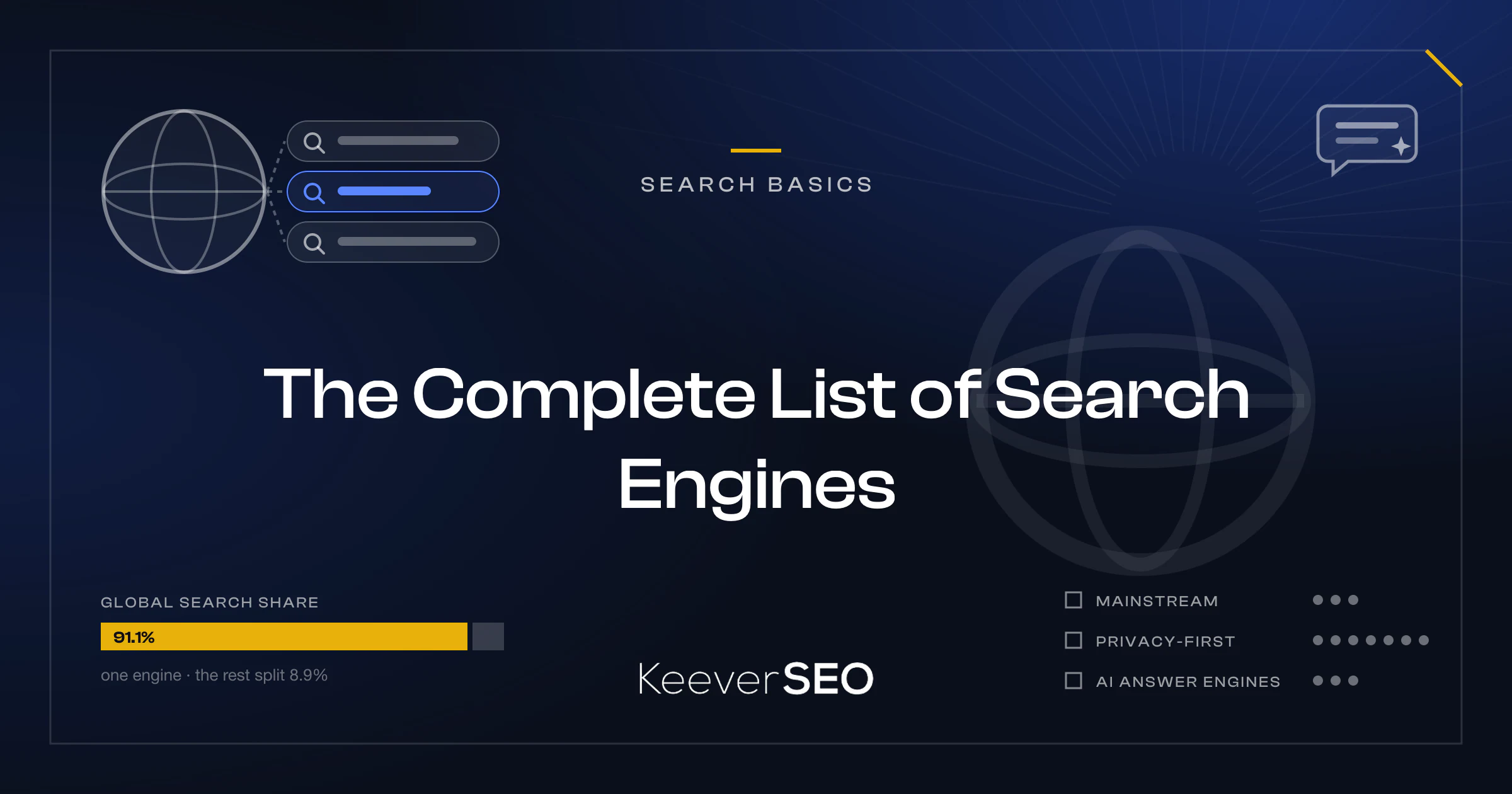
A search engine is a software system designed to search for information on the World Wide Web, and the complete list of search engines spans mainstream, privacy-focused, regional, specialized, and AI answer engines. The mainstream tier holds Google, Bing, and Yahoo; the privacy-first tier holds DuckDuckGo, Brave, Startpage, Swisscows, Ecosia, Kagi, and Mojeek; the open-source, metasearch, and media tier holds SearXNG, video search, and Openverse; the regional leaders are Yandex, Baidu, Sogou, and Naver; and the computational and AI answer engines include WolframAlpha, Perplexity, and You.com.
Search engines operate through a three-stage process of crawling, indexing, and ranking: automated bots find web pages, massive databases store and organize the content, and ranking algorithms retrieve the most relevant results per query. Google leads the field with over 90% of global market share, carried by its crawler, its index scale, and its integration across products, while Bing, Yahoo, Yandex, Baidu, and DuckDuckGo split the remainder.
Search engines earn revenue mainly through search advertising, with affiliate referrals, subscriptions, and donation-based funding rounding out the models. Results get ranked on hundreds of signals, relevance, authority through backlinks, E-E-A-T (Experience, Expertise, Authoritativeness, Trustworthiness), and user-experience metrics among them. Businesses appear in search through organic visibility, earned by optimizing for the ranking criteria, and hiring an agency like SEO Agency In USA pays when technical challenges mount, in-house skills run short, or the digital presence needs scale. Diversification beyond Google reaches audiences on regional leaders like Yandex and Baidu, privacy-minded users on DuckDuckGo and Brave, and the growing populations inside AI answer engines like Perplexity. The search field keeps moving under AI and personalization, and the list opens where the market does: with Google Search, still the benchmark every other engine gets measured against.
What is Google Search?
Google Search is the world's leading search engine, driven by its proprietary crawler, Googlebot, and an index covering billions of web pages. Google Search holds the dominant global market share, processing billions of queries daily across languages and regions, and it now folds in AI features, AI Overviews and AI Mode, that place summarized answers and conversational search at the top of results pages.
Beyond the results page, Google Search connects into the wider Google product family, Google Maps, Google Images, Google Shopping, Google News, and YouTube, giving users every information format from one platform and cementing Google's position as the default engine for most of the world's internet users.
What is Microsoft Bing?
Microsoft Bing is a search engine operated by Microsoft on its own independent web index, which lets Bing produce results no third-party feed dictates. Bing folds in AI through Microsoft Copilot and GPT technology, pairing conversational AI answers with traditional results, a combination that keeps Bing central to the AI turn in search.
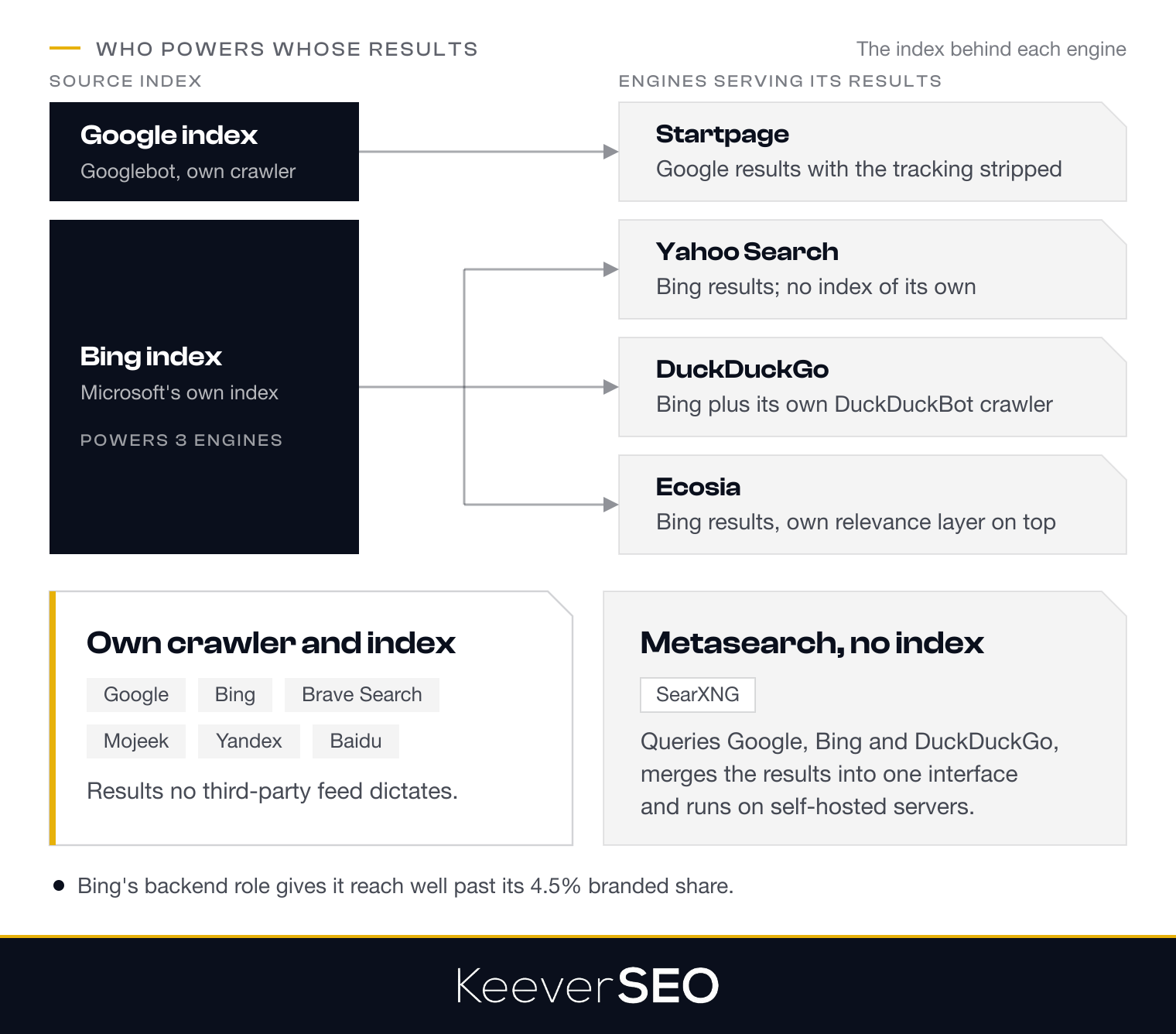
Bing carries weight beyond its own brand: it powers the backend results of other engines, Yahoo Search and DuckDuckGo most notably, so searches on those platforms draw on Bing's index and ranking even behind different interfaces. The backend role gives Bing influence well past its branded market share.
What is Yahoo Search?
Yahoo Search is a web search portal that joins search functionality to the wider Yahoo service family. Yahoo Search results come from Microsoft Bing, since Yahoo maintains no independent index, an arrangement that delivers relevant results without Yahoo crawling the web itself. The portal-style interface pairs search with Yahoo's news, mail, finance, and sports services, and the distinct interface plus the loyal audience keep Yahoo Search a working brand despite the borrowed engine underneath.
What is DuckDuckGo?
DuckDuckGo is a privacy-focused search engine that tracks no personal data and no search history. Its index draws primarily on Bing, supplemented by its own DuckDuckBot crawler and hundreds of added sources, a mix that keeps results complete while the privacy holds. Duck.ai extends the offer, letting users work with AI models like GPT-3.5 without surrendering privacy, and the privacy-first stance has made DuckDuckGo the default choice for users who value digital anonymity.
What is Brave Search?
Brave Search is a privacy-centric search engine running on its own independent web index, a rarity among the alternatives that lean on third-party results. Built by Brave Software, the maker of the Brave browser, Brave Search tracks no searches and builds no user profiles, and its integration with the Brave browser completes a privacy-first product family with Web3 support. Where privacy peers like DuckDuckGo and Startpage draw on Bing or Google, Brave Search keeps full independence, controlling its own ranking and result quality while holding its transparency and privacy commitments.
What is Startpage?
Startpage is a privacy-focused search engine that serves Google search results with the tracking stripped out. Startpage retrieves Google results and removes identifying details, IP addresses and cookies included, before showing them, so users get Google's result quality without the surveillance. Based in the European Union, Startpage operates under GDPR data protection, an added layer for privacy-minded users.
The Anonymous View feature extends the protection, a proxy browsing option that lets users open websites without the sites tracking them. Startpage logs no searches and builds no profiles, the European privacy alternative for users who put confidentiality first.
What is Swisscows?
Swisscows is a privacy-focused search engine built on family-safe filtering and semantic search. Operating under Swiss data privacy law, Swisscows keeps queries anonymous, untracked, and unstored, while its semantic technology reads the context and meaning behind each query instead of matching keywords alone. The built-in family-safe filter blocks inappropriate content automatically, the feature that makes Swisscows a standing choice for families and schools, and the Swiss-hosted infrastructure adds one more layer of data protection under Swiss jurisdiction.
What is Ecosia?
Ecosia is a search engine that turns search revenue into trees. Ad income funds global tree-planting projects, the model that sets Ecosia apart, while Microsoft Bing powers the results with Ecosia's own algorithms layered on for relevance. Privacy holds alongside the mission: no personal profiles, searches anonymized within a week, an ethical alternative wrapped around a familiar search experience.
What is Kagi Search?
Kagi Search is a premium search engine on a paid subscription model, ad-free and privacy-focused. The monthly fee replaces advertising revenue, so no advertiser touches the results, and the model frees Kagi to rank for user satisfaction alone, with zero tracking and no data collection.
Customization completes the offer: "lenses" let users prioritize or block chosen domains, and adjustable ranking preferences let each subscriber curate their own results. Control at that depth, on top of the zero-tracking policy, makes Kagi the option for privacy-minded users who want search built for them rather than for advertisers.
What is Mojeek?
Mojeek is a search engine built on a fully independent crawler and index. Where most privacy-focused engines borrow third-party results, Mojeek crawls and indexes the web itself, keeping full control over its ranking and the content it surfaces.
The independence pairs with a strict no-tracking policy: no personal data, no search histories, nothing collected, stored, or shared. Own index plus real privacy gives Mojeek a transparent, unbiased search experience few alternatives can match structurally.
What is SearXNG?
SearXNG is an open-source metasearch engine that aggregates results from multiple engines rather than keeping an index of its own. SearXNG queries engines like Google, Bing, and DuckDuckGo and merges their results into one interface, with no tracking and no profiling in the metasearch layer.
Self-hostability defines the project: users deploy their own instances on private servers, controlling configuration and data flow completely. Queries scatter across multiple engines, so no single provider can assemble a profile, the architecture for users who want transparency and customization down to the server level.
What is Video Search?
Video search is the specialized vertical for finding video content across the internet, covering dedicated video search engines and the platforms users treat as search engines outright. YouTube leads the category, widely described as the world's second-largest search engine, where users hunt how-to videos, reviews, and music through a ranking system built on relevance, engagement, and quality.
Past YouTube, dedicated video engines index content across sources through metadata, transcripts, and visual recognition, and the general engines, Google and Bing, run video tabs with rich previews, thumbnails, and duration data. With video carrying an ever-larger share of internet traffic, video search sits at the center of content discovery.
What is Openverse?
Openverse is a search engine for copyright-free and openly licensed media. Built by Automattic, Openverse opens access to over 600 million creative works, images and audio under Creative Commons licenses and public domain designations, the content users can legally reuse, remix, and share.
The sources span repositories from Flickr and Wikimedia Commons to NASA, and license-type filters let users match content to their use case, commercial work or derivatives included. License information prints beside every result, clearing the legal uncertainty that usually surrounds reuse and keeping open knowledge genuinely open.
What is Yandex?
Yandex is Russia's leading search engine, holding the dominant share of the Russian-speaking web. Yandex runs its own independent crawler and full index, a fully autonomous platform in the class of Google and Bing, with algorithms tuned to the Russian language and Cyrillic script, the technical edge behind its read of local intent and regional content. Around the engine sits a full service family, maps, email, ride-sharing, and cloud computing, all wired into search.
What is Baidu?
Baidu is China's leading search engine, holding the largest share of the Chinese market. Its proprietary crawler, Baiduspider, indexes the web for Chinese-language users, and its results operate inside Chinese content regulation, producing a search experience tuned to Chinese language, culture, and usage patterns.
Localization and compliance define the platform: simplified Chinese content and mainland-relevant hosting take priority, and content outside local rules gets filtered. Around the core engine, Baidu runs maps, cloud services, and AI features, making it the working gateway for any business chasing visibility in China's market.
What is Sogou?
Sogou is a prominent Chinese search engine defined by its integration with Tencent's WeChat platform. As a Tencent subsidiary, Sogou holds exclusive access to WeChat's content and user base, and the ability to index and surface WeChat public-account content gives it search coverage no rival in China can copy. Localized content built for Chinese users, delivered from inside Tencent's platform family, anchors Sogou's market position.
What is Naver?
Naver is South Korea's leading search engine, holding the local market through a portal and curated-content model. Naver serves a full web portal rather than a bare results page, blending search with user-generated content, news, blogs, and specialized knowledge databases, all structured for Korean-language queries.
The service family carries the model: Naver Knowledge iN for questions and answers, Naver Blog, Naver Café, and shopping services, one platform where indexed web content and community-curated information sit side by side, matched to Korean users' preference for structure plus community.
What is WolframAlpha?
WolframAlpha is a computational knowledge engine, a different species from the crawl-and-index search engine. Instead of returning links, WolframAlpha computes answers directly from curated data and built-in algorithms, an answer engine processing natural-language queries across mathematics, science, statistics, and engineering. Precise, authoritative answers with visualizations and data tables make it the specialized tool for students, researchers, and professionals who need computed results rather than a list of websites.
What is Perplexity?
Perplexity is an AI answer engine delivering direct responses through a conversational interface, synthesizing information and citing its sources. Where a traditional engine returns links, Perplexity's AI models read the question, compose an answer, and attribute the sources behind it, turning search into a dialogue where follow-up questions refine the thread naturally. Large language models paired with real-time web indexing put Perplexity at the front of the AI answer-engine category, immediate synthesized knowledge in place of ranked result pages.
What is You.com?
You.com is an AI-powered search engine built for task-oriented users, developers first among them. AI-mode search lets users work with results dynamically, and the platform leans into productivity, with features fitted to coding, research, and content creation, the workflows past standard web search.
Flexible AI modes and model selection carry the technical crowd, and the blend of web search with conversational AI bridges the traditional engine and the modern answer engine. The developer-centric design moves users from query to action fast, the working tool for technical fields.
What is a search engine and what does this complete list cover?
A search engine is a software system designed to search for information on the World Wide Web and present results against a user's query. The complete list covers the full spread: the mainstream engines Google, Bing, and Yahoo that dominate global usage; the privacy-focused engines DuckDuckGo, Brave Search, Startpage, Swisscows, Ecosia, Kagi, and Mojeek; and the regional leaders Yandex, Baidu, Sogou, and Naver commanding their geographic markets.
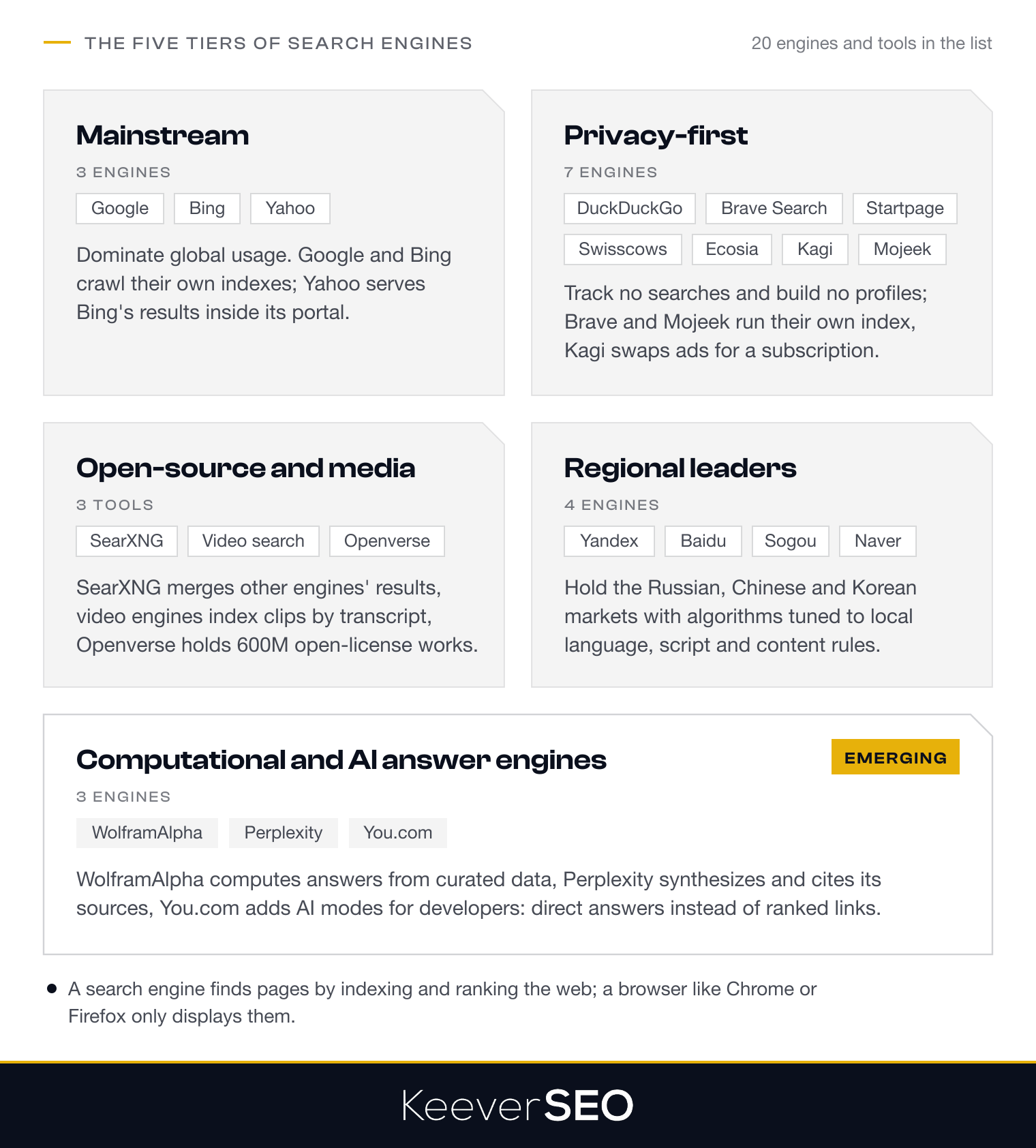
The list runs on through the specialized and open-source tools, SearXNG, video search, and Openverse, into the emerging AI answer engines, WolframAlpha, Perplexity, and You.com, the computational and conversational category. One distinction frames it all: a search engine differs from a web browser, since a browser like Chrome or Firefox displays websites while a search engine finds them by indexing and ranking the web, and the span from crawl-and-index models to AI-powered systems is the modern search world entire.
How do search engines crawl, index, and rank web pages?
Search engines crawl, index, and rank web pages through a systematic three-stage process. Crawling comes first: automated programs, the bots and spiders like Google's Googlebot, browse the internet to find new and updated content, following links page to page and downloading the HTML, images, and resources they meet.
Indexing organizes the gathered content into the structured database called the index. The engine analyzes each page, parsing text, reading images, cataloging video, and mapping the links between pages, building the library catalog that holds billions of pages for instant retrieval.
Ranking decides the order at query time. The algorithm weighs signals from relevance to the search terms and the authority of the page's backlinks to content quality markers like Experience, Expertise, Authoritativeness, Trustworthiness (E-E-A-T), page speed, and mobile-friendliness, scoring each page so the most relevant, authoritative results reach the top, the best available answer to the query.
Why is Google the most popular search engine?
Google is the most popular search engine because of its technology and its reach. Googlebot indexes billions of pages at unmatched speed and scale, keeping the index complete and current, while continuously refined ranking algorithms read query signals with the precision behind Google's result quality.
Product integration hardens the position: Google Search sits inside Gmail, Google Maps, YouTube, Android, and Chrome, a product family users touch daily, and the network effects make Google the default by momentum as much as by choice. StatCounter's Global Stats put Google at roughly 91% of the global search market in late 2026, far ahead of Bing and Yahoo, the return on sustained infrastructure and innovation investment.
The market never fully closes, though: Bing, Yahoo, and the regional and privacy-focused alternatives hold their portions, serving the needs Google leaves open, a working diversity underneath the dominance.
Which search engines hold the largest global market share?
The search engines holding the largest global market share are laid out in the table below.
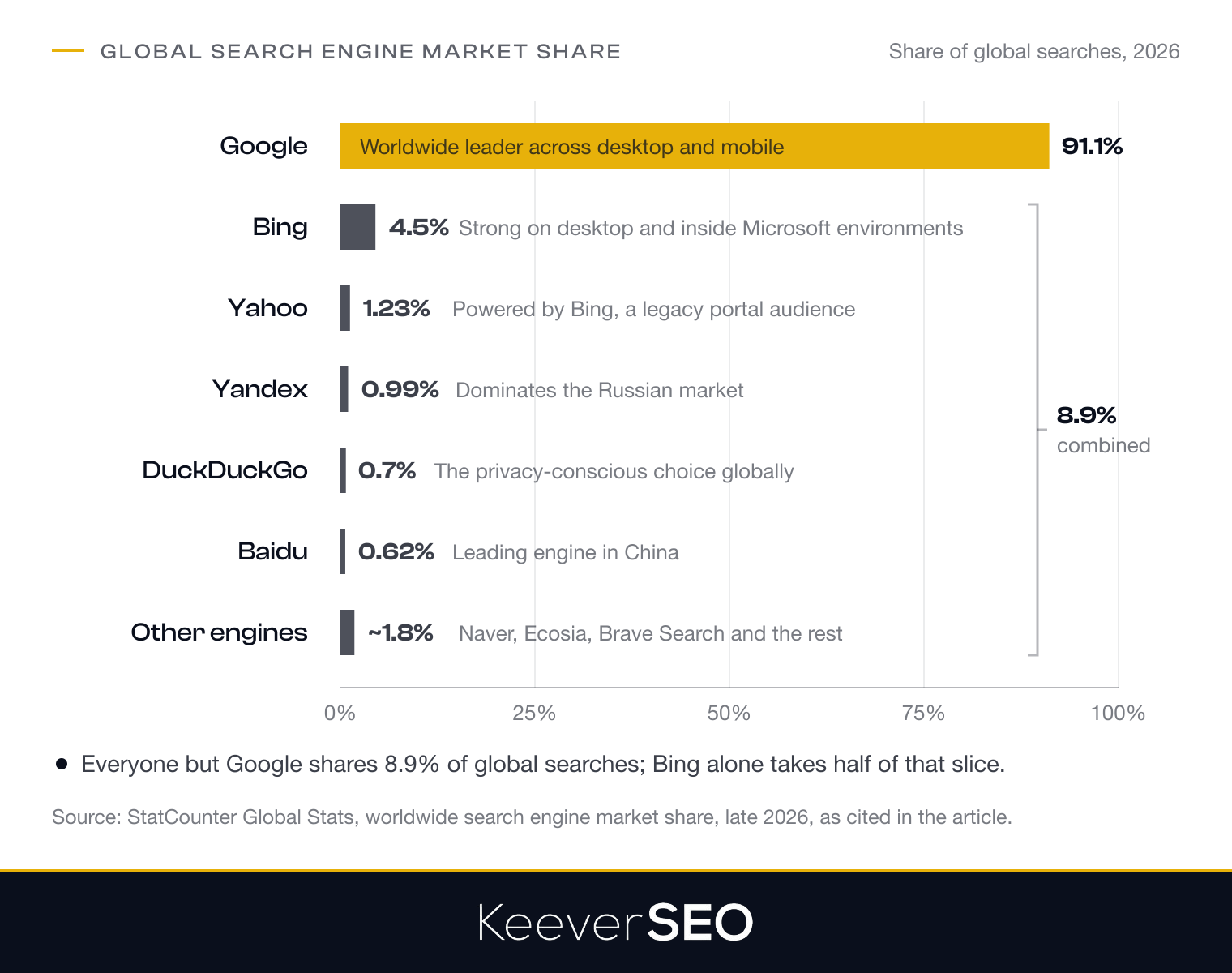
| Search Engine | Global Market Share | Primary Region/Notes |
|---|---|---|
| 91.1% | Worldwide leader across desktop and mobile | |
| Bing | 4.5% | Strong on desktop and inside Microsoft environments |
| Yahoo | 1.23% | Powered by Bing, holding a legacy portal audience |
| Yandex | 0.99% | Dominates the Russian market |
| DuckDuckGo | 0.7% | The privacy-conscious choice globally |
| Baidu | 0.62% | Leading engine in China |
| Other Engines | ~1.8% combined | Naver, Ecosia, Brave Search, and the rest |
Google's 90-plus percent tells the headline story, with Bing the strongest challenger on the back of Microsoft integration and Yahoo carrying its Bing-powered legacy share. Yandex and Baidu convert regional dominance into global fractions, DuckDuckGo holds the privacy niche, and the small engines split the remainder. The figures follow StatCounter's Global Stats, the industry's standard measurement of search referral share.
How do search engines make money?
Search engines make money through the revenue models listed below:
- Search ads: sponsored placements beside organic results, billed pay-per-click (PPC) as users click.
- Display and partner ads: ads across owned properties and partner sites, with revenue shared to publishers, the model of the large ad networks.
- Affiliate and referral revenue: commissions on users routed to e-commerce sites and services, a percentage per sale or lead.
- Subscription revenue: recurring fees at the privacy and specialty engines, buying ad-free search, richer features, or hardened privacy.
- Donation or cause-based funding: ad profits routed to environmental or social causes, Ecosia's tree planting the model case, with the mission accounting kept transparent.
Most engines blend several models, spreading the revenue base while staying true to their positioning.
How do search engines rank results?
Search engines rank results by weighing signals against the query. Relevance measures how well content matches the search intent and terms; authority and links read trustworthiness through backlink quality and quantity; E-E-A-T, Experience, Expertise, Authoritativeness, and Trustworthiness, weighs heaviest where content touches wellbeing or money; and user-experience signals, page speed, mobile-friendliness, engagement, reward the pages that treat visitors well.
Modern algorithms run machine learning and natural language processing past keyword matching into context and intent, reading on-page factors like title tags and content depth beside off-page authority and technical structure. The weights shift by query type and industry, completeness leading on informational queries, proximity leading on local ones, and the individual factors deserve their own breakdown.
What are search ranking factors?
Search ranking factors are the criteria search engines use to position pages in results:
- Relevance: how well the page's content matches the query, from keyword usage to topic alignment.
- Authority and links: credibility read through backlink quality and quantity, the external endorsements.
- E-E-A-T (Experience, Expertise, Authoritativeness, Trustworthiness): the credentials of the creators, the reputation of the site, the reliability of the information.
- User-experience signals: load speed, mobile-friendliness, engagement, and usability, how well the page serves its visitors.
The factors work in combination, and their weights move with query intent and context, the dynamic Google's own ranking documentation describes across its hundreds of signals.
How does indexing affect rankings?
Indexing affects rankings as the gate everything else stands behind: a page must be crawled and added to the index before it can rank at all. Index status is visibility, since an indexed page competes for its queries while an unindexed one does not exist to searchers, and a page dropped from the index, through technical errors, crawl blocks, or duplicate-content problems, loses every ranking at once.
For businesses, indexing decides whether the site can be found in the first place: without it, the best-optimized pages stay invisible, which is why index monitoring belongs in every SEO routine.
How do businesses appear in search engines?
Businesses appear in search engines through organic search visibility, presence in the unpaid results earned when engines judge the business's pages relevant and useful for the query. Search Engine Optimization (SEO) does the earning: optimizing the technical layer, raising content quality, and building authority so engines can find, read, and trust the site, alignment with the ranking factors converted into placement.
The SEO toolkit spans site structure tuned for crawling and indexing, content matched to search intent, and backlinks earned from authoritative sites. A business that invests there wins sustained visibility, organic traffic arriving without a running ad bill, and the mechanics of organic visibility deserve their own definition.
What is organic search visibility?
Organic search visibility is the prominence and frequency with which a website appears in unpaid search results for its relevant queries. Visibility of that kind decides how easily potential customers find the site when they search the topic, product, or service, and unlike paid placement it gets earned, through SEO that aligns content and technical infrastructure with the ranking criteria. Content relevance, quality, user experience, and backlink authority drive it, and the payoff compounds: traffic, brand exposure, and growth that continues without a media budget behind it.
When should a business hire an SEO agency?
A business should hire an SEO agency when internal resources or skills cannot carry an effective SEO strategy. The signals: stagnant organic growth, sliding rankings, and technical issues clouding visibility, joined by the event-driven cases, a site launch or redesign, expansion into new markets, competitive pressure in the rankings.
The case extends to any business that wants SEO as a reliable growth channel without staffing the ongoing work. Our search engine optimization firm fits the role with a full approach, audits, realistic goal-setting, and transparent reporting, which leads straight to what the optimization work involves.
How does an SEO agency optimize for search engines?
An SEO agency optimizes for search engines through five core workstreams, the structure we run.
Technical SEO Technical SEO keeps the site accessible, crawlable, and indexable: architecture audits, crawl-error fixes, page speed, mobile-friendliness, URL structures, redirects, structured data, and XML sitemaps, every barrier to search-engine reading removed.
On-page SEO and Content Optimization On-page work aligns each page with its keywords and intent: keyword research, title tags and meta descriptions, heading hierarchy, internal linking, image alt text, and content complete enough to satisfy the searcher, relevance made explicit.
Off-page SEO and Link Building Off-page work builds authority: link-acquisition campaigns earning quality backlinks from authoritative domains, digital PR and content partnerships, brand mentions, and citation profiles for local businesses, the trust signals that keep ranking weight.
E-E-A-T Optimization E-E-A-T work makes the expertise visible: author profiles and credentials, real About pages, demonstrated experience, authoritative mentions, and content held to accuracy.
Measurement and Continuous Optimization Measurement closes the loop: rankings, organic traffic, impressions, click-through, conversions, and technical health tracked through analytics and SEO tools, with the data steering the next round of fixes, content, and authority work.
The five workstreams together move how engines find, read, trust, and rank the site, which is exactly what the visibility metrics then measure.
How should businesses measure search engine visibility?
Businesses should measure search engine visibility through the metrics listed below:
- Organic visibility: how frequently the site appears in unpaid results, expressed as a percentage or score against competitors.
- Keyword rankings: the site's position per target term, the progress meter for gains and slips.
- Impressions and clicks: appearances in results and the clicks they convert, reach on one side, title and description effectiveness on the other.
- Share of voice: the brand's slice of available search traffic across a keyword set, visibility in competitive terms.
Read together, the four metrics give the complete picture of search performance.
Why should businesses diversify beyond Google Search?
Businesses should diversify beyond Google Search to reach the audiences Google misses and to cut single-platform risk. Google's global dominance still leaves whole markets to the regional leaders, Yandex in Russia, Baidu in China, Naver in South Korea, engines tuned to local preferences with user bases Google reaches weakly.
The privacy tier holds its own audience: DuckDuckGo, Brave Search, and Startpage collect the users who choose no-tracking policies on principle, a segment unreachable through Google alone, while AI answer engines like Perplexity and You.com reshape search behavior with direct conversational answers.
Zero-click search sharpens the argument: SparkToro's 2026 study of Similarweb clickstream data found 68.01% of U.S. Google searches ended without a click in early 2026, which makes visibility inside the results themselves, and across alternative platforms, the hedge every search strategy needs.
How do search engines change over time?
Search engines change over time under advancing AI and shifting user expectations. AI Overviews and generative features now sit inside the traditional engines, Google first, placing summarized answers above the links and retiring the classic "ten blue links" page a step at a time, while dedicated AI answer engines, Perplexity and You.com, run conversational interfaces that synthesize sources into cited answers.
User behavior moves with the technology. Zero-click searches keep climbing as answers land on the results page itself, rewriting the visibility economics for content creators, and users increasingly expect synthesized answers over curated link lists; Ahrefs' study "AI Overviews Reduce Clicks by 34.5%" measured the click-through cost of the shift directly. Privacy-focused engines gain ground as data concerns grow, and the regional leaders keep tuning their algorithms to local language and culture.
The complete list of search engines, from Google's AI Mode to Perplexity's conversational model, from privacy-first Brave to regional giants Baidu and Naver, maps the terrain where information gets found, ranked, and consumed, and knowing the map is the starting requirement for competing on it.