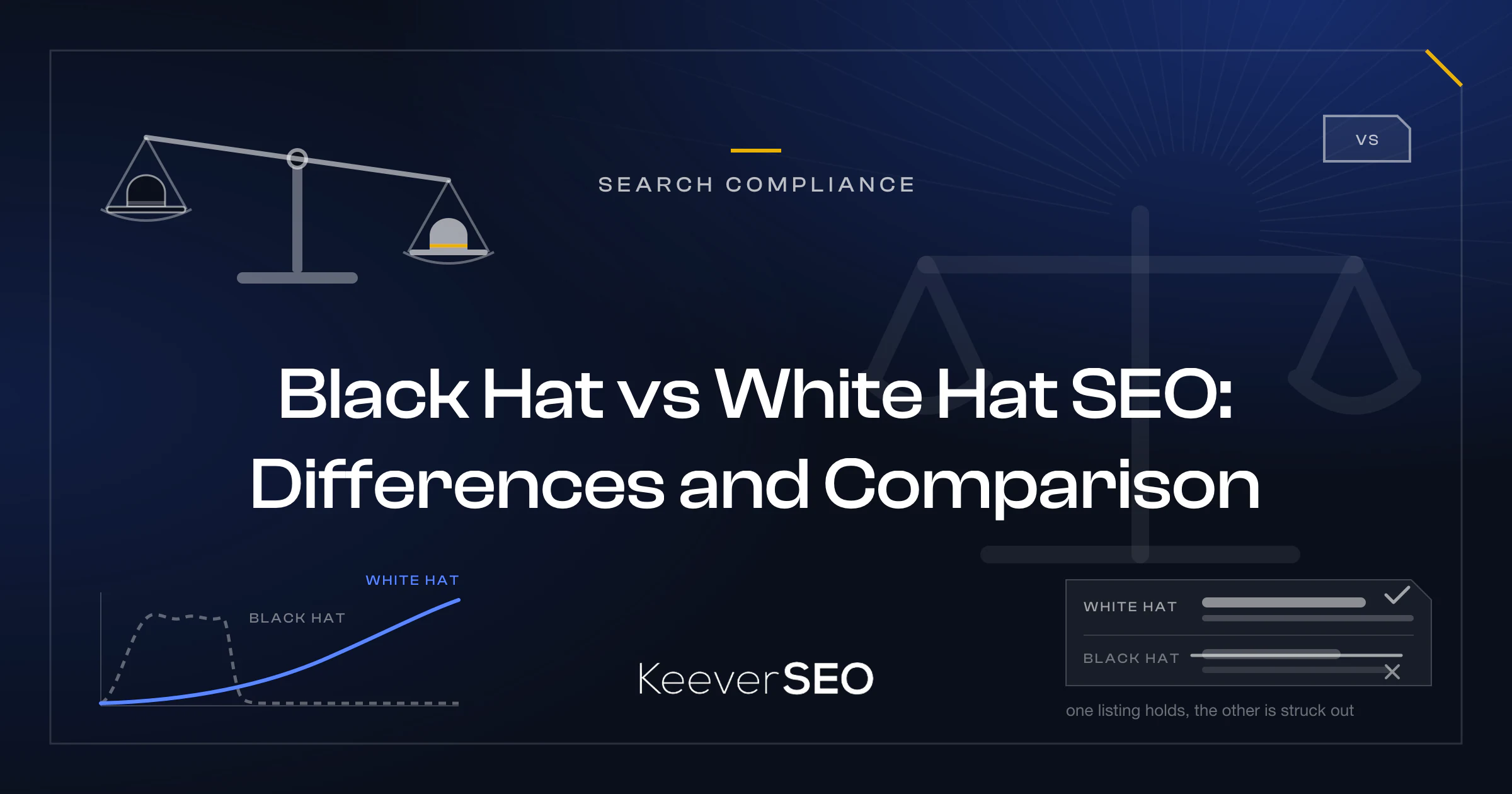
Black hat SEO uses tactics that break search-engine guidelines to manipulate rankings, while white hat SEO uses guideline-compliant tactics built to serve users. Black hat SEO sets out to deceive search engines through manipulative practices, which brings short-term gains and high penalty risk. White hat SEO centers on quality content and user experience within search-engine guidelines, which brings sustainable growth and low penalty risk.
Black hat SEO covers keyword stuffing, cloaking, hidden text, doorway pages, sneaky redirects, link schemes, content scraping, and automated or spun content, and the practices can trigger manual actions or algorithmic penalties that end in ranking collapse or de-indexation. White hat SEO relies on content quality, keyword research, on-page and technical SEO, user experience optimization, and earned authoritative links, which deliver durability against algorithm changes, compounding ROI, and trust.
The differences between black hat and white hat SEO run across several dimensions. In guideline compliance and penalty risk, black hat SEO violates search-engine rules and carries a high risk of penalties, while white hat SEO follows the guidelines and holds stable performance. In results timeline, black hat SEO may produce quick but volatile gains, whereas white hat SEO takes longer and leads to stable, long-term growth. In cost and resource investment, black hat SEO looks cheaper up front but can bring heavy recovery costs, while white hat SEO demands sustained investment and returns predictable ROI. The comparison at a glance below sets the dimensions side by side.
What Is the Difference Between Black Hat and White Hat SEO at a Glance?
The difference between black hat and white hat SEO at a glance is guideline compliance: black hat SEO violates search engine rules to manipulate rankings, while white hat SEO follows the guidelines and serves users. The two approaches are compared in the table below:
| Dimension | Black Hat SEO | White Hat SEO |
|---|---|---|
| Guideline Compliance | Violates search engine rules to manipulate rankings | Follows search engine guidelines and recommendations |
| Intent | Manipulates search engines for quick gains | Serves users with relevant, trustworthy content |
| Results Timeline | Quick, volatile gains exposed to algorithm updates | Slow, sustainable growth over time |
| Penalty Risk | High risk of manual actions and de-indexing | Low risk, with stable rankings that build trust |
The comparison shows why SEO strategy should align with compliant practice and long-term success, and each side is defined in full below.
What Is Black Hat SEO?
Black hat SEO is a set of practices that manipulate search engine rankings by violating established guidelines. The intent behind black hat SEO is to exploit search engine algorithms for quick, unsustainable ranking gains. The term "black hat" comes from Western films, where the villains wore black hats, and the metaphor captures the deceptive nature of the tactics.
Some practitioners keep using black hat SEO despite the risks, drawn by rapid results and financial gain. Black hat SEO deceives search engines rather than serving users, which can lead to severe penalties, including ranking suppression or full removal from search results. The pursuit of short-term benefit overshadows the long-term consequences, which makes black hat SEO a high-risk strategy that undermines a website's credibility and trust.
What Techniques Define Black Hat SEO?
The techniques that define black hat SEO are manipulative tactics that exploit search engine algorithms for higher rankings at the expense of users. The common black hat techniques are listed below:
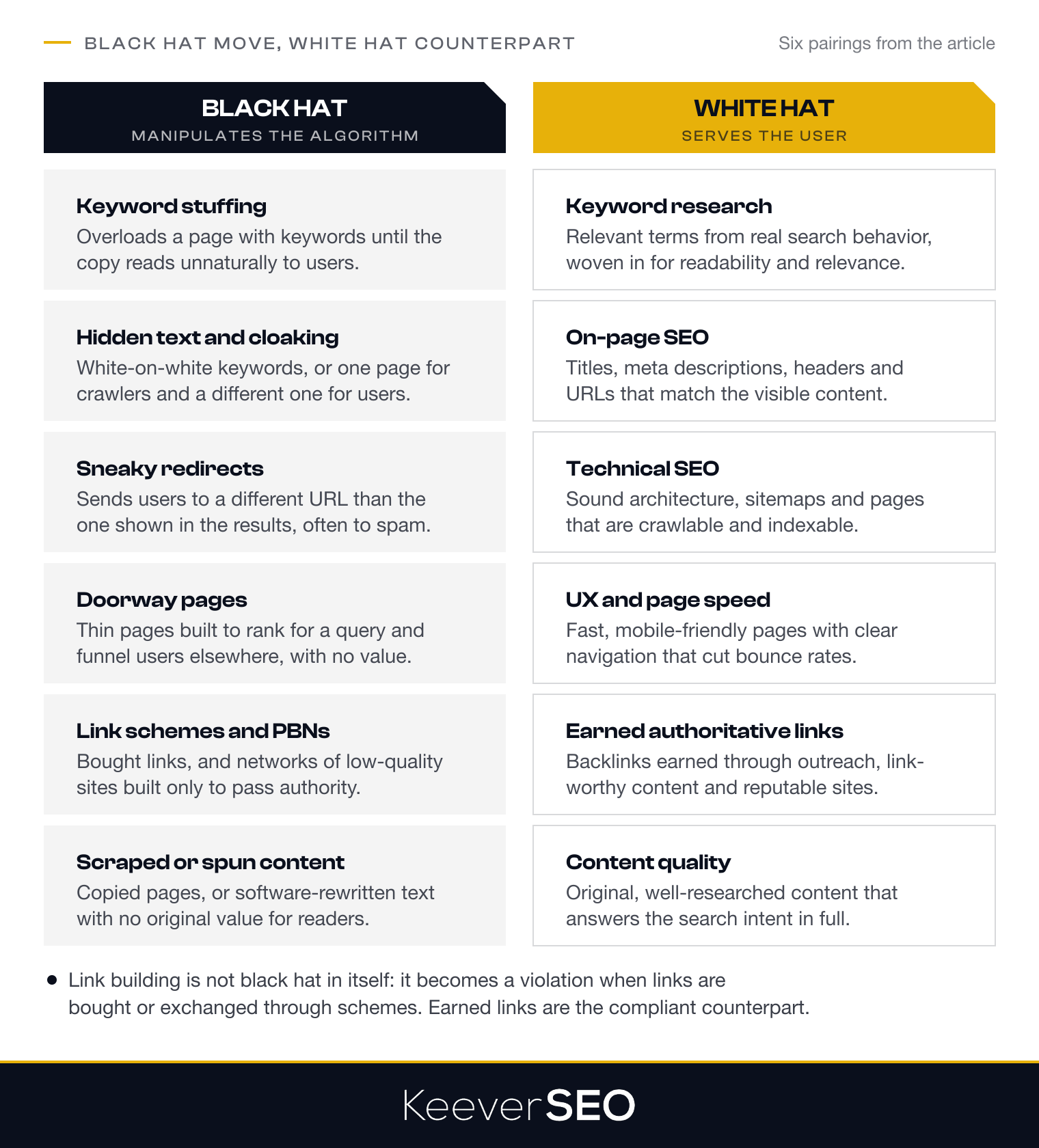
- Keyword Stuffing: Overloading a webpage with excessive keywords to manipulate rankings, which makes the content read unnaturally and degrades the user experience.
- Cloaking: Presenting different content to search engines and users, which misleads crawlers about the page's actual content.
- Hidden Text: Placing keywords where users cannot see them but search engines can, such as white text on a white background.
- Doorway Pages: Low-quality pages built to rank for specific queries and funnel users to a different destination, with little or no value of their own.
- Sneaky Redirects: Sending users to a different URL than the one shown in search results, often toward irrelevant or spammy content.
- Link Schemes and PBNs (Private Blog Networks): Acquiring links to manipulate rankings, including networks of low-quality sites built only to pass link authority.
- Content Scraping: Copying content from other websites without adding original value and republishing it for search visibility.
- Automated or Spun Content: Using software to generate or rewrite content, which produces low-quality pages built to deceive search engines rather than serve users.
The manipulative nature of the tactics triggers penalties such as ranking drops, manual actions, or de-indexation by search engines.
What Risks Does Black Hat SEO Create?
Black hat SEO creates the risk of manual actions and algorithmic penalties that can collapse rankings or remove a site from the index. Manual actions are applied by human reviewers when a website violates Google's spam policies, and Google's "Manual actions report" documentation states that an affected page or site may rank lower or be omitted from results outright. Algorithmic penalties, such as those from the Google Panda and Penguin updates, target low-quality content and unnatural link schemes without human review; Google introduced Penguin in Matt Cutts's April 2012 post "Another step to reward high-quality sites" as a webspam update that affected about 3.1% of English queries. Either kind of penalty can cut search rankings, organic traffic, and credibility. Sites that use black hat tactics risk removal from the search index, and recovery is slow and uncertain even after the offending tactics are cleaned up, with reconsideration reviews that take from several days to a few weeks according to the same Google documentation.
What Is White Hat SEO?
White hat SEO is a search engine optimization strategy that follows search engine guidelines and centers on user experience for long-term, sustainable results. The approach prioritizes valuable, high-quality content for users over manipulation of search engine algorithms. White hat SEO aligns with Google Search Essentials and other search engine standards, with methods that comply with indexing rules and evolving algorithms.
The intent behind white hat SEO is to serve the user, so content matches search intent and offers real value. The strategy optimizes websites for speed, mobile responsiveness, and user-friendly design to raise satisfaction and engagement. Well-researched keywords, optimized meta tags, and credible internal and external links build trust and authority with search engines and users alike.
White hat SEO practices deliver lasting benefits, including stable rankings that hold through algorithm updates and carry no risk of penalties or de-indexing. The focus on real value through better webpage design and content quality produces a positive user experience and sustainable search growth, and the research and analysis behind it raise rankings through organic means.
What Techniques Define White Hat SEO?
The techniques that define white hat SEO are compliant practices that serve users and build sustainable search visibility. The core white hat techniques are listed below:
- Content Quality: Original, valuable, well-researched content that addresses user search intent and answers queries in full.
- Keyword Research: Analysis of user search behavior, with relevant terms woven into content for readability and relevance.
- On-Page SEO: Optimized title tags, meta descriptions, header tags, and URL structures that match the content and aid both user understanding and search engine indexing.
- Technical SEO: Sound site architecture, XML sitemaps, structured data markup, crawlability, and indexability that help search engines discover and read website content.
- User Experience (UX) and Page Speed: Faster load times, mobile-friendliness, clear navigation, and usability that create positive experiences and reduce bounce rates.
- Earned Authoritative Links: Backlinks earned through outreach, link-worthy content, and relationships with reputable sites rather than through manipulative schemes.
Link building is not black hat in itself; it becomes a violation when links are bought or exchanged through schemes. The sustainable, user-focused tactics lead into the long-term benefits white hat SEO provides.
What Benefits Does White Hat SEO Provide?
The benefits white hat SEO provides are durability, compounding ROI, trust, and resilience to algorithm updates. The four benefits are listed below:
- Durability: High-quality content and user-focused strategies keep traffic and engagement flowing over time.
- Compounding ROI: As content ages, it draws more traffic and backlinks, which raises the return on investment, and First Page Sage's SEO ROI research puts the average long-run return on SEO at 748%.
- Trust and Authority: Guideline compliance builds credibility with search engines and users and strengthens brand reputation.
- Resilience to Algorithm Updates: Compliance with best practice protects against ranking swings when algorithms change.
White hat SEO is the strategic choice for businesses that want lasting online success.
What Are the Key Differences Between Black Hat and White Hat SEO?
The key differences between black hat and white hat SEO lie in guideline compliance and penalty risk, results timeline, and cost and resource investment. The three differences are listed below:
- Guideline Compliance and Penalty Risk: Black hat SEO uses tactics that violate search engine guidelines, which brings high penalty risk through algorithmic penalties and manual actions, while white hat SEO follows the guidelines, minimizes penalty risk, and builds trust with search engines.
- Results Timeline: Black hat SEO chases quick gains that tend to be volatile and short-lived, while white hat SEO builds sustainable growth that demands patience but delivers long-term stability and compounding benefit.
- Cost and Resource Investment: Black hat SEO looks cheaper up front because it relies on shortcuts, but it can bring heavy penalty and recovery costs, while white hat SEO demands ongoing investment in quality content, technical optimization, and user experience and proves more cost-effective through durable, trustworthy results.
Each of the three differences is broken down below.
How Do Black Hat and White Hat SEO Differ in Guideline Compliance and Penalty Risk?
Black hat and white hat SEO differ in guideline compliance and penalty risk because black hat SEO violates Google Search Essentials while white hat SEO follows them. Black hat tactics deceive search engines rather than serve users, which exposes websites to manual actions, the penalties Google's human reviewers apply when they find guideline breaches, and to algorithmic penalties triggered by updates like Penguin, which targets link schemes, and Panda, which demotes low-quality content. Websites that run black hat practices face ranking demotions, full de-indexing from search results, and a loss of credibility that can prove hard or impossible to reverse.
White hat SEO follows the rules and best practices set out in Google Search Essentials, whose spam policies state that content in violation may rank lower or not appear in results at all. Valuable content for human users, faster and mobile-friendly sites, and backlinks earned through outreach and quality carry minimal penalty risk, and search engines reward the approach with long-term trust and authority that holds as algorithms evolve. White hat SEO requires patience and sustained investment, but it shields websites from the manual actions and algorithmic penalties that wreck black hat operations, so compliance translates into ranking stability and sustainable organic growth.
How Do Black Hat and White Hat SEO Differ in Results Timeline?
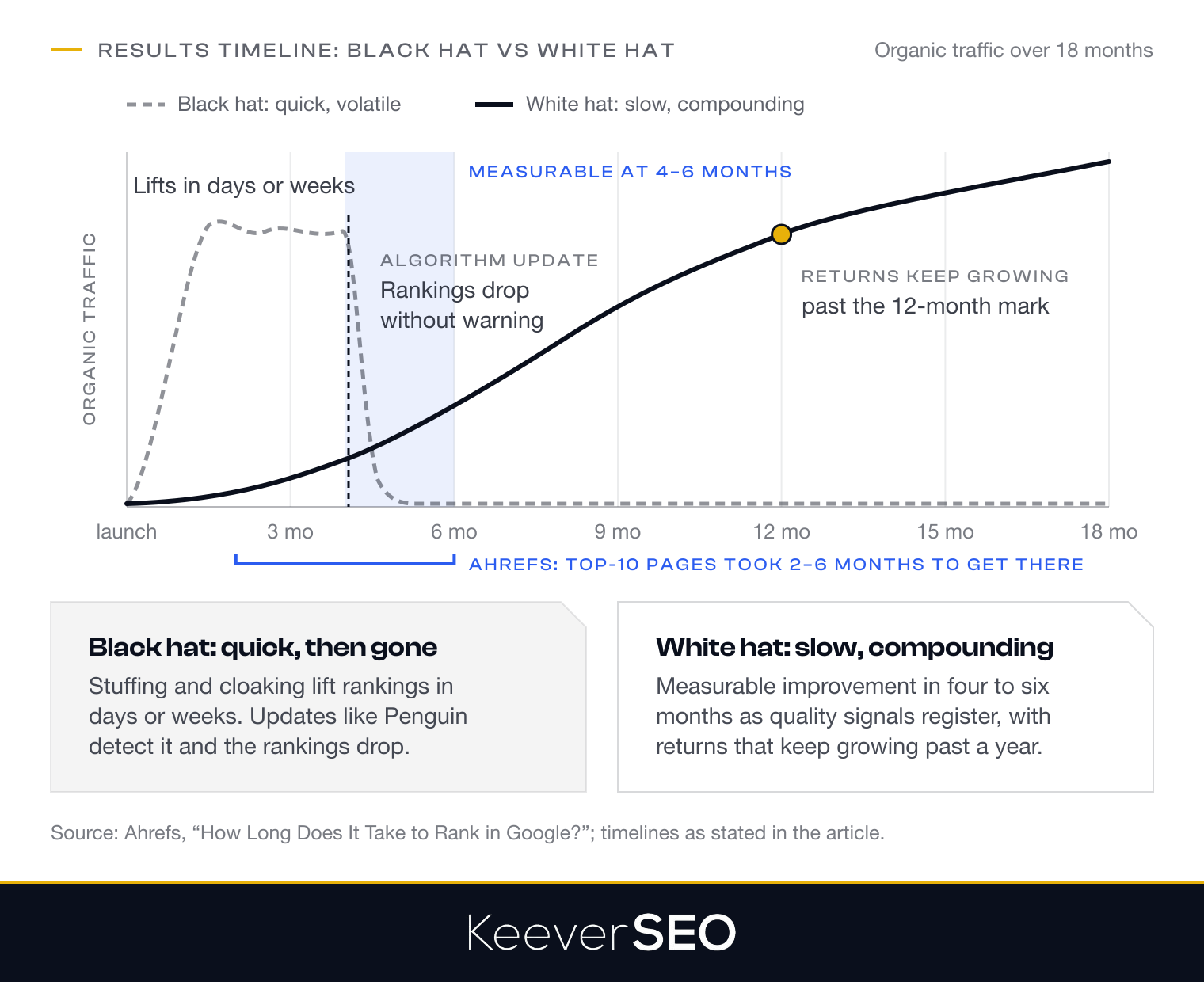
Black hat and white hat SEO differ in results timeline because black hat SEO produces rapid but unstable gains while white hat SEO delivers gradual, compounding growth. Black hat techniques such as keyword stuffing and cloaking can lift rankings within days or weeks, but the gains are short-lived, because search engines like Google detect the manipulation through updates like Penguin and the rankings drop without warning. White hat SEO demands patience, with meaningful results over several months as search engines recognize real quality signals, including high-value content and earned backlinks. White hat campaigns tend to show measurable improvement within four to six months, in line with Ahrefs' study "How Long Does It Take to Rank in Google?", which found that the pages reaching the top 10 within a year took two to six months to get there, with returns that keep growing past the twelve-month mark.
How Do Black Hat and White Hat SEO Differ in Cost and Resource Investment?
Black hat and white hat SEO differ in cost and resource investment because black hat SEO is cheap up front and expensive later, while white hat SEO costs more up front and pays back over time. Black hat SEO looks cheaper at the start because it relies on quick, low-cost tactics like automated content generation, keyword stuffing, and link schemes, which need little strategic planning and run on inexpensive tools or services. The true cost of black hat SEO appears when penalties land: recovery through content rewrites, link cleanup, and disavow work is costly and slow, and it often exceeds the initial savings.
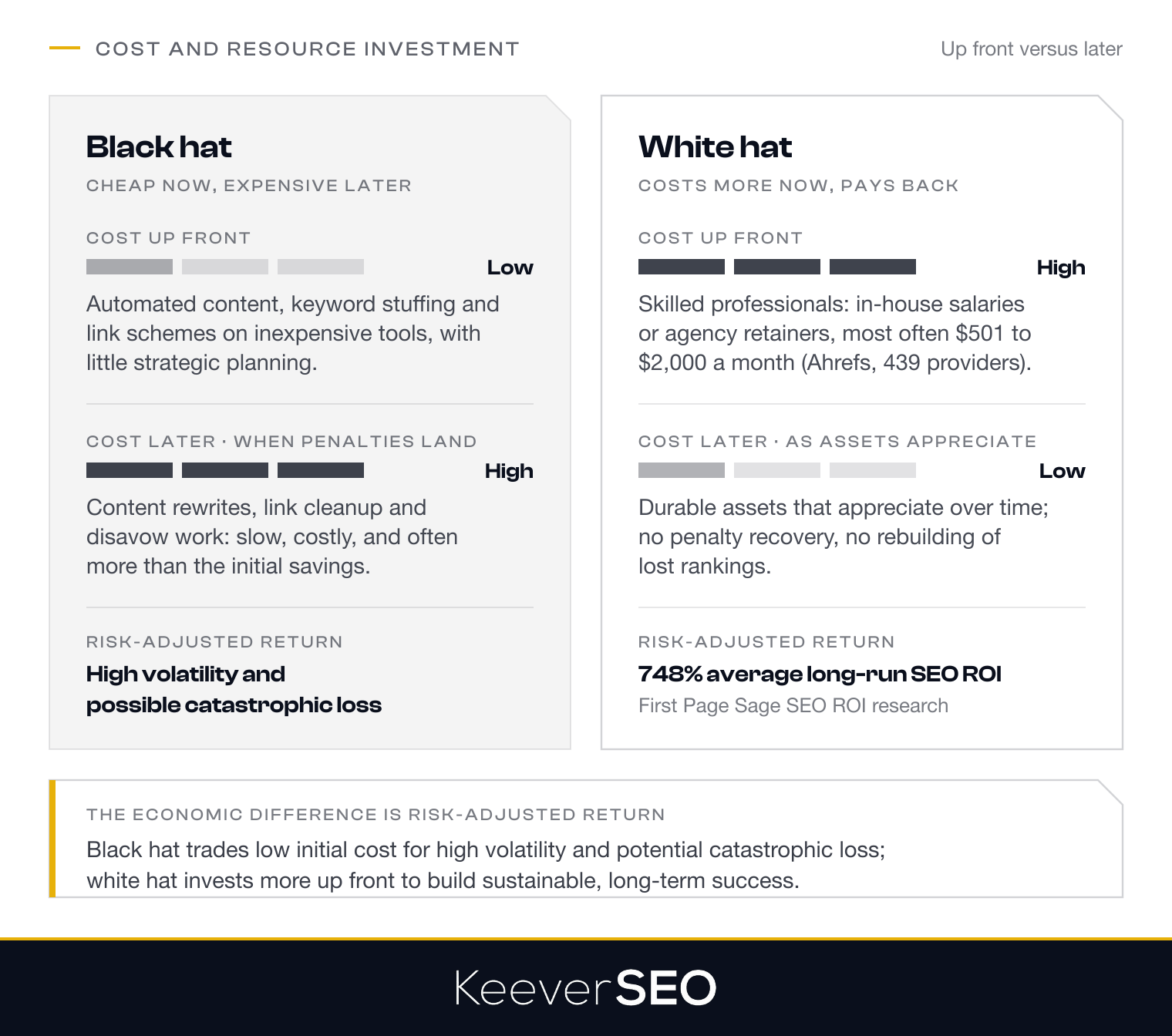
White hat SEO demands sustained investment in time and resources. The approach centers on quality content, thorough keyword research, technical optimization, and earned authoritative backlinks, which require skilled professionals and consistent effort. The upfront costs run higher, whether as salaries for an in-house team or as retainers for a reputable agency, which Ahrefs' SEO pricing survey of 439 providers places most often between $501 and $2,000 per month, but the long-term benefits outweigh the expense, because white hat SEO builds durable assets that appreciate over time and avoids the recurring costs of penalty recovery or rebuilding lost rankings.
The economic difference between the two comes down to risk-adjusted return. Black hat SEO trades low initial cost for high volatility and potential catastrophic loss, while white hat SEO invests more up front to build sustainable, long-term success.
How Can a Website Identify Black Hat SEO?
A website can identify black hat SEO through warning signs that point to manipulative tactics. The most common indicators are listed below:
- Sudden spikes in unnatural backlinks: A rapid rise in spammy or irrelevant backlinks signals a black hat link scheme.
- Unexpected drops in organic rankings: Sharp ranking declines may follow penalties for unethical SEO tactics.
- Manual action notifications in Google Search Console: The alerts show that Google has detected violations of its guidelines.
- Presence of hidden text or cloaked content: Hidden keywords, or content shown to search engines but not to users, mark a common black hat tactic.
- Unauthorized redirects or doorway pages: Redirects that send users elsewhere without consent, or doorway pages built to manipulate search engines, point to black hat activity.
Regular monitoring through Google Search Console, along with content and backlink audits, catches the issues in time to address them.
Are Sudden Unnatural Backlinks a Warning Sign?
Yes, sudden unnatural or spammy backlinks are a clear warning sign of possible black hat SEO activity. An unexpected surge of low-quality links from irrelevant domains or automated networks points to manipulative link building. Google's "Spam policies for Google web search" treat such links as link spam, which can bring manual actions or algorithmic penalties that suppress rankings. Spammy backlink patterns, marked by irrelevant anchor text or links from penalized domains, should be caught in time through regular backlink audits, which makes a review of the link profile in Google Search Console the next step.
What Should Be Reviewed in Search Console?
The areas to review in Google Search Console when identifying black hat SEO are the manual actions notice, the links report, and the security issues report. The three checks are listed below:
- Manual Actions Notice: The report shows whether Google has issued a manual action against the site for a guideline violation, with the type of infraction and the affected pages.
- Unnatural Links Report: The links section surfaces suspicious inbound links that might indicate a black hat link scheme, such as sudden increases in low-quality links or links from irrelevant sites.
- Security Issues Report: The report flags threats like hacked content or malware, which reveals unauthorized changes made through black hat tactics.
The three checks feed the recovery process and guide the steps that follow.
How Can a Website Recover From Black Hat SEO?
A website can recover from black hat SEO through a structured audit, cleanup, disavow, and reconsideration sequence. Recovery begins with a full audit of the website's content, backlinks, and redirect behavior, which identifies thin or spammy pages, unnatural inbound links, and sneaky redirects. Once identified, the elements are removed or fixed wherever possible.
After the initial cleanup, Google's Disavow Tool addresses the toxic backlinks that cannot be removed by hand, because it tells Google to ignore the specified links when evaluating the site's backlink profile. Following the disavowal, a reconsideration request through Google Search Console can speed recovery when a manual penalty was applied. During the recovery period, the site should shift fully to white hat SEO practices, such as high-quality content and legitimately earned backlinks, to rebuild trust with search engines and support long-term organic growth.
Which Harmful Pages, Links, and Redirects Should Be Audited First?
The harmful elements to audit first are thin or spammy pages, unnatural inbound links, and sneaky redirects. The three priorities are listed below:
- Thin or Spammy Pages: Pages with low-value or autogenerated content, often with excessive keyword stuffing that signals manipulation to search engines.
- Unnatural Inbound Links: Backlinks with suspicious patterns, such as links from link farms or irrelevant directories, which can bring algorithmic or manual penalties.
- Sneaky Redirects: Redirects that mislead users or search engines by sending them to unintended destinations, which search engines treat as deceptive.
A thorough audit of the three elements reveals the issues that may call for the disavow tool.
When Should a Site Use the Disavow Tool?
A site should use the Disavow tool when it holds a large number of harmful links that cannot be removed by hand. The links tend to be spammy, artificial, or low-quality backlinks that risk a manual action or algorithmic penalty. Google's "Disavow links to your site" documentation treats the Disavow tool as an advanced feature for use after attempts to contact webmasters have failed, and it fits cases where harmful links have already caused a manual action or are likely to. Caution matters, because incorrect use can hurt a site's performance in search results, and most sites will never need the tool at all.
How Can Businesses Evaluate an SEO Agency?
Businesses can evaluate an SEO agency on transparency, guideline compliance, and measurable results. Agencies that promise guaranteed rankings signal high-risk or black hat tactics, because no one controls search engine algorithms. Transparent communication about methods, above all link-building processes, marks an ethical SEO company.
The evaluation covers whether the agency follows search engine guidelines and how it measures organic growth. The agency should explain its strategies, including how it earns links and keeps to Google Search Essentials. Clients should ask which metrics define success, with a focus on organic traffic quality, rankings for relevant terms, and conversions, which secures long-term value and avoids the penalties tied to manipulative practice. The two warning signs that matter most are covered below.
Does Guaranteed Ranking Language Signal Risk?
Yes, guaranteed ranking language signals black hat or high-risk SEO tactics. No legitimate SEO agency can control search engine rankings, because the algorithms are complex and change all the time. An agency that promises guaranteed first-page results tends to rely on manipulative techniques that violate search engine guidelines, such as link schemes, keyword stuffing, or doorway pages, which can end in ranking collapse or manual actions. Businesses should treat guaranteed ranking language as a warning sign and choose providers that offer transparent, data-driven strategies built for sustainable growth.
Should Agencies Explain Their Link-Building Process?
Yes, agencies should explain their link-building process in full. A transparent process shows that the agency follows search-engine guidelines. The explanation should cover how links are sourced, how relevance is checked, and whether any placements are paid. Clients should expect detail on sourcing methods, editorial standards, and anchor-text choices. Transparency builds trust and lets clients spot risk before it affects rankings.
What Questions Should Clients Ask an SEO Provider?
Clients should ask an SEO provider about guideline compliance, growth measurement, link building, past work, and timelines. The questions separate providers that use risky tactics from those committed to sustainable SEO, and they are listed below:
- Do you follow search-engine guidelines?: The provider should confirm adherence to search-engine guidelines such as Google's best practices and explain its processes across content work, technical SEO, and link building.
- How do you measure organic growth?: The provider should track organic traffic, conversion rates, and business impact rather than rankings alone, which keeps the focus on sustainable growth.
- What is your link-building process?: A transparent link-building process marks a guideline-compliant agency that earns backlinks through outreach and high-quality content instead of buying links.
- Can you show examples of work for similar businesses?: Case studies from similar industries show the provider's experience and its ability to deliver results relevant to the client's business.
- When should I expect to see results?: A reputable provider gives a realistic timeline that reflects white hat SEO's long-term horizon rather than promising quick gains.
The two questions that matter most, on guidelines and on measurement, are detailed below.
Do They Follow Search-Engine Guidelines?
Clients should ask whether an SEO provider follows search-engine guidelines because the answer reveals whether the provider's methods are sustainable. A compliant answer details adherence to Google Search Essentials, with tactics like natural link building and quality content creation. The provider should explain how its strategy aligns with search engine rules and raises visibility without risking manual actions or algorithmic penalties. A provider that is evasive or suggests "bending the rules" signals reliance on high-risk tactics that could harm the client's website. The question identifies agencies committed to long-term, sustainable growth.
How Do They Measure Organic Growth?
Clients should expect an SEO provider to measure organic growth through metrics that show sustainable results rather than rankings alone. The metrics are listed below:
- Organic Traffic Volume: The number of visitors who arrive through unpaid search results.
- Keyword Ranking Improvements: Changes in ranking positions for targeted keywords over time.
- Conversion Rates from Organic Search: The percentage of organic visitors who complete desired actions, such as purchases or sign-ups.
- Quality of User Engagement: Signals like time on site and bounce rate that show how users interact with the website.
- Growth of Referring Domains: The rise in the number of authoritative sites that link to the website.
- Business Outcomes: How organic visibility translates into results like leads or sales.
Together the metrics give a full view of organic growth and confirm that the SEO strategy serves business goals.
What Is Gray Hat SEO?
Gray hat SEO is a middle-ground approach that sits between black hat and white hat SEO. Gray hat tactics are not banned outright by search engine guidelines, but they carry risk. Black hat techniques break search engine rules, whereas gray hat methods operate in an ambiguous zone where the tactics are not forbidden yet fall short of the user-first spirit search engines advocate.
Gray hat practitioners push the boundaries of acceptable optimization without crossing into open manipulation. The tactics run more aggressive than pure white hat methods but stop short of the deception that marks black hat work. Excessive link building, for instance, can count as gray hat because it prioritizes ranking manipulation over user value. The risk lies in the fact that search engines keep updating their algorithms and guidelines, so what is permitted today may be penalized tomorrow.
The appeal of gray hat SEO lies in faster results than white hat methods deliver, combined with an attempt to avoid the severe penalties tied to black hat tactics. The approach demands constant monitoring of guideline changes and carries the uncertainty that borderline tactics could be reclassified as violations at any time, which puts a site's rankings and credibility at risk.
How Does Gray Hat SEO Differ From White Hat SEO?
Gray hat SEO differs from white hat SEO in guideline compliance and risk management. White hat SEO follows search engine guidelines to the letter and creates value for users through compliant practice, whereas gray hat SEO operates in an ambiguous zone with tactics that are not prohibited but carry manipulative intent. White hat strategies prioritize long-term, sustainable growth through quality content and real user experience improvements, whereas gray hat approaches exploit loopholes or stretch the rules without open violations.
The ambiguity of gray hat SEO makes it riskier than compliant white hat methods. Gray hat tactics can drift into black hat territory when guidelines tighten or algorithms evolve to treat them as manipulation, which makes gray hat SEO less stable and less predictable than white hat strategies that stay compliant through every update.
Can Gray Hat Tactics Become Black Hat Over Time?
Yes, gray hat tactics can become black hat over time as search engine guidelines and algorithm updates redraw the line. Search engines like Google keep refining their policies to detect and penalize manipulative techniques, so methods once treated as ambiguous or tolerated may later be prohibited outright. Google's Penguin update, announced in April 2012 as a webspam algorithm change, reclassified aggressive link-building strategies as violations after years in a gray area. As search engines push for better user experience and content quality, gray hat tactics risk turning black hat, with penalties for the sites that use them, which is why fully compliant SEO practice is the safer course.
What Is the Final Black Hat vs White Hat SEO Verdict?
The final verdict is that white hat SEO is the sustainable approach for long-term digital success. White hat practices align with search engine guidelines and center on quality content and user experience, which builds lasting organic visibility and resilience to algorithm updates. Black hat SEO offers short-term gains through manipulative tactics that violate search engine rules and carry severe risk of penalties and de-indexing.
Investment in white hat SEO yields compounding returns through trust and authority. Google Search Essentials and updates like Panda and Penguin target manipulative practice, and Google's guidance "Creating helpful, reliable, people-first content" states that its ranking systems are designed to reward content made for people rather than for rankings. As search engines keep evolving, the safest strategy is a full commitment to white hat SEO, which delivers stable traffic growth without the volatility of black hat methods and confirms the core distinction the article set out: manipulation versus compliance, short-term risk versus long-term success.