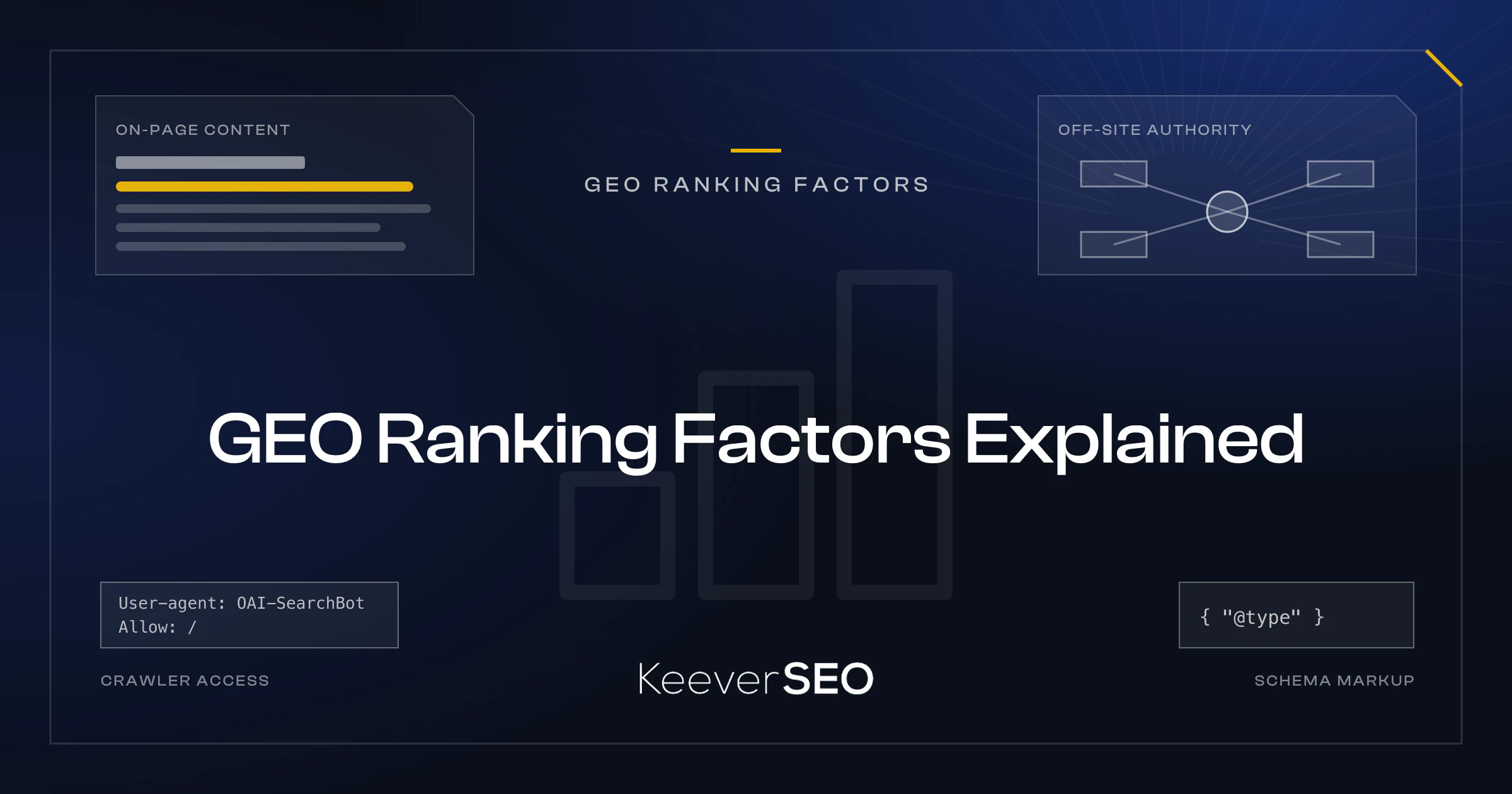
GEO ranking factors are the signals that decide whether AI models retrieve, cite, and recommend a source, grouped into on-page content, technical accessibility, and off-site authority factors. Generative engines retrieve candidate pages, select relevant passages, assess their usefulness, and synthesize information into answers with citations. On-page factors include direct answers, sourced statistics, extractable formatting, fluent language, and fresh information, technical factors include AI crawler access and schema markup, and off-site factors include brand mentions and E-E-A-T signals.
GEO ranking factors matter because they influence which sources appear in AI answers and which brands competitors may replace. An AI answer may quote a page's sourced statistic, recommend a business mentioned by trusted review sites, or omit a page that blocks relevant crawlers. GEO shares SEO foundations such as relevance, authority, and crawlability, but gives added attention to extractable passages, brand mentions, and clear language, and research and practice point to citations, sourced data, brand mentions, and direct answers as influential signals, without a universal weighting system.
Local service businesses can first improve consistent listings and reviews, direct answers on service pages, and LocalBusiness schema. Professional optimization helps when competition is strong, trusted mentions are scarce, crawler access has technical problems, or internal teams cannot maintain content. Google AI Overviews, ChatGPT, and Perplexity share many signals but rely on different retrieval systems, so GEO work should combine content improvements, technical checks, off-site authority building, and measurement of citations, mentions, and referral traffic. The sections below define each GEO ranking factor and explain how the signals shape source selection.
What Are GEO Ranking Factors?
GEO ranking factors are the content, technical, and off-site signals that AI models use to choose sources for citation and brands for recommendation. Content signals show whether a page answers a question directly, while technical signals help AI systems access and interpret the page.
Off-site signals include independent brand mentions, reviews, and evidence of subject knowledge. Together, the factors influence whether generative engines retrieve a source, select its information, and use it in a generated answer.
How Do Generative Engines Rank and Select Sources?
Generative engines rank and select sources by retrieving candidate web pages that match a user's question, then selecting relevant passages and synthesizing them into an answer with citations to the source pages. Google describes the technique as retrieval-augmented generation, relying on "core Search ranking systems to retrieve relevant, up-to-date web pages from our Search index," in "Google's Guide to Optimizing for Generative AI Features on Google Search," published by Google Search Central in May 2026.
Each platform applies its own retrieval and selection methods, so source ranking varies. The selection process highlights three GEO factor groups: on-page content, technical accessibility, and off-site authority.
What Types of GEO Ranking Factors Exist?
The types of GEO ranking factors that exist are on-page content factors, technical factors, and off-site authority factors. On-page factors shape the information and structure of a page, while technical factors help AI systems access and interpret it.
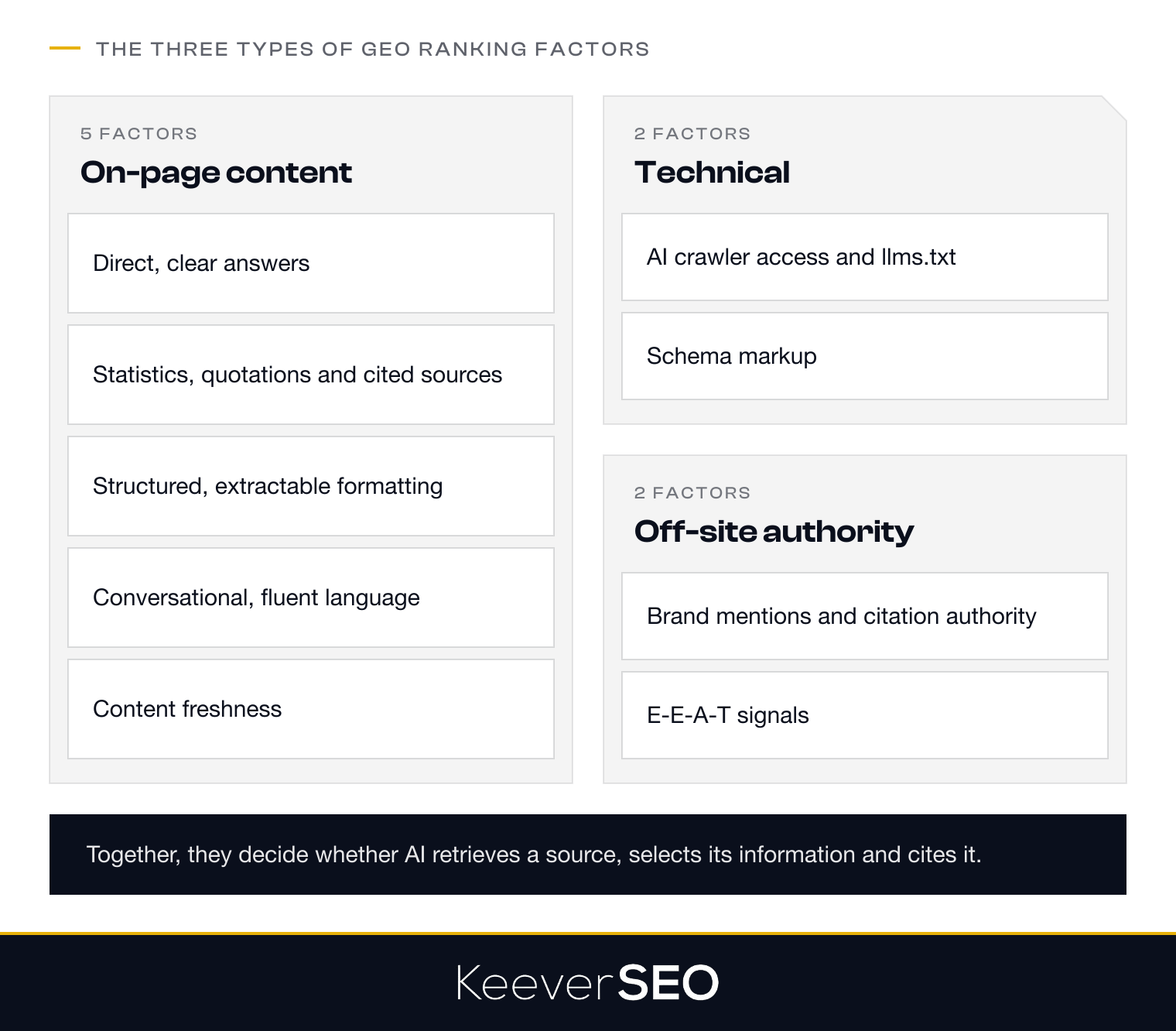
Off-site authority factors show how trusted external sources describe a brand or organization. The sections below explain how each factor type affects AI source selection and brand recommendations.
On-Page Content Factors
On-page content factors are webpage signals that help generative engines interpret, retrieve, and reuse information accurately. Clear, direct answers give AI systems self-contained passages, while statistics, quotations, and cited sources provide supporting evidence. Question headings, short paragraphs, lists, and tables make information easier to extract and synthesize. Fluent language and current facts improve clarity and keep time-sensitive content relevant.
Direct, Clear Answers
Direct, clear answers help generative engines match a page to a user's question and select relevant passages. Place an answer-first sentence immediately below each question heading, then add supporting context or qualifications. Each passage should state its subject and meaning without relying on surrounding text, navigation, or unexplained pronouns. A 2026 review of 45 studies, "Optimizing Visibility in Generative Engines: A Critical Survey of Generative Engine Optimization (2023-2026)," found that "topical relevance and context position are the most reproducible levers."
Statistics, Quotations, and Cited Sources
Statistics, quotations, and cited sources give generative engines verifiable evidence to extract and attribute. A 2023 study by Aggarwal and colleagues, "GEO: Generative Engine Optimization," found that the Cite Sources, Quotation Addition, and Statistics Addition methods "achieved a relative improvement of 30-40%" in visibility, while keyword stuffing offered "little to no improvement." The NeurIPS 2025 benchmark "C-SEO Bench: Does Conversational SEO Work?" urges caution, since "most current C-SEO methods are not only largely ineffective but also frequently have a negative impact on document ranking." Effective figures identify the measurement, population, timeframe, and original source, while quotations name the person or organization.
Structured, Extractable Formatting
Structured, extractable formatting organizes content so readers and generative systems can identify and reuse main information. Question-based headings label topics, while short paragraphs present focused answers that can stand alone. Lists group related facts, and tables compare details across consistent fields. Carnegie Mellon researchers found that content rewritten to follow learned rules "such as Conclusion First, Logical Structure, Comprehensive coverage, and In-depth" improved GEO metrics by an average of 35.99% in "What Generative Search Engines Like and How to Optimize Web Content Cooperatively" (October 2025), although results vary across platforms and study designs.
Conversational, Fluent Language
Conversational, fluent language helps AI systems match page content with natural, question-based searches. Plain wording, clear explanations, and defined technical terms help readers follow the answer. Phrasing that reflects users' questions and search intent makes passages easier for generative engines to retrieve and summarize. Avoiding jargon and awkward keyword repetition keeps GEO content clear and readable.
Content Freshness
Content freshness can improve GEO visibility when AI systems need current, accurate information, especially for changing topics such as regulations, pricing, health, and finance. Google's "A Guide to Google Search Ranking Systems" describes "query deserves freshness" systems "designed to show fresher content for queries where it would be expected." Publishers should display clear publication or "Last updated" dates and revise outdated facts, statistics, links, and recommendations. Reviews should match each topic's rate of change, and Google's "Creating helpful, reliable, people-first content" asks whether site owners are "changing the date of pages to make them seem fresh when the content has not substantially changed."
Technical Factors
Technical GEO ranking factors determine whether AI systems can access, render, and interpret a website's pages. Crawl permissions, hosting rules, and server-rendered content help AI crawlers read important information, while schema markup clarifies page types and entities. "To be eligible to be shown as a supporting link in AI Overviews or AI Mode, a page must be indexed and eligible to be shown in Google Search with a snippet," according to Google's "AI features and your website," and no special AI markup is required. The two main technical factors are AI crawler access and schema markup.
AI Crawler Access and llms.txt
AI crawler access allows eligible bots to retrieve a site's content for potential inclusion in AI answers. Site owners can configure robots.txt rules for individual crawlers, and OpenAI's "Overview of OpenAI Crawlers" documents separate controls for OAI-SearchBot, used for search, and GPTBot, used for model training. Server-rendered HTML helps crawlers read important page content without relying on heavy client-side JavaScript. The proposed llms.txt file offers language models a Markdown guide to site content, but llms.txt is not a ranking signal, and Google's generative AI guide states that "Google Search ignores them."
Schema Markup
Schema markup is structured data that helps search systems identify page entities and their relationships. Organization schema describes a company, while Article schema identifies an article's headline, author, publisher, and dates. Product schema can state product details such as price and availability, while Service schema describes a service offered on the page. FAQPage schema represents visible question-and-answer content, although Google stopped showing FAQ rich results in May 2026, and accurate markup clarifies page information but does not guarantee AI citations or replace useful copy.
Off-Site Authority Factors
Off-site authority factors are signals outside a business's website that help AI systems assess brand credibility. Independent mentions, customer reviews, community discussions, and links provide external evidence about a brand and its credentials. Generative engines can use third-party sources alongside clear, well-supported website content when selecting sources and recommending brands. The two main off-site authority factors are brand mentions with citation authority, and E-E-A-T signals.
Brand Mentions and Citation Authority
Brand mentions and citation authority from trusted publications, review platforms, and relevant community sites can strengthen visibility in AI-generated answers. A 2025 Ahrefs study of 75,000 brands, "An Analysis of AI Overview Brand Visibility Factors" by Louise Linehan, found that "brand web mentions show the strongest correlation (0.664) with AI Overview brand visibility." University of Toronto researchers found a similar pattern: AI search shows "a systematic and overwhelming bias towards Earned media (third-party, authoritative sources) over Brand-owned and Social content," in "Generative Engine Optimization: How to Dominate AI Search" (September 2025). Citation rate and brand mention rate measure different outcomes, so businesses should track both.
E-E-A-T Signals
E-E-A-T signals describe a source's Experience, Expertise, Authoritativeness, and Trustworthiness. First-hand experience appears in documented project work, product use, or customer outcomes, while author credentials appear through relevant qualifications and subject knowledge. Author biographies, business details, citations, publication dates, and clear contact information help readers assess credibility and trust. Google's "Creating helpful, reliable, people-first content" states that "E-E-A-T itself isn't a specific ranking factor."
Why Are GEO Ranking Factors Important?
GEO ranking factors are important because they influence whether AI systems retrieve a business, cite its content, or recommend its brand in an answer. Strong signals raise the chance that a business enters the shortlist of sources considered for an AI-generated response.
Businesses that ignore GEO ranking factors risk losing visibility when generative engines answer relevant queries. Competitors with clearer content, accessible pages, and stronger authority may receive the citations and recommendations instead.
What Are Examples of GEO Ranking Factors in Action?
Examples of GEO ranking factors in action show which passages AI systems retrieve and cite. An article that reports a customer-retention figure, explains its calculation, and names its source gives an AI model a verifiable statistic to quote.
Trusted review-site mentions can support an AI recommendation for a local contractor described as reliable for emergency plumbing. In contrast, a page that blocks PerplexityBot in robots.txt drops out of the crawler that Perplexity's "Perplexity Crawlers" documentation describes as "designed to surface and link websites in search results on Perplexity," so the page is less likely to appear as a cited source.
How Do GEO Ranking Factors Differ From SEO Ranking Factors?
GEO ranking factors differ from SEO ranking factors by optimizing for inclusion in AI-generated answers rather than visibility in ranked search results. Both approaches value relevance, crawlability, content quality, and authority.
GEO gives added weight to clear, self-contained passages, sourced claims, trusted brand mentions, and fluent language. A page can rank well in organic search yet remain uncited if AI systems cannot easily retrieve or verify its information.
Which GEO Ranking Factors Carry the Most Weight?
The GEO ranking factors that carry the most weight are sourced statistics and citations, brand mentions, and direct answers, although no universal weighting applies across AI platforms. The Aggarwal GEO study tested 10,000 queries and found that its best methods "improve upon baseline by 41% and 28%" on its two visibility measures.
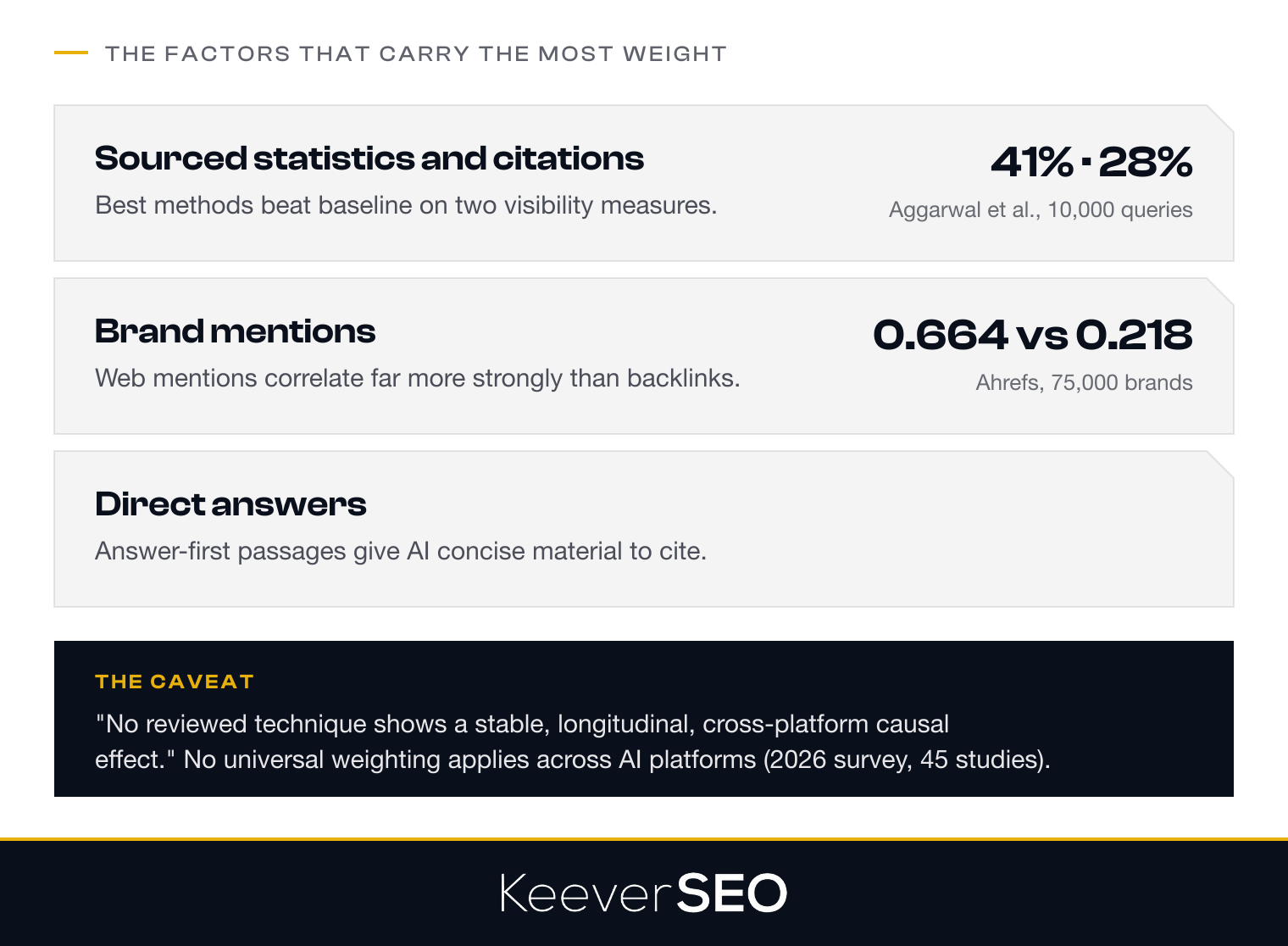
Brand mentions strengthen AI visibility because external references help systems assess a company's recognition and relevance, and the Ahrefs analysis of 75,000 brands found that "web mentions (0.664) correlate much more strongly than backlinks (0.218)" with AI Overview visibility. The evidence has limits, since the 2026 survey of 45 GEO studies concluded that "no reviewed technique shows a stable, longitudinal, cross-platform causal effect." Clear, answer-first passages complement the other signals by giving AI systems concise material to retrieve and cite.
Which GEO Ranking Factors Should a Local Service Business Improve First?
The GEO ranking factors a local service business should improve first are accurate, consistent listings across Google Business Profile, major directories, and review platforms. Keep business names, addresses, phone numbers, service areas, hours, categories, and services aligned, and encourage a steady flow of genuine customer reviews.
Service pages should answer common questions about pricing, service areas, response times, and appointments directly. Add accurate LocalBusiness schema for business details and services, then validate the markup and confirm search engines can crawl the page.
When Do GEO Ranking Factors Need Professional Optimization?
GEO ranking factors need professional optimization when a business competes in a crowded market, lacks trusted third-party mentions, or cannot maintain accurate content. Those gaps can block AI systems from finding, interpreting, and citing the business.
A specialist can audit crawler access, indexing, page rendering, and structured data, then improve service pages and build legitimate mentions. Professional support helps when internal teams lack the time or skills to maintain the improvements, and no provider can guarantee AI citations.
How Does Keever SEO Improve GEO Ranking Factors Through Generative Engine Optimization Services?
Keever SEO improves GEO ranking factors through generative engine optimization services covering content updates, technical implementation, authority building, and performance tracking. The GEO ranking SEO agency service restructures priority pages with direct answers, conversational wording, supporting evidence, statistics, and question-and-answer sections, adds Organization, FAQ, and Product schema, and checks robots.txt, page rendering, and AI crawler access.
Keever SEO builds off-site authority through relevant publications, directories, forums, and community sources. The company tracks brand mentions, citation share, sentiment, share of voice, and AI referral traffic across platforms such as ChatGPT, Perplexity, Gemini, and Google AI Overviews.
How Do GEO Ranking Factors Compare Across AI Platforms?
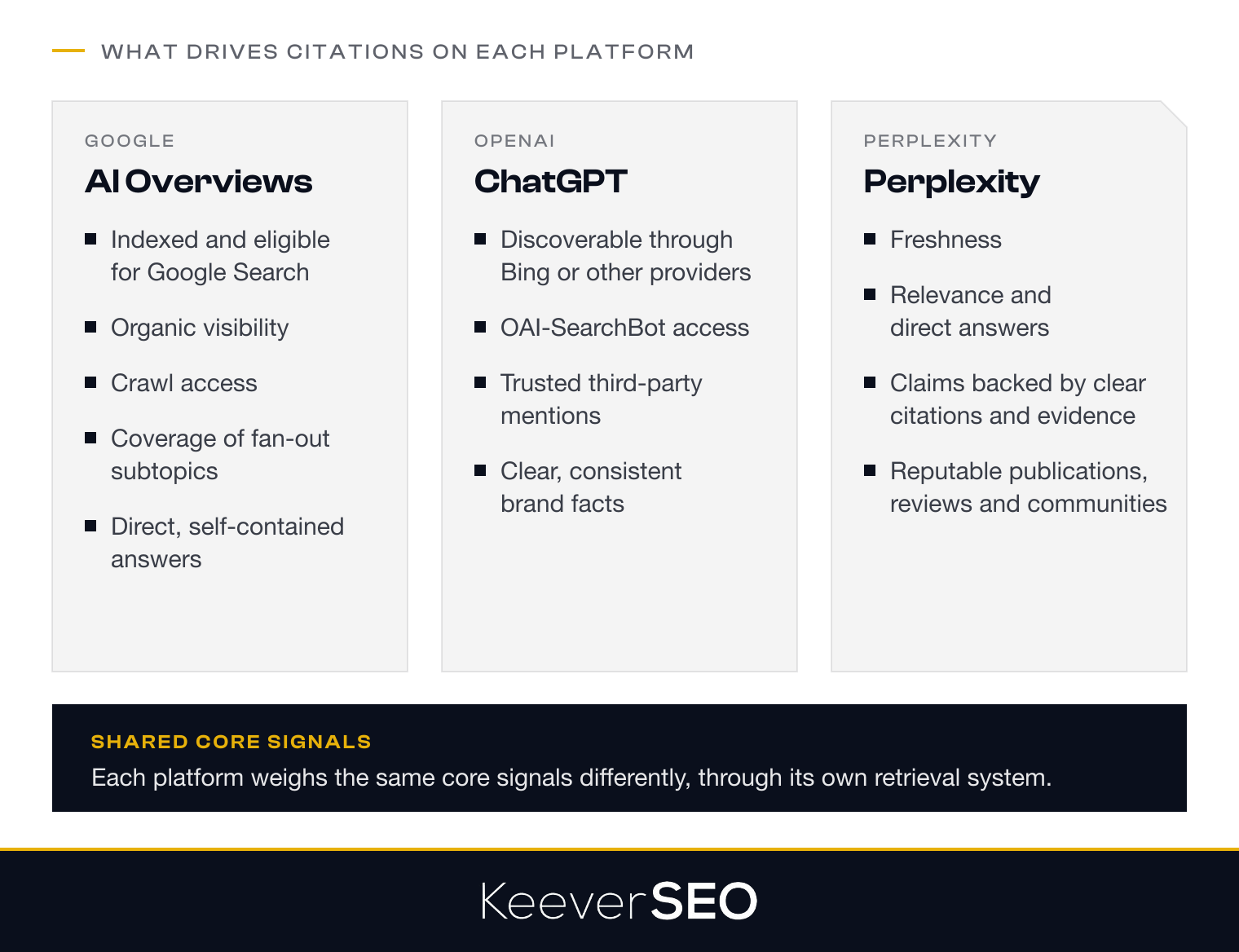
GEO ranking factors compare across AI platforms as shared core signals that Google AI Overviews, ChatGPT, and Perplexity weigh differently. Google AI Overviews connects citations closely to organic search visibility and coverage of related queries. ChatGPT centers on retrievable web information, trusted mentions, and clear facts about entities. Perplexity favors fresh, well-supported sources and displays citations alongside its answers.
Which Factors Drive Google AI Overviews Citations?
The factors that drive Google AI Overviews citations are indexing and eligibility for standard Google Search, organic visibility, and crawl access. Query fan-out can retrieve pages covering related subtopics, while direct, self-contained answers help Google select useful passages for its synthesized response.
Which Factors Drive ChatGPT Rankings?
The factors that drive ChatGPT rankings are discoverability through Bing or other search providers and access for OpenAI's OAI-SearchBot, since "sites that are opted out of OAI-SearchBot will not be shown in ChatGPT search answers," according to OpenAI's crawler documentation. Trusted third-party mentions and clear, consistent facts about a brand's name, services, location, authorship, and credentials help ChatGPT assess and cite a source, and indexing alone does not guarantee citation.
Which Factors Drive Perplexity Rankings?
The factors that drive Perplexity rankings are freshness, relevance, direct answers, and claims supported by clear citations and verifiable evidence. Reputable publications, review sites, and community discussions strengthen visibility when they provide trustworthy information or first-hand experience.
How Do You Act on GEO Ranking Factors?
To act on GEO ranking factors, strengthen on-page content, technical access, and off-site authority together. Write direct answer-first passages, use clear headings and concise formatting, cite reliable sources, and update time-sensitive facts. Check robots.txt, server responses, and JavaScript rendering so AI crawlers can access page content, then add accurate schema that matches visible information. Earn relevant mentions from trusted publications, review platforms, and community sites, and track citations and referral traffic over time.
How Do You Measure Progress on GEO Ranking Factors?
To measure progress on GEO ranking factors, track mention rate, citation share, and AI referral traffic over time. Test consistent customer prompts across relevant AI platforms on a fixed schedule, recording the platform, date, and location for each result. Pair visibility metrics with analytics for referral sessions, landing pages, engagement, and conversions.
How Will GEO Ranking Factors Change as AI Search Grows?
GEO ranking factors will likely favor current, verifiable information and content that AI agents can interpret across formats as AI search grows. Agentic search systems can research multiple sources, compare options, and monitor changing details, which raises the value of clear evidence and machine-readable facts.
Google reported in its Q3 2026 earnings remarks that "one in five AI Mode searches globally use voice, images, or documents," and its generative AI guide tells site owners to "stay informed about emerging technologies that allow AI agents to interact with your site." As AI answers use more formats and verification steps, GEO ranking factors remain the content, technical, and off-site signals that help AI systems find, trust, extract, cite, and recommend sources.