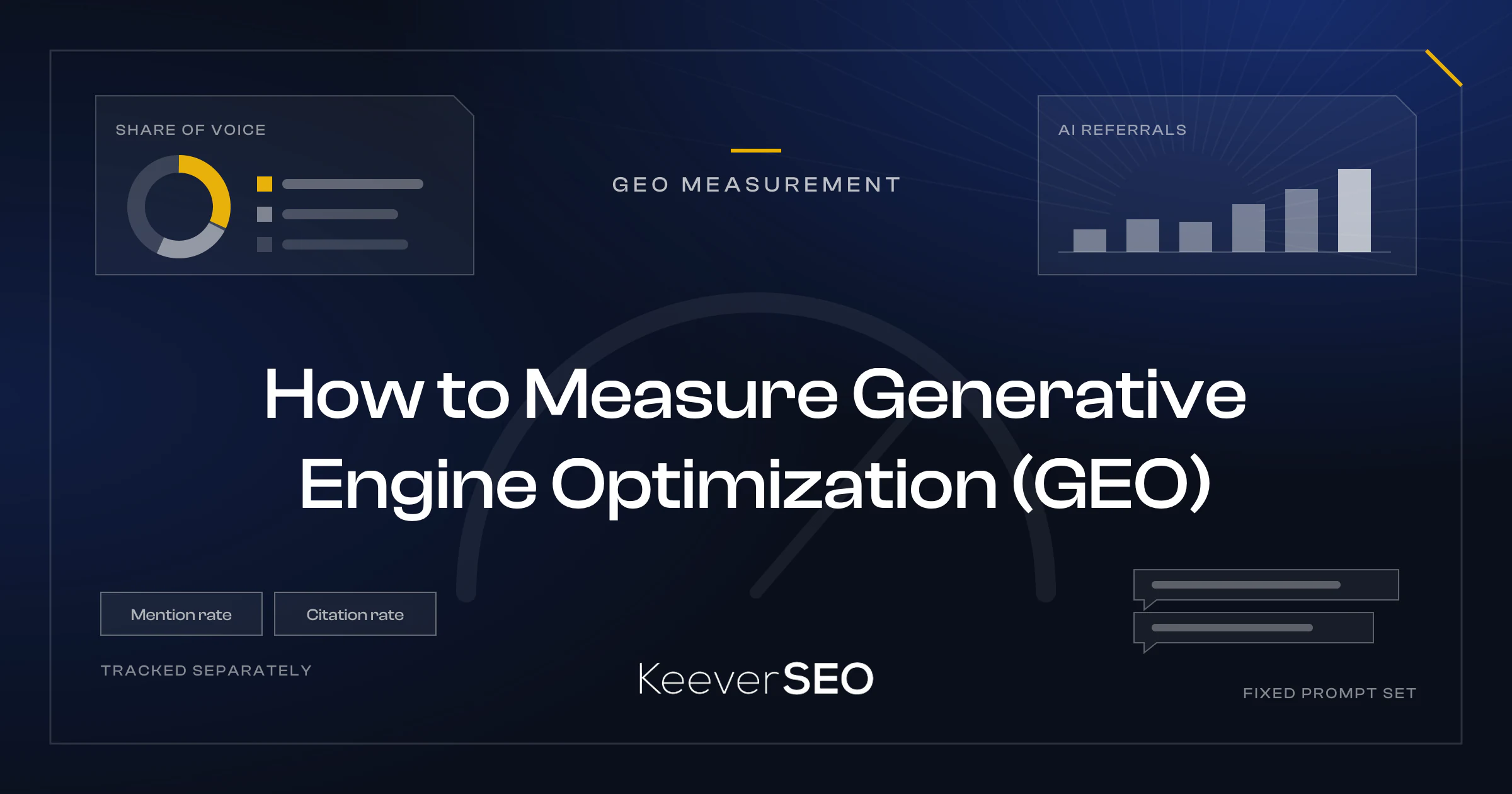
To measure generative engine optimization, run a fixed set of buyer prompts across each AI model and track mention rate, citation share, prominence, sentiment, and AI referral traffic against competitors. GEO measurement tracks how frequently and how favorably AI-generated answers name and cite a brand, and what that visibility produces. Before measuring, prepare consistent buyer prompts and analytics that identify AI referrals. The five core metrics are mentions and citations, share of voice, answer prominence, brand sentiment, and referral traffic and conversions.
A practical measurement routine builds prompts for each product or service, runs them across AI models, records mentions and citations, tracks AI referrals, and compares competitor results monthly. Prompt volume, closed-app answers, citation reasons, and attribution across blended sources remain difficult to measure. Connect GEO results to revenue through referral conversions, branded search trends, and lead-source questions, and run prompts weekly or every two weeks while reporting results monthly. Local service businesses should prioritize service and "near me" mentions, calls and form leads, and review sentiment, while agencies can manage tracking across multiple models, services, and locations.
GEO tools automate prompt runs and report mentions, citations, sentiment, and competitor share of voice, and platforms such as Semrush, Ahrefs, Peec AI, and Profound offer related tracking, while Google Analytics 4 measures referral activity. Many answer engine optimization (AEO) tools overlap with GEO measurement. Citation patterns point to content, technical accessibility, and off-site authority improvements, while zero-click answers make mentions and citations important visibility signals even without website visits. The sections below explain what GEO measurement involves and how to apply the full process.
What Does Measuring Generative Engine Optimization Involve?
Measuring generative engine optimization (GEO) involves running consistent buyer prompts across AI models and recording when they mention or cite a brand. GEO measurement tracks mention frequency, citation presence, answer prominence, and brand sentiment across platforms such as ChatGPT, Gemini, Perplexity, Claude, and Google AI Overviews.
GEO measurement connects AI visibility with business outcomes, including referral sessions, engagement, leads, and conversions. Comparing results across competitors shows how frequently AI answers recommend each brand and whether that visibility contributes to customer actions.
What Do You Need Before Measuring GEO?
Before measuring GEO, you need a fixed set of buyer prompts and analytics configured to identify AI referrals. A consistent prompt set lets you compare brand mentions, citations, and sentiment across measurement runs, and analytics show whether AI visibility produces website visits, engagement, and conversions. Start by defining the buyer prompts that will anchor each GEO measurement run.
A Fixed Set of Buyer Prompts
A fixed set of buyer prompts contains realistic questions customers ask about each product or service. Include discovery questions, such as "What is the best solution for [problem]?", alongside comparison and purchase-choice questions. Keep the wording unchanged across measurement runs so changes in AI mentions and citations reflect visibility shifts, not different prompts, and run the same prompts across each selected AI model.
Analytics Set Up to Capture AI Referrals
Analytics set up to capture AI referrals records identifiable visits from AI platforms and connects those visits to business outcomes. In Google Analytics 4, create a custom channel group using verified referral patterns for ChatGPT, Perplexity, Gemini, Claude, and Copilot, and place the AI channel above the general Referral channel. Track each AI source, landing page, session, engaged session, and engagement rate. Mark form submissions, calls, purchases, demo requests, and bookings as key events to compare conversions from AI referrals with other channels, keeping in mind that some AI visits lack detectable referrers, so analytics cannot capture every AI-influenced visit.
Which GEO Metrics Should You Track?
The GEO metrics you should track are AI mention and citation rate, share of voice, position and prominence, brand sentiment, and AI referral traffic and conversions. Mention and citation rates show whether AI answers name your brand or cite your pages.
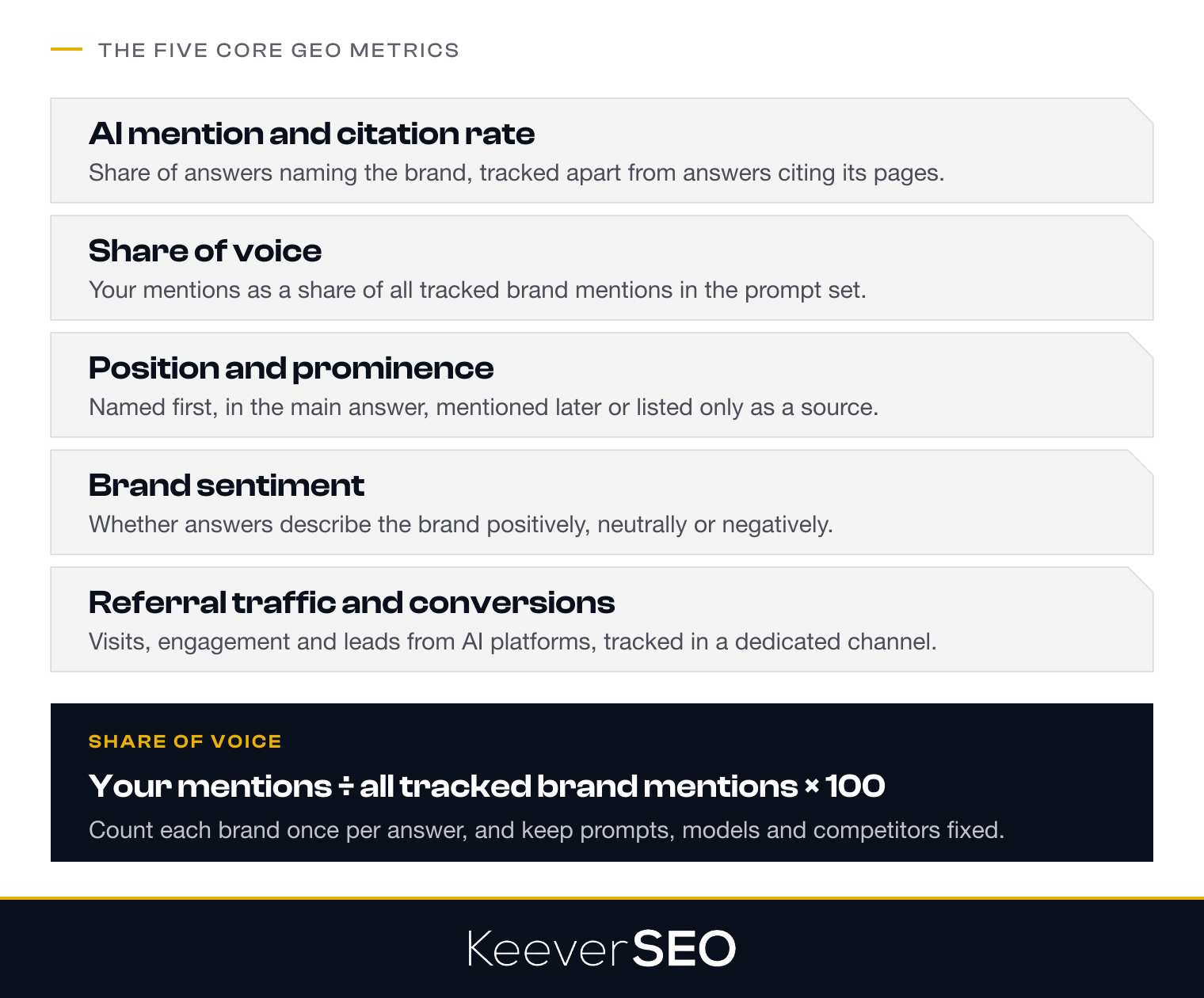
Share of voice compares your mentions with competitors. Position and prominence show where your brand appears in an answer, while sentiment records how AI systems describe it. Referral traffic and conversions show whether AI visibility leads to website visits, engagement, and business results.
AI Mention and Citation Rate
AI mention and citation rate covers two separate measures: mention rate is the percentage of tested answers that name the brand, whether or not they link to its website, and citation rate is the percentage of answers that cite the brand's website or a different owned page. Track mention rate and citation rate separately for each AI model and prompt category. Repeating the same prompts on a consistent schedule shows how brand visibility changes over time.
Share of Voice Against Competitors
Share of voice against competitors measures your brand's mentions as a percentage of all tracked brand mentions across the prompt set. Count each brand once per answer, then divide your brand's mentions by the total mentions for your brand and competitors, and multiply the result by 100. Keep prompts, AI models, settings, and competitor lists consistent between reporting periods, and track citation share separately from brand mentions.
Position and Prominence Inside the Answer
Position and prominence inside the answer measure how visibly a brand appears in an AI-generated answer. Record whether the AI names the brand first, features it in the main answer, mentions it later, or lists it only as a source. A first-position recommendation with substantive detail shows greater prominence than a brief mention near the end. Compare positions across repeated prompts, because AI answers vary between runs.
Brand Sentiment in AI Answers
Brand sentiment in AI answers measures whether AI-generated answers describe a brand positively, neutrally, or negatively. Positive answers recommend the brand or associate it with favorable qualities, while neutral answers describe it without endorsement. Negative answers stress weaknesses, risks, complaints, or unfavorable comparisons. Record each sentiment label with the AI model, prompt, date, and wording, then compare patterns across models and runs.
Referral Traffic and Conversions From Generative Engines
Referral traffic and conversions from generative engines show whether visibility in AI answers leads to measurable website activity and business outcomes. Analytics platforms such as Google Analytics 4 can track sessions from ChatGPT, Gemini, and Perplexity through a dedicated AI referral channel. Compare landing pages, engagement, leads, purchases, and conversion rates across those sessions. Referral data measures trackable clicks, but it may not capture purchases influenced by AI answers without a website visit.
How Do You Measure Generative Engine Optimization Step by Step?
To measure generative engine optimization step by step, follow five steps: build buyer prompts, run prompts across AI models, record mentions and citations, track AI referral conversions, and compare competitors monthly. A consistent schedule and prompt set help distinguish meaningful visibility changes from variation between AI answers.
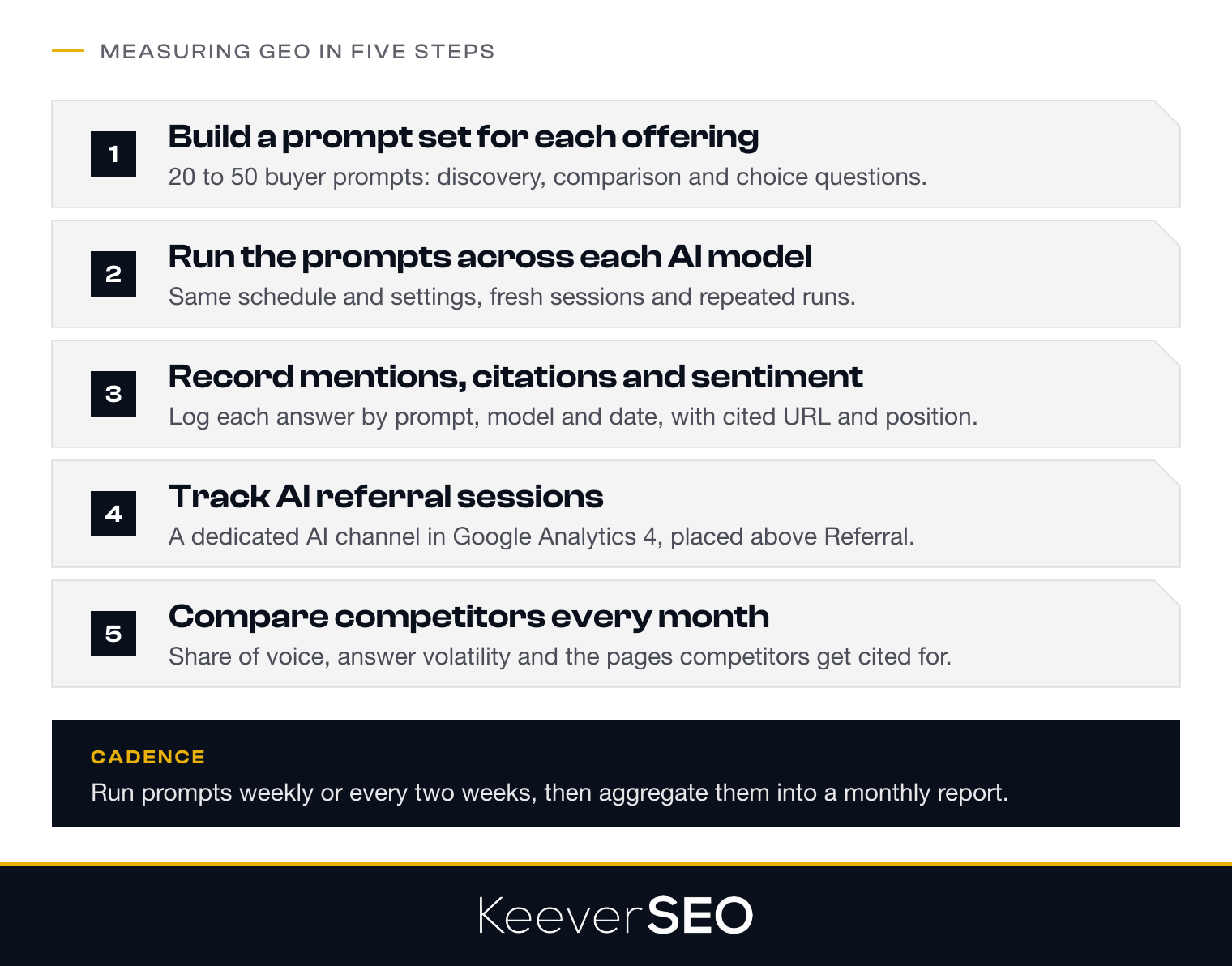
The measurement process connects AI visibility with website traffic, leads, and competitor performance. Start by building a prompt set for each product or service.
1. Build a Prompt Set for Each Product or Service
Building a prompt set for each product or service starts measurement with 20 to 50 buyer prompts per offering. The prompt set should cover discovery questions about options, comparison questions about alternatives, and choice questions about pricing, suitability, or providers. Use realistic buyer language from sales calls, customer support conversations, and search queries, then keep each prompt unchanged between measurement runs.
2. Run the Prompts Across Each AI Model
Running the prompts across each AI model means sending every buyer prompt to ChatGPT, Gemini, Perplexity, Claude, and Google AI Overviews on the same schedule. Keep settings consistent, including locale, language, account state, and product mode, and record each run's date and time. Use fresh sessions and repeat prompts to account for answer volatility and prevent earlier conversation context from influencing later responses. Save the complete answers and cited URLs for logging brand mentions, citations, prominence, and sentiment.
3. Record Mentions, Citations, and Sentiment
Recording mentions, citations, and sentiment means logging each AI answer in a tracking sheet by prompt, model, and run date. Log whether the brand appears, the exact cited URL, its position in the answer, and its sentiment as positive, neutral, or negative.
Track brand mentions separately from citations, since a mention names the brand while a citation identifies a source used by the AI model. Preserve the full response and note whether the brand appears in the opening recommendation, main body, or source list, and the recorded results then guide referral-session tracking.
4. Track AI Referral Sessions in Analytics
Tracking AI referral sessions in analytics starts with a dedicated "AI Assistants" channel group in Google Analytics 4. Add source-matching rules for platforms such as ChatGPT, Gemini, Claude, Perplexity, and Copilot, and place the group above standard Referral so sessions receive the correct classification. Review landing pages, engagement, and conversions such as form submissions, calls, purchases, or booked consultations. Referral data may undercount AI visits when platforms do not pass source information, so compare monthly traffic and conversion trends with competitor visibility and citation gains.
5. Compare Results Against Competitors Every Month
Comparing results against competitors every month uses the same prompts, AI models, competitors, settings, and collection window each time. Calculate share of voice by comparing your brand's mentions with all tracked brand mentions across the prompt set. Review answer volatility by checking how mentions and cited URLs change between runs. Record which competitors gained or lost citations, and inspect their cited pages for patterns in content and sources.
Which GEO Metrics Are Still Hard to Measure?
The GEO metrics that are still hard to measure limit the accuracy of visibility and attribution data. The four main measurement challenges are listed below:
- Prompt volume: Small prompt sets produce unstable results, while large sets require more time and analysis.
- Closed-app answers: AI platforms may show brand mentions without exposing referral data or clicks.
- Citation reasons: A citation shows attribution, but rarely explains why an AI model selected that source.
- Blended-source attribution: AI answers combine multiple sources, making influence and revenue difficult to assign to one brand or page.
How Do You Connect GEO Results to Revenue?
To connect GEO results to revenue, track AI referral conversions, branded search trends, and lead-source responses. Segment AI referral sessions by platform, landing page, and conversion event, then compare their conversion rates and revenue with other channels. Adobe Digital Insights reported in its August 2026 "AI Traffic Trends Report" that "in July 2026, AI-referred retail visitors converted at a rate 60% higher than non-AI traffic," with 53% more revenue per visit, though non-AI traffic still converted slightly better in travel.
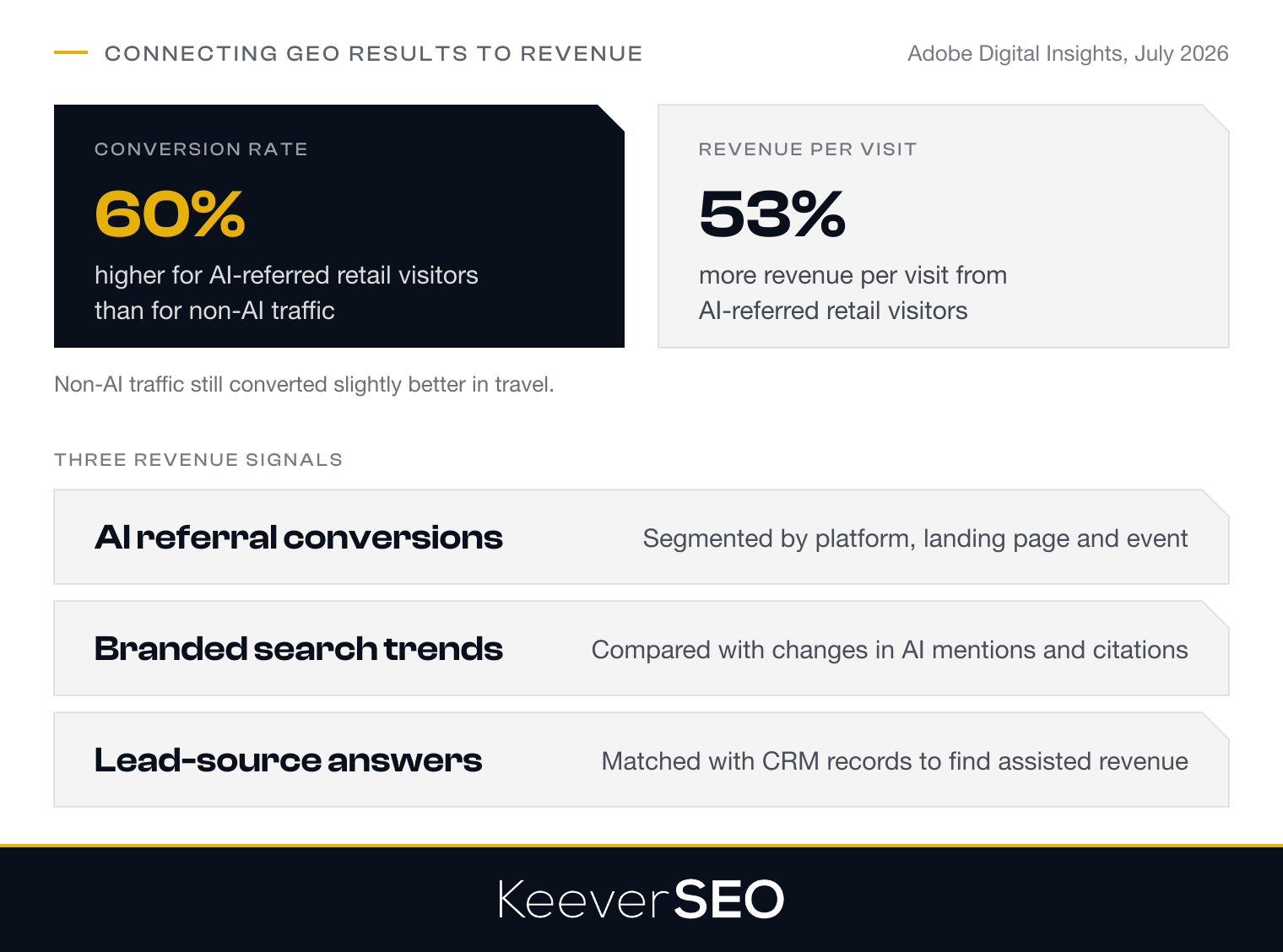
GEO can influence sales without producing a direct AI referral session. Compare branded search growth with changes in AI mentions and citations, and ask new leads whether ChatGPT, Gemini, Perplexity, or Google AI Overviews influenced their decision. Match survey responses with CRM records to identify assisted leads and revenue.
How Often Should You Measure GEO?
You should measure GEO weekly or every two weeks, running the same buyer prompts across consistent AI models, settings, and locations. SparkToro's January 2026 study "NEW Research: AIs are highly inconsistent when recommending brands or products" found "a <1 in 100 chance" that ChatGPT or Google's AI returns the same list of brands in any two responses, and recommends asking each prompt "usually at least 60-100X, then average these out." Ahrefs found that AI Overview content changes every 2.15 days on average, with 45.5% of cited sources new between consecutive responses, in "AI Overviews Change Every 2 Days (But Never Change Their Mind)" (November 2025). Aggregate repeated runs into a monthly report comparing mentions, citations, prominence, sentiment, and competitors, and increase monitoring during launches, site migrations, reputation issues, or major competitive changes.
Which GEO Metrics Should a Local Service Business Prioritize?
The GEO metrics a local service business should prioritize are AI mentions for service and "near me" prompts, calls and form leads from AI referrals, and review sentiment. Prompts such as "emergency dentist in Austin" or "best plumber near me" show whether AI platforms recommend the business to nearby customers.
Track mentions, citations, answer position, and local competitor share of voice for each service area. Measure AI-referred calls, form submissions, and booked appointments separately, then monitor whether AI answers describe the business positively, neutrally, or negatively.
When Should GEO Measurement Be Handed to an Agency?
GEO measurement should be handed to an agency when it spans several AI models, many services, or multiple locations. A specialist team can run consistent prompts across platforms and compare brand mentions, citations, sentiment, and referral traffic.
Agency support helps when internal teams lack time for monthly analysis. Recurring reports connect AI visibility trends with leads and highlight competitor changes.
How Does Keever SEO Measure Generative Engine Optimization for Clients?
Keever SEO measures generative engine optimization for clients by creating a fixed buyer-prompt set for each client service. The data-driven SEO agency team runs those prompts across ChatGPT, Gemini, Perplexity, Claude, and Google AI Overviews, then records brand mentions, citations, cited URLs, answer position, and sentiment.
Keever SEO compares those results with competitors to calculate AI share of voice and track visibility changes. Monthly reports show which prompts earn citations and connect AI referral traffic with leads and conversions.
Which Tools Measure Generative Engine Optimization?
The tools that measure generative engine optimization automate prompt runs across AI platforms and report brand mentions, citations, and sentiment. Options include Semrush AI Visibility Toolkit, Otterly, Peec AI, Profound, Scrunch, Writesonic, and SE Ranking. Depending on the platform, reports compare competitors and track cited URLs, visibility trends, and prompt-level results across ChatGPT, Gemini, Perplexity, and Google AI Overviews, and some tools connect AI visibility data with website analytics, technical audits, content recommendations, or AI referral traffic.
Which AEO Tools Overlap With GEO Measurement?
The AEO tools that overlap with GEO measurement are most Answer Engine Optimization (AEO) tracking tools, because both disciplines measure brand visibility in AI-generated answers. AEO tracking tools report mentions, citations, position, sentiment, share of voice, and competitor visibility across platforms such as ChatGPT, Gemini, Perplexity, and Google AI Overviews.
What Do GEO Metrics Reveal About Ranking Factors?
GEO metrics reveal which content, technical, and off-site signals correlate with brand citations and mentions in AI answers. Repeated citations to service pages, comparison guides, original research, or well-structured content point to opportunities to improve relevance, depth, freshness, and extractability. Technical patterns can highlight crawlability, semantic HTML, schema markup, and page performance issues, while off-site citations can reveal gaps in trusted publications, review platforms, and industry mentions. Treat the patterns as signals, then compare results across AI models and controlled updates before prioritizing changes.
How Do Zero-Click Searches Affect GEO Measurement?
Zero-click searches affect GEO measurement by making brand mentions and citations the main visibility measures, because users receive answers without visiting a website. "In the first four months of 2026, a whopping 68.01% of Google searches ended without a click," according to "In 2026, Less than One Third of Google Searches Still Send a Click" by Rand Fishkin, published by SparkToro in June 2026, so referral traffic alone cannot measure search visibility.
What Is the Simplest Way to Start Measuring GEO?
The simplest way to start measuring GEO is to run 20 realistic buyer prompts across ChatGPT, Gemini, and Perplexity once a month. Record brand mentions, website citations, answer prominence, and how each AI model describes the brand.
Create an AI referral channel in analytics to track landing pages, engagement, and conversions from AI platforms. The monthly routine provides a practical starting point for the full GEO measurement process, connecting AI answer visibility with business outcomes.