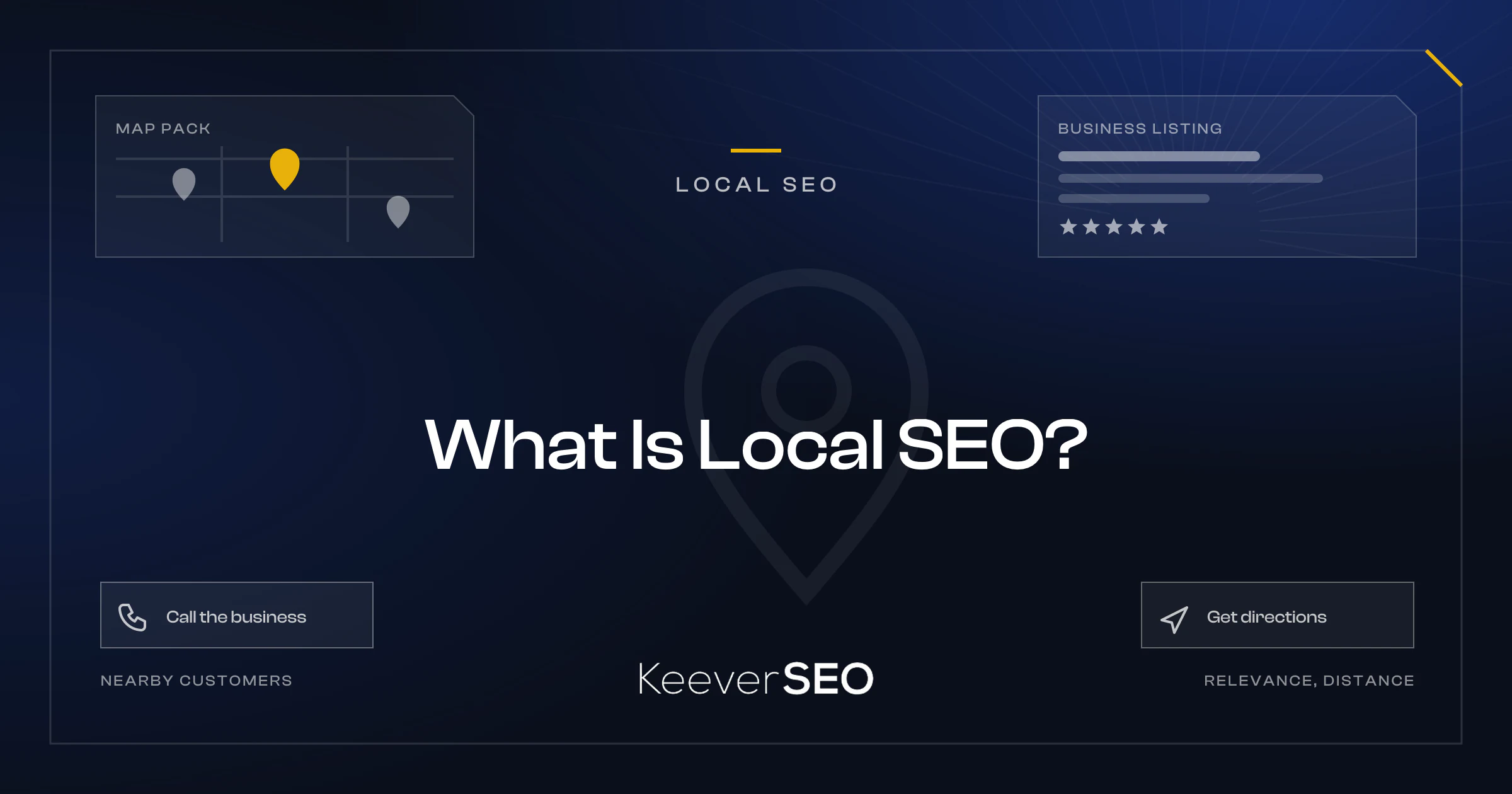
Local SEO is the practice of optimizing a business’s online presence so it appears in Google’s local results and Map Pack when nearby customers search for its services. Local search means a search for businesses tied to a place or service area, such as “plumber near me” or “coffee shop in Austin,” and local search results can show map listings, business profiles, local website pages, reviews, and actions such as calls or direction requests. Local SEO works when Google weighs relevance, distance, and prominence, and a searcher then compares listings, reads reviews, calls, requests directions, or books. People who ask what is local SEO marketing or what is local search engine optimization are asking about the same work: aligning a business’s profile, website, location details, and reputation with nearby search needs. The answer to what is local SEO optimization comes down to six main parts: Google Business Profile optimization, local keyword research, on-page local SEO, citations and consistent name, address, and phone number (NAP), reviews, and local link building. As for what is local SEO in digital marketing, local SEO is the channel that brings nearby customers to an area-serving business, and that business can start by completing its profile and correcting its business information while avoiding inaccurate listings, ignored reviews, and thin location pages. Restaurants, clinics, contractors, retailers, and other local service businesses need local SEO because nearby searchers are ready to call, visit, or book. Businesses facing strong competition, managing multiple locations, or lacking time and technical skills may hire an agency, and Keever SEO manages profiles, citations, reviews, local pages, and call tracking with monthly reporting for US service businesses. The sections ahead explain local SEO costs, timelines, benefits, the difference from national SEO, ranking factors, and do-it-yourself options, all building on the definition of local SEO as optimizing a business’s online presence for local results.
What Does Local SEO Mean?
Local SEO means optimizing a business’s online presence so it appears in Google’s local results and Maps when nearby customers search for its products or services. The definition of local SEO centers on visibility within a defined geographic area, the city, neighborhood, or service area a business serves. The local SEO meaning covers a Google Business Profile, location-focused website content, and accurate business listings. What is local search optimization beyond those listings? Local search optimization adds customer reviews, local citations, and links from relevant local websites to strengthen a business’s standing in its area. What is Google local SEO? Google local SEO describes the work of improving a business’s presence in Google Search, Google Maps, and the Map Pack. The answer to what is meant by local SEO, and to what does local SEO mean in daily practice, is the connection between nearby customers and relevant businesses at the moment those customers search.
What Does Local Search Mean in SEO?
Local search in SEO means a search for a business, service, or place within a defined geographic area. People express local intent with queries such as “plumber near me” or “Italian restaurant in Chicago,” and Google uses the searcher’s location to show nearby results in Google Search, Google Maps, and the Map Pack. The short answer to what is local search in SEO is the optimization of a business’s visibility for those location-based queries. What is local search marketing? Local search marketing uses online channels, such as business profiles, directories, and local ads, to reach customers in a service area. What is Google local search, and what is a local search engine more broadly? Google local search connects the query and the searcher’s location with relevant nearby businesses, and a local search engine is any platform, such as Google Search or Google Maps, that returns results based on location.
What Are Examples of Local Search Results?
Local search results appear in Google Search, Google Maps, and local directories, and the common examples of local search results are listed below:
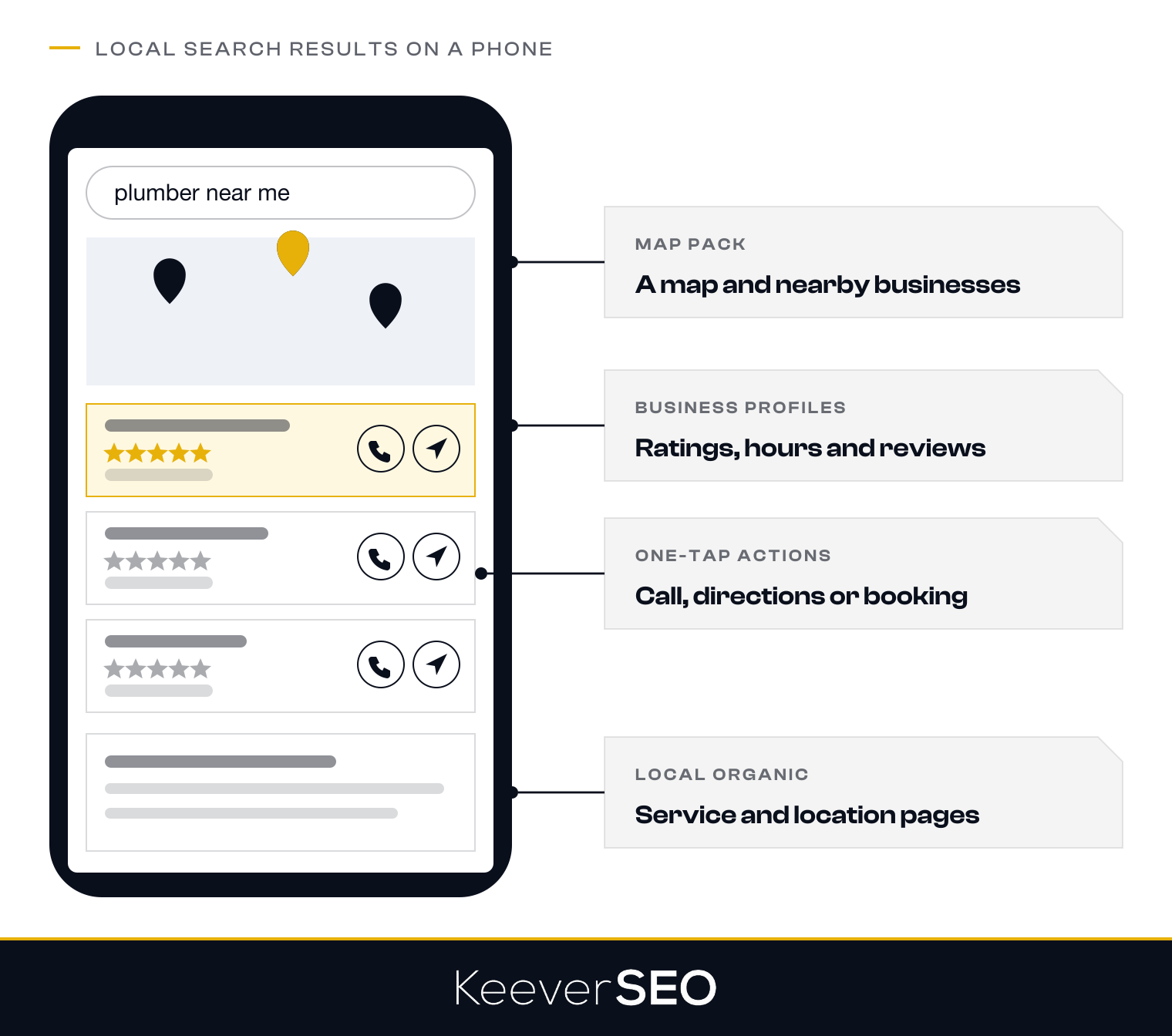
- Google Map Pack: A map and a short list of nearby businesses, usually with ratings, hours, addresses, and contact options.
- Google Maps results: Business pins and profiles that let users compare nearby locations and request directions.
- Google Business Profile listings: Business profiles that display contact details, hours, photos, reviews, and service areas.
- Local organic results: Website links to location pages, menus, service pages, and local guides.
- Local Finder results: Expanded local listings that appear when users select “More places” from the Map Pack.
- Local Services Ads: Paid listings for eligible service businesses, usually with direct call or message options.
- Local directory and review listings: Results from platforms such as Yelp or Yellow Pages that show business details and customer ratings.
How Does Local SEO Work?
Local SEO works by matching a business’s online information with the searches of nearby customers. A complete Google Business Profile, local website content, consistent business details, customer reviews, and links from reputable local websites help Google identify which businesses are relevant to a search. Location-based keywords connect services with searches such as “plumber in Austin.” Accurate name, address, and phone number details across directories build consistency, while mobile-friendly pages help customers find business hours, services, and contact options. A nearby customer who finds the business in Google Search or Maps can then call, request directions, visit the website, or book a service. The answer to “what is local SEO and how does it work” leads straight to the factors Google uses to decide which local businesses rank.
How Does Google Decide Local Rankings?
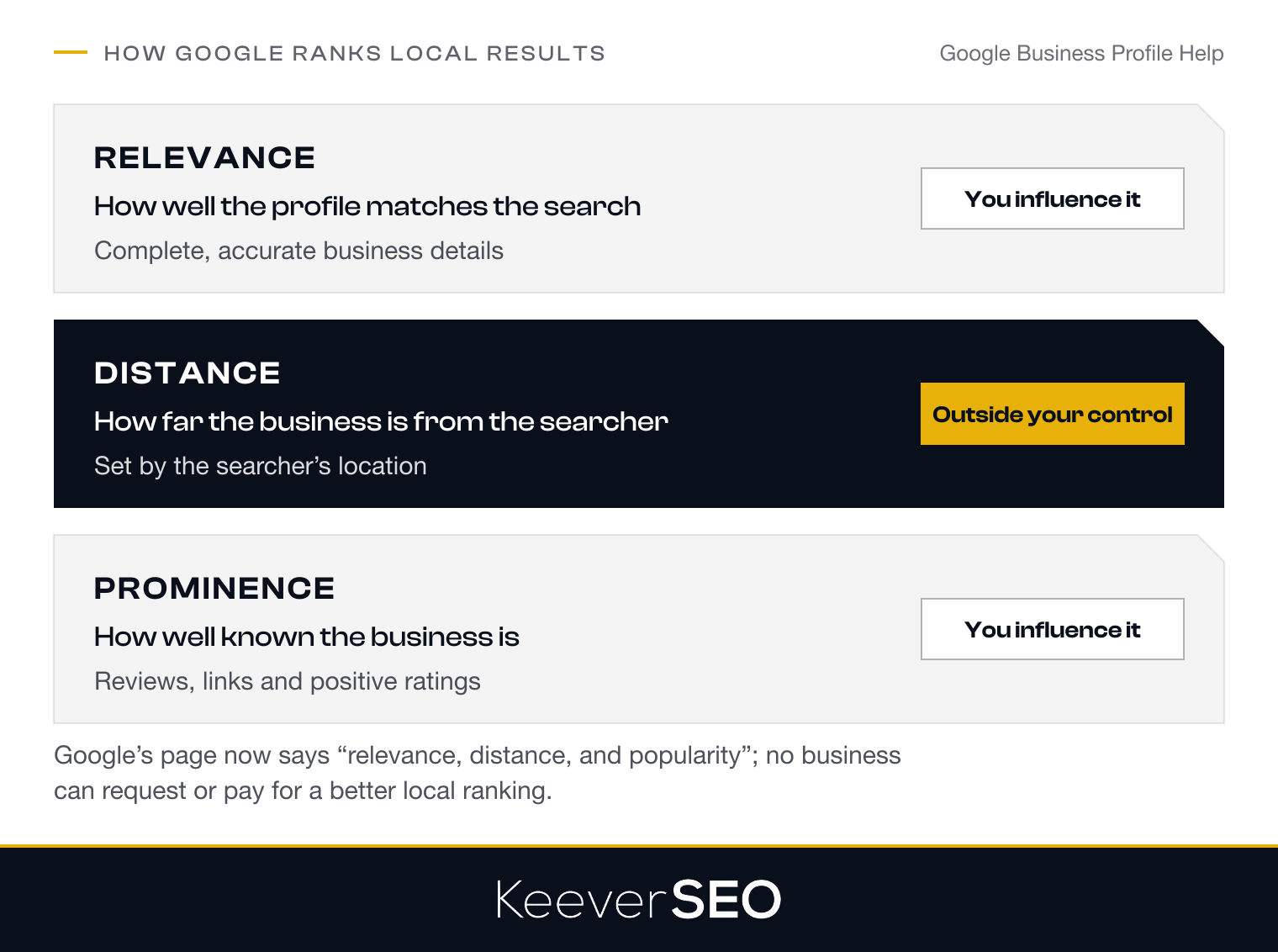
Google decides local rankings mainly by relevance, distance, and prominence. Relevance is how well a Business Profile matches what someone searches for, distance is how far the business is from the searcher or the named location, and prominence is how well known the business is. Google’s own wording now reads “Local results are mainly based on relevance, distance, and popularity,” according to "Tips to improve your local ranking on Google" by Google Business Profile Help, which still lists the third factor under the heading Prominence. Relevance, distance, and prominence answer what affects local SEO in map results, and the three factors explain what is local ranking and what is GMB ranking, the older name for a Business Profile’s position in Google Maps. Complete, accurate business information supports relevance, while reviews, links, and positive ratings contribute to prominence. Distance stays outside a business’s control because the searcher’s location sets it, and Google states that no business can request or pay for a better local ranking. A stronger local ranking puts the business in front of nearby customers at the moment they decide whether to call or visit.
How Does Local SEO Turn Searches Into Calls?
Local SEO turns searches into calls by presenting a relevant business with clear contact options at the moment a nearby customer searches. A Google Business Profile can show the business’s phone number, hours, services, location, reviews, and booking link in Google Search or Maps, so the searcher can call, request directions, or book straight from the result. Accurate profile details and a mobile-friendly website help searchers choose a business and take the next step. Google Business Profile performance data records call-button clicks, direction requests, and website visits, while booking systems record reservations.
What Are the Main Parts of Local SEO?
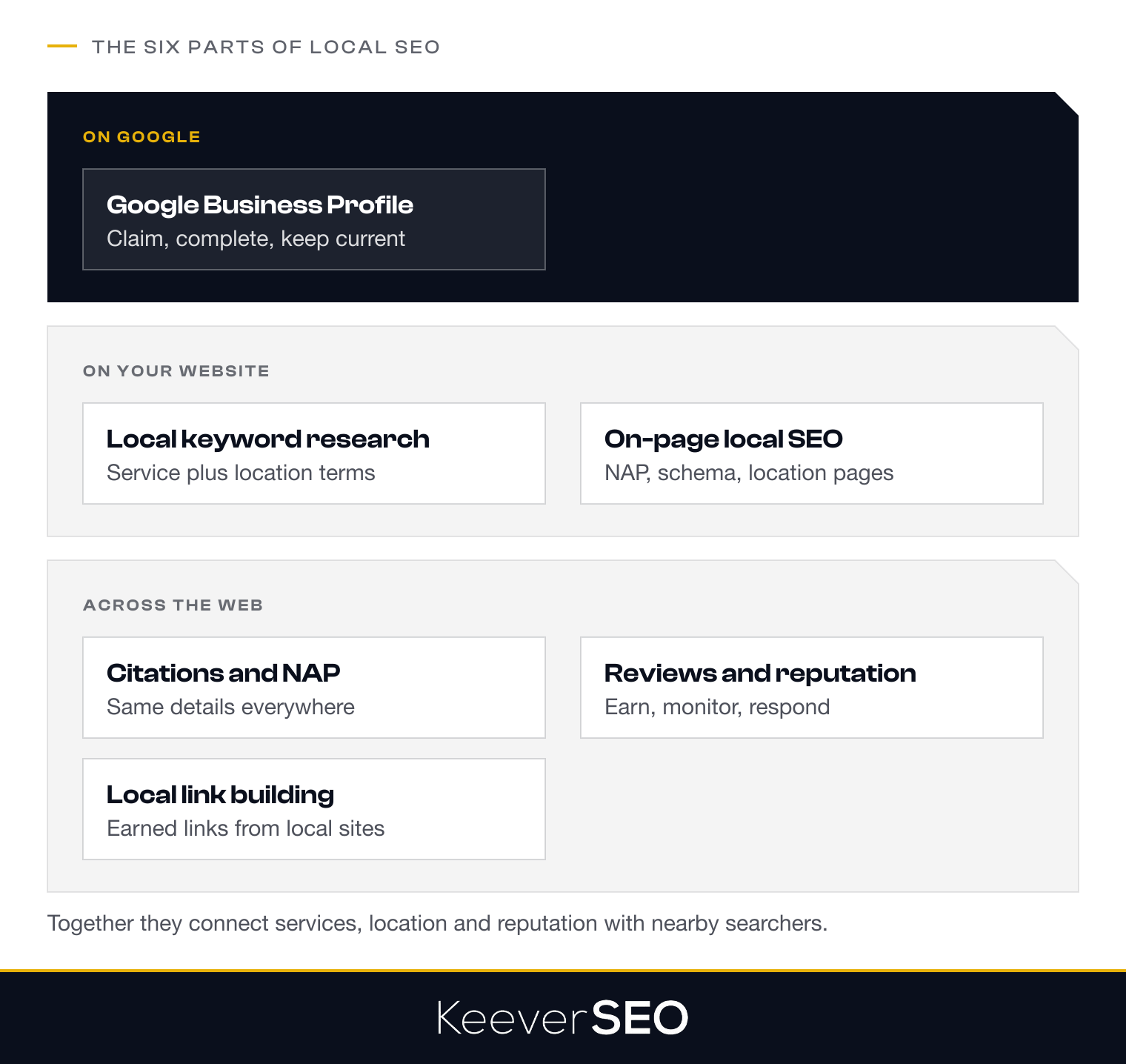
The main parts of local SEO are Google Business Profile optimization, local keyword research, on-page local SEO, local citations and NAP consistency, reviews and reputation management, and local link building. Together, the six parts help Google connect a business’s services, location, and reputation with nearby searchers. Local keyword research identifies the terms nearby customers use, and on-page local SEO connects those terms to relevant website content. Citations, consistent business details, customer reviews, and local links strengthen accuracy, trust, and local authority. The first part to address is the Google Business Profile, because the profile is what searchers see first in the Map Pack.
Google Business Profile Optimization
Google Business Profile optimization means claiming, completing, and managing the free profile that shows a business in Google Search and Maps. Google My Business is the former name of the profile, so a searcher asking what is GMB in SEO or what is Google My Business in SEO is asking about the same local listing tool. Google Business Profile optimization starts with verifying the profile and entering accurate business details: the real business name, address or service area, phone number, website, hours, and categories. Businesses strengthen the profile with service information, photos, current updates, and genuine customer reviews, then respond professionally to feedback. The answer to what is Google My Business optimization is that routine of keeping the profile complete and current, while the question “what is Google My Business SEO” points to the wider goal of matching the business with the right local searches.
Local Keyword Research
Local keyword research identifies the phrases nearby customers use to find a service. Businesses combine service terms with location modifiers, such as “plumber in Austin,” “water heater repair Austin,” or “emergency plumber near me.” Local keyword research draws on Google Autocomplete, Keyword Planner, Search Console, and competitor results. Researchers group keywords by search intent, check whether Google displays local results for each one, and match each priority phrase to a relevant service page, location page, FAQ, or Google Business Profile service. Natural keyword use connects local content with customer searches without stuffing.
On-Page Local SEO
On-page local SEO optimizes website content and technical details so search engines can connect a business’s services with nearby searches. The business name, address, and phone number (NAP) should appear as crawlable text and match the Google Business Profile and other listings. LocalBusiness schema labels details such as the business address, phone number, hours, and website for search engines. Businesses with multiple locations can create a dedicated location page for each area, with accurate NAP details, relevant services, and original information about that location.
Local Citations and NAP Consistency
A local citation is an online mention of a business’s name, address, and phone number (NAP). Citations appear in directories, map services, review platforms, social networks, and local organization websites, and a citation can support local SEO without linking to the business website. What is business listing in SEO? A business listing is a profile on an online platform such as Yelp or Apple Maps, and a local listing ties that profile to a physical location or service area, which answers what is local listing in SEO. NAP consistency means keeping the business name, address, and phone number accurate across the Google Business Profile, website, and other listings. Consistent details help search engines connect citations to the same business and help customers contact it. Businesses should correct outdated information, resolve duplicate listings, and update hours, services, and URLs when details change.
Reviews and Reputation Management
Reviews and reputation management involve earning, monitoring, and responding to customer feedback on Google Business Profile and relevant review platforms. Reviews appear in Google Search and Maps, where potential customers weigh ratings and owner responses before they call, request directions, or book. BrightLocal’s "Local Consumer Review Survey 2026" by Rosie Murphy, published in February 2026, found that 97% of consumers read reviews for local businesses and that 68% will only use a business with four or more stars. Businesses should ask customers for honest feedback and respond professionally to positive and negative reviews. Google’s contribution policies prohibit fake engagement, so businesses should not buy reviews, offer rewards for ratings, or pressure customers to give a certain score.
Local Link Building
Local link building is the practice of earning backlinks from trustworthy websites in a business’s industry and service area. Links from local news outlets, chambers of commerce, trade associations, community groups, suppliers, and regional directories can strengthen a business’s local relevance and online authority. Businesses earn local links by sponsoring community events, contributing know-how to local publications, and creating useful regional resources. Relevant, editorially earned links carry more value than large numbers of low-quality links, so businesses should avoid buying links, automated link schemes, and excessive link exchanges.
Why Is Local SEO Important?
Local SEO is important because nearby customers use search to find and contact businesses when they need a product or service. A July 2026 BrightLocal survey of 1,227 US consumers, "Google is #1 for local search, but three-quarters use more than one channel" by Rosie Murphy, found that 84% of consumers searched for a local business online in the previous three months, with 52% starting on Google Search. Why is local SEO important for a business with a defined service area? Strong local visibility places the business in Google’s Map Pack and local results, where searchers compare services, reviews, hours, and directions. The reason why local SEO is important for restaurants, medical practices, retailers, and home-service providers is the same: local results attract nearby customers with an immediate need.
Visibility in the Map Pack and Local Results
Local SEO brings visibility in Google’s Map Pack, Google Maps, and other local search results. The Map Pack displays nearby businesses for searches such as “dentist near me” or “plumber in Austin,” so customers can compare services, locations, and reviews in one place. An optimized Google Business Profile, accurate business details, relevant local website content, customer reviews, citations, and local backlinks support local visibility. Stronger local signals help a business reach nearby searchers, because Google ranks local results by relevance, distance, and prominence.
Higher-Intent Local Traffic
Local search traffic carries higher purchase intent because searchers name a nearby service or business they need soon. Queries such as “emergency plumber near me” and “dentist in Austin” point to a near-term need, and the next action is a call, a booking, a direction request, or a store visit. Local intent shows in the result itself: the Map Pack can place a call button, directions, hours, and reviews next to each business, so a searcher can act without opening a second page. Conversion rates from local searches vary by industry, market, and device.
Who Needs Local SEO?
Local SEO benefits any business that draws customers from a city, neighborhood, or service area, and the answer to what is SEO for small businesses usually starts with local search. The businesses that need local SEO are listed below:
- Businesses with storefronts: Restaurants, salons, shops, clinics, and gyms use local SEO to attract nearby visitors.
- Service-area businesses: Plumbers, electricians, cleaners, and contractors use local SEO to reach customers in the areas they serve. What is local SEO for plumbers? Local SEO for plumbers puts a plumbing company in results for searches such as “emergency plumber near me.”
- Small businesses: Independent retailers and practices use local SEO to compete for customers within a defined geographic area.
- Medical and wellness practices: Doctors, dentists, therapists, and fitness studios reach people searching for nearby care or appointments.
- Professional services: Lawyers, accountants, and real estate agents connect with clients in the cities and regions they serve.
- Restaurants and hospitality businesses: Restaurants, hotels, and entertainment venues reach nearby residents and visitors searching for places to eat, stay, or visit.
- Multi-location businesses: Companies with several branches use accurate profiles and location pages to reach customers in each market.
How Do You Start With Local SEO?
To start with local SEO, define the areas your business serves and the results you want, then follow the steps below:
- Set goals: Choose target locations and prioritize calls, bookings, visits, or website traffic.
- Claim your Google Business Profile: Verify the profile and complete its business details, categories, hours, and services.
- Standardize your NAP: Match your business name, address, and phone number across your website and listings.
- Research local keywords: Match services with relevant city, neighborhood, and “near me” search terms.
- Optimize your website: Improve service and location pages, mobile usability, and local business structured data.
- Build local trust: Add accurate directory listings, request genuine customer reviews, and earn links from relevant local organizations.
- Track performance: Monitor calls, direction requests, website visits, rankings, and leads, then update business details as needed.
Which Local SEO Mistakes Should You Avoid?
The local SEO mistakes that you should avoid are the errors that reduce visibility, confuse customers, and weaken trust, and the main local SEO mistakes are listed below:
- Using inaccurate business information: Keep the business name, address, and phone number consistent across the website, Google Business Profile, and directories.
- Adding keywords to the business name: Use the real-world business name, because unnecessary information in a business name can lead to the suspension of the Business Profile, as Google Business Profile Help warns in "Guidelines for representing your business on Google."
- Creating duplicate or false profiles: Maintain one eligible profile per location and use an accurate address or service area.
- Choosing irrelevant categories: Select categories that describe the business and its services accurately.
- Leaving the Google Business Profile incomplete: Add accurate hours, contact details, services, photos, and business attributes.
- Ignoring customer reviews: Request genuine feedback and respond professionally without buying or fabricating reviews.
- Neglecting mobile optimization: Make the website easy to use on phones so local visitors can call, get directions, or book.
- Overlooking local keywords: Target the services and locations that the business serves in reality.
- Publishing thin or duplicate location pages: Give each location page useful, accurate details instead of repeating near-identical text.
- Skipping local business schema: Use accurate structured data so search engines can interpret business details.
- Failing to track results: Measure calls, form submissions, bookings, and direction requests to assess local SEO performance.
What Does Local SEO Look Like for a Local Service Business?
Local SEO for a local service business looks like a Google Business Profile with defined service areas, service and location pages, a steady flow of reviews, and call tracking. The business sets its service areas in its Google Business Profile, hides its address when customers do not visit the location, and creates relevant service and location pages. Accurate business details, useful local content, and genuine customer reviews support visibility in the Google Map Pack. Map Pack rankings depend on relevance, distance, and prominence, so listing a service area does not guarantee visibility in every nearby town. Call tracking connects calls from Google Search, Maps, and website pages to their marketing sources, and it separates qualified leads from missed calls, repeat callers, and existing customers.
When Does Local SEO Need a Local SEO Agency?
Local SEO needs a local SEO agency when the work exceeds the time or skills a business has in-house. Stagnant rankings, inconsistent listings, unmanaged reviews, multiple locations, and weak lead tracking signal a need for professional support. Searchers who type “what is local SEO services” or “what is a local SEO service” want the scope, and local SEO services usually cover Google Business Profile management, citation cleanup, review guidance, location-page improvements, and performance reporting. The answer to what is local SEO company is a firm that delivers those services as a managed engagement, which suits businesses facing complex competition, while a single-location business with a simple service area can manage basic tasks in-house. Google Search Central states that "No one can guarantee a #1 ranking on Google" in its guide "Do you need an SEO?"
How Does Keever SEO Run Local SEO as an SEO Agency?
Keever SEO runs local SEO for US service businesses by auditing the Google Business Profile, citations, reviews, website, and local rankings of each client. The Keever SEO team improves business profiles, corrects listings, supports review requests, and builds service-area and location pages around customer searches. Keever SEO tracks Map Pack visibility across target locations and keywords, and monthly reports connect ranking changes with phone calls, form submissions, booked appointments, and other leads. Keever SEO never guarantees rankings.
What Should You Know Before Investing in Local SEO?
Before investing in local SEO, you should know the monthly cost, the time results take, and the benefits the work brings. Monthly cost depends on competition, service scope, and the number of locations. Local SEO can show early movement within weeks, while meaningful ranking and lead gains usually take three to six months and competitive markets can take six to twelve months. The benefits include greater local visibility, more calls and bookings, and more visits to the business.
How Much Does Local SEO Cost?
Local SEO costs about $1,557 per month on average, depending on competition, location count, and campaign scope, according to "SEO Pricing: How Much Does SEO Cost? 439 People Polled" by Joshua Hardwick, Ahrefs, August 2024. The same survey of 439 SEO providers found that the most common monthly retainer across all SEO work falls between $501 and $1,000, and Keever SEO prices local campaigns from about $1,500 per month.
How Long Does Local SEO Take to Work?
Local SEO takes about three to six months to work, measured as meaningful improvements in rankings, visibility, and qualified leads. Google Business Profile updates can show early movement within a few weeks, while new businesses and competitive markets can take six to twelve months or longer to reach stable rankings.
What Are the Benefits of Local SEO?
The benefits of local SEO are higher visibility in Google Search, Google Maps, and the Map Pack for nearby customers who need the business’s services. Higher local visibility brings qualified website visits, phone calls, direction requests, bookings, and in-person visits, while accurate business information and customer reviews build trust.
How Is Local SEO Different From National SEO?
Local SEO differs from national SEO in target area, keyword type, and the results it competes for. Local SEO targets customers in a defined area with location-based keywords such as “plumber in Austin,” while national SEO targets searchers across the country with broader terms such as “plumbing services.” Local SEO competes for the Map Pack and localized organic results, while national SEO focuses on standard organic rankings. A searcher who types “what is local SEO learn the differences with traditional SEO” wants that contrast: local SEO connects nearby searchers with a business, and traditional SEO builds visibility across a wider market.
Which Factors Affect Local SEO Rankings?
The factors that affect local SEO rankings are relevance, distance, and prominence, which Google assesses through how closely a business matches the search, how far the business sits from the searcher, and how well known the business is through reviews, citations, links, and accurate Business Profile information. In Whitespark’s "2026 Local Search Ranking Factors" by Darren Shaw, November 2025, 47 local search experts ranked the primary Google Business Profile category first and the proximity of the address to the point of search second among local pack factors.
Can You Do Local SEO Yourself?
Yes, you can do local SEO yourself by completing your Google Business Profile, adding local keywords to your website, keeping business details consistent, and managing customer reviews. A single-location small business can handle those basics, while multi-location businesses and highly competitive markets usually need specialist support and regular performance tracking.
What Does Local SEO Mean for a Business That Serves Nearby Customers?
For a business that serves nearby customers, local SEO means visibility at the moment people in its area search for relevant products or services. Restaurants, clinics, retailers, plumbers, and other local service businesses use local search results and Google Maps to reach potential customers. Strong local visibility helps nearby searchers find business information, read reviews, request directions, call, or book an appointment. Local SEO is the practice of optimizing a business’s online presence for those nearby searches.