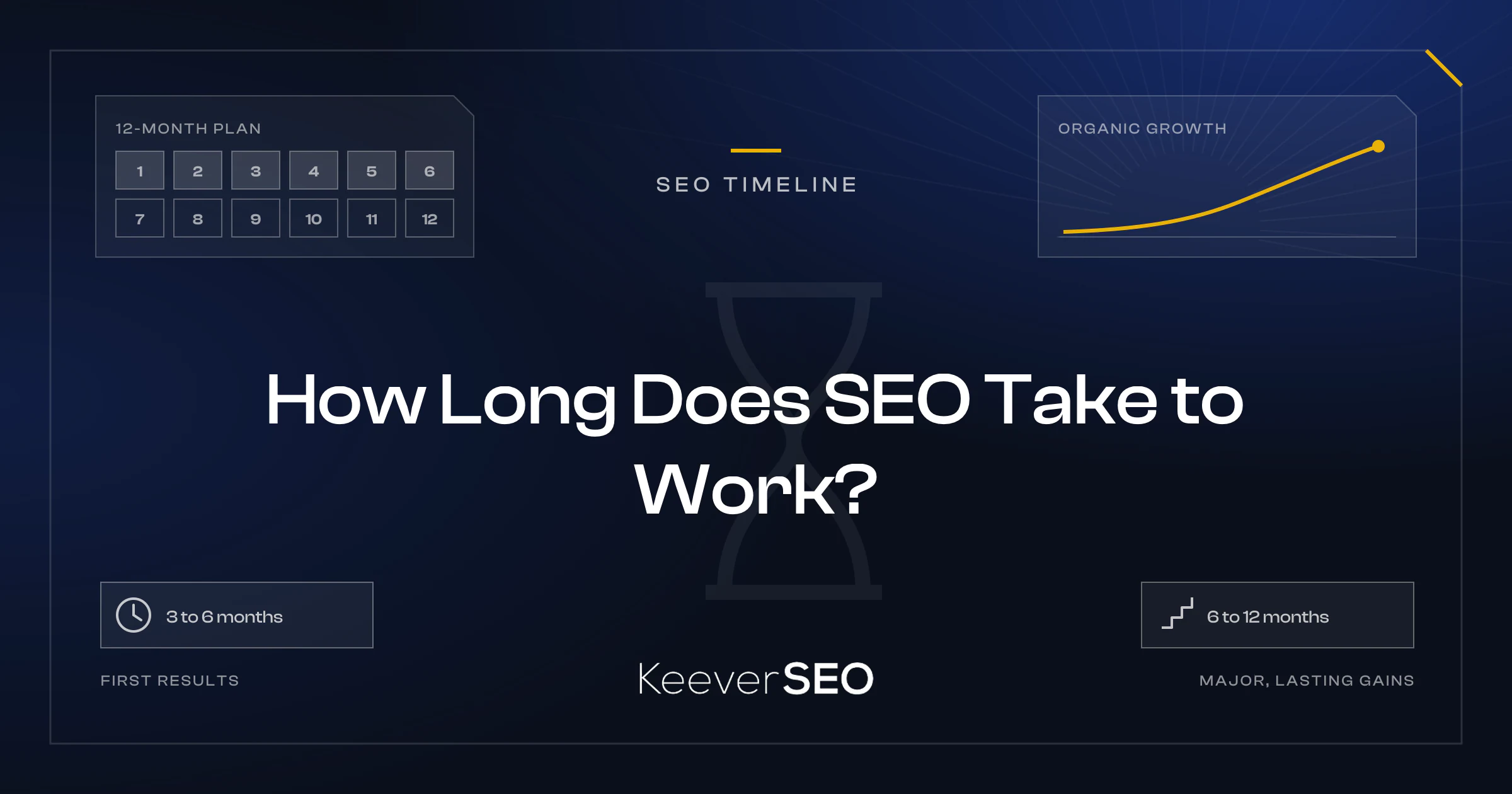
SEO takes about 3 to 6 months to show first results and 6 to 12 months to deliver major, lasting gains. In most cases, SEOs need "four months to a year to help your business first implement improvements and then see potential benefit," Google's Maile Ohye said in her 2017 video "How to hire an SEO," according to "Google: Give SEOs 4-12 Months To See Positive Ranking Benefits" by Barry Schwartz, Search Engine Roundtable, February 2017. SEO is working when rankings, organic traffic, and qualified leads rise in a measurable way and hold over time, rather than spiking for a few weeks and fading. Searches such as "how long does it take for SEO to start working" and "how long does SEO take to start working" ask about the first signal, while "how long for SEO to work" and "how long does it take for SEO to work" ask about results that last.
Google's guidance on the timeline comes first, followed by the month-by-month stages from the first three months to compounding growth after a year. Five factors set the pace: website age, keyword competition, backlinks, content quality, and technical health, and on-page changes, backlinks, and new content each run on their own clock. The guide then shows how to know SEO is working, how to make SEO work faster, and why SEO can take longer than expected.
The last sections answer whether an agency speeds things up, how long local SEO takes for service businesses, and how long Keever SEO takes to show results, before turning to cost, budget, value, and choosing an agency with realistic timelines. Knowing how long it takes for SEO to work starts with the direct answer in the first section. So, how long does SEO take to work? Plan for 3 to 6 months of early evidence and 6 to 12 months for major results.
How Long Does SEO Take to Show Results?
SEO takes about 3 to 6 months to show early results and 6 to 12 months to show major gains for most websites. The exact time depends on website history, competition, technical health, content quality, and how steady the optimization work is.
A May 2025 Ahrefs study by Patrick Stox, "How Long Does It Take to Rank in Google? And How Old Are Top Ranking Pages?", tracked 1 million random URLs for a year and found that "Only 1.74% of newly published pages rank in the top 10 within a year (down from 5.7% in 2017)." The Ahrefs figure is a ranking benchmark for brand-new pages, not a forecast for an established site that already holds rankings.
The search "SEO how long does it take" has two answers, because impressions and rankings move first and traffic and leads follow weeks later. Anyone asking how long does SEO take to show results, or how long does SEO take to see results, should count from the date changes go live, not from the contract date. Searches for "how fast does SEO work" and "how quickly does SEO work" get the same honest reply: SEO moves as fast as Google can recrawl the pages and as the competition allows.
What Does Google Say About How Long SEO Takes?
Google says SEO changes take anywhere from a few hours to several months to show in search results, and Google recommends waiting a few weeks before judging a change. The "SEO Starter Guide" from Google Search Central states that "Some changes might take effect in a few hours, others could take several months," and adds, "In general, you likely want to wait a few weeks to assess whether your work had beneficial effects in Google Search results."
Google does not publish a fixed SEO timeline, because crawling, indexing, and ranking each take their own time. For a full SEO campaign, Google's Maile Ohye gave a longer planning window of four months to a year in the 2017 hiring video cited above.
What Does an SEO Timeline Look Like Month by Month?
An SEO timeline month by month moves through four stages: foundation in months 1 to 3, momentum in months 4 to 6, major results in months 6 to 12, and compounding growth after the first year. Early indexing and impressions can appear within weeks, while steady organic traffic and leads take longer to build.
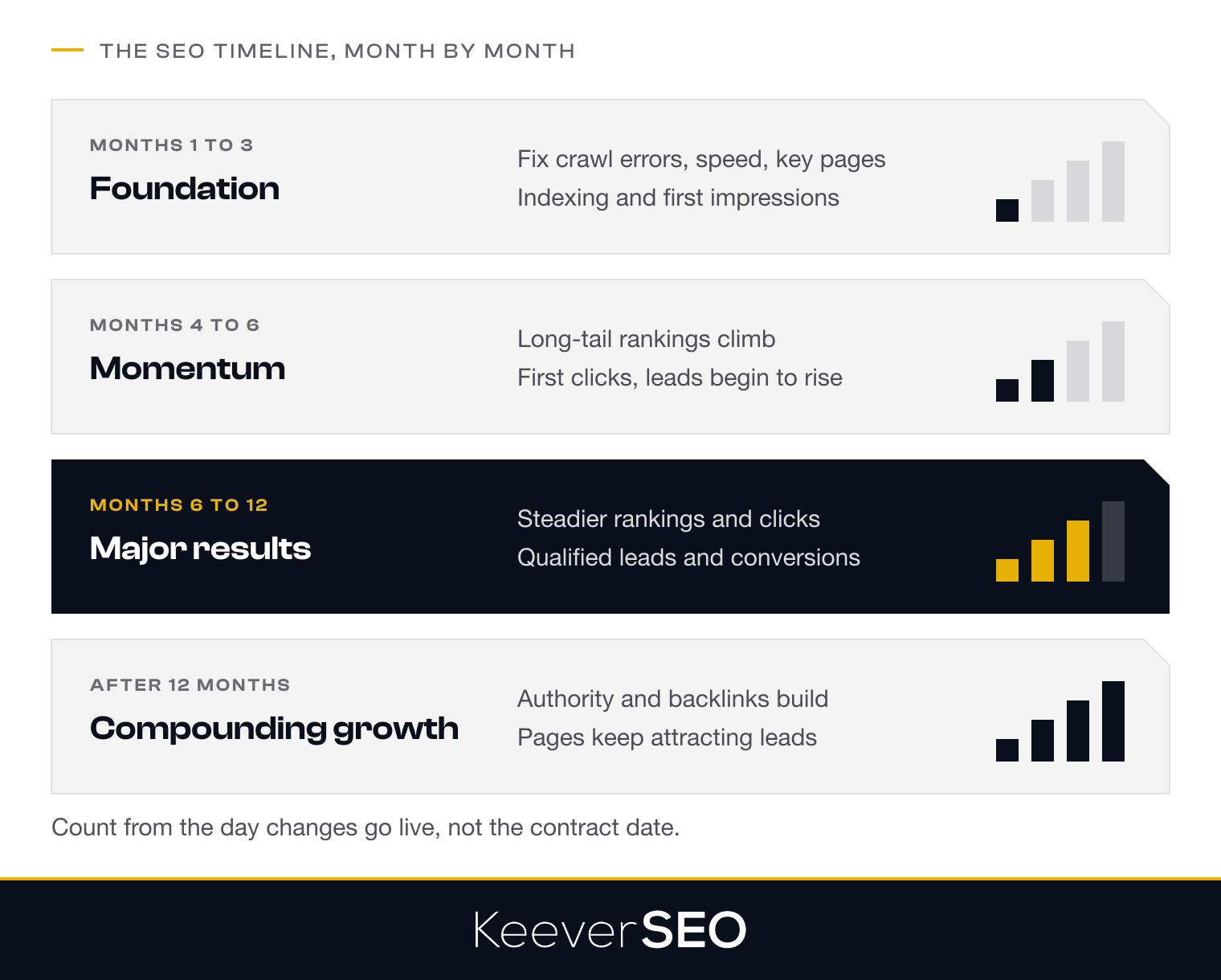
Each stage answers a different version of the same search. "How long does it take for SEO to kick in" points to the first impressions of months 1 to 3, while "how long does it take for SEO to be effective" points to the leads that arrive between months 6 and 12. Searches for how long until SEO takes effect, how long before SEO takes effect, or how long for SEO to take effect describe the gap between a change going live and Google reflecting that change. Anyone typing "how long does SEO take effect" or "how long does it take for SEO to take effect" can read the stages in order, starting with the foundation work of the first three months.
Months 1 to 3: Laying the SEO Foundation
The first three months of SEO make a website accessible, indexable, and aligned with search demand. Foundation work in months 1 to 3 includes fixing crawl errors, improving mobile usability and page speed, refining keyword targets, strengthening internal links, and updating priority pages. Established websites can see new indexing, impressions, or clicks within a few weeks, while brand-new websites need longer.
Google Search Console tracks indexed pages, impressions, clicks, and average position from the date changes go live, and the URL Inspection tool finds indexing barriers such as an unintended noindex directive. Once priority pages earn relevant impressions and early clicks, the technical foundation can carry the site into the momentum of months 4 to 6.
Months 4 to 6: Building SEO Momentum
Months 4 to 6 bring SEO momentum as indexed pages gain relevant impressions and climb for long-tail, lower-competition keywords. Google Search Console starts to show initial clicks, while organic traffic and leads begin to rise in a gradual way. Rankings can fluctuate as Google evaluates page relevance and performance.
SEO teams build on the second-stage movement by expanding content around queries that gain impressions, strengthening internal links, keeping the site technically healthy, and earning relevant backlinks. Continued work in months 4 to 6 lays the base for larger traffic and lead growth between months 6 and 12.
Months 6 to 12: Seeing Significant SEO Results
Months 6 to 12 bring major SEO results as early gains turn into steadier rankings, organic clicks, and qualified leads. Established websites can reach meaningful traffic sooner, while new sites targeting competitive keywords can need 12 months or longer. Progress in the third stage shows in sustained visits and conversions, not in temporary ranking spikes.
SEO teams in the third stage improve pages that sit close to page one, strengthen internal links, earn relevant backlinks, and expand content around topics that already gain impressions. Consistent gains between months 6 and 12 set up the compounding growth that follows the first year.
After 12 Months: Compounding SEO Growth
After 12 months, SEO shifts from building visibility to compounding growth. Established pages keep attracting organic traffic and leads as they accumulate rankings, backlinks, engagement, and topical authority.
Compounding SEO growth still needs ongoing work. Businesses sustain performance by updating aging content, fixing technical problems, earning relevant backlinks, and publishing useful pages on related topics. Competitor activity and Google ranking changes can move results, so monthly monitoring protects the gains.
Which Factors Decide How Long SEO Takes to Work?
The factors that decide how long SEO takes to work are website age and history, keyword competition, backlink profile, content quality, and technical SEO health. Together, the five factors shape how quickly Google finds pages, evaluates their relevance, and builds confidence in a website.
Website age and history set the starting point for every SEO timeline.
Website Age and History
Website age and history change the SEO timeline because older sites start with indexed pages, backlinks, and topical relevance that newer sites still need to earn. Domain age alone does not guarantee higher rankings, but an established site gives new pages a head start, while a new site builds the same signals from zero.
72.9% of pages in Google's top 10 are more than 3 years old, and the average #1 ranking page is 5 years old, according to "How Long Does It Take to Rank in Google? And How Old Are Top Ranking Pages?" by Patrick Stox, Ahrefs, May 2025. The Ahrefs data shows an association between page age and rankings, not proof that age causes rankings. A clean history, consistent publishing, and accessible pages support discovery; unresolved indexing problems or past site penalties delay progress.
Keyword Competition
Keyword competition changes the SEO timeline more than almost any other factor. Narrow, low-competition long-tail keywords can gain impressions and rankings within weeks or months, while highly competitive commercial terms can take 12 months or longer.
Search competition depends on the relevance, quality, authority, and backlink strength of the pages already ranking, not on search volume alone. Newer websites build visibility by targeting narrow queries first, then pursuing broader terms as their content and authority grow.
Backlink Profile
A backlink profile changes the SEO timeline by setting how much authority a website brings to each new page. Relevant links from reputable, topic-related websites strengthen that authority, while few or weak links make competitive rankings take longer. Websites with established backlinks give new pages a stronger starting point.
Link quality matters more than link volume. Earning useful backlinks takes time because outreach, publication, and search engine discovery happen in stages, and a steady, natural link profile supports long-term SEO progress better than a sudden surge of low-quality links.
Content Quality
Content quality changes the SEO timeline because Google rewards useful pages that match search intent and provide distinct, reliable information. Original analysis, relevant experience, clear structure, and complete answers help pages earn visibility, and Google's guidance asks site owners to create helpful, people-first content.
Thin, duplicated, outdated, or loosely targeted content needs substantial revision before it can compete. A focused content workflow gives each page a distinct customer need to serve, and stronger content supports earlier and more sustained organic growth without guaranteeing a ranking date.
Technical SEO Health
Technical SEO health changes the SEO timeline by deciding how quickly Google can find, crawl, render, and index website pages. Blocked crawling, incorrect noindex directives, server errors, broken redirects, duplicate URLs, weak internal links, or inaccessible JavaScript can delay rankings or keep pages out of search results.
A technically sound website uses accessible pages, accurate canonical tags, XML sitemaps, mobile-friendly layouts, HTTPS, and clear URL structures. Minor technical fixes can show in search within days or weeks, while site-wide problems can take months to resolve and reassess, and technical compliance supports indexing without guaranteeing rankings.
How Long Do Different SEO Tactics Take to Work?
Different SEO tactics take different amounts of time to work: on-page changes show signals within weeks, backlinks take several weeks to several months, and new content needs about 3 to 6 months or longer to reach meaningful rankings.
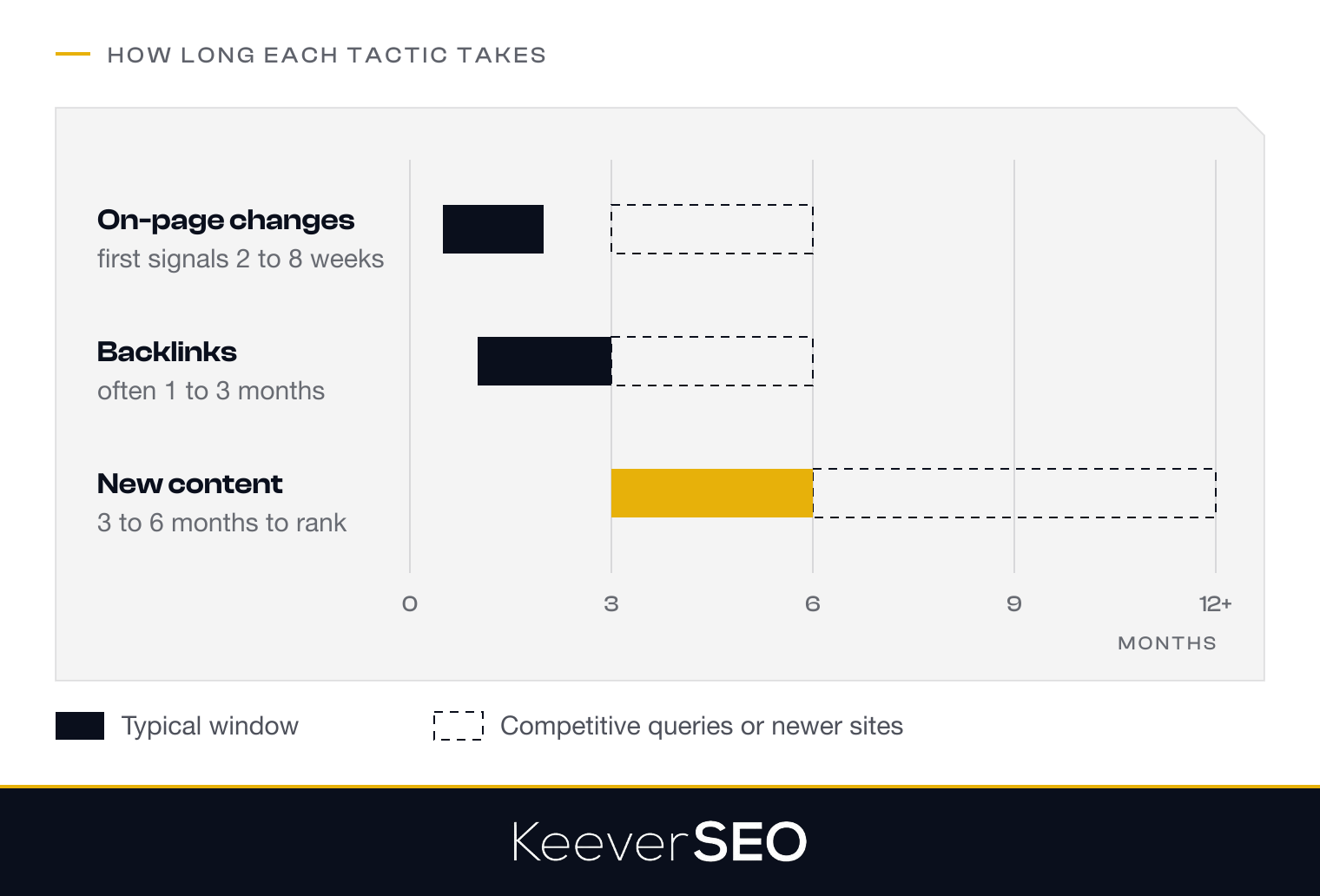
Google's crawl and processing speed, website authority, keyword competition, and technical health set the pace of each tactic. The next three sections give the timeframe for on-page changes, backlinks, and new content.
How Long Do On-Page SEO Changes Take to Work?
On-page SEO changes take about 2 to 8 weeks to work, measured as changes in indexing, impressions, or clicks. Google must recrawl and reassess updated titles, headings, content, and internal links, and competitive ranking improvements from on-page work can take 3 to 6 months or longer.
How long for SEO changes to take effect depends on crawl frequency, site authority, keyword competition, and technical health. Google Search Central's "Ask Google to recrawl your URLs" states that "Crawling can take anywhere from a few days to a few weeks," and that a crawl request "does not guarantee that inclusion in search results will happen instantly or even at all." Google Search Console confirms recrawling and shows how long before SEO changes take effect through impressions, average position, clicks, and conversions.
How Long Do Backlinks Take to Work?
Backlinks take about 1 to 3 months to work in many cases, measured from the point Google finds and evaluates them. The searches "how long does it take for backlinks to work" and "how long do backlinks take to work" share one answer: the clock starts when Google crawls the linking page, and the result depends on the linking site's authority and relevance, keyword competition, and the target page's existing strength.
Some links move rankings within several weeks, while competitive queries or newer websites can take 3 to 6 months or longer, so how long before backlinks take effect varies by query. Anyone asking how long does it take for backlinks to take effect should measure sustained changes in rankings, impressions, organic traffic, and conversions rather than the discovery date in a backlink tool.
How Long Does New Content Take to Rank in Google?
New content takes about 3 to 6 months to rank in Google for most queries, while competitive queries can take 6 to 12 months or longer to reach the top 10. How long does it take to rank in Google for a new page depends on site authority, keyword competition, content quality, and how quickly Google finds and indexes the page.
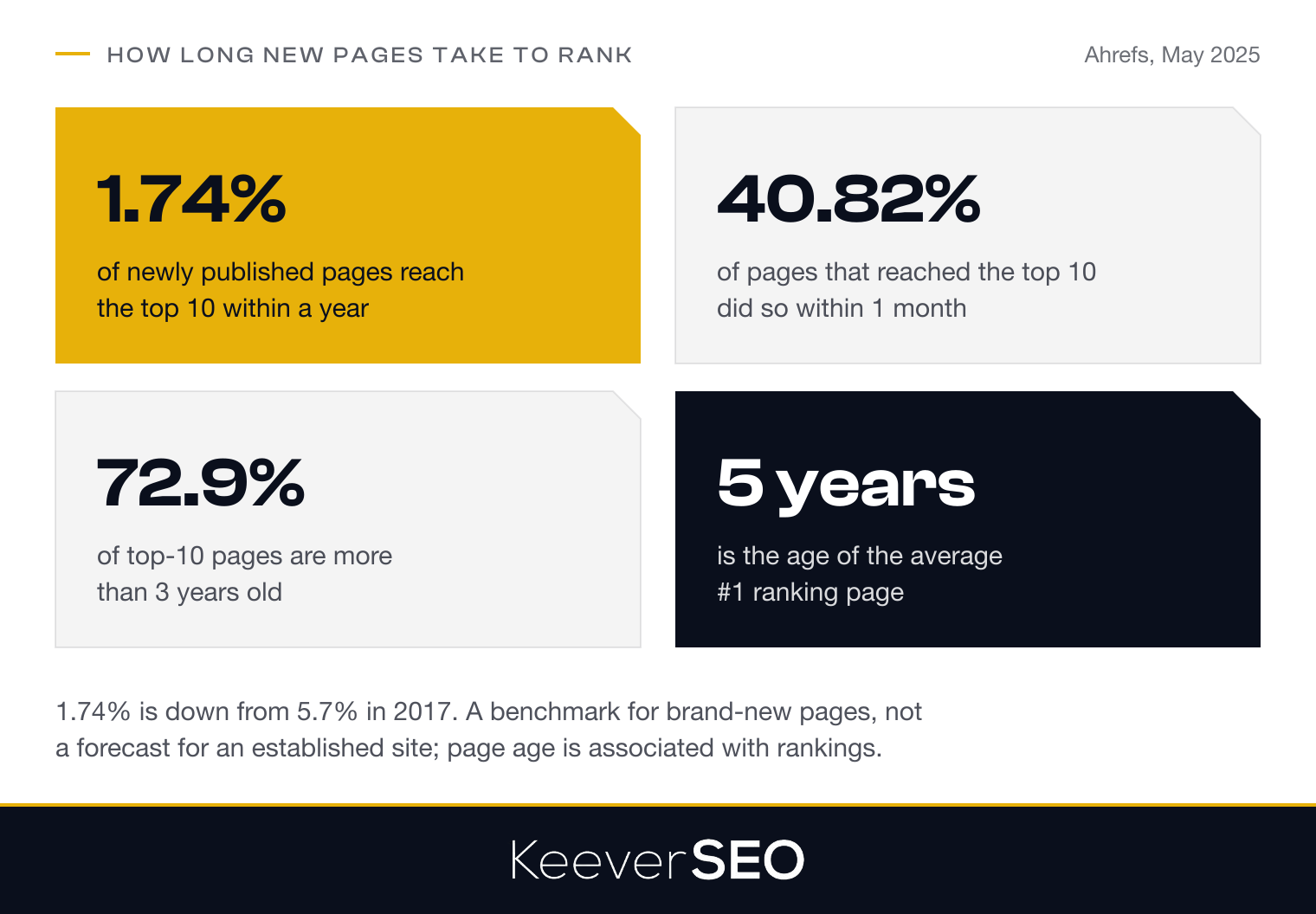
Data from Patrick Stox's May 2025 Ahrefs study shows that "40.82% of pages that ranked in the top 10 did so within 1 month," yet only 1.74% of newly published pages reached the top 10 within a year. The Ahrefs figures work as a benchmark, not a guaranteed timeline, and indexing and early impressions can appear before meaningful rankings or organic traffic.
How Do You Know If SEO Is Working?
You know SEO is working when search visibility, organic traffic, and business results improve and hold over time, not when a single ranking jumps for a week. The signs that SEO is working are listed below:
- Priority pages get indexed: Google includes the important pages in its search index.
- Search impressions rise: Pages appear for more relevant queries.
- Keyword rankings improve: Target pages move up for high-value searches.
- Organic clicks increase: More searchers visit the website from unpaid results.
- Click-through rate improves: A larger share of search impressions turns into clicks.
- Qualified leads grow: Organic visitors generate more calls, form submissions, bookings, or sales.
- Technical errors decline: Fewer indexing and crawling problems block important pages.
- Gains hold over time: Rankings, clicks, and leads stay stable or improve across several months.
How Can You Make SEO Work Faster?
To make SEO work faster, remove technical barriers first and focus on search opportunities the site can win now. The steps that make SEO work faster are listed below:
- Fix indexing and technical barriers first. Check Google Search Console for crawl errors, blocked pages, accidental noindex directives, broken links, and incorrect canonical tags. Use the URL Inspection tool to confirm that priority pages can be crawled and indexed.
- Measure progress from implementation day. Record baseline clicks, impressions, indexed pages, rankings, leads, and technical issues before making changes. Track SEO timelines from the date changes go live, rather than from the date an agency contract begins, and in the first 90 days check indexing first, relevant impressions second, and clicks and conversions third.
- Choose achievable keywords. Target relevant long-tail, local, and lower-competition searches before pursuing broad, competitive terms. Realistic keyword targets help a site attract early impressions while it builds authority.
- Match each page to one search intent. Create distinct pages for informational questions, service searches, and location needs. Give every page a clear purpose so overlapping content does not compete for the same queries.
- Improve pages that already receive impressions. Update titles, headings, content, and internal links on existing pages with search visibility. Existing pages can gain traction sooner than new pages because Google already knows about them.
- Fill customer content gaps with useful information. Identify questions that customers ask but the website does not answer. Add original explanations, examples, current details, and clear next steps rather than expanding copy only to increase word count.
- Strengthen internal links and site discovery. Connect related pages with descriptive anchor text and submit an accurate XML sitemap through Search Console. Clear internal links help visitors and search engines find important pages.
- Earn relevant backlinks through genuine value. Build links with useful resources, local partnerships, expert contributions, original research, and digital public relations. Avoid buying manipulative links or using schemes that create search-policy risks.
- Improve local SEO signals when serving nearby customers. Complete and verify the Google Business Profile, keep business details accurate, and request honest reviews from real customers. Consistent location details help Google match the business to its service area.
- Refine page titles when impressions rise but clicks stay low. Review Search Console queries and landing-page data, then write accurate titles and descriptions that reflect the page's content and search intent. Avoid misleading wording that attracts unqualified visits.
- Keep a steady implementation schedule. Publish and update content on a fixed schedule, assign each page a distinct role, and review results at planned intervals. Steady work compounds over time, while frequent reversals make performance harder to assess.
- Allow Google time to process changes. Recrawling can take a few days to a few weeks, and a crawl request does not guarantee indexing or ranking. Avoid changing a page again before search data can show the effect of earlier updates.
Why Is SEO Taking So Long?
SEO is taking so long because Google must find, crawl, index, and evaluate each website change against competing pages. Established websites can need 3 to 6 months for meaningful organic traffic, while new websites can need 6 to 12 months or longer for competitive searches. A site that dropped in a core update can wait longer still: "If it's been a few months and you still haven't seen any effect, that could mean waiting until the next core update," as Google Search Central notes in "Google Search's core updates and your website."
Slow SEO progress comes from weak site history, few backlinks, unhelpful content, technical barriers, or delayed implementation. Check whether priority pages are indexed, earning relevant impressions, and gaining clicks or leads, and measure progress from when SEO changes go live, not when a contract begins.
Does Hiring an SEO Agency Make SEO Work Faster?
Yes, hiring an experienced SEO agency can make SEO work faster by finding technical issues sooner, prioritizing high-impact pages, and coordinating content and link-building work. Meaningful gains still take 3 to 6 months for established websites and 6 to 12 months or longer for new websites.
An SEO agency improves execution and removes avoidable delays, but no agency controls Google's crawling, indexing, or ranking decisions. Agency results still depend on website history, competition, content quality, authority, and implementation speed, so an agency cannot guarantee rankings or a fixed timeline. No agency can buy faster results either, because "Google doesn't accept payment to crawl a site more frequently, or rank it higher," according to "In-depth guide to how Google Search works" by Google Search Central.
How Long Does Local SEO Take for Service Businesses?
Local SEO for service businesses takes about 1 to 3 months to show early Google Business Profile gains and 3 to 6 months to build steadier review counts and Map Pack rankings, while competitive city searches can take 6 to 12 months or longer. Completing the Google Business Profile, correcting business details, choosing accurate categories, adding photos, and earning genuine reviews improve visibility and calls over time.
Map Pack rankings can improve within 2 to 3 months in moderately competitive areas. Google Business Profile Help states in "Tips to improve your local ranking on Google" that "Local results are mainly based on relevance, distance, and popularity," and that "More reviews and positive ratings can help your business's local ranking."
How Long Does Keever SEO Take to Show Results for Local Service Businesses?
Keever SEO plans local campaigns for US service businesses around the same four-months-to-a-year window that Google's Maile Ohye described, with no guaranteed date. Onboarding comes first, with a technical audit, analytics baselines, keyword research for the services and cities the business covers, and a Google Business Profile review. The first fixes then target crawl and indexing problems, core service pages, and profile details.
Monthly reporting puts leads and conversions first, then Google Business Profile activity, organic visibility, work completed, and next priorities, so each step ties to a result the business can check. Calls and bookings tend to rise once Map Pack and organic positions improve, and the pace depends on local search demand, competition, and how fast the business answers inquiries. Keever SEO never guarantees rankings, because no agency controls Google's results.
What Should You Expect From SEO Beyond the Timeline?
Beyond the timeline, you should expect SEO to bring an ongoing cost, a monthly budget decision, and long-term value that are judged together with rankings and traffic. A lower monthly fee funds fewer hours and less implementation, while a larger budget pays for technical improvements, content, digital PR, and local SEO.
A realistic SEO budget depends on competition, location, website condition, and the leads or sales the business needs. SEO value shows in qualified leads, conversions, revenue, and customer acquisition cost, and the next three sections give typical prices and budgets.
How Much Does SEO Cost in the USA?
SEO costs about $500 to $5,000 per month in the USA for most businesses, depending on competition, business size, and campaign scope. An Ahrefs survey of 439 SEO providers, "SEO Pricing: How Much Does SEO Cost? 439 People Polled" by Joshua Hardwick (August 2024), puts the modeled average at $2,917 per month, with agencies averaging $3,209 and local SEO averaging $1,557.
What Is a Realistic SEO Budget for a Small Business?
A realistic SEO budget for a small business in the United States is about $1,000 to $3,000 per month. A 2024 Ahrefs survey of 439 SEO providers put the average local SEO retainer at $1,557 per month and found that 79.1% of providers in the US and Canada charge at least $1,001 per month, so budgets well under $1,000 buy little work in competitive markets. Keever SEO's local campaigns start from about $1,500 per month, and national campaigns from about $2,000.
Is SEO Worth It for Small Businesses?
Yes, SEO is worth it for most small businesses that target local customers or purchase-ready searches. SEO builds a durable source of qualified website visits, calls, and leads, but meaningful results take several months. Small businesses gain the most value when they track conversions and keep a realistic budget for ongoing SEO work.
How Do You Choose an SEO Agency With Realistic Timelines?
To choose an SEO agency with realistic timelines, pick one that builds a plan for your site and sets milestones around your website's age, competition, authority, and technical health. A credible agency separates early signals from meaningful growth: indexing and impressions can appear within weeks, while established sites need 3 to 6 months for meaningful organic traffic and new sites can need 6 to 12 months or longer.
Ask for a written 90-day work plan, monthly reports, relevant case studies, and clear measures such as qualified leads, calls, and bookings. Every candidate should answer the questions "What kind of results do you expect to see, and in what timeframe?" and "How do you measure your success?", as Google Search Central recommends in "Do you need an SEO?" An agency that explains uncertainty and ties its milestones to completed work sets realistic expectations, and a guaranteed ranking timeline is the warning sign to watch for next.
Is a Guaranteed Ranking Timeline a Red Flag?
Yes, a guaranteed ranking timeline is a red flag because no SEO agency controls Google's ranking systems or competing websites. "No one can guarantee a #1 ranking on Google," according to "Do you need an SEO?" by Google Search Central, and Keever SEO never guarantees rankings or ranking dates.
How Long Should You Give SEO Before Judging Results?
You should give SEO at least 6 months before judging results, and 6 to 12 months for a fair assessment of traffic, leads, and revenue. Measure the window from when SEO changes go live, not from when an agency contract begins or a strategy receives approval.
During the first 90 days, track indexing, relevant impressions, rankings, and qualified clicks as early signals, and investigate barriers such as noindex directives or technical errors if progress stalls. A 6-to-12-month judgment window matches how long SEO takes to work into sustained organic growth.