An SEO agency gives you a team, a wider service range, and more capacity at a higher price, while an SEO freelancer gives you one specialist at a lower cost with less capacity. An SEO agency is a firm with specialists in areas such as technical SEO, content, and local search. An SEO freelancer is an independent professional who works alone. The SEO agency vs freelancer comparison covers cost, skills, services, scalability, communication, and accountability, and both options can provide keyword research, optimization, content planning, and reporting. Agencies offer broader coverage and backup capacity but usually cost more and follow structured processes. Freelancers offer direct communication and flexible, lower-cost support but have smaller capacity and may provide narrower services. Hire an agency for complex, ongoing work or rapid growth, and hire a freelancer for a defined project, specialized skills, or a smaller budget. The word "freelancer" describes an independent work arrangement, while the word "consultant" describes an advisory role, so one person can be both. Local businesses should compare Map Pack experience, service-area coverage, and lead-generation needs. An agency can coordinate several specialists, and Keever SEO describes its offering as team-based, locally focused, and supported by monthly reporting and month-to-month terms. The sections ahead compare an agency with freelancers, in-house SEO, and do-it-yourself work, and examine cheap services, agency selection, and costs. The at-a-glance table below summarizes the main differences by team, services, price, capacity, communication, accountability, and best fit.
SEO Agency vs Freelancer: At-a-Glance Comparison
| Dimension | SEO Agency | SEO Freelancer |
|---|---|---|
| Team | A team of SEO specialists, strategists, and content professionals | One independent SEO professional |
| Services | A broad range, including technical SEO, content, local SEO, and link building | A focused set of services based on individual skills |
| Cost | Usually higher, reflecting team capacity, tools, and management | Usually lower, with flexible project or per-hour pricing |
| Capacity | Handles larger campaigns by dividing work across specialists | Handles a smaller workload based on one person’s time |
| Communication | Uses scheduled updates, reports, or an account manager | Offers direct communication with the person doing the work |
| Accountability | Shares responsibility through team processes and quality checks | Places responsibility directly with the individual freelancer |
| Best fit | Growing businesses with complex needs or sustained SEO campaigns | Small businesses and focused projects with defined budgets or scope |
What Is an SEO Agency?
An SEO agency is a company that improves website visibility through a coordinated team of search specialists. Agency teams may include SEO strategists, technical experts, content professionals, link builders, analysts, and account managers. SEO agencies provide services such as technical audits, keyword research, on-page optimization, local SEO, link building, and performance reporting. The agency team structure supports broader skills and greater project capacity than one independent provider can offer.
What Is an SEO Freelancer?
An SEO freelancer is an independent search engine optimization professional who works alone rather than as part of an agency. A business hires an SEO freelancer directly for keyword research, technical SEO, on-page optimization, content recommendations, or performance reporting. A freelance SEO service can cover one project or ongoing support through per-hour, project-based, or retainer pricing. The terms SEO service freelancer, freelance SEO services, SEO freelance services, and SEO services freelance describe work provided by an independent specialist.
What Are the Key Differences Between an SEO Agency and a Freelancer?
The key differences between an SEO agency and a freelancer are cost, expert knowledge, service range, scalability, communication, and accountability. An agency assigns work across specialists and supports broader campaigns, while a freelancer handles SEO independently with direct client contact and smaller capacity. Agencies can coordinate technical, on-page, off-page, and local SEO, while many freelancers focus on selected services. Team size, reporting processes, and available work hours shape the scalability and accountability of each provider. Cost is the first difference to compare.
Cost Differences Between an SEO Agency and a Freelancer
The cost difference between an SEO agency and a freelancer is that agencies charge more on average, because agencies provide multiple specialists and broader services. Agencies charge an average of $3,209 per month and freelancers $1,348, so agency fees run about 138% higher, according to "SEO Pricing: How Much Does SEO Cost? 439 People Polled" by Joshua Hardwick, Ahrefs, August 2024, which models those averages from the upper end of each pricing tier. Many freelancers charge by the hour, per project, or through a smaller monthly retainer. The final SEO cost depends on the scope of the work, provider experience, and required services, so compare deliverables alongside fees.
Expertise Differences Between an SEO Agency and a Freelancer
The difference in expert knowledge between an SEO agency and a freelancer is breadth against depth, since an SEO agency offers broader skills through specialists in technical SEO, content, link building, analytics, and strategy. The agency team can coordinate several disciplines on complex campaigns and provide coverage when a team member is unavailable. An SEO freelancer commonly provides greater depth in one or two areas, such as local SEO, technical audits, or content strategy. Clients work directly with the freelance specialist, but projects requiring multiple disciplines may need additional contractors or internal support. Review portfolios and case studies to assess relevant experience.
Service Range Differences Between an SEO Agency and a Freelancer
The service range difference between an SEO agency and a freelancer is that an agency covers more disciplines, because its team can manage technical SEO, content strategy and production, local SEO, link building, analytics, and reporting. Depending on its scope, an agency may coordinate digital PR, website improvements, or paid marketing alongside SEO work. An SEO freelancer can provide many of the same services, but the freelancer’s skills, available time, and capacity usually limit the range. Many freelancers specialize in one or two areas, such as technical SEO, content, keyword strategy, or link outreach, and broad campaigns may require subcontractors or multiple providers.
Scalability Differences Between an SEO Agency and a Freelancer
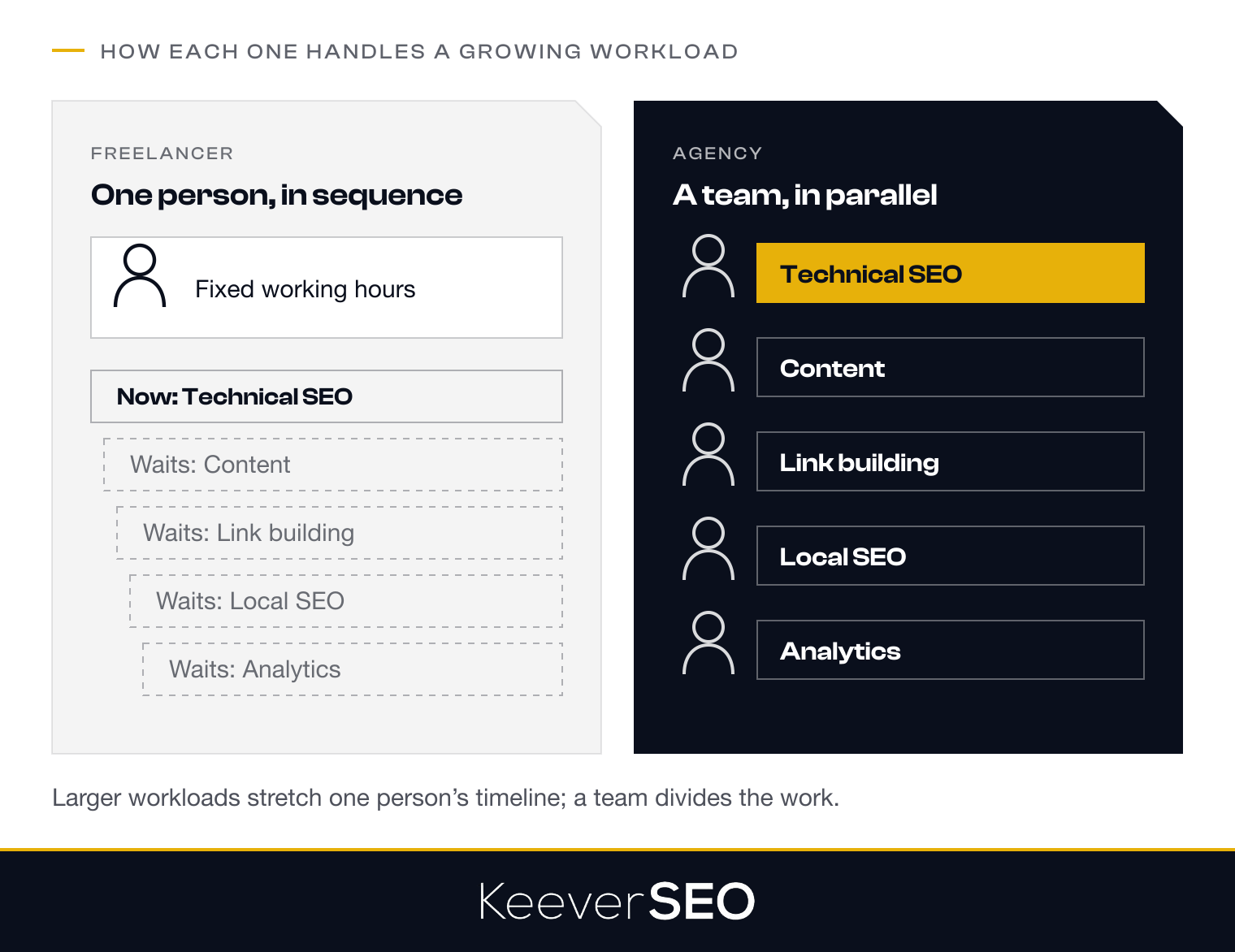
The scalability difference between an SEO agency and a freelancer is that an agency scales more easily, because a team can divide growing workloads among specialists, project managers, and production staff. Agency teams can support multi-location expansion, large numbers of service pages, and concurrent technical SEO, content, link-building, and reporting needs. An SEO freelancer has restricted capacity because one person has a fixed number of working hours. Larger workloads can extend a freelancer’s timelines or require subcontractors, which adds coordination and may create inconsistent quality or writing styles.
Communication Differences Between an SEO Agency and a Freelancer
The communication difference between an SEO agency and a freelancer is that agency communication usually follows a structured process, while an SEO freelancer communicates directly with clients. An agency account manager or project lead coordinates specialists, schedules check-ins, shares reports, and tracks milestones through project-management tools. The account manager improves visibility for businesses with several stakeholders but adds an intermediary. An SEO freelancer gives clients direct access to the person doing the work, which can make feedback and decisions faster. A freelancer’s availability may limit response times when several clients need support. Both arrangements work best when clients agree on responsibilities, response times, reporting frequency, and approval steps.
Accountability Differences Between an SEO Agency and a Freelancer
The accountability difference between an SEO agency and a freelancer is that agency accountability rests with a team and its business structure, while freelancer accountability rests with one professional. Many agencies define deliverables, reporting schedules, project responsibilities, and termination terms in contracts. Account managers or agency leadership provide escalation channels, while team members can cover work when a specialist becomes unavailable. SEO freelancer accountability gives clients direct access to the person doing the work. The freelancer’s reporting and follow-through depend on agreed processes and contract terms. Before hiring either option, document responsibilities, success metrics, reporting frequency, account ownership, and termination conditions.
Where Do an SEO Agency and a Freelancer Overlap?
The overlap between an SEO agency and an SEO freelancer lies in the shared goal of improving a website’s visibility in search results. Both providers can deliver keyword research, technical SEO audits, on-page optimization, content recommendations, competitor analysis, link-building support, performance monitoring, and reporting. Results from either option depend on sound strategy, accurate implementation, useful content, and compliance with search engine guidelines. Businesses can assess an agency or freelancer by reviewing relevant case studies, service scope, and project fit.
What Are the Pros and Cons of Hiring an SEO Freelancer?
The pros and cons of hiring an SEO freelancer weigh direct access to one independent specialist, usually at a lower cost, against smaller capacity and fewer backup resources for larger campaigns. The pros of hiring an SEO freelancer are listed below:
- Lower cost. Freelancers generally have lower operating costs than agencies and may charge by project, hour, or retainer. A focused freelance engagement can help small businesses control spending without funding a larger team.
- Direct communication. Clients work directly with the SEO specialist who plans or completes the work. Fewer handoffs can make feedback, decisions, and priority changes easier to coordinate.
- Personalized attention. An independent SEO professional can fit recommendations to a business’s website, industry, audience, and goals. Direct collaboration can help the freelancer understand the client’s needs in detail.
- Specialized skills. Many freelancers focus on a particular discipline, such as technical SEO, local SEO, keyword research, content optimization, or link building. A specialist freelancer can suit a project that needs depth in one area.
- Flexible engagement. Freelancers may offer short-term projects, per-hour consulting, or narrow-scope retainers. Flexible freelance arrangements suit businesses with changing workloads or defined tasks, such as an SEO audit or content plan.
- Good fit for defined projects. A freelancer can handle targeted assignments without requiring a broad, ongoing campaign. Defined freelance projects include optimizing key pages, researching keywords, or reviewing local search visibility.
The cons of hiring an SEO freelancer are listed below:
- Restricted capacity. One person can manage only a finite number of clients and tasks. A freelancer may have difficulty delivering content, technical fixes, outreach, analytics, and local SEO at the same time.
- Single point of failure. A freelancer’s illness, leave, or unavailability can pause work when no replacement is available, because a solo SEO provider may lack colleagues who can take over during emergencies or busy periods. Businesses should clarify coverage, communication expectations, continuity plans, and ownership of accounts, reports, and work files before signing an agreement.
- Narrower service range. One specialist may not have equal experience in technical SEO, content, link building, and development. Broad campaigns may require additional contractors or internal staff.
- Scaling challenges. Businesses that add several freelancers must coordinate schedules, briefs, quality checks, and reporting. Multiple writers or specialists can produce inconsistent approaches without clear processes.
- Variable quality and availability. Freelancers differ in experience, methods, and workload. Businesses should review relevant portfolios, references, and proposed deliverables rather than selecting a provider by price alone.
- Fewer supporting resources. Some freelancers have fewer paid tools, dedicated developers, or reporting systems than an agency, which can affect research, implementation, and campaign monitoring. A freelancer can identify website issues without having the developer support to fix them, so businesses may need to supply technical, content, or design resources for the recommendations to be implemented.
What Are the Pros and Cons of Hiring an SEO Agency?
The pros and cons of hiring an SEO agency weigh access to a team, broader services, and greater capacity against agency fees that usually exceed freelancer rates and less direct contact with specialists. The pros of hiring an SEO agency are listed below:
- Broader skill coverage. An SEO agency can assign technical SEO, content, local SEO, link building, analytics, and strategy to different specialists. The agency team can address several parts of an organic search campaign at once.
- Greater capacity. An agency can divide work among multiple employees and manage larger websites, multiple locations, or simultaneous campaigns. Shared staffing can help maintain progress when one team member becomes unavailable.
- Wider service range. An agency can coordinate audits, keyword research, content production, on-page optimization, technical recommendations, and performance reporting. A business can manage those workstreams through one provider.
- Scalable support. An agency can adjust resources as a business adds services, enters markets, or increases content production. Established agency workflows help organize larger workloads.
- Structured processes and reporting. Many agencies use onboarding plans, project-management systems, and scheduled performance reports. Clear scopes and review meetings help clients track completed work and discuss priorities.
- Shared resources and continuity. Agencies can provide access to professional SEO tools and documented account knowledge. Multiple team members can reduce reliance on one person for ongoing campaign work.
The cons of hiring an SEO agency are listed below:
- Higher cost. Agency fees cover specialist labor, management, tools, and business overhead. A small business with modest SEO needs may pay for capacity it does not use.
- Less direct communication. Clients may communicate mainly with an account manager rather than the specialist completing each task. Questions can take longer when account managers coordinate responses across teams.
- Variable execution quality. Agency quality differs by staff experience, processes, and industry knowledge. Clients should confirm who performs the work and review relevant examples before signing.
- Less flexibility and control. Fixed packages, retainers, or contract terms can limit changes to the monthly scope. Clients may have less choice over which specialists handle their accounts.
- Shared attention. Agency teams serve multiple clients, so agency staff may not respond immediately to every request. Businesses should agree on communication schedules, response expectations, and escalation procedures.
- Results depend on implementation and market conditions. An agency cannot guarantee search rankings or business results. Website access, client approvals, technical implementation, competition, and search engine changes can affect campaign performance.
When Should You Hire an SEO Agency Instead of a Freelancer?
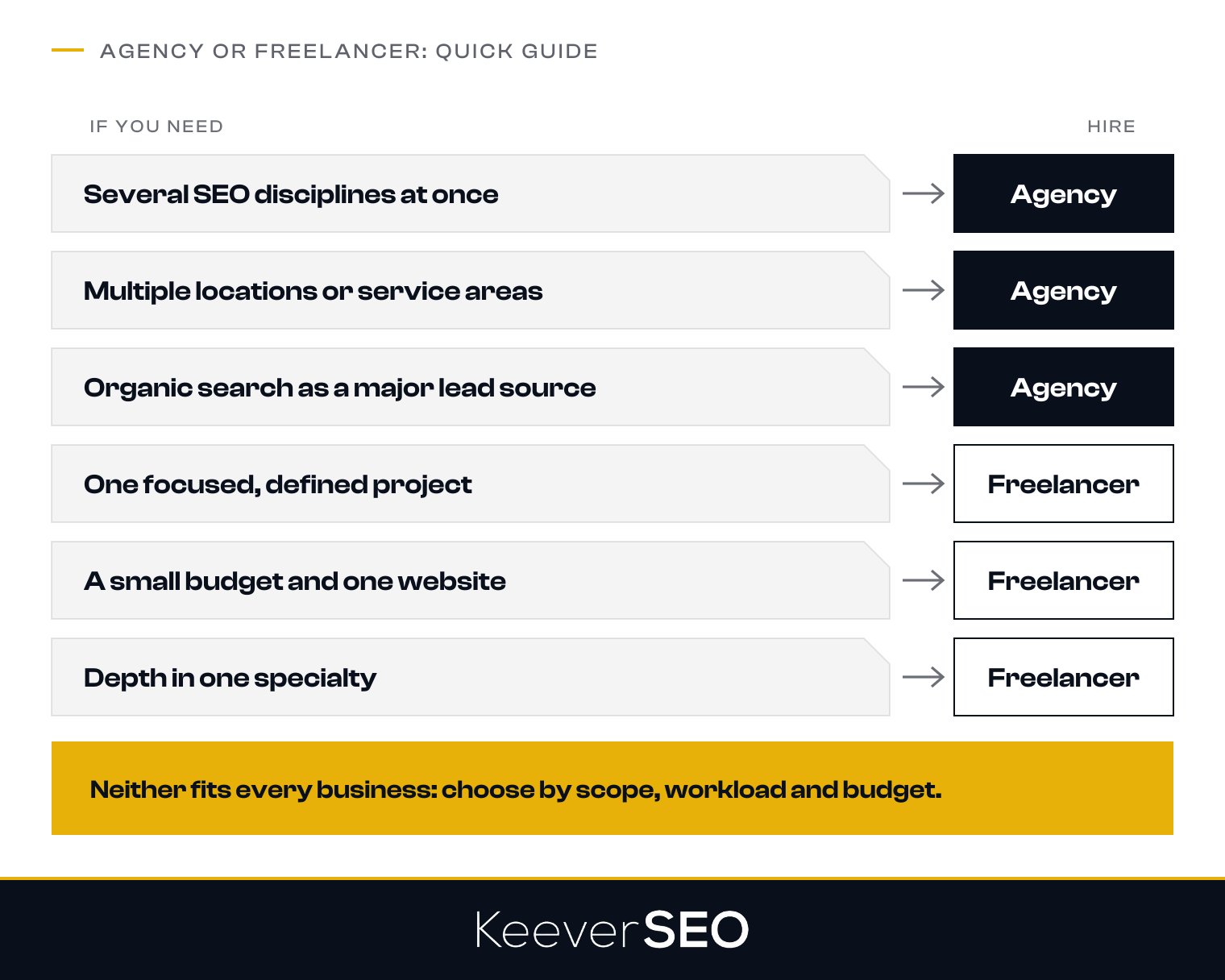
The right time to hire an SEO agency instead of a freelancer is when your business needs several SEO disciplines, sustained capacity, or coordinated work across a large or competitive website. An agency team can manage technical SEO, content, link building, local SEO, analytics, and reporting together. An agency suits businesses targeting multiple locations or scaling organic search as a major source of leads. Structured agency processes and team coverage support consistent delivery when one specialist lacks the time or range to manage the campaign.
When Should You Hire an SEO Freelancer Instead of an Agency?
The right time to hire an SEO freelancer instead of an agency is when your SEO needs are focused, well defined, and manageable by one specialist. A freelancer suits a small business with a small budget, one website, or a short-term project such as an SEO audit, keyword research, local SEO, or on-page optimization. Businesses that hire freelance SEO support gain direct communication and flexible project terms without paying for a full agency team. Before you hire SEO freelancers, check each specialist’s relevant experience, availability, reporting process, and ability to meet the project scope.
Is an SEO Freelancer the Same as an SEO Consultant?
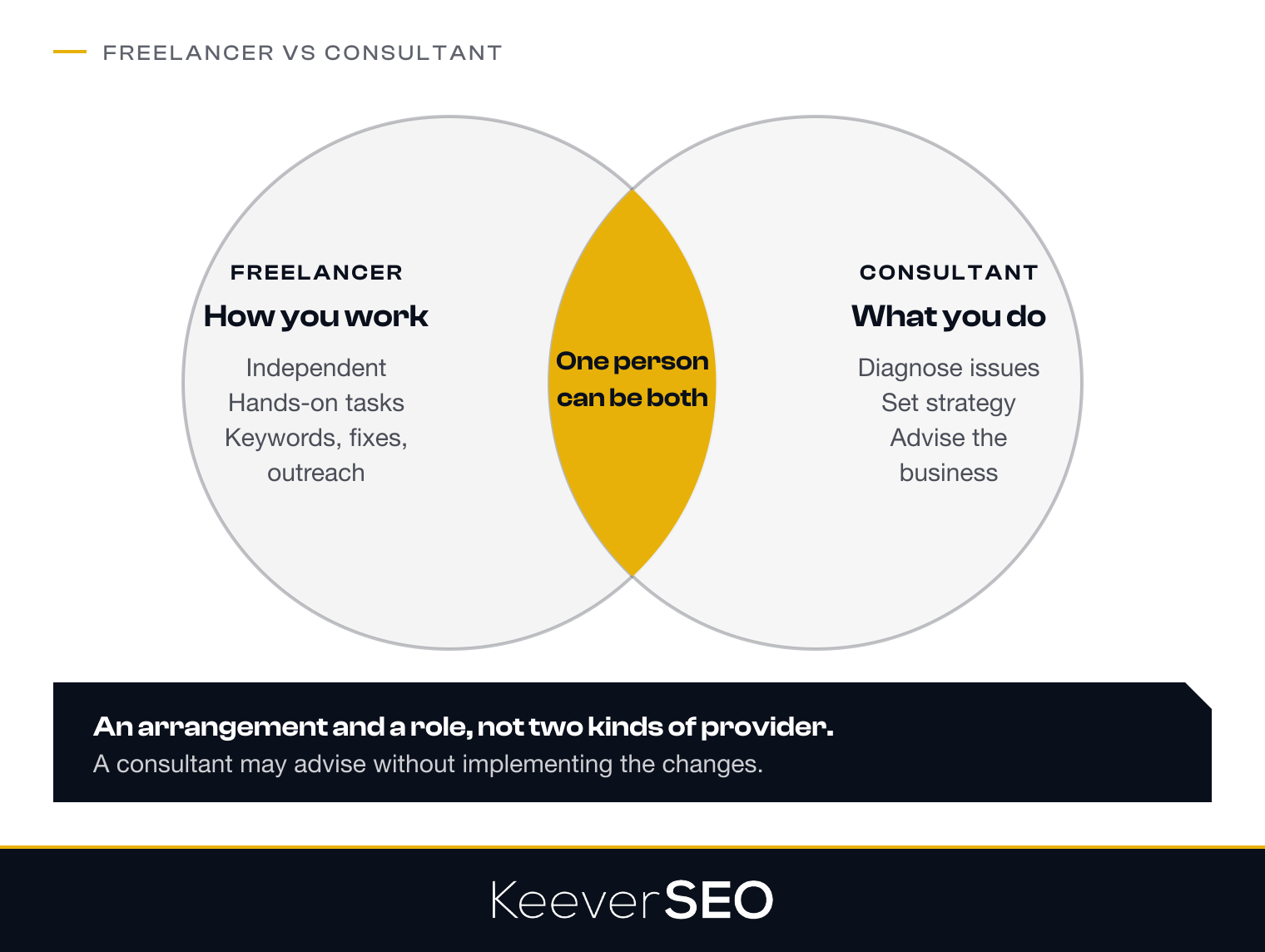
No, an SEO freelancer is not the same as an SEO consultant, because the two terms describe different aspects of a professional’s work. “Freelancer” describes an independent work arrangement, while “consultant” describes a role focused on diagnosing SEO issues, setting strategy, and advising a business. An SEO freelancer may complete hands-on tasks such as keyword research, content optimization, technical fixes, or link outreach. An SEO consultant may provide audits and recommendations without implementing them, although one professional can work as both a freelancer and a consultant.
Should a Local Service Business Hire an SEO Agency or a Freelancer?
A local service business should hire an SEO agency for several service areas and steady lead generation, or a freelancer for one location and a smaller budget. Both providers can support Google Business Profile optimization and Map Pack visibility. Local SEO work can include location pages, citations, reviews, technical improvements, and locally relevant content. An agency can assign local SEO tasks across specialists as the campaign grows, while a freelancer can provide direct support for a narrower project.
What Does an SEO Agency Offer That a Freelancer Cannot?
An SEO agency offers coordinated team capacity and broader specialist coverage that one freelancer cannot provide alone. Agency teams can assign technical SEO, content, link building, analytics, and local SEO to different specialists while managing work through shared processes. An agency can scale resources for larger campaigns and maintain continuity when a team member becomes unavailable. A freelancer may deliver strong specialist work, but one person has finite time and capacity to manage several SEO disciplines at once.
How Does Keever SEO Compare With Hiring an SEO Freelancer?
Keever SEO compares with hiring an SEO freelancer as a team-based alternative that combines strategy, technical SEO, content, analytics, and outreach. Keever SEO’s local SEO services focus on Google Business Profile optimization, Map Pack visibility, citations, location pages, and service-area targeting. Monthly Keever SEO reports cover leads and conversions, Google Business Profile activity, organic visibility, completed work, and next priorities. The published Keever SEO plans are billed month to month without a long-term contract, while a freelancer may offer more direct communication and lower costs for narrowly scoped projects.
What Else Should You Compare Before Hiring SEO Help?
The other options to compare before hiring SEO help are an in-house team, doing SEO yourself, and low-cost SEO services. The right choice depends on your budget, available time, internal skills, project scope, and need for consistent organic growth. An in-house team offers direct control but adds salaries and tool costs. Doing SEO yourself reduces expenses but requires time and practical skills. Low-cost SEO services can fit narrow tasks, but review the provider’s methods, deliverables, and reporting before hiring.
How Does an SEO Agency Compare With an In-House Team?
An SEO agency compares with an in-house team by providing a team of specialists and flexible capacity without requiring employee hires. An in-house SEO team offers closer brand knowledge and daily collaboration but requires salaries, benefits, tools, and training. Indeed puts the average base salary for an SEO specialist in the United States at $83,004, based on 867 job-posting salaries, in "SEO specialist salary in United States," updated November 2026.
Can You Do SEO Yourself Instead?
Yes, you can do foundational SEO yourself by improving page titles, writing useful content, organizing site navigation, and monitoring Google Search Console. DIY SEO suits smaller websites and businesses with few service areas and time to learn, since "If you run a small local business, you can probably do much of the work yourself," according to "Do you need an SEO?" by Google Search Central. Technical migrations, competitive campaigns, and sustained content or link building usually require specialist support.
Are Cheap SEO Services Worth It?
No, cheap SEO services are not a safe default, because unusually low prices can mean minimal work, generic content, weak reporting, or manipulative link building, even though a low price alone does not make a provider ineffective. Google treats links created mainly to manipulate search rankings as link spam, and sites that violate its spam policies "may rank lower in results or not appear in results at all," as Google Search Central notes in "Spam policies for Google web search," so assess a provider’s deliverables, experience, and transparency before hiring.
How Do You Choose the Best SEO Agency?
To choose the best SEO agency, pick an agency that connects its strategy to your business goals, demonstrates relevant results, and explains its methods in plain terms. Review comparable case studies, identify who will manage your account, and ask how the agency handles technical SEO, content, local SEO, implementation, and reporting. Compare proposals using the same criteria, including deliverables, fees, communication, account ownership, and cancellation terms. Avoid agencies that promise particular rankings or use unclear tactics. Google Search Central’s guide "Do you need an SEO?" advises asking a prospective SEO for examples of previous work and success stories, and the guide warns that "No one can guarantee a #1 ranking on Google."
How Much Does SEO Cost in the USA?
SEO in the USA costs about $1,000 to $5,000 per month for most ongoing services. Local campaigns with a narrow scope may cost less, while competitive national, ecommerce, or enterprise campaigns can exceed $5,000 monthly. A 2024 Ahrefs survey of 439 SEO providers found average monthly fees of $2,917 across all providers, $3,209 for agencies, and $1,348 for freelancers, averages that Ahrefs modeled from the upper end of each pricing tier. In the same survey, 79.1% of providers in the US and Canada charged at least $1,001 per month. The survey figures provide industry benchmarks, not fixed US rates, and actual SEO costs depend on competition, website size, target locations, and the work required.
Which Is Better for Your Business: an SEO Agency or a Freelancer?
The better choice for your business between an SEO agency and an SEO freelancer depends on scope, because neither option fits every business better. A freelancer suits a focused SEO project or small budget, while an agency suits ongoing work that needs several specialists and greater capacity. Choose based on your SEO goals, workload, budget, and growth plans. The SEO agency vs freelancer comparison favors a freelancer for targeted tasks and an agency for sustained, multidisciplinary SEO support.