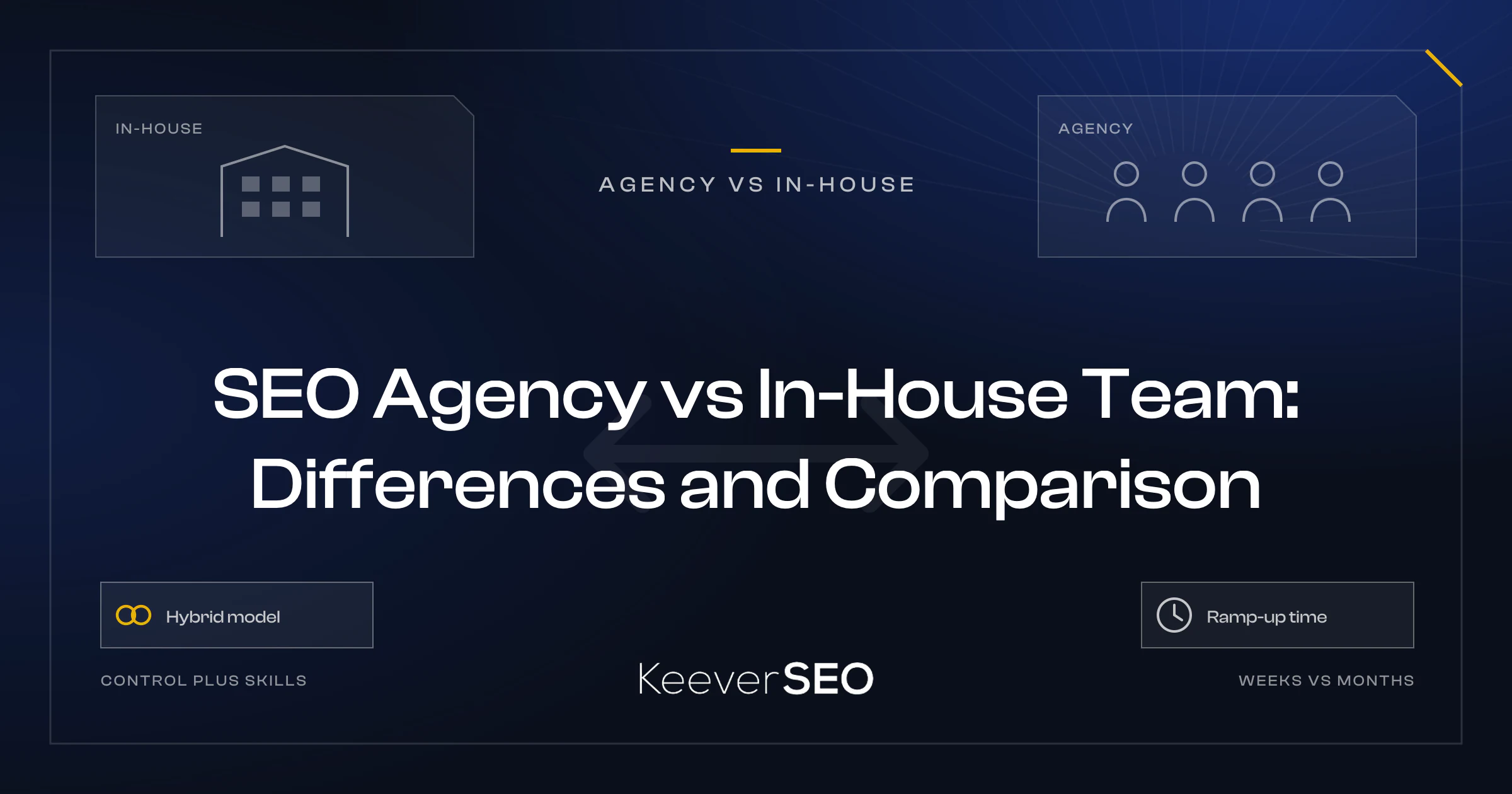
An SEO agency gives you a ready team and broad SEO skills for a monthly fee, while an in-house team gives you full control and detailed brand knowledge at the cost of salaries, tools, and hiring time. An in-house SEO team consists of employees who run search optimization inside the business, and an SEO agency is an outside firm hired to plan and deliver that SEO work. The SEO agency vs in house comparison centers on six dimensions: cost, skills, control, brand knowledge, ramp-up time, and scalability.
Both models handle technical SEO, content planning, on-page improvements, local SEO, analytics, and reporting, which is where the two options overlap. In-house SEO offers close collaboration and direct control, but the in-house model requires recruiting, training, and ongoing investment. Agency SEO provides specialist skills and flexible capacity, while agency work requires clear communication and oversight from the client. A hybrid SEO model combines internal ownership with agency support, and an agency suits businesses that need specialist skills quickly or cannot justify full-time SEO salaries.
Local service businesses rarely need a full SEO department unless their locations, content demands, and budget support one, and an agency can coordinate with an existing marketing team through shared goals, access, and reporting. Keever SEO compares with an in-house team on team structure, local SEO focus, retainer scope, and reporting. The sections below cover freelancers, doing SEO yourself, SEO costs, agency selection, and performance evaluation, starting with an at-a-glance table of the main differences.
SEO Agency vs In-House Team: At-a-Glance Comparison
| Dimension | SEO Agency | In-House Team |
|---|---|---|
| Cost | A monthly retainer or project fee for agreed SEO services | Salaries, benefits, tools, training, and recruitment costs |
| Skills | Access to specialists across technical SEO, content, analytics, and digital PR | Skills built through employees; small teams may have gaps |
| Control | The client sets goals and approves priorities while the agency runs agreed work | The business controls SEO priorities, processes, data, and daily work |
| Brand knowledge | Learned during onboarding and ongoing collaboration | Detailed knowledge of the brand, products, and internal processes |
| Ramp-up time | Starts faster with established staff, tools, and workflows | Needs hiring, onboarding, and process setup before full capacity |
| Scalability | Service scope adjusts as business needs change | Growth needs more hiring, training, and budget |
| Best fit | Businesses that want specialist skills, a fast start, or flexible support | Businesses with sustained SEO needs, enough budget, and a preference for direct control |
What Is an In-House SEO Team?
An in-house SEO team is an employee or group of employees who run search engine optimization inside a business. The in-house SEO team may sit within the marketing department or operate as a dedicated SEO function.
In-house SEO employees handle keyword research, content planning, on-page optimization, technical SEO, and performance analysis. A small business may employ one SEO generalist, while a larger company may assign separate specialists to content, technical SEO, analytics, and digital PR.
What Is an SEO Agency?
An SEO agency is an outside firm hired to improve a business's visibility in unpaid search results. SEO agency specialists plan and manage technical SEO, keyword research, content optimization, link building, local SEO, and performance reporting.
An SEO agency works across many client accounts and brings professional tools and experience without requiring the client to hire or train employees. Agency pricing usually takes the form of a monthly retainer or a fixed project fee.
What Are the Key Differences Between an SEO Agency and an In-House Team?
The key differences between an SEO agency and an in-house team are cost, skills, control, brand knowledge, ramp-up time, and scalability. An agency provides a ready group of specialists, while an in-house team offers closer brand familiarity and direct control over SEO priorities.
Cost is the first difference to compare, because salaries, tools, agency fees, and hiring time shape the full investment in each model.
Cost Differences Between an SEO Agency and an In-House Team
The cost difference between an SEO agency and an in-house team is that an in-house team carries fixed employment costs, while an agency charges a monthly fee for agreed work. An in-house SEO specialist earns an average base salary of $83,004 in the United States, before benefits, payroll taxes, recruiting, training, and software, according to "SEO specialist salary in United States" by Indeed, November 2026. A business that hires several SEO employees faces higher fixed costs, even when its workload changes.
An SEO agency replaces many employment expenses with one monthly retainer. A 2024 Ahrefs survey of 439 SEO providers found that agencies charge $3,209 per month on average, a figure Ahrefs modeled from the upper end of each pricing tier, and that the most common agency retainer falls between $500 and $1,000 per month. Actual agency pricing varies by scope and provider. Compare the full annual cost of in-house salaries, benefits, tools, and hiring against an agency's fee for equivalent work.
Expertise Differences Between an SEO Agency and an In-House Team
The skills difference between an SEO agency and an in-house team is breadth: an agency usually covers technical SEO, content strategy, analytics, digital PR, link building, and local search in one team. Agency specialists work across many industries and websites, which gives clients access to varied experience, established processes, and professional tools.
An in-house SEO team builds its skills around one company's products, customers, and systems. A small in-house team may rely on one or two generalists, and adding specialist skills requires further hiring, training, and tools.
Control Differences Between an SEO Agency and an In-House Team
The control difference between an SEO agency and an in-house team is that an in-house team gives the business direct, day-to-day control over priorities, implementation, and reporting. In-house employees can coordinate SEO decisions with product launches, internal teams, and changing business goals.
An SEO agency works within the scope and approval process agreed with the client. The client sets objectives and approves major decisions while the agency runs daily execution, and clear deliverables, regular check-ins, and reporting keep strategic oversight with the business.
Brand Knowledge Differences Between an SEO Agency and an In-House Team
The brand knowledge difference between an SEO agency and an in-house team favors the in-house team, because employees work with the company's products, customers, terminology, and priorities every day. Daily familiarity with the business helps in-house staff write accurate content, keep the brand voice, and spot relevant keyword opportunities.
An SEO agency builds brand knowledge through onboarding, stakeholder interviews, brand guidelines, and regular communication. A detailed brief and access to internal subject-matter experts help the agency produce relevant SEO work, while agency experience across clients brings a wider industry view.
Ramp-Up Time Differences Between an SEO Agency and an In-House Team
The ramp-up time difference between an SEO agency and an in-house team favors the agency, because agency specialists, tools, workflows, and reporting systems already exist. After contract approval and account access, an agency can begin audits and implementation within weeks.
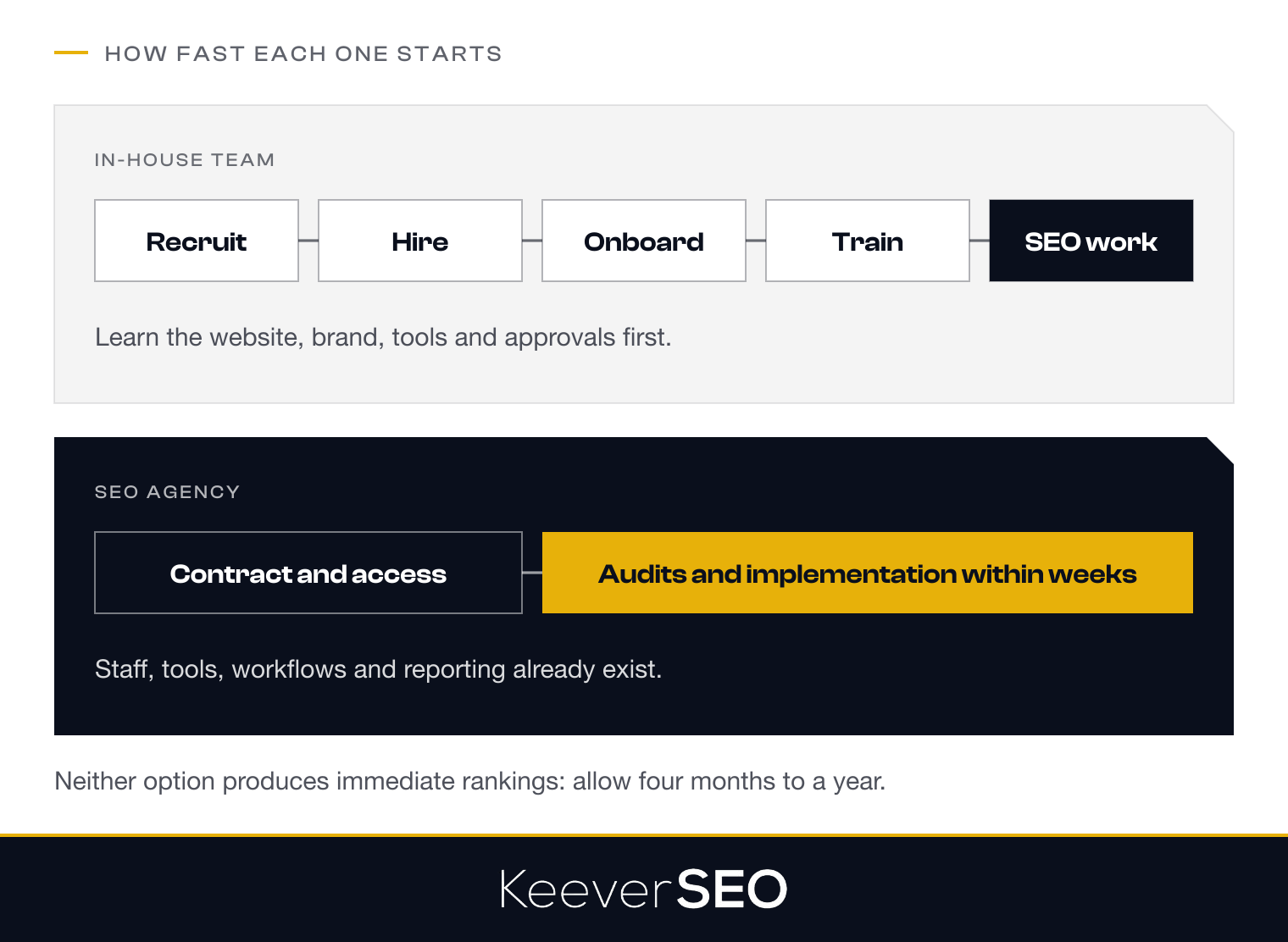
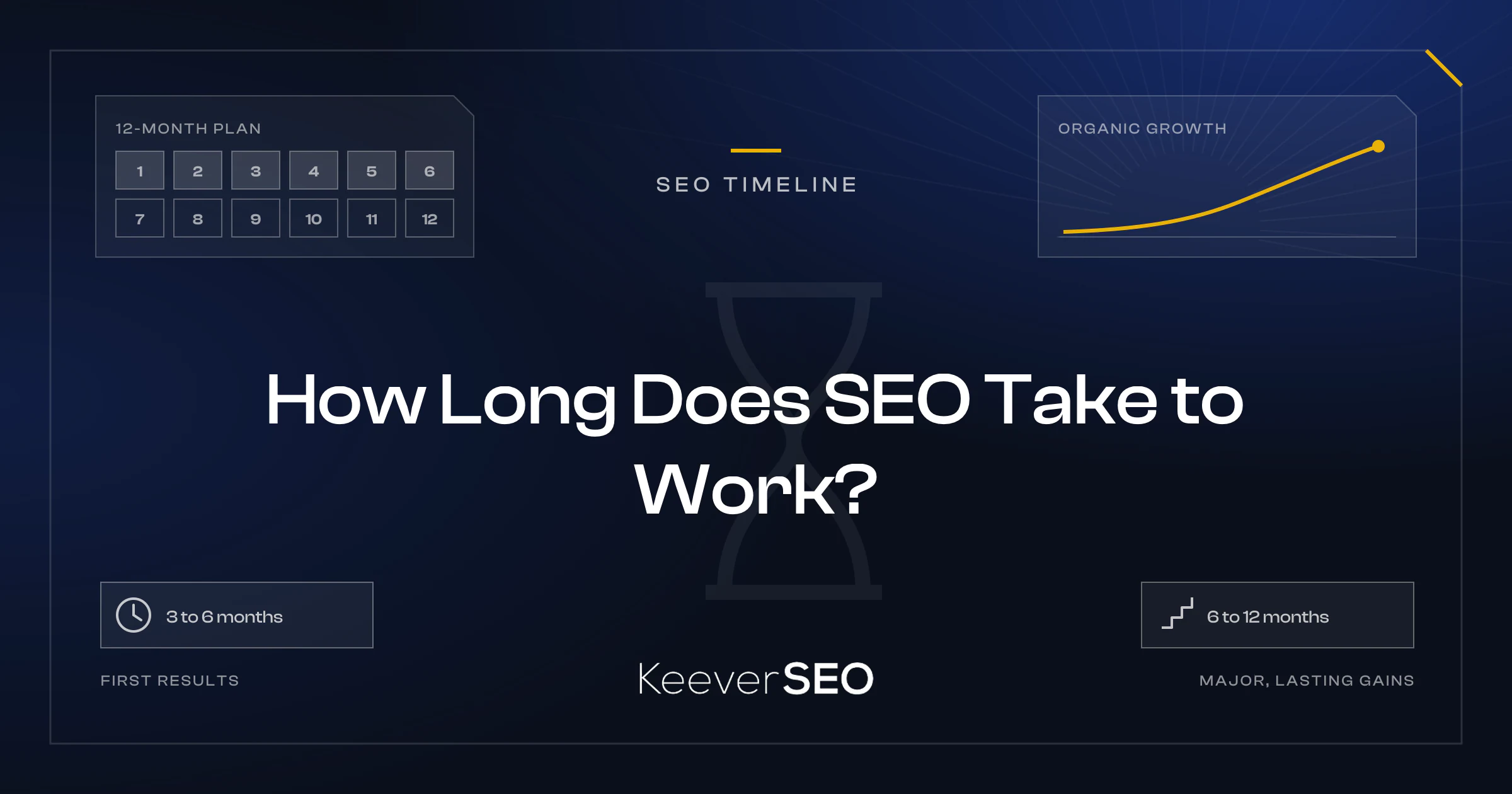
An in-house SEO team needs recruitment, hiring, onboarding, and training before consistent work begins. New employees must learn the website, brand, customers, tools, and approval processes, and neither option produces immediate search rankings. In most cases, SEO work needs four months to a year to be implemented and show potential benefit, according to Google's Maile Ohye in the 2017 video "How to hire an SEO," as reported in "Google: Give SEOs 4-12 Months To See Positive Ranking Benefits" by Barry Schwartz, Search Engine Roundtable, February 2017.
Scalability Differences Between an SEO Agency and an In-House Team
The scalability difference between an SEO agency and an in-house team is that an agency can add specialists, content production, or technical support without permanent hiring. Businesses can expand or reduce agency services as budgets, campaigns, and priorities change.
An in-house SEO team scales through recruitment, onboarding, training, tools, and management capacity. A large organization with steady, high-volume SEO needs may benefit from building internal specialists, while an agency offers more flexibility for market launches, new product lines, or technical migrations.
Where Do an SEO Agency and an In-House Team Overlap?
An SEO agency and an in-house team overlap in their goals and core responsibilities. Both models work to improve organic visibility, attract relevant visitors, and support leads and revenue through keyword research, technical audits, content optimization, link building, and performance reporting.
Agency and in-house SEO teams both use tools such as Google Search Console and Google Analytics to track results. Both teams coordinate with developers, writers, designers, and sales staff, and both align SEO work with business goals and Google's search guidelines. The main difference between the two models lies in staffing and payment, not in what effective SEO requires.
What Are the Pros and Cons of In-House SEO?
The pros of in-house SEO are direct control, close brand alignment, and lasting internal knowledge, and the cons are salaries, hiring time, ongoing training, and narrower access to specialist skills. The pros and cons of in-house SEO are listed below:
Pros of in-house SEO
- Detailed brand knowledge. In-house SEO employees work closely with the company's products, customers, and business goals, which helps them write relevant content and respond to product or service changes.
- Greater control. Company leaders set SEO priorities, approve recommendations, and change direction without going through an outside provider.
- Direct collaboration. In-house SEO specialists work with writers, developers, designers, sales teams, and executives to coordinate content updates and technical changes.
- Dedicated attention. Internal employees focus on one website and its search goals, without competing with other agency clients.
- Fast access to business information. Employees can reach internal data, subject-matter experts, and product details directly, which keeps SEO research and content accurate.
- Institutional knowledge. An in-house team can document past tests, website limitations, and campaign results, and the company keeps that record when staff follow clear handoff processes.
Cons of in-house SEO
- High ongoing costs. A business pays salaries, benefits, recruiting expenses, software subscriptions, and training costs, and full coverage may require several specialists.
- Recruitment and ramp-up time. Hiring qualified SEO employees takes time, and vacant roles can delay campaigns and technical improvements.
- Narrow skill range. A small internal team may not cover every SEO discipline at an advanced level, and hiring separate experts raises operating costs.
- Training responsibility. Search platforms and SEO practices change over time, so employers need to fund ongoing education and suitable tools.
- Scaling constraints. Expanding SEO capacity requires new hires, added management, and more software, while reducing capacity can mean difficult staffing decisions.
- Dependence on key employees. A business can lose important knowledge and campaign momentum when a specialist leaves, unless documentation and cross-training are in place.
What Are the Pros and Cons of Hiring an SEO Agency?
The pros of hiring an SEO agency are access to specialists, established workflows, and flexible capacity, and the cons are less day-to-day control, varying quality, and ongoing fees. The pros and cons of hiring an SEO agency are listed below:
Pros of hiring an SEO agency
- Specialist skills. An agency can combine technical SEO, content strategy, link building, local SEO, and analytics without the client hiring separate specialists.
- Faster start. An established agency already has staff, tools, and workflows, so audits and planning can begin without recruiting and onboarding.
- Access to professional tools. Agency teams use platforms for keyword research, site crawling, backlink analysis, rank tracking, and competitive research.
- Flexible capacity. A business can increase or reduce contracted SEO work as priorities and budgets change, without changing employee headcount.
- Outside perspective. Agency specialists review a website and its search strategy from outside the company and can spot problems or opportunities an internal team may overlook.
- Support for internal staff. An agency can handle audits, technical recommendations, content production, or overflow work while internal marketers keep brand standards and business priorities.
Cons of hiring an SEO agency
- Less day-to-day control. A business shares SEO planning and execution with an outside provider and needs clear approval steps to keep oversight.
- Agency quality varies. The assigned team determines the quality and consistency of the work, so a business should review methods, deliverables, references, and reporting before signing.
- Less brand knowledge at first. Agency staff need time to learn the company's products, audience, and voice, and internal experts must review content for accuracy.
- Shared attention across clients. Agency specialists manage multiple accounts, so the contract should define communication channels, response times, and meeting frequency.
- Ongoing fees and scope limits. SEO agency services require recurring payments, and contracts may cap content volume, technical work, or reporting.
- Provider dependence. A company may lose working knowledge when an agency relationship ends, so the business should keep account access, strategy records, and ownership of its website and analytics data.
Agency strengths in specialist capacity can sit alongside internal control and brand knowledge, which makes a hybrid SEO model a practical option for some businesses.
What Is a Hybrid SEO Model?
A hybrid SEO model is a setup that combines an in-house SEO owner or marketing team with an external SEO agency or specialist. In a hybrid SEO model, the internal team sets business priorities, guides brand direction, shares company knowledge, and approves work.
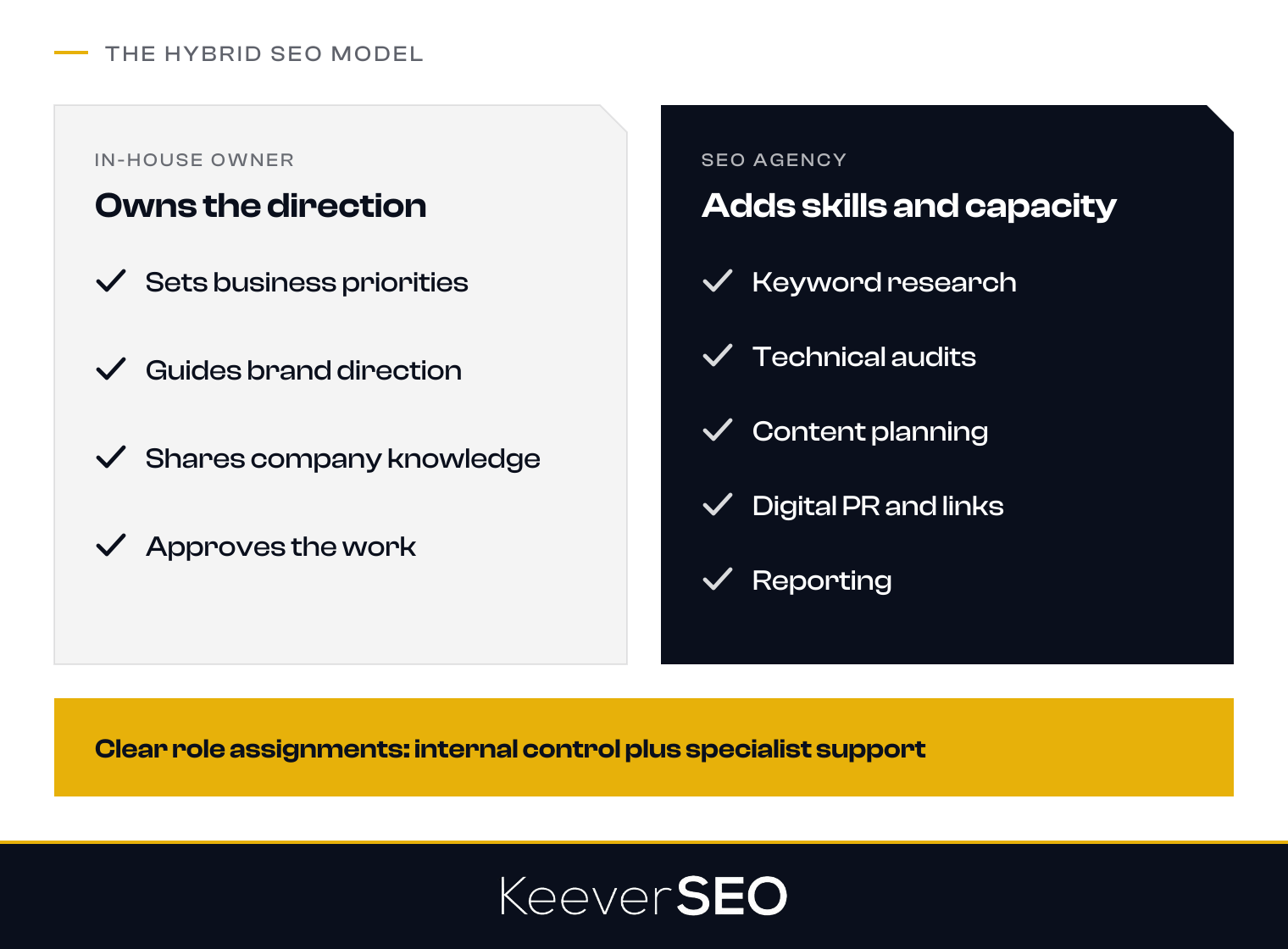
The SEO agency in a hybrid setup adds specialist skills and execution capacity through keyword research, technical audits, content planning, digital PR, link building, or reporting. Clear role assignments let the hybrid SEO model combine internal control with outside specialist support.
When Should You Choose an SEO Agency Over an In-House Team?
You should choose an SEO agency over an in-house team when you need specialist support sooner than hiring allows, lack skills across technical SEO, content, or link building, or cannot justify several full-time roles. An agency gives your business access to multiple SEO specialists through one service agreement, with capacity that can adjust as priorities change.
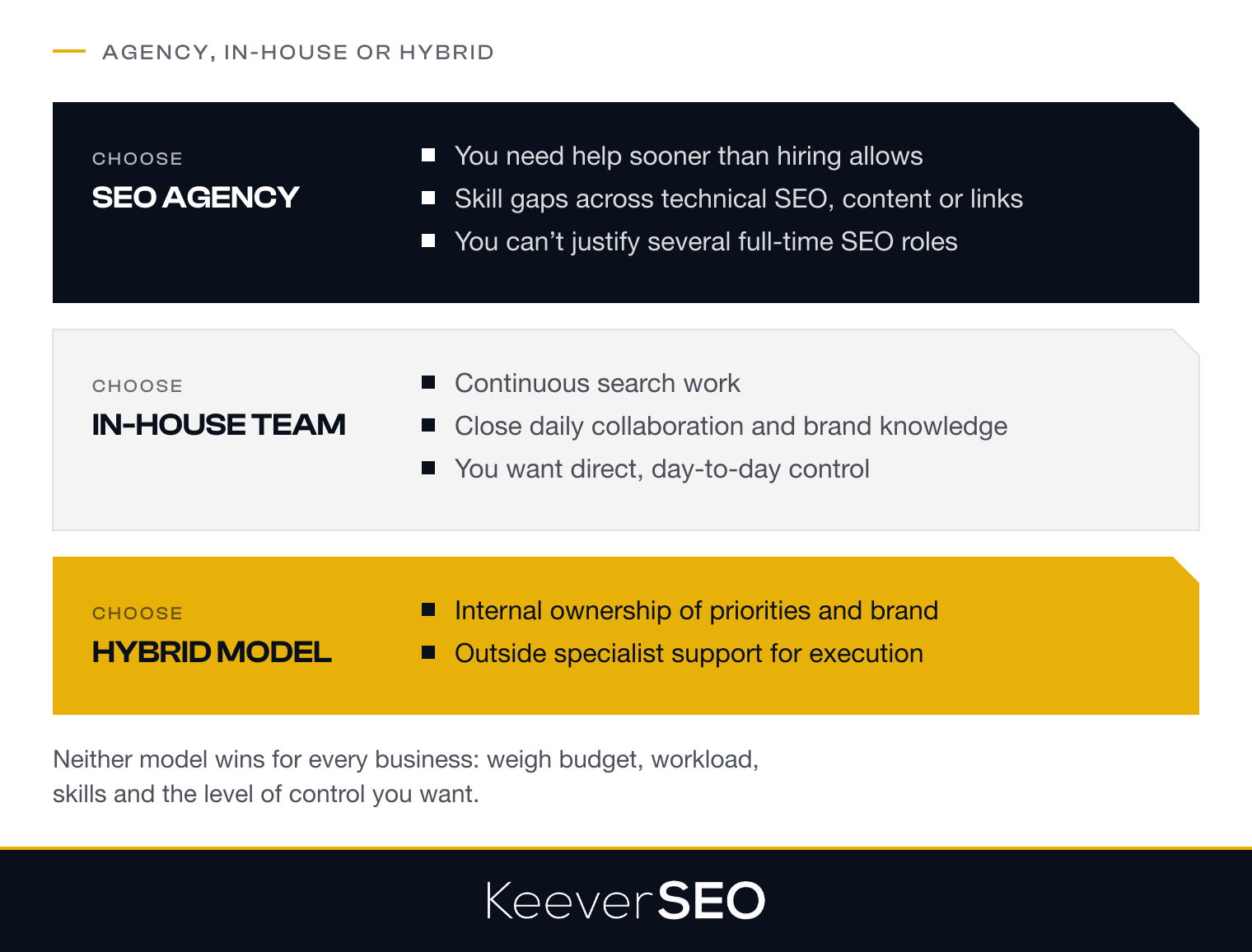
An in-house SEO team suits a business with continuous search work that needs close daily collaboration, strong brand knowledge, and direct control. Choose an agency when speed, broader skills, or flexible costs matter more, and choose a hybrid model when internal ownership and outside specialist support both fit your needs.
Should a Local Service Business Build an In-House SEO Team?
No, most local service businesses with one or a few locations do not need a dedicated in-house SEO team. A full-time hire adds salary, software, training, and management costs, and a small business may not have enough ongoing SEO work to fill a full team's time. An agency or part-time specialist can handle local SEO within a more flexible budget.
Local SEO still needs regular attention to Google Business Profile, reviews, business listings, location pages, and Map Pack visibility. A local business can assign one employee to share brand knowledge and coordinate priorities while an SEO provider handles specialist tasks. Multiple locations, a larger budget, and a steady workload can make in-house SEO more practical.
How Can an SEO Agency Work Alongside Your Marketing Team?
An SEO agency works alongside your marketing team by providing search skills while internal staff keep brand and business context. Your marketing team shares priorities, customer feedback, brand guidelines, and content approvals, and the agency contributes SEO strategy, technical recommendations, content planning, implementation support, and performance reporting.
The agency and the marketing team should each assign a primary contact, clarify task ownership, set approval deadlines, and track work in a shared project-management system. Regular check-ins and shared reports help both teams review progress, resolve obstacles, and connect SEO work to business goals.
How Does Keever SEO Compare With Building an In-House SEO Team?
Keever SEO compares with building an in-house SEO team by providing an agency team for businesses that need local SEO without hiring separate in-house specialists. Senior people work on every Keever SEO account rather than a rotating bench, and the Keever SEO local work focuses on service-business needs such as Google Business Profile optimization, citation building, review management, location pages, and Google Map Pack visibility.
Keever SEO works on monthly retainers and project work, with published prices starting at about $1,500 per month for local campaigns and about $2,000 per month for national campaigns, while the final fee depends on market, scope, and competition. Monthly Keever SEO reports put leads and conversions first, then Google Business Profile activity, organic visibility, work completed, and next priorities, whereas an in-house team offers more day-to-day control and closer brand knowledge.
What Else Should You Compare Before Hiring SEO Help?
The other options to compare before hiring SEO help are a freelancer, doing SEO yourself, and the market cost of SEO in the USA. An SEO agency, a freelancer, and a do-it-yourself approach offer different levels of skill, time commitment, and support.
Three questions clarify which option fits your goals: how an agency compares with a freelancer, whether your business can handle SEO itself, and how much SEO costs in the USA.
How Does an SEO Agency Compare With a Freelancer?
An SEO agency compares with a freelancer by providing a team of specialists across strategy, content, technical SEO, and link building, while a freelancer works independently with smaller capacity. Freelancers usually cost less and suit defined projects, such as an SEO audit or a local SEO campaign. An agency fits ongoing, multi-skill work that needs more scale, backup coverage, and structured reporting.
Can You Do SEO Yourself Instead?
Yes, you can do foundational SEO yourself, especially for a small website or a small budget, by improving page content, titles, internal links, site structure, and Google Search Console monitoring. Google Search Central's "SEO Starter Guide" explains the basic practices for site owners, while technical issues, competitive markets, or a lack of time can make hiring an SEO professional the practical choice.
How Much Does SEO Cost in the USA?
SEO in the USA costs about $1,000 to $3,000 per month for most ongoing campaigns, depending on campaign scope, competition, and website needs. SEO costs $2,917 per month on average, and 79.1% of SEO providers in the US and Canada charge at least $1,001 per month, according to "SEO Pricing: How Much Does SEO Cost? 439 People Polled" by Joshua Hardwick, Ahrefs, August 2024.
How Do You Choose the Best SEO Agency?
To choose the best SEO agency, match the agency's experience, strategy, communication, and contract terms to your business goals. Set clear objectives and KPIs first, then review relevant case studies, client references, proposed work, named account staff, pricing, and reporting plans.
Ask how each agency will address technical SEO, content, search intent, and local visibility. Choose a provider that follows Google's guidelines, explains deliverables and timelines, and measures qualified leads or sales alongside traffic and rankings. Avoid guaranteed ranking promises, vague scopes, and undisclosed methods, because Google Search Central states in "Do you need an SEO?" that "No one can guarantee a #1 ranking on Google."
How Do You Know If Your SEO Agency Is Doing a Good Job?
To know if your SEO agency is doing a good job, check whether its work supports agreed business outcomes, such as qualified organic traffic, leads, calls, sales, or revenue. Review regular reports for completed technical, content, and local SEO tasks, and check Google Search Console for clicks, impressions, click-through rate, average position, search queries, and landing pages.
A clear SEO report explains what the agency changed, why it made each change, and what it plans next. Compare results with an agreed baseline and account for seasonality and conversion delays. Google Search Central recommends waiting at least a full week after a core update completes before analyzing a site in Search Console, in "Google Search's core updates and your website." Check Search Console for indexing issues, traffic drops, or manual actions. A reliable agency provides account access, explains setbacks, and avoids ranking guarantees.
Which Is Better for Your Business: an SEO Agency or an In-House Team?
The better option for your business, an SEO agency or an in-house team, depends on budget, workload, skills, and the level of control you want, because neither model wins for every business. An SEO agency suits businesses that need broad skills and flexible support without hiring multiple specialists, while an in-house team suits businesses with ongoing SEO needs and the resources to build internal skills.
A hybrid model gives businesses internal brand and strategy ownership alongside agency support for specialist work. In the SEO agency vs in-house team comparison, agencies offer speed and flexibility, while in-house teams offer closer brand knowledge and day-to-day control.