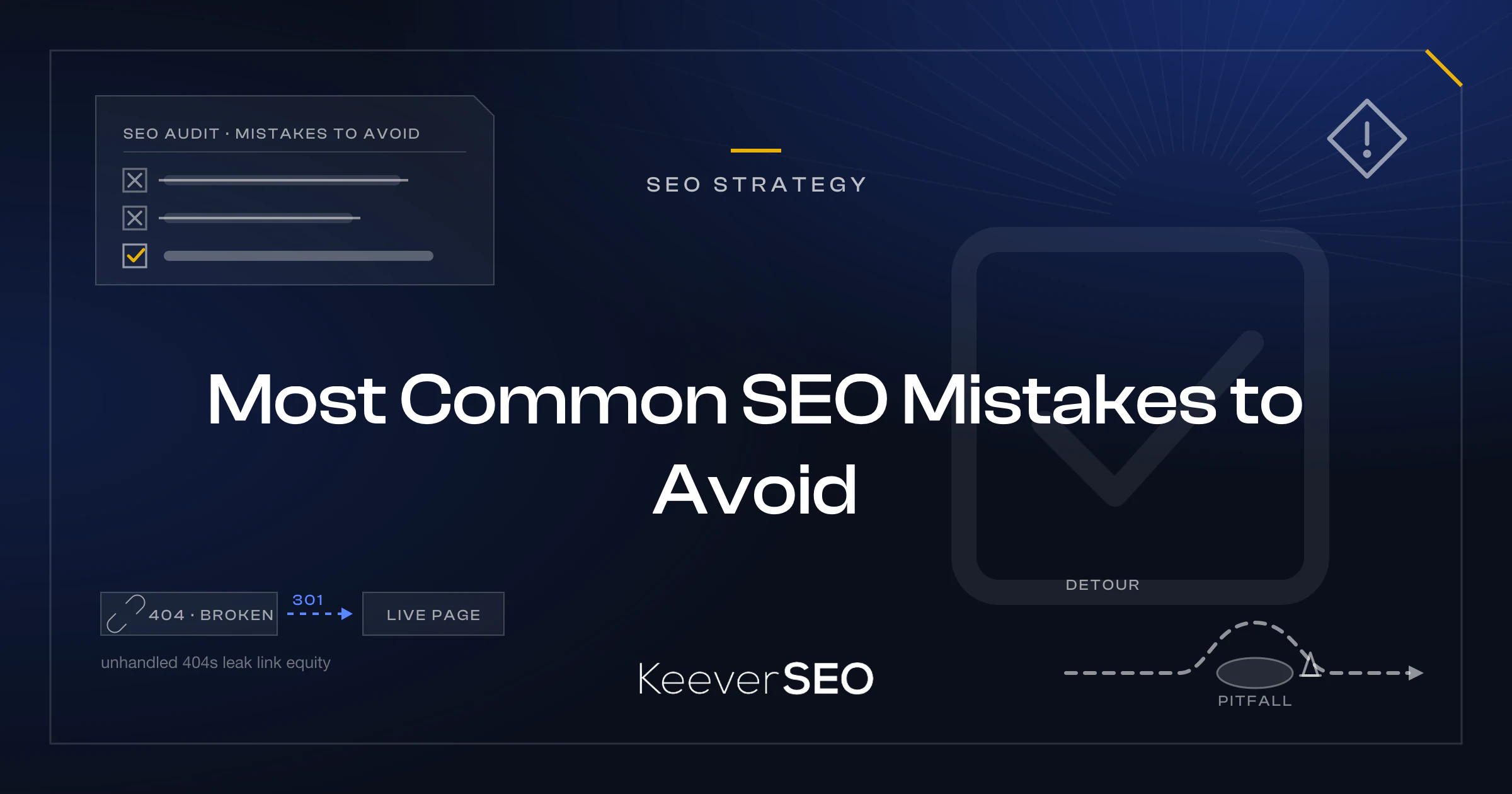
The most common SEO mistakes fall into eight categories: poor keyword research, search-intent mismatch, weak content quality, keyword stuffing and on-page errors, broken architecture and internal linking, technical and speed issues, spammy backlinks, and no performance monitoring. Keyword research and search intent deserve the first fixes, because they underpin every other SEO effort. An SEO mistake is any action or omission that keeps search engines from crawling, reading, or ranking a page, which costs visibility, traffic, and conversions.
Keyword research and search-intent errors come first. Chasing high-volume, high-difficulty terms wastes resources when the domain lacks authority, ignoring long-tail queries misses easy wins, and keyword cannibalization leaves search engines unsure which page to rank, whereas keywords aligned with user intent earn clicks and conversions. Content-quality mistakes cover thin, duplicate, or outdated content: thin content gives little value, duplicate URLs dilute ranking signals, and outdated pages lose credibility over time, while content audits every six to twelve months, canonical tags, and merged articles keep pages relevant. On-page mistakes involve keyword stuffing, oversized titles, missing meta descriptions, poor URL slugs, and missing image alt text, each of which hurts click-through or visibility.
Crawlable architecture and internal linking errors include orphan pages, generic anchor text, and weak navigation, where descriptive anchors and a logical hierarchy restore discoverability. Technical SEO issues cover robots.txt or noindex blocking, broken XML sitemaps, redirect chains, mixed HTTP and HTTPS, and broken 404s, with Core Web Vitals (LCP, INP, and CLS) and a sub-three-second load target as the performance bar. Backlink quality issues come from spammy or irrelevant links that trigger penalties, so relevance and trust decide link value. Monitoring gaps round out the list: without Google Search Console and Analytics, teams track the wrong metrics, chase rankings over conversions, and treat SEO as a one-time task, whereas regular reviews catch regressions in time. The first mistake to fix, poor keyword research, is covered below.
1. Avoid poor keyword research
To avoid poor keyword research, stop chasing high-volume, high-difficulty terms that the domain cannot win and start valuing long-tail queries. Long-tail queries carry lower competition and clearer intent. Keyword cannibalization, where several pages compete for the same term, confuses search engines and dilutes ranking potential. The fix is research that balances search volume against keyword difficulty and prioritizes the terms that match audience behavior and business goals.
Effective targeting reads the intent behind each keyword, whether users want to learn, compare, purchase, or reach a specific site. Tools like Google Keyword Planner, Ahrefs, or Semrush expose difficulty scores and monthly volumes that reveal attainable, high-value keywords. An audit of existing content for cannibalization lets pages be consolidated or given a distinct intent focus. Once the right keywords are chosen, matching them to searcher intent is the next mistake to address.
2. Match content to search intent
To match content to search intent, deliver the content type the query's purpose demands. Search-intent mismatch occurs when content fails the searcher's actual purpose, which produces weak engagement and rankings. Google's guidance on search intent covers four categories: informational intent seeks knowledge, commercial intent compares options before a decision, transactional intent is ready to buy or act, and navigational intent seeks a specific website or page.
The fix tailors content to the intent type: an informational query calls for a detailed article or guide, while a transactional query calls for a product page or purchase path. Analyzing the search engine results page (SERP) for a target keyword reveals the dominant content format and intent, and content built to that pattern earns relevance and rankings. Content aligned with user intent raises satisfaction, dwell time, and conversion rates.
3. Publish helpful, original, and up-to-date content
To publish helpful, original, and up-to-date content, remove the content-quality mistakes that come from thin content, duplicate URLs, stale pages, over-reliance on AI, and word-count extremes. Thin content lacks depth and fails the searcher's query. Duplicate and near-duplicate URLs confuse search engines and dilute authority and rankings. Stale content suffers content decay, the gradual decline in performance as information goes out of date.
The fix creates content that meets user needs with original examples and expertise, consolidates duplicate pages through canonical tags that name the preferred version, and sets a refresh cadence that updates core pages every six to twelve months. AI-generated drafts need human review for accuracy and insight, and word count should give enough substance to answer the query in full without padding. Content that stays useful and current supports sustainable organic growth.
4. Avoid keyword stuffing and optimize on-page SEO elements
To avoid keyword stuffing and optimize on-page SEO elements, use keywords in natural language and fix the title, description, URL, image, and header errors that hurt performance. Keyword stuffing overloads a page with keywords to manipulate rankings, which search engines like Google recognize as over-optimization and can penalize. Keywords belong in the content at a natural frequency that keeps the text readable.
Title tags should be concise, within about 50 to 60 characters to avoid truncation in search results, and unique to each page. Meta descriptions are not a direct ranking factor, but a compelling description of 150 to 160 characters raises visibility and click-through rates. URL slugs should be short, descriptive, and keyword-rich, with hyphens between words. Images need alt text that describes their content for accessibility and image search.
Header tags (H1, H2, H3) should structure content in logical order, because skipped levels or keyword-loaded headers confuse search engines and weaken the structure. A systematic audit of on-page elements, starting with high-traffic and conversion-driving URLs, catches missing meta descriptions, oversized titles, and absent alt text through tools like Screaming Frog or Semrush, and the fixes let search engines read page relevance and user intent.
5. Build crawlable site architecture and internal links
To build crawlable site architecture and internal links, fix orphan pages, generic anchor text, shallow link depth, and weak navigation. Orphan pages, which no internal link reaches, stay undiscovered by search engines and users. The fix links every important page from at least one other page, ideally within three clicks of the homepage, which strengthens internal link equity and shows search engines the content hierarchy.
Descriptive anchor text in place of generic phrases like "click here" gives search engines context and directs link equity to relevant pages. Content organized into topic clusters within a shallow structure keeps important pages within reach, which helps search engines crawl the site and helps users find their way. Once the architecture is crawlable, the technical issues that slow the site and block indexation come next.
6. Fix technical SEO issues affecting speed, Core Web Vitals, and mobile usability
To fix technical SEO issues affecting speed, Core Web Vitals, and mobile usability, clear the crawl blocks first and then bring performance within Google's thresholds. The issues come from robots.txt or noindex directives that block pages, missing or broken XML sitemaps, canonical misconfiguration, redirect chains and loops, mixed HTTP and HTTPS content, and broken 404 pages that waste crawl budget and trigger security warnings. Missing schema markup keeps content out of rich results, and mobile usability problems like unresponsive design and tiny tap targets degrade the mobile experience.
Core Web Vitals set the performance bar, per Google's "Web Vitals" guidance on web.dev: Largest Contentful Paint (LCP) within 2.5 seconds, Interaction to Next Paint (INP) under 200 milliseconds, and Cumulative Layout Shift (CLS) below 0.1. Reaching the thresholds means removing render-blocking resources, compressing images, turning on browser caching, and serving through a content delivery network (CDN). 301 redirects for permanent moves rather than 302s, correct hreflang for international sites, and regular monitoring in Google Search Console keep technical health intact.
Unresolved technical issues hold rankings down regardless of content quality, so the fixes belong at the top of any SEO strategy.
7. Earn relevant, trusted links instead of spammy backlinks
To earn relevant, trusted links instead of spammy backlinks, build links from credible, related domains and remove the ones that endanger the profile. Spammy backlinks, often bought or drawn from link farms, private blog networks (PBNs), or irrelevant domains, break Google's spam policies and can bring manual actions or algorithmic penalties like those from Penguin, which suppress rankings and in severe cases de-index a site.
The fix begins with a backlink audit in Ahrefs or Google Search Console that flags toxic links, followed by Google's Disavow Tool for the links that cannot be removed. Relationships with reputable sites in the industry then earn high-quality, editorially placed backlinks through original research, expert contributions, and guest posts on authoritative platforms. Relevance and trust build the durable authority behind long-term organic growth.
8. Monitor SEO performance and update your strategy
To monitor SEO performance and update your strategy, treat SEO as an ongoing process rather than a one-time task. Businesses that skip monitoring miss optimization opportunities and fall behind algorithm changes, so core metrics need regular tracking in Google Search Console and Google Analytics. The three components of effective monitoring are listed below:
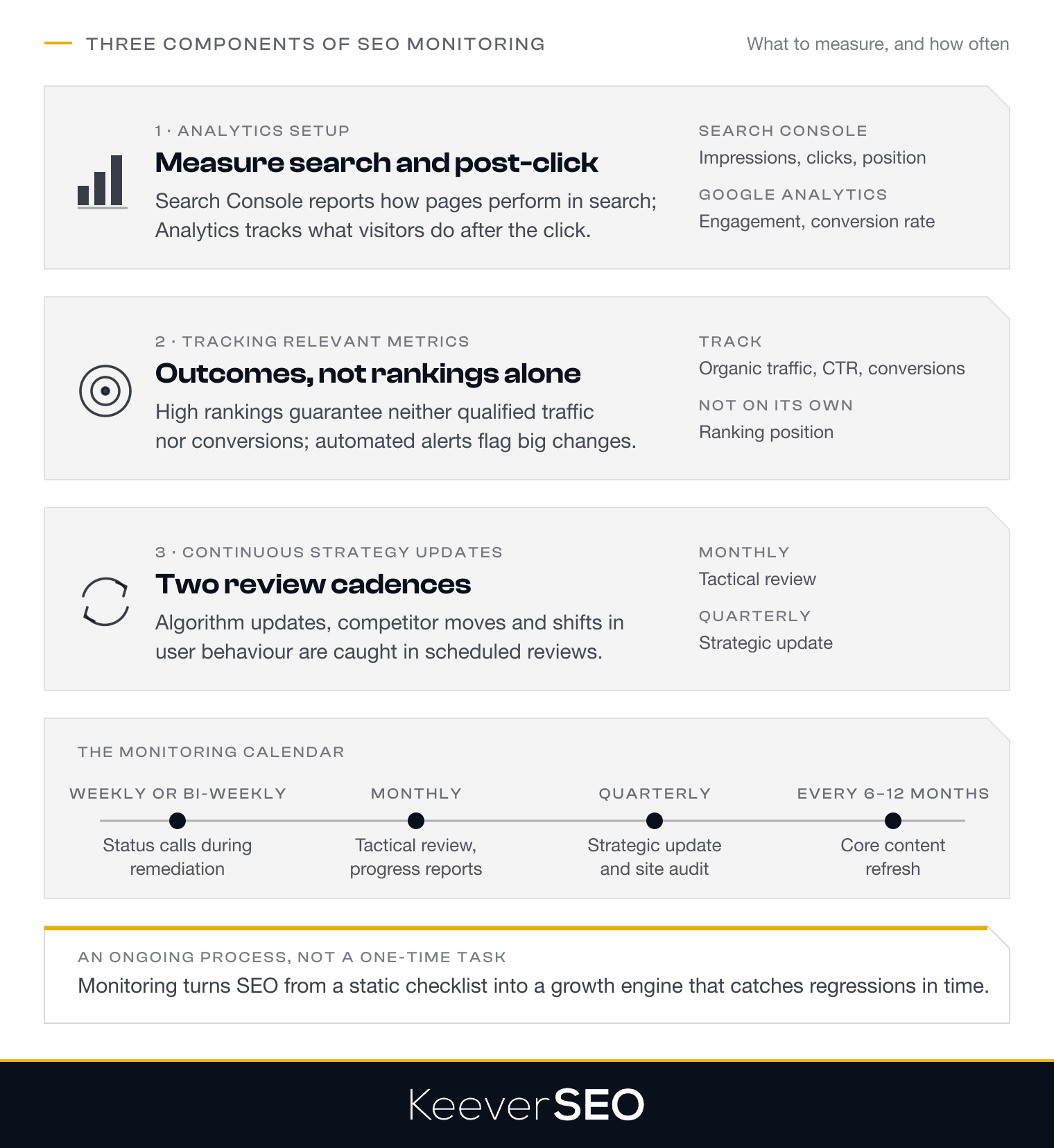
- Analytics Setup: Google Search Console shows how pages perform in search through impressions, clicks, and average position, and Google Analytics tracks post-click behavior such as engagement and conversion rates; without both, SEO success cannot be measured.
- Tracking Relevant Metrics: The metrics that matter tie to business outcomes, such as organic traffic, click-through rate (CTR), and conversion rate, because high rankings alone guarantee neither qualified traffic nor conversions, and custom dashboards with automated alerts flag major changes.
- Continuous Strategy Updates: Algorithm updates, competitor moves, and shifts in user behavior call for monthly tactical reviews and quarterly strategic updates that keep content relevant, technical settings tuned, and regressions fixed.
The three practices turn SEO from a static checklist into a growth engine that adapts to market change and keeps common mistakes from compounding.
What are the most common SEO mistakes to avoid, and which should be fixed first?
The most common SEO mistakes to avoid are poor keyword research, search-intent mismatch, weak content, keyword stuffing and on-page errors, broken architecture and internal linking, technical and speed issues, spammy backlinks, and missing performance monitoring, and crawl-and-index problems should be fixed first because they keep search engines from reading the site at all. An SEO mistake is any action that weakens a website's ability to rank, with lower rankings, organic traffic, click-through rates, and conversions as the cost. The fix order runs from crawl-and-index issues to keyword targeting and intent alignment, then content quality, on-page elements, internal linking, technical performance, backlinks, and continuous monitoring. The mistakes grouped by fix priority are listed below:
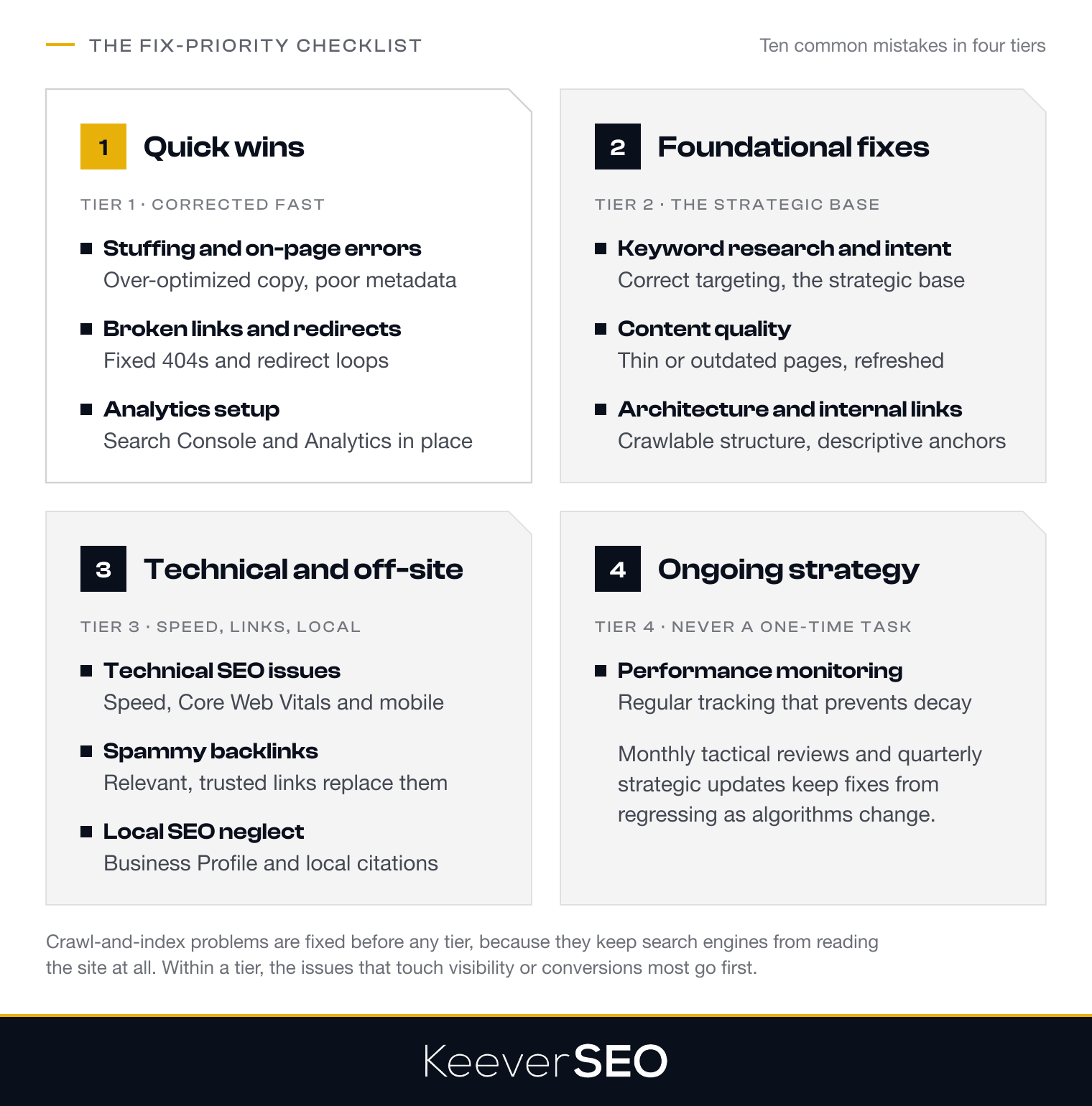
Quick Wins
- Keyword Stuffing and On-Page Errors: Over-optimized content and poor metadata can be corrected fast.
- Broken Links and Redirects: Fixed 404 errors and redirect loops restore the user experience.
- Analytics Setup: Google Search Console and Analytics in place allow data-driven decisions.
Foundational Fixes
- Keyword Research and Search-Intent Mismatch: Correct targeting forms the strategic base.
- Content Quality: Thin or outdated content refreshed on a schedule.
- Site Architecture and Internal Linking: A crawlable structure with descriptive anchors.
Technical and Off-Site Foundations
- Technical SEO Issues: Speed, Core Web Vitals, and mobile usability.
- Spammy Backlinks: Relevant, trusted links in place of manipulative ones.
- Local SEO Neglect: Optimized Google Business Profiles and local citations.
Ongoing Strategy
- Performance Monitoring: Regular updates and tracking that prevent ranking decay.
What keyword research and search-intent mistakes should be avoided?
The keyword research and search-intent mistakes to avoid are chasing hard terms, ignoring long-tail queries, keyword cannibalization, and intent mismatch. The four mistakes are set out below:
Chasing High-Volume, High-Difficulty Terms Many businesses target popular keywords with high search volume and overlook the competition attached, which yields minimal ranking gains for newer websites without domain authority.
Ignoring Long-Tail Queries Long-tail keywords are longer, more specific phrases with lower search volume but higher conversion rates, and overlooking them forfeits targeted traffic from users close to a purchase decision.
Keyword Cannibalization Cannibalization occurs when several pages on a website target the same or similar keywords and compete against each other, which dilutes authority, confuses search engines, and often leaves none of the pages ranking well.
Intent Mismatch Keywords chosen without regard for searcher intent produce content that misses user needs, whereas content aligned with informational, commercial, transactional, or navigational intent holds relevance and rankings.
Keyword difficulty analysis, search volume research, and keyword-intent alignment keep content matched to user needs.
What content-quality mistakes, including thin, duplicate, and outdated content, reduce rankings?
The content-quality mistakes that reduce rankings are thin content, duplicate URLs, outdated content, unreviewed AI content, and word-count extremes, each of which lowers a site's authority and engagement. The five mistakes are set out below:
Thin Content Thin content lacks the depth or unique information to satisfy user intent, which makes it less valuable to users and search engines, and the fix adds substantive, relevant detail.
Duplicate and Near-Duplicate URLs Duplicate content appears when identical or near-identical content sits on several URLs, which confuses search engines and dilutes ranking signals, and canonical tags point search engines to the preferred version.
Outdated or Stale Content Outdated content loses credibility as its information goes stale, which cuts visibility and trust, and regular updates keep it current and authoritative.
Over-Reliance on AI-Generated Content Unreviewed AI content tends toward generic or inaccurate information, so editing and fact-checking are required for quality and unique insight.
Word-Count Extremes Pages that run too short or needlessly long hurt user experience and rankings, and the right length matches the depth the topic demands while staying readable.
What on-page SEO mistakes in title tags, metadata, URLs, images, and internal links should be avoided?
The on-page SEO mistakes to avoid are weak title tags, missing meta descriptions, poor URL slugs, missing alt text, and generic anchors with orphan pages. The five mistakes are listed below:
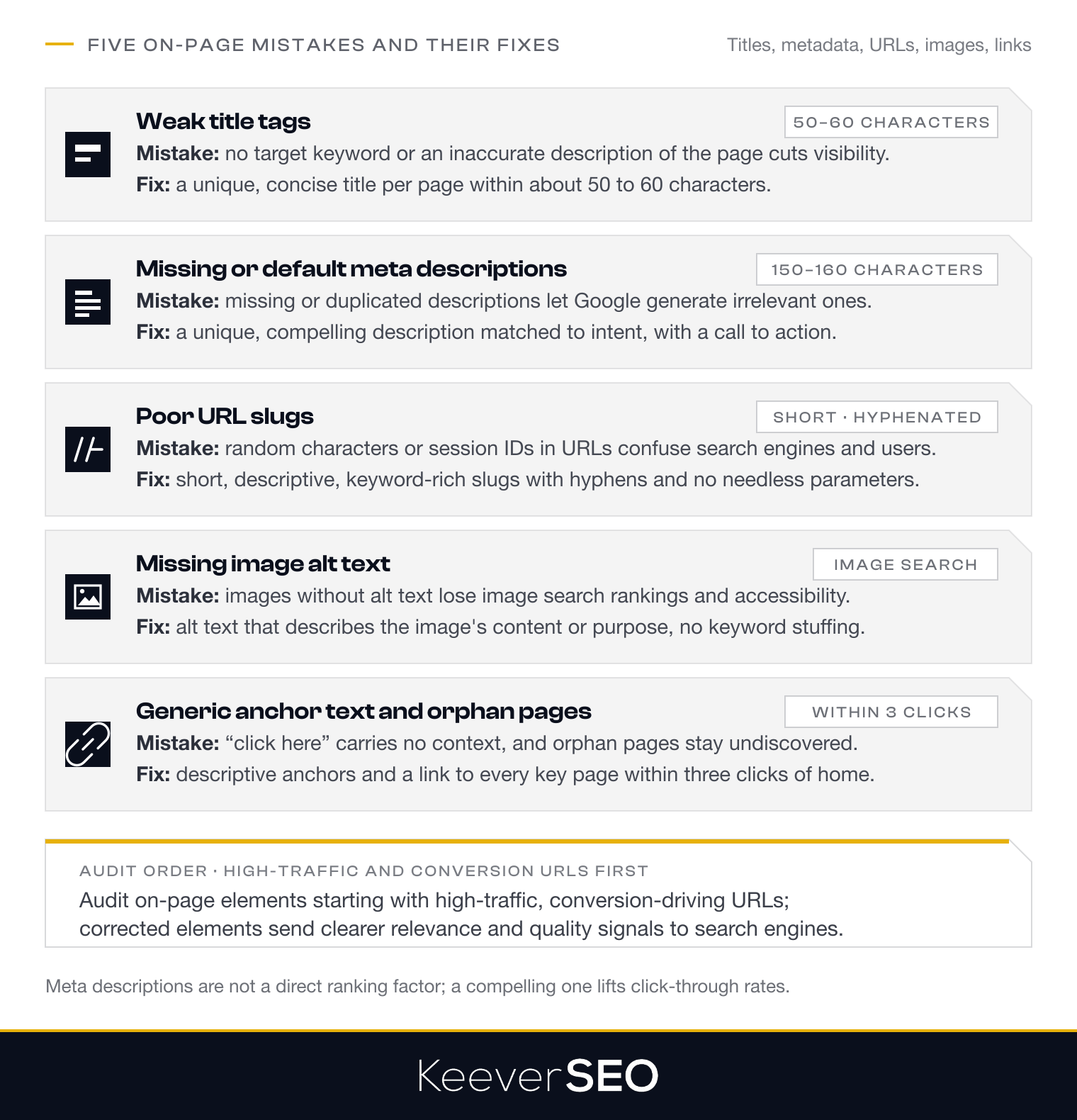
- Weak Title Tags: Titles without target keywords or an accurate description of the page cut search visibility, so each title should be unique, concise, and within about 50 to 60 characters to avoid truncation.
- Missing or Default Meta Descriptions: Missing or duplicated descriptions let search engines generate irrelevant ones, so each page needs a unique, compelling description that matches search intent and carries a call-to-action.
- Poor URL Slugs: URLs full of random characters or session IDs confuse search engines and users, so URLs should be short, descriptive, and free of needless parameters or stop words.
- Missing Image Alt Text: Images without alt text lose image search rankings and accessibility, so alt text should describe the image's content or purpose without keyword stuffing.
- Generic Anchor Text and Orphan Pages: Phrases like "click here" give search engines no context, and orphan pages without internal links are hard to discover, so every important page needs descriptive anchor text that spreads link equity and builds topical authority.
Corrected on-page elements send clearer relevance and quality signals to search engines and sharpen the site's competitive position.
What technical SEO mistakes harm crawling, indexation, XML sitemaps, redirects, and page experience?
The technical SEO mistakes that harm crawling, indexation, XML sitemaps, redirects, and page experience are blocking directives, broken sitemaps, canonical errors, redirect chains, mixed content, broken 404s, missing schema, and failed page-experience signals. The eight mistakes are set out below:
Robots.txt or Noindex Blocking Incorrect robots.txt or noindex directives block core pages from crawling, often after a site migration or when temporary directives stay active, which cuts visibility.
Missing or Broken XML Sitemaps An XML sitemap is the roadmap for search engines, and a missing, outdated, or error-returning sitemap leaves crawlers without guidance and indexation incomplete.
Canonical Misconfiguration Misconfigured canonical tags leave search engines unsure which page version is authoritative, which dilutes ranking signals across duplicate URLs.
Redirect Chains and Loops Chains of several redirects, or loops back to the original URL, waste crawl budget and slow page loads.
Mixed HTTP/HTTPS Content Mixed HTTP and HTTPS content triggers security warnings and erodes user trust, so one protocol must run throughout.
Broken 404 Pages Pages that return 404 should redirect to relevant content through 301 redirects, because unhandled 404s leak link equity and break the user experience.
Missing Schema Markup Schema markup supplies structured data, and a site without it misses rich-result opportunities and the competitive edge they bring.
Page-Experience Signals Core Web Vitals, including Largest Contentful Paint (LCP), Interaction to Next Paint (INP), and Cumulative Layout Shift (CLS), shape user experience, and meeting Google's thresholds of LCP under 2.5 seconds, INP under 200 milliseconds, and CLS under 0.1 supports both interaction and rankings.
Of the eight, slow site speed does the most damage through bounce rates and lost engagement, as set out next.
How does slow site speed become one of the most common SEO mistakes to avoid?
Slow site speed becomes one of the most common SEO mistakes to avoid because it hurts user experience and search rankings at once. Render-blocking resources, weak caching, and heavy images push load times up. Google's Core Web Vitals, Largest Contentful Paint (LCP), Interaction to Next Paint (INP), and Cumulative Layout Shift (CLS), set the performance targets, with LCP within 2.5 seconds, INP under 200 milliseconds, and CLS below 0.1. Sites that pass a three-second load time lose visitors before the page renders, and Google's research "The need for mobile speed" found that 53% of mobile visitors abandon a page that takes longer than three seconds to load.
Faster sites come from compressed images, less render-blocking JavaScript and CSS, browser caching, content delivery networks (CDNs), and faster server response. With about six in ten web visits arriving from mobile devices, according to StatCounter Global Stats, site speed decides competitive visibility in search results.
What local SEO mistakes should businesses avoid?
The local SEO mistakes businesses should avoid are the errors that cut visibility in geographically targeted searches. The nine mistakes are listed below:
- Unoptimized or Unclaimed Google Business Profile: An unclaimed or unoptimized profile limits local search appearances, so categories, hours, and photos should be accurate and complete.
- NAP Citation Inconsistency: Inconsistent Name, Address, and Phone number (NAP) data across directories confuses search engines, cuts trust, and hurts local rankings.
- No Review Strategy: Ignored reviews forfeit user-generated content and the trust signals local SEO depends on.
- Missing Local Keywords and Location Pages: Missing local keywords or location-specific pages limit relevance for nearby searches, and pages should reflect real service areas rather than generic templates.
- Duplicate Business Listings: Several listings for one business confuse Google Maps and Search, so duplicates should be consolidated or removed.
- Incomplete Profile Details and Weak Local Signals: Every profile field should be complete, because the fields help Google read and rank the business in local results.
- Inconsistent Local Content Across the Site: Contact pages, footer details, and location pages should match the Google Business Profile to avoid mixed signals.
- Review Gating or Policy-Unsafe Tactics: Asking only satisfied customers for reviews or offering incentives breaks platform policies and hurts long-term performance.
- Failing to Maintain Citations Over Time: Regular audits keep names, phone numbers, and addresses current so outdated data does not suppress visibility.
Avoiding the nine mistakes lifts local search performance and customer engagement.
When should businesses get help fixing SEO mistakes?
Businesses should get help fixing SEO mistakes when their own efforts stop producing improvement. Stalled rankings despite attempted fixes point to deeper issues than content adjustments can reach, recurring errors point to process gaps that experienced teams close faster, and penalties, sharp traffic declines, or missing technical expertise in-house all call for specialist intervention. The problems that need technical expertise are set out next.
Which SEO problems require technical expertise?
The SEO problems that require technical expertise are crawl and indexation issues, canonicalization errors, redirects, schema markup implementation, and Core Web Vitals optimization. The problems involve server settings, code, and site architecture, which puts them beyond DIY fixes, and specialist expertise secures accurate diagnosis and resolution, above all when an audit needs an independent review to catch what was missed.
When does an SEO audit need independent review?
An SEO audit needs independent review when a conflict of interest exists, such as an auditor with a financial stake in the recommended fixes, because independence protects the objectivity and credibility of the assessment. A second opinion adds value when the quality and completeness of a prior agency or in-house audit need verification, and an independent review confirms that the core technical, content, and backlink issues were identified and that the business's goals match current best practice.
What should an SEO agency audit first?
An SEO agency should audit technical barriers first, then keyword research and intent alignment, then content quality and on-page elements. The audit opens with the technical SEO barriers, such as robots.txt or noindex directives that block core pages, broken or missing XML sitemaps, canonicalization errors, and redirect chains, because the barriers keep search engines from crawling and indexing the site and blunt every later optimization. Keyword research and search-intent alignment come next, so content targets the right user queries. Content quality and on-page elements follow, including thin or duplicate content, title tags, meta descriptions, and internal linking. The order resolves crawlability and indexation before time goes into content or backlink work that search engines might never see.
Should an agency audit technical, content, and backlink issues?
Yes, an agency should audit technical, content, and backlink issues together. Each area shapes search performance, and auditing one in isolation creates blind spots: technical barriers keep excellent content from ranking, thin content undermines strong technical foundations, and spammy backlinks trigger penalties that no on-page optimization can offset. A full audit reads the connected health of crawlability, indexation, site speed, Core Web Vitals, metadata, content quality, keyword targeting, internal linking, and the backlink profile, which finds root causes rather than surface symptoms.
Once the full-scope audit maps every technical error, content gap, and link-quality issue, the findings are prioritized by direct business impact so the fixes that produce the most traffic, conversions, and revenue come first, as set out next.
How should an agency prioritize fixes by business impact?
An agency should prioritize fixes by weighing revenue and traffic impact, effort versus reward, and the split between quick wins and foundational fixes. High-impact issues that touch visibility, conversions, or user experience, such as crawl blocks, failed Core Web Vitals, or high-value keyword targeting, come first even when they take moderate effort. Quick wins like missing title tags or alt text ship fast and show early progress, while foundational fixes such as a site architecture overhaul or duplicate-content consolidation take longer but set up sustained gains. Weighing the potential outcome, in organic sessions, goal completions, or revenue, against the time and resources required keeps remediation focused on the strongest return and aligned with commercial objectives.
How can businesses hire an SEO agency for remediation?
Businesses can hire an SEO agency for remediation by vetting credentials and case studies and by defining the remediation scope up front. The two steps are set out below:
Vetting Credentials and Case Studies Case studies should show measurable gains in rankings, traffic, and conversions after remediation work, in a scope and industry that match the business, and references from clients who faced similar SEO problems add insight into the agency's effectiveness.
Defining Remediation Scope The proposal should state which mistake categories the agency addresses first, whether technical errors, content-quality issues, on-page gaps, backlink cleanup, or local SEO, and which require ongoing optimization. We position ourselves as an SEO remediation partner with full audits across crawlability, indexation, content alignment with search intent, and backlink hygiene, followed by phased implementation that balances quick wins with foundational architecture work.
The two steps secure an agency that corrects existing mistakes and leaves the business with monitoring frameworks that prevent recurrence.
What SEO services help businesses upgrade their SEO strategy and prevent recurring errors?
The SEO services that help businesses upgrade their strategy and prevent recurring errors are technical SEO, content optimization, on-page fixes, link building and management, SEO audits, and ongoing monitoring. The six services are set out below:
Technical SEO Technical SEO resolves crawlability and indexing issues through sitemap optimization, robots.txt fixes, and mobile usability, so search engines can access and read the site.
Content Optimization Content optimization raises the quality and relevance of website content by refreshing outdated pages, aligning them with search intent, and removing duplicates, which lifts engagement and search visibility.
On-page SEO Fixes On-page fixes target title tags, meta descriptions, and URL slugs so each page sends clear relevance signals, which improves click-through rates and user experience.
Link Building and Management Link building earns high-quality backlinks from trusted sources and disavows the spammy links that hurt site authority, which strengthens domain credibility and rankings.
SEO Audits Regular audits identify the most impactful issues across technical, content, and backlink areas and deliver a prioritized plan that keeps the site in line with search engine guidelines.
Ongoing Monitoring and Reporting Ongoing monitoring tracks rankings, traffic, and conversions through Google Analytics and Search Console, which catches regressions in time and keeps the strategy current.
The six services together prevent the common mistakes and sustain search visibility.
How should businesses work with an SEO agency?
Businesses should work with an SEO agency through structured onboarding, a set communication cadence, and a collaborative relationship. Onboarding documents goals, timelines, and access requirements, aligns expectations, and defines success metrics, and the agency's initial audit sets baseline metrics and a roadmap of prioritized fixes tied to objectives such as better rankings or more organic traffic.
The communication cadence holds momentum and transparency: weekly or bi-weekly status calls during intensive remediation, then monthly strategy reviews that cover progress reports, deliverables like optimized content or technical fixes, and priorities adjusted on performance data. Clear reporting includes traffic trends, ranking changes, conversion metrics, and completed tasks, each tied to business goals.
The best client-agency relationships run both ways. Internal insight about product launches or seasonal trends shapes SEO priorities, and prompt responses to agency requests for content direction or technical changes keep work moving. We run on a two-way partnership that pairs the client's domain expertise with the agency's technical knowledge, and open communication, timely feedback, and treating the agency as an extension of the team maximize the return on the SEO investment.
How much does SEO mistake remediation cost?
SEO mistake remediation costs from a few hundred dollars for a focused one-off fix to several thousand dollars for a full audit and remediation project, with larger and more complex sites at the top of the range. A full technical SEO audit alone can run into the low thousands for enterprise or highly competitive sites, and monthly retainers for ongoing support run from the low thousands upward for continuous monitoring and optimization.
The main price factors are the website's size, the severity and complexity of the issues, and whether the work is a one-time cleanup or an ongoing program. Fixing basic on-page issues such as missing meta descriptions or alt text costs less than complex technical work like redirect chains or Core Web Vitals failures, and Ahrefs' SEO pricing survey of 439 providers found the most common monthly retainer falls between $501 and $2,000, with an average of about $3,209, for ongoing SEO that includes mistake prevention and performance optimization.
For a custom remediation quote, contact us, and we build customized proposals on a detailed audit of the site's technical health, content quality, backlink profile, and business goals, so the investment goes to the fixes with the highest return.
How can ongoing SEO monitoring prevent the most common SEO mistakes?
Ongoing SEO monitoring prevents the most common SEO mistakes by catching regressions before they cost rankings. A regular audit cadence surfaces and fixes issues in time, and Google Search Console and Google Analytics track organic traffic, indexation status, and user behavior in real time, which exposes anomalies such as sudden ranking drops or conversion declines.
Audits should run quarterly for most sites and more often for large or fast-changing properties, because they reveal content decay, technical regressions, and backlink profile changes. Prompt alerts flag new indexation errors, Core Web Vitals deterioration, or mobile usability problems, which turns monitoring from a reactive task into a proactive strategy.
Monitoring built into the SEO workflow keeps every category of common mistake under watch: poor keyword research, search-intent mismatch, content quality, on-page errors, technical faults, and backlink problems. The fixes stay effective and adapt to algorithm updates, competitive shifts, and changing user behavior.