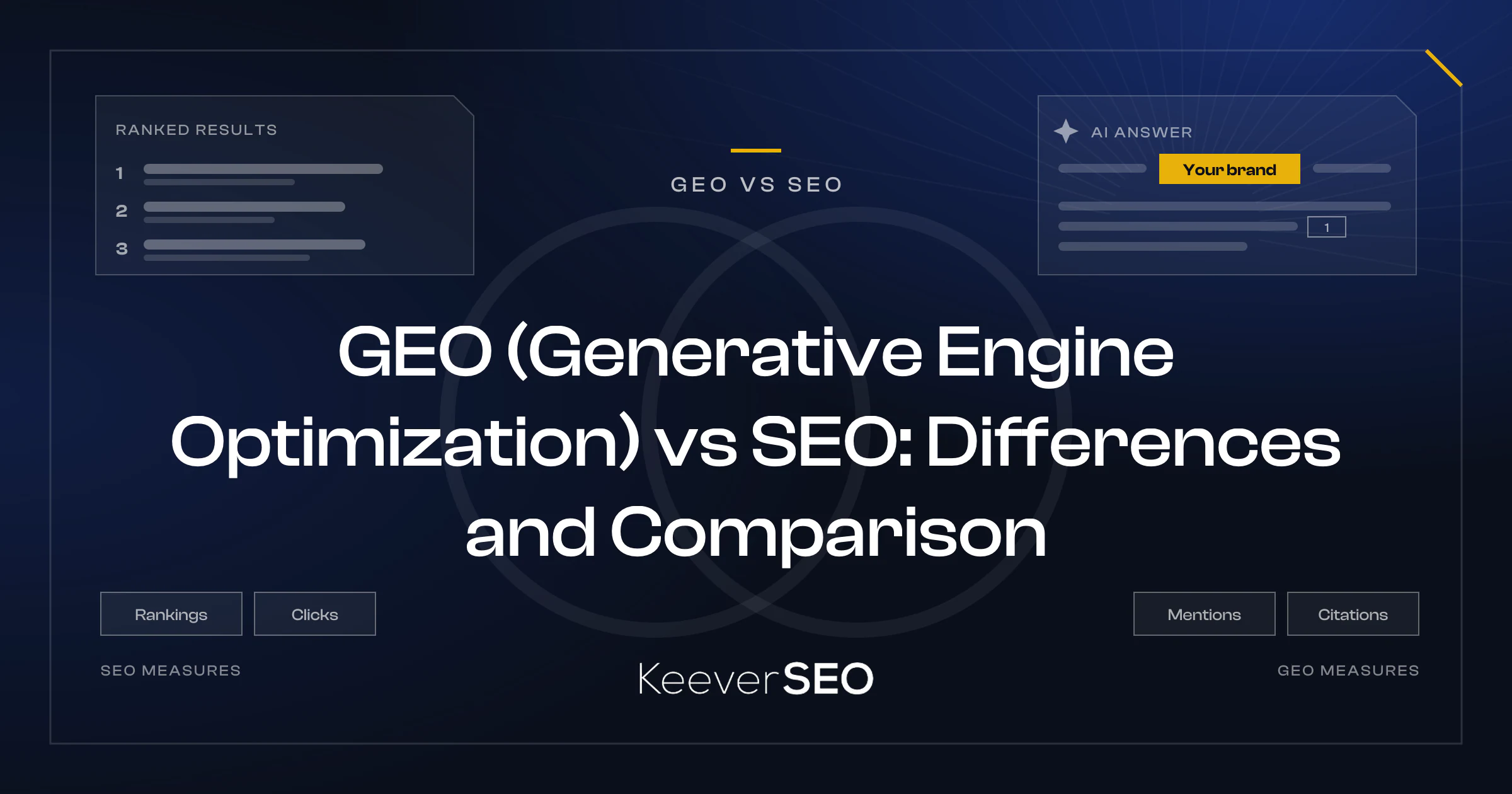
The difference between GEO and SEO is that GEO optimizes content and brand signals for inclusion and citation in AI-generated answers, while SEO optimizes pages to rank in search results and earn clicks. Search engine optimization focuses on indexed pages, ranking algorithms, keyword relevance, backlinks, rankings, traffic, and click-through rates. Generative engine optimization focuses on language models, clear passages, attributable facts, brand mentions, reviews, citations, and AI visibility measures.
SEO and GEO differ in technology, success goals, content structure, user intent, authority signals, and measurement, but they share crawlable pages, useful content, and relevance. GEO is not SEO with a new name, and GEO is unlikely to replace SEO, because generative engines draw information from accessible, indexed web content. Businesses can combine technical SEO with citation-ready passages and earned mentions, then track organic performance alongside AI citations and brand mentions.
New and local businesses should prioritize SEO and Map Pack visibility, while established brands can expand GEO when customers use AI tools to compare providers. Businesses evaluating an agency should check its ranking and AI-visibility reporting, documented content and schema practices, and transparent off-site work. AEO focuses on extracted direct answers, while GEO targets inclusion in generated responses across AI search engines, and the verdict is to use SEO as the foundation and GEO as an added visibility layer. The at-a-glance comparison below breaks down the differences.
What Is the Difference Between GEO and SEO at a Glance?
The difference between GEO and SEO at a glance is that GEO optimizes a brand's visibility in AI-generated answers, while SEO improves webpage rankings in organic search results.
| Dimension | GEO | SEO |
|---|---|---|
| Goal | Earn brand mentions, citations, or recommendations in AI-generated answers. | Rank pages in organic search results and earn clicks. |
| Underlying technology | AI systems retrieve information and use language models to generate responses. | Search engines crawl and index webpages, then rank relevant results. |
| Content optimization | Create clear, self-contained passages with concrete facts and credible sources. | Create useful pages that match search intent and support relevant keywords. |
| User intent | Answer questions within an AI conversation. | Direct users to webpages to read, compare, buy, or contact a business. |
| Authority signals | Build consistent brand mentions, reviews, citations, and evidence. | Strengthen page relevance, quality, crawlability, and links. |
| Measurement | Track AI mentions, citation share, sentiment, answer placement, and AI referrals. | Track rankings, impressions, organic traffic, click-through rate, and conversions. |
| Platforms | ChatGPT, Perplexity, Gemini, Claude, Copilot, and Google's generative search features. | Google, Bing, and other traditional search engines. |
What Is Search Engine Optimization (SEO)?
Search engine optimization (SEO) is the practice of improving website pages so they rank higher in unpaid search results. SEO helps search engines crawl, interpret, and index pages for relevant queries.
SEO combines technical, on-page, and off-page work. Technical SEO improves crawlability and site speed, on-page SEO aligns content with user queries, and off-page SEO builds authority through external links. Higher organic visibility attracts qualified visitors who click through to the website.
What Is Generative Engine Optimization (GEO)?
Generative engine optimization (GEO) is the practice of improving a brand's chances of appearing in AI-generated answers. GEO helps generative engines such as ChatGPT, Google AI Overviews, Perplexity, Gemini, and Claude retrieve, include, cite, and accurately represent a brand's content.
Generative engine optimization prioritizes clear, self-contained, fact-dense, and well-sourced information that AI systems can identify and attribute. The outcomes of GEO are brand mentions, citations to company pages, and recommendations within generated answers.
What Are the Key Differences Between GEO and SEO?
The key differences between GEO and SEO appear across six dimensions: underlying technology, success goal, content optimization, user intent, authority signals, and measurement. SEO improves page rankings and organic clicks, while GEO raises the chance that AI systems include or cite a brand in generated answers.
SEO focuses on indexed pages, keyword relevance, backlinks, rankings, traffic, and click-through rate. GEO focuses on retrieved information, answer-ready passages, brand mentions, citations, and AI referrals.
How Do GEO and SEO Differ in Underlying Technology?
GEO and SEO differ in underlying technology because SEO works with search engine algorithms that evaluate and order indexed pages by relevance and other ranking signals. The search engine presents ranked links, and users choose which pages to visit.
GEO targets generative search systems that retrieve relevant documents or passages, then use language models to synthesize an answer. Generative engines select and cite source passages, so GEO focuses on making content clear and usable within AI-generated responses.
How Do GEO and SEO Differ in Success Goal?
GEO and SEO differ in success goal because SEO measures success by a page's position in organic search results and the clicks it earns. Higher rankings bring more visitors to the website.
GEO measures success by a brand's inclusion, citation, or recommendation in AI-generated answers. GEO visibility places a brand inside the answer, even when users do not click through to its website.
How Do GEO and SEO Differ in Content Optimization?
GEO and SEO differ in content optimization because SEO content targets keywords through pages that demonstrate relevance with focused headings, internal links, metadata, and supporting information. The SEO page aims to rank in organic search results and attract clicks.
GEO content presents self-contained, fact-dense passages that generative engines can retrieve and quote accurately. Clear answers, sourced statistics, credible citations, and expert quotations help AI systems identify useful evidence: the 2023 paper "GEO: Generative Engine Optimization" by Aggarwal and colleagues found that those additions improved visibility while keyword stuffing offered "little to no improvement," although the NeurIPS 2025 benchmark "C-SEO Bench: Does Conversational SEO Work?" found that "most current C-SEO methods are not only largely ineffective but also frequently have a negative impact on document ranking."
How Do GEO and SEO Differ in User Intent Fulfillment?
GEO and SEO differ in user intent fulfillment because SEO helps people find and visit a relevant webpage through organic search results. Searchers click a result to read details, compare options, or complete an action on the site.
GEO fulfills user intent by helping an AI system answer a question inside the conversation. The AI may summarize information, compare providers, or recommend an option, with a citation or brand mention but without requiring an immediate website visit.
How Do GEO and SEO Differ in Authority Signals?
GEO and SEO differ in authority signals because SEO uses backlinks as a central authority signal, since links help search engines assess a page's prominence, relevance, and credibility. GEO relies on broader signals, including consistent brand mentions, reviews, contextual references, and citations, whether or not those mentions link to a website.
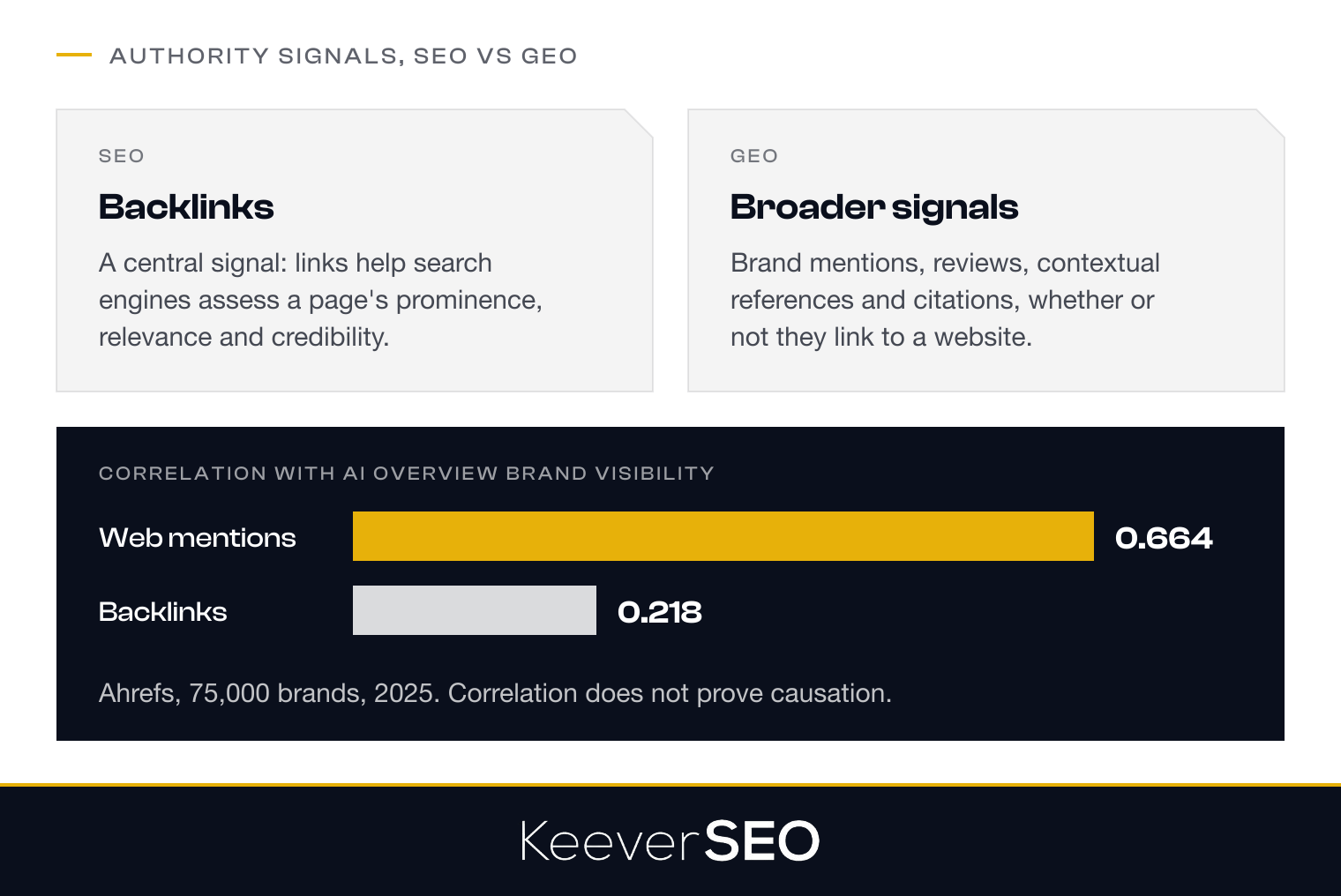
A 2025 Ahrefs study of 75,000 brands, "An Analysis of AI Overview Brand Visibility Factors" by Louise Linehan, found that "web mentions (0.664) correlate much more strongly than backlinks (0.218)" with AI Overview brand visibility. The correlation does not prove causation, and an AI-generated answer can mention a brand without citing its website.
How Do GEO and SEO Differ in Measurement?
GEO and SEO differ in measurement because SEO tracks keyword rankings, organic impressions, traffic, click-through rate, and conversions. SEO metrics show how well search listings attract visitors and produce business outcomes.
GEO measurement tracks brand mention rate, citation share, recommendation prominence, sentiment, and share of voice in AI answers. AI-referred sessions, engagement, leads, and revenue connect AI visibility to outcomes, while a brand mention alone does not confirm a citation or website visit.
Where Do GEO and SEO Overlap?
GEO and SEO overlap through crawlable pages, useful content, authority signals, and clear alignment with user intent. Generative engines retrieve and synthesize information from indexed pages, so strong organic visibility supports AI citations without guaranteeing them.
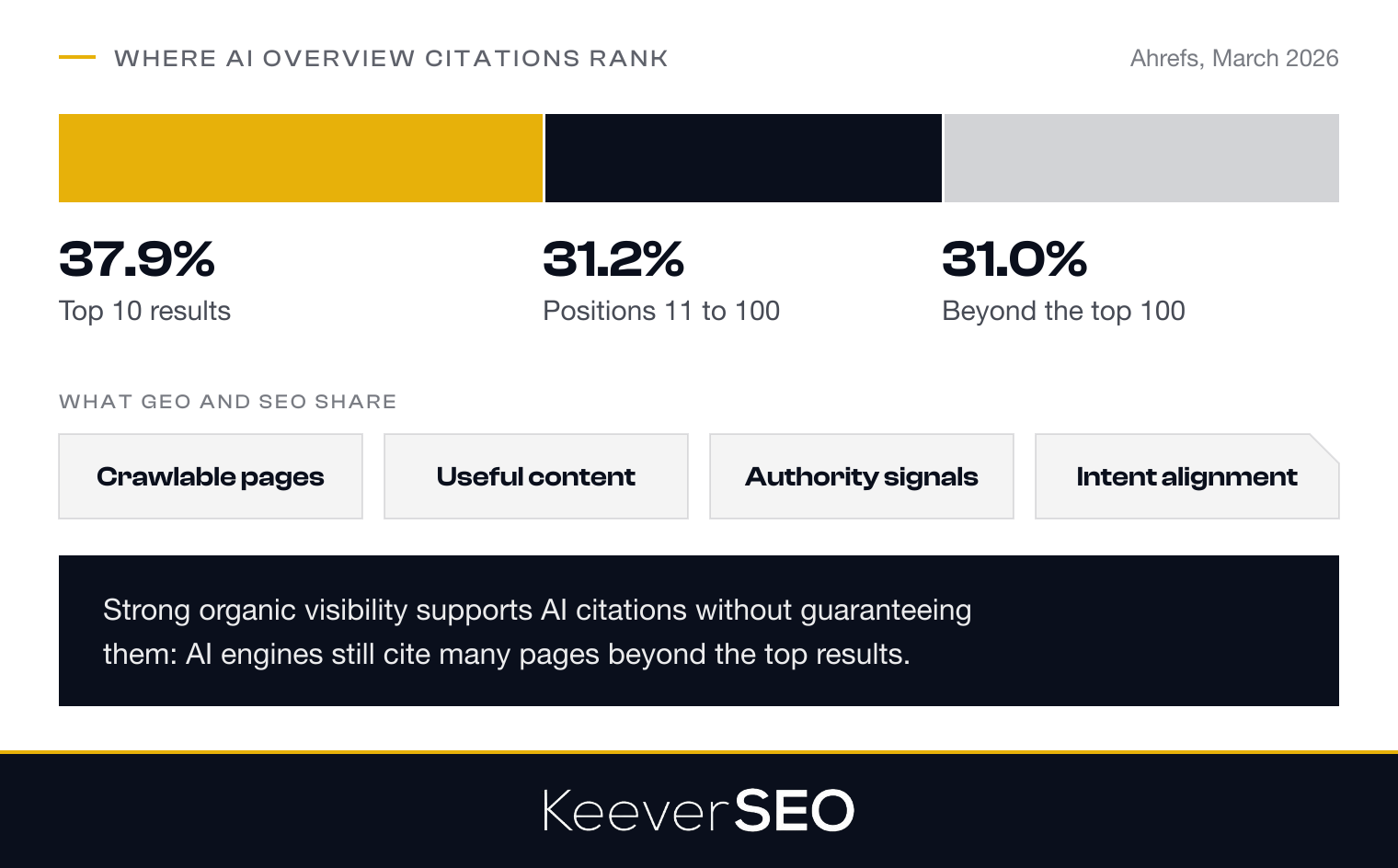
"37.9% of URLs cited in AI Overviews also appeared within the first 10 blocks," with the rest split between positions 11 to 100 (31.2%) and beyond the top 100 (31.0%), according to "Update: 38% of AI Overview Citations Pull From The Top 10" by Louise Linehan, published by Ahrefs in March 2026. The finding shows that SEO visibility contributes to GEO, while AI engines still cite many pages beyond the top organic results.
Is GEO Just SEO With a New Name?
No, GEO is not just SEO with a new name, although GEO shares SEO's foundations, including crawlable content, clear site structure, and credible authority. Google takes the opposite view, stating that "optimizing for generative AI search is optimizing for the search experience, and thus still SEO" in "Google's Guide to Optimizing for Generative AI Features on Google Search" (May 2026). SEO aims to rank pages in organic search results and earn clicks, while GEO aims to earn inclusion, citations, and recommendations in AI-generated answers, and GEO gives added weight to citation-ready passages, brand mentions, and AI visibility metrics.
Will GEO Replace SEO?
No, GEO will not replace SEO, because traditional search still drives far more web traffic. "AI platforms now account for 0.32% of all website traffic, up from 0.24% in 2025," according to "Analysis of Top AI Search Engines: Who Is Catching Up to ChatGPT?" by Yulia Deda, published by SE Ranking in June 2026. Datos reports that traditional search held 10.52% of US desktop activity in Q2 2026, against 1.83% for AI tools, in its "State of Search Q2 2026." Generative search engines retrieve information from crawled and indexed sources before synthesizing answers, so SEO remains the foundation for discoverable content, while GEO adds work to earn visibility in AI-generated answers.
When Should a Business Prioritize GEO vs SEO?
A business should prioritize SEO when its website lacks search rankings, organic traffic, or local visibility, and GEO when the business already ranks well and customers use AI tools to compare providers or research complex purchases.
The two best-fit cases depend on the business's current search position and customer path. The sections below explain when SEO or GEO offers the better investment.
When Is SEO the Better Investment?
SEO is the better investment for new websites without organic rankings or visibility. Search engine optimization supports transactional searches, such as "emergency plumber near me," by attracting qualified clicks, leads, and sales. Local businesses should prioritize SEO when Google Maps and the Map Pack drive customer acquisition, since Google's "Tips to improve your local ranking on Google" states that "local results are mainly based on relevance, distance, and popularity." Businesses can add GEO after establishing search visibility to pursue inclusion in AI-generated recommendations.
When Is GEO the Better Investment?
GEO is the better investment for established businesses that already earn strong organic visibility. Generative engine optimization matters most when buyers use AI tools to compare providers, products, or services. Research-heavy purchases, such as electronics, lead many customers to ask AI assistants for summaries and recommendations. Businesses can strengthen AI visibility by making their credentials, evidence, customer reviews, and third-party mentions easy to identify.
How Do You Pursue GEO and SEO at the Same Time?
To pursue GEO and SEO at the same time, maintain a crawlable technical foundation, make high-value pages citation-ready, and earn credible third-party mentions. The combined approach supports search rankings, organic visits, AI citations, and brand visibility.
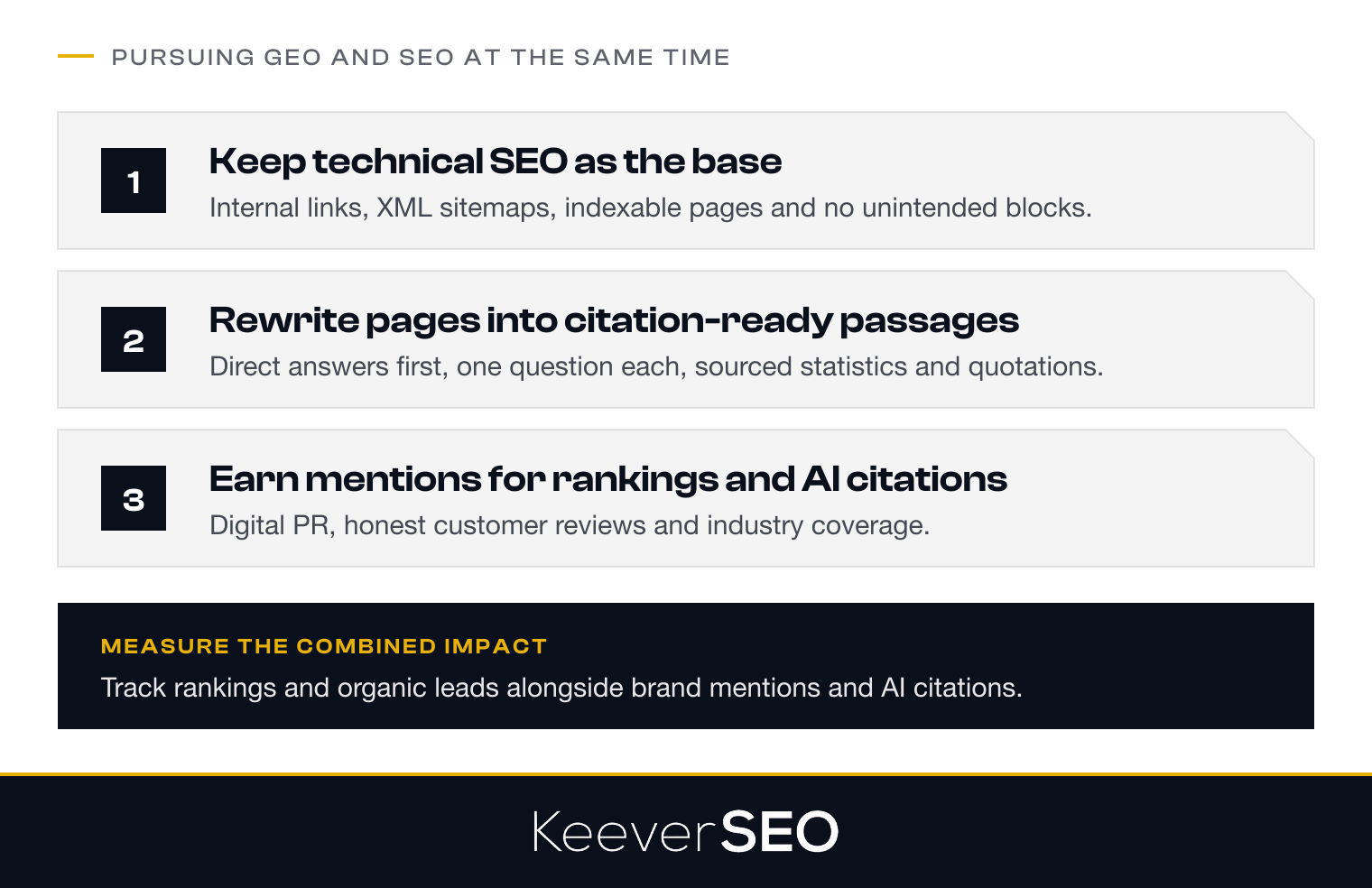
The work follows that sequence: make the site accessible to search engines and AI systems, structure clear passages with evidence, then build authority through digital PR, reviews, and industry publications. A strong technical SEO base supports the first step.
1. Keep Technical SEO as the Base for AI Retrieval
Keeping technical SEO as the base for AI retrieval gives search engines and AI systems access to content they can crawl and interpret. Make important pages discoverable through internal links and XML sitemaps, return successful HTTP responses, and avoid unintended robots.txt, authentication, firewall, or noindex barriers. "To be eligible to be shown as a supporting link in AI Overviews or AI Mode, a page must be indexed and eligible to be shown in Google Search with a snippet," according to Google's "AI features and your website," and indexing eligibility does not guarantee visibility.
Keep pages fast, mobile-friendly, and stable by reducing unnecessary scripts and monitoring Core Web Vitals. Review crawler permissions so legitimate search and AI crawlers can reach the public content the business wants surfaced. With technical access in place, rewrite high-value ranking pages into clear, citation-ready passages.
2. Rewrite Ranking Pages Into Citation-Ready Passages
Rewriting ranking pages into citation-ready passages supports both organic visibility and inclusion in AI-generated answers. Open each important section with a direct answer, then define the topic and explain its main claim with enough context to stand alone if an AI system extracts it. Keep each passage focused on one user question.
Support factual claims with relevant statistics, named sources, and attributed quotations. A 2023 study by Aggarwal and colleagues, accepted to the ACM SIGKDD conference in 2024, found that the Cite Sources, Quotation Addition, and Statistics Addition methods "achieved a relative improvement of 30-40%" in visibility, while keyword stuffing offered little benefit. Link evidence to original sources and distinguish firsthand findings from outside research. Clear, sourced passages prepare ranking pages for external mentions that reinforce search authority and AI visibility.
3. Earn Mentions That Support Both Rankings and AI Citations
Earning mentions that support both rankings and AI citations comes from digital PR, honest customer reviews, and industry coverage. Digital PR and reputable publications may earn editorial backlinks that support SEO while giving AI systems context about a company's credentials and services.
Businesses can share original research, case studies, and expert commentary with relevant journalists and trade publications. Satisfied customers can leave detailed, truthful reviews on appropriate platforms. Track referring domains, organic leads, review quality, brand mentions, AI citations, and qualified referrals to assess the combined impact.
Should Local Service Businesses Invest in GEO or SEO First?
Local service businesses should invest in SEO and Google's Map Pack first, then add GEO as customers use AI assistants to find and compare providers. AI use is rising fast but from a smaller base: "Use of ChatGPT and other generative AI tools for local recommendations has grown rapidly, rising from 6% last year to 45% and becoming the third most popular source of business recommendations," according to the "Local Consumer Review Survey 2026" by Rosie Murphy, published by BrightLocal in February 2026.
Local SEO should build a complete Google Business Profile, accurate location pages, consistent business details, and a steady review profile. GEO can extend that foundation by making services, locations, credentials, and customer proof clear for AI systems to identify and cite.
How Can Businesses Evaluate an Agency That Runs Both GEO and SEO?
Businesses can evaluate an agency that runs both GEO and SEO by checking whether its reports separate search performance from AI visibility. SEO reporting should show rankings, impressions, clicks, click-through rates, indexed pages, and conversions. GEO reporting should identify brand mentions, citations, cited URLs, answer accuracy, sentiment, and AI referrals, with the tested prompts, platforms, competitors, and reporting period documented.
A qualified agency should explain its content, technical SEO, and schema processes, including how it checks crawlability, verifies sources, and uses structured data that matches visible page content. Businesses should ask the agency to disclose its digital PR, link acquisition, review practices, fees, and account ownership. Avoid agencies that guarantee AI citations or provide vague visibility scores without underlying prompts and cited sources.
How Does Keever SEO Combine Generative Engine Optimization With SEO?
Keever SEO combines generative engine optimization with SEO through connected workstreams. The generative SEO agency team's SEO work targets keyword rankings, organic traffic, and conversions, while its GEO work shapes citation-ready content with clear claims, sources, definitions, and intent-focused structure.
Keever SEO builds brand mentions through relevant directories, communities, forums, and industry publications. Keever SEO tracks keyword rankings and organic performance alongside AI citations, mention rate, citation share, sentiment, share of voice, and referral traffic across platforms such as ChatGPT, Gemini, Perplexity, Copilot, Claude, and Google AI Overviews.
How Does GEO vs SEO Fit the Wider AI Search Picture?
GEO vs SEO fits the wider AI search picture alongside answer engine optimization (AEO), within the shift from traditional search to AI-assisted search. SEO targets ranked organic listings, AEO helps search engines extract direct answers, and GEO seeks inclusion or citations in generated responses. AI search engines such as ChatGPT, Perplexity, Gemini, and Google AI Overviews synthesize information from sources into conversational answers. The comparisons below explain how AEO, GEO, and AI search engines differ.
How Does AEO Differ From GEO?
AEO differs from GEO because AEO (Answer Engine Optimization) structures content so answer engines can extract and display a direct response, such as a featured snippet or People Also Ask result, while GEO (Generative Engine Optimization) builds source credibility and brand visibility so generative engines select, synthesize, mention, and cite content within broader AI-generated answers.
How Does AEO Differ From SEO?
AEO differs from SEO because answer engine optimization structures content so answer engines can extract and present concise responses, while search engine optimization improves webpage rankings in organic listings. AEO measures answer inclusion, citations, and brand mentions, and SEO measures rankings, click-through rate, and organic traffic.
How Do AI Search Engines Differ From Traditional Search Engines?
AI search engines differ from traditional search engines by synthesizing information from retrieved sources into a response, with citations or links in most products. Traditional search engines rank webpages and present an ordered list of links, titles, and snippets. Platforms such as Google combine both approaches by showing AI-generated summaries alongside links to source pages.
Which GEO Ranking Factors Differ From SEO Ranking Factors?
The GEO ranking factors that differ from SEO ranking factors are clear passages, sourced statistics, citations, quotations, fresh information, and credible brand mentions. AI systems retrieve and reuse self-contained information that closely matches a topic or entity. SEO relies more directly on page relevance, technical accessibility, usability, credentials, and backlinks that support organic rankings. Research identifies GEO signals as emerging correlates, not confirmed universal ranking rules, and no single factor guarantees inclusion in an AI-generated answer.
What Is the Final GEO vs SEO Verdict?
The final GEO vs SEO verdict is that SEO should remain the foundation, while GEO adds visibility inside AI-generated answers. SEO helps websites become crawlable, relevant, and eligible to rank, and GEO helps clear, well-supported content and brand signals earn inclusion or citations in those answers.
The practical choice is SEO plus GEO: SEO supports rankings and clicks, while GEO extends visibility through AI mentions and citations. The distinction resolves the GEO versus SEO comparison, because the two serve different goals and work best together.