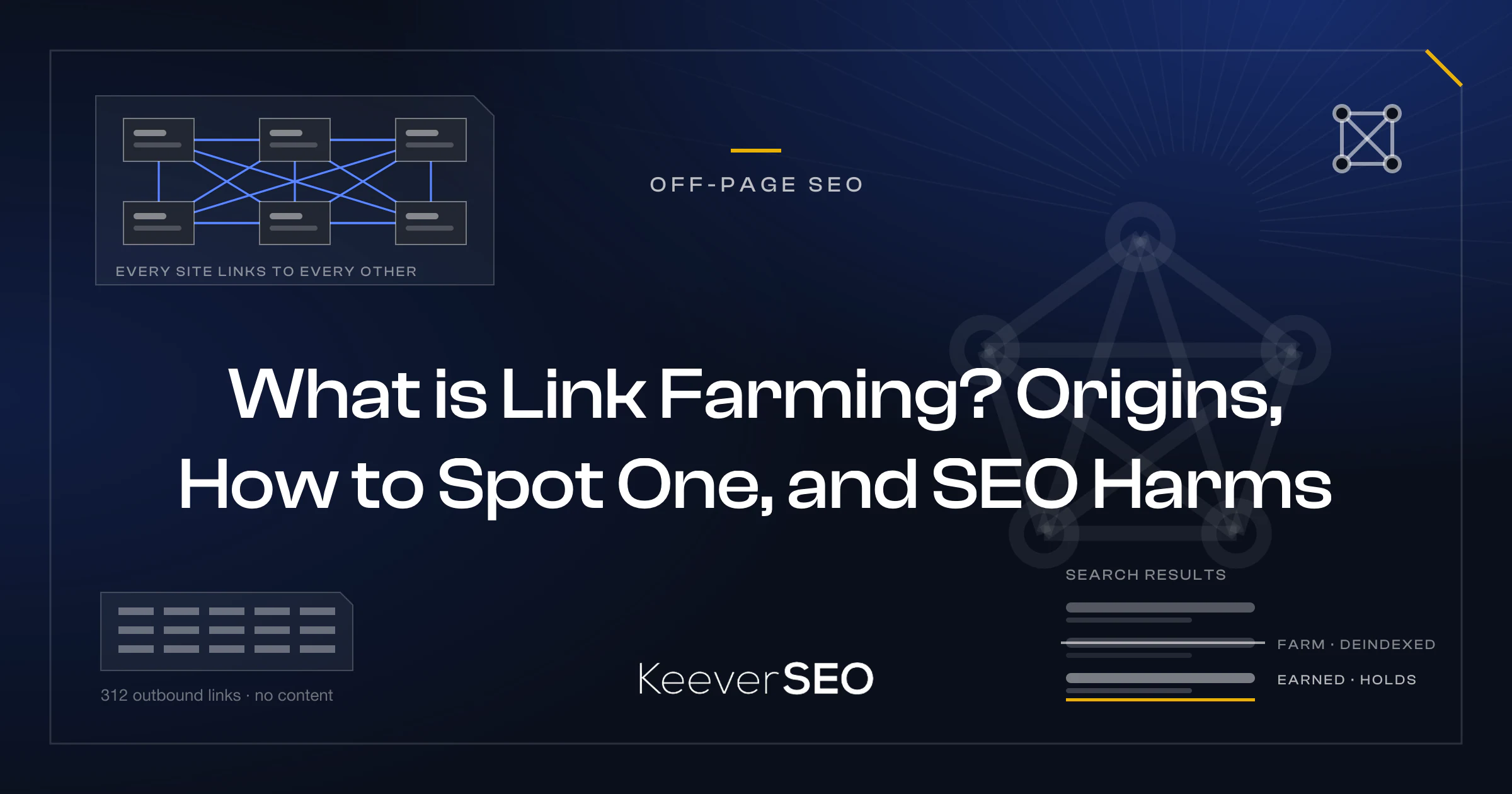
Link farming is an interlinked network of websites created solely to inflate search engine rankings. The practice runs on reciprocal and networked interlinking that inflates PageRank-like signals artificially, manufacturing the appearance of authority and popularity. Link farms come in public form, sites openly cross-linking each other, and concealed form as Private Blog Networks (PBNs), built on expired high-authority domains with hidden ownership that pass link equity quietly to a target "money site."
Link farming matters because of the damage it does to credibility and rankings. Websites caught in link farming face ranking losses, complete deindexing from results, wasted crawl budget, and lasting link devaluation. The farms give themselves away through a recognizable set of markers: hundreds of outbound links per page, thin or keyword-stuffed content, high domain rating beside near-zero organic traffic, anonymous author pages, exact-match anchor patterns, unrelated topic mixes, cookie-cutter templates, and spammy domain names.
The impact spreads across the whole search environment. Search engines run algorithmic systems like SpamBrain and manual actions against the offenders, while businesses tied to link farms absorb guilt-by-association penalties, lost revenue and traffic, and expensive recoveries. The alternatives are the durable ones: quality content that earns natural links through information gain and E-E-A-T signals, and ethical link building through digital PR, relevant outreach, and considered guest posting. Recovery from a link farm penalty runs through a full backlink audit, manual removal attempts, the Google Disavow Tool for the links that will not move, and patient monitoring while the penalty lifts. The road ahead only tightens: AI and machine learning keep shrinking the space where manipulated links can move rankings at all.
What is Link Farming?
Link farming is an interlinked network of websites built solely to inflate search engine rankings through artificial link manipulation. The practice assembles sites that trade hyperlinks to simulate authority and popularity, with no genuine value for users anywhere in the network, betting that volume of reciprocal and networked links will convince the algorithms the linked sites matter more than they do.
The engine underneath is PageRank inflation through interlinking, quantity over quality, hundreds or thousands of links traded between sites to pump perceived authority. Two main forms exist: public mutually-interlinked farms, where sites exchange links in the open, and Private Blog Networks (PBNs), which run expired high-authority domains under hidden ownership and point one-way links at a target site to dodge the obvious reciprocal pattern.
Link farming earns its place in every SEO curriculum through its harms: algorithmic devaluation, manual penalties, and full deindexing wait for the sites involved. The clearest way to see what link farming is starts with what it is not, legitimate link building.
How does link farming differ from legitimate link building?
Link farming differs from legitimate link building in intent, execution, and value. Link farming manipulates rankings through networks of interconnected sites that inflate link volume with no editorial merit, no topical relevance, and keyword-stuffed anchors, a facade of authority with nothing behind it.
Legitimate link building earns its links through high-quality content and real relationships with authoritative sites. The links arrive editorially placed, contextually relevant, and naturally distributed, endorsements that mean something, which is why they align with search engine guidelines and hold their value.
What are the common characteristics and origins of link farming?
Link farming emerged in 1999 as an early exploit of search engines that ranked on link popularity, the Inktomi engine above all, a history Wikipedia's "Link farm" reference entry documents. The networks of interconnected sites inflated backlink counts to move rankings, and the common characteristics have never changed: excessive outbound links, low-value or keyword-stuffed content, and linking patterns with no topical logic. The practice lost its power in stages, first to Google's Panda and Penguin updates targeting low-quality content and manipulative links, then to the SpamBrain AI system, which raised detection to the point where link farms carry maximum risk for minimum return.
How does Link Farming work?
Link farming works by wiring a network of websites into a machine for manufacturing perceived authority. Multiple sites link systematically to each other and to a targeted "money site," building the illusion of widespread endorsement that search engines could misread as credibility.
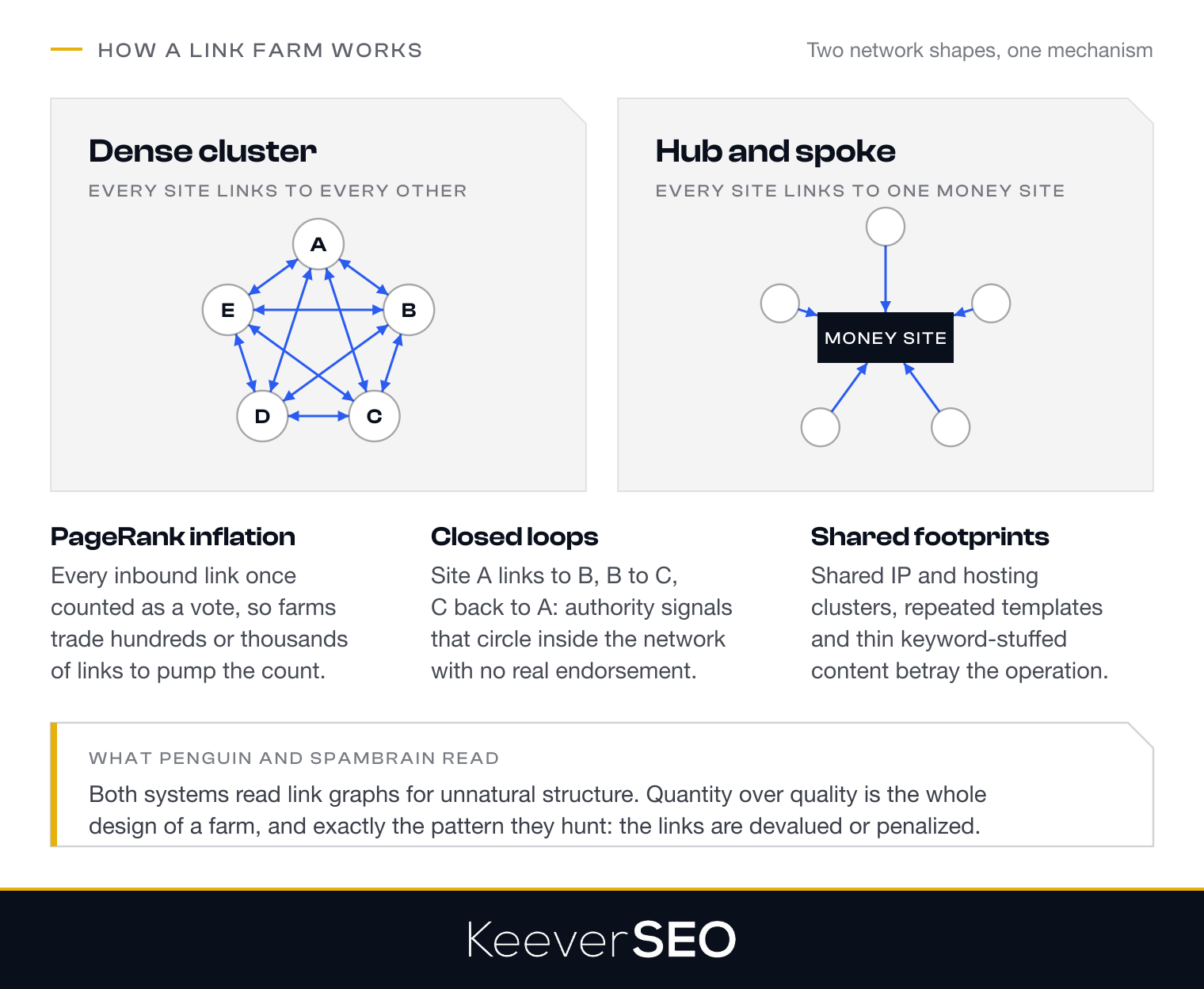
The mechanics run on PageRank inflation: raising backlink volume through reciprocal and networked interlinking to pump a target's ranking authority. The configurations vary, dense clusters where every page links to every other, hub-and-spoke models funneling links to one center, each shaped to imitate natural link patterns and slow detection.
The technical shortcuts betray the operation. Networks share IP addresses and hosting clusters to cut costs, leaving detectable footprints; template-based designs repeat across domains, producing near-identical sites; and the content stays thin and keyword-stuffed, existing to house links rather than say anything. Quantity over quality is the whole design, and it is exactly the pattern detection systems hunt.
What is the basic mechanism behind link farming?
The basic mechanism behind link farming is PageRank inflation through manipulated link volume and reciprocal linking. Sites in the network reinforce each other, Site A linking to Site B, B to C, C back to A, closed loops of authority signals aimed at algorithms that once counted inbound links as importance.
PageRank, described in Brin and Page's 1998 paper "The Anatomy of a Large-Scale Hypertextual Web Search Engine," scores a page's importance from the quantity and quality of links pointing at it, and link farms attack the quantity side, weaving dense webs of low-value links to mislead the calculation. Modern engines answered with Penguin and SpamBrain, systems that read link patterns for unnatural structure, and the arms race moved to the network level: shared hosting, template reuse, and the other operational fingerprints farms leave behind.
How are networks of websites used in link farming?
Networks of websites are used in link farming as the delivery system for artificial authority. Cross-site interlinking wires multiple sites to each other or to a central target, manufacturing the signals, and shared IP addresses and hosting clusters keep the operation cheap while leaving footprints detection systems read. Template reuse compounds the exposure: similar designs and content frameworks make the networks easy to build and easier to catch, since the shared IP clustering and repeated patterns expose the manufactured origin to any engine looking.
What are the types of Link Farming?
The types of link farming split by structure and concealment.
Public Interlinked Farms Public interlinked farms wire every site in the network to every other, mass reciprocal links built to inflate rankings, and their open interlinking pattern makes them the easiest type for search engines to catch.
Reciprocal Link Schemes Reciprocal link schemes trade links between websites by agreement, authority for authority, value optional. A single trade between related sites passes without notice; systematic exchanges at scale draw the penalty.
Expired-Domain Networks Expired-domain networks build on domains that once held authority and backlinks, repurposed with minimal content to drain the residual equity toward target sites.
Private Blog Networks (PBNs) Private Blog Networks are concealed networks under single ownership, built on high-authority expired domains and pointed one-way at a money site, with ownership obscured to stall detection, the most sophisticated form and every bit as risky.
What is a Private Blog Network in the context of link farming?
A Private Blog Network (PBN) in the context of link farming is a collection of websites assembled to manipulate rankings by feeding backlinks to a central money site. PBNs run on expired domains with high Domain Rating (DR), harvesting the backlink equity the domains earned in their past lives, and their defining trait is concealed ownership: private WHOIS registrations and scattered hosting providers hiding the common hand. Where public farms interlink openly, PBNs point one-directional links at the money site alone, pumping its perceived authority without the reciprocal fingerprint.
The concealment extends to the surface: varied designs and content themes hold up a facade of legitimacy and shrink the visible footprint. Search engines target PBNs regardless, reading pattern signals and unnatural link structures, and the penalty risk covers the network and the money site together, the entire investment exposed to one detection event.
Why does Link Farming matter?
Link farming matters because of what it does to search performance and site credibility. The networks promise short-term ranking gains and deliver long-term damage, a trade that keeps looking worse as detection sharpens.
The SEO harms carry the argument: sites caught in link farming take ranking losses up to full deindexing, through algorithmic devaluation and manual penalties that can hold for months or years. The penalties burn more than positions, they burn the trust signals a site spent years earning, which is what makes recovery slow and expensive.
Credibility erodes in parallel. Search engines rank on trust signals, and sites earning links naturally through quality content hold the advantage while link-farm participants absorb steady downward pressure. Lost organic traffic, lost revenue, and reputational damage complete the bill, a high-risk strategy whose returns keep shrinking.
What SEO harms are associated with link farming?
The SEO harms associated with link farming are listed below:
- Ranking loss: search algorithms detect and devalue the artificial link signals, dropping the involved sites down the results.
- Deindexing: engines can remove offending pages or whole domains from the index, erasing organic visibility outright.
- Wasted crawl budget: crawlers burn resources on low-quality farm pages instead of legitimate content, leaving real pages undiscovered.
- Permanent devaluation: domains with a link-farming history carry lasting trust deficits, with suppressed rankings and heightened scrutiny following future link acquisition.
The four harms track Google's own enforcement terms: "Spam policies for Google web search" classifies link schemes as violations that can drop a site's rankings or remove it from results entirely, and whatever a link farm buys, it costs more.
How can link farming affect website credibility and ranking?
Link farming affects website credibility and ranking by converting artificial link patterns into penalties and lost trust. Search engines read the manufactured patterns as ranking manipulation rather than endorsement, devalue or penalize the links as spam, and press the site's visibility downward.
The credibility damage runs on the same evidence: excessive cross-linking and irrelevant links resemble no authentic editorial behavior, so engines and users alike stop reading the site as authoritative. Organic traffic falls with the perception, recovery gets harder as the association deepens, and over time the credibility deficit spreads until even legitimate content on the domain struggles to rank.
How to Spot a Link Farm?
To spot a link farm, read the site for its true purpose: link exchange dressed as content. The diagnostic covers content quality, linking patterns, and authority metrics together. A genuine site shows a clear topical focus, content worth reading, and a natural link profile; a farm shows outbound link density and editorial standards near zero.
The working checks: scan the backlink profile for unrealistic growth and repeated exact-match anchors, read the content for thin, keyword-stuffed filler, and weigh the domain's organic traffic against its domain rating (DR), where high DR beside negligible traffic marks inflated metrics. Authorship credibility and topical coherence complete the read, and when the red flags stack together, the site belongs to a manufactured network. The individual indicators line up below.
What indicators suggest a website is part of a link farm?
The indicators that suggest a website is part of a link farm are listed below:
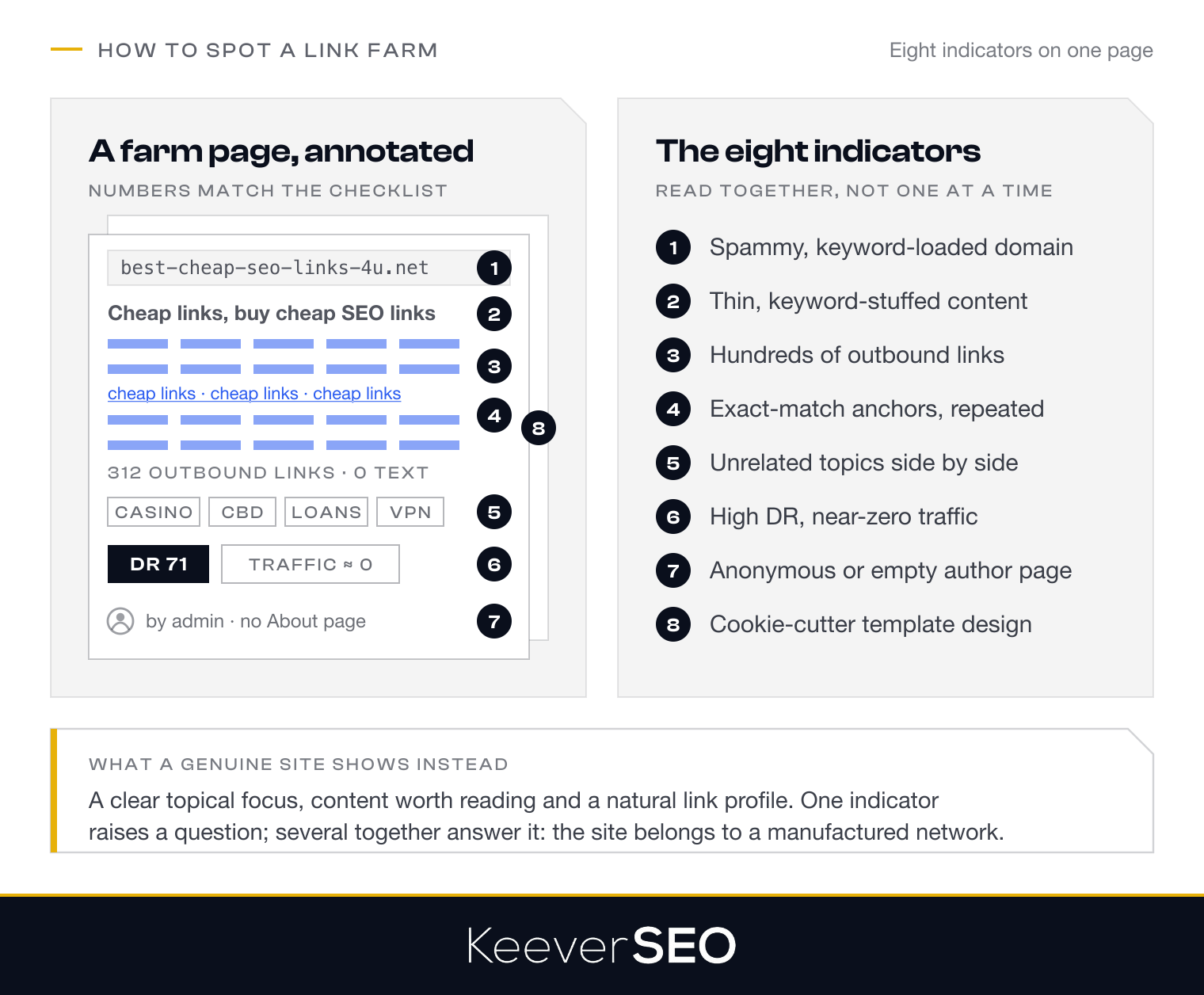
- Hundreds of outbound links per page: link counts far past anything content could justify, aimed at unrelated targets.
- Thin or keyword-stuffed content: sparse pages or repetitive keyword filler with no reader value.
- High DR with near-zero organic traffic: inflated domain metrics beside an empty search footprint.
- Anonymous or empty author and about pages: no verifiable people or company behind the site.
- Exact-match anchor patterns: precise keyword anchors repeated past any natural rate.
- Unrelated topic mix: coverage sprawling across disconnected subjects with no editorial logic.
- Cookie-cutter design: identical templates repeating across domains, the mark of a coordinated network.
- Spammy domain names: generic or keyword-loaded domains built for links rather than brands.
Any one indicator raises a question; several together answer it.
Who is impacted by Link Farming?
Link farming impacts three groups, each carrying its own share of the damage.
Search Engines Search engines defend result integrity against the manipulation, spending detection resources on algorithmic updates and manual review to keep manufactured authority out of the rankings.
Businesses Running Link Farms Businesses operating or buying into farms face the direct penalties, deindexing and demotion, lost visibility and revenue, with the investment itself wasted the moment detection lands and the reputation damage outlasting the scheme.
Websites Receiving Toxic Links Sites on the receiving end of farm links, invited or not, risk guilt-by-association penalties, traffic declines, and weakened trust signals, and the cleanup, auditing backlinks, chasing removals, filing disavows, drains time and budget from productive work.
How do search engines penalize sites involved in link farming?
Search engines penalize sites involved in link farming through algorithmic devaluation and manual actions. Algorithmic devaluation runs silently: systems like Google's SpamBrain detect the unnatural link patterns, sudden link-velocity spikes among them, and strip the links' value automatically, dropping the dependent rankings without a word to the site owner. Manual actions land harder: Google's webspam team confirms a link-scheme violation by human review and applies penalties up to partial or complete removal from results. Google's webspam report "How we fought spam on Google Search in 2022" documents the machinery, with SpamBrain detecting five times more spam sites than the year before, and link-scheme participation carrying ranking losses and trust deficits that persist long after the scheme ends.
How can businesses suffer from association with link farms?
Businesses suffer from association with link farms through guilt-by-association penalties and everything that follows them. Search engines read inbound toxic links as evidence of manipulative SEO, and the response, algorithmic devaluation or manual penalty, cuts revenue and traffic together. The bill grows from there: SEO audits, link removal campaigns, disavow files, and a recovery that can run from months past a year while competitors absorb the lost market share. The exposure argues for standing backlink monitoring, and the permanent fix is structural, sustainable link building that leaves nothing for the association to attach to.
What are the alternatives to Link Farming?
The alternatives to link farming are the practices that build the same authority without the penalty risk.
Quality Content Creation Quality content creation earns backlinks by deserving them: complete guides, original research, and data visualizations that other sites reference on merit. Content holding to E-E-A-T principles (Experience, Expertise, Authoritativeness, Trustworthiness) collects organic editorial links, and authority built on information gain and real user value survives every algorithm update the farms do not.
Ethical Link Building Ethical link building adds the outreach layer: digital PR campaigns, relevance-based guest posting, and targeted contact with authoritative sites in the niche. The links arrive topically relevant, naturally anchored, and useful to the reader, slower and costlier than a farm, and worth exactly what the farm links are not.
How does quality content creation serve as an alternative to link farming?
Quality content creation serves as the alternative to link farming by earning editorial backlinks that farms can only counterfeit. Content demonstrating experience, expertise, authoritativeness, and trustworthiness (E-E-A-T) becomes the linkable asset other sites reference by choice, and the engine behind it is information gain: original findings, fresh perspective, and complete resources that fill real gaps in a topic. The mentions arrive from authoritative sites as genuine citations, endorsements with weight, and the earned links carry more SEO value precisely because they represent real relationships, the trust signals modern evaluation is built to find.
What role does ethical link building play in sustainable SEO?
Ethical link building anchors sustainable SEO by trading manipulation for relationships and value. Digital PR and outreach earn editorial placements on merit, and guest posting done right serves the host's audience first, meeting editorial standards instead of smuggling backlinks.
Relevance-based acquisition completes the discipline: links from contextually aligned sources with genuine topical connections, building natural co-citation patterns and clean entity mapping, the authority signals engines read as authentic. Links carrying real referral potential and E-E-A-T weight (Experience, Expertise, Authoritativeness, Trustworthiness) protect against algorithmic penalties while driving qualified traffic, search visibility and business outcomes from the same work.
How to recover from a Link Farm penalty?
To recover from a link farm penalty, work through the structured cleanup below.
Backlink Audit Run a full backlink audit through Google Search Console, Ahrefs, or SEMrush, flagging links with farm characteristics: excessive outbound links, thin content, irrelevant topics, shared IP clusters, suspicious domains.
Identify Toxic Links Compile the toxic list from the audit, the links carrying spammy anchor patterns or arriving from domains with no organic traffic, the ones feeding the penalty.
Attempt Manual Removal Contact the webmasters hosting the toxic links and request removal, documenting every attempt with dates and responses; the success rate varies, and the due-diligence record matters either way.
Build and Submit a Disavow File For the links that will not move, build a disavow file, URLs or whole domains under the "domain:" prefix, and submit it through Google Search Console to cut the association formally.
Monitor Recovery Track the recovery as it unfolds: algorithmic penalties resolve over weeks to months, manual actions need a reconsideration request and Google's review time, and the record of actions taken pairs with ranking and traffic trends to show the progress.
The workflow's last-resort instrument, the Disavow Tool, deserves its own examination.
What is the Google Disavow Tool and how does it relate to link farms?
The Google Disavow Tool is the Google Search Console feature that tells Google to ignore chosen backlinks when evaluating a site, and it relates to link farms as the recovery instrument of last resort for sites poisoned by farm links they cannot remove.
The tool comes after the audit, never before it. The backlink profile gets reviewed for the suspicious links, irrelevant anchors, low-quality domains, interlinked networks, and manual removal gets attempted first through webmaster outreach. The survivors go into a plain-text disavow file, URLs or domains to disregard, and Google's Search Console documentation "Disavow links to your site" carries the operational warnings: the tool is for sites with considerable spammy links likely to draw a manual action, and a new upload replaces the existing file entirely, so the review must be complete before submission. Recovery then rides on the algorithmic cycles or the manual-action review, weeks to months either way.
What are the future trends in Link Farming?
The future trends in link farming all point the same direction: obsolescence. Detection keeps advancing on two fronts, AI-powered systems and a changed reading of backlink signals. SpamBrain-class systems analyze link patterns at a precision the farms cannot outrun, reading shared hosting clusters and unnatural anchor distributions as the fingerprints they are, and the algorithms keep shifting weight from link volume toward quality signals.
Manufactured links decay in value even when they escape detection. As E-E-A-T signals (Experience, Expertise, Authoritativeness, Trustworthiness) take more of the ranking weight, the window between a farm's short-term gain and its long-term penalty keeps closing, and the direction of travel is unambiguous: authority earned through content and editorial mentions wins, and link farming moves from risky toward functionally dead.
How will AI and machine learning impact the detection of link farms?
AI and machine learning will impact the detection of link farms by reading the patterns humans miss at a scale humans cannot reach. SpamBrain's pattern analysis works across entire link graphs, catching coordinated interlinking, shared hosting footprints, and unnatural velocity spikes, while machine-learning models map site relationships at scale, recognizing the structural signatures of manufactured networks: reciprocal clusters, IP concentrations, template repetition across domains.
Generative Engine Optimization (GEO) frameworks squeeze the farms from the other side. AI-driven search evaluates content on topical authority, engagement signals, and intent alignment, the metrics no farm can fake authentically, and as the models sharpen their read of natural versus artificial link acquisition, the detection gap closes toward zero, a trajectory Google's annual webspam reports trace year over year, leaving link farming functionally obsolete in the modern search stack.
Why do people engage in Link Farming?
People engage in link farming for the promise of fast, low-cost ranking gains. The pitch lands hardest on businesses under visibility pressure in competitive niches, where organic link building reads as too slow: the farm offers a shortcut, artificial backlinks lifting rankings without the work of content or outreach, and the networks themselves monetize by selling placements, turning manufactured authority into a product.
The motivations stay economic and impatient. Site owners choose farms to dodge the cost of ethical link building, and operators run them as businesses serving clients who want inflated profiles. The results follow the same script every time: quick gains, then detection by SpamBrain-class systems, devalued links, damaged reputation, and a recovery bill larger than the ethical route would have cost.
What motivations drive the creation of link farms?
The motivations that drive the creation of link farms are low cost, fast results, and direct profit from selling links. The networks assemble cheaply, frequently through automation, which draws operators chasing SEO gains without content or outreach investment, and the placements sell to businesses wanting quick ranking lifts. The economics collapse on contact with enforcement: engines classify the farms as manipulation, the penalties run to deindexing and devaluation, and the advanced AI systems now watching link patterns keep shortening the profitable window until the risk swallows the return.
Is Link Farming still effective in 2023?
No, link farming is not effective in 2023, and the risks dwarf whatever remains of the returns. The detection systems at Google and the other engines identify and dismantle link manipulation schemes systematically, and "Spam policies for Google web search," published by Google Search Central, puts schemes of exactly that kind on the penalty list, with visibility damage to match. Short-lived gains still flicker in low-competition niches, unstable and always outweighed by the algorithmic devaluation and manual penalties waiting behind them. The consensus stands: durable SEO performance runs on quality content and legitimate link building, and link farming belongs to the tactics the modern stack has retired.
What is the difference between Link Farms and Private Blog Networks?
The difference between link farms and Private Blog Networks (PBNs) runs across ownership, link direction, structure, content, and detection, as the table below lays out.
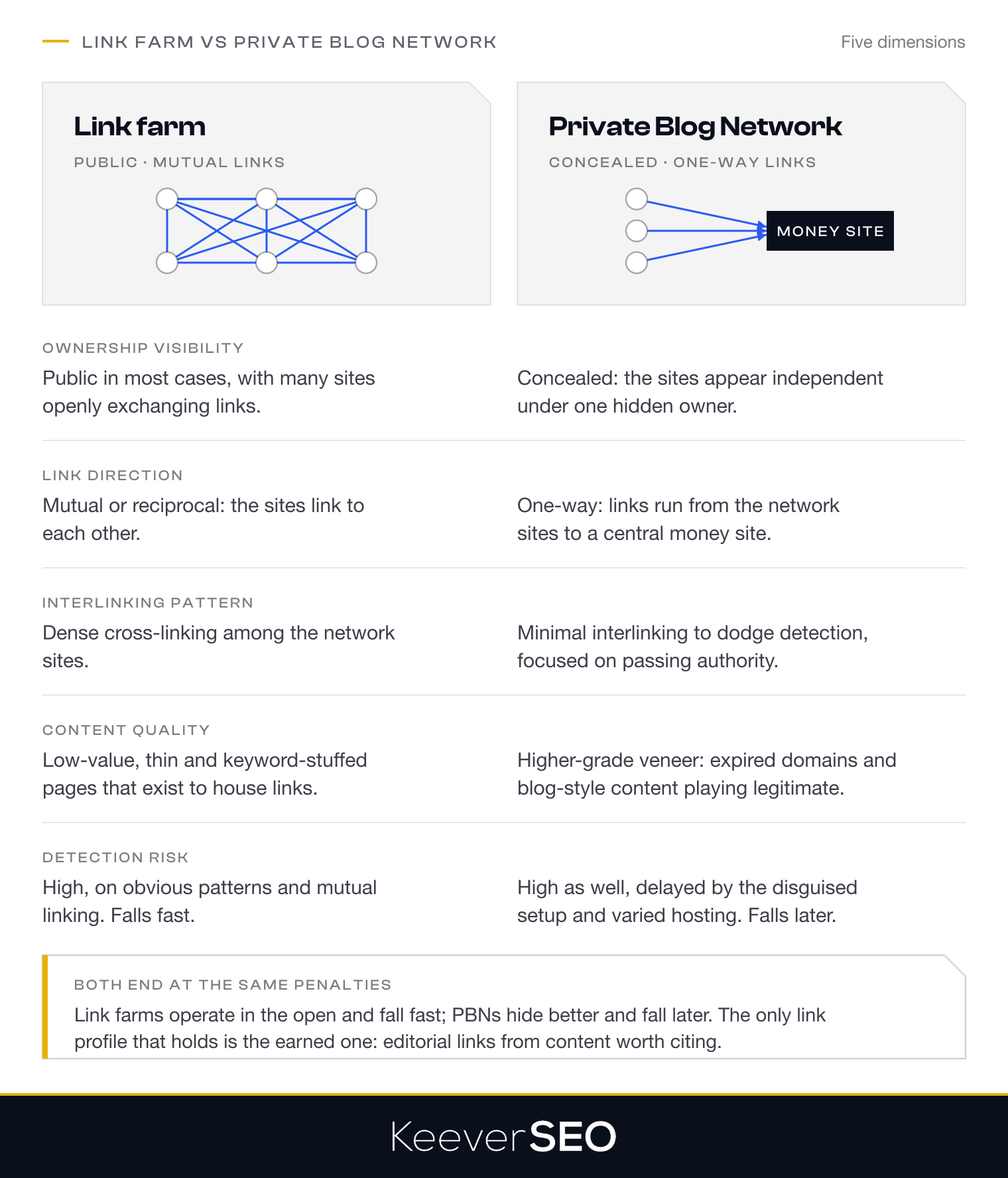
| Dimension | Link Farm | Private Blog Network (PBN) |
|---|---|---|
| Ownership Visibility | Public in most cases, with many sites openly exchanging links | Concealed, with sites appearing independent under one hidden owner |
| Link Direction | Mutual or reciprocal, sites linking to each other | One-way, links directed from network sites to a central "money site" |
| Interlinking Pattern | Dense cross-linking among network sites | Minimal interlinking to dodge detection, focused on passing authority |
| Content Quality | Low-value, thin, keyword-stuffed | Higher-grade veneer, expired domains and blog-style content playing legitimate |
| Detection Risk | High, on obvious patterns and mutual linking | High as well, with detection delayed by the disguised setup and varied hosting |
Link farms operate in the open and fall fast; PBNs hide better and fall later. Both end at the same penalties.
How can businesses recover from link farming penalties?
Businesses recover from link farming penalties through reputation repair, re-earned authority, and patience with the timeline. The work opens with a reputation audit that maps the damage the toxic links caused, followed by high-quality publishing that rebuilds trust with users and search engines alike.
Re-earning authoritative links carries the recovery: ethical outreach and digital PR built on content worth citing, pulling natural references from reputable sites until the visibility and credibility return. The timelines demand honesty, algorithmic penalties easing over months, manual penalties waiting on a reconsideration request and Google's review, and through all of it the standing disciplines hold: backlink monitoring, steady quality production, and the sustainable practices that keep the site from ever needing this recovery again.