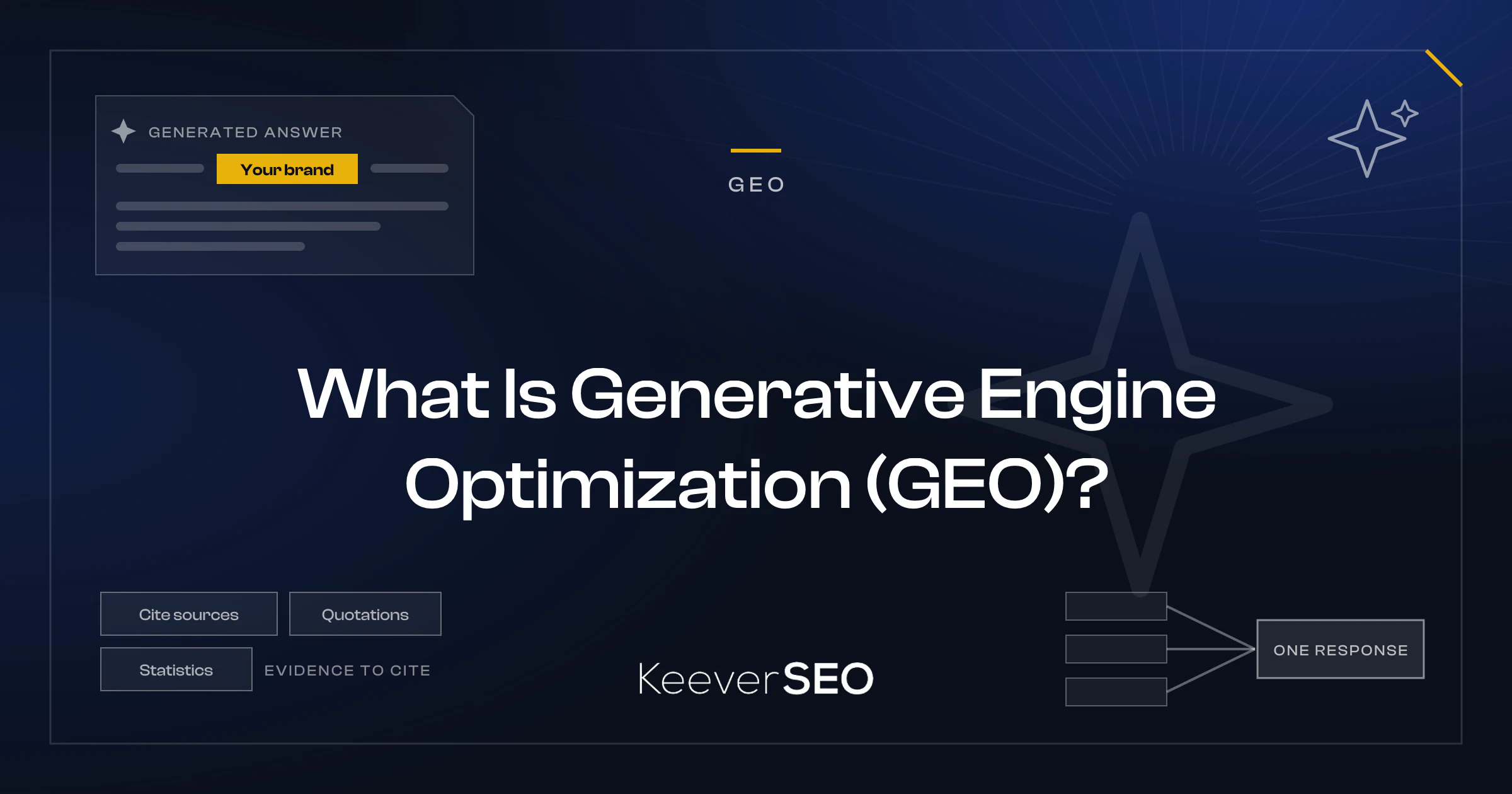
Generative engine optimization (GEO) is the practice of improving a brand's chances of being included and cited in AI-generated answers. GEO supports generative engines such as ChatGPT, Gemini, Perplexity, and Google AI Overviews.
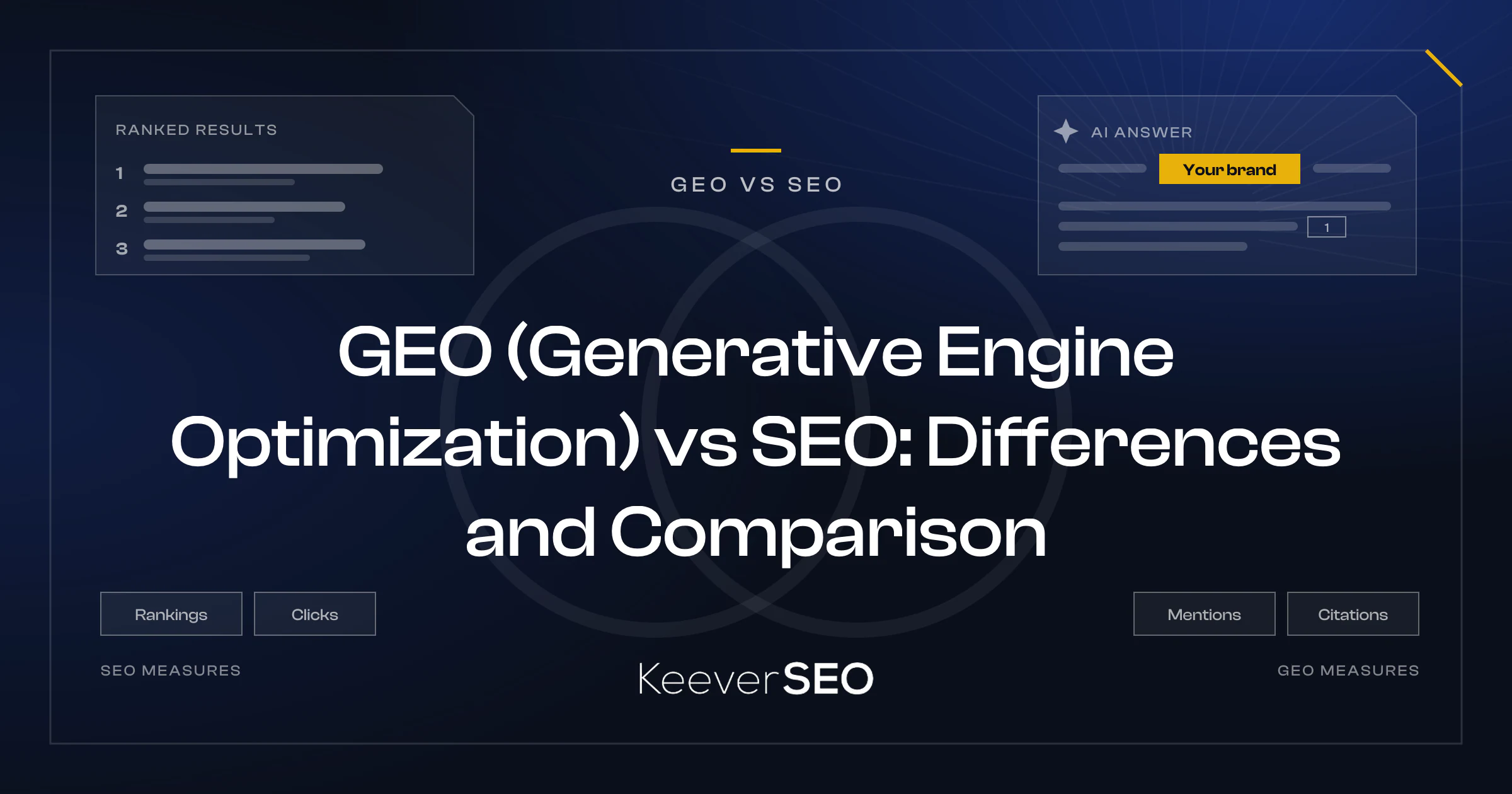
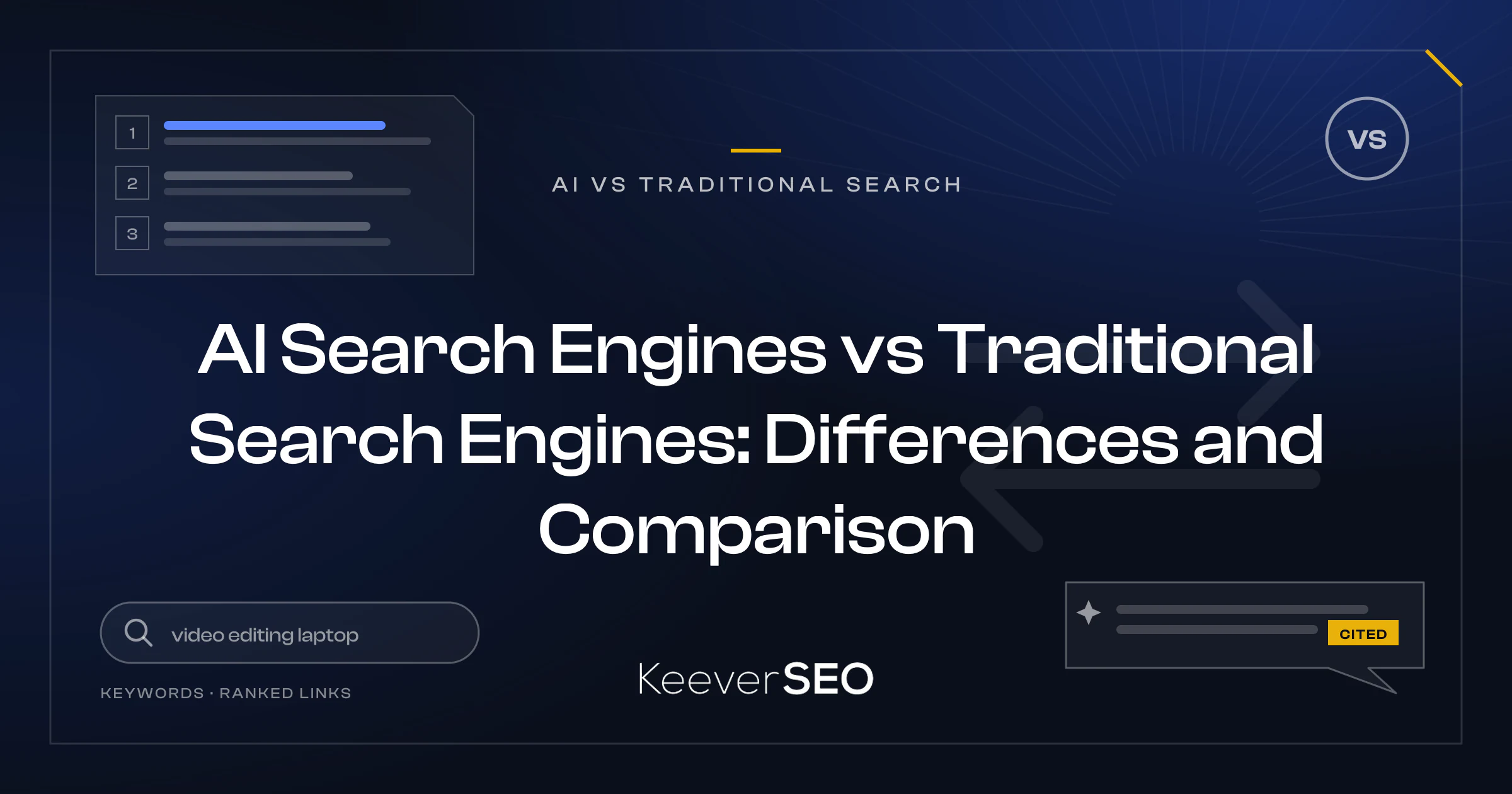
Traditional SEO focuses on ranking webpages in search-result links. GEO focuses on making content clear, relevant, and trustworthy enough for AI systems to select and reference within generated responses.
What Is Generative Engine Optimization (GEO)?
Generative engine optimization (GEO) is the practice of improving a brand's chances of appearing in AI-generated answers. GEO helps systems such as ChatGPT, Gemini, Perplexity, and Google AI Overviews find, select, mention, and cite relevant information.
Traditional SEO focuses on ranking webpages among search results. GEO focuses on whether an AI-generated answer includes a brand, cites its content, or uses its information to respond to a user's question.
What Does GEO Stand For in Marketing?
GEO stands for generative engine optimization in marketing, the practice of improving a brand's visibility in AI-generated answers. GEO differs from geo-targeting and other geographic uses of "geo," which shape marketing around a person's location.
Where Did the Term Generative Engine Optimization Come From?
The term generative engine optimization came from the November 2023 research paper "GEO: Generative Engine Optimization" by Pranjal Aggarwal, Vishvak Murahari, Tanmay Rajpurohit, Ashwin Kalyan, Karthik Narasimhan, and Ameet Deshpande, later accepted to KDD 2024. The study tested methods for improving source visibility in generative-engine responses, including adding statistics, quotations, and citations, and improving fluency and authoritative language. The researchers reported that GEO "can boost visibility by up to 40% in generative engine responses."
How Does Generative Engine Optimization Work?
Generative engine optimization works by raising the likelihood that a brand's content gets retrieved, interpreted, selected, and cited in AI-generated answers. GEO aligns accessible, authoritative content with a user's prompt so generative engines can use its information.
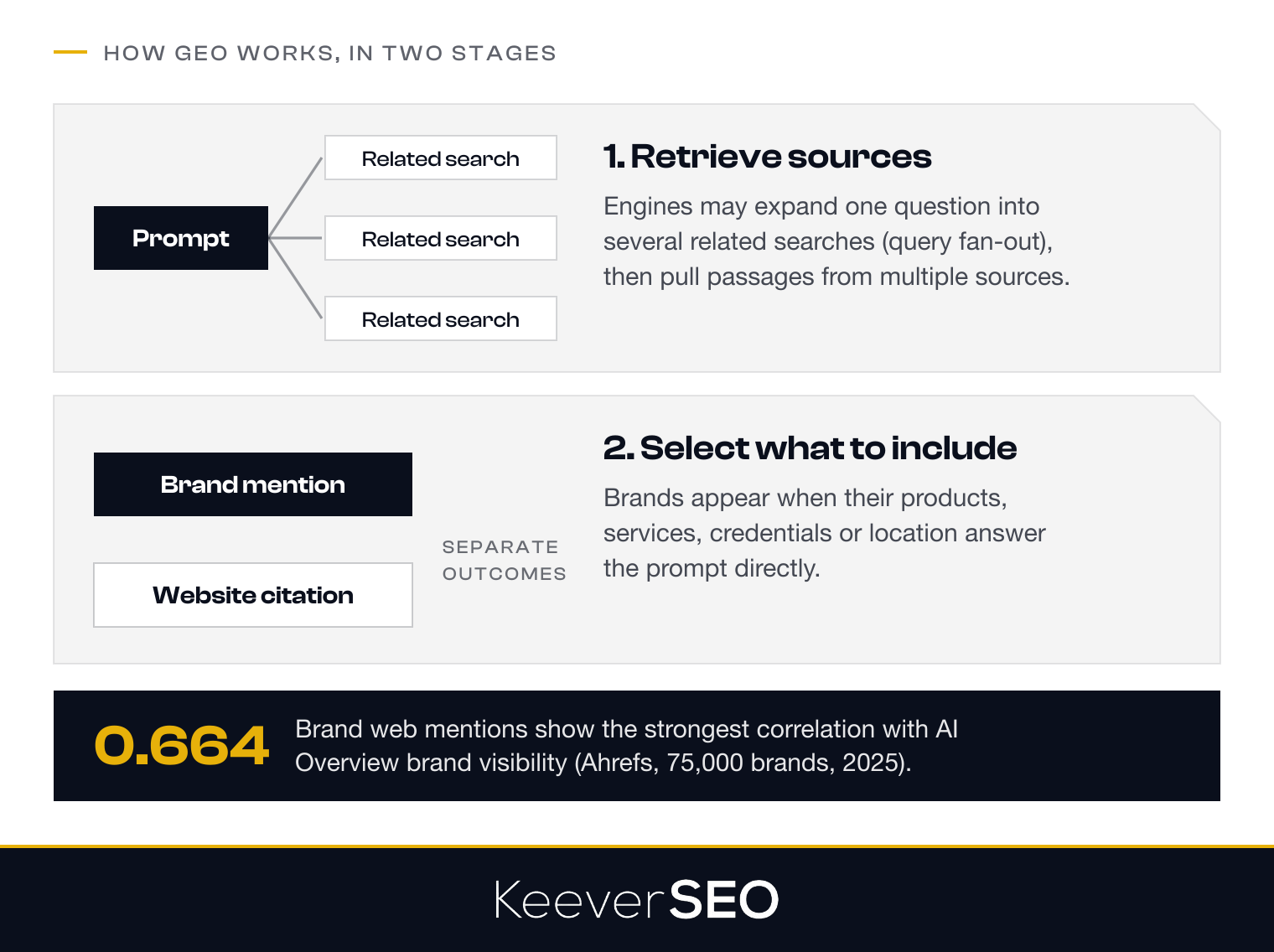
GEO works across two connected stages: engines retrieve relevant sources, then select information and brands for their answers. The first stage depends on how generative engines expand prompts, retrieve passages, and synthesize information from multiple sources.
How Do Generative Engines Retrieve and Synthesize Sources?
Generative engines retrieve and synthesize sources by running several related searches for one question and combining what they find. Google states that "both AI Overviews and AI Mode may use a 'query fan-out' technique," issuing multiple related searches across subtopics and data sources to develop a response, according to its "AI features and your website" documentation.
The engine retrieves relevant passages from multiple sources, evaluates their connection to the prompt, and synthesizes the information into one generated answer. The answer may cite or link to sources so readers can check the supporting information.
How Do Generative Engines Decide Which Brands to Mention?
Generative engines decide which brands to mention by matching a prompt with relevant information from websites and other sources. Brands are more likely to appear when their products, services, credentials, or location answer the prompt directly. A 2025 Ahrefs study of 75,000 brands, "An Analysis of AI Overview Brand Visibility Factors," found that "brand web mentions show the strongest correlation (0.664) with AI Overview brand visibility."
Consistent brand facts across credible websites clarify what a company offers, while reviews, industry roundups, news coverage, and directories provide independent context. University of Toronto researchers found "a systematic and overwhelming bias towards Earned media (third-party, authoritative sources) over Brand-owned and Social content" in "Generative Engine Optimization: How to Dominate AI Search" (September 2025), while Profound's 2026 analysis of 11.84 billion citations found that "the biggest source of AI citations isn't the press or Reddit or YouTube; rather, it is a long tail of company websites." A brand mention and a website citation are separate outcomes, since an engine can name a brand without citing its site, or cite a page without naming the organization.
What Are the Main Types of Generative Engine Optimization?
The main types of generative engine optimization are on-page GEO, technical GEO, and off-site GEO. On-page GEO makes website content clear and citable, technical GEO helps AI systems access and interpret pages, and off-site GEO builds credible brand signals across third-party sources.
Together, the three types support AI visibility by making information citable, websites retrievable, and brand facts consistent across the web.
On-Page GEO
On-page GEO structures webpage content so generative engines can identify, extract, and cite relevant information. Answer-first passages place direct responses near the beginning of each relevant section. Named-source statistics, attributed quotations, and links to credible evidence give claims verifiable context. Descriptive headings, short paragraphs, definitions, and lists help engines interpret and combine content, and the 2023 GEO study found that statistics, quotations, and citations improved visibility in generated answers.
Technical GEO
Technical GEO helps AI search systems crawl, render, and interpret website content. Site owners can allow relevant crawlers, such as OpenAI's OAI-SearchBot, in robots.txt while managing training crawlers separately, as OpenAI's "Overview of OpenAI Crawlers" explains.
Server-rendered HTML gives crawlers direct access to important page content, while JSON-LD schema markup clarifies entities, services, and authors. A site can publish an llms.txt file with main links and context, but the proposal is not a universal standard, and Google states that "Google Search ignores them" in "Google's Guide to Optimizing for Generative AI Features on Google Search" (May 2026).
Off-Site GEO
Off-site GEO improves how generative engines interpret a brand through information on third-party websites. Businesses build credible brand mentions through digital PR, genuine customer reviews, industry roundups, and relevant directories. Companies should keep core facts consistent across external listings, including business name, services, location, leadership, and contact details. Accurate details and independent coverage give AI systems clearer context for matching a brand to relevant prompts.
Why Does Generative Engine Optimization Matter?
Generative engine optimization matters because AI assistants now help large numbers of people research products, services, and purchases. OpenAI reported "more than 1 billion weekly active users" for ChatGPT in "A milestone in expanding access to AI" (August 2026), and Google reported that "the Gemini app is now at one billion users" in its Q3 2026 earnings remarks.
AI-generated summaries reduce clicks to conventional search results. Pew Research Center found that users clicked a traditional result in 8% of visits when Google showed an AI summary, compared with 15% when no summary appeared, according to "Google users are less likely to click on links when an AI summary appears in the results" by Athena Chapekis and Anna Lieb, July 2025. Brands named or cited in AI answers gain visibility during research, which shifts brand visibility toward inclusion in generated responses.
How Does GEO Change Brand Visibility When Buyers Ask AI?
GEO changes brand visibility when buyers ask AI by placing businesses inside AI-generated shortlists and recommendations. Buyers may overlook brands that AI answers omit, even when those brands rank well in traditional search results.
Businesses measure GEO visibility through brand mentions, response placement, and citations rather than keyword positions alone. A brand mention does not always include a citation or referral link.
What Are Examples of Generative Engine Optimization?
Examples of generative engine optimization include adding a statistic from a named, authoritative source to an industry guide. A business can pair the statistic with an attributed expert quotation and clear answers to common buyer questions.
Off-site GEO examples include earning a mention in an industry roundup and correcting inconsistent brand names, descriptions, or contact details across directories. Consistent listings help AI systems verify business information when generating recommendations.
What Are the Benefits and Challenges of Generative Engine Optimization?
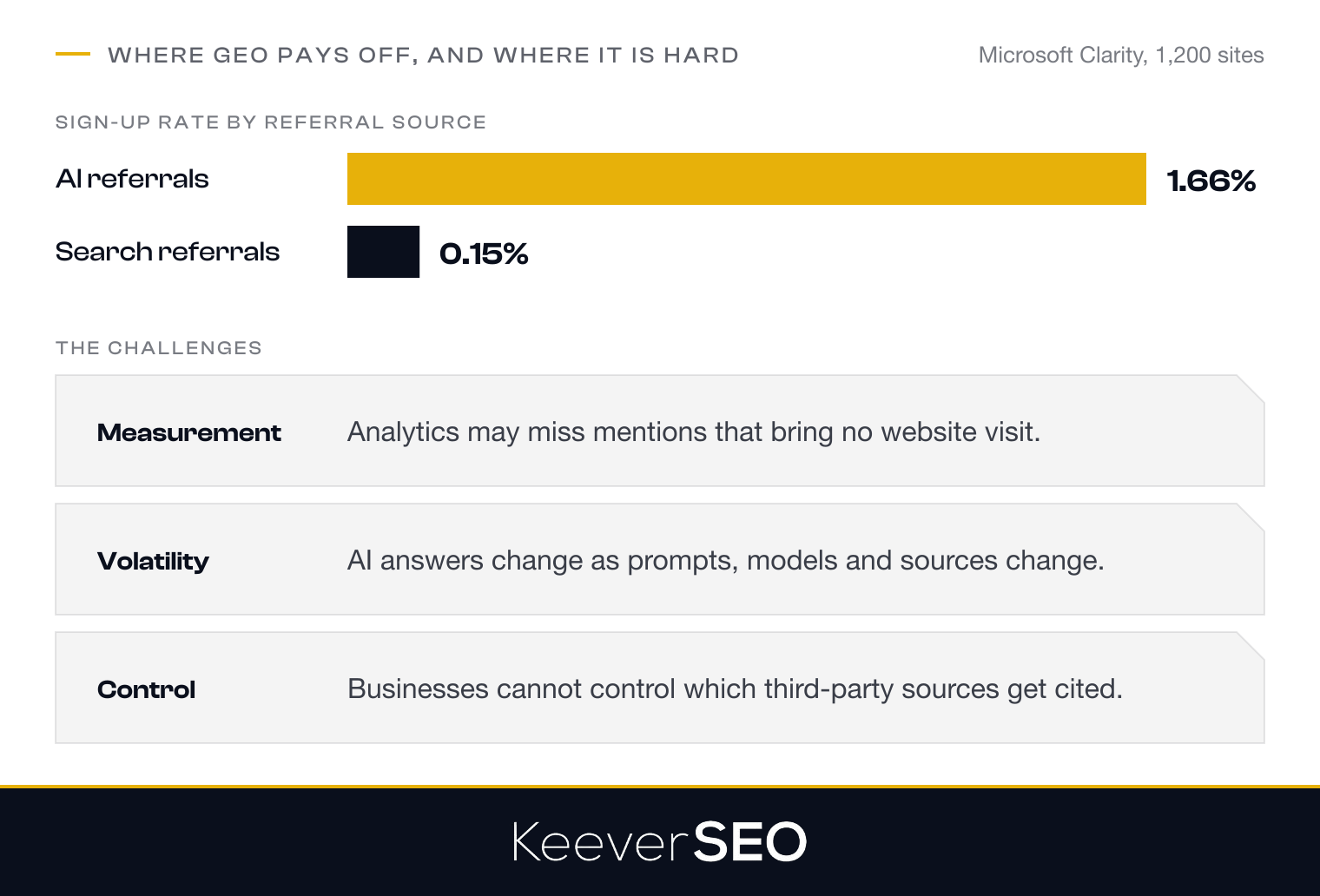
The benefits and challenges of generative engine optimization center on early brand visibility and high-intent referrals on one side, and measurement and control on the other. The main benefits and challenges are listed below:
- Benefit: AI-generated recommendations can introduce a brand while buyers compare options.
- Benefit: Microsoft Clarity's study of 1,200 publisher and news sites, "AI Traffic Converts at 3x the Rate of Other Channels (Study)" (November 2025), reported a 1.66% sign-up rate for AI referrals, compared with 0.15% for search referrals.
- Challenge: Analytics may miss brand mentions that generate no website visit.
- Challenge: AI answers can change as prompts, models, and sources change.
- Challenge: Businesses cannot control which third-party sources generative engines retrieve or cite.
How Is Generative Engine Optimization Different From SEO?
Generative engine optimization is different from SEO because GEO aims to get a brand or webpage included and cited in AI-generated answers, while search engine optimization (SEO) aims to improve a webpage's position in ranked search listings and attract clicks.
GEO builds on SEO foundations, including crawlable pages, helpful content, clear structure, and reliable information. SEO supports discoverability, while GEO focuses on whether generative engines select and reference a source.
How Do You Measure Generative Engine Optimization?
To measure generative engine optimization, test a fixed set of buyer prompts across relevant AI platforms. Track mention rate, citation share, brand sentiment, and AI referral traffic to assess visibility and response quality.
Keep prompts, engines, regions, competitors, and scoring rules consistent across scheduled tests. Compare results over time, because AI answers vary by platform, prompt, date, and location.
Does a Local Service Business Need Generative Engine Optimization?
Yes, a local service business needs generative engine optimization alongside local SEO to raise its chances of appearing in AI recommendations. "Use of ChatGPT and other generative AI tools for local recommendations has grown rapidly, rising from 6% last year to 45%," according to the "Local Consumer Review Survey 2026" by Rosie Murphy, published by BrightLocal in February 2026.
Local GEO helps AI systems find consistent details about a business's services, location, hours, credentials, reviews, and service areas. Local SEO, including Google Business Profile optimization, customer reviews, and local citations, remains important, and GEO strengthens those foundations for AI-generated answers.
When Should a Business Hire a Generative Engine Optimization Agency?
A business should hire a generative engine optimization agency when AI answers omit its core services or name competitors instead. Repeated absence from ChatGPT, Perplexity, Gemini, or Google AI Overviews can signal gaps in content, online authority, or brand information.
An agency can help when an in-house team lacks the capacity to create citation-ready content, earn credible third-party mentions, improve technical visibility, and track AI responses. Businesses with the skills and time to manage those tasks can handle GEO in-house.
How Do Keever SEO's Generative Engine Optimization Services Get Businesses Cited in AI Answers?
Keever SEO's generative engine optimization services get businesses cited in AI answers by starting with an AI visibility audit across ChatGPT, Gemini, Perplexity, and Google AI Overviews. The GEO-focused SEO agency audit checks brand mentions, citations, buyer prompts, competitors, and gaps in content, technical access, and authority.
Keever SEO then creates citation-ready content, adds schema markup, and builds relevant third-party brand mentions. Ongoing reporting tracks citation frequency, sentiment, and AI share of voice against competitors across a consistent set of prompts.
Which Generative Engine Optimization Practices Work Best?
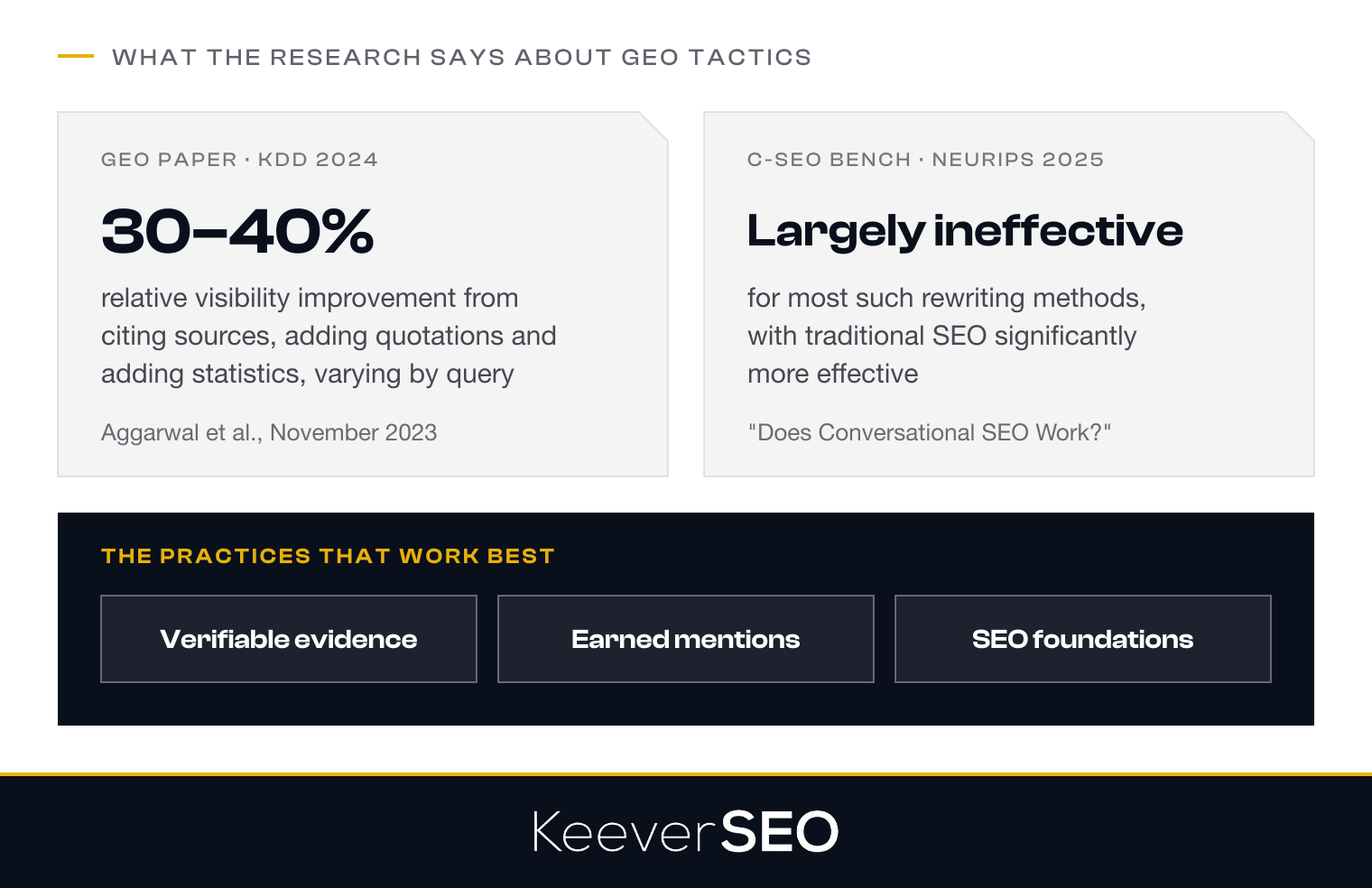
The generative engine optimization practices that work best give AI systems clear, verifiable evidence to extract and cite. Strong practices include adding statistics with named sources, using relevant expert quotations, citing authoritative references, and organizing information with clear headings and answer-first passages. The 2023 GEO paper found that the Cite Sources, Quotation Addition, and Statistics Addition methods "achieved a relative improvement of 30-40%" in visibility, with results varying by query, although the NeurIPS 2025 benchmark "C-SEO Bench: Does Conversational SEO Work?" found that most such rewriting methods are "largely ineffective" and that traditional SEO is "significantly more effective." Earned mentions on reputable third-party websites further reinforce a brand's relevance and credibility.
Which GEO Ranking Factors Shape AI Answers?
The GEO ranking factors that shape AI answers fall into three groups: content signals, technical signals, and off-site signals. Clear, well-sourced answers, crawlable and indexable pages with accurate structured data, and credible third-party mentions, reviews, and consistent brand facts help generative engines assess relevance and trustworthiness.
Which Tools Track Generative Engine Optimization?
The tools that track generative engine optimization run a fixed set of audience-relevant prompts across AI platforms such as ChatGPT, Gemini, Perplexity, and Google AI Overviews. GEO tracking platforms record brand mentions, citations, recommendations, sentiment, and share of voice over time.
How Does GEO Compare With AEO and SEO?
GEO compares with AEO and SEO as one of three related forms of search visibility: SEO improves a website's visibility in ranked search results, AEO helps search systems extract direct answers, and GEO focuses on getting brands included or cited in AI-generated responses. GEO builds on SEO foundations such as crawlability, indexing, and clear content. Their overlap raises two related questions: whether GEO is the same as AEO and whether GEO will replace SEO.
Is GEO the Same as Answer Engine Optimization?
GEO is not exactly the same as answer engine optimization (AEO), although the two overlap heavily and the terms are used interchangeably. GEO stresses inclusion and citations in generated responses, while AEO focuses on structuring content for direct answers, such as featured snippets or voice-search results.
Will GEO Replace SEO?
No, GEO will not replace SEO, because generative engines still retrieve information from discoverable, indexed pages. Google states that "optimizing for generative AI search is optimizing for the search experience, and thus still SEO," according to "Google's Guide to Optimizing for Generative AI Features on Google Search," so GEO builds on SEO by improving a page's chances of appearing in generated answers.
How Will Generative Engine Optimization Shape Search Visibility Next?
Generative engine optimization will shape search visibility next by extending from citations in AI answers to agentic search recommendations and actions. Google's generative AI guide tells site owners to "stay informed about emerging technologies that allow AI agents to interact with your site, such as browser agents and new protocols," and Google reports that "one in five AI Mode searches globally use voice, images, or documents."
As AI answers become more common in search results, businesses will track mentions, citations, sentiment, referrals, and conversions across consistent buyer prompts. Generative engine optimization will continue to mean making a business a relevant, reliable source for AI-generated answers.