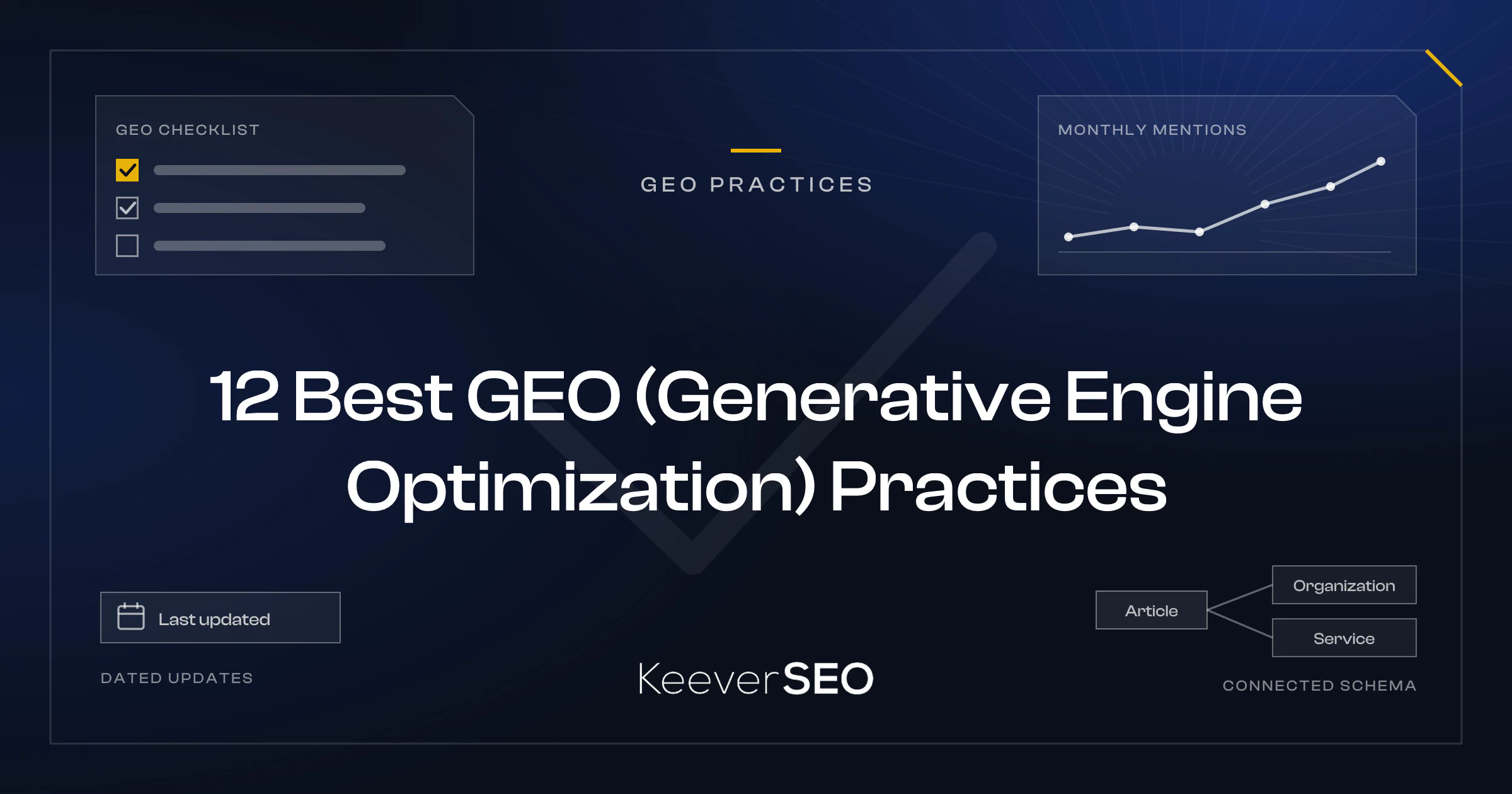
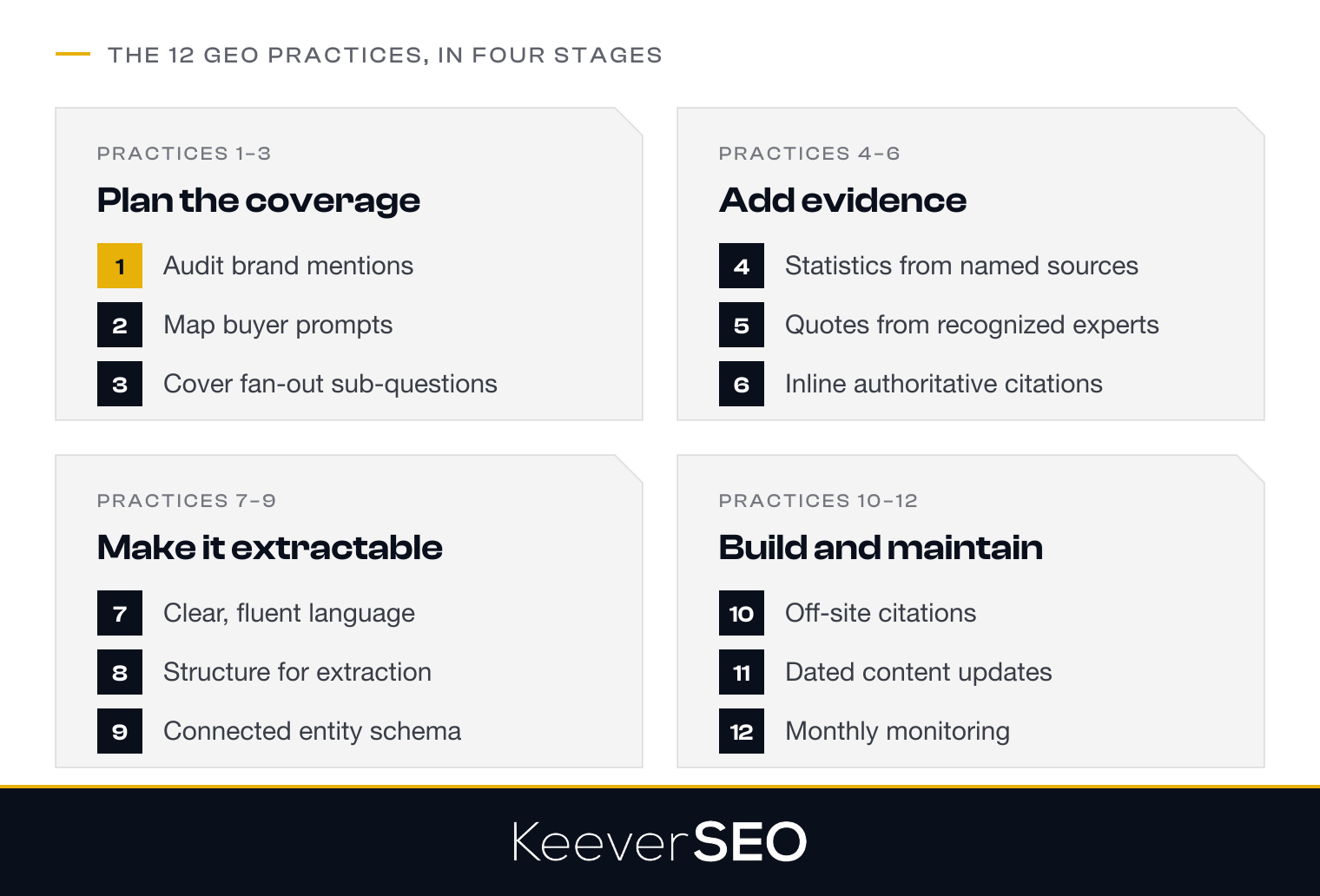
The best GEO practices are auditing brand mentions, mapping prompts, covering fan-out questions, adding sourced statistics, quotations, and citations, writing fluently, structuring for extraction, connecting schema, earning off-site citations, refreshing content, and monitoring results. A GEO practice is a repeatable action that raises the chance a brand appears, receives a citation, or earns a recommendation in AI-generated answers. The twelve practices move from a baseline audit and buyer-prompt mapping to complete page coverage, research-backed content, clear writing, extractable structure, connected schema, external citations, content updates, and monthly monitoring.
The GEO practices were selected based on academic evidence, recurrence across optimization guides, and measurable outcomes. An academic benchmark tested nine content changes across 10,000 queries and found that quotations, statistics, and source citations produced some of the largest visibility gains. Effective practices improve citation impact, reach multiple AI models, and produce measurable changes in mentions, citations, sentiment, or referrals.
Local service businesses can start with an AI visibility audit, consistent business listings and reviews, and sourced answers on core service pages. Businesses should avoid blocking legitimate AI crawlers, keyword stuffing, unsupported claims, inconsistent brand facts, neglecting off-site mentions, and tracking conventional rankings alone, and agencies can help when teams lack capacity for citation building and ongoing multi-model monitoring. The sections below connect GEO practices to ranking factors, tracking tools, measurement, and platform-level execution, beginning with the baseline audit.
1. Run a Baseline Audit of Brand Mentions Across AI Models
Running a baseline audit of brand mentions across AI models measures how frequently ChatGPT, Gemini, Perplexity, and Claude mention a brand in answers to buyer questions. Use a consistent prompt set covering discovery, comparisons, trust, strengths, weaknesses, and purchase intent. Record each brand mention, its position and sentiment, linked citations, cited pages, and the competitors that appear, and run prompts more than once because AI-generated answers vary between runs.
Separate a simple brand mention from a linked citation, then note missing mentions, absent citations, inaccurate descriptions, and competitor sources. The audit gaps provide the starting point for mapping buyer prompts.
2. Map the Prompts Buyers Use in Each AI Model
Mapping the prompts buyers use in each AI model organizes the questions buyers ask ChatGPT, Gemini, Perplexity, and Claude during their decision process. Collect buyer questions from sales calls, People Also Ask results, customer-service conversations, support tickets, and relevant forums.
Group prompts by product or service, then classify each question by intent: informational, comparison, or provider selection. Map each prompt group to a page or content asset that answers buyers' needs, objections, and questions about cost or outcomes.
3. Cover Every Fan-Out Sub-Question on the Page
Covering every fan-out sub-question on the page matters because AI models use query fan-out to expand one prompt into related sub-questions and search for information before generating an answer. Google defines query fan-out as "a set of concurrent, related queries generated by the model to request more information and fetch additional relevant search results to address the user's query," according to "Google's Guide to Optimizing for Generative AI Features on Google Search," published by Google Search Central in May 2026.
Answer relevant follow-up questions on the same page, using clear headings and direct, self-contained passages. Cover reader needs such as definitions, costs, comparisons, risks, alternatives, and implementation steps, without creating separate thin pages for each variation.
4. Add Statistics From Named Sources
Adding statistics from named sources gives AI models concrete evidence to retrieve and cite. A 2023 study by Aggarwal and colleagues, "GEO: Generative Engine Optimization," tested content changes across 10,000 queries and found that the Cite Sources, Quotation Addition, and Statistics Addition methods "achieved a relative improvement of 30-40%" in visibility within generative answers.
Pair each figure with its source, publication date, and a link to the original research or report. Named, verifiable statistics help readers assess a claim's reliability, and invented numbers backfire: a faithfulness checker in the October 2026 preprint "Do GEO Gains Survive the Live Web?" flagged all 80 Statistics Addition rewrites in its test because their numbers could not be matched to the source.
5. Quote Recognized Experts in the Content
Quoting established experts in the content can raise a page's visibility in AI-generated answers. Place a relevant quote near the passage it supports, and identify the expert by name, role, and organization so AI models can extract the quotation with its context.
Quotation Addition ranked among the top-performing methods in the Aggarwal GEO study, whose best methods "improve upon baseline by 41% and 28%" on its Position-Adjusted Word Count and Subjective Impression measures. Use accurate, verifiable quotes that clarify a point, and avoid generic testimonials or weak attribution.
6. Cite Authoritative Sources Inline
Citing authoritative sources inline links factual claims to primary research, official guidance, government data, or established institutions. The foundational GEO paper reported that GEO "can boost visibility by up to 40% in generative engine responses," with Cite Sources among the methods producing the largest gains on its benchmark.
Name each source within the sentence and link directly to the relevant evidence. Relevant citations help readers verify claims and give AI systems clearer evidence to retrieve.
7. Write in Clear, Fluent, Conversational Language
Writing in clear, fluent, conversational language helps readers follow GEO content and helps AI models interpret its answers. Use plain wording, short sentences, and familiar terms, and define specialized terms when they first appear.
Phrase answers the way buyers ask questions, such as "How much does home insulation cost?" Avoid keyword stuffing and ambiguous language, because natural, precise passages are easier to summarize and cite accurately.
8. Structure Pages for Multi-Source Extraction
Structuring pages for multi-source extraction means using question-based headings, concise answer passages, lists, and tables. Place a self-contained answer directly below each heading so an AI model can quote the passage accurately alongside information from other sources.
Use logical heading levels, native HTML lists for steps, and plainly labeled tables for comparisons or features. Keep important information in crawlable text rather than images or interactive widgets.
9. Mark Up Entities With Connected Schema
Marking up entities with connected schema describes a brand's Organization, people, products or services, and articles using structured data. Schema.org defines the vocabulary, while JSON-LD represents each entity and its verified attributes in a machine-readable format.
Use stable @id values to link an article to its publisher, author, and featured offering. Add sameAs links only to authoritative profiles that identify the same entity, and keep the markup consistent with visible page content. Connected schema helps search and AI systems distinguish related entities, but it does not guarantee retrieval or citation.
10. Earn Off-Site Citations on Sources AI Models Trust
Earning off-site citations on sources AI models trust strengthens a brand's visibility in AI-generated answers. Earn accurate brand mentions through digital PR, review platforms such as G2 and Yelp, industry publications, and relevant community discussions, and add links to supporting pages or evidence when appropriate.
Peec AI's analysis of 30 million AI search sources, "Top domains cited by AI search: Analysis based on 30M sources" (March 2026), ranks Reddit, YouTube, LinkedIn, Wikipedia, Forbes, G2, and Yelp among the most-cited domains. Prioritize credible sources that buyers trust, and avoid manufactured mentions.
11. Keep Content Fresh With Dated Updates
Keeping content fresh with dated updates keeps GEO content accurate as facts, products, and recommendations change. Review fast-changing or highly cited pages more frequently, replace outdated figures, and correct errors during each substantive update.
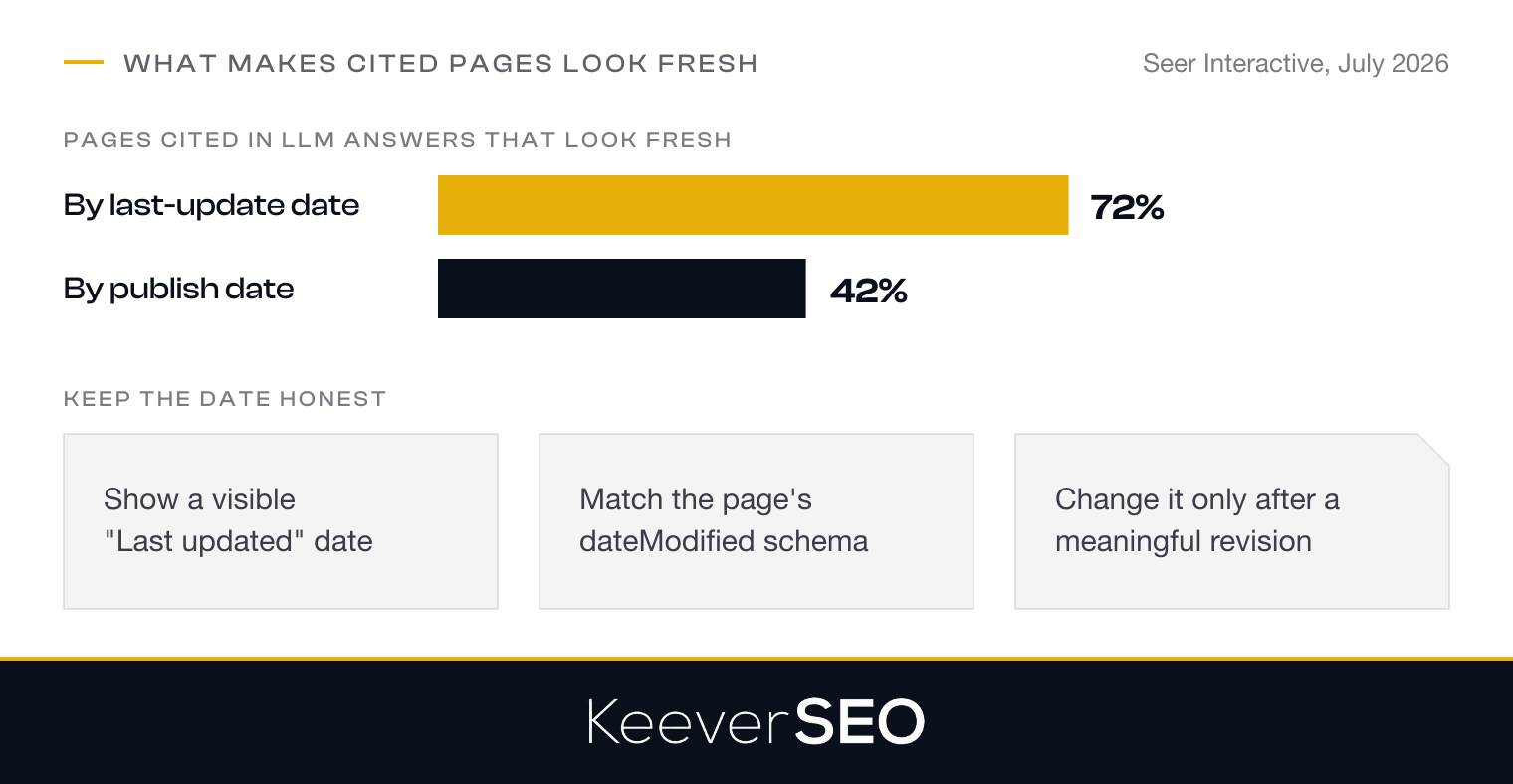
A visible "Last updated" date helps readers and AI systems identify current information. Seer Interactive's "Study: Content Recency's Impact on AI Visibility in 2026" (July 2026) found that 72% of pages cited in LLM answers look fresh by last-update date, against 42% by publish date, which shows that updates drive the freshness AI systems reward. Keep the displayed date consistent with the page's dateModified structured data, and change the date only after a meaningful revision.
12. Monitor Mentions, Citations, and Sentiment Every Month
Monitoring mentions, citations, and sentiment every month measures whether AI models mention, recommend, or cite a brand. Run the same buyer prompts separately in ChatGPT, Gemini, Perplexity, and Claude, then record competitor mentions and each response's tone.
Track mention rate, citation share, competitor share of voice, recommendation frequency, and positive, neutral, or negative sentiment. Investigate changes by updating pages when citations decline, correcting inaccurate brand facts, and strengthening sources that competitors consistently earn citations from.
How Were These GEO Practices Selected?
The GEO practices were selected using three filters: academic research support, recurrence across reputable practitioner guides, and measurable impact on AI-generated visibility. Academic GEO research identifies statistics, expert quotations, and source citations as content changes that can improve visibility in generated answers. Practitioner guides repeatedly recommend prompt testing, clear structure, connected schema, trusted off-site mentions, content freshness, and performance tracking. The selection method leads to three effectiveness criteria: citation impact, cross-model reach, and measurability.
Which Criteria Make a GEO Practice Effective?
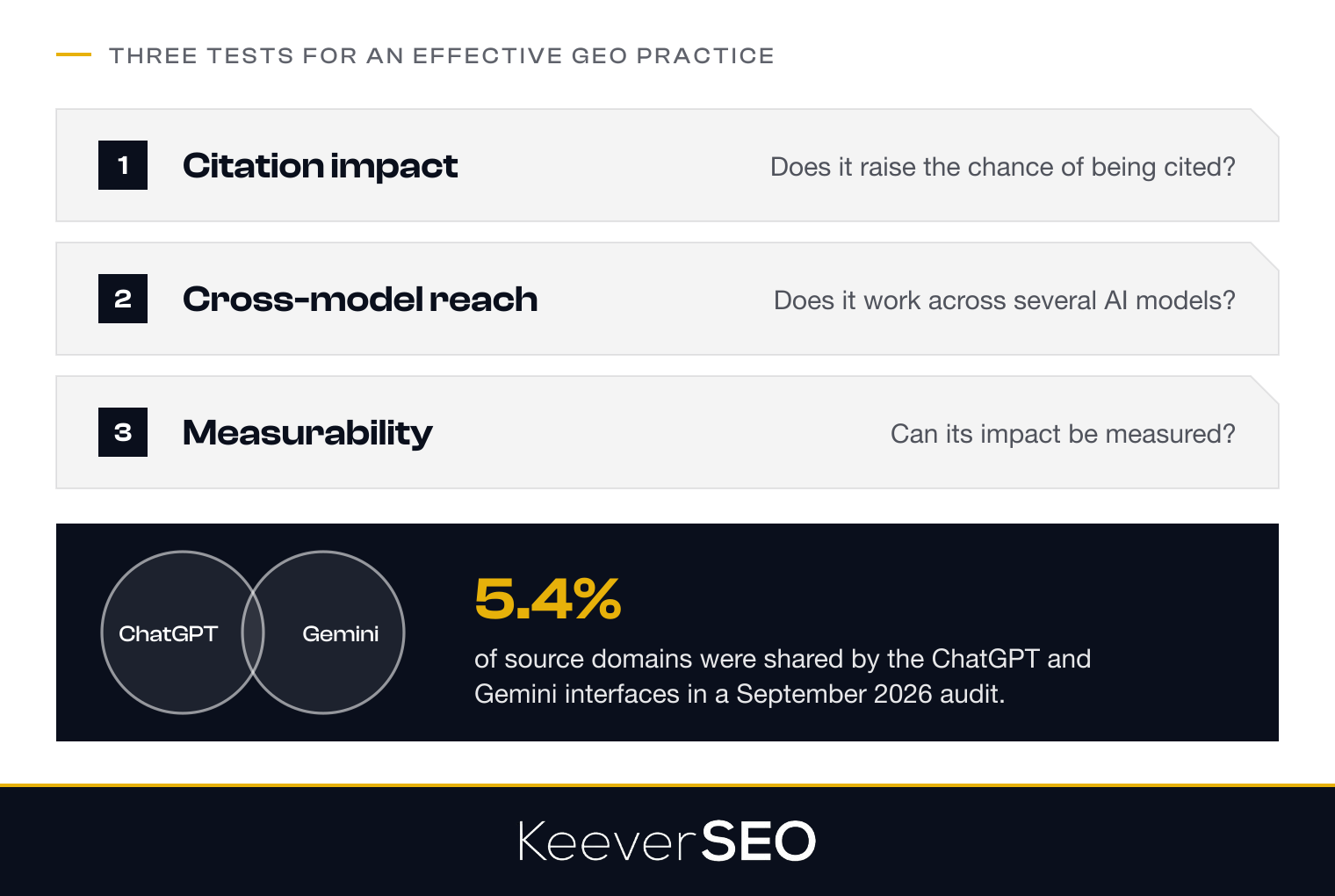
The criteria that make a GEO practice effective are citation impact, reach across multiple AI models, and measurable results. Citation impact shows whether an AI system retrieves, cites, or meaningfully uses a brand's content. Cross-model reach tests whether the practice works across platforms such as ChatGPT, Gemini, Perplexity, and Claude. Measurability tracks changes in mention rate, citation share, citation position, sentiment, and AI-referred visits.
Does the Practice Raise the Chance of Being Cited?
Yes, an effective GEO practice raises the chance of being cited, which makes citation impact the first test: the practice should increase a brand's chance of appearing as a cited source in AI-generated answers. Controlled research found that adding citations, expert quotations, and statistics improved source visibility by up to about 40% on a benchmark. Compare mention rate, citation frequency, and citation position against a baseline, since citation gains are not guaranteed.
Does the Practice Work Across Several AI Models?
Yes, an effective GEO practice works across several AI models, which makes cross-model reach the second test: the practice should improve visibility across multiple AI systems, not just one. ChatGPT, Gemini, Perplexity, and Claude use overlapping but distinct source pools, and the September 2026 audit "'If I Had to Buy Just ONE: Galaxy S26 Ultra': Auditing AI-Generated Product Recommendations" found that the ChatGPT and Gemini interfaces shared only 5.4% of source domains. Teams should compare brand mentions and citations across each model using the same buyer prompts.
Can the Practice's Impact Be Measured?
Yes, a GEO practice's impact can be measured when a consistent prompt set tracks results before and after optimization. Compare brand mention rate, citation share, sentiment, competitive share of voice, and AI-driven referral traffic.
Which GEO Practices Does Academic Research Support?
The GEO practices academic research supports most consistently are adding credible quotations, statistics, and source citations, with important caveats. Aggarwal and colleagues' "GEO: Generative Engine Optimization" (KDD 2024) tested those changes on GEO-bench, a benchmark of 10,000 queries, and found that the top methods "achieved a relative improvement of 30-40%" in visibility, with results that varied by query domain.
Later research tempers the headline. The NeurIPS 2025 benchmark "C-SEO Bench: Does Conversational SEO Work?" found that "most current C-SEO methods are not only largely ineffective but also frequently have a negative impact on document ranking," while "traditional SEO strategies... are significantly more effective." A 2026 review of 45 studies, "Optimizing Visibility in Generative Engines: A Critical Survey of Generative Engine Optimization (2023-2026)," concluded that the original gains are "conditional on a source already being present in a fixed context" and that "no reviewed technique shows a stable, longitudinal, cross-platform causal effect." The research supports sourced, relevant content as a sound practice, not as a guaranteed visibility formula.
Which GEO Mistakes Should You Avoid?
The GEO mistakes to avoid reduce a brand's visibility, weaken factual trust, or hide content from AI systems. The seven main mistakes are listed below:
- Blocking AI crawlers: Misconfigured robots.txt files, firewalls, or hosting rules can prevent crawlers from accessing eligible pages. OpenAI's "Overview of OpenAI Crawlers" states that "sites that are opted out of OAI-SearchBot will not be shown in ChatGPT search answers."
- Stuffing pages with keywords: Repeating target phrases, city names, or question variations unnaturally makes content harder to read, and Google's "Spam Policies for Google Web Search" treat keyword stuffing as spam.
- Publishing unsourced claims: Unsupported statistics, product comparisons, and medical or financial statements give readers no clear way to verify a claim. Brands should name reliable sources beside factual claims.
- Maintaining inconsistent brand facts: Conflicting business names, addresses, phone numbers, prices, services, or credentials can confuse readers and AI systems. Brands should keep website details, business listings, and review profiles accurate and consistent.
- Ignoring off-site mentions: A GEO strategy focused only on the company website overlooks reviews, industry publications, directories, news coverage, and community discussions. Brands should build a credible presence across relevant third-party sources.
- Treating schema as proof: Structured data clarifies entities and their relationships, but schema cannot replace accessible pages, useful content, or supported claims. Businesses should keep schema matched to visible page information.
- Measuring rankings alone: Traditional search rankings do not show whether AI platforms mention a brand, cite its pages, or describe it positively. GEO reporting should track AI mentions, citations, sentiment, cited URLs, and referral traffic alongside search rankings.
Which GEO Practices Should a Local Service Business Start With?
The GEO practices a local service business should start with are a baseline AI visibility audit, consistent listings and reviews, and well-sourced service pages. The audit records how ChatGPT, Gemini, Perplexity, and Claude describe the business, cite sources, and present competitors.
The business should align its name, service area, phone number, hours, and services across listings and review platforms. Core service pages should answer customer questions about services, qualifications, timelines, and pricing factors, with important claims supported by named sources.
When Should GEO Practices Be Run by an Agency?
GEO practices should be run by an agency when a business lacks the time, skills, or systems to manage AI visibility in-house. Agency support pays off when GEO work extends beyond website updates to digital PR, review platforms, directories, industry publications, and community discussions.
An agency can monitor brand mentions, citations, sentiment, competitors, and AI-referred traffic across ChatGPT, Gemini, Perplexity, Claude, and Google AI Overviews. A fixed prompt set and scheduled reporting help teams identify changes and revise their GEO practices.
How Does Keever SEO Apply These GEO Practices Through Its Generative Engine Optimization Services?
Keever SEO applies the GEO practices through its generative engine optimization services, starting with an audit across ChatGPT, Perplexity, Gemini, and Google AI Overviews. The best-practice SEO agency audit maps priority buyer prompts, records brand and competitor mentions, and identifies gaps in content, crawler access, entity clarity, and citations.
Keever SEO then develops sourced, answer-focused content and connects schema for organizations, services, and locations. The agency builds off-site citations through relevant publications, directories, forums, and communities, then reports monthly on mentions, citation frequency, share of voice, sentiment, and AI referral traffic.
How Do GEO Practices Connect to Ranking Factors and Tools?
GEO practices connect to ranking factors and tools by improving the content, technical signals, and off-site authority that influence AI retrieval. Fan-out coverage, sourced claims, and clear page structure help AI systems extract relevant information, while schema supports entity recognition. Tracking tools compare mentions, citations, competitors, sentiment, and share of voice across a consistent prompt set before and after changes. The following sections explain the ranking factors GEO practices target, the tools that track results, and the metrics used to measure performance.
Which GEO Ranking Factors Do These Practices Target?
The GEO ranking factors the practices target are content, technical, and off-site factors that influence visibility in AI-generated answers. Content practices improve relevance and extractability through prompt coverage, sourced claims, clear structure, and direct answers, and technical practices support crawling, indexability, internal linking, and connected schema. Off-site practices build corroborating brand mentions through reputable reviews, industry publications, digital PR, and community discussions.
Which Tools Track Whether GEO Practices Work?
The tools that track whether GEO practices work measure brand mentions and source citations in AI-generated answers before and after content changes. Semrush, Otterly.ai, Peec AI, Profound, HubSpot AEO, and Ahrefs Brand Radar track prompt performance, competitor visibility, sentiment, and results across AI platforms.
How Do You Measure the Results of GEO Practices?
To measure the results of GEO practices, run the same buyer prompts across AI platforms and track mention rate, citation share, and sentiment over time. Track AI referral traffic from assistant-generated links separately, since a brand mention may not include a link, and connect referral sessions with leads and conversions in analytics.
How Do GEO Practices Change by AI Platform?
GEO practices change by AI platform in how each platform retrieves and weighs sources, even though the practices themselves stay consistent. ChatGPT uses its search systems and external providers, while Google AI Overviews draws from Google's index and expands queries into related questions. Strong content, clear entity information, authoritative citations, crawlability, and scheduled measurement support visibility across both platforms. The following sections explain how to apply GEO practices to ChatGPT and Google AI Overviews.
How Do You Apply GEO Practices to ChatGPT?
To apply GEO practices to ChatGPT, keep your website in Bing's index, submit an XML sitemap through Bing Webmaster Tools, and allow relevant search crawlers. Build trusted brand mentions across reputable directories, review platforms, and industry publications, while keeping your business name, services, and locations consistent. Clear entity facts and concise, verifiable answers help ChatGPT identify and cite your brand.
How Do You Apply GEO Practices to Google AI Overviews?
To apply GEO practices to Google AI Overviews, make sure your pages are eligible for Google Search and rank for the main query or related fan-out questions. Cover likely follow-up questions on the same page, and provide clear, self-contained answers that Google can retrieve from organic search results.
Which GEO Practice Should You Apply First in 2026?
The GEO practices to apply first in 2026 are a baseline audit of brand mentions and adding sourced statistics to priority pages. Test ChatGPT, Gemini, Perplexity, and Claude with buyer questions, then record brand mentions, cited pages, competitors, and sentiment.
Use the audit findings to select high-priority pages, then add current figures from named, authoritative sources. The KDD 2024 GEO study found that evidence-based content changes, including statistics, increased visibility in controlled experiments by up to about 40%, and the result is directional, not guaranteed. The audit and sourced statistics provide a practical starting point for applying the full set of best GEO practices.