Google PageRank is Google's link-based importance metric, assigning a numerical value to web pages to measure their relative importance within the web's hyperlink structure. PageRank scores a page by weighing the quantity and quality of links pointing at it: pages linked from high-importance pages receive higher scores, which raises their visibility in search results.
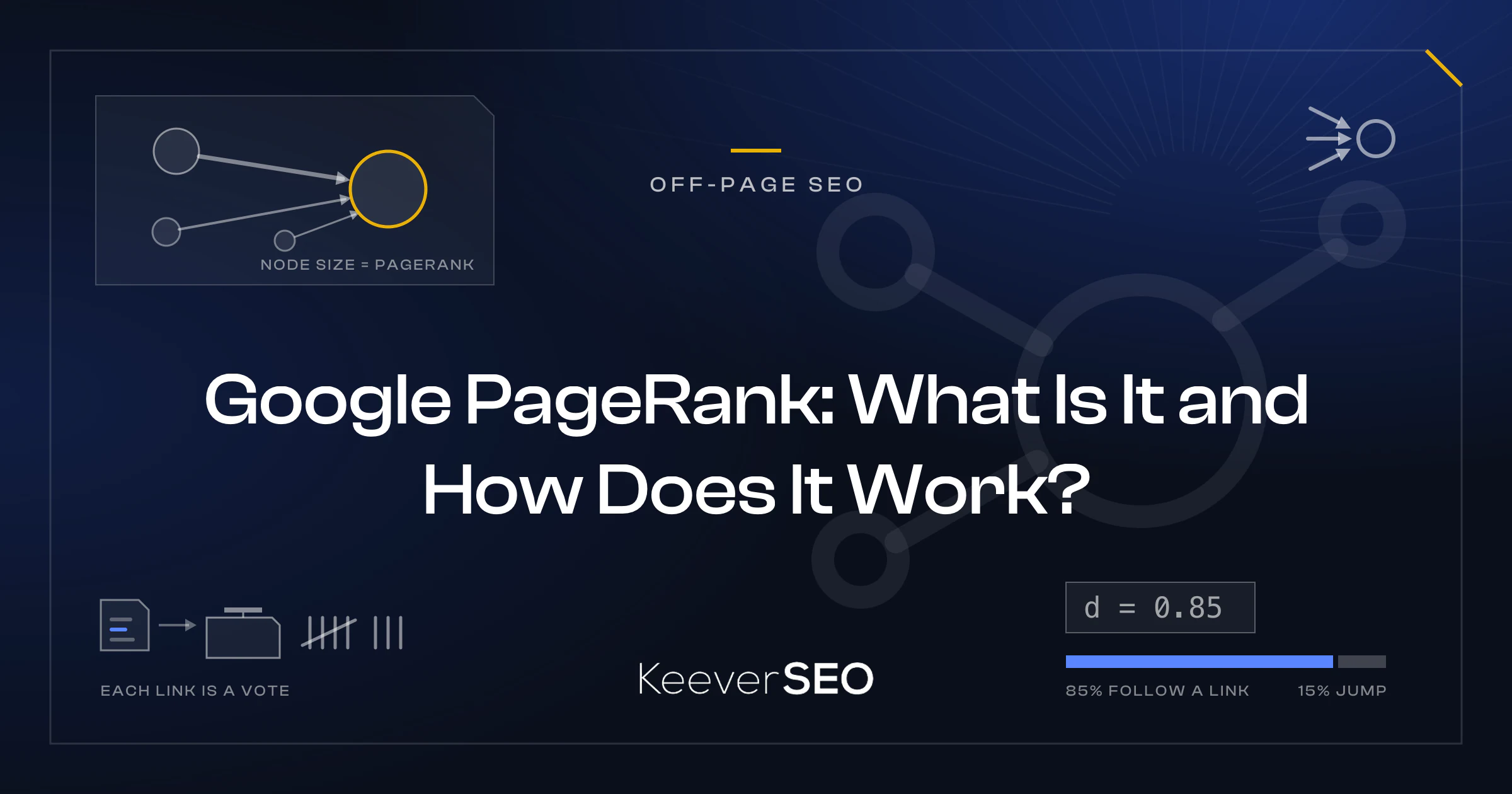
PageRank operates through a link-vote mechanism in which each link acts as a vote of confidence. The algorithm runs on the random-surfer model, simulating a hypothetical user clicking links at random across the web, with a damping factor of 0.85 representing the probability that the user keeps clicking rather than jumping to a new page. Vote-weighting means a link from a high-authority page passes more value than one from a low-authority page, and a page's PageRank divides across all its outbound links.
Link types matter as well. Dofollow links pass PageRank and represent editorial endorsements, while nofollow, sponsored, and UGC links use rel attributes to mark non-editorial contexts. PageRank matters for SEO because link authority feeds a page's ranking potential, and backlinks remain its primary fuel, with referring-domain authority, anchor text, and editorial context deciding how much equity flows.
The websites that should weigh PageRank include e-commerce, content, and service sites competing in link-dependent niches, all of which can use internal links to distribute PageRank deliberately. PageRank stays part of Google's core ranking systems, even though the public Toolbar score retired in 2016. Ethical PageRank improvement runs on earning editorial links through strong content rather than manipulation, and a PageRank SEO audit checks internal link-equity flow, orphan pages, and crawlable links.
Hiring an SEO agency for link strategy makes sense when in-house resources cannot carry editorial outreach and linkable-asset creation. Agencies build and measure links through editorial outreach, digital PR, and guest placements. Link building supports visibility without ever working alone: PageRank is one signal among many, alongside relevance, content quality, and technical factors.
What Is Google PageRank?
Google PageRank is a link analysis algorithm developed by Larry Page and Sergey Brin at Stanford University in the late 1990s, presented in their 1998 paper "The Anatomy of a Large-Scale Hypertextual Web Search Engine." PageRank measures the relative importance of web pages within a hyperlinked set of documents on a votes-by-links premise: each page receives a numerical weighting from the quantity and quality of links pointing at it, with every inbound link counted as a vote of confidence. The calculation runs recursively, so a page's score depends on how many pages link to it and on the PageRank of those linking pages themselves.
PageRank originally surfaced on a 0-to-10 scale, with higher scores marking greater authority. Link equity, the idea that authority flows through hyperlinks, forms the foundation of how PageRank distributes value across the web graph: a high-authority page passes more equity through its links than a low-authority page can. The mathematics rest on iterative eigenvector calculations with a damping factor of 0.85, modeling a web surfer who keeps clicking links with 85% probability and jumps to a random page the remaining 15% of the time. On that foundation, PageRank became a foundational metric of web search, measuring not raw popularity but the authoritative weight a page carries in the network, a distinction that sharpens against Google's full search rankings.
How Does PageRank Differ From Google Search Rankings?
PageRank differs from Google Search rankings as one signal differs from the whole system. PageRank measures a page's importance through its link profile, while Google's full rankings weigh hundreds of factors: relevance signals like content quality, keyword matching, and user intent, plus technical factors like site speed and mobile usability. A page's link authority never determines its position alone, since Google's systems score content quality, user satisfaction, and query relevance alongside. PageRank keeps its role inside that larger machine as one input among many, as Google's "A Guide to Google Search Ranking Systems" documents.
How Does Google PageRank Work?
Google PageRank works through a link-as-vote mechanism in which every hyperlink to a page acts as a vote of confidence. Pages gain authority from inbound links and hand authority onward through outbound links. The PageRank algorithm recalculates scores across the web graph iteratively until the values stabilize, reflecting the quantity and quality of links together, so each page's final score captures its position within the web's link topology.
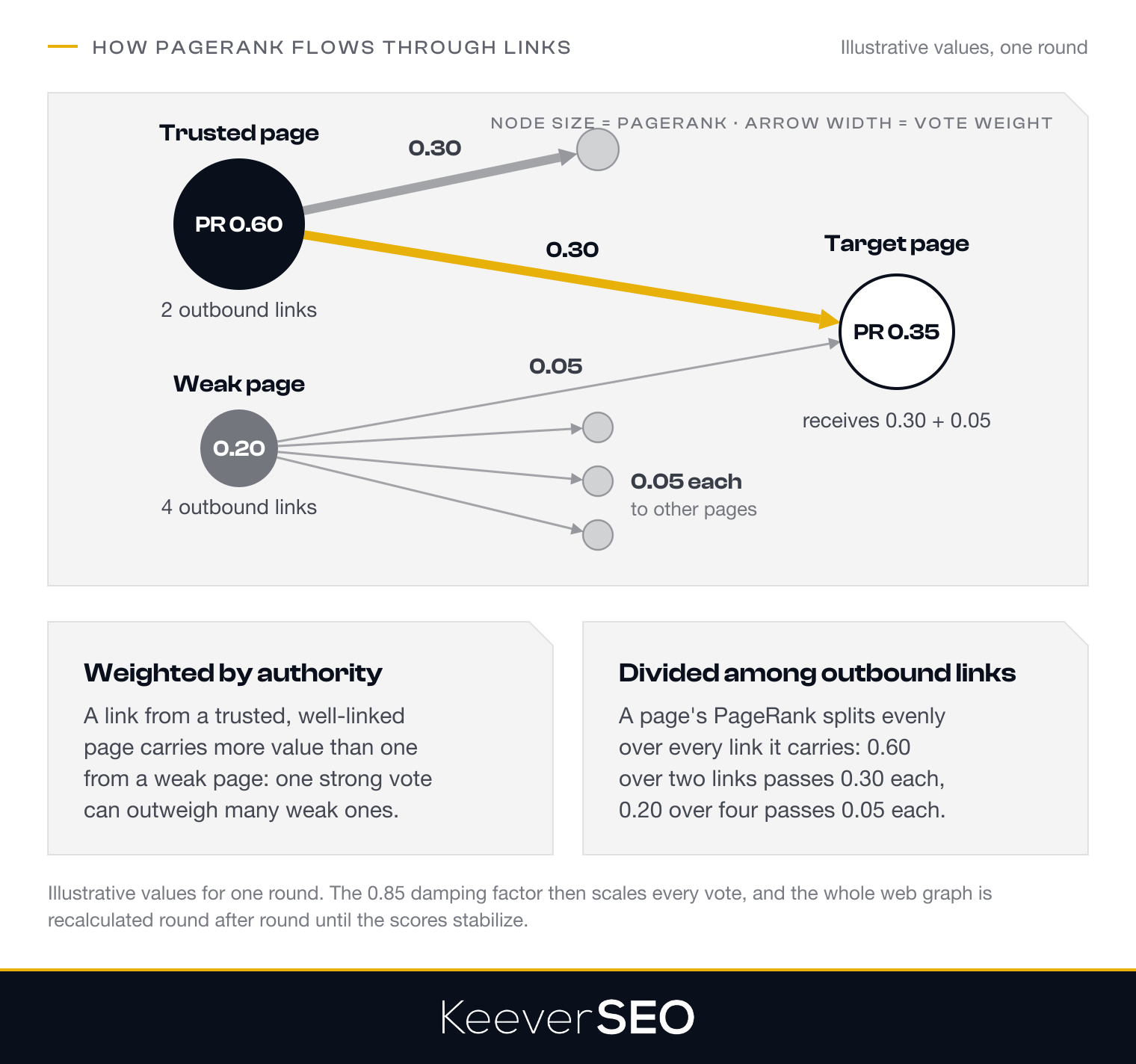
The iterative design lets the algorithm absorb changes in the web's structure: the web is treated as a vast directed graph with pages as nodes and hyperlinks as edges, and each recalculation redistributes link equity back toward equilibrium. PageRank amounts to a network analysis problem, where a page's importance depends on the importance of every page linking to it, and the behavioral rationale for that flow comes from the random-surfer model.
What Is the Random-Surfer Model?
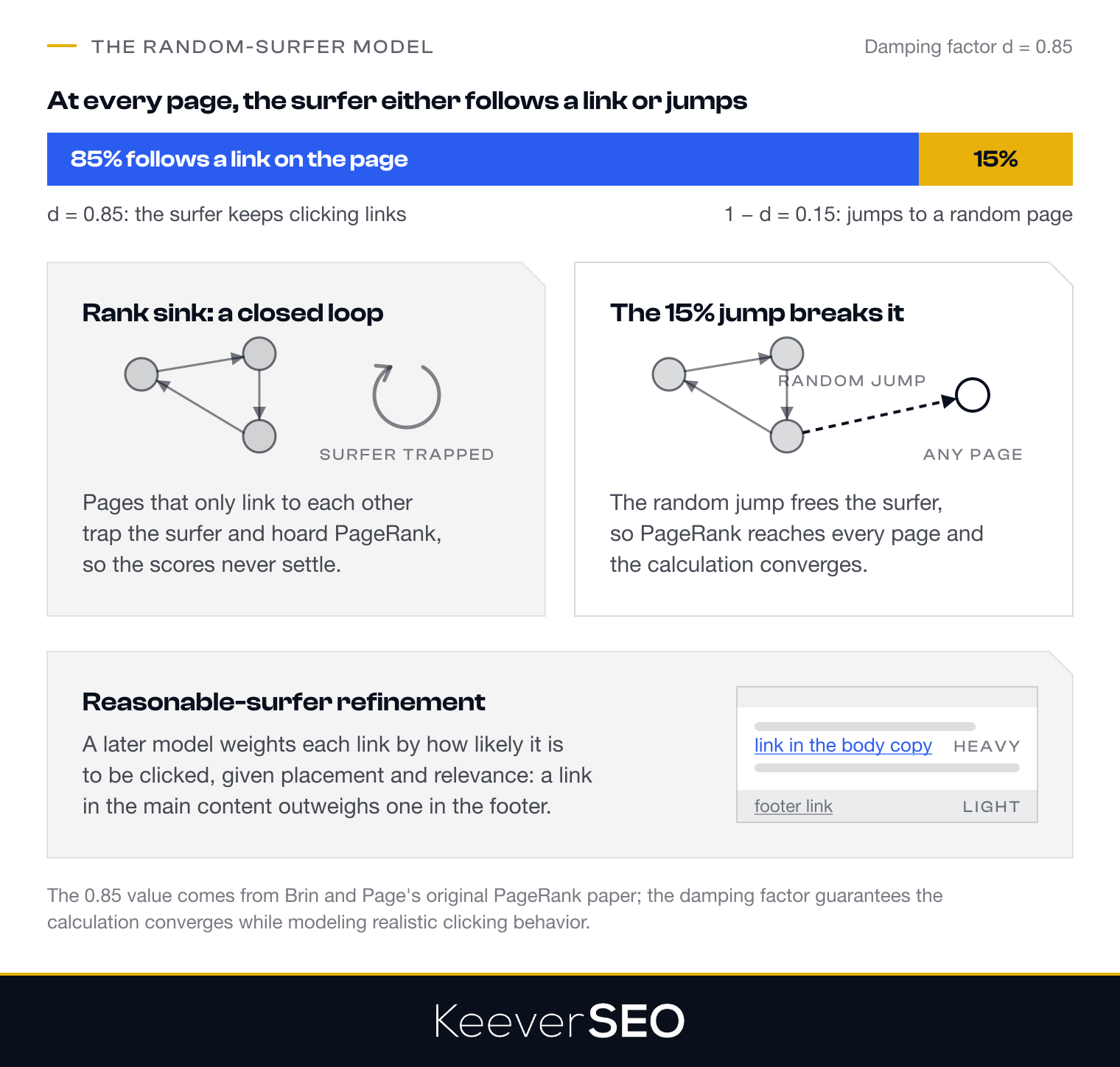
The random-surfer model is the conceptual framework inside PageRank that simulates web navigation behavior. The model pictures a hypothetical user who clicks links at random, moving page to page across the web. A teleportation mechanism keeps the surfer from getting stuck in isolated pages or loops, the rank sinks, and a damping factor of 0.85 controls it: an 85% probability of following a link against a 15% chance of jumping to a random page. The 0.85 value comes from the original PageRank paper by Brin and Page, and the damping factor guarantees the algorithm converges while modeling realistic behavior. The reasonable-surfer model later refined the concept, weighting links by how likely each is to be clicked given its placement and relevance, which sharpened PageRank's read of page importance.
How Does PageRank Weight Votes by Linking-Page Authority?
PageRank weights votes by assigning more value to links from high-authority pages than from low-authority ones. Links from reputable, well-linked domains contribute more to the PageRank of the page they point at, so the strength of each vote follows the authority of the page casting it. A single link from a trusted source can outweigh many links from weak sites, which rewards editorial endorsements from established pages. Each page then hands its accumulated PageRank onward across its outbound links, which is where the division rule takes over.
How Does PageRank Divide Votes Among Outbound Links?
PageRank divides a page's total value across its outbound links, so every added link shrinks the share each target receives. A page with few outbound links passes more value per link than a page linking everywhere. The division feeds the same iterative recalculation that runs across the whole web graph: as linking pages' scores shift, the per-link shares update with them, round after round, until the values stabilize.
What Types of Links Affect Google PageRank?
The link types that affect Google PageRank are distinguished by their rel attributes, as the table below lays out.
| Link Type | rel Attribute | Passes PageRank? | Typical Use |
|---|---|---|---|
| Dofollow | None | Yes | Editorial endorsements, natural citations, trusted references |
| Nofollow | rel="nofollow" | Treated as a hint (may pass some PageRank) | User-generated content, untrusted sources, comments |
| Sponsored | rel="sponsored" | Treated as a hint (may pass some PageRank) | Paid links, advertisements, sponsorships |
| UGC | rel="ugc" | Treated as a hint (may pass some PageRank) | User-generated content, forum posts, community contributions |
Dofollow links are the default state, passing full PageRank as editorial votes of confidence. Nofollow, sponsored, and UGC links carry rel attributes that describe the link relationship to search engines, and since 2019 Google reads the attributes as hints rather than strict directives, so some PageRank may pass depending on the link's context and value.
What Are Dofollow Links?
Dofollow links are standard hyperlinks that pass PageRank from one webpage to another. A dofollow link carries no rel attribute altering its behavior, so link equity transfers in full. Each dofollow link works as an editorial endorsement, a vote of confidence from the linking page to the target page, telling search engines the linked content holds value. The endorsement feeds the target page's PageRank calculation and raises its authority and ranking potential.
What Are Nofollow, Sponsored, and UGC Links?
Nofollow, sponsored, and UGC links are hyperlinks that use rel attributes to describe their role to search engines:
- Nofollow links: carry rel="nofollow", originally built to stop PageRank from passing; since 2019 Google reads nofollow as a hint rather than a directive, which lets the engine weigh the link for crawling or ranking where the context warrants.
- Sponsored links: carry rel="sponsored" for paid, affiliate, and compensated links, marking the commercial nature of the link apart from organic endorsements.
- UGC links: carry rel="ugc" for user-generated content, from comments to forum posts, separating community-added links from the site's editorial endorsements.
The attributes give webmasters precise tools for classifying links in line with Google's link-scheme guidelines; Google announced the shift in the September 2019 post "Evolving 'nofollow' - new ways to identify the nature of links," which introduced the sponsored and ugc attributes and reclassified all three as hints.
Why Does Google PageRank Matter for SEO?
Google PageRank matters for SEO because it measures a page's authority through its backlink profile, and link-based authority raises ranking potential when paired with relevance. Pages with strong PageRank, earned through quality backlinks from reputable sources, rank better in search results; Backlinko's analysis of 11.8 million search results found the #1 result averages 3.8 times more backlinks than the rest of page one.
PageRank's reach extends to the whole domain: a site that keeps earning editorial backlinks builds cumulative link equity, and internal links carry the equity onward, lifting the visibility of newer and deeper pages. In competitive niches, PageRank becomes the tiebreaker between pages of matched relevance, and the stronger link authority wins.
Backlinks drive the whole mechanism: backlinks feed PageRank, and PageRank powers a page's ability to compete, which is why earning meaningful backlinks belongs at the center of SEO strategy.
How Do Backlinks Influence Google PageRank?
Backlinks influence Google PageRank as votes of confidence whose weight follows the referring domain's authority and relevance. Links from high-authority, topically related websites pass more PageRank than links from weak or unrelated sources. Anchor text adds contextual signals that help Google read the target page's topic. Placement matters too: links set prominently in the main content draw more clicks and carry more weight than links tucked into footers. Editorial links earned through content quality outrank manipulated or paid links, which get discounted or penalized. Backlinks from authoritative, relevant domains correlate strongly with higher organic rankings: Ahrefs' search traffic study found referring domains correlate positively with organic traffic, and Backlinko's ranking study found a site's overall link authority tracks with higher positions, which keeps referring-domain quality the first measure of any link.
Which Websites Need to Consider Google PageRank?
The websites that need to consider Google PageRank are the ones that live on organic search visibility: e-commerce sites, content publishers, and service businesses. E-commerce sites need strong PageRank to rank product and category pages against established competitors. Content publishers, from news sites to blogs, depend on PageRank to surface articles in crowded informational queries. Service businesses need authoritative backlinks to compete in local and geo-modified searches.
Link-dependent sites, in competitive niches or on new domains, gain the most from PageRank work. A startup tech blog competing with established players like Wired needs editorial backlinks before Google's algorithm reads it as an authority. A hyper-local business with little online competition may see thin returns from link building, since relevance and user signals outweigh authority gains at that scale.
Internal linking decides how the earned PageRank spreads. A well-structured internal architecture funnels authority from high-value entry points, the homepage above all, toward conversion pages and long-tail content. Neglected internal flow leaves important pages undiscovered by crawlers and users alike, wasting the equity the backlinks earned.
How Can E-Commerce, Content, and Service Websites Use Internal Links?
E-commerce, content, and service websites use internal links in patterns suited to their structures:
- E-commerce websites: link from high-authority category pages to key product pages, channeling equity toward the pages that convert; breadcrumb navigation and related-product modules carry PageRank from the homepage and category hubs down to product detail pages.
- Content websites: run a pillar-and-cluster pattern, linking pillar pages to supporting cluster content and back, with contextual in-content links moving authority from high-traffic posts to newer pages that need ranking support.
- Service websites: connect the homepage and service-category pages to individual service detail pages, use footer and sidebar navigation so every service page receives equity, and build case studies and resource pages that link into the relevant service pages.
Is Google PageRank Still Used by Google Today?
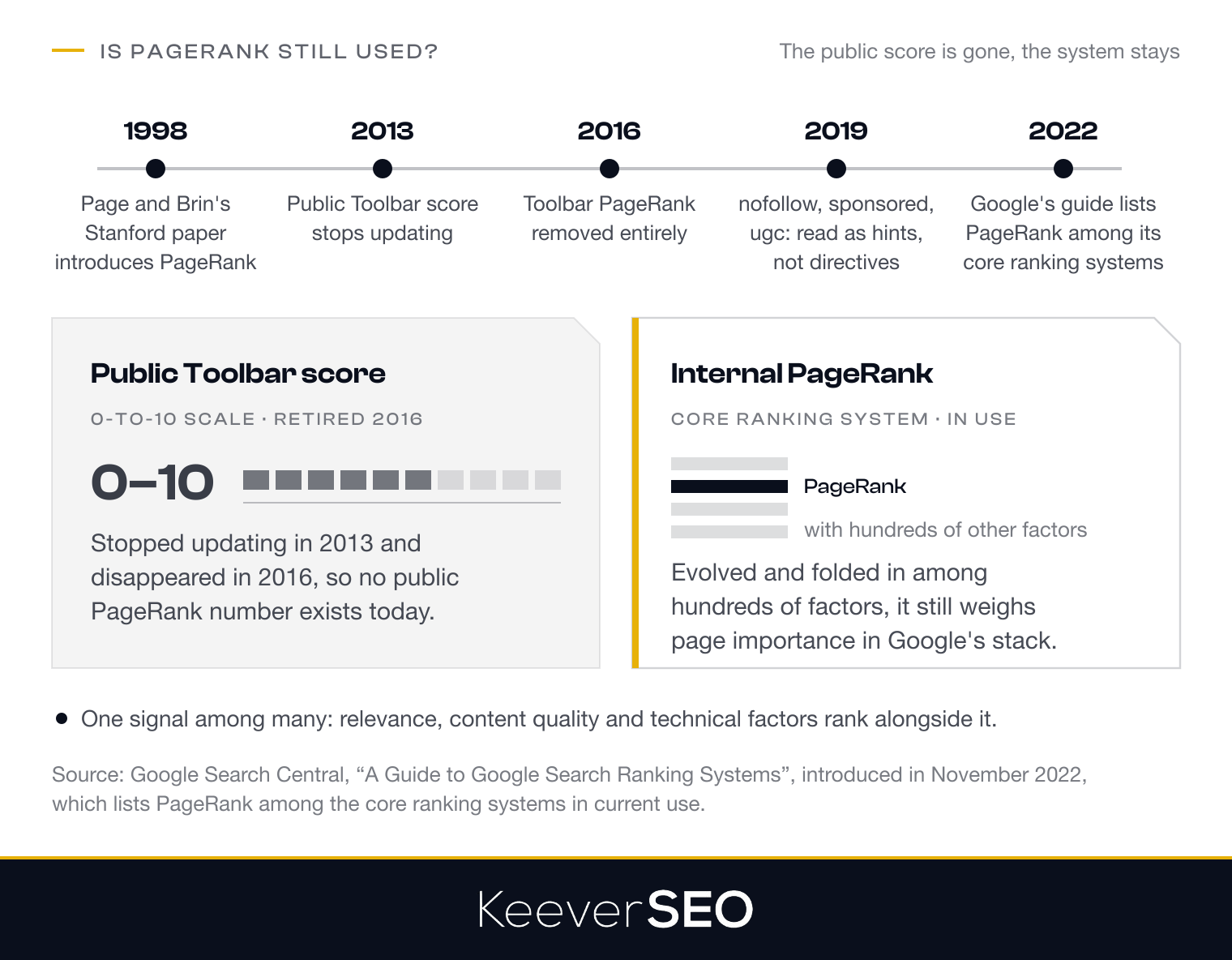
Yes, Google PageRank is still used as part of Google's core ranking systems. The public Toolbar PageRank score, the visible 0-to-10 number, stopped updating in 2013 and disappeared entirely in 2016, while the internal PageRank metric kept operating behind the scenes. The internal algorithm, evaluating page importance through link analysis, remains a working component of Google's ranking infrastructure, evolved over the years and folded in among hundreds of other factors that weigh relevance and authority. Google's "A Guide to Google Search Ranking Systems" lists PageRank among the core systems in current use, and the guide's November 2022 introduction on the Search Central blog confirms PageRank has evolved without ever leaving the core ranking stack.
How Can PageRank-Related SEO Improve Ethically?
PageRank-related SEO improves ethically by earning editorial links rather than manufacturing them. The core principle is content worth linking to: material that attracts references from reputable sources on its own merit, which matches Google's guidelines that links should represent genuine endorsements rather than attempts to game rankings.
The work centers on producing high-quality content, from original research and complete guides to data-driven analysis, that delivers real value to users and publishers, so links arrive organically. Strategic outreach and digital PR then put the assets in front of the right audiences, raising the odds of authentic backlinks while the site stays inside Google's standards.
How Can Original Resources Earn Relevant Editorial Backlinks?
Original resources earn relevant editorial backlinks by giving publishers something worth referencing:
- Linkable assets: high-value formats like complete guides, interactive tools, calculators, templates, infographics, and data visualizations, whose utility draws references naturally.
- Original research: proprietary studies, surveys, industry reports, and data analyses, which publishers and journalists cite as authoritative sources, generating editorial backlinks with each reference.
- Topical authority built through content clusters: content hubs organized around pillar pages and supporting cluster content, whose depth positions the site as the go-to resource in its niche and earns links whenever other sites need a trusted reference.
What Link Practices Should Websites Avoid?
The link practices websites should avoid are the manipulative patterns that violate Google's guidelines:
- Link spam: large-scale link exchanges, comment spam, and automated link programs that inflate PageRank without editorial merit, all detectable by Google's algorithms.
- Paid link schemes: buying or selling links that pass PageRank without disclosure, including paid placements in articles and advertorials, which undermine the editorial nature of links and draw manual penalties.
- Private blog networks (PBNs): networks of sites built solely to manipulate rankings, with no genuine editorial purpose; Google identifies the networks and penalizes the PBN and its beneficiaries together.
- Over-optimized anchor text: excessive exact-match keyword anchors that signal manipulation, where a natural profile mixes branded terms and generic phrases.
Each practice risks ranking demotions and lost trust; "Spam policies for Google web search," published by Google Search Central, prohibits them all explicitly, keeping naturally earned editorial links the only durable path.
What Should a PageRank SEO Audit Cover?
A PageRank SEO audit should cover the areas listed below:
- Internal link-equity flow: high-authority pages pass PageRank to key content and conversion pages, and strategic pages receive enough internal link support.
- Orphan pages: pages without internal links stay hard to find and miss out on PageRank and visibility.
- Broken and redirected links: links to 404 pages and links through redirect chains interrupt PageRank flow and degrade the experience.
- Crawlable internal links: internal links use standard HTML anchor tags so search engines can follow them.
- Click depth and site structure: important pages sit within a few clicks of the homepage, never buried in the architecture.
- Anchor text quality: internal links carry descriptive, relevant anchor text that communicates topic context.
- Redirect chains: no link passes through multiple redirects before resolving, so equity and crawl efficiency stay intact.
- Topic-cluster coverage: related pages link to each other and to their pillar pages, reinforcing the site's content groups.
- Indexable vs. non-indexable pages: pages meant to rank stay free of noindex tags and thin internal linking.
An audit across all nine areas keeps link equity working across the site instead of leaking away.
How Should an Audit Identify Orphan Pages, Broken Links, and Crawlable Internal Links?
An audit should identify orphan pages, broken links, and crawlable internal links through the checks below.
Orphan Pages Identification Compare the website's full crawl data against the sitemap or an analytics export. Any URL that appears in the sitemap but carries no internal inlinks gets flagged as an orphan, cut off from PageRank flow in both directions.
Broken Links Detection Run a complete site crawl that checks the HTTP status codes of internal and outbound links. Links returning 4xx errors, 404 above all, get cataloged as broken, since each one interrupts PageRank flow and needs updating or removal.
Crawlable Internal Links Confirmation Confirm internal links sit in standard HTML <a href> tags, return a valid 200 status, and stay unblocked by robots.txt and meta robots tags, so no technical barrier hides them from crawlers.
The three checks together protect the structural integrity of the site and the link equity moving through it.
When Should You Hire an SEO Agency for Link Strategy?
You should hire an SEO agency for link strategy when the website lacks the internal resources or skills to run a complete, ethical link-building campaign. Businesses reach that point after exhausting the easy wins, from fixing broken links to reclaiming lost backlinks, when the next gains demand editorial outreach and digital PR. Competitive niches raise the bar further, since quality backlinks there take original research and established industry connections.
An agency earns its fee when the business cannot spare the time to prospect link opportunities, run outreach, and measure link impact on visibility and traffic. As your SEO partner, we build high-authority, relevant backlinks through white-hat methods that comply with Google's guidelines, steering the equity toward the pages that move organic growth. The hire becomes clear when the site's revenue potential justifies a proven link-building process that delivers measurable ranking gains and protects against algorithm penalties.
When Does a Website Need an Internal-Linking Plan?
A website needs a dedicated internal-linking plan when it grows past roughly 50 to 100 pages. The need shows when key pages start losing search visibility despite strong external backlinks. Sites with layered content hierarchies, multiple product categories, or a fast publishing rhythm gain the most from structured internal linking, which keeps PageRank flowing to priority pages and stops content from ending up orphaned or buried.
How Should an SEO Agency Build Links?
An SEO agency should build links through editorial methods that earn authority rather than buy it. Our link building agency works four core methods:
- Editorial outreach: contacting relevant websites and publications with content and expert input worth linking to, building relationships that earn links on merit.
- Digital PR: creating newsworthy stories, original research, and timely industry commentary that secure media coverage and editorial mentions from authoritative news sites.
- Linkable assets: developing complete guides, original research reports, interactive tools, infographics, and calculators that other creators reference on their own.
- Relevant guest placements: contributing substantive articles to authoritative, topically relevant sites, earning contextual backlinks through genuine added value rather than volume guest posting.
Links built through those methods raise PageRank and search visibility together, and their results feed straight into measurement.
How Should an SEO Agency Measure Link Results?
An SEO agency should measure link results across the five metrics below. We track each one per campaign:
- Referring domains: the count of distinct websites linking to the client's site, where growth marks expanding link authority and a healthier profile.
- Referring-domain authority: the quality and trustworthiness of linking sites, read through domain authority or domain rating scores, since high-authority domains pass more PageRank.
- Organic traffic: changes in organic visits over time, where successful campaigns show up as rising search sessions.
- Keyword rankings: position movements for target terms, verifying that acquired links convert into SERP gains.
- Conversions: goal completions from form fills to purchases, proving the link equity produces qualified leads and revenue, not just visits.
Reading the five metrics together, we quantify the return on link investment, identify the outreach tactics that work, and adjust strategy toward the strongest ranking and business impact.
Can Link Building Improve Google Rankings Alone?
No, link building alone cannot improve Google rankings. PageRank and link authority are necessary for SEO success without being sufficient: Google's algorithm weighs signals well beyond link equity, from content relevance and search-intent alignment to technical factors like page speed and mobile compatibility.
A page can accumulate serious PageRank through quality backlinks and still fail to rank when its content misses user intent or lacks depth. Top-ranking pages pair strong link profiles with relevant, complete content and solid technical foundations; Backlinko's large-scale ranking analysis found content quality correlates with position alongside links, and the weight of relevance in Google's algorithm has only grown. PageRank works best as one pillar in a structure that stands on several.
What Should You Remember About Google PageRank?
What to remember about Google PageRank comes down to four points:
- Definition and origin: PageRank is the link analysis algorithm Larry Page and Sergey Brin developed at Stanford University, assigning each page a numerical importance value through the link-vote mechanism.
- Link-vote mechanism: a page's importance follows the quantity and quality of links pointing at it, with links from high-authority sites carrying the heaviest votes.
- Ongoing role in ranking: PageRank remains part of Google's ranking systems, feeding the assessment of relevance and authority even as the public score is long gone.
- Ethical link building: durable PageRank gains come from editorial links earned through content quality, while manipulative shortcuts like link farms end in penalties.
Held together, the four points keep PageRank in its right place: a lasting measure of page importance and a compass for ethical SEO strategy.