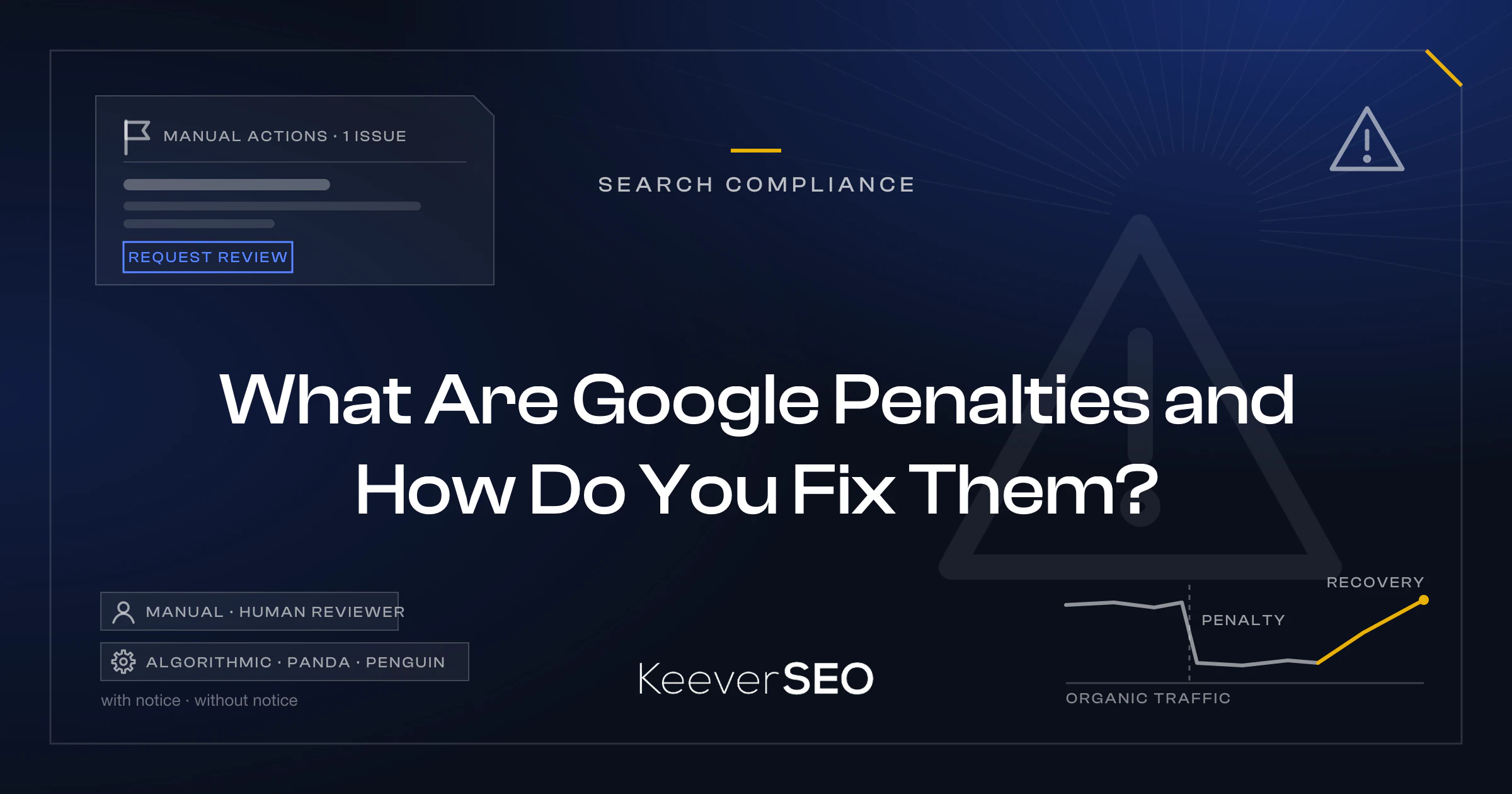
Google penalties are actions Google takes to suppress a website's ranking or visibility over violations of its spam policies. A penalty can gut a site's search performance, which makes the fix-and-recover path worth knowing in advance. The core mechanisms split in two: manual actions, applied by human reviewers when a site violates the spam policies, and algorithmic penalties, applied automatically by ranking systems in the lineage of Panda and Penguin.
The violation types run from keyword stuffing, cloaking, and hacked content to doorway pages, thin content, unnatural links, and user-generated spam, each capable of cutting rankings or removing pages from results. Penalties matter because they hit rankings and organic traffic directly, and revenue follows traffic. Recovery starts with detection through Google Search Console's Manual Actions and Security Issues reports, then runs through confirming the ranking loss, identifying the violation, fixing the issues, and, for manual actions, submitting a reconsideration request, with monitoring and safeguards closing the loop.
Detection combines the Search Console reports with traffic analysis against Google's algorithm update calendar. The eight-step recovery sequence covers confirming the loss, checking Manual Actions and Security Issues, measuring affected pages, separating penalties from technical issues and core updates, identifying the violation, fixing every affected asset, submitting the reconsideration request, and monitoring recovery. Link spam gets fixed through backlink audits and disavow files, low-quality content through rewrites and removals. Timelines vary by penalty type, complex cases justify an SEO professional, and an agency can carry the audits, fixes, and reconsideration work, at a cost scaled to the penalty's severity and the site's size. Prevention runs on monitoring and quality standards that keep the next penalty from arriving.
What are Google penalties?
Google penalties are ranking or visibility suppressions Google applies to websites that violate its Search Essentials and spam policies. Google issues the penalties to enforce its guidelines, and a penalized site can face reduced rankings, falling traffic, or removal from search results altogether.
Google penalties come in two types: manual and algorithmic. Manual penalties come from human reviewers at Google when a site breaks the spam policies. Algorithmic penalties run automatically, landing when a site trips an algorithm update. Both types enforce the same standards, the prohibitions on keyword stuffing, cloaking, unnatural links, and the rest of the spam catalog.
The manual-versus-algorithmic split matters because each type follows a different enforcement path and demands a different recovery, starting with how the penalties actually work.
How do Google penalties work?
Google penalties work through two mechanisms: manual actions and algorithmic ranking systems. Manual actions come from human reviewers who assess sites against the spam policies, applying penalties to individual pages or whole websites, cutting visibility or removing them from results. A manual action puts the ball in the site owner's court: fix the issues, then submit a reconsideration request through Google Search Console.
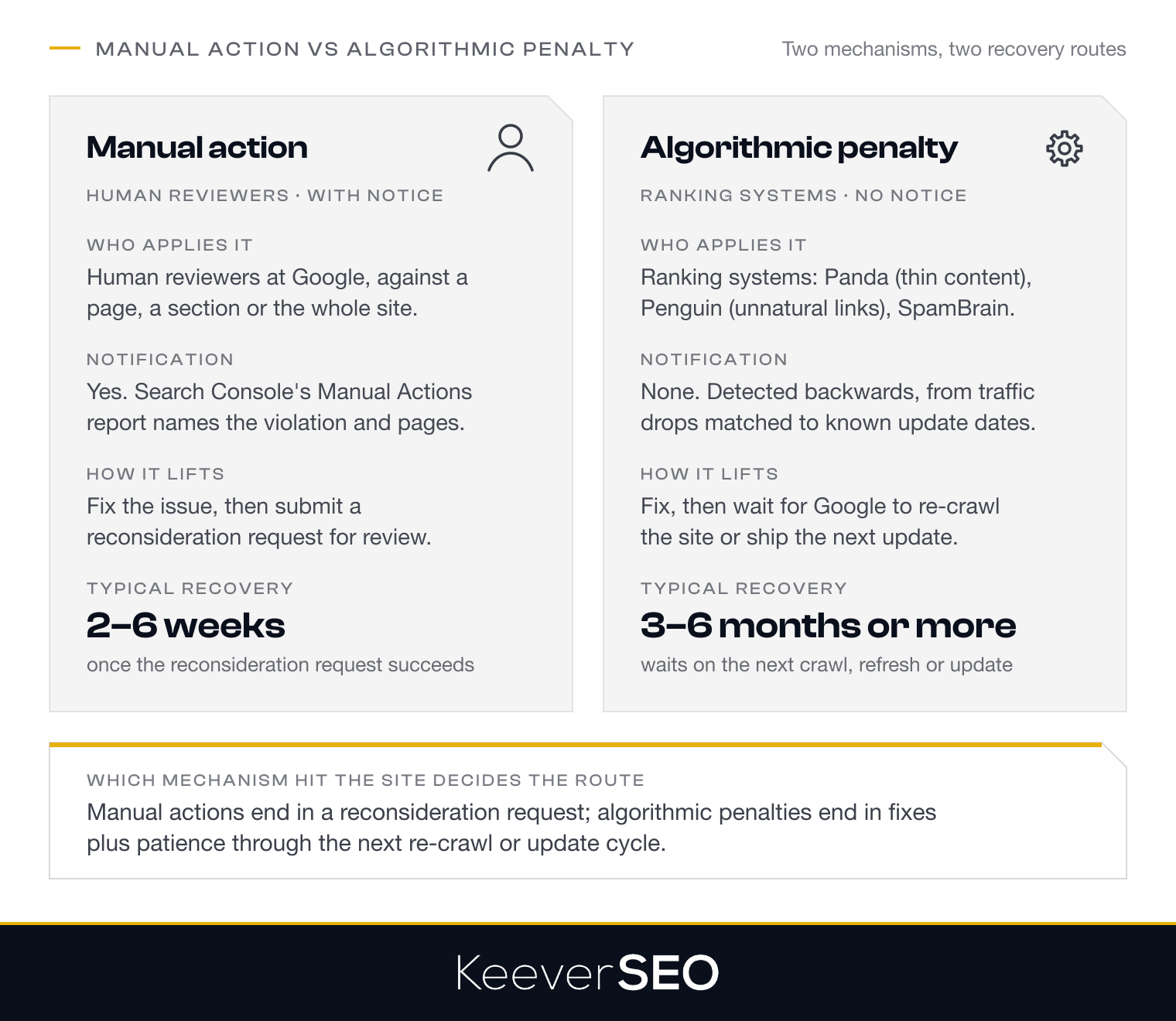
Algorithmic penalties come from the ranking algorithms themselves, with no human in the loop. Systems in the Panda and Penguin lineage detect violations during their continuous evaluation and adjust rankings without any notification, and recovery waits on Google re-crawling the fixed site or shipping the next update. Knowing which type hit a site decides the recovery route, and the decision starts with how Google identifies violations in the first place.
How does Google identify and act on spam-policy violations?
Google identifies and acts on spam-policy violations through automated systems working alongside human review. The automated side scans and analyzes websites continuously, catching technical violations like keyword stuffing, cloaking, thin content, and unnatural link patterns, and it can adjust a site's rankings the moment a violation registers, with no notification sent.
Where automation needs judgment, human reviewers step in. Reviewers investigate sites flagged by the algorithms or reported through spam reports, reading the context and intent that automated tools miss. A confirmed violation becomes a formal manual action in Google Search Console's Manual Actions report, requiring explicit remediation and a reconsideration request. The two layers split the work cleanly: algorithms carry scale and speed, reviewers carry the cases needing contextual judgment, and enforcement lands as automated ranking adjustments or documented manual actions accordingly.
How does Google evaluate spam-policy signals?
Google evaluates spam-policy signals by checking site-level and page-level indicators against the spam policies and Search Essentials guidelines. The evaluation reads content quality, link profiles, and keyword usage patterns. Site-level signals cover sitewide link quality and security status, while page-level signals cover content originality and keyword density. The systems score the signals against defined policies, keyword stuffing and cloaking among them, and the outcome routes each case: a manual action, or an algorithmic ranking adjustment.
How does Google apply manual actions or algorithmic ranking systems?
Google applies penalties through manual actions and algorithmic ranking systems, two mechanisms with different triggers and exits. Manual actions run through human reviewers who check a website against the spam policies; a confirmed violation brings an action against individual pages or the whole site, and lifting it requires fixing the issue and submitting a reconsideration request through Google Search Console.
Algorithmic ranking systems operate on their own. Panda, Penguin, and SpamBrain evaluate websites continuously during crawling and ranking, applying demotions and visibility suppressions without notice. An algorithmic adjustment lifts only when Google re-crawls the corrected site or ships a later update that reassesses the content or links.
Which mechanism hit a site decides everything that follows: the penalty types in play, the recovery process, and the timeline.
What types of Google penalties affect websites?
The types of Google penalties that affect websites fall into two categories: manual actions and algorithmic penalties, the twin enforcement arms of Google's spam policies and Search Essentials.
Manual Actions Manual actions come from human reviewers at Google when a site breaks the spam policies. The site owner gets notified through Google Search Console's Manual Actions report, and lifting the action takes a fix plus a reconsideration request. Manual actions arrive documented and precise, and they exit through a formal review.
Algorithmic Penalties Algorithmic penalties are automatic ranking suppressions from Google's systems, Panda against thin content, Penguin against unnatural links, and their successors. No notification goes out; the penalties run continuously as Google crawls and re-evaluates pages, lifting only after fixes get re-crawled or the next update lands. Detection works backwards, through traffic analysis and ranking drops matched against known update dates.
The two categories define the recovery paths: manual actions end in reconsideration requests, algorithmic penalties end in fixes plus patience through the next re-crawl or update cycle.
What is a Google manual action?
A Google manual action is a penalty issued by a human reviewer at Google when a website violates the spam policies. Where algorithmic penalties run automated, a manual action comes from direct human evaluation, and it arrives with notice: the Manual Actions report in Google Search Console details the violation, the affected pages or sections, and the specific policy breached.
Resolving a manual action means removing the manipulative practice, unnatural links, cloaking, whatever the report names, then submitting a reconsideration request through Search Console with documentation of the fixes and evidence of compliance. Google's reviewers then decide whether the action lifts, the formal review that separates manual actions from their silent algorithmic counterparts.
What is an algorithmic Google penalty?
An algorithmic Google penalty is an automatic ranking demotion applied by Google's systems without human intervention. No notification goes to the site owner, and the penalty lifts only when Google re-crawls or re-evaluates the fixed pages. The systems behind algorithmic penalties include Panda, aimed at low-quality content; Penguin, aimed at manipulative link schemes; and SpamBrain, the AI layer detecting spam patterns. Algorithmic penalties differ from core updates, which shift rankings broadly on content quality rather than punishing named spam-policy violations, and the difference shows in how each affects rankings.
How do algorithmic penalties affect Google Search rankings?
Algorithmic penalties affect Google Search rankings by re-evaluating pages automatically against the spam policies and quality guidelines. When systems in the Panda and Penguin lineage detect violations, they adjust the affected pages' rankings without human involvement, suppressing visibility for the queries where the pages ranked, and traffic falls with position. The suppression holds until the site gets re-crawled with the issues fixed, usually at the next refresh or update cycle, and the trigger is always a concrete violation, keyword stuffing and unnatural links first among them.
What is keyword stuffing in Google penalties?
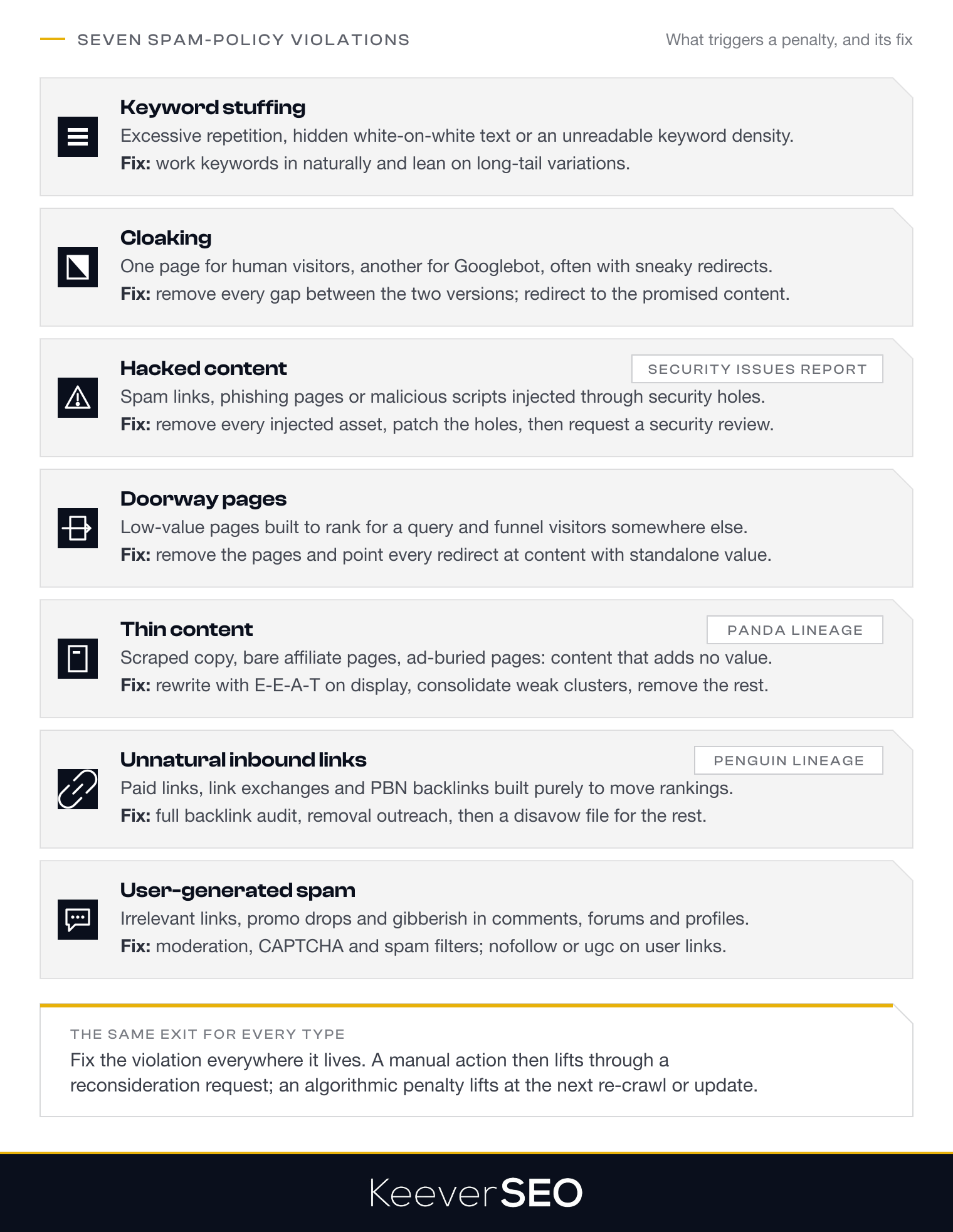
Keyword stuffing in Google penalties is the excessive, unnatural repetition of keywords through a page's content, a manipulation attempt that leaves the text awkward and repetitive. Keyword stuffing shows up in defined patterns:
- Over-repetition: keywords repeated to excess in the main content, breaking the natural flow.
- Hidden text: keywords in white-on-white text or styled invisible to users while readable to crawlers.
- Unnatural keyword density: a keyword frequency high enough to make the content hard to read.
Google's spam detection reads keyword usage against natural language patterns to catch stuffing. The clean alternative works keywords into well-written content naturally, leaning on long-tail variations instead of hammering one term.
What is cloaking in Google penalties?
Cloaking in Google penalties is the deceptive serving of different content to users and to search engine crawlers like Googlebot. The manipulation shows one version of a page to human visitors and another to the engines, chasing rankings the visible content could not earn. Cloaking travels with sneaky redirects, where users land somewhere other than what Googlebot saw or the results promised.
Common methods include text and keywords invisible to users but readable to crawlers, and user-agent detection serving different pages by visitor type. Fixing a cloaking penalty means eliminating every gap between what users and Googlebot see, pointing redirects at the intended content, and, when a manual action is attached, submitting a reconsideration request through Google Search Console.
What is hacked content or a hacked website in Google penalties?
Hacked content in Google penalties is unauthorized modification of a website's pages or code through exploited security vulnerabilities. Attackers inject spam links, phishing pages, or malicious scripts that deceive users and endanger them, and Google treats the result as a serious spam-policy violation because it corrodes result quality and user trust.
Detected hacked content triggers notification through the Security Issues report in Google Search Console, and the consequences range from warning labels in results to heavy ranking suppression and removal of the affected pages from the index. Recovery runs through removing every injected asset, patching the vulnerabilities, hardening security, and requesting a review through Search Console once the site stands clean.
What are doorway pages in Google penalties?
Doorway pages in Google penalties are low-value pages built to rank for targeted queries and funnel visitors elsewhere, carrying minimal or no content of their own. Doorway violations overlap with thin content, since the pages exist as gateways rather than answers. Google penalizes the pattern because it misleads searchers who expect relevant content and meet a pass-through page instead. Fixing a doorway penalty means removing the pages and pointing every redirect at content with genuine standalone value.
What is thin content in Google penalties?
Thin content in Google penalties is page content that adds little or no value for users, falling short of Google's quality standards. Thin content spans pages with minimal substantive information, scraped or copied material, affiliate pages republishing product descriptions without commentary, doorway pages built for engines, and pages where ads bury the content. The pattern violates Search Essentials and the spam policies alike.
Recovery from a thin-content penalty runs through quality: rewriting affected pages to add genuine value with expertise, experience, authoritativeness, and trustworthiness (E-E-A-T) on display, consolidating clusters of weak pages into complete resources, and removing the pages beyond saving.
What are unnatural or low-quality inbound links in Google penalties?
Unnatural or low-quality inbound links in Google penalties are backlinks that violate the spam policies by manipulating rankings artificially. The links come from link schemes: paid links passing PageRank, exchanges built purely for rankings, and private blog networks (PBNs) manufacturing backlinks. Google's Penguin lineage targets exactly that manipulation.
Fixing an unnatural-links penalty starts with a full backlink audit separating legitimate links from spam. Outreach to the linking sites removes what can be removed, and the disavow tool covers the rest, telling Google which backlinks to ignore when assessing the site. White-hat link practices and regular audits keep the profile clean afterward.
What is user-generated spam content in Google penalties?
User-generated spam content in Google penalties is spam contributed by users through a site's interactive surfaces: comments, forums, and profiles. The spam runs to irrelevant links, promotional drops, and gibberish planted to manipulate rankings, and weak moderation is what separates a spammed site from a healthy community. Google penalizes sites that let the spam stand, since unmoderated spam violates the policies and drags on credibility and visibility together. Moderation and filtering tools are the standing defense, and the stakes are the same as every other violation: rankings and organic traffic.
Why do Google penalties matter for rankings and organic traffic?
Google penalties matter for rankings and organic traffic because suppression lands directly on both. A penalized site loses positions, and since most users never pass the first page of results, lost positions mean lost traffic at scale, and lost revenue behind it for any business that leans on organic search. The documented cases show the ceiling: J.C. Penney lost its top rankings across major commercial terms to a manual action, as reported in The New York Times' investigation "The Dirty Little Secrets of Search" by David Segal, February 2011, and BMW's German site left Google's index entirely over doorway pages, as The Register documented in February 2006, overnight losses of the visibility their businesses had built on.
The damage outlasts the traffic drop. A penalty erodes the trust signals Google uses to evaluate quality, making rankings harder to regain even after the violation is fixed, and the effect compounds when a penalty lands alongside an algorithm update that resets the site's quality assessment. Penalties threaten immediate traffic and long-term competitive standing at once, which is why prevention and fast recovery both pay.
Who needs Google penalty recovery after a traffic loss?
The sites that need Google penalty recovery after a traffic loss are the ones whose revenue rides on search visibility: e-commerce sites, content publishers, and local businesses first. When a penalty hits core landing pages or a large site section, traffic and revenue fall together.
E-commerce platforms lean on organic search for acquisition and sales, so lost visibility converts straight into lost income. Content publishers funded by advertising need the recovery fast to protect revenue. Local businesses losing location-based queries lose foot traffic behind them, and enterprise sites with widespread technical or content violations face recovery across thousands of pages.
Urgency peaks when the traffic decline is sharp, sustained, and matched to a manual action or a known update. The first move is always the same: confirm whether the drop traces to a manual action, an algorithmic change, or a technical fault, and route the recovery accordingly.
How do I know if Google penalized my site?
You know if Google penalized your site by checking Google Search Console's Manual Actions and Security Issues reports first. Both reports notify directly: a manual action entry names the violation and the affected pages, and the Security Issues report flags hacked or malicious content. A clean pair of reports rules out the documented penalty types.
Without a notification, the evidence is behavioral: sharp drops in organic traffic and rankings, read against Google's algorithm update calendar. A decline that lines up with a known core or spam update points to an algorithmic penalty, which never announces itself.
Cross-referencing the loss dates with the update timeline separates algorithmic penalties from other causes. A drop during an update window calls for an audit against Google's spam policies to find the root violation, and that diagnostic read opens the recovery sequence.
1. Confirm the Google ranking loss
Confirming the Google ranking loss anchors the whole recovery. Segment organic search traffic in Google Analytics down to Google specifically, excluding direct, referral, and paid sources, and look for hard drops in sessions, users, and pageviews from Google's results.
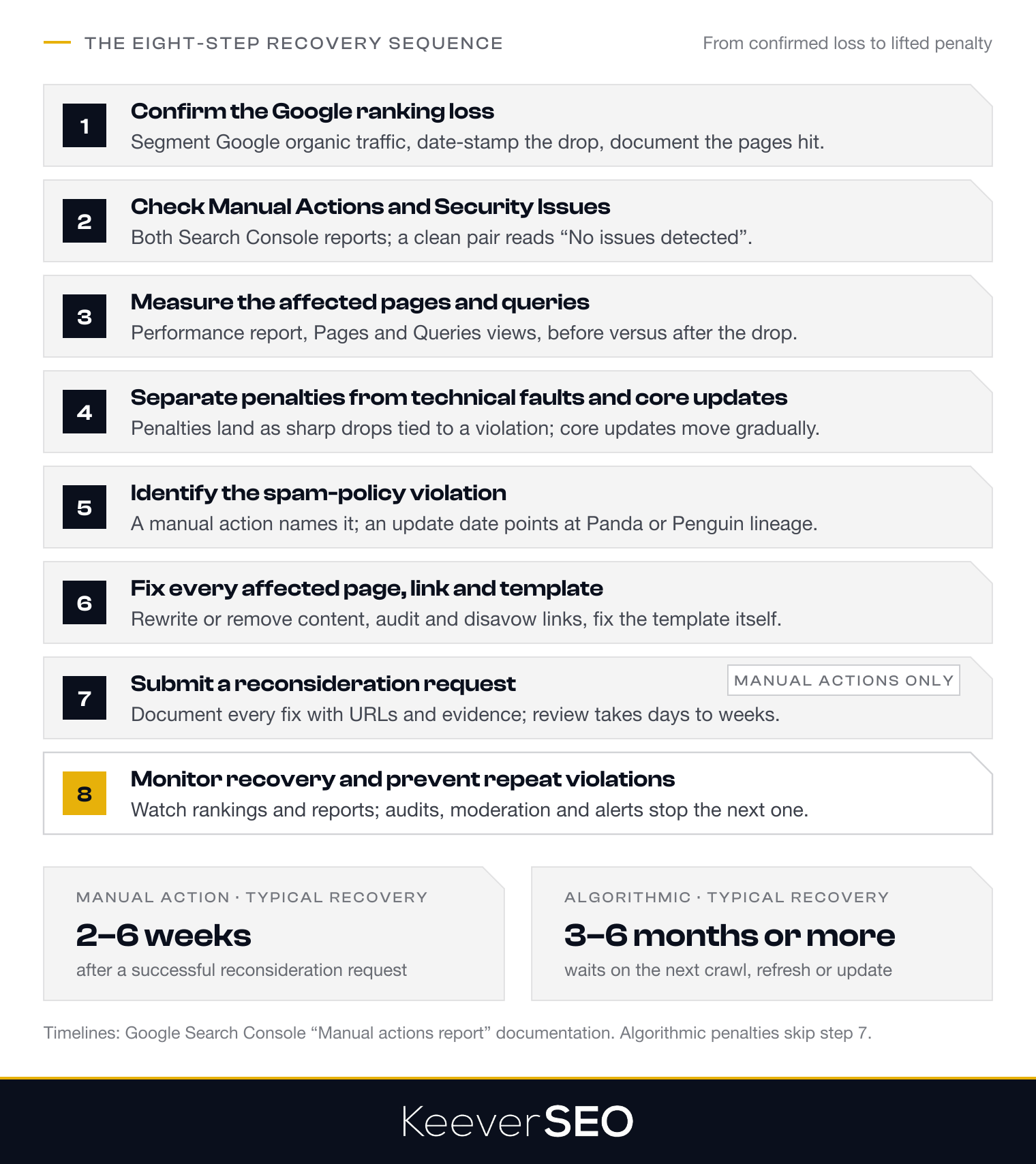
Date-stamping the decline matters most: fix the exact moment performance degraded by comparing the affected period against the prior one. Document the percentage lost, the pages hit hardest, and whether the damage covers the whole site or defined sections, then cross-reference the drop date against Google's public update history for a match with a core or link spam update.
With the loss confirmed and date-stamped, the diagnosis moves to Search Console's Manual Actions and Security Issues reports.
2. Check Manual Actions and Security Issues
Checking Manual Actions and Security Issues in Google Search Console confirms whether human reviewers penalized the site or security compromises triggered the loss.
Accessing the Manual Actions Report In Google Search Console, open the website property, then "Security & Manual Actions" in the sidebar, then "Manual actions." An active manual action shows the violation, the affected pages, and the breached spam policy; a clean report reads "No issues detected."
Checking Security Issues In the same section, "Security issues" lists any compromise: hacking, malicious code, phishing content, with affected URLs and discovery dates. "No issues detected" clears the site. Both reports update as Google detects and resolves issues, making them the authoritative confirmation of penalty type, and a flagged issue hands the recovery its next step: measuring exactly which pages and queries took the hit.
3. Measure the affected pages and queries
Measuring the affected pages and queries turns the loss into a map. In Google Search Console's Performance report, open the Pages view and compare the period before the drop against the period after on clicks, impressions, and average position, isolating the URLs that lost the most.
The Queries view runs the same comparison on search terms, showing which queries carried the loss. The split matters: a loss isolated to defined pages or queries points differently than a site-wide decline, and the timing, checked once more against the update calendar, ties the pattern to a core update, a spam refresh, or neither.
The measured map of pages and queries feeds the next distinction: penalty, technical fault, or core update.
4. Separate penalties from technical SEO issues and core updates
Separating penalties from technical SEO issues and core updates keeps the recovery aimed at the right target. A penalty ties to a named spam-policy violation; technical faults and core updates produce similar traffic drops without one. Technical candidates include crawl errors, indexing failures, and server downtime, while core updates re-evaluate content quality broadly rather than punishing violations.
The separation runs through a site audit: crawl errors checked in Search Console, indexability verified, server performance cleared. A decline matching a core update with no manual action attached points to content quality, not a penalty; penalties tend to land as sharp, well-defined drops tied to a violation, while core updates move rankings gradually across queries and pages. With technical causes excluded and no core-update match, the search narrows to the specific spam-policy violation.
5. Identify the Google spam policy violation
Identifying the Google spam policy violation maps the observed damage onto a named rule in the Search Essentials and spam policies. Start from the pages that lost rankings and look for the patterns: content, structure, or link profiles matching known violations. A manual action shortens the search, since the notification names the violation outright, "thin content with little or no added value," "unnatural links to your site."
For algorithmic penalties, the drop's timing points at the system: Panda-lineage updates for content quality, Penguin-lineage for link spam. The page review looks for the signatures, excessive keyword repetition, content mismatches between users and Googlebot, suspicious backlink profiles heavy with paid links, backed by a content audit and backlink analysis through Search Console and dedicated SEO tools.
With the violation named, the fix phase begins, covering every affected page, link, and template.
6. Fix every affected page, link, and template
Fixing every affected page, link, and template clears the violation everywhere it lives, not just where it was noticed.
Content Rewrites Content penalties, keyword stuffing, thin content, doorway pages, get fixed by rewriting or removing the affected pages. Rewrites center on user value with keywords worked in naturally; thin and duplicate pages get consolidated with related pages, expanded with original information, or removed when nothing can save them.
Link Spam Cleanup Link penalties get fixed through a full backlink audit, catching manipulative links from PBNs and paid schemes. Outreach to webmasters removes what it can, the disavow file covers the rest through Google's Disavow Tool, and sitewide footer or sidebar links implicated in the penalty get removed or nofollowed across every page.
Template-Wide Fixes Violations baked into templates get fixed at the template, updating the source module so the pattern disappears from every page at once. The fixed pages must stay reachable for Googlebot, with no noindex, robots.txt block, or login wall standing between the fix and the re-crawl. With the cleanup verified, a manual action moves to reconsideration.
7. Submit a reconsideration request for a manual action
Submitting a reconsideration request applies to manual actions only: the formal ask for Google to re-review the site after the fixes. The request goes through the Manual Actions report in Google Search Console, via "Request Review."
A strong request documents honestly and completely: which pages were affected, what was rewritten or removed, which links were disavowed, which templates were corrected, with examples and URLs. Acknowledging the violation, explaining its root cause, and showing the safeguards against recurrence carry the request with Google's human reviewers.
Review takes days to weeks, and the outcome lands in Search Console: action lifted, or more work needed. An approval opens the final phase, monitoring the recovery while keeping the safeguards on.
8. Monitor recovery and prevent repeat violations
Monitoring recovery and preventing repeat violations closes the loop. After a lifted manual action or a completed algorithmic fix, rankings and the relevant Search Console reports need steady watching, since visibility returns incrementally across the affected pages, queries, and sections.
Prevention holds the ground gained. Editorial review and content moderation keep the site aligned with the spam policies, and regular backlink audits catch new toxic links before they trigger the next penalty. Sites carrying user-generated content run active moderation, spam filters, CAPTCHA, and nofollow or ugc attributes on user links. Documented compliance processes and internal guidelines for content, links, and technical SEO keep the team clear of penalty-prone practices.
Automated alerts on traffic drops and recurring audits complete the framework: proactive monitoring, documented process, and trained people, protecting the recovered visibility and the organic growth built on it.
What are the signs and common causes of a Google penalty?
The signs and common causes of a Google penalty are listed below:
- Sudden drop in organic traffic: the classic marker of a spam-policy violation taking effect.
- Disappearance from search results: absence even on branded queries points to severe violations like cloaking or hacked content.
- Manual action notification in Google Search Console: the explicit confirmation, naming violations like thin content or user-generated spam.
- Rankings drop for high-volume keywords: competitive terms falling together suggests algorithmic action.
- Entire site or section deindexed: the severest outcome, following hacked content or massive duplication.
- Traffic drop coinciding with algorithm updates: losses on update dates mark algorithmic penalties.
- Loss of featured snippets and rich results: structured-data manipulation or quality problems pulling enhanced placements.
- Excessive keyword density and unnatural repetition: the keyword-stuffing signature.
- Backlink profile dominated by low-quality links: the link-scheme signature.
- Duplicate or scraped content across pages: the thin-content trigger at scale.
- User-generated spam in comments, forums, or profiles: unmoderated contributions carrying penalties inward.
- Pages designed solely to funnel users elsewhere: the doorway-page pattern.
- Different content for users versus Googlebot: cloaking, penalized on detection.
- Security issues and malware warnings: hacked-content penalties waiting on remediation.
- Intrusive pop-ups and interstitials: usability violations bringing ranking suppression.
- Misleading or deceptive structured data markup: markup that deceives users or engines, penalized as structured-data spam.
How do you fix link spam and low-quality content penalties?
You fix link spam and low-quality content penalties through separate corrective tracks, one per violation type.
Link Spam Fix:
- Conduct a backlink audit: analyze the full profile and isolate harmful links from schemes and private blog networks (PBNs).
- Request link removals: contact the hosting webmasters, ask for removal, and document the outreach.
- Create a disavow file: compile the unremovable links and submit the file through Google Search Console.
- Monitor the link profile: keep auditing so new spam never accumulates.
Low-Quality Content Fix:
- Audit site content: flag thin, duplicate, and scraped pages against the quality bar.
- Rewrite pages worth saving: add original, useful information matched to user intent.
- Consolidate thin pages: merge overlapping weak pages into complete resources behind 301 redirects.
- Remove the irredeemable: delete doorway pages and auto-generated spam with proper status codes, 410 Gone or 404 Not Found.
- Fix template issues: correct the site-wide patterns feeding low-quality output.
With links and content cleaned, prevention turns to the remaining vector: user-generated spam.
How do you prevent user-generated spam content that can cause Google penalties?
You prevent user-generated spam content through the defenses listed below:
- Enable comment and profile moderation: review user submissions before they publish, catching spam at the gate.
- Deploy CAPTCHA and spam filtering: block automated submissions on forms and comments, with filtering plugins catching the common patterns.
- Apply nofollow or ugc link attributes: mark user-contributed links rel="nofollow" or rel="ugc" so they pass no PageRank and carry no association.
- Disable comments where they add nothing: when spam outruns moderation, closing comments on low-value pages removes the vector entirely.
The same posture extends outward to the links pointing in.
How do you prevent unnatural inbound links that can cause Google penalties?
You prevent unnatural inbound links through the link-hygiene practices listed below:
- Vet link sources carefully: weigh the quality and relevance of every prospective backlink source, declining links from weak or unrelated sites.
- Avoid paid links and link schemes: no purchased links, no exchanges, no private blog networks (PBNs), the practices the spam policies name.
- Run ongoing backlink monitoring: audit the profile on a schedule, set alerts for new toxic links, and disavow them as they appear.
Held together, the practices keep the backlink profile clean and the penalties theoretical.
How long does Google penalty recovery take?
Google penalty recovery takes from a few weeks to many months, split by penalty type. Manual penalty recovery runs roughly 2 to 6 weeks after a successful reconsideration request: Google's Search Console documentation "Manual actions report" puts most reconsideration reviews at several days to a few weeks, link-related cases longer, and once the action lifts, rankings can start moving within days while full recovery takes additional weeks.
Algorithmic penalty recovery runs longer, commonly 3 to 6 months or more, because it waits on Google's re-evaluation at the next crawl, refresh, or update cycle. The timing depends on the violation's severity and the thoroughness of the fixes, and it stays less predictable than the manual path, since no reviewer confirms the work; the next update simply lands, and the corrected site either recovers or reveals what remains unfixed.
When should a business hire an SEO professional for a Google penalty?
A business should hire an SEO professional for a Google penalty when the case outgrows internal skills. The deciding signals: severe traffic loss, an unclear cause, and sitewide scope. Link spam, hacked content, and unresolved manual actions all reward specialist handling, and the red flags are concrete, not knowing which pages are affected, not grasping the manual action's violation, or needing a second reconsideration request after a denial. A specialist diagnoses the root cause, executes the fixes, and builds the documentation the recovery depends on, which is exactly the work an agency packages.
What can an SEO agency do for Google penalty recovery?
As an SEO agency, we carry Google penalty recovery end to end. Our work opens with a full site audit that finds the penalty's root cause, unnatural links, thin content, or another violation, then measures the damage: affected pages and queries mapped, traffic segmented, dates cross-referenced against algorithm updates and the Manual Actions report. The fixes follow the diagnosis, rewriting or removing thin content, auditing backlinks for toxic links, and building disavow files against the harmful remainder.
For manual actions, we prepare and submit the reconsideration request, documenting every corrective step with evidence. Through the recovery, we track rankings, organic traffic, and Search Console reports, confirming the fixes hold and the penalty lifts on the following crawls and updates. The whole engagement molds to the site's actual damage, which is where custom recovery separates from packaged fixes.
What are non-cookie-cutter SEO services for Google penalty recovery?
Non-cookie-cutter SEO services for Google penalty recovery are engagements built around the actual site, penalty, and business rather than a standard package:
- Full site audit: a detailed examination pinning the penalty's exact nature, link, content, or technical.
- Customized recovery plan: a strategy aimed at the identified violations and root causes, never a generic checklist.
- Prioritized fixes: the pages and signals that matter most to recovery handled first.
- Adaptive timeline: scope and schedule fitted to the actual penalties and the business's goals.
Recovery shaped to the site's business model and link history lands better and lasts longer than any one-size approach.
How do you choose an SEO agency for Google penalty recovery?
You choose an SEO agency for Google penalty recovery on defined criteria, while watching for the red flags.
Selection Criteria
- Proven penalty recovery experience: documented case studies of lifted manual actions and recovered algorithmic suppressions, the record we build our practice on.
- Transparent audit and diagnostic process: a full site audit with a clear explanation of how the root cause gets identified.
- Custom recovery strategy: recovery fitted to the site, never a package.
- Documented cleanup and reconsideration skill: thorough reconsideration requests with cleanup evidence and honest acknowledgment of the violations.
- Backlink audit and disavow competency: professional tooling for audits, toxic-link identification, and correct disavow files.
- Ongoing monitoring and prevention safeguards: post-recovery tracking and the safeguards against repeat violations.
Red Flags to Avoid
- Guaranteed instant results: promises of instant recovery or guaranteed rankings never survive contact with reality.
- Lack of transparency: refusal to explain methods or show verifiable recovery cases.
- Risky tactics: recommendations of paid links, link schemes, or cloaking, the road back into penalties.
- Long contracts before diagnosis: commitment demanded before any audit or cleanup.
- No prevention story: inability to show how repeat violations and negative SEO get stopped.
An agency clearing the criteria without the flags, like our SEO consultancy, can carry a site from penalty back to performance.
How much does Google penalty recovery cost?
Google penalty recovery costs run from roughly $500 to $10,000 and beyond, scaled by the penalty's severity and the site's size and structure; industry pricing guides such as SEO Sherpa's "SEO Pricing" benchmark place project-based recovery work in the same range, from about $1,000 to well past $10,000 by scope. The cost drivers are the penalty's type and scope, the count of affected pages and backlinks, and the depth of cleanup required, with sitewide manual actions costing more than page-level fixes and heavy content rewrites or link cleanups pushing toward the top of the range.
Smaller, contained issues land around $500 to $2,000. Mid-range recoveries with moderate link cleanup or content overhauls run $2,000 to $5,000, and enterprise recoveries against severe manual actions, sprawling link schemes, or site-wide thin content pass $10,000. Early detection pays directly: a problem isolated to a few pages or links costs a fraction of one left to spread.
Agency experience, backlink-audit hours, and content-remediation depth complete the bill. A site carrying thousands of low-quality inbound links or thin content across whole sections demands proportionally more work, and service packages tend to fold in the ongoing monitoring and prevention that keep the spend from repeating.
How can an SEO agency prevent future Google penalties and address negative SEO?
We prevent future Google penalties through standing surveillance and proactive defense. Backlink profiles get monitored continuously for suspicious link-building, with regular vetting neutralizing harmful inbound links before they trigger anything. A maintained disavow file guards against negative SEO, the toxic-link injections competitors aim at a ranking site. Systematic content audits keep the site inside the spam policies, and security hardening blocks the unauthorized injections behind hacked-content penalties. The posture covers both directions, internal drift and external attack, and keeps the search presence stable.
FAQs about Google penalties
Frequently asked questions about Google penalties are answered below:
- Can Google penalties be removed automatically? Algorithmic penalties can lift on their own once Google updates its algorithms or re-crawls the corrected site.
- Does a Google penalty affect my entire site? A penalty can run site-wide or hit individual pages, depending on the violation's scope.
- Is it possible to appeal a Google algorithmic penalty? No formal appeal exists; recovery means fixing the issues and waiting for re-evaluation.
- Can user-generated content trigger a penalty? Yes, spammy user-generated content triggers penalties, which is what diligent moderation exists to prevent.
How can you prevent and fix Google penalties?
You prevent Google penalties by holding the site to Google's Search Essentials and spam policies: regular audits that catch violations before they take hold, backlink monitoring that keeps the profile clean, moderation systems on user-generated content, security strong enough to block spam injections, and original, useful content built without keyword stuffing, cloaking, or any manipulative shortcut.
You fix Google penalties systematically. Manual actions take a full cleanup of the affected pages, documented changes, and a reconsideration request through Google Search Console; algorithmic penalties take removal of the underlying quality or spam problem, then patience through the re-crawl and reassessment. The recovery loop stays constant: confirm the drop, check Manual Actions and Security Issues, name the violated policy, fix every affected asset, and monitor until performance returns.
Prevention and recovery both point back to what Google penalties are, ranking and visibility suppressions enforcing the spam policies, and to the discipline that avoids them: quality-focused SEO that keeps the site aligned with the guidelines while the content and technical work carry sustainable organic performance.