Semantic SEO is the practice of optimizing content around topics, meaning, and search intent rather than exact-match keywords. Search engines interpret entities, relationships, and context instead of matching strings of text, and Semantic SEO works with that behavior by organizing content around entities such as people, places, and concepts while satisfying the full spectrum of search intent. The practice builds a topical structure that demonstrates full subject coverage. Semantic SEO matters for search rankings because it lets websites rank for more queries beyond their targeted keywords, establishes topical authority as a measurable ranking factor, and raises visibility in AI-powered search environments. The approach improves the user experience as well by supplying intent-matched answers.
Semantic SEO strategies include satisfying search intent, clustering keywords by topic, using semantic and related keywords, writing descriptive subheadings, and answering People Also Ask (PAA) and FAQ questions. Leading with extractable answers and adding information gain matter as much, alongside strategic internal links and structured data. Schema.org markup and E-E-A-T (Experience, Expertise, Authoritativeness, Trustworthiness) support the strategies. Applying Semantic SEO to a website means defining the central entity and source context, building a topical map with a pillar-and-cluster architecture, creating well-structured entity-attribute content clusters, including semantic keywords that match search intent, optimizing page metadata for semantic relevance, and building a clear internal linking structure that reinforces entity relationships.
Semantic SEO drives business growth by attracting qualified organic traffic that converts at higher rates than broad-match visitors, and it builds topical authority as a compounding asset that creates a path from search visibility to revenue. Businesses should bring in specialized support when they need to scale content strategy, establish authority in competitive markets, or execute the technical implementation of structured data and entity optimization. An experienced SEO agency can define entities, map topics, and execute content clusters as a managed service. Research tools that support Semantic SEO include Google Autocomplete, Google Related Searches, People Also Ask, AlsoAsked, AnswerThePublic, Ahrefs, and Semrush. The principles apply across ecommerce, local SEO, and B2B websites. Semantic SEO helps search engines read not just which words appear on a page, but what the words mean, how they relate to entities and intent, and why the content answers what users are seeking.
What Is Semantic SEO?
Semantic SEO is the practice of optimizing content around topics, meaning, and user intent rather than isolated keywords. The practice creates content that helps search engines read the context, the relationships between concepts, and the deeper meaning behind search queries. Instead of targeting exact-match keyword phrases, Semantic SEO builds full topic coverage that addresses what users want to find, incorporates related entities, answers connected questions, and satisfies the full scope of informational, navigational, commercial, or transactional intent.
Semantic SEO rests on the fact that modern search engines use natural language processing (NLP), entity recognition, and knowledge graphs to interpret queries semantically, reading "things" (entities) rather than matching "strings" (keywords). Content organized around entity-attribute relationships, semantic keyword clusters, and full intent satisfaction lets pages rank for a broader range of related queries while establishing topical authority within a subject domain.
The shift to semantic optimization reflects how search engines now evaluate content quality, relevance, and authority, which makes the practice a condition for visibility in both traditional search results and emerging AI-powered search experiences. Semantic SEO contrasts with traditional keyword-based SEO, which relied on repeating specific terms and matching exact phrases.
How Does Semantic SEO Differ From Traditional Keyword-Based SEO?
Semantic SEO differs from traditional keyword-based SEO by centering on topics and entities instead of keyword density and exact-match phrases. Traditional SEO leaned on keyword density and exact-match phrases to rank pages, often optimizing for narrow keyword variations, and the method falls short because it ignores the broader context and the relationships between concepts. Semantic SEO optimizes content on meaning and search intent, which lets search engines interpret the relationships between entities and read context rather than match strings of words.
The evolution was driven by Google's algorithm updates Hummingbird, RankBrain, and BERT. Hummingbird, launched in 2013, marked the shift toward whole-query meaning rather than individual keywords. RankBrain, introduced in 2015, applied machine learning to interpret search intent and context, and Google's "A Guide to Google Search Ranking Systems" still lists it among the systems that help the engine relate words to concepts. BERT, rolled out in 2019, extended Google's ability to read the relationships between words in a query through natural language processing, a change Google's Pandu Nayak described in "Understanding searches better than ever before" (October 2019) as one of the biggest leaps forward in the history of Search. The three updates moved Google beyond simple keyword matching toward semantic analysis of content context and intent, the "strings to things" shift that defines the present.
How Does Semantic SEO Work?
Semantic SEO works through natural language processing (NLP), which interprets the meaning behind search queries and web content. Search engines parse user queries to discern the underlying intent, concepts, and context, analyzing not just the individual words but how they relate to each other. NLP identifies related concepts and synonyms within content, which lets search engines match pages to queries even without exact keyword matches. The matching reads co-occurrence patterns, where terms that often appear together signal semantic relationships, and concept relationships that connect entities, attributes, and ideas across the web.
Search engines use co-occurrence data to build a conceptual map of topics and their boundaries. The data shows how often certain words and phrases appear near each other across authoritative content, which forms the basis for evaluating content relevance. The meaning-parsing mechanism moves beyond surface-level keyword presence to assess whether a page addresses the user's informational need in full. The mechanism informs how entities and search intent are identified and matched to content.
What Role Do Entities and Search Intent Play in Semantic SEO?
Entities and search intent play the role of the two anchors that search engines use to read a query and match it to content. Entities are distinct people, places, objects, or concepts that search engines can identify and categorize independently of keywords. Search engines use entity-attribute pairs, such as "Tesla" + "electric car manufacturer," to read an entity's properties and relationships. Google's Knowledge Graph maps entities and their connections, which allows entity disambiguation, such as separating "Apple" the fruit from "Apple" the technology company by context. Natural Language Processing (NLP) supports the work by parsing queries to determine which entities are mentioned and what the user intends.
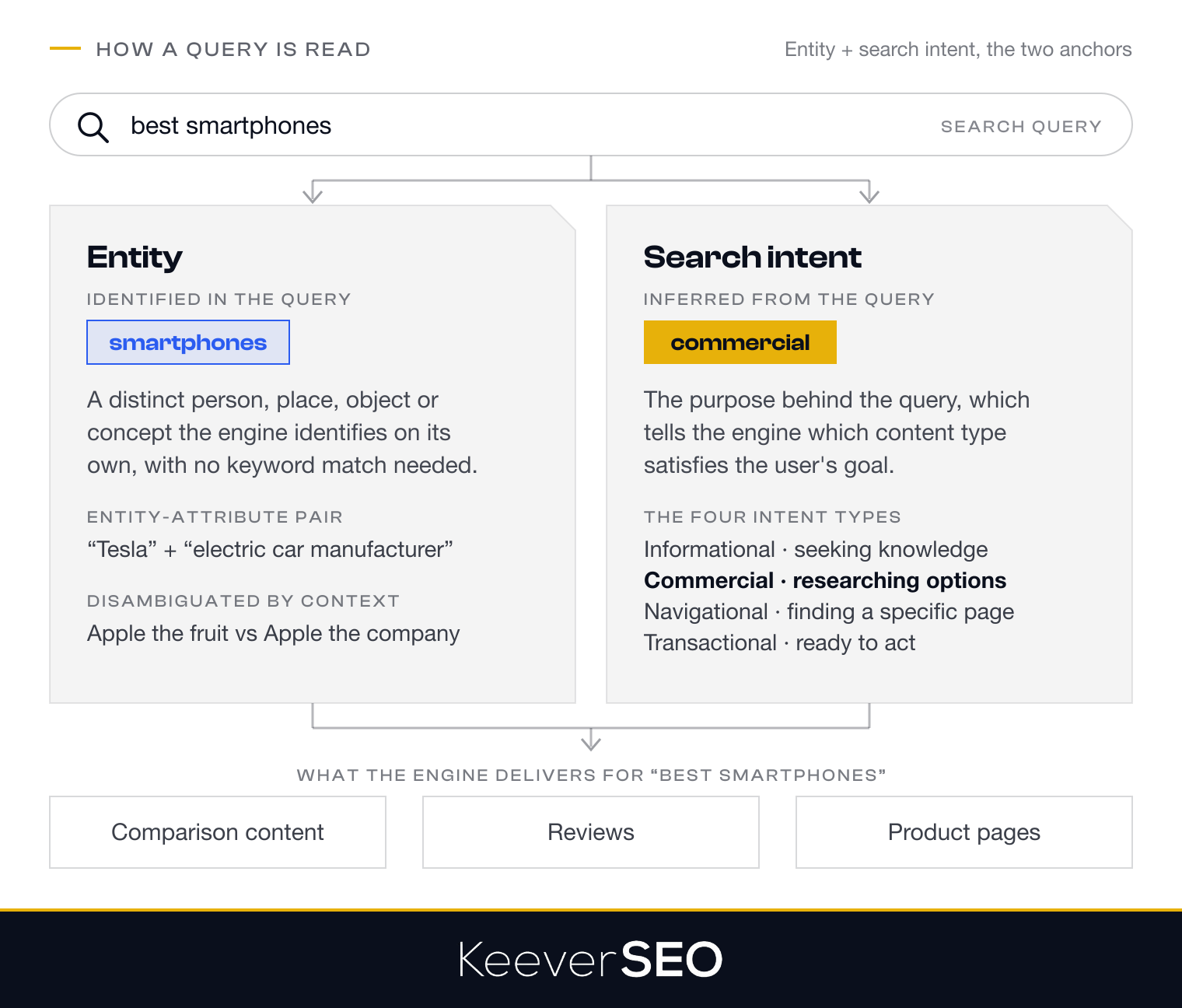
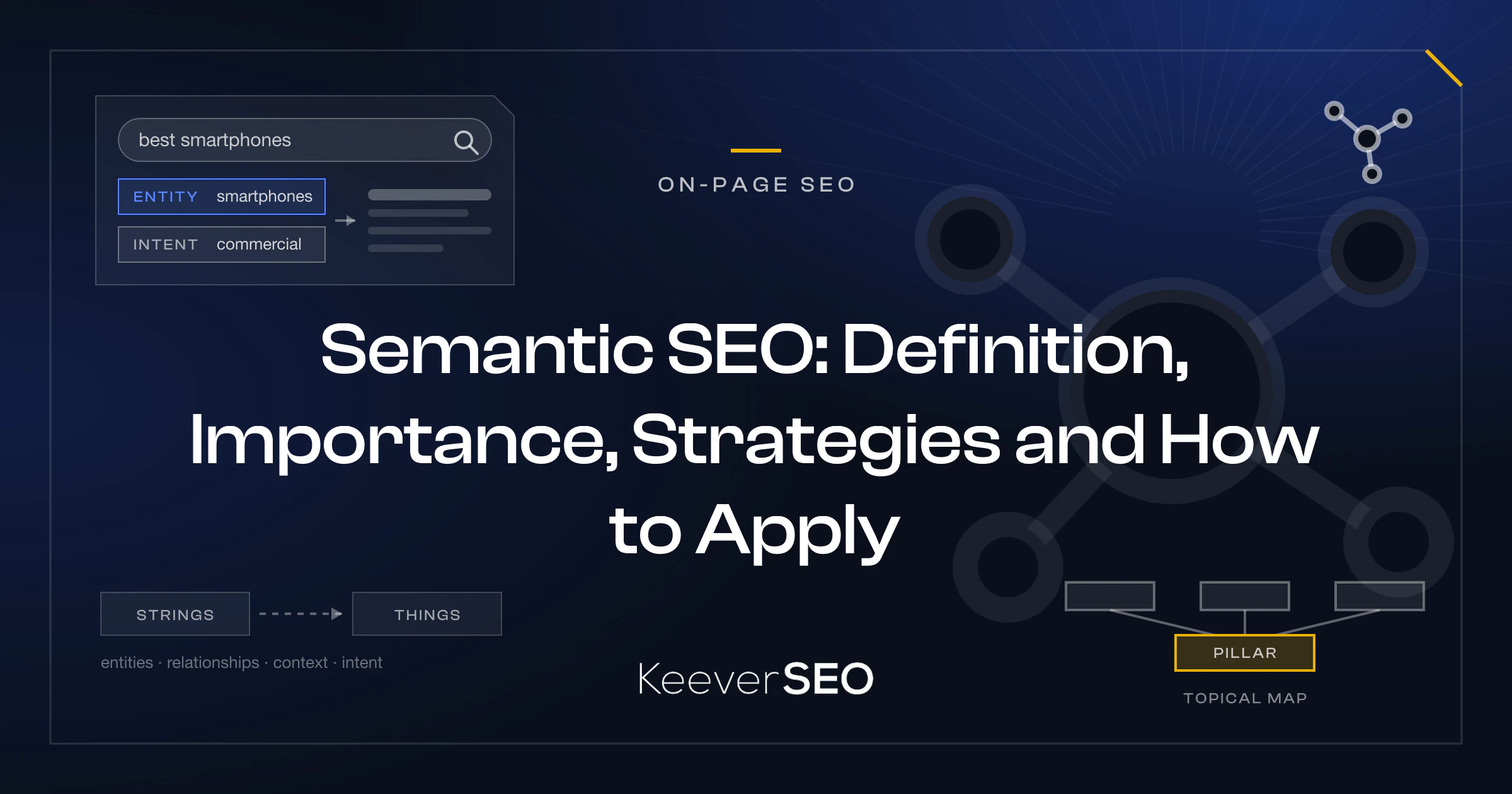
Search intent adds a layer of purpose to entity recognition. Intent categorizes queries into types such as informational (seeking knowledge), commercial (researching options), navigational (finding a specific page), or transactional (ready to act). When a user searches for "best smartphones," search engines identify "smartphones" as an entity and infer commercial intent, then deliver comparison content, reviews, and product pages. Semantic SEO requires content that addresses both the entity and the intent, which gives full coverage and alignment with the user's goal. Entity relationships and intent signals form the semantic structure that search engines read, and organizing the structure across a website begins with mapping the relationships in a cohesive topical architecture.
What Is a Topical Map in Semantic SEO?
A topical map in Semantic SEO is a strategic framework that organizes content around a central subject through the pillar-and-cluster model. The model builds a pillar page that serves as the hub for the main topic, supported by cluster pages that cover specific subtopics, questions, and related entity-attribute pairs. The structure defines topic boundaries and gives full coverage of a subject, which strengthens topical authority.
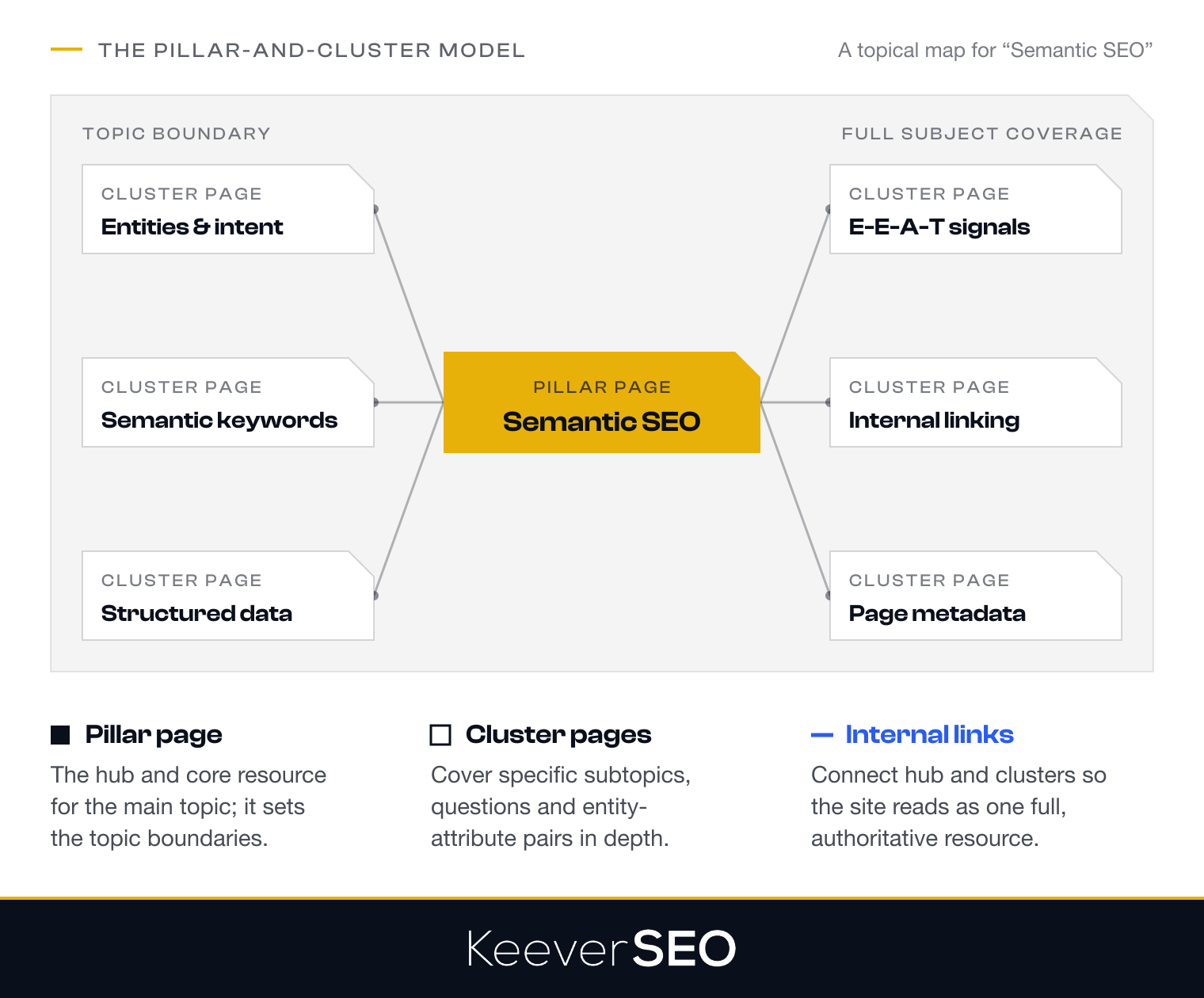
The pillar page acts as the core resource, while cluster pages explore detailed aspects and semantic variations of the topic. The interconnected architecture signals to search engines the site's expertise across the subject's full spectrum, which improves its recognition as a complete resource. Mapping content in that way helps search engines read the relationships between pages and recognize the site as an authoritative destination that satisfies many search intents.
Why Does Semantic SEO Matter for Search Rankings?
Semantic SEO matters for search rankings because it lets websites rank for a broader array of keywords. Traditional SEO focuses on single-keyword optimization, whereas Semantic SEO relies on full topic coverage. The coverage lets search engines recognize a website as a topical authority, which improves visibility across a range of related queries. A page optimized semantically can rank for many keyword variations by covering topics in depth, which satisfies related searches at once: an Ahrefs study of 3 million search queries, "How many keywords can you rank for with one page?", found that the average #1 ranking page also ranks in the top 10 for nearly 1,000 other relevant keywords.
Topical authority is a strong ranking signal. Websites that demonstrate full subject coverage through interconnected content clusters signal expertise and relevance to search engines, which translates into improved rankings. Semantic optimization matters as much for visibility in AI-powered search experiences, such as Google's AI Overviews, where AI systems synthesize answers from content that is organized, entity-clear, and structured around questions.
The benefits of Semantic SEO extend to user experience metrics. Content that matches the full scope of user intent and answers related questions in advance improves engagement. Users find well-structured information that addresses their core query and related questions on a single page, which leads to longer visits, deeper engagement, and higher conversion rates. Search engines read the signals as markers of quality and relevance, which reinforces rankings over time.
What Are Semantic SEO Strategies?
Semantic SEO strategies are the methods that align content with topics and user intent rather than isolated keywords. The strategies are listed below:
- Satisfy Search Intent: Align content with the specific intent behind user queries so it meets informational, commercial, navigational, or transactional needs.
- Cluster Keywords by Topic: Group related keywords into full topic clusters so a single page can rank for several queries.
- Use Semantic and Related Keywords: Integrate synonyms and related terms in natural language to reinforce topical relevance and broaden ranking opportunities.
- Write Descriptive Subheadings: Use clear H2 and H3 headings that convey the section's main concept for both users and search engines.
- Answer PAA and FAQ Questions: Address People Also Ask and frequently asked questions in the content to widen coverage and snippet visibility.
- Lead with Extractable BLUF Answers: Start each section with a clear, concise answer that search engines and AI systems can extract.
- Add Information Gain: Provide original insights and thorough explanations that go beyond surface-level coverage.
- Build Internal Links: Create a logical internal linking structure with descriptive anchor text to connect related content and reinforce semantic relationships.
- Implement Structured Data: Use Schema.org markup to clarify entities and relationships, which sharpens contextual understanding and qualifies pages for rich search results.
How Does Structured Data Support Semantic SEO?
Structured data supports Semantic SEO by supplying explicit, machine-readable signals that define the meaning and context of web content. Schema.org markup clarifies entities, attributes, and relationships so search engines interpret content with more accuracy. Specific schema types like Article, Product, and FAQPage give entity clarity and connect content to the broader knowledge graph. The connection lets search engines read not just the text but the underlying entities and their relationships, which improves the site's eligibility for rich results and AI-driven search visibility.
Schema Types and Entity Clarity Structured data uses schema types to define content elements. The Organization schema identifies business entities, while the Product schema details specific items. The markup disambiguates content, which makes it easier for search engines to parse and categorize information. Semantic HTML elements like <article> and <nav> add structural context that matches how search engines parse meaning.
Connection to the Knowledge Graph Structured data links content to Google's Knowledge Graph, which raises its semantic relevance. Identifiers like sameAs and about connect web pages to recognized entities and reinforce their authority and relevance. The integration supports rich snippets and improves visibility in AI-driven search experiences, where semantically clear pages are more likely to be cited.
How Does E-E-A-T Support Semantic SEO?
E-E-A-T, which stands for Experience, Expertise, Authoritativeness, and Trustworthiness, supports Semantic SEO by establishing the credibility of content creators and their subject matter. The framework lets search engines assess whether a source holds the qualifications to cover a topic in full. Author credentials, brand reputation, and trust signals such as citations and author bios help search engines judge the authority of content, which makes it more likely to appear in high-visibility search results.
Brand-entity association serves as a strong semantic signal within the framework. When a brand publishes in-depth, well-structured content on a defined topic, and the content is reinforced by E-E-A-T signals like expert authorship and external references, search engines begin to associate the brand entity with topical authority. The association strengthens the semantic connection between the brand and its core subjects, which raises the likelihood of the site being cited in AI Overviews and featured snippets.
In practice, E-E-A-T supports Semantic SEO by adding trust and authority to entity-rich, intent-aligned content. The work means identifying content authors with relevant expertise, linking to authoritative external sources, and maintaining updated author profiles. Semantic structure and E-E-A-T signals together create a content profile that search engines can interpret, rank, and recommend with confidence.
How Do You Apply Semantic SEO to a Website?
You apply Semantic SEO to a website through six steps that organize content around meaning and context rather than isolated keywords. The steps are listed below:
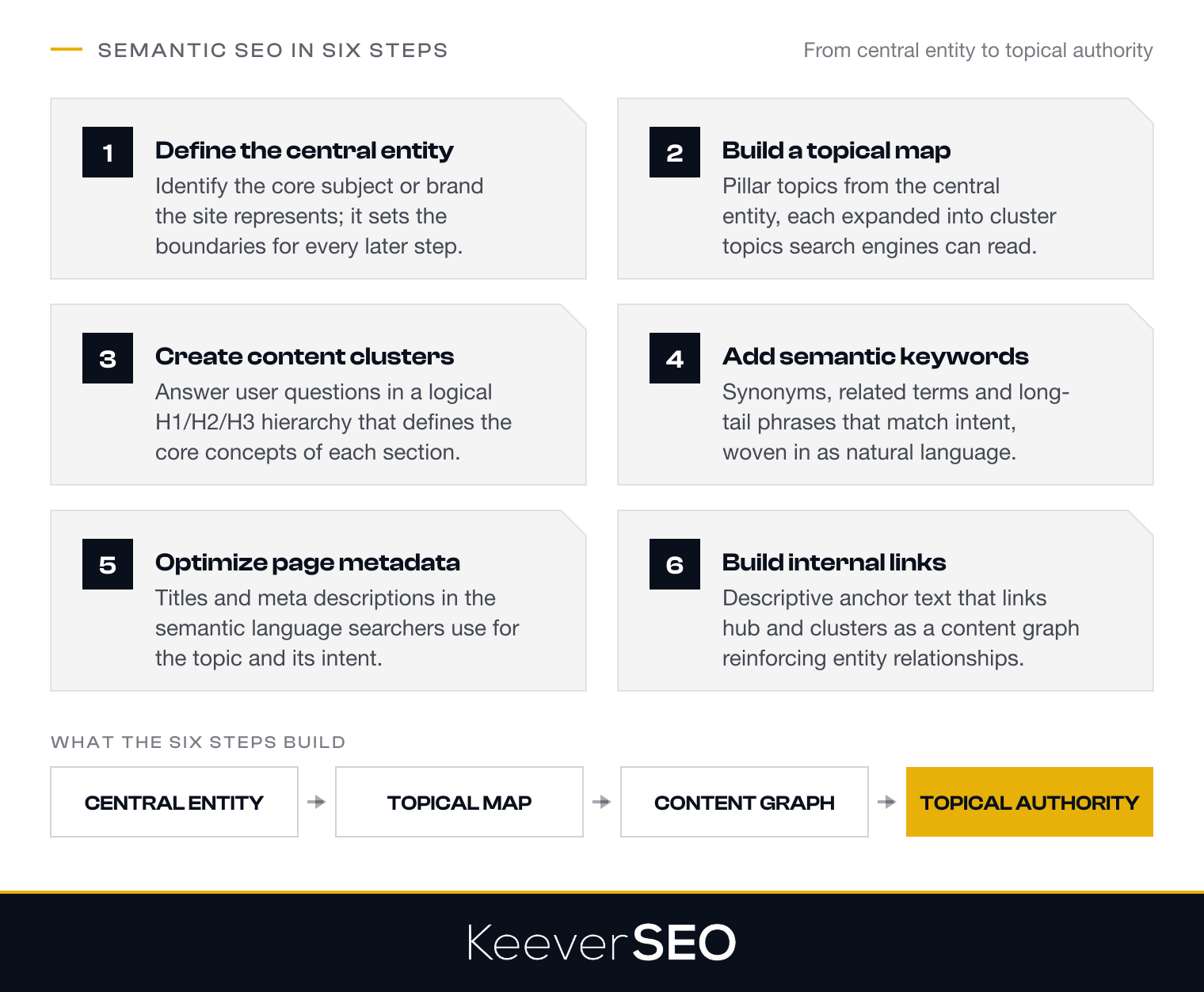
- Define the Central Entity and Source Context: Identify the core subject or brand the website represents, which sets the boundaries for the content strategy so every later action aligns with the central entity's purpose and authority.
- Build a Topical Map: Create a full map of related topics and subtopics, organized through a hub-and-spoke model into pillar topics and supporting clusters with clear semantic relationships that search engines can recognize.
- Create Well-Structured Entity-Attribute Content Clusters: Develop content clusters that answer user questions and fulfill search intent, with a logical H1/H2/H3 hierarchy that defines the core concepts within each section.
- Include Semantic Keywords That Match Search Intent: Conduct semantic keyword research to identify synonyms, related terms, and long-tail phrases, then integrate them in natural language to reinforce topical relevance and satisfy user queries.
- Optimize Page Metadata for Semantic Relevance: Write descriptive titles and meta descriptions that align with the page's topic and intent, in semantic language that signals relevance and improves visibility in search engine results.
- Build a Clear Internal Linking Structure: Establish a content graph with internal links that reinforce entity relationships and topical hierarchy, with descriptive anchor text that guides users and search engines through related content.
1. Define the Central Entity and Source Context
Defining the central entity and source context is the first step in applying Semantic SEO to a website. The step identifies the core topic the site aims to own and sets clear boundaries around it. The focus is audience-first rather than keyword-first, so the content plan reflects the real subject a searcher wants covered, including related concepts and the brand or business entity that should be associated with it. A strong definition of the central entity makes the source context explicit as well, which aligns the site's pages with a recognizable organization, product, service, or expert perspective.
In practice, defining the central entity means deciding what the page or site is about, which entities it should connect to, and how the brand itself should be represented as part of the topic model. Once the central entity and context are defined, the next step turns that scope into a topical map that organizes every related subtopic and supporting page around it.
2. Build a Topical Map
Building a topical map is the second step in applying Semantic SEO, and it organizes content around the central entity in a structure that search engines can read. The topical map begins with the primary pillar topics that stem from the defined central entity, the broad themes at the heart of the subject. Each pillar topic is then expanded into supporting cluster topics that cover specific facets, questions, and subtopics. The pillar-and-cluster model covers the subject in full and establishes clear topic boundaries.
The topical map should show the relationships between entities through semantic connections. Tools such as Google Autocomplete, People Also Ask, and keyword research platforms like Ahrefs or Semrush surface related concepts, common questions, and long-tail intent phrases. Organizing the topics within the map signals topical authority to search engines, because the site explains concepts rather than mentions them. With the topical map defined, the next step creates well-structured entity-attribute content clusters that support the site's semantic framework.
3. Create Well-Structured Entity-Attribute Content Clusters
Creating well-structured entity-attribute content clusters is the third step, and it organizes content around user-centric questions rather than keyword variations. The approach explains concepts and relationships in depth rather than mentioning terms. Each content piece follows a clear H1/H2/H3 hierarchy, where the H1 defines the primary entity and intent, the H2s break down core attributes or questions, and the H3s cover supporting concepts, comparisons, or FAQs. The hierarchy creates a semantic content model that users and search engines can follow, which reinforces topical boundaries and entity relationships across the cluster.
To build effective content clusters, each section should answer a specific question about the entity, which gives full coverage and a clear topical structure. Instead of separate pages for "semantic SEO," "semantic SEO definition," and "what is semantic SEO," a single resource should address the full spectrum of questions about the entity. The method aligns with how users think and ask, and it rewards full coverage and clear organization. Defining the core concepts within the content helps search engines read the relationships between concepts on the page and within the broader site.
4. Include Semantic Keywords That Match Search Intent
Including semantic keywords that match search intent is the fourth step, and it widens content relevance to broader search queries. The step identifies synonyms, related terms, and long-tail intent phrases that align with user search behavior. Semantic keyword research centers on how users search for information, which lets content cover a wide range of related queries.
Semantic Keyword Research Semantic keyword research uses tools like Google Autocomplete and keyword research platforms to uncover variations and related terms. If the core topic is "digital marketing," relevant semantic keywords might include "online marketing strategies," "SEO best practices," and "social media engagement." The variations help search engines read the content's topical breadth.
Clustering by Intent Clustering keywords by search intent gives each page a coherent group of queries to target. Google groups related keywords under the same topic, so a single full page can rank for several variations. Semantic keywords belong throughout the content, in subheadings and body text, in natural language. The approach signals to search engines that the content covers the topic in full and matches different user intents, which positions the page to rank for a broader set of queries.
5. Optimize Page Metadata for Semantic Relevance
Optimizing page metadata for semantic relevance is the fifth step, and it aligns titles and meta descriptions with the topic and search intent so search engines and users read the page's content at a glance. Descriptive titles should communicate the core topic and entity relationships in natural language that reflects how users search for the subject. Meta descriptions should give a semantically rich preview that places the page within the broader topic cluster, with related terms and intent-specific phrases that signal relevance to both search engines and users.
Semantically aligned metadata helps search engines and AI systems read the page's contextual relevance and its position within the knowledge graph, which extends the benefit beyond click-through rate. Titles and descriptions that reflect full topic coverage and intent satisfaction strengthen the semantic signals and connect the content to the entity relationships and topical authority established in the content clusters.
6. Build a Clear Internal Linking Structure
Building a clear internal linking structure is the sixth step, and it strengthens the semantic relationships and topical relevance of the website's content. Internal links function as a content graph that connects related pages, which lets search engines read the hierarchy and contextual flow of information across the site. Descriptive anchor text that names the topic or entity being linked, such as "customer retention strategies" or "local SEO optimization techniques," helps search engines parse the semantic relationship between the linking page and the destination page, which reinforces topical signals across the site.
A logical internal linking structure distributes authority among the content clusters, so pillar pages and related cluster content stay interconnected. The setup mirrors the entity relationships and intent pathways that users follow, which improves both user navigation and search engine crawl paths. Linking related content with topic-centered anchor text solidifies the semantic relationships that make a site a cohesive, authoritative resource on its core topics, which widens the range of related queries the site can rank for and supports the whole SEO strategy.
How Does Semantic SEO Support Business Growth?
Semantic SEO supports business growth by attracting qualified organic traffic that aligns with user intent and search context. Content optimized around topics, entities, and full intent satisfaction captures visitors who are seeking the solutions or products a business offers. Intent-matched traffic tends to convert at higher rates than broad, keyword-driven traffic, because the user's need and the content delivery line up. Organic search drives 53.3% of all trackable website traffic, according to BrightEdge Research, which makes it the channel with the strongest influence on the customer journey and business outcomes.
Topical authority, built through semantic optimization, becomes a compounding asset over time. As a site establishes expertise across interconnected topic clusters, it earns trust signals that improve rankings across an expanding set of related queries. The cycle of visibility and credibility shortens the path from discovery to revenue. Pages optimized semantically appear in AI Overviews, traditional search results, and People Also Ask boxes, which multiplies touchpoints and establishes the brand as a definitive source within its domain. Full coverage lifts immediate traffic and builds long-term equity in topical domains, which turns visibility into sustained revenue growth through market share and customer acquisition.
Can Qualified Organic Traffic Improve Conversions?
Yes, qualified organic traffic improves conversion rates compared with broad, unqualified traffic. Users who arrive at a website through search queries that match their intent, whether informational, commercial, or transactional, are more likely to engage with the content or complete the desired action. Intent-matched traffic aligns the visitor's need, timing, and page message, which smooths the path to conversion, and HubSpot reports that leads from SEO close at a 14.6% rate against 1.7% for outbound leads such as direct mail or print advertising. The improved conversion performance shows most where content is organized around clear intent categories, which lets businesses guide users from first discovery through to conversion. The stronger conversion rates driven by semantically optimized, intent-aligned content shape the business case for when to bring in specialized Semantic SEO support.
When Should a Business Get Semantic SEO Support?
A business should get Semantic SEO support when specific signals show the need for specialized expertise. The signals appear when organic growth has plateaued despite ongoing content production, or when the site struggles to establish topical authority in competitive markets. High traffic paired with low conversion rates, or competitors that keep winning visibility in AI-powered search features, are further signs that professional help is due.
As your SEO growth partner, we serve companies that lack the internal resources to implement entity-driven topical architecture at scale, and we supply a structured methodology to define central entities, map related topics, and execute content clusters, which accelerates results and raises search visibility.
How Can an SEO Agency Apply Semantic SEO?
We apply Semantic SEO through a structured, managed service that runs from entity definition to cluster execution. The work begins with defining the core entity, which identifies the business's primary topic and brand entity within the search ecosystem. We then construct a full topical map that organizes pillar topics and supporting content clusters to cover the client's domain, so each piece of content aligns with a specific user intent and contributes to topical authority.
We execute content cluster creation by developing detailed, entity-attribute content that explains concepts rather than mentions keywords. The execution covers semantic keyword research to capture related terms and intent variations, metadata optimization for semantic relevance, and a strategic internal linking structure that reinforces entity relationships through contextual anchor text. Structured data markup is deployed to clarify entities for search engines and connect the website to the Knowledge Graph. The managed approach gives businesses the ranking and visibility benefits of Semantic SEO without in-house expertise in NLP principles or advanced content architecture.
Which Tools Support Semantic SEO Research?
The tools that support Semantic SEO research uncover user intent, related concepts, and semantic keyword opportunities, and they are listed below:
- Google Autocomplete: Reveals real-time search predictions and query variations that users type, which exposes natural language patterns and related intent phrases straight from Google's reading of user behavior.
- Google Related Searches: Displays semantically connected queries at the bottom of search results pages, which helps identify topic boundaries and related concepts that Google associates with the primary topic.
- People Also Ask (PAA): Shows question clusters that Google deems relevant to a query, which gives direct insight into user intent, semantic relationships, and opportunities to answer interconnected questions within the content.
- AlsoAsked: Visualizes the nested structure of People Also Ask questions, which maps how users explore topics through related questions and reveals the semantic web of a subject area for content planning.
- AnswerThePublic: Generates question-based and preposition-based semantic keyword variations from autocomplete data and organizes them visually to uncover the full spectrum of how users phrase queries around a topic.
- Ahrefs: Provides semantic keyword clustering, "Also rank for" data that shows related queries a page ranks for, and content gap analysis to identify semantically related terms and entities competitors cover.
- Semrush: Offers keyword clustering tools, semantic keyword discovery through the Keyword Magic Tool, topic research features, and SEO Content Template recommendations that surface semantically related terms to strengthen topical relevance and authority.
How Does Semantic SEO Apply to Ecommerce?
Semantic SEO applies to ecommerce by organizing content around product and category entities so buyer intent is covered in full. Category pages should function as pillar content that details product attributes like type, use case, and brand. Product pages gain from semantic optimization through detailed descriptions, features in context, and structured data.
Faceted intent matters in ecommerce, because shoppers often search with attribute-based phrases such as brand, size, and price. Some filter combinations deserve indexable landing pages, while the rest are consolidated to avoid duplicate content. Semantic clustering groups content by buying stage, which supports discovery and purchase decisions. Internal links connect product pages to related categories and accessories, which extends the site's topical coverage.
Semantic SEO turns ecommerce catalogs into authoritative resources. The method captures qualified traffic across the purchase funnel and improves visibility in both traditional and AI-generated shopping results.
How Does Semantic SEO Apply to Local SEO?
Semantic SEO applies to local SEO by optimizing content for location-based entities and local user intent. The work creates content around specific geographic areas and services so search engines read the context of local queries, which connects businesses with users seeking local solutions.
Location Entities and Service-Area Coverage Local SEO gains from Semantic SEO through defined location entities such as city names, neighborhoods, and landmarks. Businesses should create content that names their service areas and the specific services offered within each location, with dedicated pages for each location and service, which raises visibility for location-specific searches.
Local Intent Signals Semantic SEO captures local intent by addressing queries like "near me" or specific service requests tied to a location. Businesses should answer common local questions, such as operating hours, pricing, and service availability. Structured data like LocalBusiness schema clarifies the relationship between the business and its geographic coverage, which improves local search rankings.
The combined strategies strengthen a business's presence in local search results and make it easier to find for potential customers seeking nearby services.
How Does Semantic SEO Apply to B2B Websites?
Semantic SEO applies to B2B websites by addressing extended buying cycles and complex decision-making. B2B buyers research across several stages before a purchase decision, which calls for content that covers each stage of the buyer's journey, from first problem awareness through solution evaluation to vendor selection. Semantic optimization in the B2B context means building topical authority around industry-specific problems, solutions, and technical concepts that matter to professional audiences.
In practice, B2B Semantic SEO creates decision-stage content clusters that answer complex questions about integration capabilities, compliance requirements, and comparative analyses between competing approaches. The approach helps search engines and AI systems read the relationship between a company, its product category, and the problems it solves. Structuring content around interconnected entities and implementing the right schema markup establishes B2B websites as authoritative sources that capture qualified traffic throughout the long B2B research and evaluation process.
How Does Ongoing Measurement Improve Semantic SEO?
Ongoing measurement improves Semantic SEO by showing which content strategies work and where coverage falls short. Key performance indicators (KPIs) such as topical coverage, query breadth, and AI citation signals carry the most weight. Tracking the metrics surfaces gaps in content and areas for improvement, and analyzing topical coverage confirms that the content addresses every relevant subtopic, which strengthens topical authority.
The re-optimization loop drives the improvement. The loop begins with a baseline, continues with publishing or updating content, and ends with a review of performance metrics. Pages that underperform on impressions or fail to earn clicks are re-optimized to improve visibility and engagement. The iterative work keeps content aligned with evolving search algorithms and user needs.
Ongoing measurement turns Semantic SEO into a practice that keeps refining itself. Websites that adapt their content strategies to performance data maintain and grow their authority across both traditional and AI-powered search engines.