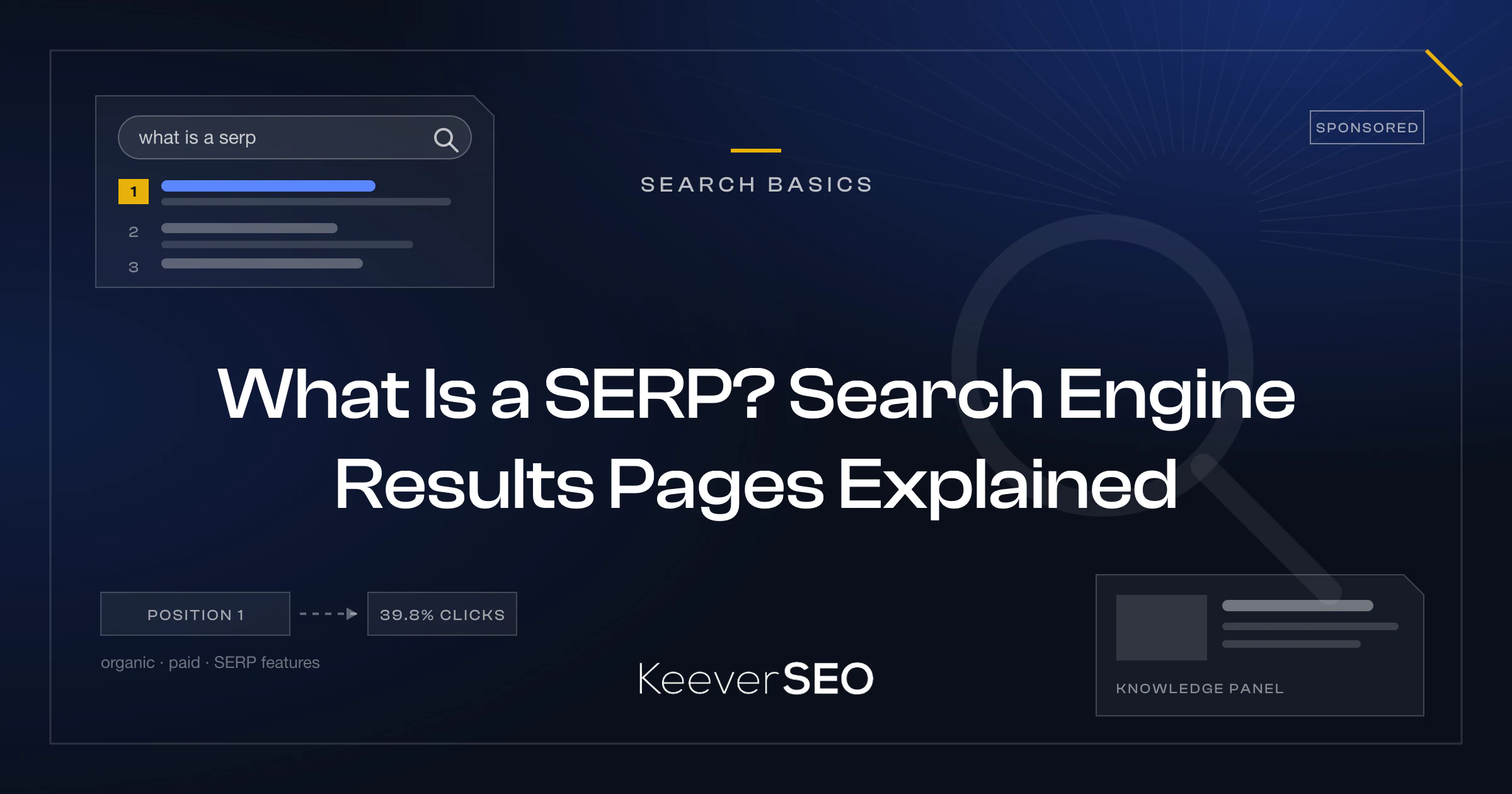
A Search Engine Results Page (SERP) is the webpage a search engine displays in response to a user's query. The page mixes organic search results, paid advertisements, and a range of added features. The SERP differs from the search engine itself, which processes the query and generates the results page.
A SERP works by retrieving matching pages from the search index, ranking them by relevance, and assembling result modules by search intent. The composition varies with the intent behind the query, whether informational, navigational, or transactional. SERPs matter because they are the primary gateway to web content, relied on by users, businesses, and marketers for visibility and traffic.
A typical SERP holds organic results ranked by relevance, paid ads marked "Sponsored," and features like answer boxes and knowledge panels. Content quality, user location, and search history shape the page. A listing's position decides its click rate, with the top positions earning the most clicks. Businesses raise SERP visibility through SEO, often with an agency like SEO Agency In USA for keyword strategy and content optimization. Reading what a SERP is and how it works is the first step toward stronger visibility in search results, and the definition follows below.
What Is a SERP?
A Search Engine Results Page (SERP) is the webpage a search engine displays in response to a user's query. The page holds a mix of organic search results, paid advertisements, and added features like snippets and panels, and it serves as the interface between users and search engines, with information retrieved and ranked by algorithms.
The distinction between a SERP and the search engine lies in their functions. The search engine is the technology that indexes web content, while the SERP is the output that displays the ranked results. The SERP is built by retrieving pages that match the query, ranking them by relevance, and assembling result modules by search intent. The modules can include web links, images, videos, and featured snippets, and they change with the user's intent.
SERPs decide visibility and traffic, because they determine which websites appear where. Businesses, marketers, and users rely on SERPs to find information, discover products, and make decisions. A SERP holds organic results, paid ads, and SERP features like knowledge panels and local packs, and search intent, user location, and content quality shape its composition and ranking. A listing's position affects its click-through rate, with higher positions earning more clicks, so businesses raise SERP visibility through SEO and at times through specialized agencies.
How Does a SERP Differ From a Search Engine?
A SERP differs from a search engine in that the SERP is the visible page of results while the search engine is the software system that produces it. The search engine, such as Google or Bing, processes user queries by crawling the web, indexing pages, and applying algorithms to rank content. The SERP is the formatted page users interact with, with organic listings and paid advertisements side by side.
The search engine stays constant as a platform, while each SERP is unique and changes with the query, the user's location, and search history. The search engine does the backend work, and the SERP is the user-facing outcome.
How Does a SERP Work?
A SERP works through a multi-stage process that starts when a user submits a query. The search engine first interprets the query to read the user's intent, then accesses its search index to identify pages that match. The step weighs factors such as content relevance, source authority, and user-specific signals like location and search history, and ranking algorithms sort the pages by relevance and quality.
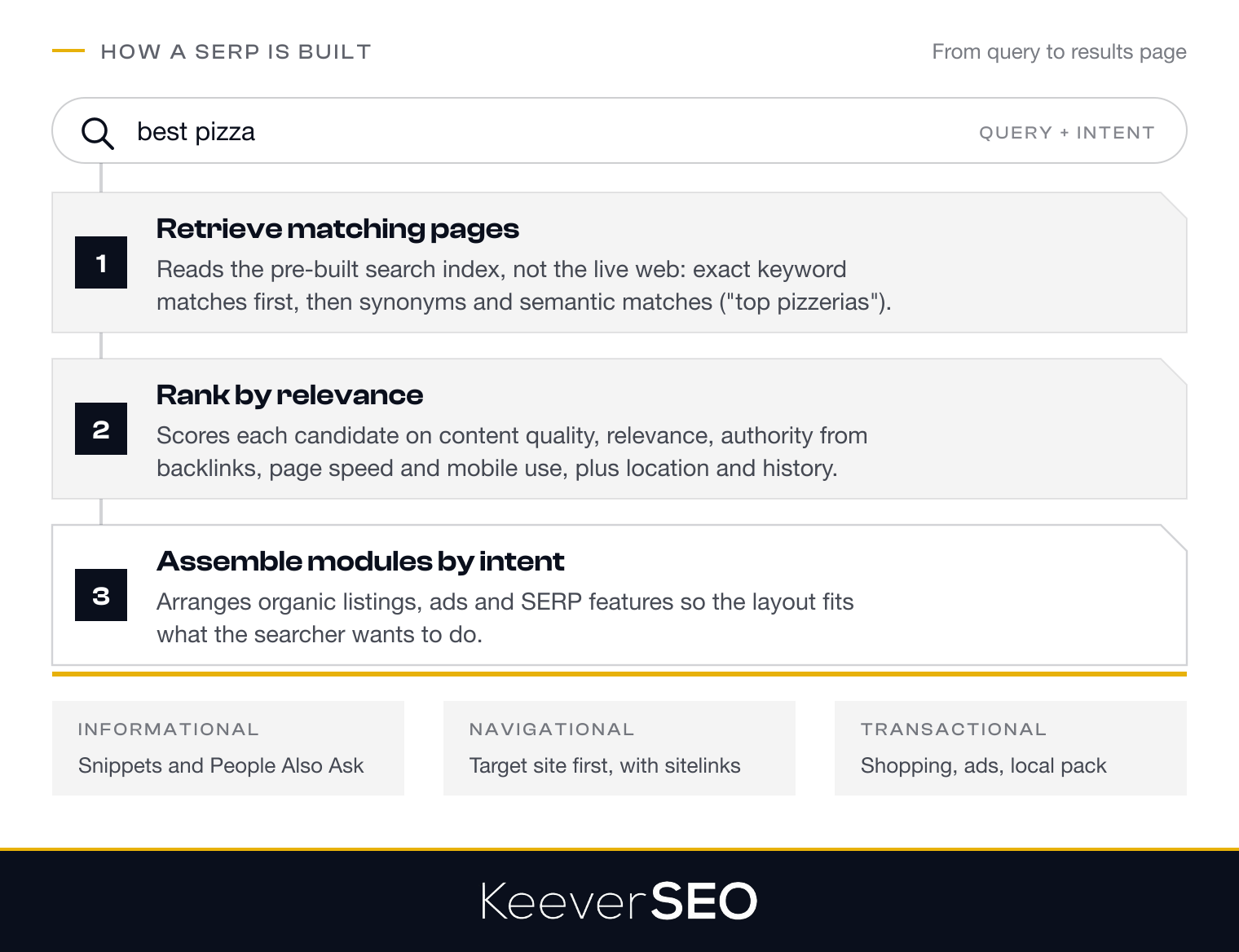
Once the relevant pages are identified, the search engine assembles the results page. The assembly selects and arranges result modules such as organic listings, paid advertisements, and SERP features like rich snippets or answer boxes. The composition adapts to the detected search intent so the most relevant information comes first.
The whole process runs in fractions of a second and produces a customized results page that serves as both a delivery mechanism for search answers and a competitive space for businesses that want visibility and clicks. The delivery of results from the index is broken down next.
How Are Search Results Delivered From a Search Index?
Search results are delivered from a search index through a three-step process of retrieval, ranking, and assembly. When a user submits a query, the search engine does not scan the whole web in real time; it reads a pre-built search index, a database of web pages that were crawled and stored in advance, which lets it locate pages tied to the query's terms and concepts in an instant.
The retrieval stage identifies and gathers the pages from the index that match the query terms. The ranking stage evaluates and sorts the pages by relevance, quality, and other ranking signals. The assembly stage builds the pages into a coherent search engine results page (SERP) that fits the user's search intent, and each of the three steps is covered below.
Retrieve Matching Pages
Retrieving matching pages is the first step in producing a SERP, and it locates the documents in the search index that correspond to the user's query. The step reads a pre-built index that holds information about billions of web pages, including their content, keywords, and metadata, rather than searching the live web.
During retrieval, the search engine looks first for exact keyword matches, then applies semantic understanding, synonyms, and natural language processing to capture pages that meet the user's intent without the exact query terms. A search for "best pizza" might retrieve pages that mention "top pizzerias" or "highest-rated Italian restaurants." The phase narrows the pool of results to a manageable set of candidate pages, which are then ranked by relevance to decide their position on the SERP.
Rank Results by Relevance
Ranking results by relevance is the second step, and it evaluates the candidate pages against many signals to decide which best satisfy the user's search intent. The signals include content quality, relevance to the query, and the authority of the source, often measured through backlinks, along with technical performance factors such as page speed and mobile-friendliness and user context like location and search history.
The pages that score highest across the relevance signals take the top of the organic results, so users receive the most relevant and useful results for their queries. Once the pages are ranked, the search engine assembles the result modules by search intent and weaves in the SERP features that improve the user experience.
Assemble Result Modules by Search Intent
Assembling result modules by search intent is the third step, and it shapes the SERP to match what users want to accomplish. The search engine identifies the user's intent, whether informational, navigational, or transactional, and arranges the modules to fit. For informational queries, the SERP may lead with direct answers through featured snippets, People Also Ask boxes, and knowledge panels.
Navigational queries, where users seek a specific website, put the target site in a prominent position, often with sitelinks and a prioritized spot at the top of the organic results. Transactional queries, which signal intent to purchase, bring commercial content forward, including shopping results, product listings, local packs, and paid advertisements for users who want to compare options or buy.
The assembly keeps the SERP aligned with the detected search intent, which produces different SERP compositions for different tasks rather than one list of pages sorted by rank.
How Do SERP Types Vary by Search Intent?
SERP types vary by search intent because each intent, navigational, informational, transactional, local, or commercial investigation, calls for a different arrangement of results and features. The five SERP types are set out below:
Navigational SERPs Navigational queries look for a specific website or page, such as "Facebook login." The SERPs put the destination at the top, often with sitelinks to important sections of the site, and knowledge panels or branded information may appear to speed the user to the destination.
Informational SERPs Informational queries seek knowledge or explanations, such as "how photosynthesis works." The SERPs carry featured snippets with direct answers, People Also Ask boxes with related questions, and knowledge panels with detailed data, and video results may appear to add visual explanation.
Transactional SERPs Transactional queries signal purchase intent, like "buy running shoes." The SERPs lead with paid search ads that capture a large share of clicks, shopping results with product images and prices, local packs with nearby stores, and review snippets that support the purchase decision, in a layout built for conversion.
Local SERPs Local queries, such as "pizza near me," are personalized to the user's location. The SERPs often include a local pack with a map and three business listings with ratings, addresses, and contact details, plus local teaser packs and location-specific organic results that change with the searcher's position.
Commercial Investigation SERPs Commercial investigation queries research a purchase in advance, like "best smartphones 2026." The SERPs blend in-depth articles, comparison content, review snippets, and video reviews, and featured snippets may present lists or tables that support an informed decision.
The variation in SERP composition by intent shows how search engines like Google combine algorithms and natural language processing to serve the purpose behind each query, with organic results, paid ads, and specialized features arranged to fit.
Why Do SERPs Matter?
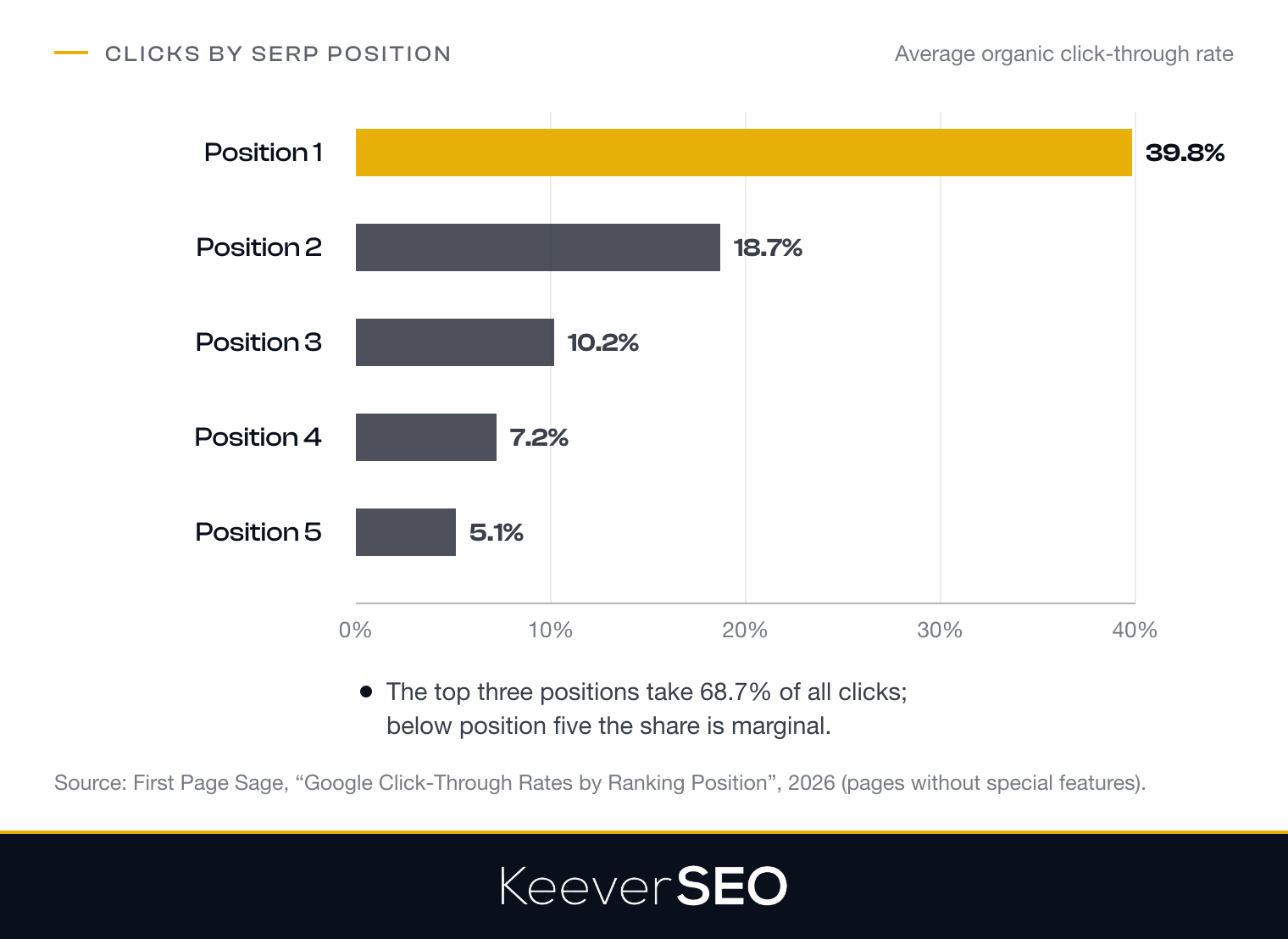
SERPs matter because they decide which websites gain visibility and traffic. The results page is the primary interface between users and the whole of online content, and a strong SERP presence feeds website visits, lead generation, and revenue. Position decides the reward: according to First Page Sage's 2026 report "Google Click-Through Rates (CTRs) by Ranking Position," the first organic result draws 39.8% of clicks on a results page without special features, the second draws 18.7%, and the top three positions together take 68.7% of all clicks.
SERPs shape user trust and brand perception as well, because few users go past the first page of results. The concentration of attention makes high SERP rankings a condition of brand visibility and competitive position. For digital marketers, SERP optimization is the base of search engine marketing, with measurable returns through engagement and conversions, and organic search remains the largest single source of trackable website traffic, at 53.3% of visits according to BrightEdge Research.
Who Uses SERPs?
SERPs are used by everyday searchers, businesses, marketers, advertisers, publishers, retailers, local businesses, agencies, and researchers, each for a different purpose. The nine user groups are listed below:
- Everyday Search Users: Individuals use SERPs to find information, answers, product recommendations, and local services, moving through organic results, paid ads, and SERP features to reach relevant content fast.
- Businesses and Brand Managers: Companies monitor SERPs to track their online visibility and how their websites rank for target keywords, and they rely on SERP performance to drive traffic, leads, and conversions.
- Digital Marketers and SEO Professionals: Specialists analyze SERPs to find optimization opportunities, read which SERP features appear for target queries, and study competitor rankings, then refine content strategy to raise search visibility.
- PPC Advertisers and Paid Search Managers: Paid advertising professionals evaluate SERPs to analyze ad positions and tune campaigns for visibility and return on investment.
- Content Creators and Publishers: Writers and bloggers study SERPs to read what type of content ranks, find content gaps, and craft content that satisfies both search intent and ranking algorithms.
- E-commerce Businesses: Online retailers depend on SERPs for product visibility and transactional search traffic, and they aim for shopping results and product listings to compete.
- Local Businesses: Brick-and-mortar establishments rely on SERPs, above all local pack features, to attract nearby customers and manage their reputation through the reviews shown in results.
- SEO Agencies and Consultants: SEO service providers use SERPs for competitive analysis, ranking opportunities, campaign measurement, and proof of the value of their work to clients.
- Researchers and Analysts: Market researchers and data analysts examine SERPs to read market trends, assess brand visibility, and study search behavior within niches or demographics.
Each group turns to the SERP for a distinct goal, from visibility and traffic to insight into search behavior and market trends.
What Appears on a SERP?
A SERP shows organic search results, paid search results, and a set of SERP features. Organic results are unpaid listings ranked by the search engine on relevance and quality, shown as blue links with titles, URLs, and descriptive snippets. Paid results, marked "Sponsored" or "Ad," sit at the top or bottom of the page and come from businesses that bid on keywords through platforms like Google Ads.
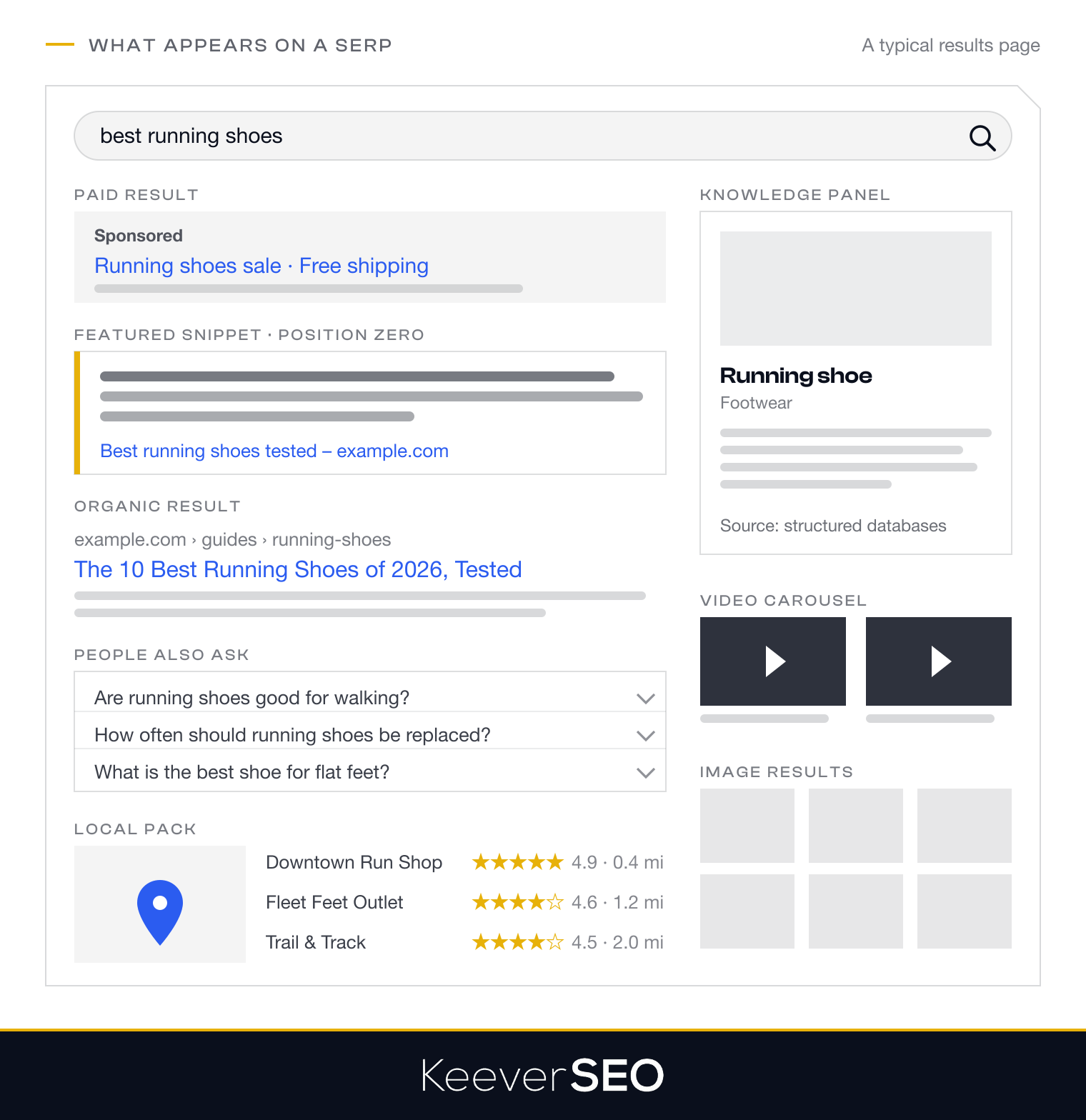
Beyond the core elements, modern SERPs carry rich features such as featured snippets, knowledge panels, People Also Ask boxes, local packs, image results, and video carousels. Featured snippets give concise answers at the top of the page, knowledge panels supply detailed information from structured databases, People Also Ask boxes present related questions and answers, local packs highlight nearby businesses, and image and video results serve visual needs. The mix lets one SERP meet many search intents and user preferences, and the two core result types are defined below.
What Are Organic Search Results?
Organic search results are the unpaid listings on a search engine results page (SERP), ranked by the search engine's algorithm on relevance to the user's query. Organic results are earned through search engine optimization (SEO), which improves content quality, keyword relevance, and website usability, rather than bought through advertising.
Organic listings carry a clickable title, a URL, and a descriptive snippet, and they may include sitelinks, breadcrumbs, and meta descriptions. The listings give users the most relevant and authoritative information for the query, without the influence of ad spend.
What Are Paid Search Results?
Paid search results are advertisements that appear on search engine results pages (SERPs) when businesses bid on specific keywords. The results carry labels such as "Sponsored" or "Ad" that set them apart from organic listings. Companies secure the positions through platforms like Google Ads on a pay-per-click (PPC) basis, and placement depends on bid amount, ad relevance, and quality score. The ads appear at the top or bottom of the SERP and give immediate visibility, matched to the search intent of the targeted keywords, which makes them the fast route to traffic while organic rankings are still low.
What Are SERP Features?
SERP features are the added elements on a search engine results page that give users information beyond the traditional blue links. The features improve the experience with direct answers or rich content formats, and the main types are set out below:
Featured Snippets Featured snippets give concise answers to user queries at the top of search results, as paragraphs, lists, or tables, without a click-through.
Knowledge Panels Knowledge panels display structured information about a person, place, or thing, drawn from verified databases, on the right side of the results page as a quick overview.
People Also Ask Boxes People Also Ask boxes display related questions and answers that widen the user's grasp of a topic, with each question expanding to show its answer on the SERP.
Local Packs Local packs highlight businesses or locations relevant to a geographic query, with a map and contact details for nearby services or places of interest.
Video Carousels Video carousels show video content related to the query, so users can preview and open videos from the results page.
SERP features shape visibility and user interaction by making the results page richer and more interactive, and the features that matter most for SEO are covered below.
What Is a Video SERP Feature?
A video SERP feature is an element on a search engine results page that displays video content relevant to the user's query. The feature shows a thumbnail, title, and source, and at times a short description or duration, which gives users direct access to video content. Video SERP features appear when the search engine judges that visual content best matches the intent, such as tutorials or reviews.
The feature lets users preview and open videos without leaving the results page. To earn visibility in video SERP features, content creators should publish videos on established platforms, write titles and descriptions around strategic keywords, and add structured data markup so search engines index the content.
What Are People Also Ask Boxes on a SERP?
People Also Ask (PAA) boxes are interactive features on search engine results pages (SERPs) that list related questions and answers tied to the user's original query. The expandable panels appear among the organic results and let users explore further aspects of a topic without a new search. When a user clicks a question, it expands to reveal a concise answer drawn from a relevant web page, with a link to the source, and new related questions load beneath as the user interacts, which invites deeper exploration.
PAA boxes appear on a large share of queries, most often for informational searches, and a place inside one can drive real traffic to a website. To earn inclusion, businesses should build FAQ content that answers common user questions, add schema markup that clarifies the content structure, and keep answers clear, concise, and authoritative. The feature gives websites a way to capture attention and build topical authority beyond the traditional organic listings.
What Are Featured Snippets in SERPs?
Featured snippets in SERPs are the elements that appear at the top of Google's results with a concise answer extracted from a webpage. A featured snippet carries a summary as a paragraph, list, table, or video, along with the page's title and URL and at times an image. Often called "position zero," the snippet sits above the standard organic listings and earns strong visibility.
A featured snippet can lift web traffic because it occupies the most prominent spot on the page. To earn one, content must answer common questions with well-structured information and sound technical SEO, including schema markup and organized formatting. The snippet's components, the description, site logo, site name, URL, and page title, may all come from a single page, while the image may come from a different website, so full optimization of the page decides whether it wins the feature.
What Is a Featured Snippet in a SERP?
A featured snippet in a SERP is a highlighted search result at the top of Google's organic results that answers a user's query without a click-through. Often called "position zero," a featured snippet extracts a concise summary from a webpage as a paragraph, list, or table, with the page title, URL, and at times an image, and its placement above every other organic result makes it a high-value spot.
Search engines like Google generate featured snippets by algorithm, choosing the content that best answers a query on relevance, structure, and clarity. The snippet text comes from the webpage itself, while the image may come from the same source or a different website. To win a featured snippet, a website needs high-quality, well-structured content that answers common queries in a concise format, backed by technical SEO such as schema markup and clear headings.
What Shapes a SERP?
A SERP is shaped by search intent, user location, personalization, device type, query structure, content availability, structured data, and paid advertising activity. The eight factors are set out below:
Search Intent Search intent, whether informational, navigational, transactional, or commercial, is the primary factor: informational queries bring featured snippets and "People Also Ask" boxes, while transactional queries trigger shopping results and product listings.
User Location Geographic location changes the SERP by prioritizing local results. A query for "best pizza" in New York shows different local packs and map features than the same query in Chicago.
Search History and Personalization Previous browsing behavior and search patterns personalize results, because search engines use personal data to align results with individual preferences and past interactions.
Device Type The device, whether mobile, desktop, or tablet, shapes SERP layout and feature prominence. Mobile SERPs lean toward local packs and click-to-call buttons, while desktop SERPs show fuller knowledge panels.
Keyword Type and Query Structure The words and structure of a query decide which SERP features appear. Question-based queries trigger "People Also Ask" boxes and featured snippets, while branded searches surface knowledge panels.
Content Availability The existence and quality of relevant content decide what the SERP can show. Video-rich queries bring video carousels, while image-heavy topics surface image packs.
Structured Data Markup Websites with schema markup and structured data qualify for rich snippets and other rich results, which lets search engines display detailed, visual SERP elements.
Paid Advertising Activity The volume and quality of advertisers bidding on a keyword decide the number and placement of sponsored results. High-competition queries may show several paid ads, while low-competition queries may show none.
Each of the eight factors decides not only what appears on the SERP but how it is organized and presented.
What Affects SERP Rankings?
SERP rankings are affected by content relevance and quality, backlinks and authority, technical SEO and usability, on-page optimization, user engagement signals, and freshness. The six factors are listed below:
- Content Relevance and Quality: Pages that match the user's search intent and give accurate, complete information come first, because thorough content signals value to the ranking algorithms.
- Backlinks and Authority: The number and quality of backlinks to a page act as endorsements, and pages linked from authoritative, trustworthy sources rank higher because the links signal credibility within the topic, the principle behind PageRank as defined in Brin and Page's 1998 paper "The Anatomy of a Large-Scale Hypertextual Web Search Engine."
- Technical SEO and Usability: Page speed, mobile-friendliness, secure connections (HTTPS), and sound site structure affect rankings, because search engines favor pages that load fast, display on every device, and work without friction.
- On-Page Optimization: Keywords in titles, headings, meta descriptions, and body content help search engines read page topics, and structured data markup qualifies pages for rich snippets and SERP features.
- User Engagement Signals: Click-through rate, time on page, and bounce rate show whether users find results satisfying, and pages that hold users tend to keep or improve their rankings.
- Freshness and Updates: For time-sensitive queries, recent or updated content ranks higher, and regular updates signal that information stays current.
The factors work in combination rather than in isolation: Google's "How Search Works" guide describes its ranking systems weighing the meaning of the query, the relevance and quality of content, usability, and context together for each search, and Backlinko's analysis of 11.8 million Google search results found the #1 result has 3.8 times more backlinks than positions 2 through 10, and position then translates into user clicks and traffic, as the click data below shows.
How Do Search Listings Affect Clicks?
Search listings affect clicks through their position on the search engine results page (SERP), where higher positions earn more clicks. The average click-through rates by organic position, from First Page Sage's 2026 report "Google Click-Through Rates (CTRs) by Ranking Position," are set out in the table below:
| SERP Position | Average Click-Through Rate |
|---|---|
| Position 1 | 39.8% |
| Position 2 | 18.7% |
| Position 3 | 10.2% |
| Position 4 | 7.2% |
| Position 5 | 5.1% |
The first position captures close to 40% of user clicks, the second drops to about 18.7%, and the rate keeps falling down the page, with positions beyond the fifth drawing far fewer clicks. Click behavior of that shape is what businesses work against, and the metrics that track it are covered next.
How Is SERP Performance Measured?
SERP performance is measured through metrics that cover visibility, engagement, and ranking strength. The eleven metrics are listed below:
- Impressions: How often a webpage appears in search results, which measures visibility.
- Clicks: How often users select a link to visit a webpage from search results, which measures the traffic the SERP delivers.
- Click-Through Rate (CTR): Clicks divided by impressions, which shows how well a listing turns visibility into visits.
- Average Position: The mean ranking position a page holds across the searches it appears for, which shows ranking strength.
- Query-Level Performance: How a page performs for specific search terms, which shows which queries drive the most visibility and clicks.
- Page-Level Performance: How individual URLs perform across search results, which separates strong and weak landing pages.
- Device and Country Performance: How results differ by device, location, or market, which shows ranking and click variations.
- SERP Feature Visibility: Whether a listing appears in special result formats like featured snippets, which changes exposure.
- Visibility Share: How much of the SERP a site controls across a set of keywords, which measures competitive presence.
- Organic Click Share: The portion of total organic clicks a page earns relative to its impressions and position, which measures traffic capture.
- Position Distribution: How often a page appears in top, middle, or lower rankings, which reads more than a single average rank.
Together the metrics give a full view of a page's SERP performance and direct the optimization work.
How Can Businesses Analyze SERPs?
Businesses can analyze SERPs through rank tracking, Search Console data, competitor analysis, feature identification, visual monitoring, and benchmarking. The six methods are set out below:
Rank-Tracking Tools Rank-tracking software monitors keyword positions across locations and devices and shows how a page's ranking changes over time, which reveals trends and opportunities.
Google Search Console Data Google Search Console reports queries, impressions, clicks, and average positions, which shows where a site appears in search results and where it underperforms.
Competitor SERP Analysis Analyzing competitors' SERPs reveals which pages and features dominate specific keywords, which exposes content patterns and the strength of competing pages.
SERP Feature Identification Tools that identify SERP features, such as featured snippets, local packs, or People Also Ask boxes, let businesses shape content to capture the added result types.
Visual SERP Monitoring Visual SERP monitoring captures how the results page looks over time, including layout shifts and AI-style result modules, which flags changes that affect click behavior.
Performance Benchmarking Analyzing click-through rates, impressions, and visibility across SERP positions lets businesses benchmark their performance against industry standards.
SERP composition and performance metrics lead into the actions that improve visibility on the results page.
How Can Businesses Improve SERP Visibility?
Businesses can improve SERP visibility through SEO, content, snippet optimization, structured data, FAQ content, video, local SEO, technical SEO, link building, and paid search. The ten tactics are listed below:
- Search Engine Optimization (SEO): Full SEO strategy across relevance, content quality, usability, and backlinks, through keyword research, content optimization, technical fixes, and link building, to raise organic rankings.
- Content Optimization: High-quality, relevant content that matches user search intent and carries strategic keywords in natural language, paired with attention to technical SEO detail.
- Featured Snippet Optimization: Content structured to win featured snippets at the top of the SERP, with clear, concise answers to common queries in paragraphs, lists, or tables.
- Structured Data Markup: Rich snippets through structured data that help search engines read and index content and produce more detailed search results.
- FAQ Content Development: FAQ sections with appropriate schema markup that capture "People Also Ask" boxes and draw added traffic.
- Video Content Strategy: Videos on platforms like YouTube with strategic keywords, detailed descriptions, transcripts, and structure, to raise visibility in video SERP features.
- Local SEO: Optimization for local pack appearances through accurate business information, location data, and local relevance signals.
- Technical SEO: Page speed, mobile usability, site architecture, and crawlability improvements that raise indexing and ranking potential.
- Link Building: A strong backlink profile from authoritative sources that raises domain authority and rankings.
- Paid Search Advertising: Pay-per-click (PPC) advertising through platforms like Google Ads for sponsored positions at the top of SERPs, which gives immediate visibility while organic strategies mature.
The ten tactics form the foundation of SERP visibility, and when a business needs expert help to run them at scale, a specialized SEO agency becomes the next consideration.
When Should a Business Hire an SEO Agency?
A business should hire an SEO agency when internal efforts to improve search visibility plateau or decline. The situation arises when organic traffic stagnates, when the business lacks the expertise for complex work like technical audits and content strategy, or when competitors keep outranking it in search results and professional services are needed to regain position.
Hiring an SEO agency becomes the right move when the cost of not ranking well exceeds the investment in professional services, above all when SERP visibility maps directly onto revenue growth. Our SEO marketing agency supplies specialized knowledge and resources that internal teams may lack, which secures effective optimization and sustained traffic gains.
The decision often coincides with the need for advanced strategies beyond in-house capability, such as recovery from algorithm penalties or a product launch. Once a business recognizes that SEO decides its success and that internal resources fall short, hiring an agency becomes a strategic step, and the services we provide for SERP visibility are set out next.
What Does an SEO Agency Do for SERP Visibility?
We build and strengthen a business's presence on search engine results pages through eleven coordinated activities, which are set out below:
Technical SEO Foundation Building We audit and optimize the website's technical infrastructure, including site speed, mobile responsiveness, crawlability, and indexability, so search engines can access and rank the site, which shapes how it appears in SERPs.
Keyword Research and Strategy We run in-depth keyword research to identify the search terms and queries target audiences use, then target the keywords across content and pages so the business appears for the searches that drive qualified traffic.
Content Optimization and Creation We optimize existing content and create new content built for target keywords and search intent, structured to capture featured snippets, People Also Ask boxes, and other SERP features above the traditional organic listings.
On-Page SEO Enhancement We refine meta titles, descriptions, header tags, and schema markup so pages present better in search results and earn higher click-through rates from searchers who see the listing.
Link Building and Authority Development We run link-building campaigns that earn high-quality backlinks from authoritative sources, which raises domain authority and the ability to rank for competitive queries.
SERP Feature Optimization We target featured snippets, local packs, image results, and video carousels through structured data, content formats, and the requirements of each feature type.
Local SEO Management For businesses that serve specific areas, we optimize Google Business Profile listings, manage local citations, and build local relevance signals for local pack results and location-based searches.
Competitive Analysis and Gap Identification We analyze competitor SERP performance without pause, identify where competitors rank and the business does not, and build targeted strategies to close the gaps.
Performance Monitoring and Reporting We track rankings, traffic, and conversions from SERP visibility and deliver regular reports that show progress and guide further optimization.
Algorithm Update Adaptation We monitor search engine algorithm changes and update strategy to protect existing SERP visibility and capture the new ranking opportunities each change creates.
User Experience Optimization Beyond rankings, we improve the engagement metrics search engines read as ranking signals, with longer dwell time, lower bounce rates, and a better experience from the moment someone clicks a SERP listing.
The eleven activities together raise how often and how prominently a business appears across relevant SERPs, and the specific services behind them are covered next.
Which SEO Services Affect SERP Performance?
The SEO services that affect SERP performance target the technical, content, and authority signals that decide a website's position. We offer twelve services, which are set out below:
Keyword Research and Strategy Keyword research identifies the search terms target audiences use and aligns content with queries that hold ranking potential and commercial value.
On-Page SEO Optimization On-page SEO refines web pages for relevance and ranking signals through title tags, meta descriptions, and header tags, which raises the odds of ranking for the target queries.
Technical SEO Technical SEO addresses the infrastructure that lets search engines crawl and index the site, including site speed, mobile responsiveness, and structured data markup, so pages get indexed and ranked without technical barriers.
Content Creation and Optimization Content services develop text and multimedia that satisfy user queries, with thorough, authoritative content optimized for target keywords that raises rankings and captures featured snippets.
Link Building Link building earns backlinks from authoritative websites, which strengthens credibility and the authority signals search engines treat as a primary ranking factor for competitive keywords.
Local SEO Local SEO optimizes a business's presence for location-based searches through Google Business Profile management and "near me" optimization, which raises visibility in local packs and geo-targeted listings.
Schema Markup Implementation Schema markup adds structured data that gives explicit signals about content meaning, which produces rich snippets and richer listings that lift visibility and click-through rates.
SERP Feature Optimization SERP feature optimization targets featured snippets and People Also Ask boxes with content shaped for each feature, which wins high-visibility placements that capture traffic.
Content Refresh and Updates Content refresh services update existing pages to hold relevance and accuracy, which prevents ranking decay by aligning content with current search intent and keyword targets.
Competitor Analysis and Gap Identification Competitor analysis identifies keyword opportunities and content gaps, which uncovers untapped ranking opportunities and sharpens content strategy.
Mobile Optimization Mobile optimization keeps pages performing on mobile devices, in line with mobile-first indexing, which decides whether pages meet competitive ranking requirements.
Site Architecture and Internal Linking Site architecture services organize content hierarchies and internal links to distribute authority, which raises the ranking potential of individual pages by directing authority to priority content.
The twelve services together strengthen the technical, content, and authority signals behind a website's SERP position, and the results are measured as set out next.
How Should Businesses Measure SEO Results in SERPs?
Businesses should measure SEO results in SERPs through key performance indicators (KPIs) that cover visibility, engagement, and business outcomes. The ten KPIs are listed below:
- Clicks: How often users click a website link from search results, which shows direct engagement and interest.
- Impressions: How often a website appears in search results, which shows visibility and reach.
- Click-Through Rate (CTR): Clicks divided by impressions, which shows how compelling the listing is against its neighbors.
- Average Position: The typical ranking of a website for specific queries, which tracks changes in search visibility.
- Organic Traffic: The number of visits from unpaid search results, which shows how well SEO attracts visitors.
- Conversions: Actions such as purchases or sign-ups, which tie search visibility to business outcomes.
- Revenue from Organic Search: The financial return from SEO, which shows the contribution of organic search to total revenue.
- Indexed Pages and Ranking Keywords: The extent of a site's visibility and the number of queries it competes for.
- Brand Search Visibility: The presence of branded queries in search results, which protects brand recognition and demand.
- CTR by Page or Query: The listings that underperform and need optimization for better engagement.
Google Search Console and analytics platforms supply the ten metrics for a full assessment of SEO performance.
How Can Businesses Maintain Visibility in Search Engine Results Pages?
Businesses can maintain visibility in search engine results pages (SERPs) through an ongoing routine across content, keywords, technical health, links, SERP monitoring, algorithm updates, and user behavior. The seven practices are set out below:
Regular Content Updates Fresh content aligned with current search intent holds relevance and rankings, so businesses should audit and update their web pages at regular intervals to reflect new information, trends, and user needs.
Continuous Keyword Research Ongoing keyword research keeps content targeted at the terms users search for now and adjusts to evolving language and trends so content matches user queries.
Technical SEO Health Technical maintenance covers fast site speed, mobile optimization, and secure connections, with crawl errors and broken links fixed at regular intervals to preserve indexability and usability.
Link Building High-quality backlinks earned with consistency signal authority to search engines, through content marketing, digital PR, and partnerships that raise the page's trustworthiness and ranking potential.
Monitoring SERP Changes Businesses should watch for changes in SERP features such as paid ads, featured snippets, and video results and adjust content to capture visibility in the modules that appear.
Adapting to Algorithm Updates Search engines update their algorithms often, so staying informed about the changes and adjusting SEO strategy keeps the site compliant and optimized for current ranking factors.
Analyzing User Behavior Reviewing click-through rates and bounce rates identifies underperforming listings, and continuous refinement of titles, descriptions, and content brings them into line with user expectations.
Maintaining visibility in SERPs is a continuous process of improving content, technical health, and authority, and sustained visibility is what gives a search engine results page its value to a business.