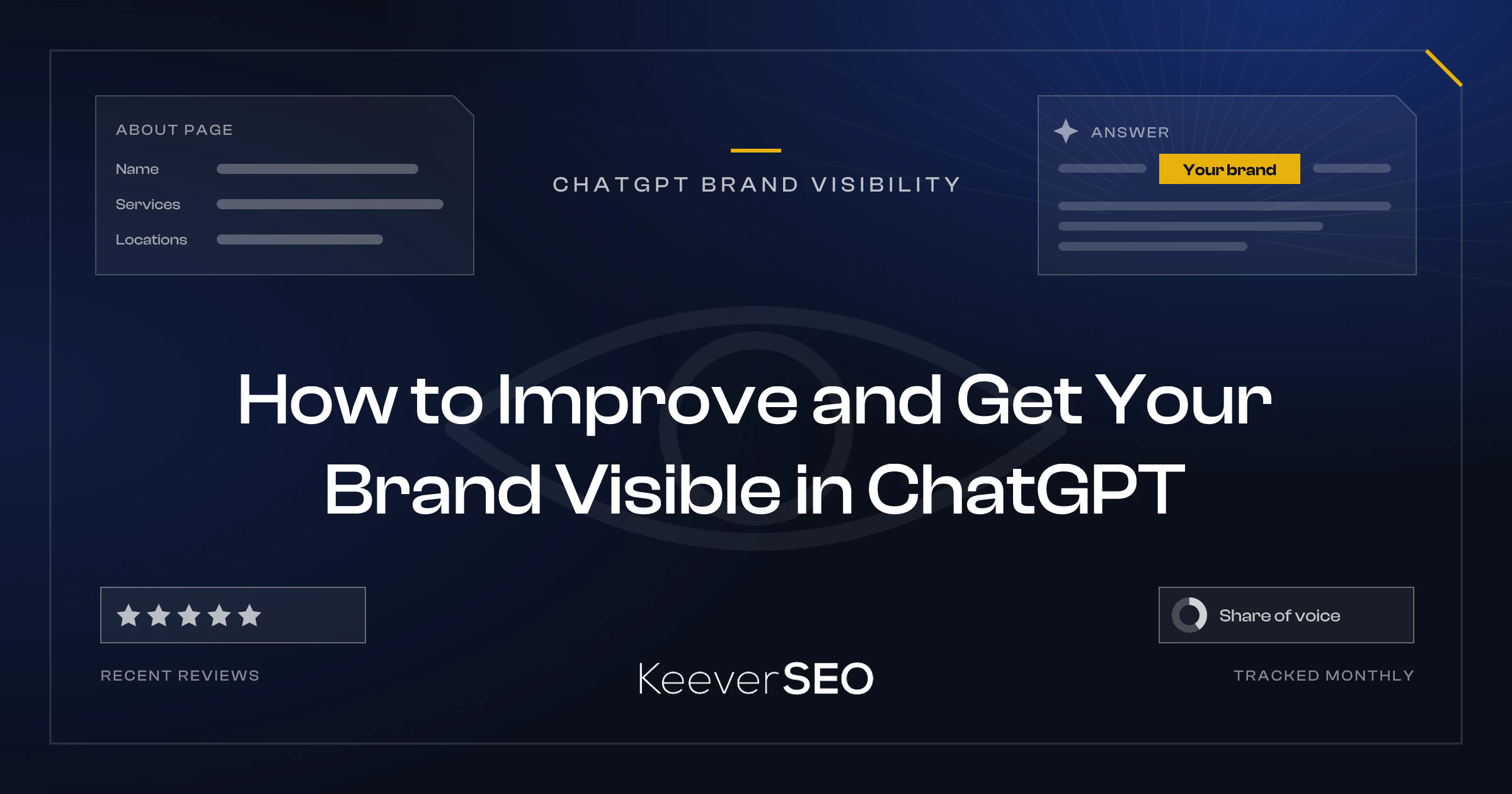
To get your brand visible in ChatGPT, give the model consistent, crawlable facts about who you are and earn mentions on the sources it cites when it names brands. Brand visibility in ChatGPT means how frequently and how accurately ChatGPT names, describes, and links your brand in its answers, and a brand mention (your name in the text) is a different outcome from a citation (a linked source page).
ChatGPT decides which brands to mention from prompt relevance, consistent brand facts, trusted public sources, and, when it searches the web, the pages it retrieves live. The work starts with a few checks, then follows six steps: ask ChatGPT what it already says, open crawler access, build a clear About page, add credible citations and quotes, earn mentions in databases and forums, and track the results.
Reviews shape how ChatGPT describes and recommends a brand, a 30-day plan organizes the first month, and mention rate, share of voice, fact accuracy, sentiment, citations, and referral traffic measure progress. Local service businesses gain the most from complete listings, recent reviews, and useful service pages, and an agency fits when wrong facts or competitor mentions persist, before the same groundwork carries over to ChatGPT rankings, content optimization, Perplexity, and Claude. The first section defines brand visibility in ChatGPT.
What Does Brand Visibility in ChatGPT Mean?
Brand visibility in ChatGPT is how frequently and how accurately ChatGPT names and describes a brand in relevant answers. The definition covers the frequency of mentions, the accuracy of facts about a company's products, services, audience, locations, and credentials, and the sentiment of the description.
ChatGPT brand visibility includes a brand's place in recommended shortlists for buyer prompts such as "Which providers should I consider?" A plain mention, a positive description, and a direct recommendation are three different visibility outcomes, which is why mentions and citations need separate tracking.
How Are Brand Mentions Different From Citations in ChatGPT?
Brand mentions differ from citations in ChatGPT because a mention names the company, product, or service inside the answer text, while a citation links a page as a source. ChatGPT can mention a brand without citing it, cite a brand's page without naming the brand, or do both.
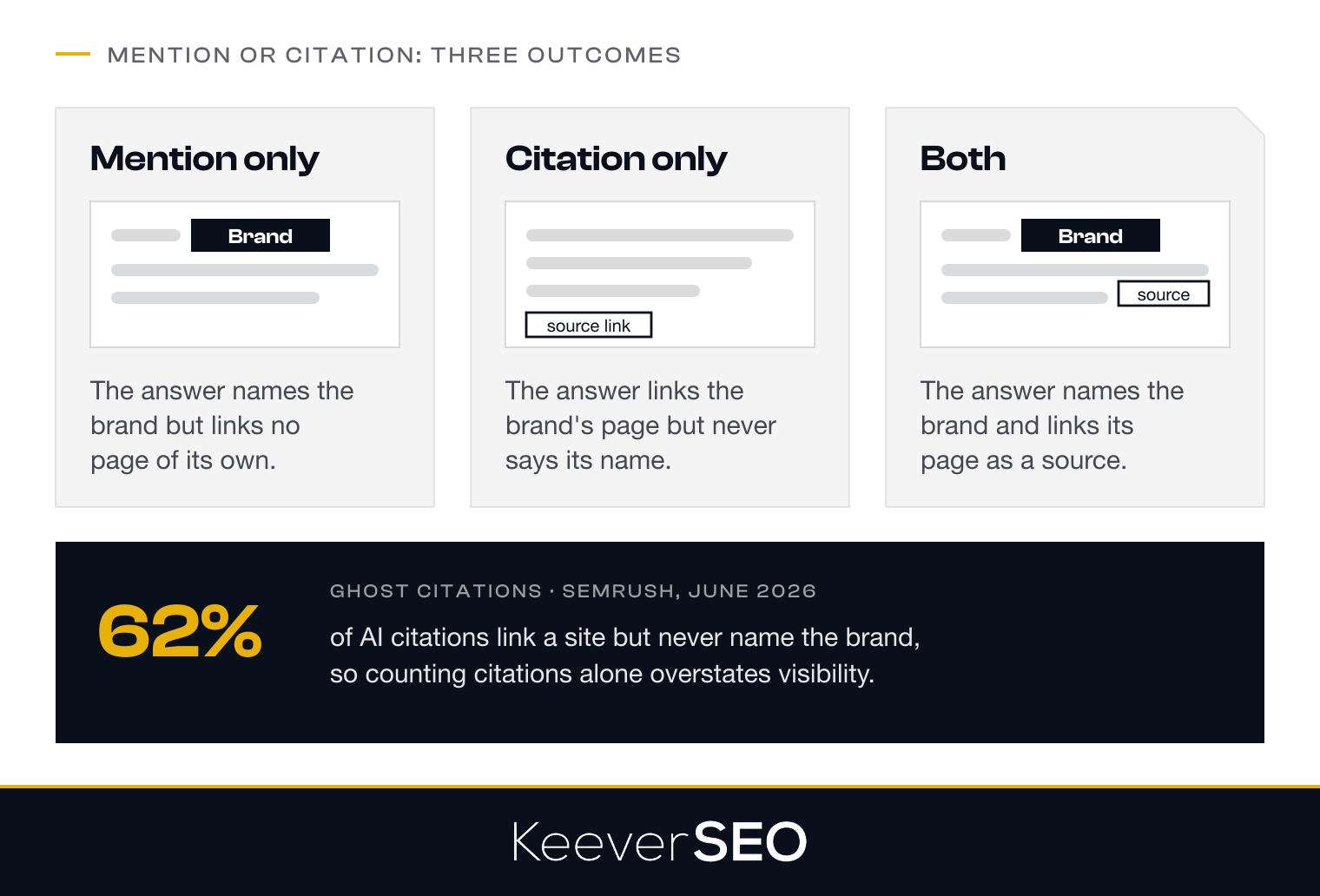
A June 2026 Semrush study by Margarita Loktionova found that 62% of AI citations are "ghost citations", where a site gets a source link but the answer never says the brand's name, according to "Why 62% of AI citations don't lead to brand mentions [Study]". Counting citations alone therefore overstates how frequently buyers see a brand's name.
How Does ChatGPT Decide Which Brands to Mention?
ChatGPT decides which brands to mention by matching the prompt against what trusted sources say about each brand. Repeated, consistent mentions across trusted sources tie a brand to a product category or customer need, while clear facts about its name, services, and locations remove ambiguity.
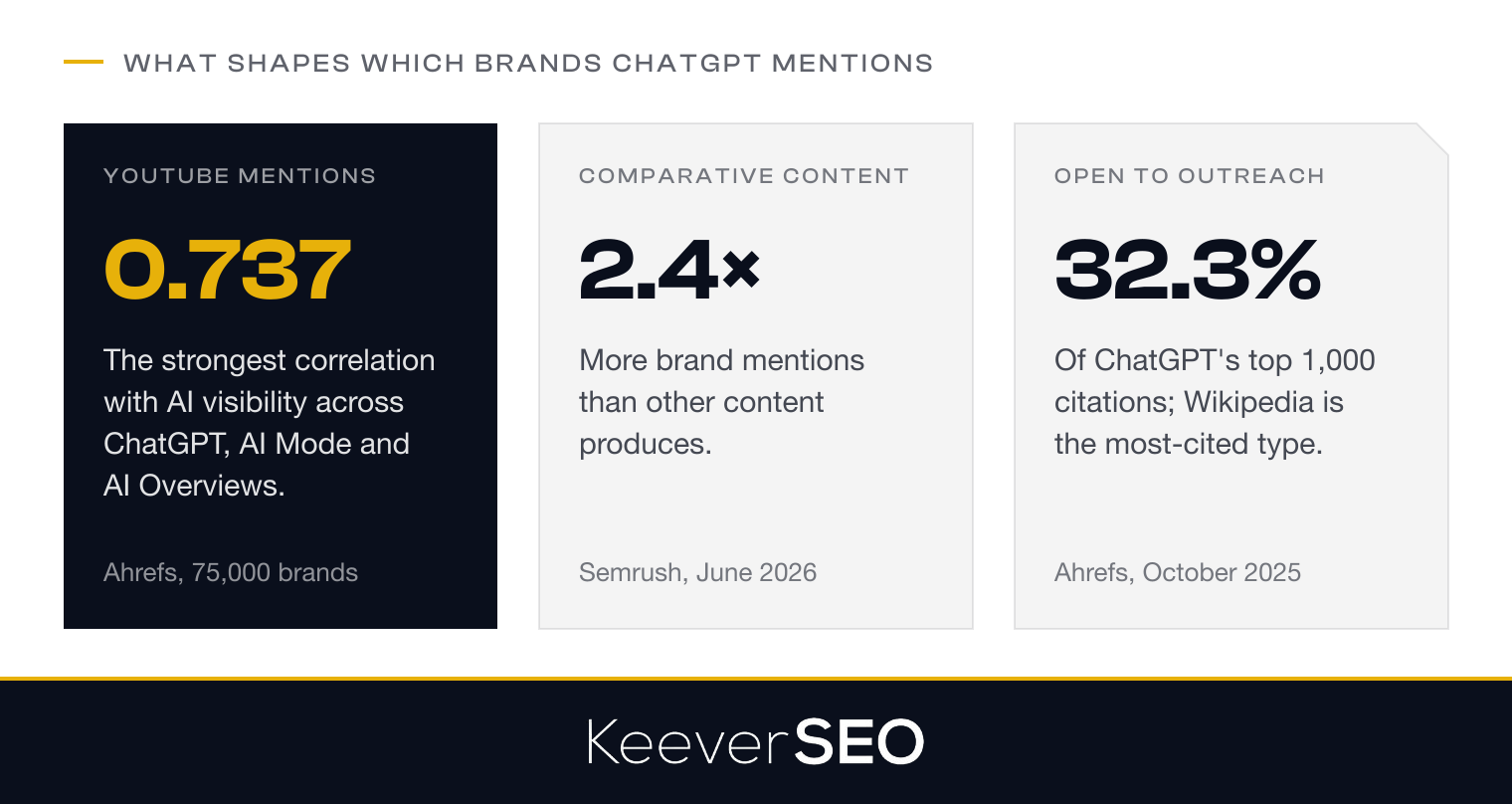
Mentions off a brand's own website carry weight: a December 2025 Ahrefs study of 75,000 brands found that YouTube mentions had the strongest correlation with AI visibility, at about 0.737, across ChatGPT, AI Mode, and AI Overviews, according to "Top Brand Visibility Factors in ChatGPT, AI Mode, and AI Overviews (75k Brands Studied)" by Louise Linehan. The shape of the content matters too: Semrush research found that comparative content produces 2.4 times more brand mentions than other content, according to the same June 2026 study, "Why 62% of AI citations don't lead to brand mentions [Study]".
ChatGPT answers draw on what the model learned in training and, when ChatGPT searches the web, on pages retrieved at the moment of the question. Brand mentions in ChatGPT therefore change as web content and available sources change.
Which Sources Does ChatGPT Cite When It Names Brands?
The sources ChatGPT cites when it names brands are brand websites, reference sources such as Wikipedia, review platforms, industry publications, and community forums such as Reddit. An Ahrefs analysis of ChatGPT's top 1,000 citations found that Wikipedia was the single most-cited content type and that only 32.3% of those citations were open to outreach, according to "67% of ChatGPT's Top 1,000 Citations Are Off-Limits to Marketers" by Louise Linehan, October 2025.
The cited sources shift with the prompt: product questions lead ChatGPT to official product, pricing, or service pages, while comparison questions draw on review sites and directories. Brands widen their citation coverage by publishing accurate, crawlable information and earning independent mentions in reputable publications, relevant directories, and credible communities.
What Should You Check Before Improving Brand Visibility in ChatGPT?
The checks to run before improving brand visibility in ChatGPT are listed below:
- What ChatGPT says about the brand today, including its descriptions, recommendations, and cited sources.
- Whether OpenAI's crawlers can reach the website.
- Whether the brand name, address, services, and locations match across the site and online listings.
- Which branded, category, comparison, review, and problem-based prompts buyers use.
The answers to the checks form the baseline for the six steps below.
How Do You Improve Brand Visibility in ChatGPT?
To improve brand visibility in ChatGPT, make the business easier to find, read, verify, and cite through six steps: audit ChatGPT's current answers, open crawler access, state brand facts on the About page, back key pages with credible citations and quotes, earn mentions across trusted sources, and track the results.
The steps run in order: first establish what ChatGPT already says, then fix access and information gaps, then build authority and measure the change. The process begins with an audit of ChatGPT's existing brand answers.
1. Ask ChatGPT What It Already Says About Your Brand
To audit current brand visibility, ask ChatGPT direct questions such as "What do you know about [Brand]?" and "What products or services does [Brand] offer?", then test buyer prompts such as "What are the best [service] providers in [location]?" Record whether ChatGPT mentions the brand and whether its facts are missing, wrong, or out of date.
Save every link ChatGPT provides and open each cited page, since search citations can be incomplete, outdated, or wrong. Running the same prompts under the same conditions and comparing the answers with competitors sets the baseline, and the gaps it reveals point straight to whether ChatGPT's crawlers can reach the site.
2. Make Sure ChatGPT's Crawlers Can Reach Your Site
ChatGPT brand visibility depends on OpenAI's search crawler reaching the pages that state your brand facts. Allow OAI-SearchBot in robots.txt, and check that the hosting provider, CDN, firewall, and security tools do not block OpenAI's published IP ranges.
Brand facts belong in server-rendered HTML, not only in JavaScript or interactive widgets. Key pages should return successful responses, carry no accidental noindex directives, and appear in an accurate XML sitemap.
Submitting the site through Bing Webmaster Tools supports discovery and indexing for ChatGPT search. ChatGPT-User handles page visits that a user triggers, while OAI-SearchBot finds pages for ChatGPT search.
3. Build an About Page That States Who You Are
An About page raises brand visibility in ChatGPT by stating verifiable facts about the business in one place. The page should name the brand, describe its products or services, identify its customers, and list its locations, founders, and credentials.
Organization structured data should repeat the same facts as the visible page, using fields such as name, url, logo, sameAs, foundingDate, founder, address, areaServed, and contactPoint. Consistent facts help ChatGPT identify the business, but schema alone does not guarantee a mention or a recommendation.
4. Add Credible Citations and Quotes to Key Pages
Credible citations and expert quotes make key pages more useful to readers and easier for ChatGPT to reference. Each factual claim needs a current statistic or a direct link to the original study, with the source named, dated, and placed next to the claim.
The best methods in the GEO research, Cite Sources, Quotation Addition, and Statistics Addition, improved visibility by 30% to 40% on the study's position-adjusted word count measure, according to "GEO: Generative Engine Optimization" by Pranjal Aggarwal and colleagues, published on arXiv in November 2023 and accepted to KDD 2024. Later benchmarks are more cautious, finding most rewriting methods "largely ineffective" and traditional SEO "significantly more effective", according to "C-SEO Bench: Does Conversational SEO Work?" by Haritz Puerto and colleagues, NeurIPS 2025, so citations and quotes work best on pages that already rank. Each quote should carry a named expert and organization, and each statistic should sit beside the claim it supports.
5. Earn Mentions in Databases, Directories, and Forums
Brand mentions across trusted databases, directories, review platforms, forums, and comparison articles connect a brand with its category, services, locations, and customers. The places to earn those mentions are listed below:
- Wikidata and industry databases: create a Wikidata entry only when the business meets Wikidata's notability and sourcing rules, and keep the official name, website, industry, and locations consistent with reliable sources.
- Review platforms and trade directories: complete profiles on platforms such as G2, Yelp, TripAdvisor, and established industry directories, ask customers for honest reviews, and never buy reviews or publish fabricated testimonials.
- Reddit and niche forums: disclose the affiliation, answer relevant questions, and share useful guidance without promotional links, since spam and hidden promotion damage trust.
- Roundup and comparison articles: pitch for factual inclusion in credible roundups, show how the services fit the article's audience, and back every differentiator with evidence.
Track which pages mention the brand, the facts and sentiment they carry, and whether ChatGPT cites them. Accurate, durable coverage outperforms a large volume of thin or artificial mentions.
6. Track ChatGPT Referrals and Brand Mentions
Tracking ChatGPT referrals and brand mentions shows whether brand visibility improves over time. An analytics segment for chatgpt.com referrals captures sessions tagged with utm_source=chatgpt.com.
A fixed set of brand, category, comparison, and buyer-intent prompts, run on a schedule, gives the mention data. Each run logs the brand mentions, their accuracy and sentiment, the competitors named, and every page or domain ChatGPT links, so prompt results, citations, and referral sessions can be compared month to month.
Do Reviews Affect Brand Visibility in ChatGPT?
Yes, reviews affect brand visibility in ChatGPT, because review volume, recency, and the language customers use give ChatGPT third-party detail about a business's services, strengths, and locations. Review volume shows the clearest link: in an audit of 10,000 US local businesses, those surfaced by both ChatGPT and Perplexity averaged 133.4 reviews, against 10.7 for businesses surfaced by neither, according to "Do Google reviews affect AI recommendations? Yes, here's by how much" by Andrew Waite, Insites, August 2026.
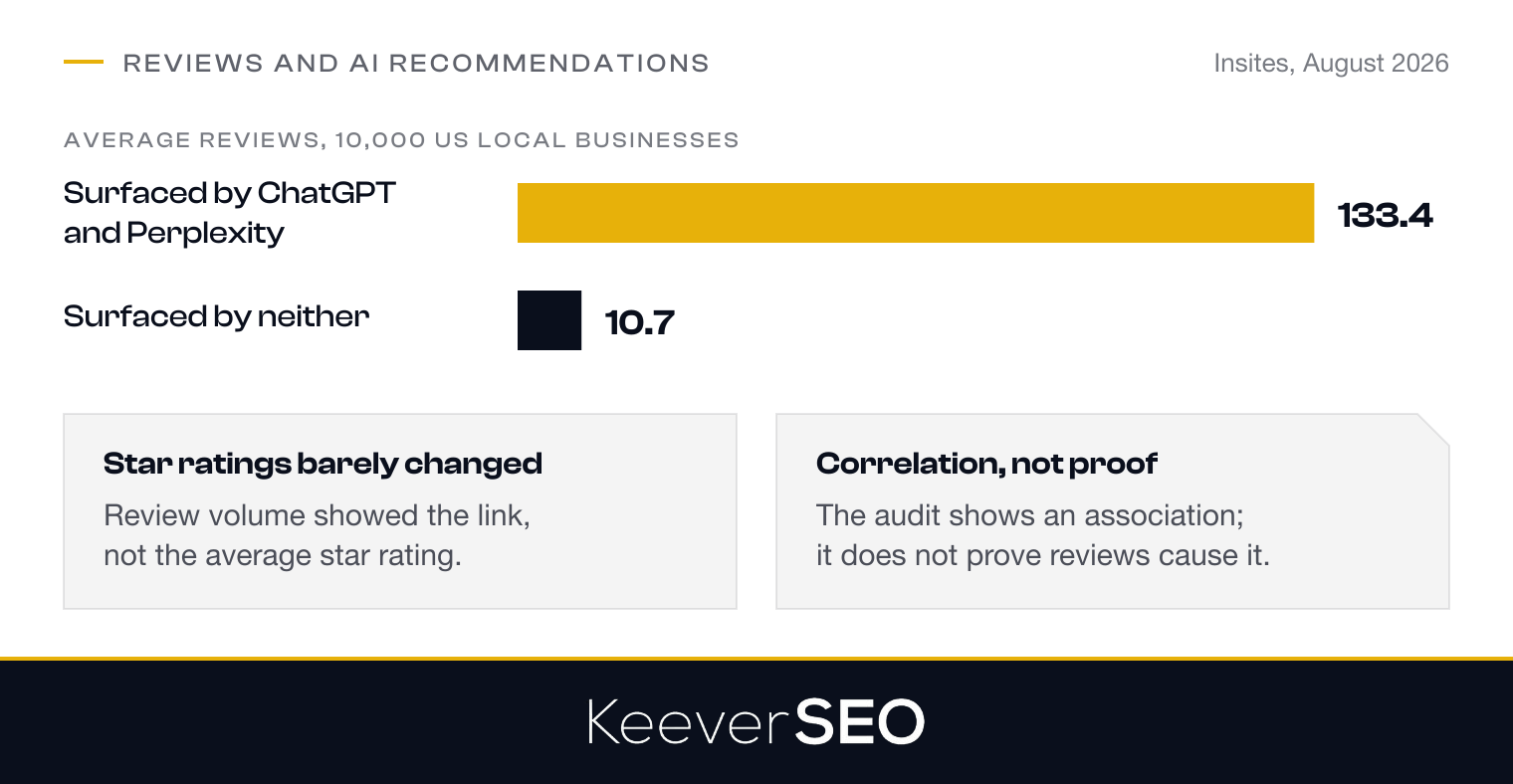
The same audit found star ratings barely changed between recommendation tiers, and the findings show correlation rather than proof that reviews cause recommendations.
What Does a 30-Day Plan to Improve ChatGPT Brand Visibility Look Like?
A 30-day plan to improve ChatGPT brand visibility sets a baseline in week 1, fixes access and the About page in week 2, upgrades key pages in week 3, and builds mentions and tracking in week 4.
| Week | Focus | Key Tasks | Output |
|---|---|---|---|
| Week 1 | Audit and baseline | Test a fixed set of branded and buyer-intent prompts. Record brand mentions, descriptions, sentiment, competitors, factual gaps, and cited pages. Check ChatGPT referral traffic in analytics. | Baseline report with prompt results, competitor comparisons, citation list, factual-error log, and starting visibility metrics. |
| Week 2 | Technical access and About page | Review robots.txt, firewall, CDN, and server settings. Allow OAI-SearchBot to reach public pages. Create or update the About page with the brand name, services, audience, locations, founders, credentials, and contact details. Add matching Organization or LocalBusiness structured data. | Crawl-access checklist, corrected technical barriers, and an About page with consistent brand facts. |
| Week 3 | Citations and key page updates | Update the main service, product, location, and comparison pages. Place direct answers near the top, back claims with reputable statistics, name sources, add expert quotes, and remove conflicting facts. Keep key information readable in HTML. | Citation-ready pages, a source log, corrected structured data, and a prioritized content-gap list. |
| Week 4 | Mentions and tracking setup | Correct profiles in directories, databases, review platforms, and trade publications. Pitch for accurate mentions in industry articles, local sources, community discussions, Reddit, and niche forums. Re-run the prompt set and track referrals, mentions, sentiment, competitors, and linked pages. | Outreach and listing tracker, analytics report, updated prompt results, and a repeatable monthly reporting process. |
Which Brand Visibility Metrics Should You Track in ChatGPT?
The brand visibility metrics to track in ChatGPT are listed below:
- Mention rate: the percentage of tracked answers that name the brand.
- Share of voice: the brand's share of mentions compared with competitors.
- Brand fact accuracy: how frequently answers describe the services, locations, credentials, and other key facts correctly.
- Sentiment: whether each mention is positive, neutral, or negative.
- Citation count: the number of answers that link to the website, with the pages cited.
- ChatGPT referral traffic: visits, engagement, and conversions from ChatGPT.
How Can a Local Service Business Get ChatGPT to Recommend It?
A local service business can get ChatGPT to recommend it by keeping its Google Business Profile and other listings complete, accurate, and consistent. The name, address, phone number, hours, services, and service area should match on every platform, including Google Maps and Yelp.
Recent, genuine reviews give ChatGPT signals about customer experience and service quality. Service and location pages that answer buyer questions about pricing, availability, coverage, and qualifications, together with mentions in trusted local sources, round out the case for a recommendation.
When Should Brand Visibility in ChatGPT Be Handled by an Agency?
Brand visibility in ChatGPT should be handled by an agency when wrong or missing brand facts persist after the obvious fixes, or when ChatGPT keeps recommending competitors instead. Agency support suits teams without the capacity to manage technical updates, content, business listings, and outreach at the same time.
An agency sets up repeatable tracking for prompts, brand mentions, citations, accuracy, and sentiment. A focused audit or pilot is the usual starting point, since it sets a baseline, maps competitor and citation gaps, and produces a prioritized action plan.
How Does Keever SEO's AI Optimization Service Make Brands Visible in ChatGPT?
Keever SEO's AI optimization service makes brands visible in ChatGPT by raising how frequently and how accurately ChatGPT mentions them. The work starts with a brand visibility audit that reviews current mentions, citations, competitors, buyer prompts, and gaps in site access, content, and authority.
The brand visibility SEO agency then corrects entity information and About pages, rewrites key pages as clear, citation-ready content, and builds relevant mentions across publications, directories, forums, and review platforms. Ongoing reporting tracks citations, brand mentions, sentiment, referral traffic, and share of voice against competitors.
How Does Brand Visibility in ChatGPT Connect to Rankings and Content?
Brand visibility in ChatGPT connects to rankings and content because all three feed the same answers while measuring different outcomes. Search rankings help crawlers find pages, while question-focused content and authority across independent sources raise the chance that ChatGPT retrieves or cites them. A brand can appear in ChatGPT without ranking first, and a top-ranking page can go uncited. The two questions below cover ranking in ChatGPT and content optimization.
How Do You Rank in ChatGPT?
To rank in ChatGPT, allow OAI-SearchBot to crawl your pages and get them indexed in Bing. Clear, factual content that ChatGPT can cite and consistent mentions on trusted websites build the authority that turns access into citations, though no tactic guarantees inclusion.
How Do You Optimize Content to Appear in ChatGPT?
To optimize content to appear in ChatGPT, organize pages into modular sections that answer one buyer question each, with the direct answer first under a descriptive heading. Key facts belong in server-rendered text, and Organization, Article, or LocalBusiness schema should match the visible page, since schema does not guarantee ChatGPT citations on its own.
How Do You Get Recommended by Other AI Assistants?
To get recommended by other AI assistants, keep brand facts consistent and earn trusted third-party mentions, since every assistant draws on those signals. Each assistant runs its own search system and source selection, so visibility varies from platform to platform. The website, directories, review platforms, industry databases, and community discussions should agree on what the business offers and where it operates. Perplexity and Claude follow their own discovery methods, covered below.
How Do You Get Your Brand Mentioned in Perplexity?
To get your brand mentioned in Perplexity, publish fresh, well-cited pages that answer buyer questions and allow PerplexityBot to crawl them in robots.txt, with no firewall or bot-management rule blocking its requests.
Independent mentions on review platforms, industry directories, and community discussions give Perplexity outside sources that name the brand. Tracking unlinked mentions alongside Perplexity citations shows how visibility changes.
How Do You Get Mentioned in Claude?
To get mentioned in Claude, publish crawlable pages with clear information about the brand name, services, audience, and locations, and keep those facts consistent on industry directories, review platforms, and relevant publications. Claude retrieves current pages and cites them when it searches the web, so allowing the Claude-SearchBot and Claude-User agents to reach key pages lets Claude confirm the brand facts.
How Long Does It Take to Make a Brand Visible in ChatGPT?
Making a brand visible in ChatGPT takes a few weeks for live search answers and several months for broader gains. Live search mentions can shift within weeks of crawler access and content fixes, while authority built across trusted sources compounds over months and varies with indexing, competition, content quality, and source updates.
No published study measures a reliable timeline, and training-data visibility changes only when OpenAI updates or releases a model. The pace therefore follows the full process of making a brand visible in ChatGPT: crawl access first, clear facts second, and trusted mentions over time.