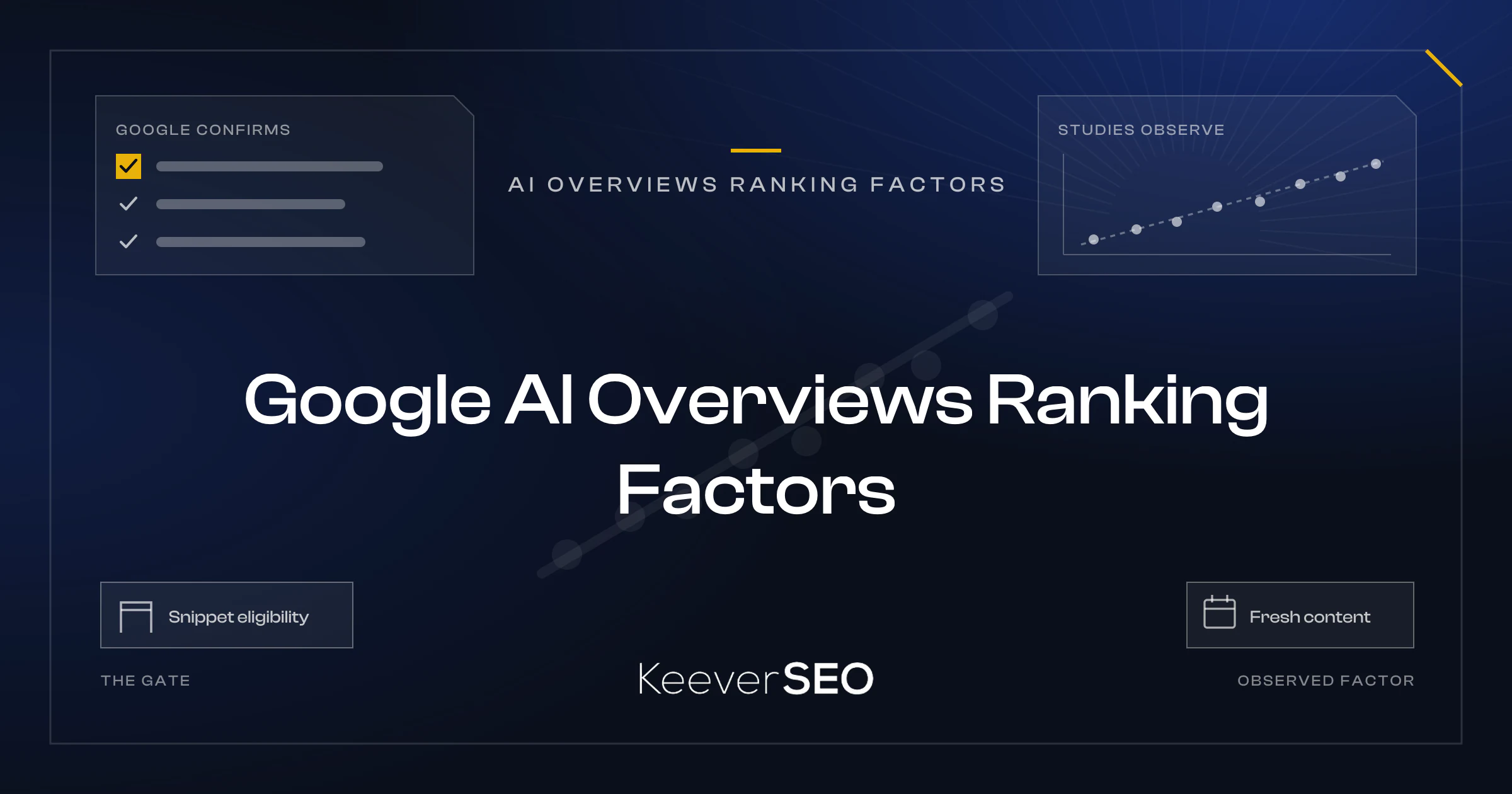
Google AI Overviews ranking factors are the signals that decide which pages Google links as sources, split into factors Google confirms and factors studies observe. An AI Overviews ranking factor is a page or site property that raises the chance of a citation in an AI-generated summary, and Google selects those sources by retrieving indexed pages, judging them through its Search systems, and choosing passages that support the answer across related searches.
The confirmed factors are indexing and snippet eligibility, helpful content, page experience, and structured data that matches the visible content, while studies observe links with organic rankings, answer-first writing, entity coverage, freshness, and off-page authority. The factors matter because AI Overviews place cited sources above the organic listings, and examples such as a nosnippet directive, a direct answer, or a refreshed guide show them at work. AI Overviews select supporting passages while classic rankings order whole pages, and snippet eligibility is the gate before query visibility, useful answers, and authority carry the most weight.
A local service business should first check service-page indexing and snippet settings, answer cost and process questions, complete its Google Business Profile, and earn local reviews, and outside help fits when pages rank without citations. The article then turns the factors into ranking steps, compares them with other AI answer surfaces and with GEO ranking factors, and looks at how they will change next, starting with a definition of Google AI Overviews ranking factors.
What Are Google AI Overviews Ranking Factors?
Google AI Overviews ranking factors are the confirmed requirements and observed correlations that influence which pages Google cites in AI-generated summaries. A ranking factor in AI Overviews is a page or site property that raises a page's chance of appearing as a source.
Google confirms the technical eligibility requirements and applies its existing Search quality systems, while research and industry analyses observe patterns such as organic visibility, clear answers, topical coverage, freshness, and authority. Confirmed requirements decide whether Google can use a page, and observed correlations describe traits linked with citation, since Google publishes no AI Overviews ranking formula.
How Does Google Select Pages for an AI Overview?
Google selects pages for an AI Overview by expanding the query, retrieving relevant pages from its index, and choosing passages that support the generated answer. Query fan-out issues "multiple related searches across subtopics and data sources", and a page "must be indexed and eligible to be shown in Google Search with a snippet" to appear as a supporting link, according to "AI features and your website" published by Google Search Central, December 2025.
Google's ranking and quality systems pick the useful sources, and Google links the pages that support individual claims in the overview. AI features require no special markup beyond the established Search requirements.
What Types of Google AI Overviews Ranking Factors Exist?
The types of Google AI Overviews ranking factors are factors Google confirms and factors independent studies observe. Confirmed factors come from Google's own guidance, while observed factors describe correlations found in citation studies.
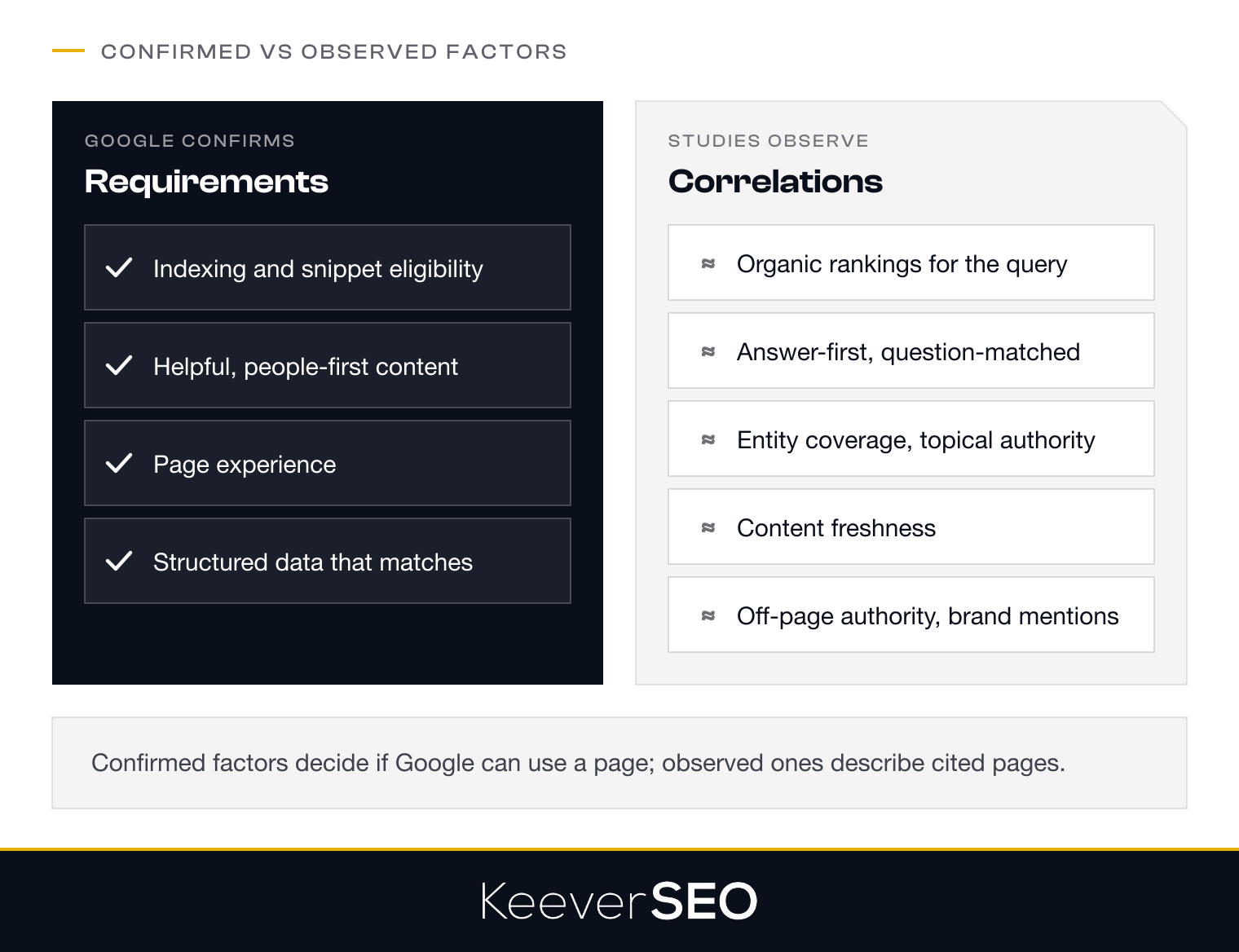
Google confirms indexing and snippet eligibility, helpful and reliable content, page experience, and structured data that matches the visible content. Studies observe associations with organic rankings, answer-first content, entity coverage, freshness, and off-page authority, as the sections below explain for both groups.
Factors Google Confirms
The factors Google confirms for AI Overviews are the foundational Search requirements, not special AI ranking rules. Google states that optimizing for generative AI search "is optimizing for the search experience, and thus still SEO", and that "there's no special schema.org markup you need to add", according to "Google's Guide to Optimizing for Generative AI Features on Google Search" published by Google Search Central, May 2026.
Google names indexing and snippet eligibility as the conditions for a supporting link and recommends helpful, reliable, people-first content and a strong page experience. Structured data should describe the visible page content accurately, as the four factors below explain.
Indexing and Snippet Eligibility
Indexing and snippet eligibility decide whether Google can consider a page as a source for an AI Overview. Google must index the page and be allowed to show it with a text snippet in Search.
Site owners should remove nosnippet from content intended for citation, because the directive stops Google from using that content as direct input for AI Overviews. Meeting the requirements does not guarantee a citation.
Helpful, Reliable, People-First Content
Helpful, reliable, people-first content gives Google AI Overviews useful pages to cite. Original research, independent analysis, and clear explanations add value beyond generic summaries.
First-hand experience, such as product testing or documented case work, shows real experience and gives readers concrete evidence. Content written for the searcher's needs supplies accurate, useful information instead of material made to influence rankings.
Page Experience
Page experience describes how easily visitors use and understand a web page. Fast loading, mobile usability, and responsive design let visitors reach the main content on every device.
Clear layouts place the main answer where readers find it, without intrusive pop-ups or heavy advertising. A strong page experience supports search visibility, but it does not guarantee a citation in a Google AI Overview.
Structured Data That Matches Visible Content
Structured data that matches visible content helps Google interpret a page when the schema describes what visitors can see. Article, FAQPage, HowTo, Product, or LocalBusiness markup should cover only information shown on the page.
Google requires no special schema for AI Overviews, and structured data does not guarantee a citation. Google's Rich Results Test validates the markup, and Google's structured data guidelines show how to fix errors.
Factors Studies Observe
The factors studies observe among pages cited in Google AI Overviews are organic rankings, answer-first content, entity coverage and topical authority, content freshness, and off-page authority. SEO studies and practitioner analyses report the patterns, but Google has not confirmed them as ranking rules.
Pages that rank for the original query or related searches and give clear, current, authoritative information appear more among citations, although no factor guarantees inclusion. The following sections explain each observed factor and its link to AI Overview citations.
Organic Rankings for the Query
Organic rankings for the query correlate with Google AI Overviews citations, although a high ranking does not guarantee inclusion. Only 37.9% of URLs cited in AI Overviews appeared in the first 10 results, with the rest split between positions 11 to 100 (31.2%) and beyond the top 100 (31.0%), according to "Update: 38% of AI Overview Citations Pull From The Top 10" by Louise Linehan, Ahrefs, March 2026.
Google cites pages that rank for related fan-out queries even when they do not rank high for the original search. The findings describe observed correlations, not confirmed ranking rules.
Answer-First, Question-Matched Content
Answer-first, question-matched content gives a direct response beneath a heading phrased as the searcher's question. Clear headings and focused paragraphs help Google find passages that address individual queries.
Short, self-contained passages make answers easier to quote in an AI Overview. Studies observe the pattern as a correlation, not a confirmed Google ranking rule.
Entity Coverage and Topical Authority
Entity coverage and topical authority describe how plainly a page names its subject and how thoroughly a site covers related topics. Clear names for people, products, places, and concepts help Google connect page content with the query.
Coverage of related subtopics and linked supporting pages builds depth around the subject. Studies observe a relationship between topical coverage and AI Overviews citations, but Google has not confirmed topical authority as a stand-alone ranking rule.
Content Freshness
Content freshness is an observed Google AI Overviews ranking factor, not a confirmed citation rule. Updated facts, statistics, prices, instructions, and dates keep the information on a page accurate.
Recency matters most for time-sensitive searches about software releases, regulations, market data, and current events. Evergreen pages gain from real accuracy updates, while a new publication date without better content offers little value.
Off-Page Authority and Brand Mentions
Off-page authority covers signals outside a website that show trust in a brand, including backlinks, mentions in trusted publications, and customer reviews. A study of 75,000 brands found that brand web mentions had the strongest correlation with AI Overview brand visibility (0.664), against 0.218 for backlinks, according to "An Analysis of AI Overview Brand Visibility Factors (75K Brands Studied)" by Louise Linehan, Ahrefs, May 2025.
The finding shows an association, not a confirmed Google ranking rule or proof of causation. Genuine reviews and reputable brand mentions support authority when the pages give useful content and stay eligible for indexing.
Why Are Google AI Overviews Ranking Factors Important?
Google AI Overviews ranking factors are important because they influence which pages Google links as sources in summaries shown above or beside the organic results. Cited pages gain early visibility and chances to build awareness and credibility.
Businesses that ignore eligibility, content clarity, and authority signals risk losing citations to competitors. Competing pages then earn the attention and trust of users researching answers through AI Overviews.
What Are Examples of Google AI Overviews Ranking Factors at Work?
Examples of Google AI Overviews ranking factors at work include a service page that loses its citation after a developer adds a nosnippet directive restricting Google from showing its content.
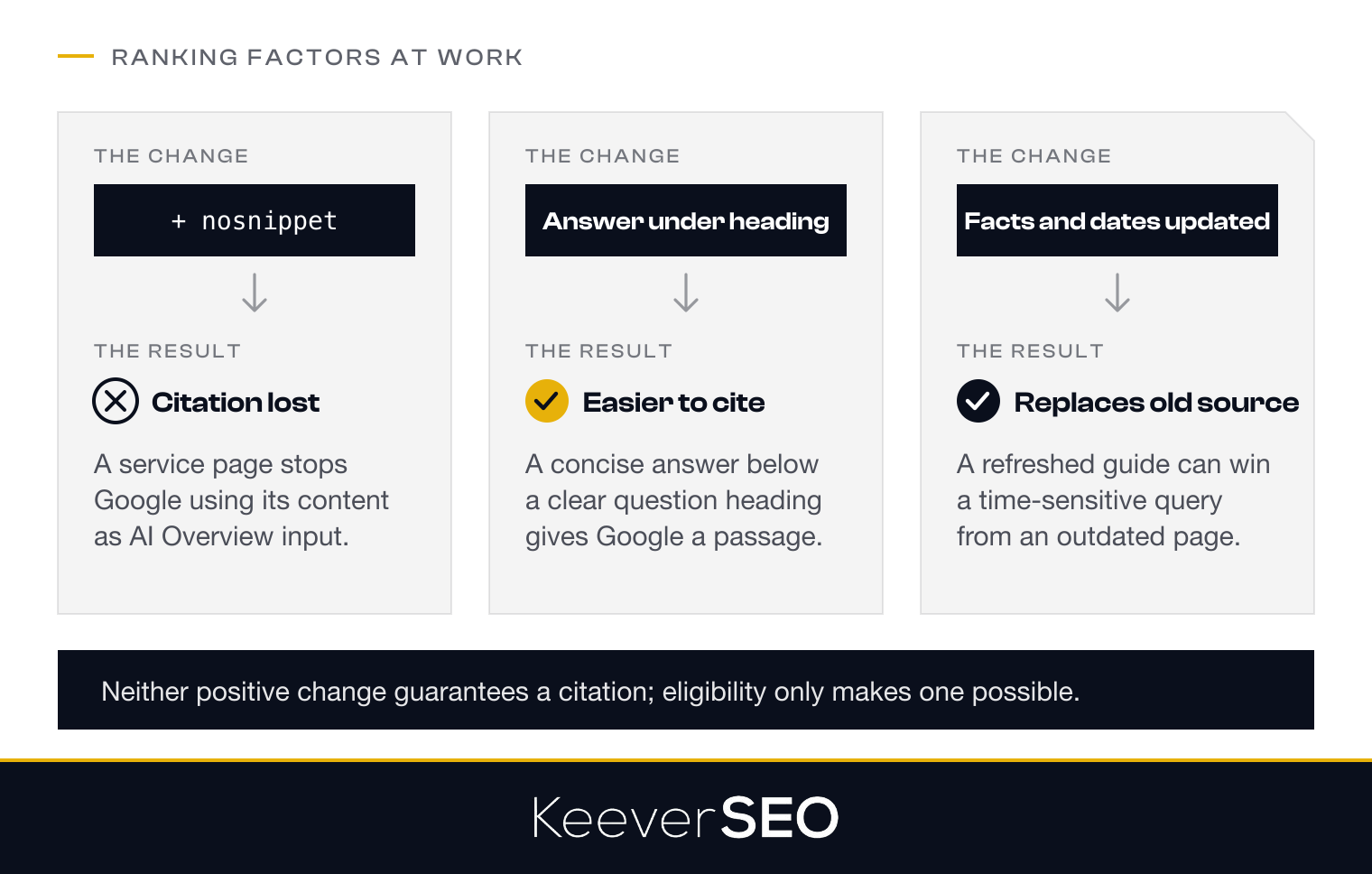
A page that places a concise answer beneath a clear question heading becomes easier for Google to cite. A refreshed guide with corrected facts and current dates can replace an outdated source for a time-sensitive query, though neither change guarantees a citation.
How Do AI Overviews Ranking Factors Differ From Classic Google Ranking Factors?
AI Overviews ranking factors differ from classic Google ranking factors because they help Google select pages and passages that support a generated answer, while classic factors order whole pages in a list of search results.
| Factor Area | AI Overviews | Classic Google Rankings |
|---|---|---|
| Unit ranked | Google selects passages or pages that support individual claims in a generated answer. | Google ranks webpages as individual search results. |
| Query scope | Google expands a query into related searches, then retrieves sources for several subtopics. | Google matches results to the query the searcher entered. |
| Answer format | Google combines information from sources into a summary with links to supporting pages. | Google presents a ranked list of links, titles, and snippets. |
| Role of snippets | A page must be indexed and eligible to show a Search snippet to qualify as a supporting link. | A snippet describes a search result, and snippet eligibility does not decide ranking. |
| Freshness | Current information matters more when a query concerns changing facts or events. | Freshness matters most for queries where recent information is more useful. |
| Success measure | Success means earning a citation in an overview and relevant visibility or visits. | Success means ranking prominently and earning impressions, clicks, or conversions. |
Which Google AI Overviews Ranking Factors Carry the Most Weight?
The Google AI Overviews ranking factors that carry the most weight start with snippet eligibility, the gate a page must pass before it can serve as a source. Google grounds generative AI search in its "core Search ranking systems to retrieve relevant, up-to-date web pages", according to "Google's Guide to Optimizing for Generative AI Features on Google Search", Google Search Central, May 2026.
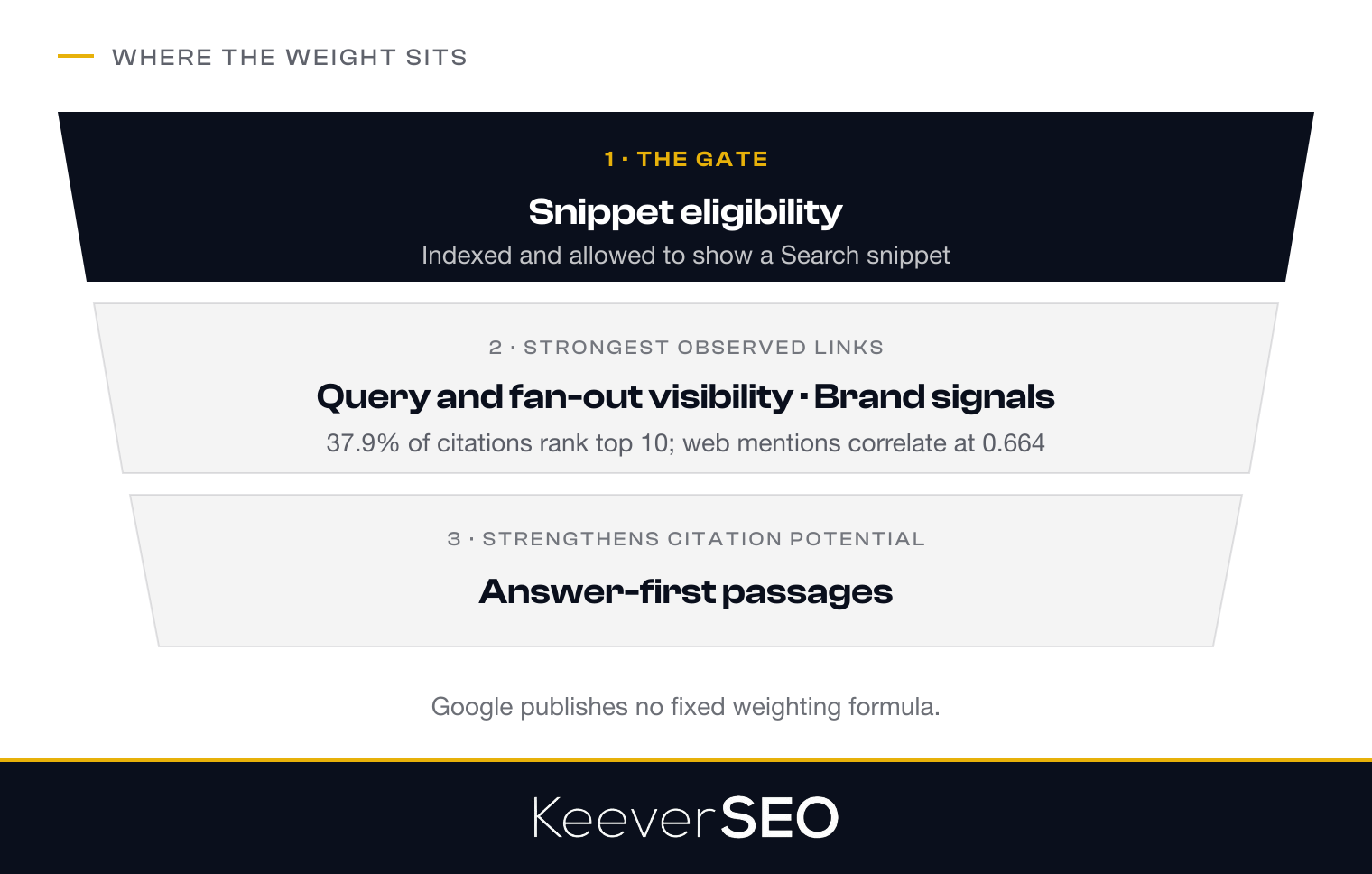
Among eligible pages, visibility for the main query and its fan-out searches and off-site brand signals have the strongest observed links with citations. Ahrefs found 37.9% of cited URLs in the top 10 for the query in its March 2026 update, and brand web mentions correlated with AI Overview brand visibility at 0.664 in its 75,000-brand study, while answer-first passages strengthen citation potential and Google publishes no fixed weighting formula.
Which AI Overviews Ranking Factors Should a Local Service Business Improve First?
The AI Overviews ranking factors a local service business should improve first are indexing and snippet eligibility on its service pages. Content intended for citation needs no nosnippet restriction, and concise answers about service costs, processes, timelines, and service areas belong near the top of each page.
The Google Business Profile comes next, with accurate services, categories, hours, contact details, and service areas. Genuine local reviews with helpful replies and consistent business information across the website and local listings complete the set.
When Should a Business Hire Help With Google AI Overviews Ranking Factors?
A business should hire help with Google AI Overviews ranking factors when relevant pages rank in Google but rarely appear as AI Overview sources. An audit finds indexing failures, snippet restrictions, or structured data errors that stop Google from finding and reading the page content.
Professional support fits when a site lacks trusted backlinks, brand mentions, or relevant reviews, or when staff cannot track citations on a schedule. A specialist assesses citation gaps, improves answer-focused content, and monitors visibility, while no provider can guarantee inclusion in AI Overviews.
How Does Keever SEO's AI Optimization Service Improve Google AI Overviews Ranking Factors?
Keever SEO's AI optimization service improves Google AI Overviews ranking factors starting with a factor audit of citations, organic visibility, competitors, crawler access, indexing barriers, content gaps, schema, and authority signals. The audit sets the priority service pages and customer questions with the strongest chances of AI Overviews visibility.
Keever SEO then fixes indexing or snippet issues, restructures pages around direct answers, and adds schema that matches the visible content. The AI optimization service builds authority through relevant publications, directories, reviews, forums, and third-party mentions, then tracks cited URLs, competitor appearances, citation frequency, and share of voice across AI platforms.
How Do These Ranking Factors Turn Into Ranking Steps?
The ranking factors turn into ranking steps because each one maps to a practical action on a page's eligibility, clarity, or authority. Confirming that target pages are indexed and allow snippets comes first, followed by concise answers under relevant question headings.
Accurate, current information, matching structured data, fast mobile performance, and trusted backlinks or reviews strengthen the pages. Citation tracking across search queries shows which sources Google AI Overviews use and how visibility compares on other AI answer surfaces, as the two questions below cover.
Which Sources Do Google AI Overviews Cite Most?
The sources Google AI Overviews cite most are pages that rank well in organic results, alongside Reddit discussions, YouTube videos, and Wikipedia entries. Government, university, healthcare, news, and industry publishers appear as sources too, with citation patterns that vary by topic and query.
How Do Ranking Factors Compare Across AI Answer Surfaces?
Ranking factors compare across AI answer surfaces by the retrieval system behind each one. Google AI Overviews rely on Google's index and ranking systems, ChatGPT search sends queries to partner search providers such as Bing and weighs wider web and brand signals, and Perplexity favors live retrieval, fresh information, and passages it can cite directly, as observed behavior rather than published formulas.
How Do Google AI Overviews Ranking Factors Compare With GEO Ranking Factors?
Google AI Overviews ranking factors compare with GEO ranking factors as one engine's signals against signals for every generative engine. GEO ranking factors address visibility across Google AI Overviews, ChatGPT, and Perplexity, while Google AI Overviews ranking factors depend on Google's index, snippet eligibility, and Search ranking systems.
Both approaches value clear, relevant, trustworthy content, but GEO recommendations are not universal ranking rules for every engine.
How Will Google AI Overviews Ranking Factors Change Next?
Google AI Overviews ranking factors will change next as Google handles more complex searches. Wider query fan-out can surface pages that answer related sub-questions, AI Mode can raise the value of clear, verifiable information across longer conversations, and multimodal answers can draw more on useful images and video.
Trusted sources with transparent authorship and evidence stand to gain, though the exact weighting remains unconfirmed, so the outlook is informed rather than established. Google AI Overviews ranking factors remain the page and site properties that decide which sources Google selects and cites in its AI-generated summaries.