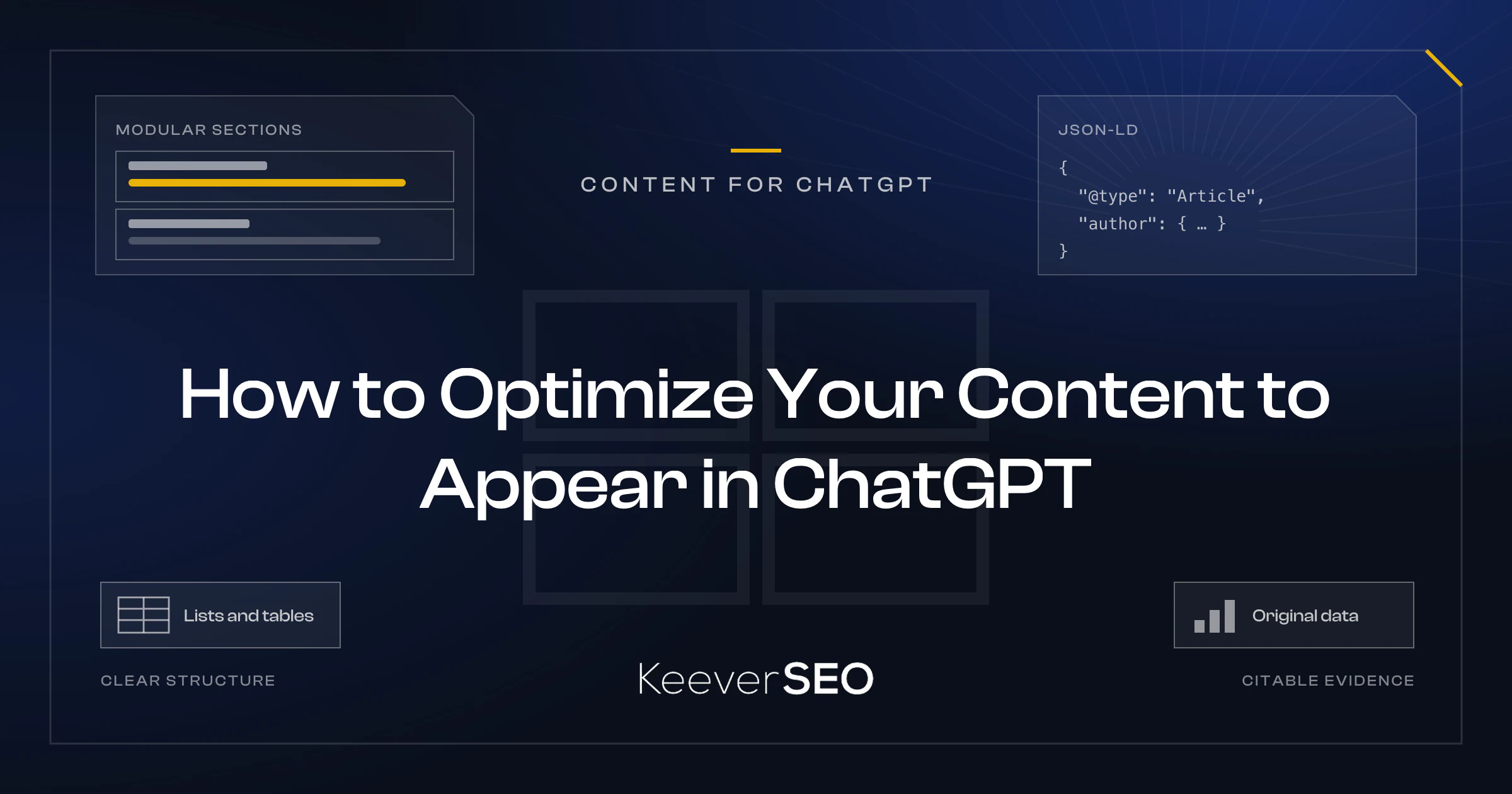
To optimize content to appear in ChatGPT, remove crawl and authority barriers first, then write modular sections that open with the direct answer and carry clear structure, matching schema, and original data. Content appears in ChatGPT when a page is retrieved for a prompt, quoted or paraphrased in the answer, or linked as a source.
ChatGPT chooses content through two layers: a training layer learned from web text before a cutoff date, and a live retrieval layer that searches current pages, where page improvements show results fastest. Technical access barriers and authority gaps come first, followed by six steps: modular sections, answers first, clear headings and formats, schema, related entities and questions, and original images, data, and examples.
Definitions, how-to guides, comparisons, listicles, statistics pages, and FAQ answers are the formats ChatGPT cites, and a fixed prompt set tested before and after changes measures whether optimized content appears. Local service businesses should start with service, location, pricing FAQ, and About pages, and hand the work to an agency when page counts, rendering problems, or tracking outgrow the team, before the same principles carry over to Perplexity, Google AI Overviews, and ranking in ChatGPT. The first section defines what appearing in ChatGPT means.
What Does It Mean for Content to Appear in ChatGPT?
Content appearing in ChatGPT means ChatGPT retrieves a webpage for a user's prompt and uses its information in the answer. ChatGPT may quote the page, paraphrase it, or show a linked citation the user can open.
A retrieved page does not appear in every answer, and its place can change from one run to the next. ChatGPT picks sources according to the prompt, the page's relevance, and the information available at the moment of live retrieval.
How Does ChatGPT Choose Which Content to Cite?
ChatGPT chooses which content to cite through a training layer and a live retrieval layer. The training layer supplies general knowledge, while live retrieval searches for current pages that answer the prompt.
During live search, ChatGPT turns a prompt into several queries and weighs pages for relevance, accessibility, source quality, and direct support for the claim. The training layer, covered first, decides how published content shapes the model's future knowledge.
What Is ChatGPT's Training Layer?
ChatGPT's training layer is the knowledge a model learns from training data, including web text published before its knowledge cutoff. The model answers from learned patterns when it does not search the web.
Publishing or updating a webpage does not change the training layer right away. A webpage shapes later model knowledge only if the model provider includes its information in a future training run.
What Is ChatGPT's Live Retrieval Layer?
ChatGPT's live retrieval layer is the web search step that fetches current pages for a prompt and cites them in the answer. ChatGPT searches on its own when a question needs up-to-date information, and users can open the cited sources to check them.
Pages qualify for live retrieval only when they allow OAI-SearchBot and accept traffic from OpenAI's published crawler IP ranges. Clear, well-supported passages raise the chance that a retrieved page is picked and cited, which makes live retrieval the layer where content optimization shows results fastest.
What Should You Fix Before Optimizing Content for ChatGPT?
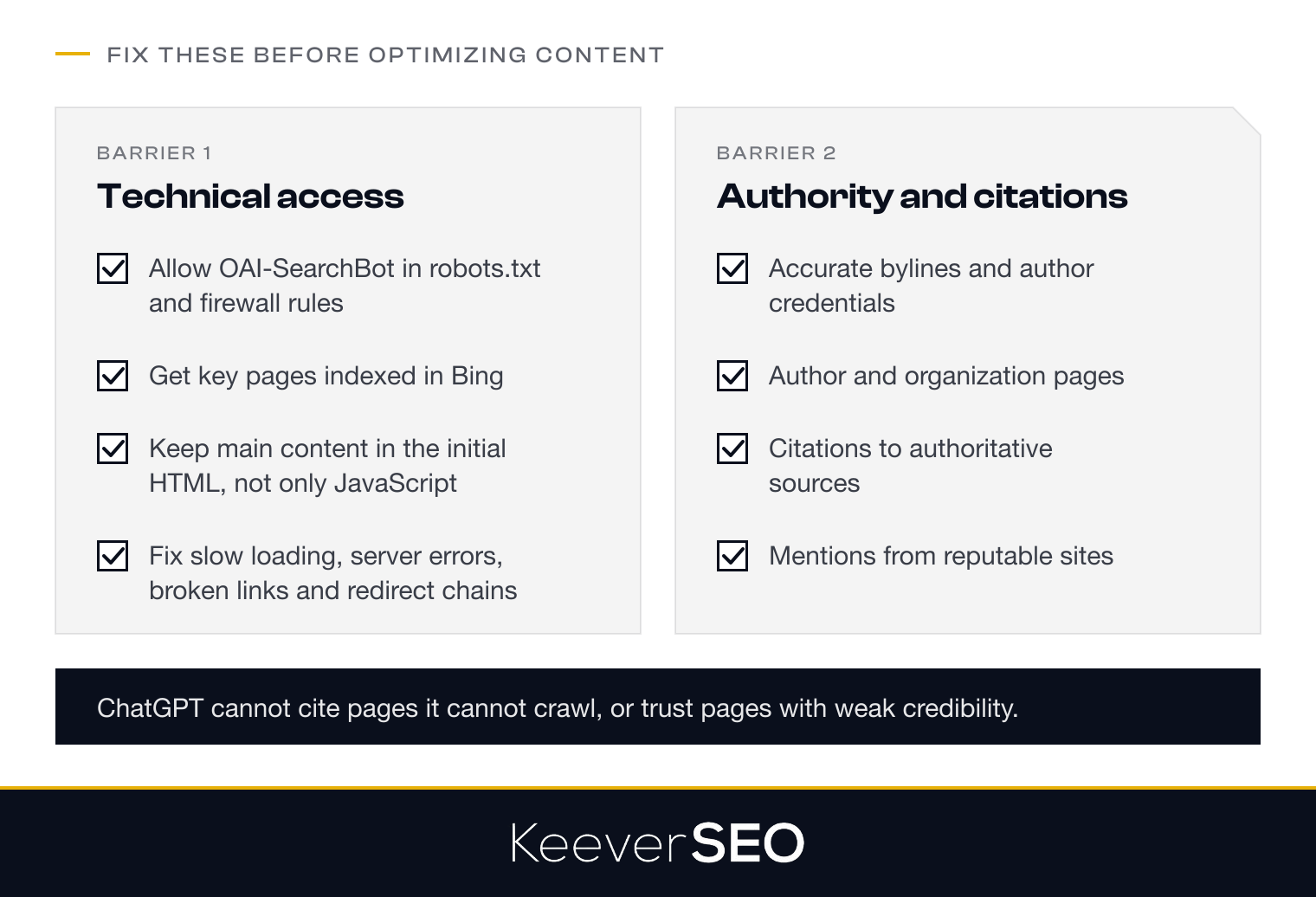
Before optimizing content for ChatGPT, fix technical access and authority problems, because ChatGPT cannot cite pages its search systems cannot crawl, and weak credibility gives it few reasons to trust a page. The two barrier types are technical access barriers and authority and citation gaps.
Technical Access Barriers
Technical access barriers stop ChatGPT's search systems from finding, fetching, or reading a page. Robots.txt and firewall rules must allow OAI-SearchBot, since sites opted out of the crawler "will not be shown in ChatGPT search answers", according to "Overview of OpenAI Crawlers" published by OpenAI in its developer documentation, accessed November 2026.
Bing should index the page, and the main content should sit in the initial HTML instead of loading only through JavaScript. Slow loading, server errors, broken links, and redirect chains need fixing so crawlers can fetch pages without failures.
Authority and Citation Gaps
Authority and citation gaps make accessible content less likely to earn trust or citations in ChatGPT answers. Thin author biographies, missing author or organization pages, few credible third-party mentions, and unsourced claims all weaken a page's credibility.
Accurate bylines, author credentials, citations to authoritative sources, and mentions from reputable sites close the gaps. With access and authority fixed, the six optimization steps below can take effect.
How Do You Optimize Content to Appear in ChatGPT?
To optimize content to appear in ChatGPT, follow six steps once access and authority are fixed: create modular sections, lead with direct answers, use clear structure, add matching schema, cover related entities, and provide original assets. Each step makes useful passages easier for search systems to read and retrieve.
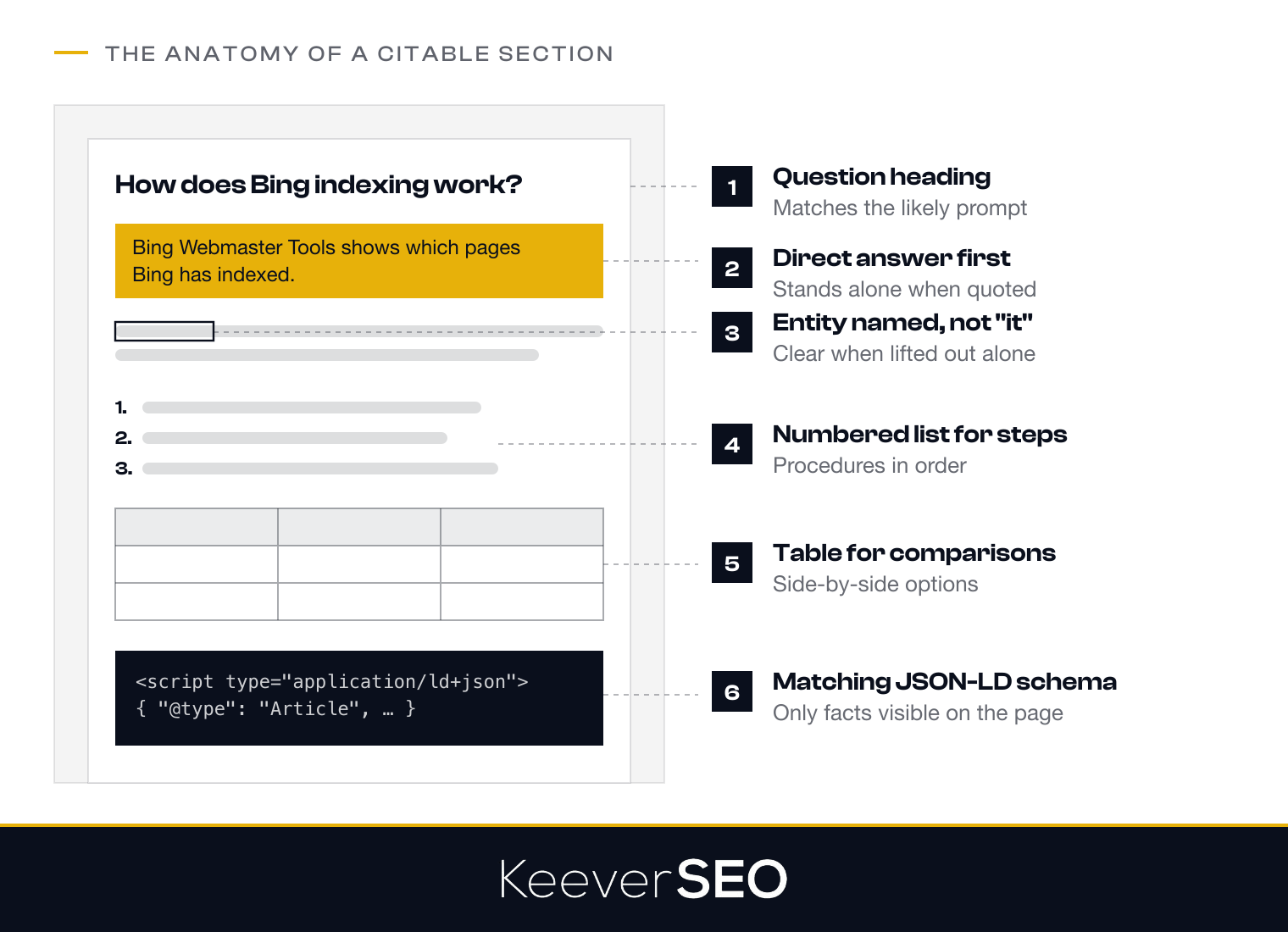
The process starts by splitting each page into self-contained sections that each answer one question, then layers answers, structure, schema, related topics, and original data on top. The first step is the modular section.
1. Break Content Into Modular, Self-Contained Sections
To optimize content for ChatGPT, give each section one clear question and enough context for the passage to make sense when retrieved or quoted on its own. Modular sections let ChatGPT match a focused passage to a narrow prompt.
Each passage should repeat the relevant entity name instead of relying on pronouns such as "it" or "they". Clear headings and self-contained explanations make a passage easier for ChatGPT to identify and use as a source.
2. Put the Direct Answer First in Each Section
To make passages easy to cite, put a concise answer in the first sentence of each section. The opening sentence answers the heading, while later sentences add context, evidence, or practical guidance.
Each opening answer should stand on its own when quoted. A section on Bing indexing, for example, can begin with "Bing Webmaster Tools shows which pages Bing has indexed."
3. Use Clear Headings, Lists, and Tables
Clear headings, numbered lists, comparison tables, and short paragraphs help ChatGPT read and retrieve content. Question headings such as "How do you optimize content for ChatGPT?" match likely prompts and name the subject of each passage.
Numbered lists suit procedures, HTML tables suit comparisons, and short paragraphs suit single ideas. A descriptive heading over a focused passage keeps the information intact when a search system retrieves the passage on its own.
4. Add Schema Markup to Key Pages
Schema markup describes a page's content and entities in a format search systems can read. JSON-LD in a <script type="application/ld+json"> block carries the markup, and every property should match information visible on the page.
Article fits editorial content, Organization fits company details, FAQPage fits real question-and-answer content, and HowTo fits sequential instructions. Product or Service schema covers what a business sells, and linked entities connect an article to its author and publisher.
Validate the JSON-LD and remove inaccurate or hidden claims before publishing. Schema markup helps systems read a page, but it does not guarantee that ChatGPT will retrieve or cite the content.
5. Cover Related Entities and Questions
Covering related entities and questions helps ChatGPT connect a topic with the needs behind a prompt. The people, organizations, products, locations, standards, and concepts tied to the subject belong on the page, along with the sub-questions drawn from People Also Ask, customer inquiries, support requests, and query variations.
Important questions deserve their own focused pages, linked to each other with descriptive anchor text. Internal links help search systems find supporting content, while the sub-question coverage gives ChatGPT a passage for each angle of the prompt.
6. Add Original Images, Data, and Examples
Original data, worked examples, and labeled images give ChatGPT concrete material to retrieve and cite. First-party findings from customer research, surveys, experiments, or business operations should state the sample, method, date, and limits.
Adding statistics was one of the best-performing methods in the GEO research, where Cite Sources, Quotation Addition, and Statistics Addition improved visibility by 30% to 40% on the study's position-adjusted word count measure, according to "GEO: Generative Engine Optimization" by Pranjal Aggarwal and colleagues, KDD 2024. A later benchmark found most rewriting methods "largely ineffective" next to traditional SEO, according to "C-SEO Bench: Does Conversational SEO Work?" by Haritz Puerto and colleagues, NeurIPS 2025, so original data adds the most on pages that already rank.
Worked examples should show the inputs, steps, and result of a calculation, process, or decision. Charts, diagrams, and screenshots need labels, descriptive alt text, and an explanation in the nearby text, and transparent figures or datasets give other sites a clear way to cite the original research.
Which Content Formats Does ChatGPT Cite Most Often?
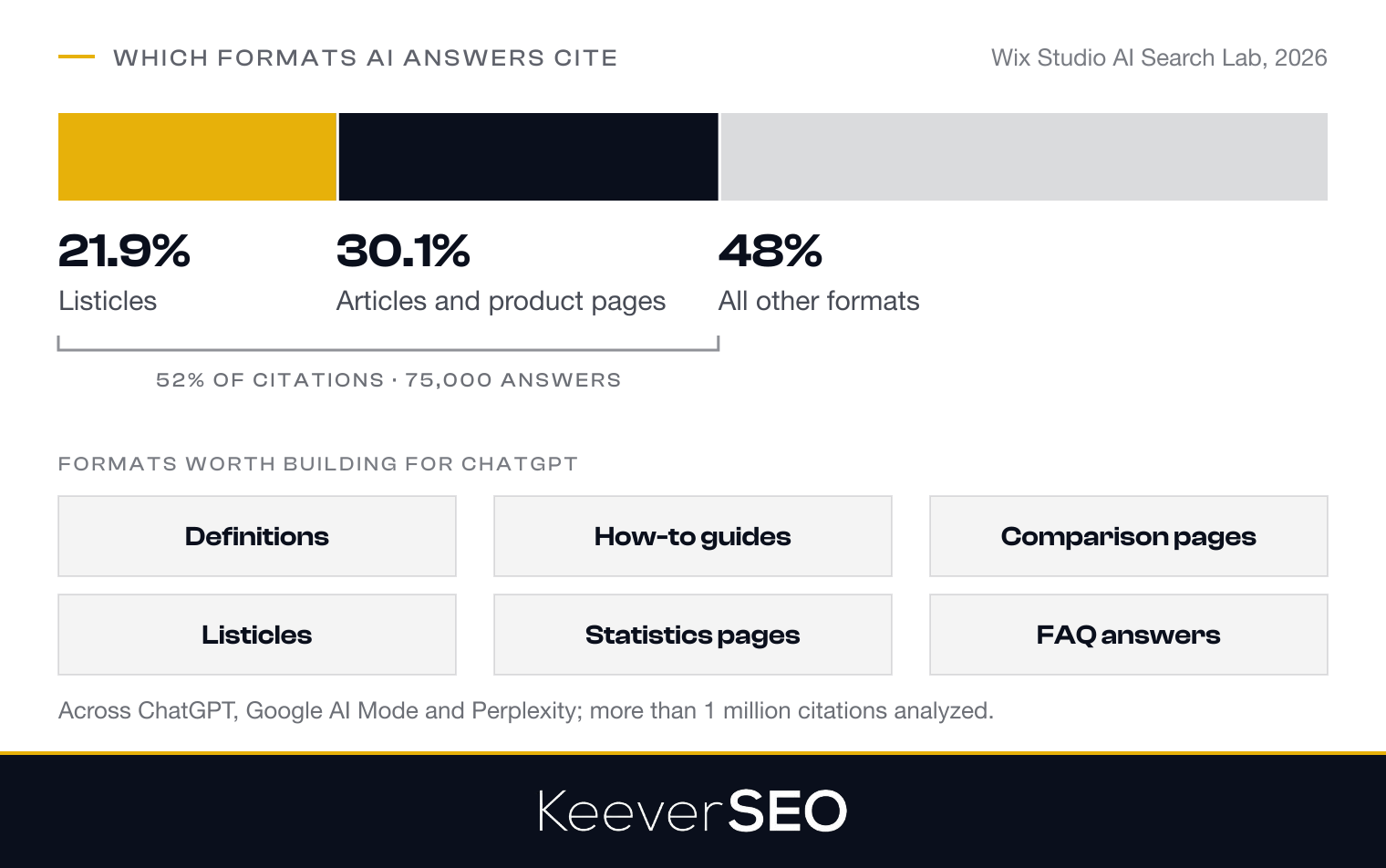
The content formats ChatGPT cites most are listicles, articles, and product pages, which made up 52% of AI citations across ChatGPT, Google AI Mode, and Perplexity in Wix Studio AI Search Lab research covering 75,000 AI answers and more than 1 million citations, with listicles alone at 21.9%, according to "AI citations favor listicles, articles, product pages: Study" by Danny Goodwin, Search Engine Land, March 2026. The formats worth building for ChatGPT are listed below:
- Definitions: direct explanations of terms and concepts.
- How-to guides: numbered instructions for completing a task.
- Comparison pages: side-by-side evaluations of options.
- Listicles: ranked or grouped recommendations, tools, or examples.
- Statistics pages: original research, benchmarks, surveys, and sourced figures.
- FAQ answers: concise responses to single questions.
How Do You Measure Whether Optimized Content Appears in ChatGPT?
To measure whether optimized content appears in ChatGPT, test a fixed set of relevant prompts before and after each content change. Each test records the brand or page mention, the cited URL, the citation position, and the answer's accuracy, and the tests repeat because results vary between runs.
ChatGPT referral sessions and landing pages show up in analytics through referral data and UTM parameters. AI visibility tools add monitoring of citation rates, brand mentions, competitor presence, and changes across the same prompt set.
Which Pages Should a Local Service Business Optimize for ChatGPT First?
A local service business should optimize its core service pages for ChatGPT first, followed by location pages for its highest-revenue service areas. Each service page should explain the customer problem, the service process, the service area, qualifications, timelines, and the next step.
Pricing and process FAQ pages come next, answering questions about estimates, scheduling, preparation, and costs. The About page completes the set with the company's location, team, experience, credentials, and contact details, all accurate and open to search crawlers.
When Should Content Optimization for ChatGPT Go to an Agency?
Content optimization for ChatGPT should go to an agency when a business has many pages to optimize, no in-house writers or SEO specialists, or persistent schema and rendering problems. Specialist support resolves technical barriers and scales answer-first content updates.
Ongoing citation tracking justifies agency support when the internal team lacks time to test prompts, monitor ChatGPT mentions, and report referral traffic. A smaller site with capable staff can handle the work through focused audits, technical fixes, rewrites, and periodic testing.
How Does Keever SEO's AI Optimization Service Prepare Content to Appear in ChatGPT?
Keever SEO's AI optimization service prepares content to appear in ChatGPT with a content and AI visibility audit across ChatGPT, Perplexity, Gemini, and Google AI Overviews. The audit reviews technical SEO, crawler access, content gaps, entity clarity, schema markup, and third-party corroboration to set a baseline.
Keever SEO then fixes access issues, rewrites priority pages into modular, answer-first sections, and adds matching schema markup. Ongoing citation tracking follows prompts, brand mentions, cited URLs, citation frequency, sentiment, competitors, and share of voice to steer later content and technical work.
How Does Optimizing Content for ChatGPT Differ From Other Answer Engines?
Optimizing content for ChatGPT differs from other answer engines in access and retrieval, not in writing: answer-first, well-structured content works in ChatGPT, Perplexity, and Google AI Overviews alike. Each answer engine retrieves pages through its own crawler, index, and ranking signals, so the shared practices need a platform-by-platform access check. The two questions below cover Perplexity and Google AI Overviews.
How Do You Appear in Perplexity Answers?
To appear in Perplexity answers, publish fresh, well-sourced passages that answer concrete questions, since Perplexity searches the web in real time and cites its sources. PerplexityBot must be allowed in robots.txt and its published IP ranges let through, and relevant community sources can add first-hand context alongside authoritative content.
How Do You Optimize Content for Google AI Overviews?
To optimize content for Google AI Overviews, build strong organic rankings and crawlable, helpful pages, because AI Overviews draw on Google Search systems. The direct answer belongs near the top of the page, followed by the related sub-questions Google searches through query fan-out.
How Does Content Optimization Support Ranking in ChatGPT?
Content optimization supports ranking in ChatGPT as the on-page half of the work, while crawler access and brand authority cover the rest. Clear, answer-first sections help ChatGPT read, retrieve, and cite a page, OAI-SearchBot access makes the page eligible, and trusted brand mentions and sourced claims lend it authority. OpenAI does not publish a ranking formula, so no mix of content and access guarantees a citation.
What Makes Content Ready to Appear in ChatGPT?
Content is ready to appear in ChatGPT when search crawlers can reach its pages and clear sections answer real questions. Modular passages, direct answers placed first, and matching schema help ChatGPT read and retrieve the page.
Reliable sources back the factual claims, while original data, examples, and images add information that generic summaries lack. Together, those traits make a page easy to read and cite, which is the goal of optimizing your content to appear in ChatGPT.