To get mentioned in Claude, let its crawlers reach your site, improve visibility in the web search indexes its search draws on, publish answer-first content without promotional language, and earn reviews and third-party mentions. A Claude mention occurs when Claude names or cites your brand, drawing on information in its training data or pages found through live web search. Anthropic's crawlers serve separate purposes: ClaudeBot collects public web content for possible training, Claude-User fetches pages for user requests, and Claude-SearchBot supports search quality. Claude can name familiar brands without web search, while smaller or newer brands depend more on discoverable pages and independent references.
A practical seven-step plan is to allow relevant crawlers, check Brave Search visibility, write direct answers, earn credible reviews and mentions, keep brand facts consistent, publish fresh and well-sourced content, then test a fixed set of Claude prompts every month. Reviews and community discussions can inform comparison answers because they offer independent opinions and first-hand accounts. Google SEO can support content quality and authority, but it does not guarantee Claude mentions, and web-search visibility and third-party references count too. Live-search mentions depend on crawling and indexing, while training-data mentions depend on later model updates, so neither has a guaranteed timeline.
Local service businesses can include Claude visibility in a broader AI-search plan rather than treating Claude as a standalone channel. A full optimization program can suit brands targeting several assistants without enough in-house capacity to manage technical access, content, reputation, and tracking. The same foundations support visibility in ChatGPT and Perplexity, although each assistant uses different search sources. The next section explains how Claude finds and cites sources.
How Does Claude Find and Cite Sources?
Claude finds and cites sources through live web search when web search is on, and it otherwise answers from information learned during training. For web-grounded answers, Claude uses retrieved pages as context, and "every response includes citations, so you can easily verify sources yourself," according to Anthropic's "Enable and use web search" help article.
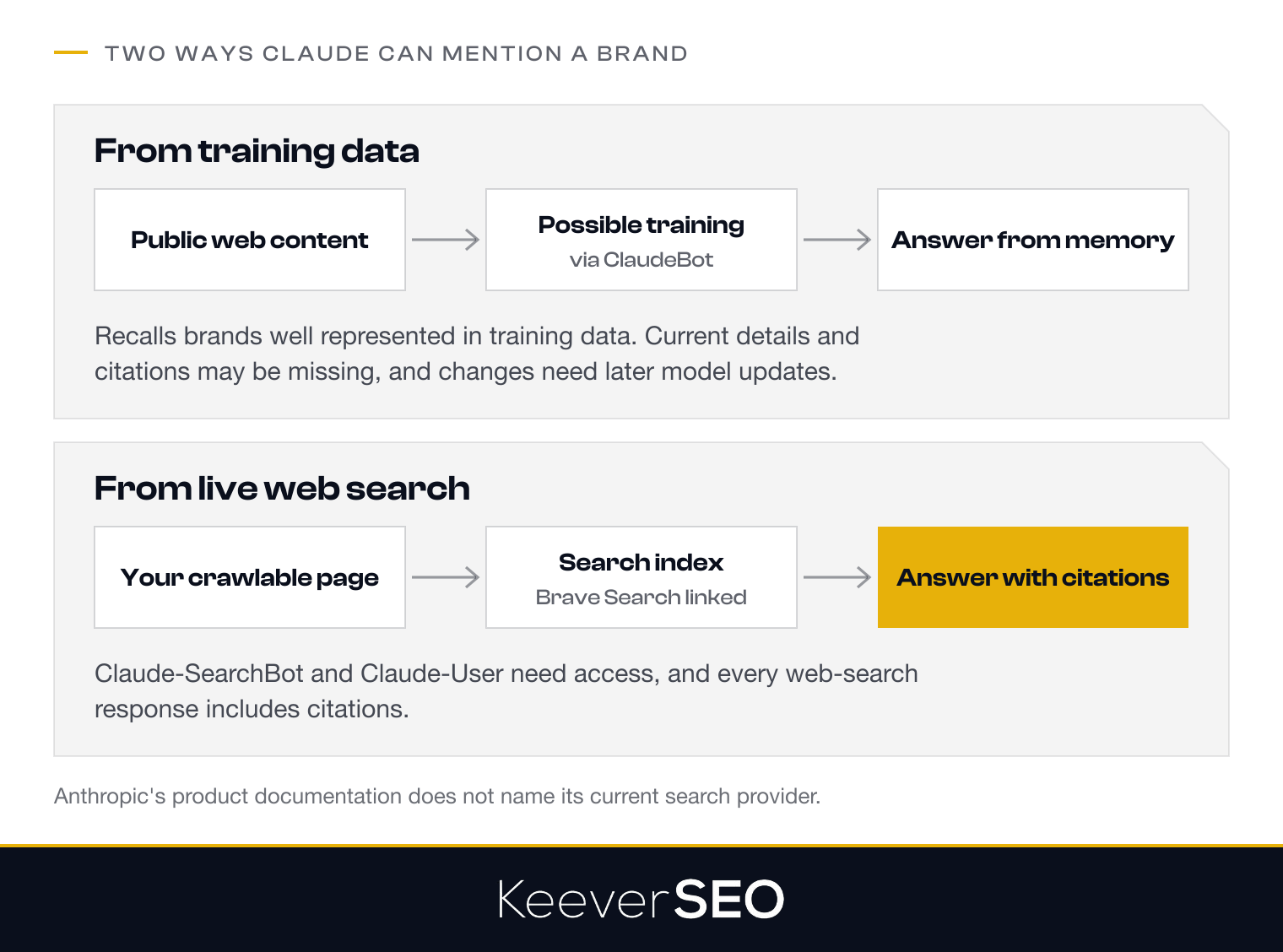
Training-based answers do not retrieve or cite a webpage in real time. Web search makes current source material available to Claude, so visibility in the search index behind those results can affect which brands and pages Claude mentions.
Which Search Index Does Claude Use for Web Results?
The search index Claude uses for web results is not named in Anthropic's public product documentation, but Brave Search is the provider most closely linked to Claude. "Anthropic added 'Brave Search' to the 'subprocessor list' in its documentation," according to the TechCrunch report "Anthropic appears to be using Brave to power web search for its Claude chatbot," March 2025, the same month Claude web search launched.
Brave Search visibility therefore gives a page a reasonable opportunity to appear in a live Claude answer, but it does not guarantee a brand mention, and the current provider mix is unconfirmed. Anthropic's help documentation states that image results are "powered by Bing," and Claude-SearchBot's role in indexing suggests that Anthropic's search draws on more than one system.
What Are ClaudeBot, Claude-User, and Claude-SearchBot?
ClaudeBot, Claude-User, and Claude-SearchBot are Anthropic's three web agents, each with a distinct purpose, as listed below:
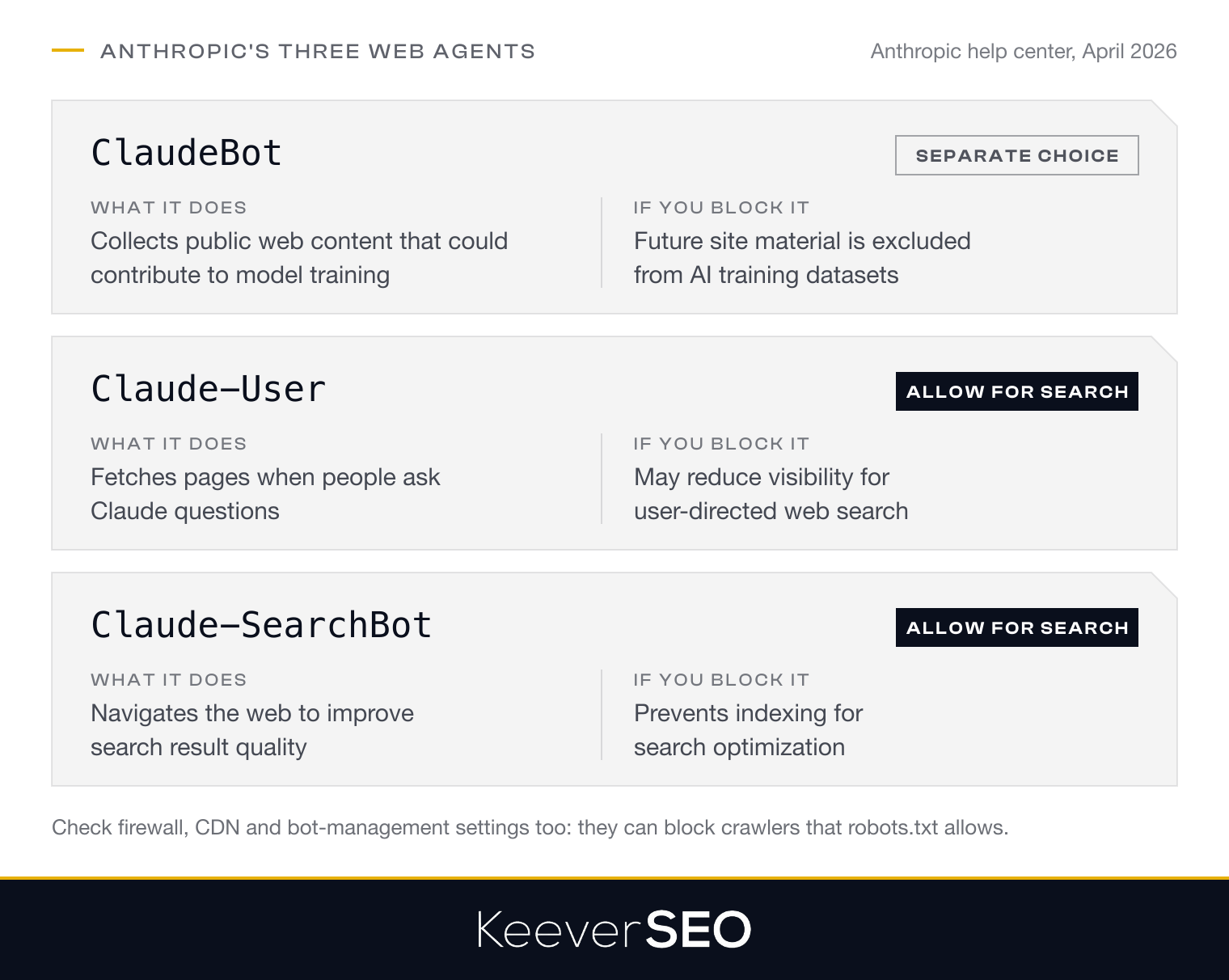
- ClaudeBot collects web content "that could potentially contribute to their training," so blocking it signals that future site material should be excluded from AI model training datasets.
- Claude-User accesses websites when individuals ask Claude questions, and disabling it "may reduce your site's visibility for user-directed web search."
- Claude-SearchBot "navigates the web to improve search result quality for users," and disabling it prevents indexing for search optimization.
Anthropic explains the crawler functions in its help article "Does Anthropic crawl data from the web, and how can site owners block the crawler?" (April 2026).
Does Claude Mention Brands Without Using Web Search?
Yes, Claude mentions brands without using web search, because its training data includes publicly available internet information. Claude may recall brands represented well in that data, but answers based on training alone may lack current details or source citations. Newer or smaller brands have less established training-data visibility, so live web search helps Claude find their current information.
How Do You Get Your Brand Mentioned in Claude?
To get your brand mentioned in Claude, allow its relevant crawlers to access your site, check visibility in Brave Search, publish direct answer-first content, and earn independent reviews and third-party mentions. A seven-step approach strengthens both discoverability and trust, which help Claude find and use reliable information about your brand.
Start by opening crawler access, then check important pages in Brave Search. Write factual, non-promotional answers, earn reviews and industry mentions, keep brand facts consistent, publish fresh and well-sourced content, and test buyer prompts in Claude each month. The first step is checking whether Claude's crawlers can reach your website.
1. Allow Claude's Crawlers in Robots.txt
Allowing Claude's crawlers in robots.txt makes your pages available for Claude's web search and citations. Add allow rules for Claude-SearchBot and Claude-User, since Anthropic uses Claude-SearchBot to improve search results and Claude-User to fetch pages during user requests.
Treat ClaudeBot as a separate choice, because it collects content that may support model training rather than live web search. Check firewall, CDN, and bot-management settings too, since those systems can block Anthropic crawlers even when robots.txt permits access.
2. Get Indexed and Visible in Brave Search
Getting indexed and visible in Brave Search gives Claude a likely route to your website when web search is on. Search Brave for your brand name, domain, and main service or location pages, then check whether the results show accurate titles and descriptions.
If important pages do not appear, review crawl access, robots.txt, noindex directives, canonical tags, internal links, XML sitemaps, and firewall rules. Brave Search visibility does not guarantee a Claude mention, but the check costs little and the fixes help every search index.
3. Write Answer-First Content Without Promotional Language
Answer-first content without promotional language gives a direct, factual response near the beginning of each page. Define the topic plainly, then support the answer with concrete details, examples, and verifiable claims.
For a better chance of being mentioned in Claude, describe products, services, prices, qualifications, locations, and trade-offs in neutral language. Remove unsupported claims such as "the best" or "industry-leading," which make explanatory content sound promotional.
4. Earn Reviews and Third-Party Mentions
Reviews and third-party mentions give Claude independent sources about your brand. Encourage honest customer feedback on relevant review platforms, and seek accurate coverage in industry publications, comparison articles, directories, and community discussions.
Reputable mentions should name your brand and describe its products or services accurately. Prioritize relevance and accuracy over volume, and never buy reviews or manufacture endorsements.
5. Keep Brand Facts Consistent Across the Web
Consistent brand facts across the web help Claude connect references to the same business. Use the same brand name, core services, locations, contact details, and factual claims across your website, business profiles, directories, review platforms, and industry listings.
Review online profiles on a set schedule for outdated descriptions, conflicting service areas, duplicate listings, and unsupported claims. Accurate, consistent details reduce ambiguity when Claude identifies your brand across web sources.
6. Publish Fresh, Well-Sourced Content
Fresh, well-sourced content can raise your chances of getting mentioned in Claude when web search is on. Anthropic's "Web search tool" documentation states that "Claude searches when the request depends on information that is current, changing, or outside its training data," and each result carries a page_age field showing "when the site was last updated." Review important pages on a set schedule, show publication and update dates, and revise outdated statistics, examples, and service details. Name and link to primary sources for main facts so Claude can assess the evidence behind your claims.
7. Test Brand Prompts in Claude and Track Mentions
Testing brand prompts in Claude and tracking mentions shows whether your brand appears in relevant answers. Use a fixed set of buyer prompts about category comparisons, alternatives, the best option, and common customer problems.
Record each brand mention, its position, competitors named, and pages or domains Claude cites. A brand mention does not always include a citation, so track mentions and cited sources separately. Repeat the same prompts every month to compare results and identify content gaps or new opportunities for third-party mentions.
Why Does Claude Cite Reviews and Community Content So Often?
Claude cites reviews and community content because independent opinions and firsthand experiences help answer buyer questions. Reviews and comparison pages describe product use, strengths, weaknesses, and differences between brands.
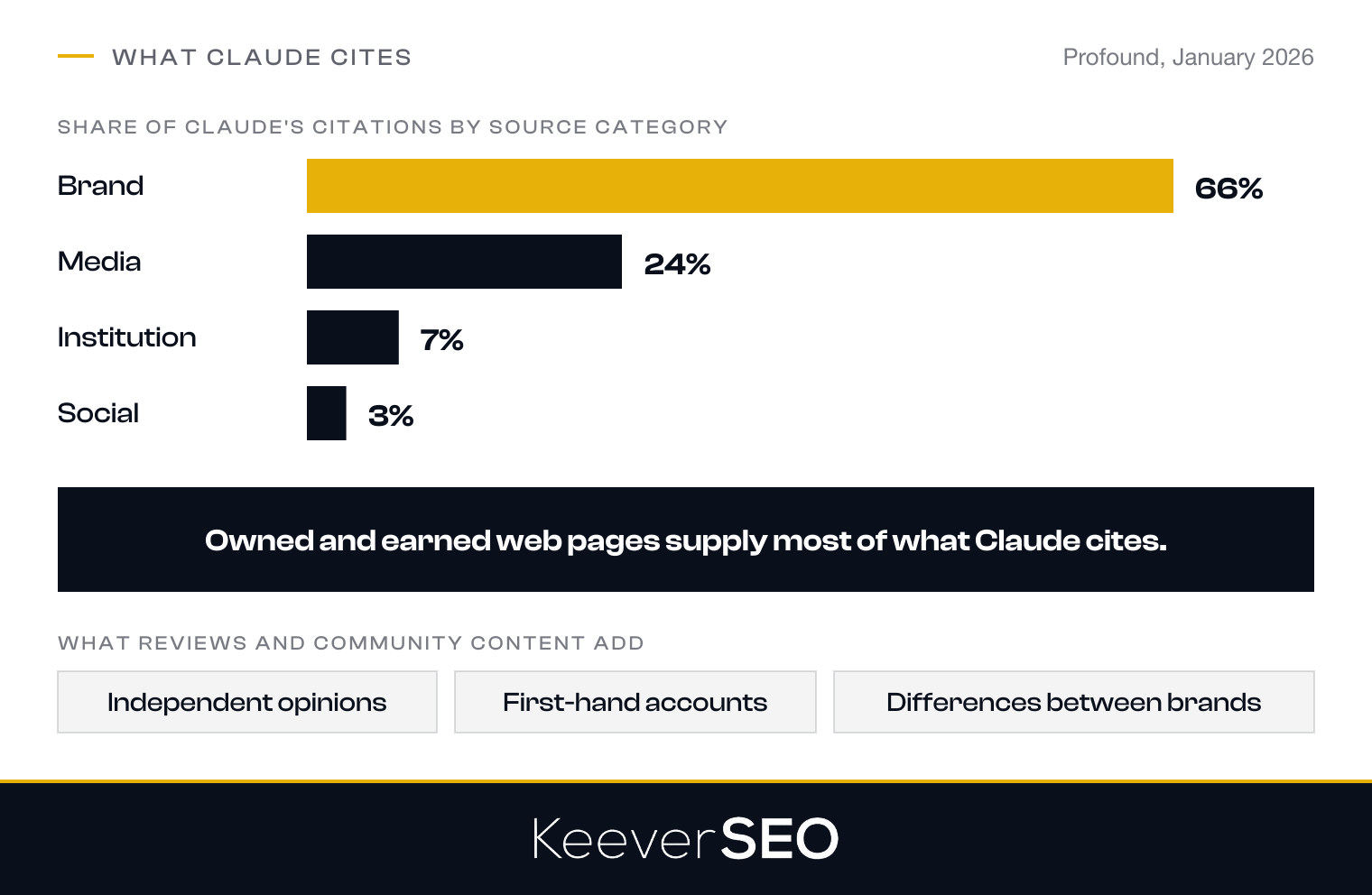
The evidence for "so often" is thinner than the heading suggests: Profound's "Who Shapes AI Answers? Introducing Enhanced Citation Categories" (January 2026) reports Claude's citations as 66% brand, 24% media, 7% institution, and 3% social, so owned and earned web pages supply most of what Claude cites. Clear, evidence-based reviews and industry discussions still provide stronger comparison signals than unstructured comments.
Does Optimizing for Google Improve Mentions in Claude?
Yes, optimizing for Google improves mentions in Claude indirectly by strengthening site crawlability, content quality, authority, and visibility across the web. High Google rankings do not guarantee that Claude will name or cite a brand. Claude's web-search mentions depend on visibility in the indexes Claude uses and on credible third-party sources, such as reviews, comparisons, and community discussions. Google SEO supports Claude visibility, but it does not replace search-index checks or independent brand mentions.
How Long Does It Take to Get Mentioned in Claude?
Getting mentioned in Claude can take anywhere from days to months, and no credible study has measured a standard timeline. Web-search mentions can appear once Claude retrieves and selects a relevant page, while training-data mentions depend on future data collection and model updates. Search Engine Journal's October 2026 coverage of the arXiv paper "From Public Posts to AI-Search Citations: Measuring the Fragility of AI Search" reported that AI search tools cited a made-up concept within seven days, which shows how quickly retrieval can move under test conditions, not how fast a normal brand will appear. Track a consistent set of prompts every month to measure changes.
Which Mistakes Keep Brands Out of Claude Answers?
The mistakes that keep brands out of Claude answers weaken technical access, search visibility, or trustworthy information. The common mistakes are listed below:
- Blocking Claude-SearchBot or Claude-User through robots.txt, firewalls, or CDN rules.
- Leaving important pages missing from Brave Search and other search indexes.
- Using promotional copy, unsupported superlatives, or vague claims.
- Publishing inconsistent brand names, services, locations, or business descriptions.
- Relying only on the company website without genuine reviews or third-party mentions.
Should Local Service Businesses Optimize to Get Mentioned in Claude?
Yes, local service businesses should optimize to get mentioned in Claude, but as part of a wider AI visibility plan rather than a standalone channel. Claude remains a smaller discovery channel, holding 1.85% of the US AI chatbot share in Statcounter's September 2026 data, but it can surface providers using business websites, reviews, directories, local publications, and other third-party sources.
Local businesses can strengthen visibility by keeping service and location details consistent, earning relevant reviews, and publishing clear service pages. Those steps support discovery across multiple AI assistants, including Claude.
When Does Getting Mentioned in Claude Need a Full AI Optimization Program?
Getting mentioned in Claude needs a full AI optimization program when a brand wants visibility across Claude, ChatGPT, Perplexity, Gemini, and Google's AI search features. Each assistant can draw on different search sources, so coordinated optimization keeps brand facts consistent and identifies citation gaps.
An external program suits companies without in-house writers, technical SEO specialists, digital PR support, or monitoring tools. The program can coordinate crawler access, content updates, third-party mentions, and recurring prompt tests across AI assistants.
How Does Keever SEO's AI Optimization Service Get Brands Mentioned in Claude?
Keever SEO's AI optimization service gets brands mentioned in Claude by reviewing crawler access, technical setup, and priority pages. The AI assistant SEO agency service checks Brave Search visibility and strengthens answer-first content, structured data, and consistent brand information.
Keever SEO builds legitimate review and third-party mention signals through sources such as industry publications and community discussions. The service records baseline brand mentions, tracks selected prompts and cited pages across Claude and other AI assistants, and uses those results to refine the strategy.
How Does Getting Mentioned in Claude Compare With Other AI Assistants?
Getting mentioned in Claude compares closely with other AI assistants, since Claude, ChatGPT, and Perplexity share foundations in crawlable pages, consistent brand facts, useful content, and credible third-party mentions. Each assistant draws on different search sources, so visibility in Claude does not guarantee visibility in ChatGPT or Perplexity. Claude's web search has been linked to Brave Search, ChatGPT search can retrieve results through providers such as Bing, and Perplexity searches the live web. The following sections explain how to build visibility in ChatGPT and Perplexity, then strengthen recommendations across AI assistants.
How Do You Get Your Brand Visible in ChatGPT?
To get your brand visible in ChatGPT, allow OAI-SearchBot to access relevant pages and make main pages discoverable through Bing. Trusted third-party mentions and consistent facts about your brand name, services, and locations help ChatGPT identify and describe your business accurately.
How Do You Get Your Brand Mentioned in Perplexity?
To get your brand mentioned in Perplexity, publish fresh, well-cited pages that answer common customer questions with clear, factual information. Earn independent mentions in trusted publications, review sites, and relevant community discussions to give Perplexity additional sources for comparisons and recommendations.
How Do You Get Recommended by AI Assistants Overall?
To get recommended by AI assistants, keep your brand name, services, locations, and main claims consistent across websites, listings, and profiles. Authentic reviews, independent mentions, and clear comparison and use-case pages help assistants verify what a brand offers and whom it serves.
How Do AI Search Engines Compare for Brand Visibility?
AI search engines compare for brand visibility through different sources and citation methods. Claude can draw on training data and, during web search, retrieve current pages with citations on every search response. ChatGPT can combine model knowledge with live search results, while Perplexity searches the web in real time and presents numbered source citations. Clear brand facts and trusted third-party coverage support visibility across platforms, but success in one assistant does not guarantee mentions in a different one.
What Is the First Step to Get Mentioned in Claude?
The first step to get mentioned in Claude is to check crawler access and Brave Search visibility. Confirm that Claude-SearchBot and Claude-User can reach important pages, and review ClaudeBot access separately because it supports training-data collection. Search Brave for your brand, services, location pages, and main articles, and fix crawl blocks or indexing gaps before changing content. Those checks establish the foundation for the full process of getting mentioned in Claude.