Google AI Overviews are the AI-generated summaries Google shows at the top of some search results, answering the query in a few sentences with links to the pages the answer draws on. An AI Overview appears as a labeled panel with source cards or link icons, and Google launched the feature across the United States in May 2024 after testing it as the Search Generative Experience.
Google AI Overviews work by combining a Gemini model with Google's ranking and quality systems, which use query fan-out to pick indexed pages that support each part of the answer. AI Overviews show up most on informational and how-to searches, comparisons, and research questions, less on purely local or transactional ones, and they differ from featured snippets (one extracted passage) and from AI Mode (a separate conversational tab).
AI Overviews are important because they reach billions of users and answer many searches without a click, which affects local service businesses whose cost and process questions now get answered above the Map Pack. Businesses get featured by publishing indexable, answer-first pages, before the article turns to ranking factors, citation sources, website traffic, and the move from the Search Generative Experience. The first section defines Google AI Overviews.
What Is Google AI Overviews?
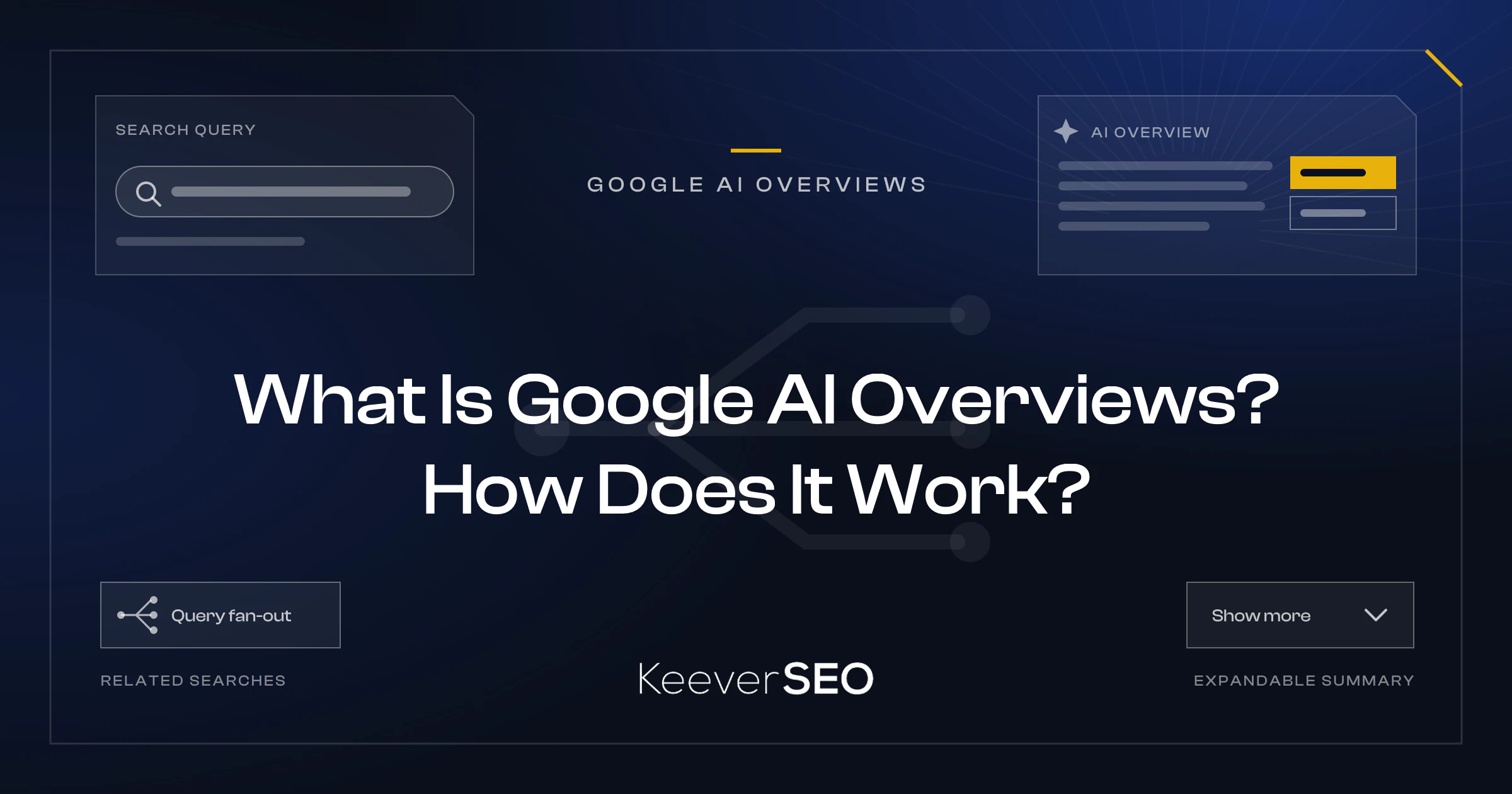
Google AI Overviews are AI-generated summaries that Google places at the top of some search results. Each summary answers the query in a few sentences and links to the webpages that support the response, and a Gemini model built for Google Search writes it alongside Google's ranking and quality systems.
AI Overviews appear mostly on complex informational questions, how-to searches, comparisons, and research topics, and on some local and commercial searches where a summary helps. The labeled summary and its source links together make up the AI Overview on the results page.
What Does an AI Overview Look Like in Search Results?
An AI Overview looks like a labeled panel near the top of a Google results page, above the organic listings. The panel holds a short AI-generated summary with source cards or link icons pointing to the supporting webpages.
Longer summaries carry a "Show more" control that expands the answer. The layout changes with the query and the device, with source links beside, below, or inside the summary.
When Did Google Launch AI Overviews?
Google launched AI Overviews in the United States on May 14, 2024, at its Google I/O developer conference, announcing that the feature "will begin rolling out to everyone in the U.S., with more countries coming soon," according to "Google I/O 2024: New generative AI experiences in Search" by Liz Reid, VP of Search, published on Google's blog in May 2024.
The feature grew out of the Search Generative Experience, which Google tested in Search Labs from 2023. Google then expanded AI Overviews to more countries and languages.
How Does Google AI Overviews Work?
Google AI Overviews work by combining generative AI with Google Search systems: Google reads the query, gathers relevant information from its index, and writes a concise summary with links to useful pages.
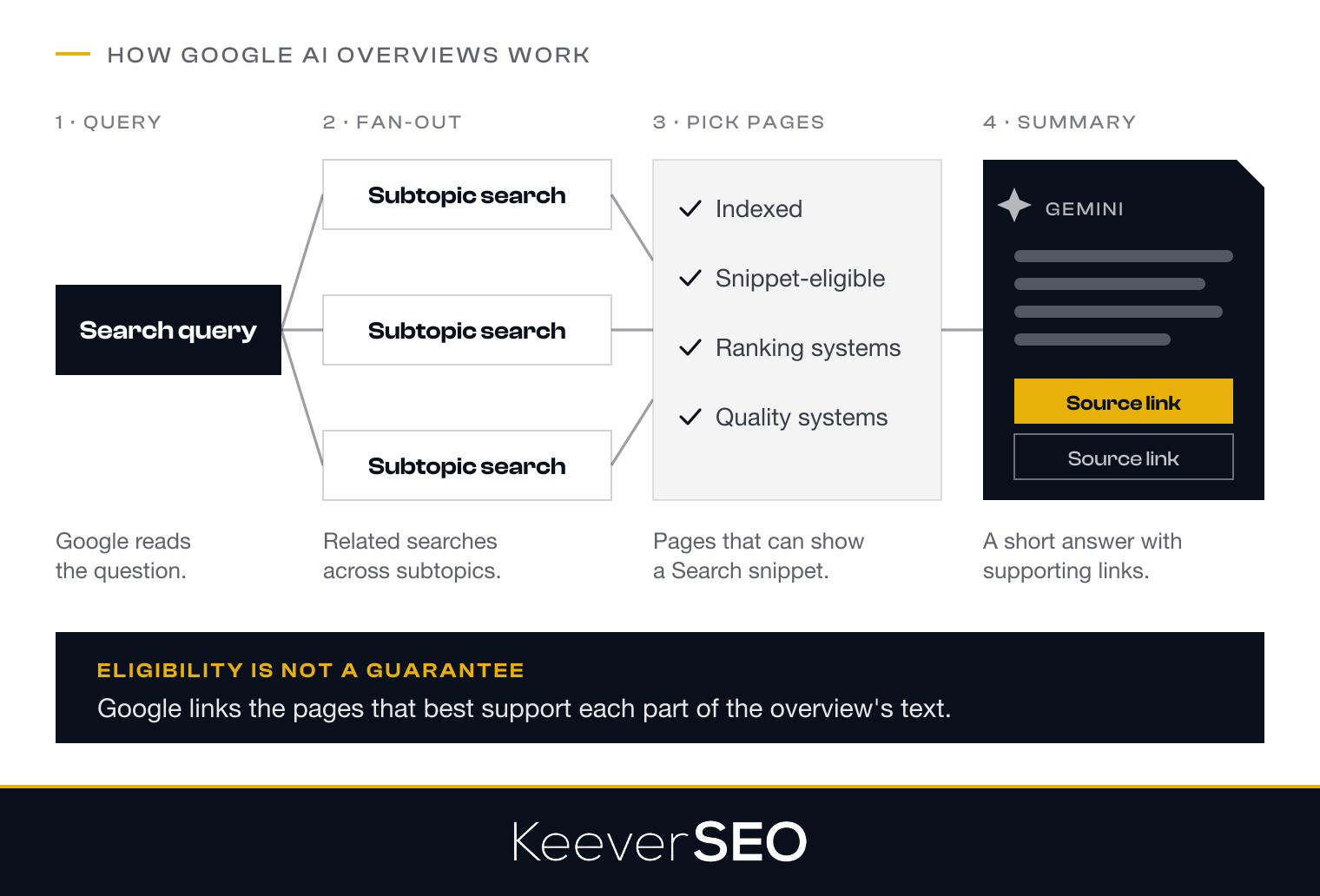
For complex searches, Google uses query fan-out to search related subtopics and find supporting pages. Ranking and quality systems pick indexed pages that are eligible for Search snippets, and a Gemini model writes the summary from them.
Which AI Model Powers Google AI Overviews?
The AI model that powers Google AI Overviews is a Gemini model customized for Google Search, which has been Gemini 3 by default worldwide since January 2026, according to "Google AI Overviews get Gemini 3 upgrade, AI Mode transition", 9to5Google, January 2026. The model works alongside Google's ranking and quality systems, which find the information the summary is built from.
How Does Google Choose the Links Shown in an AI Overview?
Google chooses the links shown in an AI Overview through query fan-out, its Search index, and its ranking and quality systems. Query fan-out issues "multiple related searches across subtopics and data sources", and to be shown as a supporting link a page "must be indexed and eligible to be shown in Google Search with a snippet", according to "AI features and your website" published by Google Search Central, December 2025.
Eligibility does not guarantee a citation. Google shows the links that best support the text of the overview, so pages that answer a subtopic directly have the best chance.
Which Searches Show Google AI Overviews?
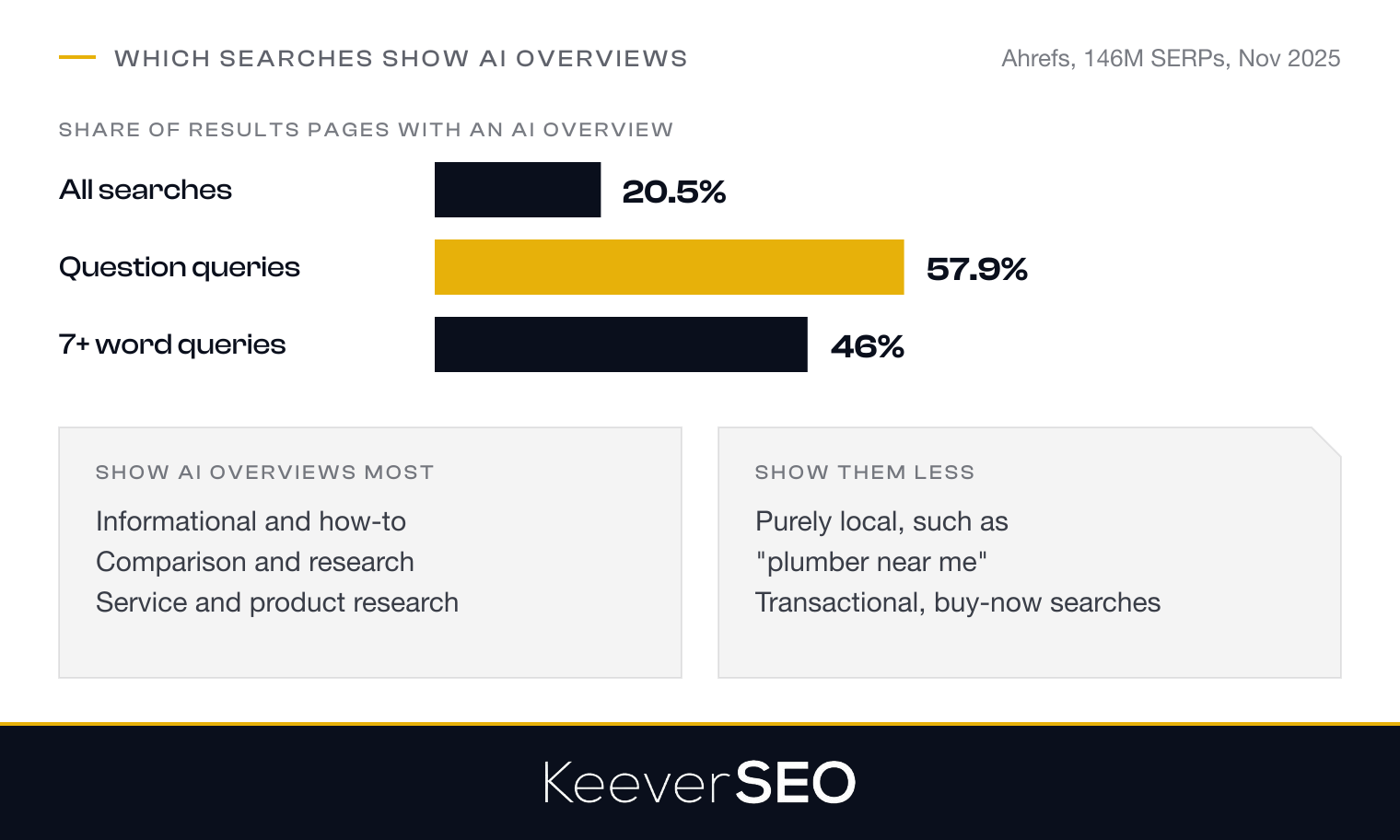
The searches that show Google AI Overviews are mostly long, informational, and question-shaped. AI Overviews appear on 20.5% of all search results pages, on 57.9% of question queries, and on 46% of queries of seven words or more, according to "What Triggers AI Overviews? 86 Factors and 146 Million SERPs Analyzed" by Ryan Law and Xibeijia Guan, Ahrefs, November 2025. The three search types below show where they appear and where they do not.
Informational and How-To Searches
Informational and how-to searches trigger Google AI Overviews most, because the searcher wants an explanation or practical guidance. Questions such as "What is compound interest?" and definitions of unfamiliar terms get concise summaries, while how-to queries such as changing a flat tire or building a budget get key steps with links to guides, videos, and other resources.
Comparison and Research Searches
Comparison and research searches trigger Google AI Overviews when the searcher asks Google to weigh several products, services, or approaches. Queries built on "X vs. Y", "best", "alternatives", or "which is better", and multi-part questions that mix price, features, and suitability, get summaries that compare findings from several pages.
Local and Commercial Searches
Local and commercial searches trigger Google AI Overviews when the searcher asks a service question or researches a product, such as "how much does roof replacement cost?" or "best accounting software for small businesses". Purely local searches such as "plumber near me" and transactional searches aimed at an immediate purchase show AI Overviews less, since Google gives priority to the Map Pack, local listings, shopping results, and product pages there.
How Are AI Overviews Different From Featured Snippets?
AI Overviews differ from featured snippets because an AI Overview writes one answer from several pages, while a featured snippet extracts a passage from a single webpage.
| Dimension | AI Overviews | Featured Snippets |
|---|---|---|
| Content source | Google writes a summary from several pages and links the supporting sources. | Google extracts a passage from one webpage. |
| Answer format | An AI-written response can combine subtopics and expand to show more detail. | A concise passage shows as a paragraph, list, or table. |
| Number of sources | Several sources appear as cards or links. | One webpage supplies the passage. |
| Position | The summary sits above the traditional organic listings. | The result sits near the top of the organic results. |
| Query types | Complex informational, comparison, and research queries. | Direct questions, definitions, facts, and simple how-to queries. |
| Click behavior | Users choose among cited links, or get the answer without a click. | Users click the linked webpage to read the source passage. |
How Are AI Overviews Different From AI Mode?
AI Overviews differ from AI Mode because an AI Overview is a summary inside the regular search results, shown when Google decides it helps, while AI Mode is a separate conversational search experience that users choose. AI Mode gives longer responses, supports follow-up questions, and runs a deeper query fan-out across related topics and sources.
Why Do Google AI Overviews Matter?
Google AI Overviews matter because they reach an enormous audience and answer many searches without a website visit. AI Overviews passed 2 billion monthly users in July 2025, Sundar Pichai said on Alphabet's earnings call, according to "At 2 billion users, Google's AI Overviews seals a new search reality" by Seb Joseph, Digiday, July 2025.
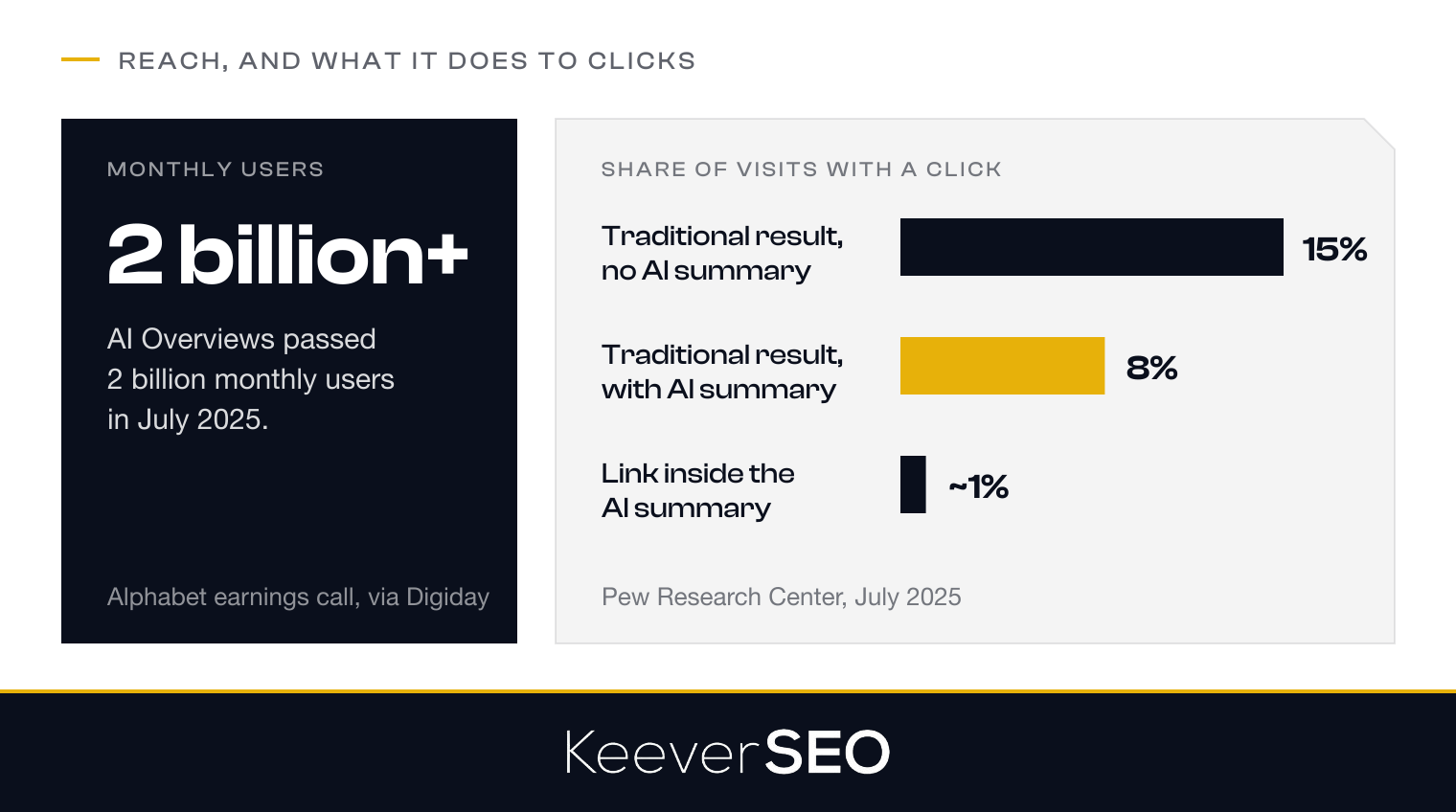
The reach of AI Overviews comes with fewer clicks. A Pew Research Center study found that users clicked a traditional result on 8% of visits when an AI summary appeared, against 15% without one, and clicked a link inside the summary on about 1% of visits, according to "Google users are less likely to click on links when an AI summary appears in the results" by Athena Chapekis and Anna Lieb, July 2025. A citation inside the overview still puts a business or publisher's name in front of the searcher at the moment of the answer.
What Are Examples of Google AI Overviews?
Examples of Google AI Overviews include health questions, how-to tasks, product comparisons, and travel plans. A search about a health condition can show key symptoms and next steps with links to medical or public-health sources.
A coffee-stain removal query can produce cleaning steps linked to instructional guides, and an air fryer versus toaster oven search can compare features and uses while citing reviews, manufacturers, or consumer publications. A family-friendly resort search can summarize travel options and link to resort websites and travel pages.
Can You Turn Off Google AI Overviews?
No, Google offers no setting to remove AI Overviews from standard Search results. The Web filter shows text links without an AI Overview, though it hides other search features too, and adding "-ai" to a query can stop an AI Overview from appearing in some searches.
Third-party browser extensions can hide AI Overviews or open Web results by default, but changes to Google's interface can break them.
How Do Google AI Overviews Affect Local Service Businesses?
Google AI Overviews affect local service businesses by placing answers to service questions above the organic results and, in some searches, above the Local Pack. A query such as "How much does a roof replacement cost in Austin?" triggers an overview more readily than "roofers in Austin", where local listings stay in front.
An AI Overview can take clicks from informational pages by answering cost or process questions in Search itself. A local business cited as the source gains visibility while customers research pricing, timelines, and service steps.
How Can a Business Get Featured in Google AI Overviews?
To get featured in Google AI Overviews, a business needs crawlable, indexed pages that qualify for search snippets, strong organic visibility, and helpful content with clear headings and a direct answer near the top of each page.
Each page should answer the main query first, cover the related questions, and back its claims with credible evidence. Google requires no special schema markup for AI Overviews, and meeting the guidelines does not guarantee inclusion.
How Does Keever SEO's AI Optimization Service Get Businesses Into Google AI Overviews?
Keever SEO's AI optimization service gets businesses into Google AI Overviews starting with a visibility audit that checks existing citations, compares competitor presence, and finds content, technical, and authority gaps.
Keever SEO then rewrites priority pages with direct answers, widens coverage of related questions, and adds relevant structured data. The AI optimization service checks crawler access and tracks cited URLs, brand mentions, citation frequency, competitors, and share of voice, while Google chooses AI Overview sources on its own terms.
How Do You Rank in Google AI Overviews?
To rank in Google AI Overviews, earn a citation in the generated answer, since AI Overviews have no conventional ranking positions. A page must be indexed and eligible for a search snippet, with no special technical setup required, and helpful, authoritative pages that answer queries directly and cover related questions stand the best chance. The two questions below cover the ranking factors and the sources Google cites most.
Which Factors Decide Google AI Overviews Rankings?
The factors that decide Google AI Overviews rankings start with eligibility: the page must be indexed and able to show a standard Search snippet. Beyond that, Google's existing ranking systems reward helpful, reliable, people-first content, and answer-first passages help the system find the right information for each query.
Which Sources Do Google AI Overviews Cite Most?
The sources Google AI Overviews cite most are top-ranking pages, alongside Reddit, YouTube, Wikipedia, and authoritative publishers. The mix changes with the query and the industry, since Google's relevance and quality systems can pick other indexed sources too.
How Do Google AI Overviews Affect Website Traffic?
Google AI Overviews reduce website traffic on the queries where they appear, because users get the answer without visiting a site. The presence of an AI Overview correlates with a 58% lower average click-through rate for the top-ranking page, according to "Update: AI Overviews Reduce Clicks by 58%" by Ryan Law, Ahrefs, February 2026.
Pages cited in an overview draw more clicks than uncited pages, but citations do not bring traffic back to levels seen without an overview. The findings describe observed patterns, not proof that AI Overviews alone caused every change.
How Did Google's Search Generative Experience Become AI Overviews?
Google's Search Generative Experience became AI Overviews in May 2024, when Google renamed the opt-in Search Labs experiment from 2023 and moved it into standard Search at Google I/O. Google then widened availability across countries and languages and adjusted its handling of sources and sensitive queries after early accuracy problems.
What Do Google AI Overviews Mean for the Future of Search?
Google AI Overviews point toward a search experience that answers more queries directly on the results page. AI Mode extends that experience with conversational follow-ups and deeper research, while links still guide users to sources for further reading.
For businesses and publishers, search visibility now includes citations inside AI-generated answers alongside rankings and clicks. Through that change, Google AI Overviews remain what they are: summaries at the top of some search results, with links to the pages that support their answers.