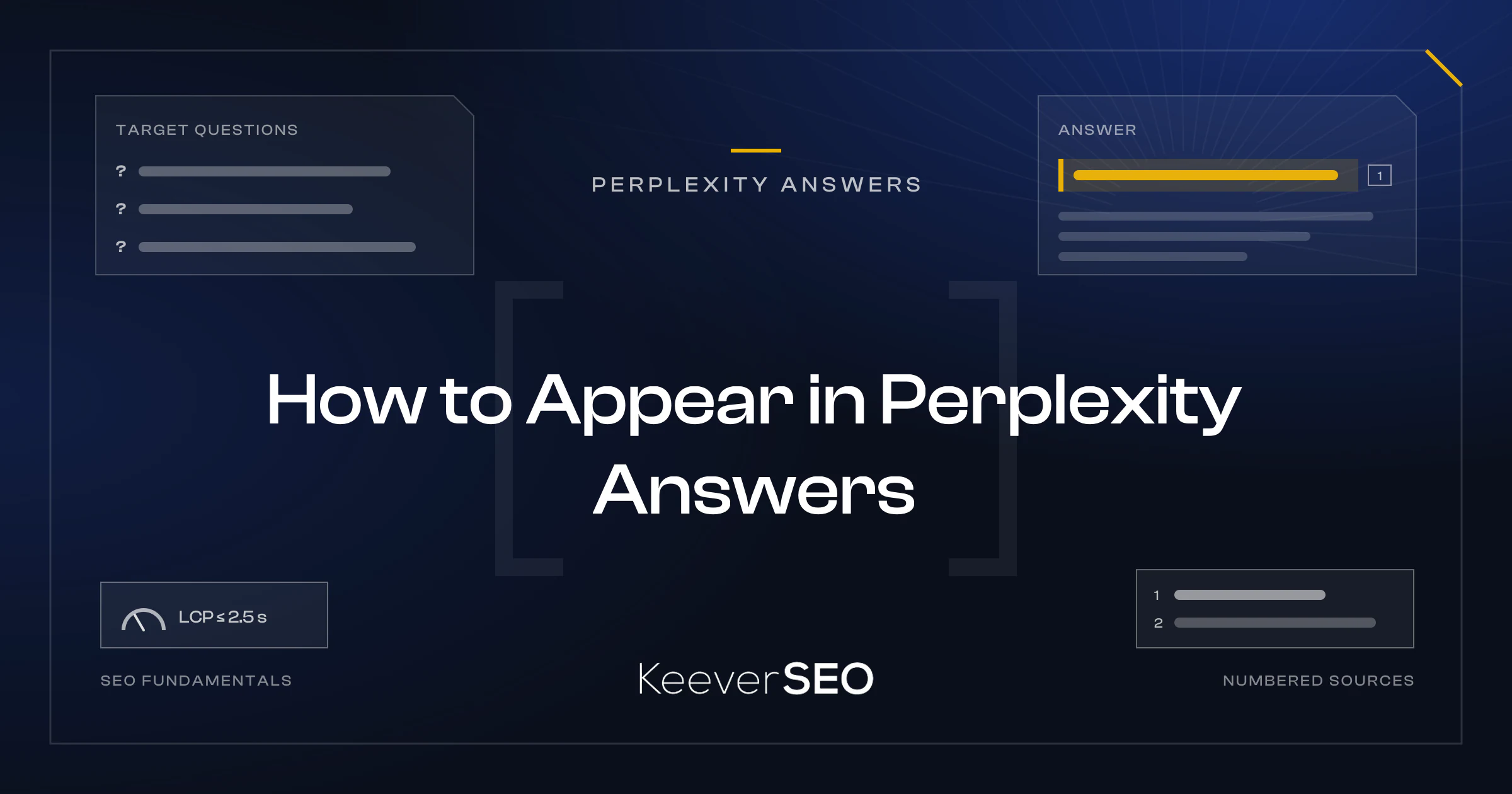
To appear in Perplexity answers, research the exact questions Perplexity users ask and publish answer-shaped passages that Perplexity can quote, backed by strong SEO fundamentals and a solid reputation. Appearing in a Perplexity answer means a page is quoted in the response or listed among its numbered sources.
Perplexity builds an answer by searching the web, retrieving relevant passages, and writing a cited summary, with the sources shown changing as freshness, trust, relevance, and follow-up questions change. How-to, comparison, recommendation, cost, definition, and long-tail questions create the openings, and the groundwork (indexable pages, PerplexityBot access, target questions, and pages that already rank) comes before six steps: SEO fundamentals, question research, competitor analysis, answer-shaped passages, reviews and reputation, and testing.
A fixed question set, a log of cited URLs, and Perplexity referral traffic show whether pages appear, and local service businesses should aim at provider, pricing, and comparison questions in their own cities. Outside help fits when competitors win almost every question or crawl problems persist, before the same work connects to brand mentions, ChatGPT, and Google AI Overviews. The first section defines what appearing in a Perplexity answer means.
What Does It Mean to Appear in a Perplexity Answer?
Appearing in a Perplexity answer means Perplexity uses a webpage as evidence for its response. Perplexity can quote or summarize a passage from the page, attach a numbered source link to a claim, or list the page in the sources panel.
A page can appear again in follow-up answers when it covers the related question. Perplexity may keep the page, swap it for a more relevant source, or add it when the follow-up narrows the search.
How Does Perplexity Build an Answer?
Perplexity builds an answer by reading a question and turning it into one or more web searches. The answer engine retrieves relevant passages from current webpages, then uses a language model to summarize them in conversational language.
Perplexity attaches numbered citations to the claims so readers can check the original sources. The passages retrieved for each question decide which links appear with the answer.
How Does Perplexity Choose the Sources Shown With an Answer?
Perplexity chooses the sources shown with an answer by picking passages that answer the question directly with credible, current information, in many cases from several sources to cover different angles. Perplexity has not published its source-ranking formula, but an independent analysis by Metehan Yesilyurt describes a three-layer machine learning reranker and manual lists of authoritative domains, according to "How Perplexity ranks content: Research uncovers core ranking factors and systems" by Danny Goodwin, Search Engine Land, August 2025, which flags the research as unverified.
The winning domains show the same pattern: YouTube (16.1%) and Wikipedia (12.5%) are among the domains Perplexity mentions most across 78.6 million searches, according to "The 10 Most Mentioned Domains for ChatGPT, Perplexity, and AI Overviews Across 78.6M Searches" by Patrick Stox, Ahrefs, June 2025. Clear, well-supported passages raise a page's chances, while no single factor guarantees it appears.
How Do Follow-Up Questions Change Which Sources Appear?
Follow-up questions change which sources appear because Perplexity reads each follow-up in the context of the conversation and runs new searches for the narrower request. The new answer can cite different pages that address sub-questions such as pricing, downsides, or local availability.
Perplexity's suggested related questions send users down new research paths, which changes the sources again. Pages with focused, self-contained answers match those narrow follow-up queries best.
Which Questions Lead to Perplexity Answers You Can Appear In?
The questions that lead to Perplexity answers you can appear in are listed below:
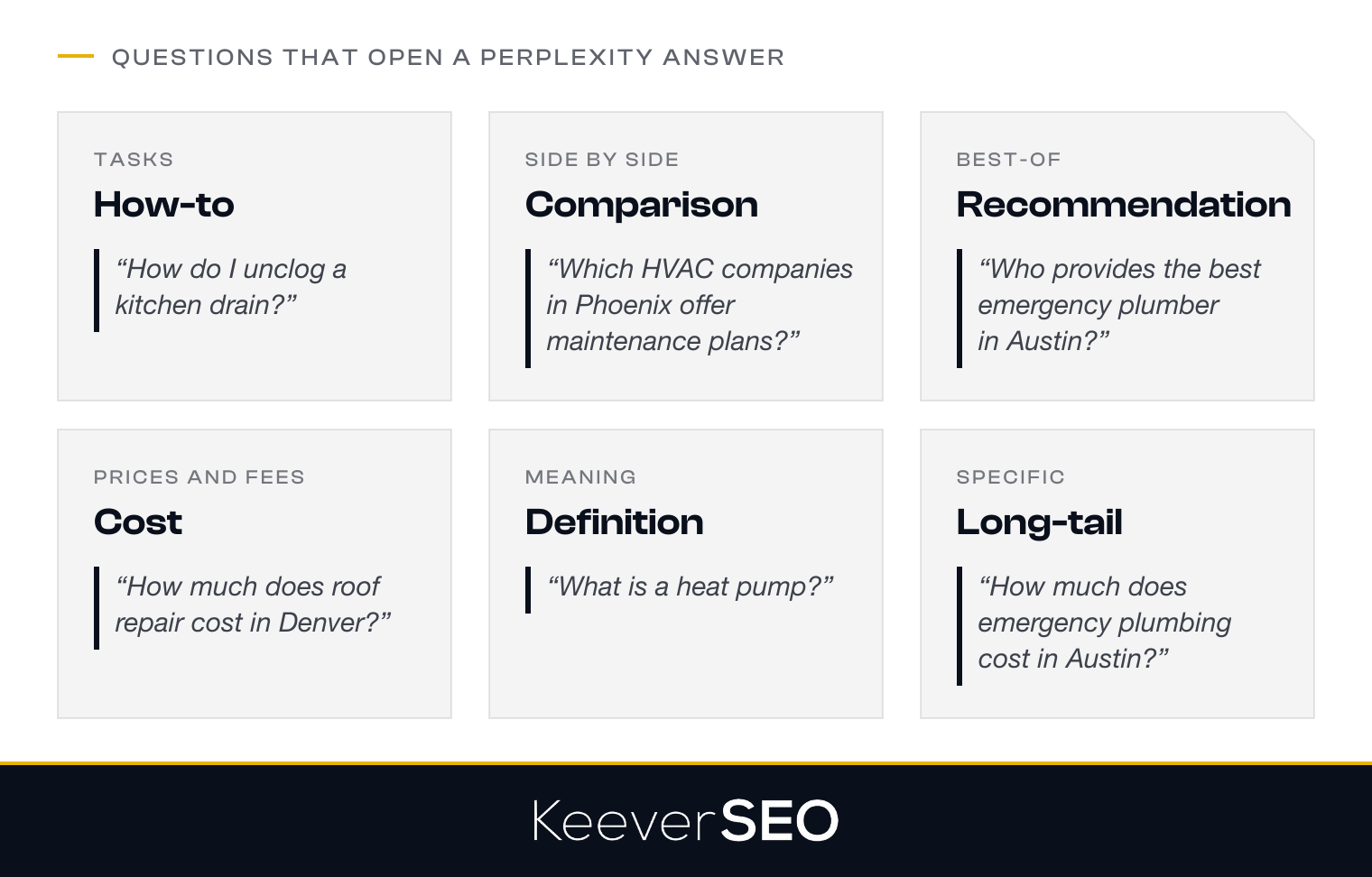
- How-to questions: how to complete a task or solve a problem.
- Comparison questions: products, providers, services, or methods side by side.
- Best-of and recommendation questions: options for a given audience, budget, location, or need.
- Cost questions: prices, typical fees, or the factors behind an estimate.
- Definition questions: what a term means or how a concept works.
- Long-tail questions: queries that add an industry, city, customer type, product, or use case.
What Do You Need Before Trying to Appear in Perplexity Answers?
The prerequisites for appearing in Perplexity answers are listed below:
- Indexable pages: useful content that is public, crawlable, and free of unintended noindex directives.
- PerplexityBot access: a robots.txt file and firewall rules that let PerplexityBot fetch the page content.
- A list of target questions: customer questions about definitions, services, comparisons, pricing, and local needs.
- Pages that already rank: pages with existing search rankings or impressions as the starting point, although rankings do not guarantee Perplexity citations.
With the prerequisites in place, the six steps below raise the chances of appearing in Perplexity answers.
How Do You Appear in Perplexity Answers?
To appear in Perplexity answers, follow six steps: start with strong SEO fundamentals, research the questions Perplexity users ask, analyze the competitors Perplexity cites, write answer-shaped passages, build reviews and brand reputation, and test the target questions.
Perplexity retrieves web sources for every query, so accessible, fresh, well-structured pages earn citations most consistently. The process begins with the SEO fundamentals that make pages reachable in the first place.
1. Start With Strong SEO Fundamentals
To appear in Perplexity answers, start with strong SEO fundamentals: fast, mobile-friendly, indexable pages that crawlers read easily, with server-rendered content and canonical URLs to avoid access and duplication problems. A Largest Contentful Paint of 2.5 seconds or less, Google's "good" threshold, is a sensible speed target.
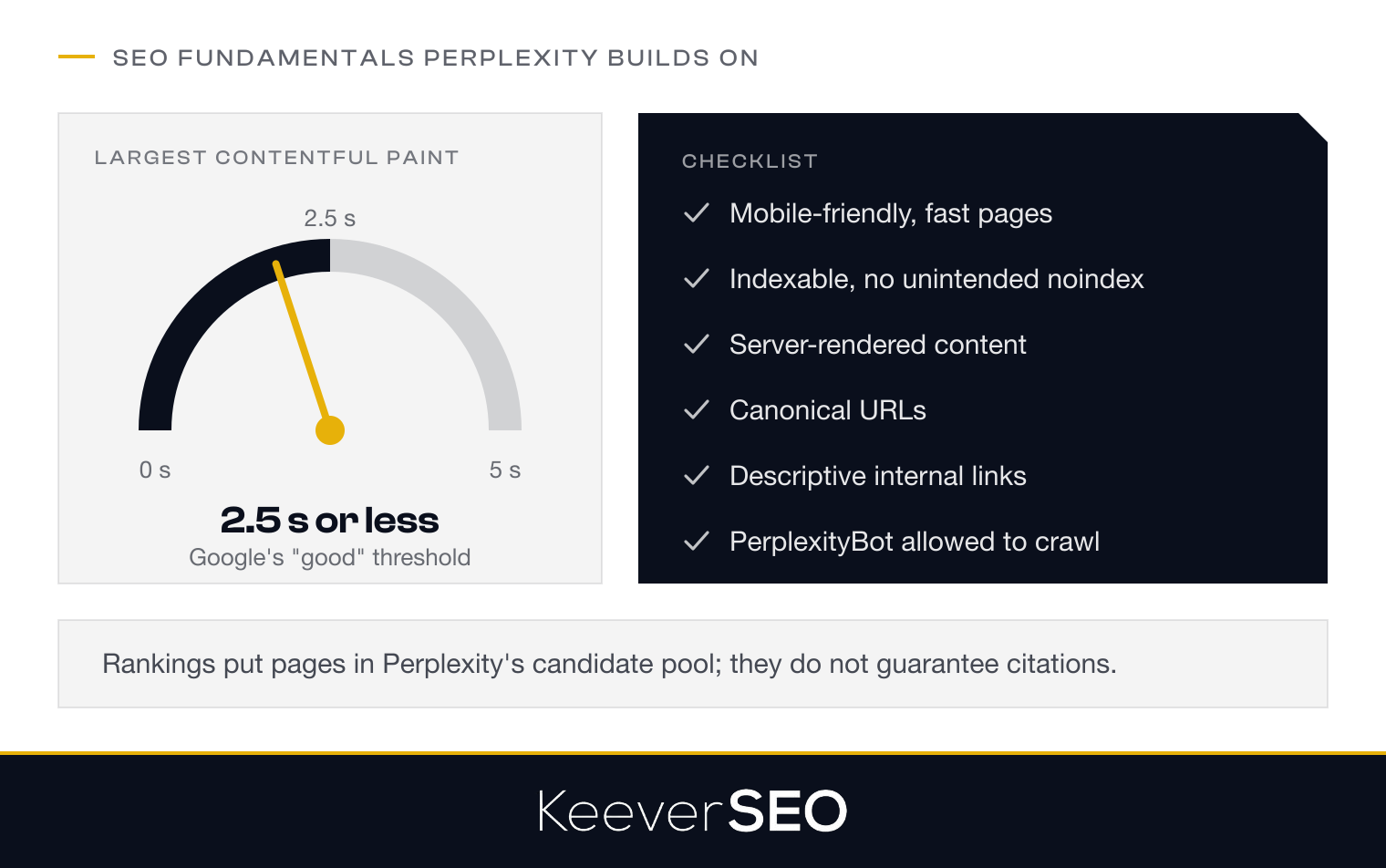
Traditional rankings help pages enter Perplexity's pool of candidate sources, but they do not guarantee citations. Descriptive internal links connect related pages, and robots.txt rules and security tools should let PerplexityBot crawl every page you want surfaced.
2. Research the Questions Perplexity Users Ask
To appear in Perplexity answers, research the questions customers ask before writing anything. Sales calls, support tickets, emails, and customer reviews show how people phrase questions about costs, providers, and service comparisons, while Google's People Also Ask results and Perplexity's suggested related questions reveal common wording and narrower follow-ups.
Long-tail questions that name a service, location, product, or situation, such as "How much does emergency plumbing cost in Austin?", deserve priority. Grouping similar questions by intent produces a fixed list of questions your pages should answer, which then shows which competitors Perplexity cites for each.
3. Analyze Which Competitors Appear in Perplexity Answers
To appear in Perplexity answers, analyze the competitors Perplexity already cites by running each target question the way a customer would phrase it. Each run records the cited domains, pages, and passages, and repeating the searches on different dates shows how the results move.
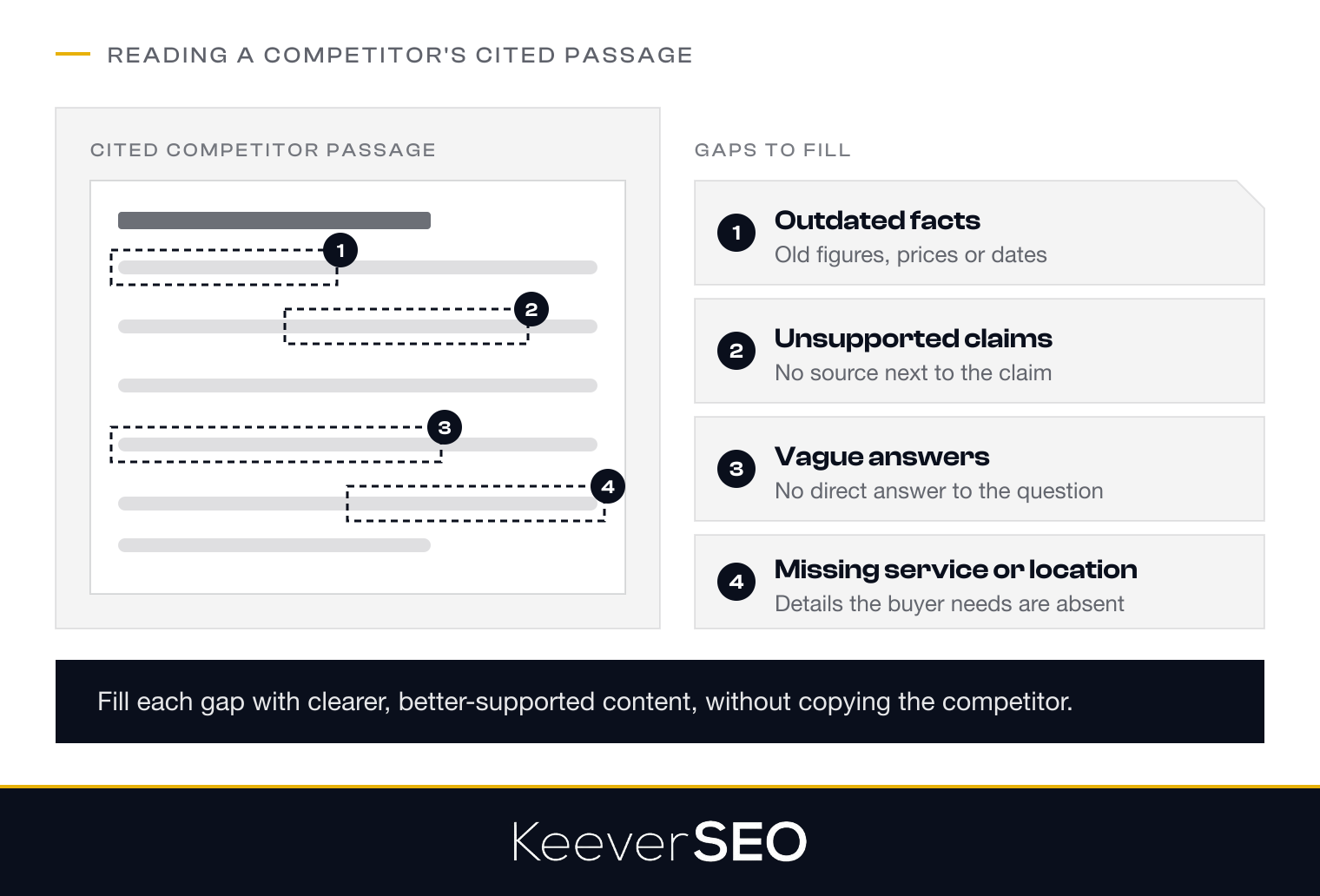
Each cited passage then gets a read for relevance, accuracy, freshness, and missing details. Outdated facts, unsupported claims, vague answers, and missing service or location information are the gaps that clearer, better-supported content can fill without copying the competitor.
4. Write Answer-Shaped Passages Perplexity Can Quote
To appear in Perplexity answers, write answer-shaped passages that give Perplexity a concise, self-contained response to one question. Each passage opens with the direct answer, then adds the relevant details, conditions, or steps.
Question headings and short paragraphs keep each section clear when Perplexity retrieves it on its own. Concrete claims need current facts and nearby sources, such as figures, dates, or named studies, placed right next to the claim they support.
5. Build Reviews and Brand Reputation
To appear in Perplexity answers, build reviews and brand reputation, which weigh most on provider recommendation and comparison questions. Genuine, steady reviews on platforms such as Google Business Profile, Yelp, Trustpilot, G2, or Capterra, with professional replies, build the record, and incentives for positive reviews are never acceptable.
Credible brand mentions come from industry publications, local news, professional associations, reputable directories, and community forums. A business name, address, phone number, service list, service area, and description that match across the website and every profile help Perplexity describe the business correctly, although consistency alone does not guarantee citations.
6. Test Your Target Questions in Perplexity
To appear in Perplexity answers, test your target questions in Perplexity once the updated pages have been crawled, and record the cited URLs, domains, and passages. The same question set, run on a schedule, shows whether Perplexity retrieves and cites your pages.
Citation records need comparing over time, since Perplexity's live results change. When competing pages appear instead, revise the passage to answer the question directly, add concrete sourced facts, and confirm that PerplexityBot can crawl the page.
How Do You Check Whether Your Pages Appear in Perplexity Answers?
To check whether your pages appear in Perplexity answers, run a fixed set of target questions on a schedule and record the date and every cited URL. Each record notes whether Perplexity quotes your page, lists it among the numbered sources, or cites competing domains, because live retrieval changes the results from run to run.
Perplexity.ai referral traffic in analytics shows the visits and landing pages that citations produce. AI visibility tools monitor citations and brand mentions across more questions, but neither referral data nor tool reports replace manual checks.
Which Perplexity Answers Should a Local Service Business Target?
A local service business should target Perplexity answers to provider recommendation questions that name its service and city, such as "Who provides the best emergency plumber in Austin?" Clear service descriptions, coverage areas, availability, and verifiable reputation details help Perplexity assess local providers.
Local pricing questions and service comparisons come next. Pages can answer queries such as "How much does roof repair cost in Denver?" or "Which HVAC companies in Phoenix offer maintenance plans?" with price ranges, what the service includes, its limits, and how the options differ, backed by business details that match across the website, review platforms, directories, and local sources.
When Should a Business Get Help Appearing in Perplexity Answers?
A business should get help appearing in Perplexity answers when competitors keep earning the citations for its target questions and its own pages do not. Outside support can find the citation gaps, fix crawl problems that block PerplexityBot, and improve page access.
Specialist help fits when the team lacks the capacity to write standalone answer passages or track results. A repeatable question set, a cited-URL log, a referral-traffic report, and periodic tests then show which content needs work.
How Does Keever SEO's AI Optimization Service Get Businesses Into Perplexity Answers?
Keever SEO's AI optimization service gets businesses into Perplexity answers through question research and competitor citation analysis. The service identifies customer queries, checks which pages Perplexity cites, and finds the gaps in content, technical access, and brand authority.
Keever SEO then writes answer-shaped passages, builds brand reputation through reviews and relevant mentions, and tests the target questions in Perplexity. Repeated testing tracks the citations and flags the pages that need revision.
How Does Appearing in Perplexity Answers Connect to Ranking and Mentions?
Appearing in Perplexity answers connects to ranking and brand mentions because all three rest on the same signals: relevance, freshness, credibility, and accessible content. A brand can appear in a third-party source without its own website being cited, and a cited page can leave the brand unnamed, so brand mentions need visibility beyond the company's own site. The question below covers brand mentions.
How Do You Get Your Brand Mentioned in Perplexity?
To get your brand mentioned in Perplexity, publish concise, factual, well-cited content that answers concrete questions and names the brand, services, and locations. Structured data helps Perplexity read the organization and its offers, while useful Reddit contributions, customer reviews, and reputable industry websites supply independent mentions.
How Do Perplexity Answers Compare With ChatGPT and Google AI Overviews?
Perplexity answers compare with ChatGPT and Google AI Overviews as the most citation-forward of the three: Perplexity runs real-time searches and numbers every source, ChatGPT gives conversational answers with web sources when it searches, and Google AI Overviews show a summary at the top of Google Search with links to cited pages. Each platform selects and presents sources differently, as the two questions below show.
How Do You Optimize Content to Appear in ChatGPT?
To optimize content to appear in ChatGPT, allow OAI-SearchBot to crawl your pages and keep them indexed in Bing. Modular sections with descriptive headings and a direct answer at the start of each section give ChatGPT passages to cite, although crawler access and Bing indexing make pages eligible without guaranteeing placement.
Which Sources Do Google AI Overviews Cite?
The sources Google AI Overviews cite are a mix of ranking pages, Reddit, YouTube, and authoritative publishers, with only 37.9% of cited URLs appearing in the first 10 results for the query, according to "Update: 38% of AI Overview Citations Pull From The Top 10" by Louise Linehan, Ahrefs, March 2026. The mix shifts with the query, with community platforms appearing more on recommendation and how-to questions and trusted news, government, education, and specialist sites more on high-stakes topics.
What Is the Fastest Way to Appear in Perplexity Answers?
The fastest way to appear in Perplexity answers is to target a few concrete questions that competing pages answer badly. Concise passages under question headings, with the answer in the opening sentence and credible sources behind each fact, give Perplexity a better option than the current citations.
Once PerplexityBot has crawled the pages, retest the same questions and revise any passage that is still not cited. The shortcut sits inside the full process of appearing in Perplexity answers: SEO fundamentals, question research, competitor analysis, reputation building, and ongoing testing.