The best strategies to optimize a website for Google AI Overviews are publishing original, people-first content, keeping pages crawlable and eligible for snippets, providing a strong page experience, and matching structured data to the visible content. Google AI Overviews SEO means optimizing pages so Google can read them and cite them as sources in its AI-generated summaries.
The remaining strategies are images and video, topic coverage instead of isolated keywords, exact answers to the question, links and trusted mentions, complete local and ecommerce details, and performance monitoring. Each strategy was selected from Google's own guidance and judged on three criteria (whether it follows that guidance, whether it helps pages get cited, and whether Search Console can measure it), followed by what Google says you don't need, why SEO still applies, and how preview controls limit what Google can use.
A local service business should start with its Google Business Profile, answer-first service pages, reviews, and matching LocalBusiness schema, and hand the work to an agency when page counts or technical problems outgrow the team. The article then shows how the strategies help pages rank, which factors they target, and how AI Overviews change traffic and SEO, starting with the first strategy: original content for people.
1. Publish Unique, Non-Commodity Content for People
Original, non-commodity content for people is the first strategy because it gives searchers original insight, first-hand experience, or expert analysis that rewritten content cannot. Pages that answer the searcher's need with evidence, examples, and practical detail give Google a reason to cite them, while commodity content repeats what Google already has.
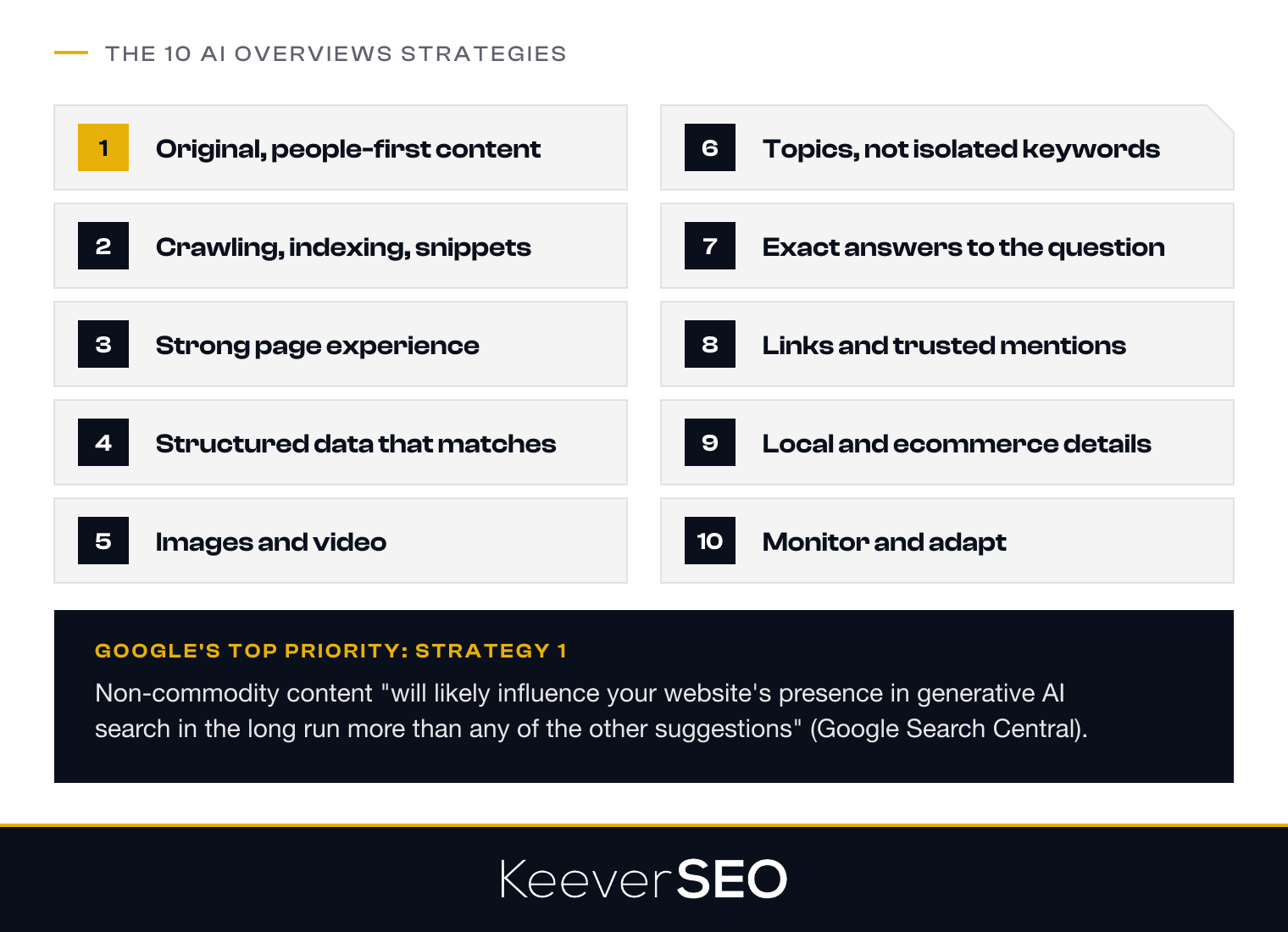
Google ranks the strategy above every other: non-commodity content "will likely influence your website's presence in generative AI search in the long run more than any of the other suggestions in this guide", according to "Google's Guide to Optimizing for Generative AI Features on Google Search" published by Google Search Central, May 2026.
2. Make Sure Google Can Crawl, Index, and Show Snippets of Your Pages
Making sure Google can crawl, index, and show snippets of your pages is the entry ticket to AI Overviews, since Google can only cite a page that is crawlable, indexed, and eligible for a search snippet. Robots.txt should let Googlebot reach important pages, and Search Console's URL Inspection and Page Indexing reports confirm the indexing, while clear internal links help Google find related pages.
Pages you want cited should carry no noindex or nosnippet directives. The nosnippet and data-nosnippet controls limit which text can appear in search features, and max-snippet caps the amount of text Google can use.
3. Provide a Strong Page Experience
A strong page experience helps visitors and Google use a page once they arrive from Search. Fast loading, good Core Web Vitals, responsive mobile design, readable text, and clear navigation make the information easy to reach.
For Google AI Overviews, page experience backs up useful content and crawlability. The main content should be easy to find, without latency, clutter, intrusive pop-ups, or ads that cover the answer, and Google recommends judging the page experience as a whole rather than chasing one signal.
4. Match Structured Data to Visible Content
Matching structured data to visible content means every schema property describes something visitors can see on the page. Article, Product, or LocalBusiness schema should carry the same prices, ratings, dates, and availability as the visible content.
Google's Rich Results Test validates the markup and flags errors, and structured data must never describe hidden, wrong, or missing information. Google states that structured data is not required for generative AI search, so accurate markup helps Google read the page without being a citation requirement.
5. Go Beyond Text With Images and Video
Going beyond text with images and video adds visual context that supports Google's multimodal search experiences. Original images with descriptive alt text, videos with clear titles, and accurate metadata help users and Google understand each asset.
Ecommerce sites should keep Google Merchant Center product details, prices, and availability current, and local businesses should keep their Google Business Profile accurate. Google lists useful visual content and accurate business and product data among its recommendations for AI features.
6. Think in Topics, Not Isolated Keywords
Thinking in topics rather than isolated keywords means covering a subject and its related questions across a set of connected pages. The pages should answer the likely follow-up searches about costs, comparisons, processes, limits, and common problems, each adding distinct information about the relevant entities and terms.
Google uses query fan-out to search related subtopics, so topic coverage gives it passages for each part of an answer. Descriptive internal links connect the pages, and useful, expert pages beat thin ones built for minor keyword variations, which Google treats as scaled content abuse when they exist only to manipulate results.
7. Answer the Exact Question Specifically
Answering the exact question specifically means stating the answer to the searcher's question in the first sentence, then explaining the figures, conditions, and exceptions. Verified prices, dates, measurements, or eligibility rules belong in the answer when they apply, along with a note when the answer depends on circumstances.
Question headings should match how people search, such as "How much does…?" or "When should…?", with the answer directly beneath each heading before any context.
8. Earn Links and Mentions as Trust Signals
Earning links and mentions as trust signals strengthens a website's authority as a Google AI Overviews source. Relevant backlinks from reputable, topic-related websites outweigh large volumes of unrelated links.
Brand mentions in trusted publications, expert commentary, and accurate third-party reviews reinforce authority and trust. Links, mentions, and reviews support a page's case without guaranteeing that Google cites it.
9. Keep Local Business and Ecommerce Details Complete
Keeping local business and ecommerce details complete helps Google understand the businesses and products it shows. The Google Business Profile should carry an accurate business name, address or service area, phone number, categories, services, description, and regular and special hours, all matching the business website.
Ecommerce sites should keep Merchant Center product feeds aligned with their product pages, updating prices, currencies, and stock whenever they change. Structured data on those pages should match the visible information.
10. Monitor AI Overviews Performance and Adapt
Monitoring AI Overviews performance shows which target queries display a summary and whether your pages appear among the cited sources. Each check logs the date, device, country, cited URL, and organic position, which reveals citation patterns over time.
Search Console's Generative AI performance report shows how content performs in Google's AI features, alongside impressions and clicks for the relevant pages and queries. When a page loses citations or impressions fall, review its accuracy, detail, evidence, internal links, and snippet eligibility, then update it and check the query again.
How Were These AI Overviews Strategies Selected?
The AI Overviews strategies were selected from Google's published guidance on AI features, combined with practices that research and industry analysis link to AI Overviews citations. Each strategy covers one practical part of visibility (useful content, technical access, credibility, or measurement), and established SEO, local, and ecommerce practices took priority over unconfirmed claims about AI rankings, judged by the three criteria below.
Which Criteria Make an AI Overviews Strategy Effective?
The criteria that make an AI Overviews strategy effective are alignment with Google's guidance, the potential to earn citations, and measurability in Search Console. Each criterion checks whether a strategy follows documented recommendations, helps pages earn source links, and produces trackable data, as the three questions below explain.
Does the Strategy Follow Google's Own Guidance?
Yes, every strategy in the list follows Google's own guidance, and strategies built on Google Search Central documentation carry less risk than unconfirmed tactics. Google's requirement for supporting links is plain: a page must be indexed and eligible to appear with a snippet.
Does the Strategy Help Pages Get Cited?
Yes, a strategy counts only when it raises the chance Google selects the page as a supporting source in an AI Overview, not when it only lifts organic rankings. Relevant, authoritative pages that answer the query give Google stronger source material, while organic position alone does not decide citation.
Can the Strategy Be Measured in Search Console?
Yes, Search Console measures the strategies through the Generative AI performance report and the Performance report's impressions and clicks over time. A separate log of target queries, cited pages, and dates, compared with Search Console data, shows which changes moved citations.
What Does Google Say You Don't Need to Do for AI Overviews?
The steps Google says you don't need to take for AI Overviews are listed below:
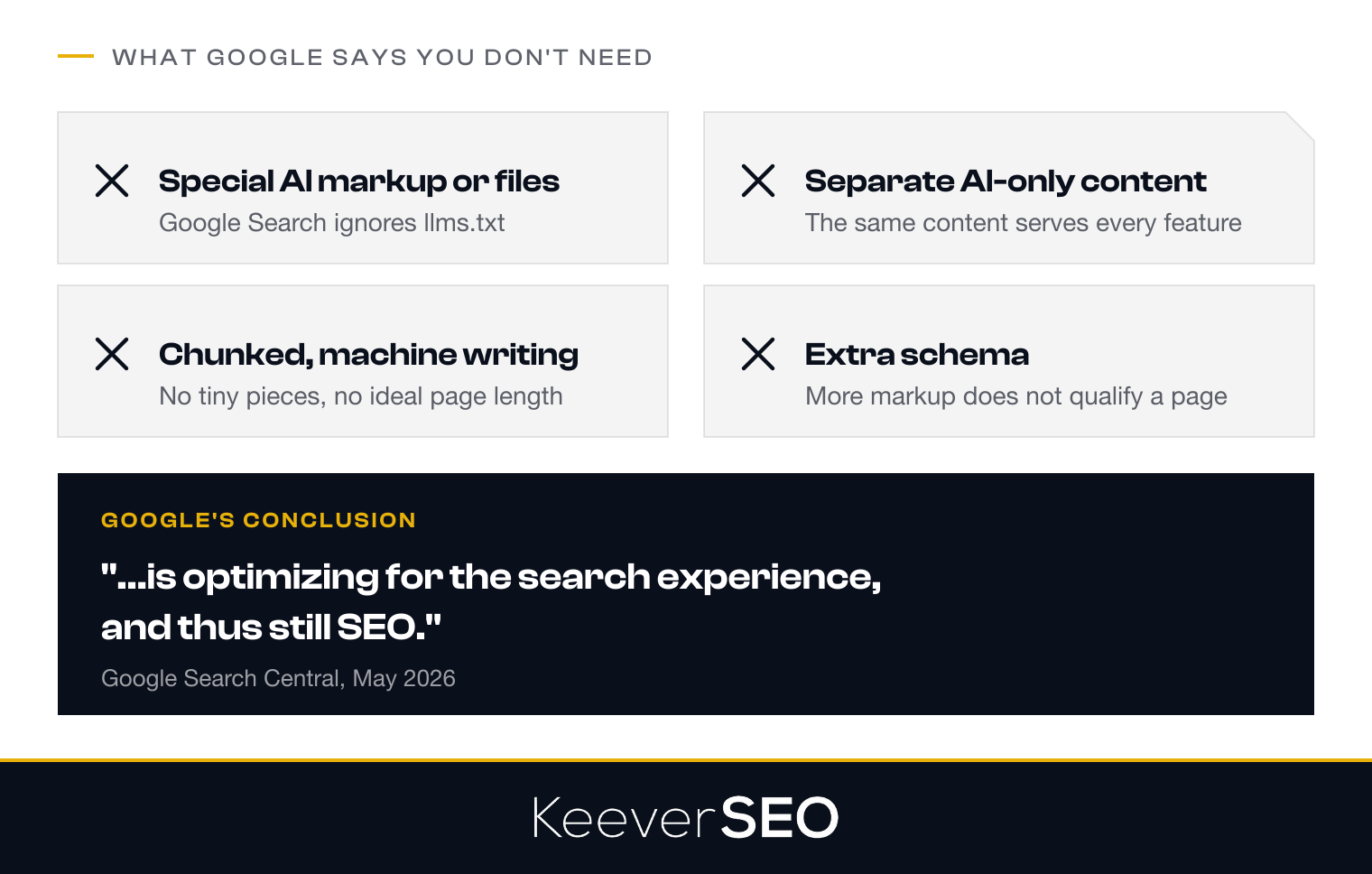
- Special AI markup or files: Google Search ignores llms.txt and similar "special" files, and "there's no special schema.org markup you need to add".
- Separate AI-only content: the same useful content serves people across every Google Search feature.
- Chunked, machine-oriented writing: there is no requirement to break content into tiny pieces, and no ideal page length.
- Extra schema: structured data should describe visible content, and adding more does not qualify a page for AI Overviews.
Google sets out each point in "Google's Guide to Optimizing for Generative AI Features on Google Search", Google Search Central, May 2026, which concludes that optimizing for generative AI search "is optimizing for the search experience, and thus still SEO".
Is SEO Still Relevant for Google AI Overviews?
Yes, SEO is still relevant for Google AI Overviews, because Google draws supporting links from pages in its Search index and relies on its core ranking and quality systems. Crawlability, indexing, helpful content, clear page structure, and page experience stay the foundation of visibility.
A page must be indexed and eligible for a Search snippet before it can appear as a supporting link. SEO best practices raise that eligibility, while the citation itself stays Google's choice.
How Do Preview Controls Affect Your Pages in AI Overviews?
Preview controls affect your pages in AI Overviews by deciding how much of the content Google may show and use. The nosnippet directive blocks text snippets and keeps the content out of AI features, data-nosnippet excludes only the marked passages, and max-snippet limits the text Google can use, with max-snippet:0 working like nosnippet.
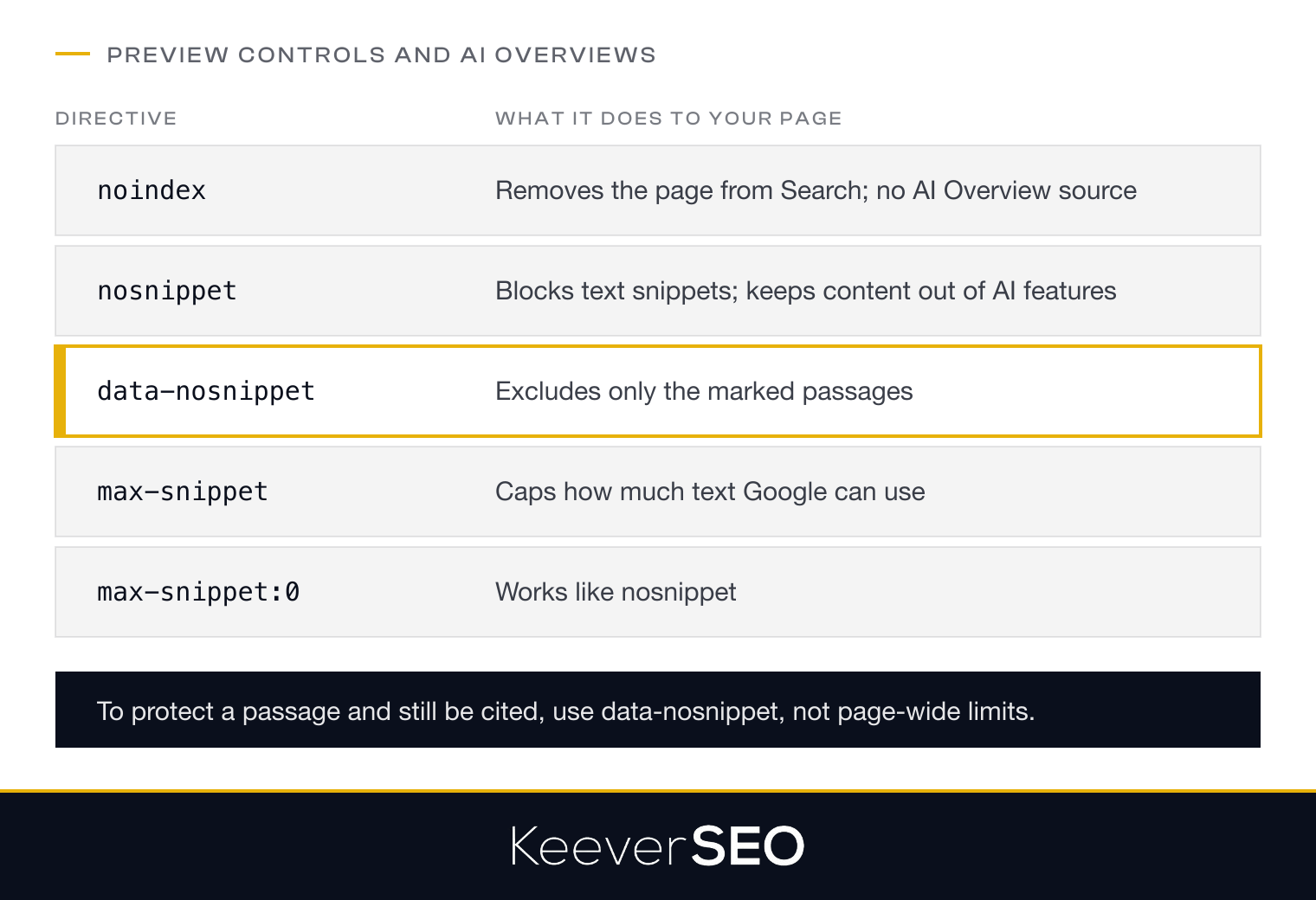
The noindex directive removes a page from Google Search, which rules it out of AI Overview sources. Restrictive settings protect chosen content at the cost of citation chances, so data-nosnippet on single passages beats page-wide restrictions when you want Google to cite the page.
Which AI Overviews Strategies Should a Local Service Business Start With?
A local service business should start with the AI Overviews strategies closest to its customers: a complete, verified Google Business Profile with accurate contact details, services, categories, service areas, and hours, and service pages that answer cost, process, timeline, and scope questions near the top.
Recent, genuine local reviews help customers judge the business. LocalBusiness schema should describe the same visible, accurate details, including the business name, address, phone number, website, and hours.
When Should AI Overviews Optimization Go to an Agency?
AI Overviews optimization should go to an agency when the work exceeds the team's time or technical skills. An agency can update many pages at once, fix crawlability or schema problems, and respond when key queries lose clicks.
Outside support fits when nobody has time to track citations on a schedule. Hiring an agency does not guarantee citations, since Google applies its normal Search requirements and runs no separate eligibility system for AI Overviews.
How Does Keever SEO's AI Optimization Service Apply These Google AI Overviews Strategies?
Keever SEO's AI optimization service applies the ten Google AI Overviews strategies starting with an audit of AI visibility, priority customer questions, competitor citations, and gaps in content, technical SEO, and authority. The AI optimization service then rewrites pages with direct answers, fixes crawler access, and corrects schema to match the visible content.
Keever SEO strengthens local business information through profiles, directories, reviews, and relevant mentions. Ongoing tracking measures citations, brand mentions, sentiment, share of voice, rankings, and AI referral traffic across AI platforms.
How Do These Strategies Help You Rank in Google AI Overviews?
The strategies help you rank in Google AI Overviews by supplying the signals Google Search uses to retrieve, judge, and cite pages. Crawlable, indexed pages with snippet eligibility give Google access, while helpful answers, clear structure, and trusted references make each page easy to judge as a source. The question below names the ranking factors the strategies target.
Which Ranking Factors Do These Strategies Target?
The ranking factors the ten strategies target are snippet eligibility, helpful content, page experience, structured data that matches visible content, organic search performance, and authority. Eligibility is the gate, and the other factors support discovery, reading, and citation without guaranteeing inclusion.
How Do AI Overviews Change Website Traffic?
AI Overviews change website traffic by cutting clicks to traditional organic results, since users find the answer on the search page. In a browsing study of 68,879 Google searches, users clicked a traditional result on 8% of visits when an AI summary appeared, against 15% without one, according to "Google users are less likely to click on links when an AI summary appears in the results" by Athena Chapekis and Anna Lieb, Pew Research Center, July 2025.
Citations inside an AI Overview help pages hold on to visibility, although cited pages still draw fewer clicks than they would on searches without an overview.
How Are AI Overviews Changing SEO?
AI Overviews are changing SEO from chasing rankings alone to earning citations inside Google's AI-generated answers. Pages need answer-first content that addresses the search question directly and adds useful supporting detail, while crawlability, indexing, helpful content, and page experience stay the foundation. SEO reporting now tracks AI Overview appearances, cited pages, and the Generative AI performance report alongside impressions and clicks.
Which Google AI Overviews Strategy Should You Apply First?
The Google AI Overviews strategy to apply first is confirming that Google can crawl, index, and show snippets for your key pages. Robots.txt should allow access, Search Console should report the pages as indexed, internal links should lead to them, and no noindex or nosnippet directive should block them.
Once eligibility is confirmed, improve the content on pages that already rank for question queries with a direct answer, concrete details, and clear conditions. Technical eligibility plus useful content is the starting point for the full list of strategies to optimize your website for Google AI Overviews.