To rank in Google AI Overviews, keep pages indexable and eligible for snippets, answer the target question first, cover its fan-out sub-questions, and back the page with authority and matching structured data. Ranking in Google AI Overviews means a page is linked as a source inside the generated answer for a query.
Google chooses who gets into an AI Overview through its Search systems, weighing query relevance, snippet eligibility, page quality, and passages that support the answer, so a first-place organic ranking alone does not guarantee a spot. The groundwork (indexed pages, no nosnippet blocks, related rankings, and a list of questions that show an AI Overview) comes before seven steps: question targeting, answer-first writing, extractable structure, fan-out coverage, authority signals, matching structured data, and monitoring.
Search Console now reports AI features in its own Generative AI performance report, buried answers and weak authority keep pages out, and updated pages that already rank move faster than new ones. Local service businesses can answer cost and process questions on service pages, and expert help fits when ranking pages stay uncited, before the article ties the steps to ranking factors, citation sources, ChatGPT, and Perplexity. The first section defines what ranking in Google AI Overviews means.
What Does It Mean to Rank in Google AI Overviews?
Ranking in Google AI Overviews means a webpage appears as a source for the AI-generated answer to a query. Google can link the page inside the summary, show it in a source card beside the summary, or use the page's information in the generated text.
A classic blue-link position places a page in Google's standard organic results, while an AI Overview citation ties the page directly to the generated answer. A page can be cited without ranking first in the organic results.
How Does Google Choose Who Gets Into an AI Overview?
Google chooses who gets into an AI Overview by running its core ranking systems over the query and its fan-out searches, then citing pages whose passages support each part of the answer. Grounding for generative AI search relies on "core Search ranking systems to retrieve relevant, up-to-date web pages", and query fan-out generates "concurrent, related queries" to fetch more results, according to "Google's Guide to Optimizing for Generative AI Features on Google Search" published by Google Search Central, May 2026.
Google judges relevance and quality across the original query and the related searches, so a page can support one part of an answer without ranking first for the full query. Organic position therefore matters, but it does not decide the outcome alone.
Does Ranking First Guarantee a Spot in an AI Overview?
No, ranking first does not guarantee a spot in an AI Overview, because most cited pages come from outside the top results for the query. Only 37.9% of URLs cited in AI Overviews appeared in the first 10 results, with the rest split between positions 11 to 100 and beyond the top 100, according to "Update: 38% of AI Overview Citations Pull From The Top 10" by Louise Linehan, Ahrefs, March 2026.
Google cites pages that answer related fan-out questions even when they do not rank for the original query. A strong ranking helps, but a directly relevant answer carries equal weight.
What Do You Need Before Trying to Rank in Google AI Overviews?
The prerequisites for ranking in Google AI Overviews are listed below:
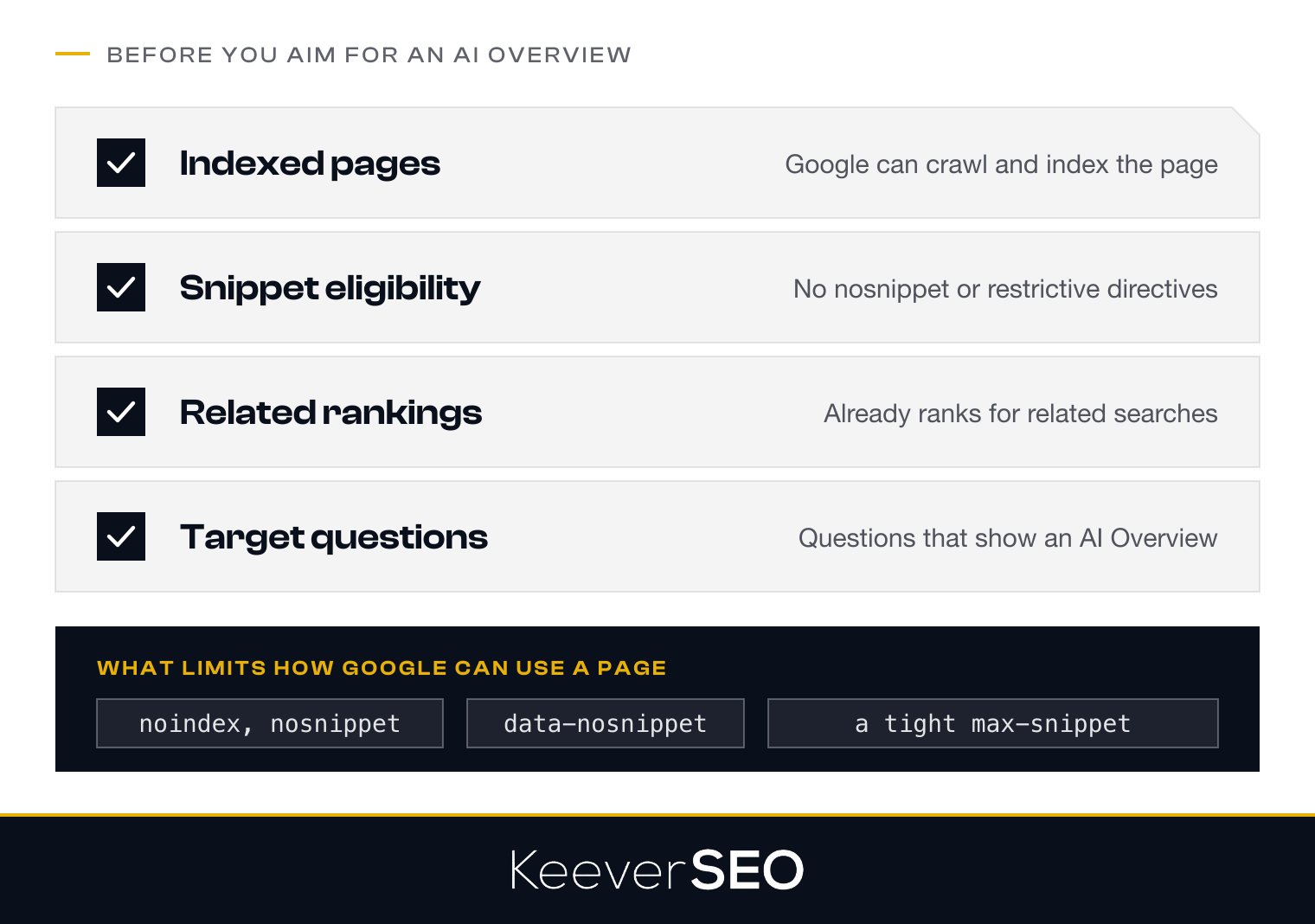
- Indexed pages: Google can crawl and index each target page.
- Snippet eligibility: no nosnippet or restrictive snippet directives on the content you want cited.
- Related rankings: pages that already rank for related searches.
- Target questions: a list of question queries that show an AI Overview today.
With the prerequisites in place, the seven steps below raise the chance of a citation.
How Do You Rank in Google AI Overviews?
To rank in Google AI Overviews, follow seven steps: target questions, answer first, structure pages for extraction, cover fan-out sub-questions, stack authority and trust signals, add structured data that matches the page, and monitor visibility.
Each step helps Google read the page and find passages that support an AI-generated answer. The process starts with question queries that trigger AI Overviews, including People Also Ask questions and conversational searches.
1. Target Questions, Not Just Keywords
To rank in Google AI Overviews, target question queries rather than bare keywords, starting with searches that begin with "how", "what", "why", "which", or "can" and already show an AI Overview.
People Also Ask questions, autocomplete suggestions, related searches, and customer questions reveal conversational long-tail searches. Grouping the questions by intent and answering related ones in useful sections beats creating thin pages for every keyword variation.
2. Answer First, Then Explain
To rank in Google AI Overviews, put a direct answer in the first sentence under each heading, then explain. A concise, self-contained answer gives readers the key information at once and gives Google a passage that supports the query.
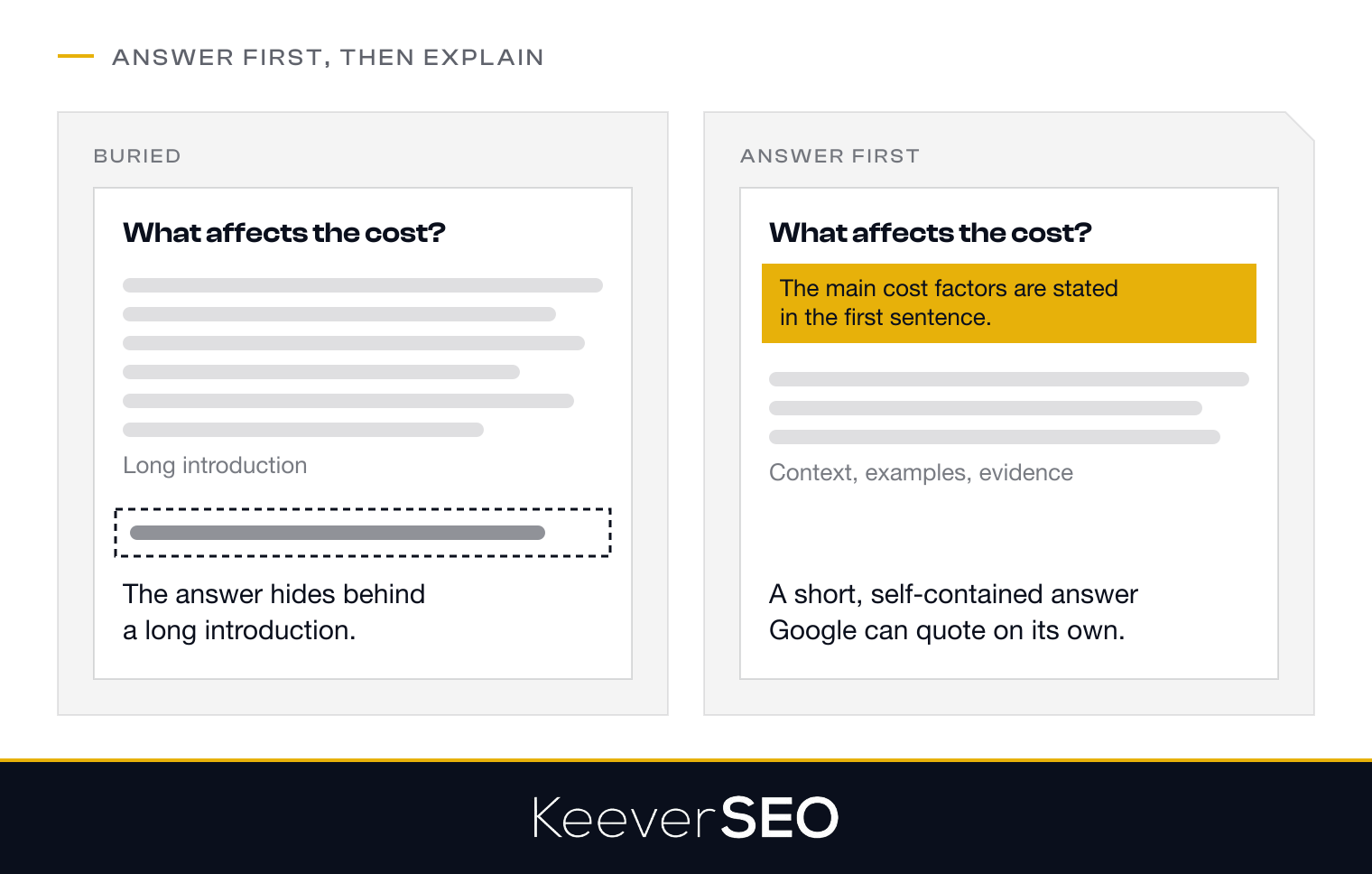
The opening answer should be short enough to quote, with context, examples, or evidence after it. A heading about service costs, for example, should state the main cost factors first and explain them afterward, never behind a long introduction.
3. Structure Pages for Easy Extraction
To rank in Google AI Overviews, structure pages so each answer is easy to extract: question headings, each followed by a concise, self-contained answer.
Short paragraphs suit explanations, numbered lists suit processes, bullet lists suit options, and tables suit comparisons or specifications, each marked up with its proper HTML element. Every section should make sense on its own and supply a passage that can support an AI Overview answer.
4. Cover Query Fan-Out Sub-Questions
To rank in Google AI Overviews, cover the fan-out sub-questions Google searches when it builds an answer. Query fan-out sends related searches across subtopics, so a page that answers those sub-questions supplies passages for several parts of the answer.
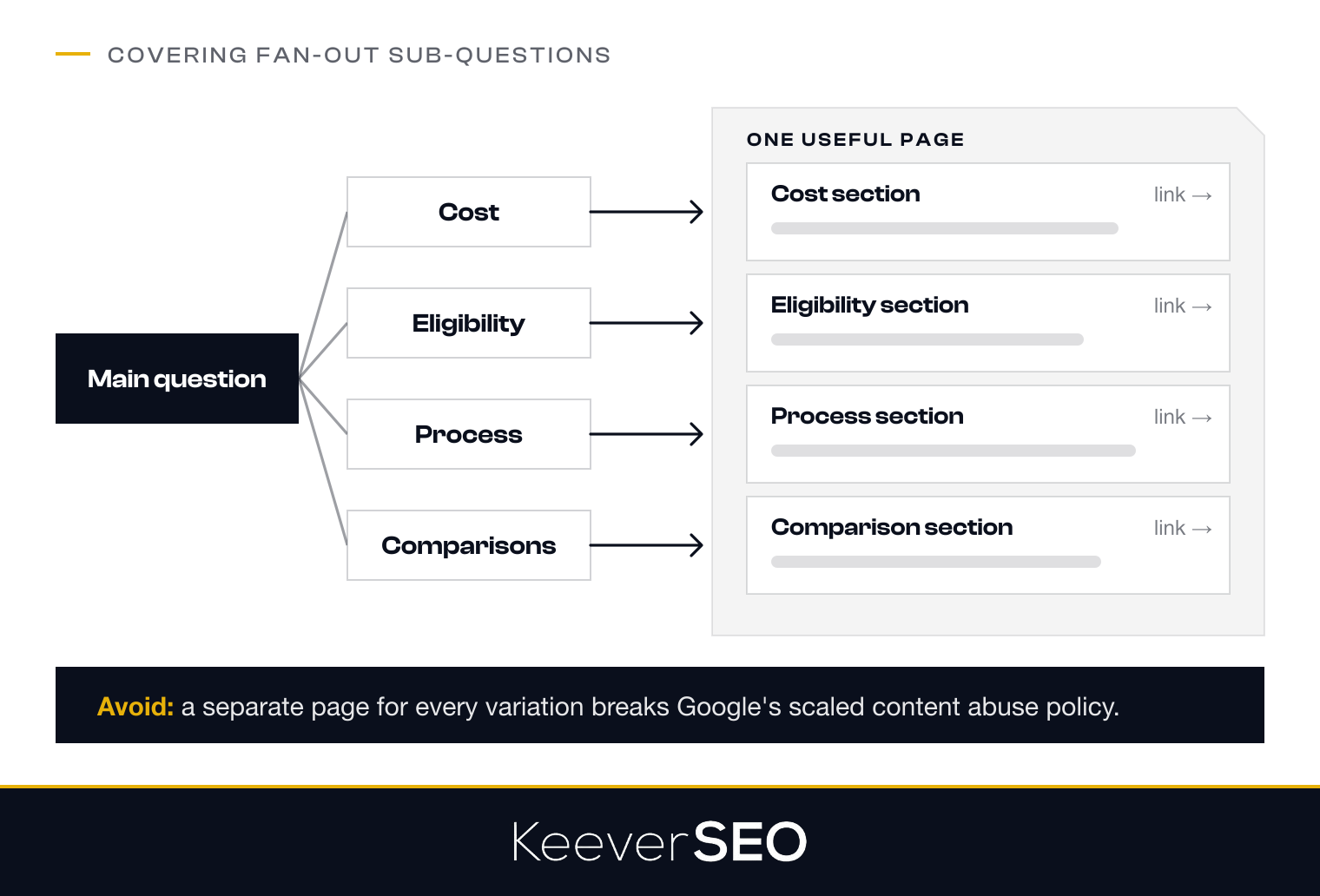
Each useful question, such as cost, eligibility, process, or comparisons, deserves its own labeled section with a direct answer, plus internal links to deeper pages. Google warns that creating separate pages for every fan-out variation to manipulate results breaks its scaled content abuse policy, so the coverage belongs on genuinely useful pages.
5. Stack Authority and Trust Signals
To rank in Google AI Overviews, stack authority and trust signals: accurate bylines, author biographies, verifiable credentials, original examples, and evidence from first-hand experience. Reliable sources behind each factual claim let readers check the information.
Relevant backlinks and brand mentions on trusted industry sites support recognition, earned through useful original content, credible partnerships, and coverage from reputable publishers. Google rewards helpful, reliable, people-first content, but no single authority signal guarantees an AI Overview citation.
6. Add Structured Data That Matches the Page
To rank in Google AI Overviews, add structured data only where it matches the visible page: Article for editorial pages, FAQPage for visible question-and-answer content, HowTo for step-by-step instructions, and LocalBusiness for service business details. Google states that no special schema is required for generative AI search, so markup helps Google read the page without being a ranking requirement. The Rich Results Test validates the markup and flags errors.
7. Monitor AI Overviews Visibility and Adapt
To keep ranking in Google AI Overviews, monitor visibility on a schedule: check each target question, record whether an AI Overview appears, and log the cited URLs, competing sources, and your page's organic position.
Search Console's Generative AI performance report shows how pages perform in Google's AI features, alongside impressions and clicks for question queries. Pages that lose citations need fresh facts, stronger direct answers, filled sub-question gaps, and structured data rechecked against the visible content.
How Do You Track AI Overviews Visibility in Search Console?
To track AI Overviews visibility in Search Console, use the Generative AI performance report, which Google points site owners to "to see how your content is performing in generative AI features on Google Search", according to "Google's Guide to Optimizing for Generative AI Features on Google Search", Google Search Central, May 2026. Impressions and clicks for question queries in the Web search type add the wider picture, and manual checks of those searches show whether an AI Overview cites your page.
AI Overview rank trackers record whether an overview appears, which pages it cites, and how citations change over time. Search Console covers performance, while a tracker covers citation-level detail.
Which Mistakes Keep Pages Out of Google AI Overviews?
The mistakes that keep pages out of Google AI Overviews are listed below:
- Blocking indexing or snippets: a noindex directive removes the page from the index, and a nosnippet directive, data-nosnippet attribute, or tight max-snippet setting limits how Google can use the content.
- Burying the answer: a long introduction hides the passage that answers the target question.
- Covering too few related questions: a page that answers only the main query misses definitions, costs, comparisons, steps, or limits that fan-out searches look for.
- Using schema that does not match the page: structured data that describes invisible or wrong content confuses search systems and cannot make up for weak content.
- Providing few authority or trust signals: missing credentials, first-hand evidence, reliable citations, and reputable mentions weaken credibility.
- Leaving facts outdated: old prices, statistics, regulations, product details, and procedures make a page wrong for current queries.
- Blocking crawling: robots.txt restrictions, rendering failures, crawl errors, or hidden content stop Google from evaluating the page.
How Long Does It Take to Rank in Google AI Overviews?
Ranking in Google AI Overviews takes several weeks to several months, depending on the page's existing visibility. An updated page that already ranks for a related query can be cited within weeks of Google recrawling it, while a new page needs months to build the organic rankings Google draws on. No published study measures a reliable time to a first AI Overview citation, so any fixed timeline is an estimate.
How Can Local Service Businesses Rank in Google AI Overviews for Service Questions?
Local service businesses can rank in Google AI Overviews for service questions by answering customer questions directly on their service pages. Concise answers about costs, processes, timelines, service areas, and how to choose a provider belong at the start of the relevant sections, with supporting detail after.
A complete Google Business Profile should show accurate services, locations, hours, contact details, and the website. Genuine, recent reviews, LocalBusiness structured data that matches the visible details, and crawlable, mobile-friendly, current service pages complete the set.
When Should You Get Help Ranking in Google AI Overviews?
You should get help ranking in Google AI Overviews when relevant pages rank but rarely appear as cited sources, or when clicks fall on important queries. A specialist can work out whether answer structure, content depth, or trust signals hold the pages back.
Professional support fits when crawlability, nosnippet settings, indexing, or schema problems may stop Google from using a page. An SEO specialist audits technical eligibility, sets the content priorities, and monitors cited pages alongside Search Console data.
How Does Keever SEO's AI Optimization Service Rank Businesses in Google AI Overviews?
Keever SEO's AI optimization service ranks businesses in Google AI Overviews with an audit-first approach. The audit reviews existing citations, organic rankings, competitors, crawler access, and gaps in content, technical SEO, and authority signals.
Keever SEO then maps the priority customer questions, rewrites the relevant pages with direct answers, and covers the related fan-out questions. The AI optimization service adds structured data that matches the visible content and tracks cited pages, competitors, and visibility changes to guide ongoing updates.
How Do AI Overviews Ranking Factors Shape These Steps?
AI Overviews ranking factors shape the seven steps because each step targets a signal Google confirms or research links to citations. Google's own requirements are indexing, snippet eligibility, and helpful, reliable content, while studies tie citations to organic visibility, passage relevance, topical authority, and clear answers. The two questions below cover the strategies and the sources Google cites.
Which Strategies Optimize a Website for Google AI Overviews?
The strategies that optimize a website for Google AI Overviews follow Google's own guidance: publish original, useful content, keep pages crawlable and indexable, give a good page experience, use structured data that matches the visible content, and support text with relevant images and video. Google requires no special schema for AI Overviews.
Which Sources Do Google AI Overviews Cite?
The sources Google AI Overviews cite are a mix of well-ranked organic pages and sources such as Reddit, YouTube, Wikipedia, and authoritative publishers. The mix shifts with the query, with YouTube supporting demonstrations, Reddit supplying first-hand opinions, Wikipedia giving reference information, and publishers covering high-trust topics.
How Does Ranking in AI Overviews Compare With Ranking in ChatGPT?
Ranking in AI Overviews depends on Google's index, organic visibility, and relevant source passages, while ranking in ChatGPT depends on a separate retrieval system that sends queries to partner search providers such as Bing, so Google rankings alone do not decide ChatGPT visibility. Trusted brand mentions on review platforms, industry publications, Reddit, and Wikipedia carry more weight in ChatGPT answers, while Perplexity runs real-time retrieval and cites accessible, current sources, as the question below covers.
How Do You Rank in Perplexity?
To rank in Perplexity, allow PerplexityBot to crawl your website and publish fresh, well-sourced answers to concrete questions. Useful contributions on trusted industry publications, reference sites, and communities such as Reddit build the outside presence Perplexity draws on.
What Is the Fastest Way to Start Ranking in Google AI Overviews?
The fastest way to start ranking in Google AI Overviews is to improve pages that already rank on the first page for question queries that show an AI Overview. Rewriting the opening under each relevant heading as a concise, direct answer, with supporting detail after, gives Google a better passage on a page it already trusts.
Once those pages are updated, cover the related sub-questions, strengthen authority, and check that Google recrawls the content. Improving existing pages is the quickest entry into the full process of ranking in Google AI Overviews.