Voice Search Optimization is the practice of shaping content so voice assistants like Siri, Alexa, Google Assistant, and Bixby select it as the single spoken answer. As voice assistants spread across phones, speakers, and cars, businesses must adapt to stay visible.
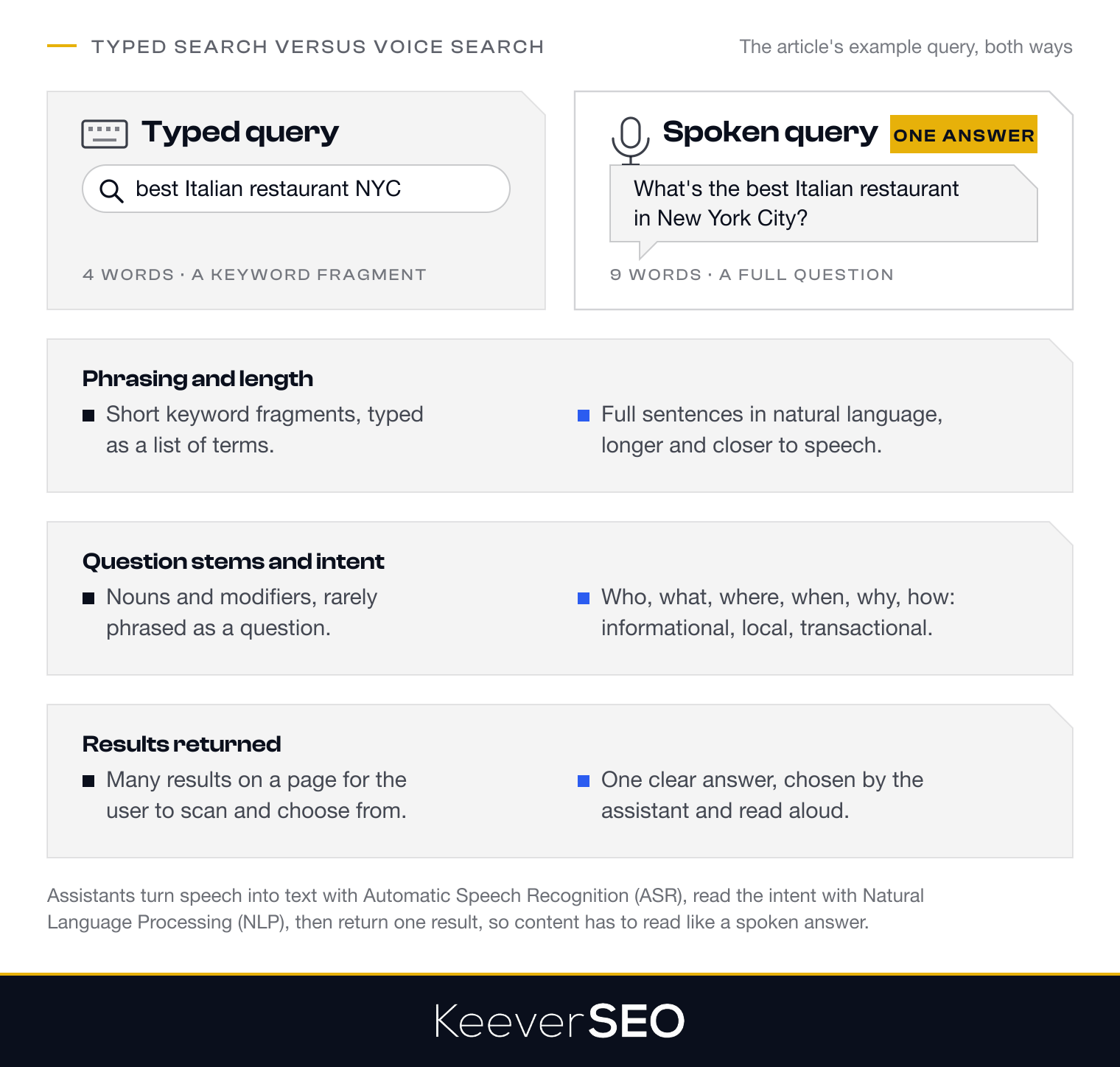
Voice search differs from text search. Text search runs on typed keywords and returns many results, whereas voice search runs on conversational, question-based queries and returns one clear answer. Voice queries run longer and read like speech, such as "What's the best Italian restaurant in New York City?" rather than "best Italian restaurant NYC," which calls for natural language, concise answers, and structured data.
The nine-step process runs from researching voice queries and mapping their intent, through answer-first content, conversational keywords, featured snippets, schema markup, local visibility, and mobile technical SEO, to measuring and updating voice content. Voice assistants process spoken queries through Automatic Speech Recognition (ASR), which turns speech into text, and Natural Language Processing (NLP), which reads meaning and intent before one result is chosen. Voice ranking leans on featured snippets, because they hold the concise answers assistants prefer, and the query types that trigger voice results run from local "near me" searches to quick facts and how-to questions.
Structured data makes content machine-readable, local SEO reinforces the proximity and business-data signals behind "near me" answers, the Google Business Profile supplies the names, addresses, hours, and ratings assistants read aloud, mobile SEO keeps pages fast enough for voice delivery, and web accessibility supplies the semantic structure assistants parse. Specialist support becomes worthwhile when complexity, languages, or scale grow, a full strategy covers audit through multilingual voice SEO, and an SEO agency can run every part of it. Ongoing optimization stays necessary because query patterns shift and assistants update, which returns the work to the first step below.
1. Research Voice Search Queries
Researching voice search queries is the first step, and it identifies how users phrase questions to assistants like Siri, Alexa, Google Assistant, or Bixby. The focus falls on question-based and long-tail queries in natural language, mined from Google's "People Also Ask" boxes and built around the question stems that dominate voice: who, what, where, when, and how. Instead of the typed keyword "Italian restaurant New York," voice optimization targets the spoken question "What's the best Italian restaurant in New York City?"
Keyword research tools surface question-based phrases, and the language inside featured snippets shows the concise, direct answers assistants prefer to read aloud. Once the spoken queries are found, the next step reads the intent behind them: informational, local, or transactional, and the single answer the assistant is most likely to choose.
2. Map Voice Search Intent
Mapping voice search intent is the second step, and it sorts each query into informational, local, or transactional intent so content matches the need. Informational intent seeks knowledge, such as "What is voice search optimization?" Local intent seeks nearby services, like "coffee shop near me." Transactional intent wants an action completed, such as "book a hotel."
Voice assistants return one answer, so content must match the dominant intent of each query with precision. Informational queries want direct, factual answers, local queries want proximity-based information, and transactional queries want actionable content. Intent mapping shapes content so the assistant reads it as the most relevant, concise answer, which sets up the answer-first writing in the next step.
3. Create Answer-First Content
Creating answer-first content is the third step, and it leads each section with the direct answer in the first sentence so assistants can extract and vocalize it at once. The ideal spoken answer runs 29 to 40 words, while the wider featured snippet window runs 40 to 60 words; Backlinko's "Voice Search SEO Study: Results From 10k Voice Searches" found the typical voice search result is 29 words long. The concise structure lets voice systems deliver a clear, immediate response and raises the odds the content becomes the single spoken result, because brevity and clarity answer the user without a further exchange.
4. Optimize Conversational Keywords
Optimizing conversational keywords is the fourth step, and it aligns content with how people speak rather than type. Typed queries arrive as fragments like "best Italian restaurant NYC," while spoken queries arrive as full sentences like "What's the best Italian restaurant in New York City?", so content needs complete question phrases and a conversational tone.
Natural language patterns built on who, what, where, when, why, and how mirror the spoken queries users give to Siri, Alexa, and Google Assistant. Question phrases placed in headings, opening sentences, and body copy align the page with the query patterns voice platforms process, which raises relevance and sets up snippet targeting, because content that reads like a spoken response is the content search systems extract and read aloud.
5. Earn Featured Snippets
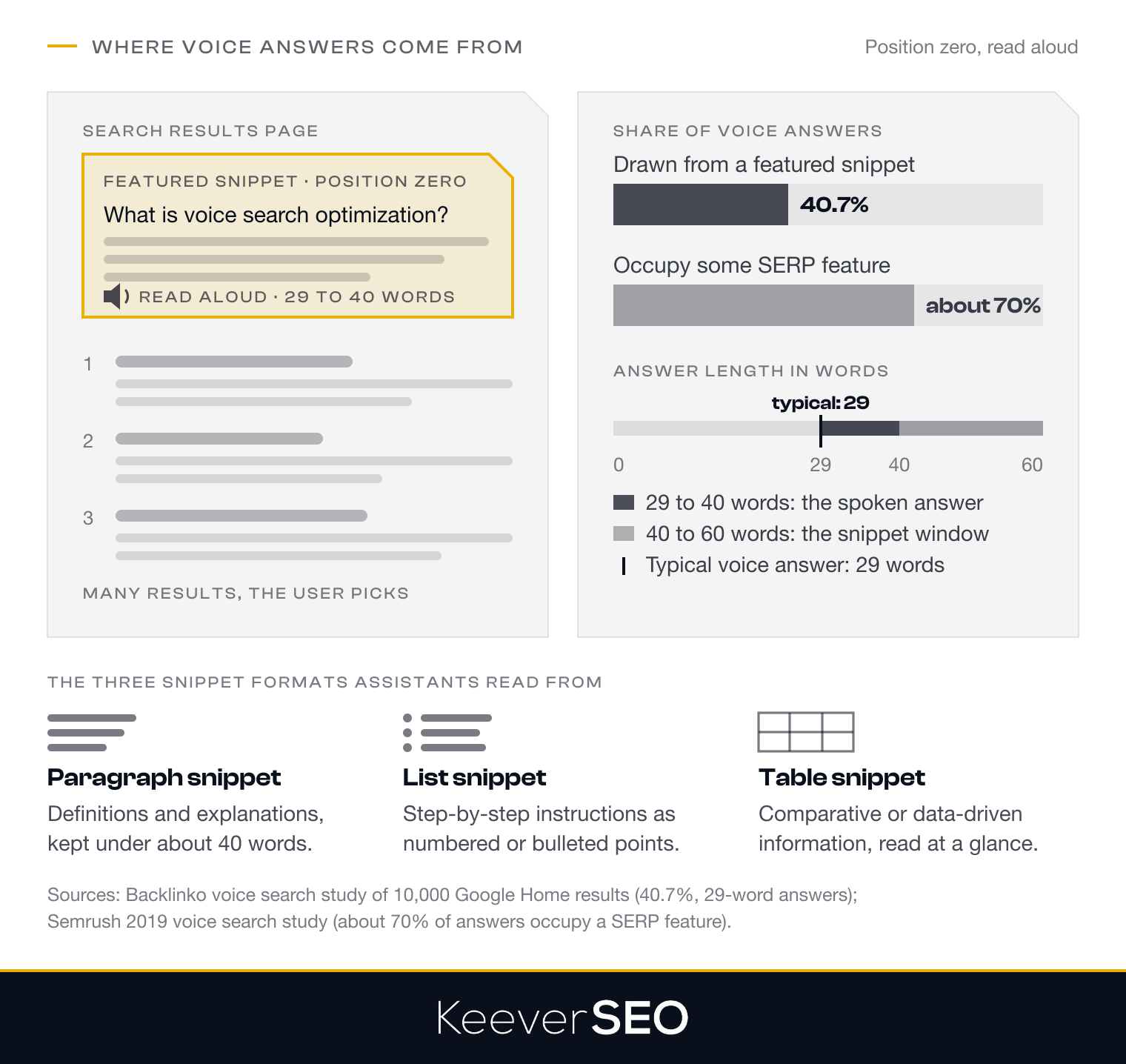
Earning featured snippets is the fifth step, because the snippet, often called "position zero," is the concise answer block above the standard results and the primary source for the spoken answers of Siri, Alexa, and Google Assistant. The three snippet formats are listed below:
- Paragraph Snippets: The format for definition and explanation queries, written clear and concise, under about 40 words, to fit the brevity voice search demands.
- List Snippets: The format for step-by-step instructions or itemized lists, set as bullet points or numbers so assistants extract them with ease.
- Table Snippets: The format for comparative or data-driven information, organized so users and search engines digest it at a glance.
Content that leads with direct answers, uses clear formatting, and keeps a natural spoken style earns snippets more often, which raises visibility in voice results.
6. Add Relevant Schema Markup
Adding relevant schema markup is the sixth step, and the structured data helps search engines read and categorize content so it can be chosen as a voice answer. The five schema types that matter most are listed below:
- FAQPage Schema: Structures question-and-answer pairs that assistants parse and deliver as concise answers.
- HowTo Schema: Organizes step-by-step instructional content for procedural queries.
- LocalBusiness Schema: Supplies location details, service areas, and contact information for local voice searches.
- Organization Schema: Establishes entity authority and brand information so assistants prioritize authoritative sources.
- Product Schema: Structures product details such as pricing, availability, and reviews for commerce queries.
Google has withdrawn FAQ rich results in traditional search for most sites, but the underlying FAQPage schema keeps its value for voice, because assistants still use the structured data to find and extract concise answers without a visual rich result.
7. Strengthen Local Voice Visibility
Strengthening local voice visibility is the seventh step, and it gets an assistant to identify the business as the best answer to a "near me" query. The work starts with a claimed and fully optimized Google Business Profile, with the business name, address, phone number (NAP), hours, categories, and services accurate and consistent across every platform.
NAP consistency matters because assistants cross-reference the details to verify a business. Customer reviews, and responses to them, build the local authority and trust signals assistants weigh when they recommend a business, and listings in directories such as Yelp and Yellow Pages add legitimacy. The steps target the "near me" pattern behind voice queries like "coffee shop near me" or "plumber near me."
8. Improve Mobile Technical SEO
Improving mobile technical SEO is the eighth step, and it makes the site fast, stable, and usable on the mobile devices where most voice queries begin. The elements are mobile-first design, HTTPS security, and load times under three seconds, and meeting them raises the odds that an assistant selects the content.
Core Web Vitals set the benchmarks: Largest Contentful Paint (LCP) measures loading, Cumulative Layout Shift (CLS) measures visual stability, and Interaction to Next Paint (INP) measures responsiveness. A site that meets the three metrics is technically ready for voice discovery, because assistants prefer answers they can retrieve fast and without friction.
With the technical foundation in place, continuous tracking finds weak pages and keeps voice visibility rising over time.
9. Measure and Update Voice Content
Measuring and updating voice content is the ninth step, and it keeps content visible as voice results change. The work tracks voice rankings, zero-click metrics, and featured snippet ownership, with Google Search Console showing the impressions, clicks, and query terms where high visibility meets low traffic, the signature of zero-click behavior.
Rank Tracking and Metrics Rank tracking centers on question-based queries and featured snippet positions, with local pages monitored for "near me" performance and local pack visibility. The voice metrics that matter are zero-click exposure, featured snippet wins, branded search lift, and assisted conversions.
Iterative Content Updates Content updates refresh direct answers, add new question phrasing from emerging queries, tighten snippet-length copy, and expand FAQ sections as intent shifts. Regular re-audits hold visibility as assistants and results evolve, and maintained voice content stays the preferred source, which ties the technical setup to long-term performance and leads back to the definition below.
What Is Voice Search Optimization?
Voice Search Optimization is the practice of shaping content to be chosen as the single spoken answer by voice assistants such as Siri, Alexa, Google Assistant, and Bixby. The practice matters more as assistant adoption grows: Juniper Research forecast that the number of voice assistant devices in use would reach 8.4 billion by 2024, more than the world's population. Traditional text search relies on short keywords and returns many results, whereas voice search delivers one spoken answer, so optimization aims at winning the single answer slot rather than a position on a page.
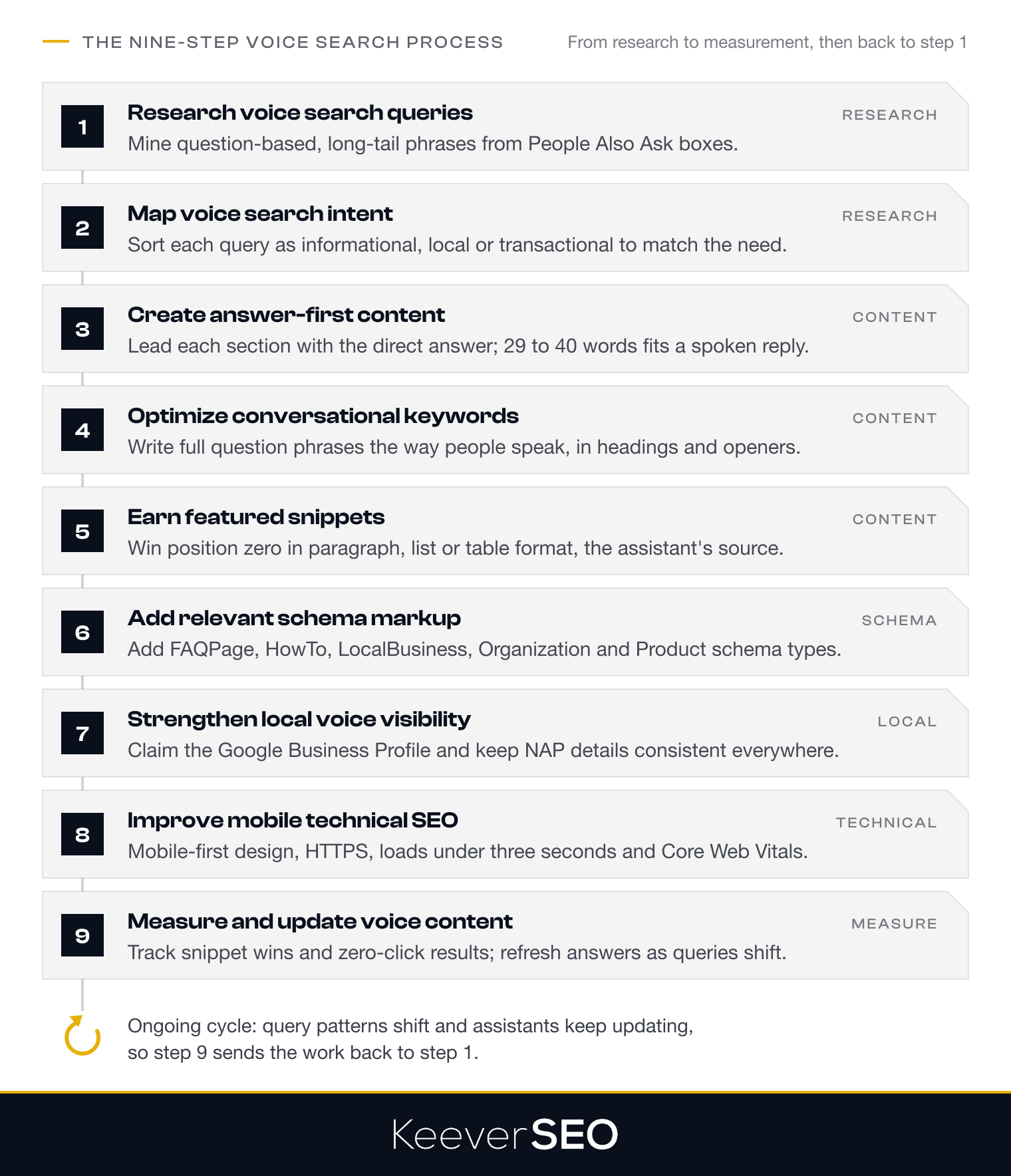
Voice optimization reads how users phrase queries in natural language and targets the featured snippets assistants read aloud. The process runs through nine steps: researching voice queries, mapping intent, creating answer-first content, optimizing conversational keywords, earning featured snippets, adding schema markup, strengthening local voice visibility, improving mobile technical SEO, and measuring and updating voice content.
Voice assistants process spoken queries through Automatic Speech Recognition (ASR) and Natural Language Processing (NLP) before they return one spoken result, and featured snippets and concise answers most often decide which response the assistant chooses, as the processing pipeline below explains.
How Do Voice Assistants Process Spoken Queries?
Voice assistants process spoken queries through a multi-stage pipeline. Automatic Speech Recognition (ASR) converts the spoken words into text, then Natural Language Processing (NLP) analyzes the text to read the user's intent and context. Once the query is understood, the system selects the most relevant answer and delivers it as a single spoken response. Text search presents many results, whereas voice search returns one definitive answer, a constraint that favors content concise, clear, and accurate enough to be spoken back to the user.
How Does Voice Search Ranking Work?
Voice search ranking works by selecting one spoken result from the possible answers. Assistants like Siri and Google Assistant lean on featured snippets, the "position zero" results, for the answer, and the selection weighs domain authority, relevance, page speed, mobile optimization, and structured data. Traditional search lets many pages compete for clicks, whereas voice search is winner-takes-all, with one answer read aloud.
The ranking favors content that is easy to read and gives immediate value. Assistants prefer pages that load fast, under about three seconds, and meet mobile-first standards, and they weigh Core Web Vitals like Largest Contentful Paint (LCP), Cumulative Layout Shift (CLS), and Interaction to Next Paint (INP). Local proximity signals matter for location queries, where Google Business Profile optimization and NAP (Name, Address, Phone) consistency decide the outcome.
The logic of voice ranking makes featured snippets and concise answers decisive, because assistants need content that stands alone as a complete answer in under 30 seconds. A 29 to 40-word range fits a spoken response, which makes snippet-worthy content the condition for voice visibility, as the two questions below explain.
Why Do Featured Snippets Matter for Voice Search Answers?
Featured snippets matter for voice search answers because they are the primary source assistants draw on. When a user speaks a query, Google Assistant, Siri, or Alexa often pulls the response from the featured snippet, the position-zero result, which gives a concise, direct answer that reads well aloud. Snippets take paragraph, list, and table formats that present structured, scannable information, and the formats let assistants extract and deliver natural-sounding responses. The share of voice answers drawn from snippets shows their weight: Backlinko's analysis of 10,000 Google Home results found 40.7% of voice answers come from a featured snippet, and Semrush's 2019 voice search study found about 70% of voice answers occupy some SERP feature.
Why Do Voice Search Results Favor Concise Answers?
Voice search results favor concise answers because assistants deliver information fast and in one breath. The best spoken answer length runs 29 to 40 words, which lets the assistant give a complete response without a pause, and users want immediate, actionable information rather than a long explanation. The typical voice answer runs about 29 words, according to Backlinko's study of 10,000 voice searches, a length that stays complete and digestible and matches the flow of conversation.
What Types of Queries Trigger Voice Search Results?
The types of queries that trigger voice search results are local, quick-fact, how-to, conversational follow-up, question-form, navigation, and transactional local queries, each with its own intent and phrasing. The seven types are listed below:
- Local Queries: Searches with "near me" or location terms from users who want businesses, services, or points of interest nearby, answered from proximity signals and Google Business Profile data.
- Quick-Fact Queries: Requests for definitions, dates, statistics, or simple calculations, answered in a sentence or two, often from a featured snippet.
- How-To Queries: Instructional questions that start with "how to" or "how do I," answered from featured snippets formatted as numbered or bulleted lists.
- Conversational Follow-Up Queries: Multi-turn interactions where users refine or extend a previous search in natural language, with the assistant holding context across the sequence.
- Question-Form Queries: Queries that open with who, what, where, how, or when, which map to spoken intent and resolve into one answer.
- Navigation Queries: Requests for a specific brand, location, or business, such as a shop, office, or website address, answered from local and business listing signals.
- Transactional Local Queries: Spoken searches with immediate action intent, such as booking, calling, visiting, or buying from a nearby business, common when users want a fast result without browsing.
The seven types stay concise and intent-clear enough for a single spoken answer, and local "near me" searches, the fastest-growing segment, are covered next.
How Do Local Near Me Queries Work in Voice Search?
Local "near me" queries work in voice search through proximity signals combined with business data. When a user asks for a service or business "near me," an assistant like Siri or Alexa pairs the user's real-time GPS location with business data, including Google Business Profile details such as operating hours and customer reviews, to pick the best local result.
The "near me" pattern weighs three factors: proximity, relevance, and user intent, and the assistant recommends one business on the strength of all three. A business that wants the spot needs a Google Business Profile with accurate name, address, and phone (NAP) details, relevant categories, and consistent citations across directories, which raise visibility and trust and make it the likely single spoken result.
How Do You Optimize Content for Voice Search Queries?
You optimize content for voice search queries by matching natural speech patterns and the way people talk to assistants like Siri, Alexa, and Google Assistant. The five practices are listed below:
- Use Conversational and Question-Form Phrasing: Build content around full-sentence questions such as "How do I optimize for voice search?" or "What's the best restaurant nearby?", which mirror how users speak to assistants.
- Implement Answer-First Structure: Place the direct answer at the start of each section or paragraph so an assistant can extract it at once.
- Optimize for Natural-Language Keywords: Replace typed keywords with longer conversational phrases and question-based queries found through voice-specific keyword tools.
- Format Content for Featured Snippets: Structure content to win position zero with clear, direct answers of 40 to 60 words under descriptive headers, bullet points, or numbered lists that search engines extract.
- Employ Simple, Accessible Language: Write at a conversational reading level without jargon or complex sentences, in chunks that sound natural when read aloud.
The five practices set up the FAQ structure that follows, so assistants can access and speak the information.
How Do You Structure FAQ Content for Voice Search?
You structure FAQ content for voice search through question-and-answer pairs, concise answers, and FAQPage markup. The three elements are listed below:
- Question-and-Answer Pair Structure: Each FAQ entry opens with a complete, natural-language question, such as "What is the best way to optimize for voice search?", which mirrors spoken queries and helps assistants recognize and extract the answer.
- Concise Answers: Each answer runs brief and direct, within about 40 to 50 words, opens with the most important information, and stands alone when read aloud.
- FAQ Page Markup: FAQPage schema markup shows search engines the structure of the content, and although Google withdrew FAQ rich results in some contexts, the schema still makes answers machine-readable for voice technology.
How Does Structured Data Improve Voice Search Optimization?
Structured data improves voice search optimization by making web content machine-readable. Schema markup labels content elements so assistants like Alexa and Siri can interpret and extract precise answers, marking the parts of a page, such as questions, steps, or business details, that voice platforms turn into spoken responses. Structured data raises eligibility for featured snippets and rich results, the primary sources of voice answers: FAQPage schema flags question-and-answer pairs, and HowTo schema flags step-by-step instructions built for readout.
Schema markup future-proofs voice optimization as well, because it helps assistants read context and entity relationships as they advance. Organization and Product schemas connect brand and product details across queries and devices, and schema aligned with concise on-page answers and local details gives a clear path from web content to spoken response. The schema types that support voice search are set out next.
Which Schema Markup Supports Voice Search?
The schema markup that supports voice search is FAQPage, HowTo, LocalBusiness, Organization, and Product, each structuring a different kind of answer. The five types are listed below:
- FAQPage Schema: Organizes question-and-answer pairs so assistants extract concise responses to common queries, and it keeps its value for voice comprehension despite Google's withdrawal of FAQ rich results for most sites.
- HowTo Schema: Structures step-by-step content so assistants deliver clear, ordered instructions for "how-to" queries.
- LocalBusiness Schema: Supplies business name, address, and operating hours, the details behind accurate "near me" answers.
- Organization Schema: Defines an organization's structure and contact information so assistants present authoritative business details.
- Product Schema: Structures product names, prices, and availability for shopping-related queries.
Each of the five types keeps content machine-readable and accessible for voice search, which raises the odds of selection as the spoken response.
How Does Local SEO Improve Voice Search Optimization?
Local SEO improves voice search optimization through the proximity signals and "near me" pattern that voice queries lean on. Voice searches often carry local intent, with users who want immediate answers about nearby services or businesses, and local SEO gets a business into the answer through an optimized Google Business Profile, consistent Name, Address, and Phone number (NAP) details, and positive reviews.
A well-kept Google Business Profile is a primary data source for assistants and supports accurate location-based answers. Current business categories, hours, and service areas let voice systems match a query to the right local result, which raises visibility and builds the trust that makes a business the chosen voice answer.
What Role Does Google Business Profile Play in Voice Search?
Google Business Profile plays the role of primary data source for voice assistants in local search. Assistants like Siri and Alexa draw on the profile to deliver local business details in response to voice queries, so a business must claim and tune its profile with precise, complete information across categories, operating hours, and contact details.
Optimization covers NAP (Name, Address, Phone number) consistency across every online directory, which lets assistants select and speak the business information with confidence. Customer reviews, and responses to them, lift voice performance as well, because positive reviews signal authority and trust, and an optimized profile raises the odds of selection as the single spoken result for local voice searches.
How Does Mobile SEO Support Voice Search?
Mobile SEO supports voice search by keeping websites fast and usable on the mobile devices where most voice queries begin. Mobile-first design matters because Google uses mobile-first indexing and ranks on the mobile version of a website, so a site must be responsive across screen sizes to meet the expectations of voice users who want quick, accurate answers.
Page speed decides voice performance. A page should load in under three seconds, because Google's research "The need for mobile speed" found 53% of mobile visitors abandon a page that takes longer, and Google's PageSpeed Insights surfaces the bottlenecks. Core Web Vitals, Largest Contentful Paint (LCP), Cumulative Layout Shift (CLS), and Interaction to Next Paint (INP), set the benchmarks per Google's "Web Vitals" guidance on web.dev, and a site that meets them signals to assistants that it can deliver the fast, stable experience voice search demands. HTTPS is a condition as well, because assistants favor secure connections that protect user data. Together the elements of mobile technical SEO build the infrastructure that lets an assistant select and deliver content as the spoken result.
How Does Web Accessibility Improve Voice Search Optimization?
Web accessibility improves voice search optimization by making content machine-readable for assistants. Semantic HTML elements, such as proper heading structures and descriptive link text, aid navigation and comprehension for screen readers and voice systems alike. Alt text gives images meaning that algorithms can process, video transcripts and captions turn multimedia into indexable text, and ARIA labels and landmarks clarify page structure for assistive technologies and voice crawlers. The features serve users with disabilities and give assistants the foundation to extract concise, accurate responses.
The technical demands of accessible, voice-ready content often exceed in-house capability. Businesses with large content libraries or several assistants to target may need specialist support that covers semantic markup, structured data, and mobile performance together, as set out next.
When Does Voice Search Optimization Need Specialist Support?
Voice Search Optimization needs specialist support when technical complexity passes in-house capability. The need arises when a business targets several assistants, Siri, Alexa, Google Assistant, and Bixby, across platforms, when multilingual or multi-regional requirements span many locations and languages, or when the volume of content to optimize for conversational queries and snippet capture grows large.
Specialist support becomes necessary for advanced schema markup across many pages or for voice-ready content coordinated across languages. Businesses with high local search volume, or in industries where voice adoption moves fast, gain from expert guidance, as do companies that invest in SEO yet lack voice visibility and need specialists who understand how voice ranking differs from text. The signals lead to the question of what a full voice strategy should include.
What Should a Voice Search Optimization Strategy Include?
A voice search optimization strategy should include an audit, query research, answer-first formatting, schema, local optimization, mobile technical SEO, monitoring, and multilingual coverage. The eight components are listed below:
- Voice-readiness audit: An assessment of the website's current ability to appear in voice results, across content structure, technical performance, schema, and snippet eligibility, which reveals gaps and opportunities.
- Query research: Discovery of the voice-specific queries the target audience uses, with question-based, conversational, and long-tail keywords built on who, what, where, how, and when.
- Answer-first and snippet formatting: Content restructured to lead with direct, concise answers that fit the 29 to 40-word spoken-answer length and the 40 to 60-word snippet window, in paragraph, list, and table formats.
- Schema markup: Structured data types that make content machine-readable for assistants, including FAQPage, HowTo, LocalBusiness, Organization, and Product.
- Local SEO and Google Business Profile optimization: A claimed, fully optimized profile with accurate information, relevant categories, and consistent NAP (name, address, phone) details across directories, plus customer reviews and "near me" targeting.
- Mobile speed and technical SEO: Mobile-first responsive design, HTTPS, sub-3-second load times, and strong Core Web Vitals, because voice results favor fast, smooth mobile pages.
- Monitoring and performance tracking: Ongoing measurement of featured snippet ownership, zero-click results, and voice query performance through Google Search Console and rank tracking.
- Multilingual voice SEO: Voice optimization extended across languages and regions, with conversational phrasing, question formats, and local signals adapted to how each linguistic community talks to assistants.
What Can an SEO Agency Do for Voice Search Optimization?
An SEO agency can run voice-readiness audits, content and schema implementation, local optimization, monitoring, and multilingual voice SEO for voice search optimization. The five services are listed below:
- Voice-Readiness Audits: An evaluation of the website's structure, content, and technical setup against voice requirements, which flags gaps such as missing answer-first formatting or conversational phrasing.
- Content and Schema Implementation: Existing content rebuilt into voice-friendly, answer-first formats with FAQPage, HowTo, and LocalBusiness schema for machine readability.
- Local Optimization: Google Business Profile optimization, NAP (Name, Address, Phone) consistency across directories, and review management aimed at the "near me" queries local voice search depends on.
- Monitoring and Iterative Updates: Tracking of featured snippet performance and voice metrics through tools like Search Console, with content updated as query patterns and assistant behavior change.
- Multilingual Voice SEO: Content and schema adapted to different languages and cultural nuances for businesses that operate across regions.
Our conversational SEO agency pairs technical expertise with content strategy to hold a voice-ready presence and capture the growing share of voice-driven searches.
How Do You Hire an SEO Agency for Voice Search Optimization?
You hire an SEO agency for voice search optimization by defining goals, requesting an audit, and reviewing experience. Goals come first, such as better local visibility, more featured snippets, or stronger performance on conversational queries, and a voice-readiness audit from each candidate then shows how well it handles query research, answer-first content, schema markup, and local SEO. The three steps are listed below:
- Define Voice Search Goals: Set specific objectives such as higher local search visibility or more snippet captures.
- Request a Voice-Readiness Audit: Test the agency's ability to assess the current setup and find the improvements that matter.
- Review Relevant Experience: Examine case studies and past voice search results to confirm the agency's expertise fits the need.
An agency with proven voice search experience, such as ours, is the target, and the criteria that predict long-term success are set out next.
How Do You Evaluate a Voice Search SEO Agency?
You evaluate a voice search SEO agency on track record, case studies, reporting, voice KPIs, business outcomes, and fit. The six criteria are listed below:
- Track Record: The agency's experience in voice optimization, including conversational keywords, featured snippet wins, and local search visibility.
- Relevant Case Studies: Detailed examples of gains in voice visibility, snippet acquisition, and local query performance that show measurable results.
- Reporting Transparency: Clear, detailed reports on what changed, when, and how it affected voice rankings and visibility.
- Voice KPIs Measured: Tracking of voice-specific metrics such as featured snippet rankings, local visibility, conversion rates from voice searches, and branded voice query captures.
- Business Outcome Focus: A link between voice optimization and outcomes like leads, revenue, and conversions rather than vanity metrics.
- Fit for Your Needs: Industry experience, multilingual capability, and the ability to handle technical and content optimization together.
The six criteria point to an agency that matches the business's goals and delivers measurable voice search gains.
How Should an SEO Agency Maintain Voice-Ready Content?
An SEO agency should maintain voice-ready content through ongoing monitoring, refreshed answers, and periodic re-audits. The three practices are listed below:
- Ongoing Monitoring: Continuous tracking of voice rankings and featured snippet ownership through rank-tracking tools, which shows which queries trigger voice results, how often the content is selected, and when it loses prominence or new opportunities open.
- Refreshing Answers and Snippets: Regular updates to answer-first content that reflect the latest information and evolving conversational patterns, with snippet-length answers held inside the 40 to 60-word window and FAQ pages and natural-language keywords revised to keep snippet capture.
- Periodic Re-Auditing: Full voice audits at set intervals, quarterly or twice a year, that check schema implementation, mobile technical performance, and local SEO elements like the Google Business Profile, so the technical base and content strategy keep pace with assistant algorithms and user needs.
Maintained voice-ready content sustains visibility and keeps the single spoken answer that assistants deliver.
Why Is Ongoing Voice Search Optimization Important?
Ongoing voice search optimization is important because query patterns shift and assistant technology keeps updating. Voice adoption keeps growing, with Juniper Research forecasting 8.4 billion voice assistant devices in use by 2024, more than the world's population, so businesses must refine their strategies with regularity to hold visibility as user behavior and assistant algorithms change and previously optimized content goes stale.
Snippet ownership decides voice success, because assistants prioritize concise, machine-readable answers, and regular updates keep content aligned with current search intent and formats through revised question phrasing, refreshed answer blocks, and maintained structured data and local signals. Without sustained effort, a business loses its position to content that is managed with more care, so ongoing optimization runs as a continuous cycle of research, implementation, and refinement.
Ongoing voice search optimization is a discipline rather than a one-time task, and a business that keeps updating and monitoring its content stays the preferred source for voice assistants as the environment changes.