The best answer engine optimization techniques are short answer blocks under question headings, answers placed in the first 100 words, snippet-ready formatting, query fan-out coverage, schema, and voice-ready local answers. An AEO technique is a page-level tactic that makes a passage easier for answer engines to extract and cite, while an AEO strategy is the broader plan for audits, question mapping, content priorities, and measurement. Answer engine optimization supports traditional SEO by extending content visibility into AI-generated answers and conversational search.
The twelve techniques move from page structure to authority and maintenance: write answer blocks and front-load answers, format passages for paragraph, list, and table snippets, target People Also Ask questions, cover query fan-out sub-questions, add relevant schema, optimize for voice queries and "near me" searches, keep brand details consistent across listings, add verifiable statistics, quotes, and named sources, publish fair comparison and alternatives pages, and rewrite older posts with answer-first openings. AEO guides from agencies and software vendors recommend the same core set of direct answers, question-led content, structured data, and answer-focused formatting.
The ranking weighs how often AEO guides recommend a technique, its likely effect on extraction or citations, its implementation effort, and its fit with existing pages. AEO results take longer when teams lack reliable citation tracking, attribution data, time to update content, or leadership support for visibility that does not produce a click. Local service pages gain the most from localized answers, service-page answer blocks, LocalBusiness schema, and consistent listings, and on-page edits are discrete tasks while profile accuracy and brand mentions need ongoing work. Google Search Console and AI visibility tools compare search performance, prompts, and citations over time, and the techniques target featured snippets, People Also Ask, voice results, and AI answers. The answer block technique is the practical first step for applying the wider set.
1. Write 40 to 60 Word Answer Blocks Under Each Question Heading
An AEO answer block is a concise, standalone response placed immediately beneath a question heading. Write roughly 40 to 60 words that answer the heading directly, name the relevant entities, and include any necessary qualification. A focused answer block gives answer engines a clear passage to extract and cite.
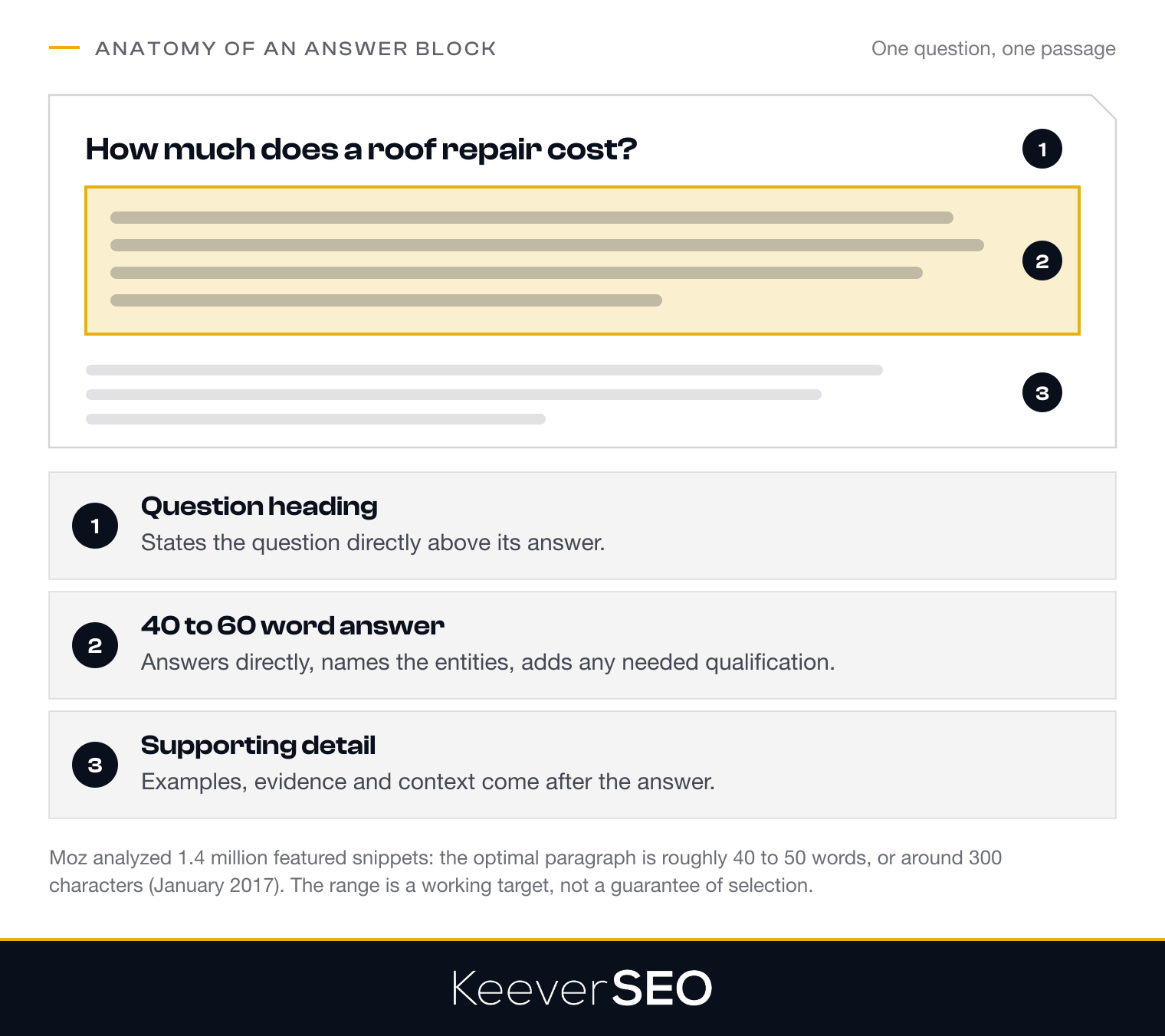
Featured snippet research supports that range: "The optimal length of a featured snippet paragraph is roughly 40 to 50 words, or around 300 characters," according to "What We Learned From Analyzing 1.4 Million Featured Snippets" by A.J. Ghergich, published by Moz in January 2017. Treat 40 to 60 words as a working range, not a guarantee of selection, because accuracy, relevance, and a clear match to the question decide selection too.
2. Front-Load the Answer in the First 100 Words of the Page
Front-loading the answer means stating the page's main response directly beneath the H1, within the first 100 words. A clear opening gives readers and answer engines the central information before background, qualifications, or examples.
For a page about roof repair costs, state the expected price range and the main cost factors first. Supporting details that explain the estimate follow the direct answer.
3. Format Answers for Paragraph, List, and Table Snippets
Answer format should match the search query: a concise paragraph for definitions, a numbered list for steps, and a table for comparisons. Place the answer directly beneath a clear question heading so readers and answer engines connect the response to the query.
Semantic HTML strengthens that structure, with <p> for explanations, <ol> or <ul> for instructions, and <table> for comparisons. Each passage stays self-contained and focused on one answer.
4. Target People Also Ask and Long-Tail Question Keywords
Targeting People Also Ask and long-tail question keywords starts with finding the questions users ask about the page's core topic. Mine Google search results, autocomplete suggestions, keyword tools, customer-service records, and related searches.
Group similar questions by intent, then answer each relevant question beneath its own descriptive H2 or H3 heading. A concise, direct response sits immediately below each heading, and a question that serves a different audience or decision stage gets its own page.
5. Cover Query Fan-Out Sub-Questions on One Page
Query fan-out coverage answers the related questions an answer engine investigates around a user's main query. Google defines query fan-out as "a set of concurrent, related queries generated by the model to request more information and fetch additional relevant search results to address the user's query," according to "Google's Guide to Optimizing for Generative AI Features on Google Search," published by Google Search Central in May 2026.
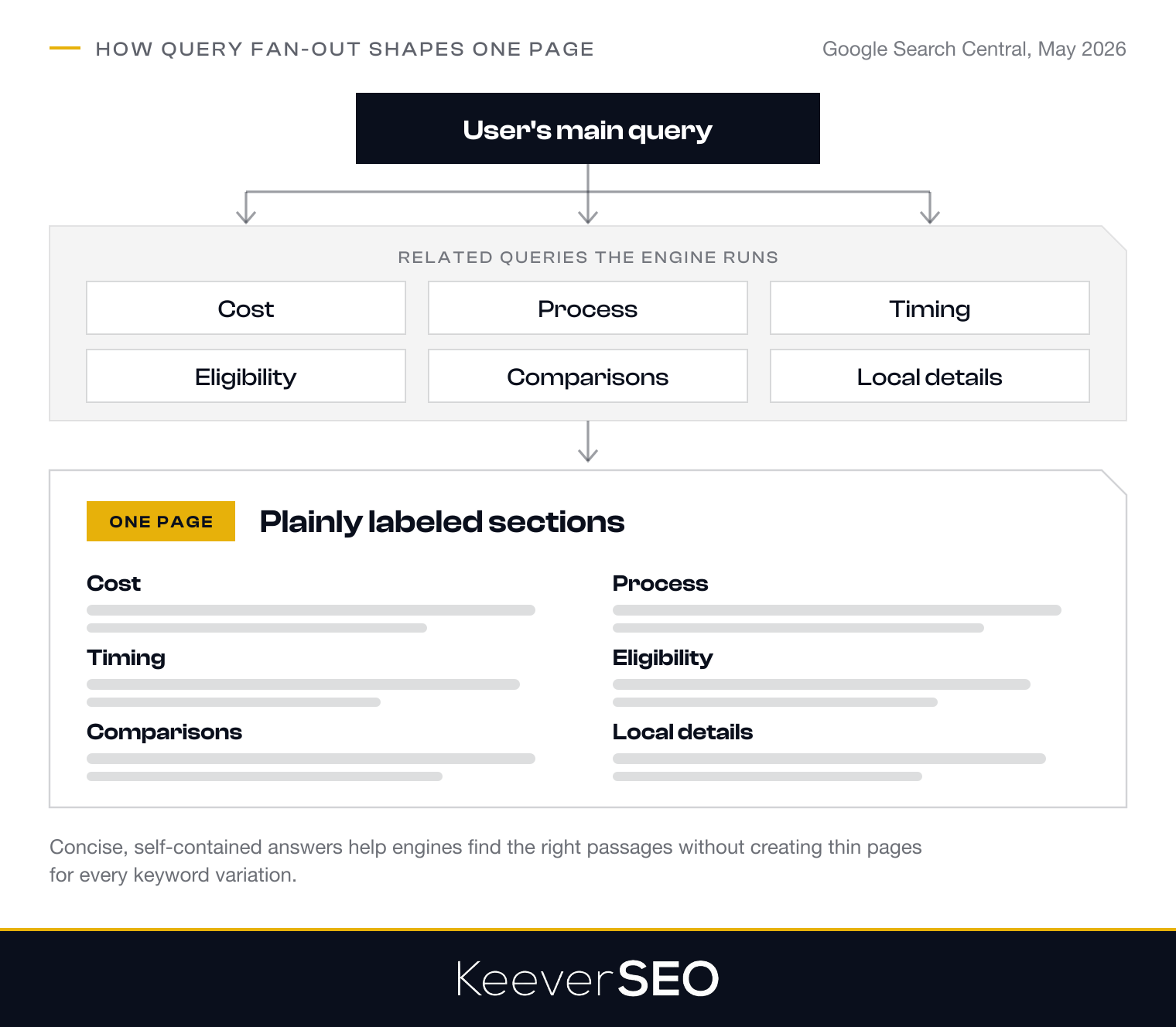
Build one complete page with plainly labeled sections for likely follow-ups, such as cost, process, timing, eligibility, comparisons, and local details. Concise, self-contained answers help answer engines find the right passages without creating thin pages for every keyword variation.
6. Add FAQPage, HowTo, and Organization Schema
FAQPage, HowTo, and Organization schema describe visible questions and answers, genuine instructions, and business details. Add the structured data as JSON-LD, and match every marked-up fact to content readers can see on the page.
Validate JSON-LD with Google's Rich Results Test and correct blocking errors before publishing. Structured data helps search engines interpret page information, but "Google does not guarantee that your structured data will show up in search results, even if your page is marked up correctly," according to Google's "General Structured Data Guidelines." Schema markup does not guarantee an AI citation either.
7. Optimize Answers for Voice and Conversational Queries
Answer engine optimization for voice searches uses natural spoken phrasing, full-sentence question headings, and concise answers. A heading such as "How do I choose a local plumber?" should lead to a brief, self-contained response that an assistant can read aloud.
Open with one or two direct sentences before adding details, examples, or steps. Simple wording and minimal jargon help voice assistants and AI answer engines extract useful passages.
8. Localize Answers for Near Me Voice Searches
Local AEO answers near-me voice searches by naming the services and locations a business serves. Use question headings such as "Who provides emergency plumbing near me in Austin?" and answer with the service, city, availability, and next step.
Add LocalBusiness schema with accurate business details, including service areas, phone number, and hours. Keeping those details consistent across the website and Google Business Profile gives search engines clear local business information.
9. Build Brand Consensus Across Business Profiles and Listings
Brand consensus means presenting the same accurate business identity across Google Business Profile, directories, review sites, and social profiles. Keep the business name, phone number, website, services, hours, categories, and address or service area consistent, and represent the business the way customers know it in the real world, as Google's "Guidelines for representing your business on Google" instruct.
Consistent listings help search and answer engines connect information from different sources to the same organization. Audit profiles for outdated contact details, duplicate listings, incorrect services, and conflicting descriptions, then update high-value profiles first.
10. Add Statistics, Quotes, and Named Sources to Key Passages
Answer engine optimization improves when key passages pair verifiable statistics with concise expert quotes and named sources. Place each attribution beside the claim it supports, and include the statistic's date and context so answer engines extract the evidence accurately.
A 2023 study by Pranjal Aggarwal and colleagues, "GEO: Generative Engine Optimization" (accepted to KDD 2024), found that the Cite Sources, Quotation Addition, and Statistics Addition methods achieved a relative improvement of 30 to 40% in visibility within generative engine responses. The researchers tested the methods on a benchmark of 10,000 queries, and the findings support well-sourced evidence in answer-ready passages.
11. Publish Comparison and Alternatives Pages
Comparison and alternatives pages answer choice-focused searches such as "X vs. Y" and "alternatives to X." Place a comparison table near the beginning, then assess each option with consistent criteria: price, features, integrations, support, weaknesses, and best-fit use cases.
Answer engines extract clear comparisons to answer product and service selection questions. Google's "How To Write Reviews" guidance recommends sharing quantitative measurements, explaining what sets a product apart from competitors, and covering comparable options.
12. Rewrite Old Posts With Answer-First Openers
Rewriting old posts with answer-first openers starts with pages that already earn search impressions, rankings, or relevant traffic. Answer the page's main question in the opening paragraph, place supporting context below the direct answer, and organize details under clear headings with concise, extractable passages.
Verify statistics, links, examples, and service details during each update. Change the visible publication or modified date only after a substantive improvement, since Google's "Creating helpful, reliable, people-first content" asks site owners whether they are "changing the date of pages to make them seem fresh when the content has not substantially changed."
How Were These Answer Engine Optimization Techniques Ranked?
The answer engine optimization techniques were ranked by how often AEO guides recommend them, their potential to raise AI citations, and their effort relative to expected impact. Direct answers, question-led content, schema, and measurement recur across AEO guidance from agencies and software vendors. The ranking favored practical tactics with measurable visibility outcomes over speculative changes. Those ranking factors lead to the criteria below: extraction gain, implementation effort, measurability, and fit with existing pages.
Which Criteria Make an AEO Technique Worth Using?
A useful AEO technique improves answer extraction and fits available resources and existing content. The main criteria for choosing an AEO technique are listed below:
- Extraction gain: Makes an answer easier for engines to identify and cite accurately.
- Effort to apply: Requires reasonable writing, development, or listing-management time.
- Measurability: Supports tracking citations, brand mentions, or AI visibility across consistent prompts.
- Fit with existing pages: Improves relevant pages without requiring an entirely new content system.
Which AEO Technique Challenges Slow Down Results?
AEO technique challenges slow results when teams struggle to measure value, track citations, update pages, or gain leadership support. The main challenges are listed below:
- Unclear attribution and ROI: AI answers can mention a brand without generating a trackable website visit, which makes revenue impact hard to measure.
- Difficulty tracking AI citations: Citation visibility varies across platforms, prompts, languages, and repeated searches.
- Low capacity to retrofit pages: Teams may lack the time or technical resources to revise content, add schema, and verify facts.
- Leadership doubt about visibility without clicks: Leaders may question AEO investment when brand exposure does not produce measurable visits or conversions.
Which AEO Techniques Work Best on Local Service Pages?
The AEO techniques that work best on local service pages are localized "near me" answers, concise answer blocks, LocalBusiness schema, and consistent business listings. Localized content should name the services, cities or neighborhoods served, operating hours, and service area accurately.
Service-page answer blocks answer common customer questions directly. LocalBusiness schema should match visible page details, while the Google Business Profile, directories, review sites, and website share consistent business information. The local techniques clarify relevance but do not guarantee rankings or AI citations.
How Much Time Do AEO Techniques Take to Apply In-House?
Quick on-page AEO edits take about 1 to 3 hours per page. A standard refresh with intent review, supporting answers, internal links, and schema takes about half a day, and a full rewrite can take one to two days.
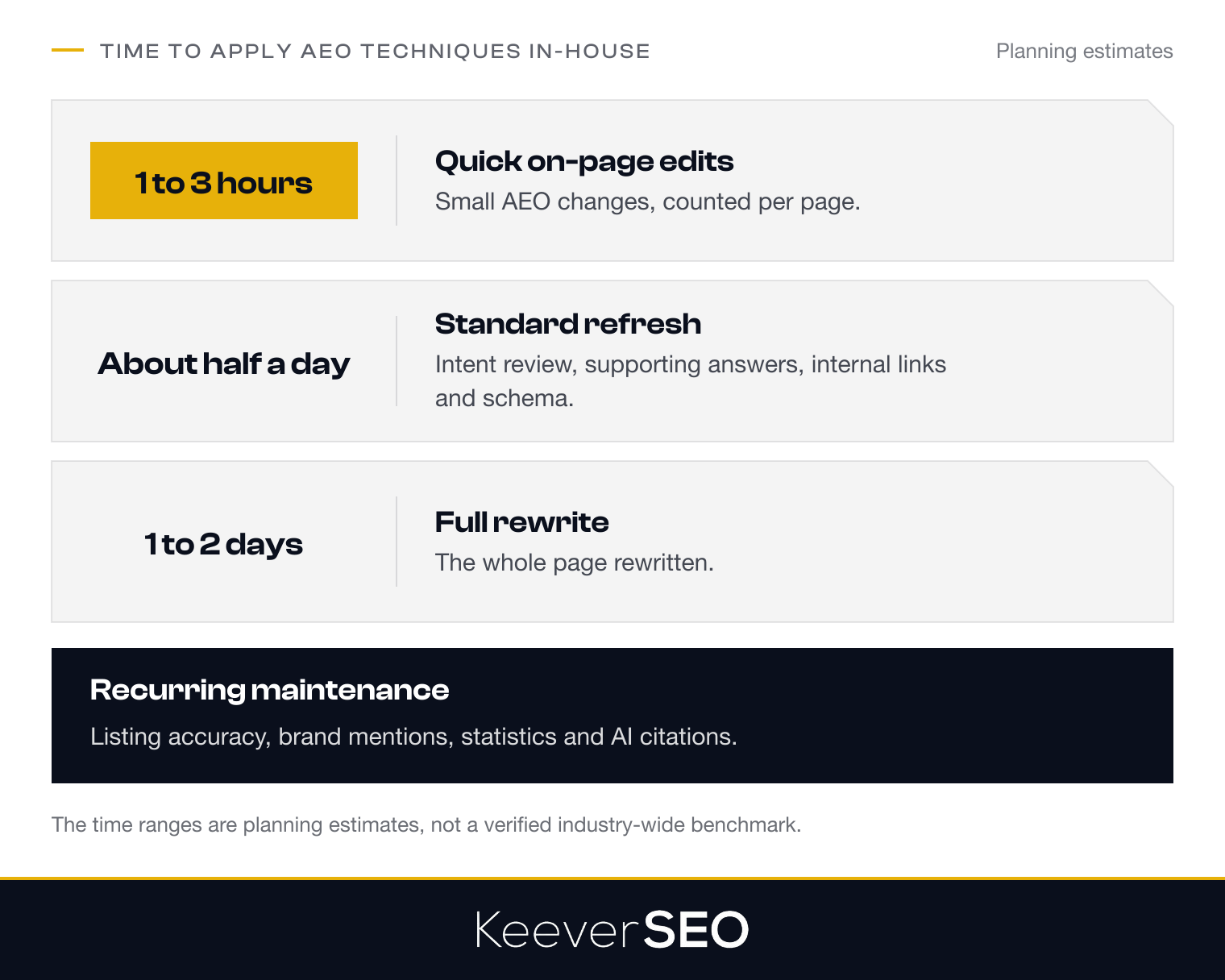
Listing accuracy, brand mentions, statistics, and AI citations need recurring maintenance. The time ranges are planning estimates, not a verified industry-wide benchmark for content update time.
How Does Keever SEO Apply Answer Engine Optimization Techniques to Service Pages?
Keever SEO applies answer engine optimization techniques by auditing AI visibility, mapping customer questions, and restructuring priority service pages. The agency adds direct answer blocks, question-led headings, snippet-ready paragraphs and lists, and relevant JSON-LD schema that matches visible page content.
For local businesses, the AEO-focused SEO agency adds city and service-area details, LocalBusiness schema, and consistent Google Business Profile information. Keever SEO tracks baseline and ongoing brand citations across ChatGPT, Perplexity, Gemini, Copilot, and Google AI Overviews.
How Do AEO Techniques Fit a Wider AEO Strategy?
AEO techniques form the execution layer of a wider answer engine optimization strategy. The strategy audits crawlability, indexability, current visibility, and competing citations before mapping priority questions to suitable pages. Page-level techniques then improve answer structure, schema, and source clarity. Measurement tracks citations, appearing URLs, brand accuracy, and AI-assisted leads or sales to guide further updates.
How Do You Apply These Techniques to Existing Content?
To apply the techniques to existing content, audit each page against its target queries, then rewrite the opening with a direct answer and organize supporting details under question-based headings. Refresh outdated facts, add matching schema and useful internal links, validate the page, and track priority prompts to compare brand mentions, citations, cited URLs, and competitor visibility before and after the update.
Which AEO Tools Show Whether a Technique Worked?
The AEO tools that show whether a technique worked, such as HubSpot AEO Grader, Semrush AI Visibility Toolkit, Profound, and Otterly, track saved prompts and citations before and after content changes. AI visibility platforms monitor brand mentions, citation URLs, citation frequency, answer position, sentiment, and share of voice across AI search engines. Google's Search Console adds a Generative AI performance report for measuring how content performs in Google's generative AI features, according to "Google's Guide to Optimizing for Generative AI Features on Google Search" (Google Search Central, May 2026).
Which Search Features Do AEO Techniques Target?
AEO techniques target featured snippets, People Also Ask questions, and FAQ-style question-and-answer content. Featured snippets display a concise passage from a relevant webpage, while People Also Ask expands visibility through related questions and answers. FAQ rich results no longer appear in Google, so FAQ-style content now earns visibility through snippets, People Also Ask, and AI answers rather than a dedicated rich result.
How Do Featured Snippets Select an Answer?
Featured snippets select an answer by pulling one concise passage, list, or table from a page that ranks for the query and matches its intent. Clear, relevant formatting helps Google identify a useful passage, but no markup or submission guarantees a featured snippet, as Google's "Featured Snippets and Your Website" documentation explains.
How Does People Also Ask Expand Answer Visibility?
People Also Ask expands answer visibility by showing related questions and concise answers from multiple webpages in Google results. Opening a question reveals further questions, which gives pages with clear answers to related subtopics additional chances to appear.
How Does FAQ Schema Markup Support Answer Extraction?
FAQ schema markup supports answer extraction by labeling visible question-and-answer pairs in machine-readable structured data. Google stopped showing the FAQ rich result on May 7, 2026, according to the "Deprecating the FAQ rich result feature" entry in Google Search Central's documentation updates, so FAQPage markup no longer earns a Google rich result. FAQ markup still describes question-and-answer content for other search engines and AI systems that read schema.
Which Answer Engine Optimization Technique Should You Apply First?
The answer engine optimization technique to apply first is a concise answer block under each question heading. Each block answers the question directly in about 40 to 60 words, then provides the relevant supporting detail.
Answer blocks are quick to add to service pages, guides, and FAQs. Clear, self-contained passages give answer engines extractable content and lay a practical foundation for the full set of best answer engine optimization techniques.