Answer engine optimization (AEO) is the practice of structuring content so AI systems and search engines can extract it as a direct answer and cite the brand behind it. In marketing, AEO stands for answer engine optimization, and unlike traditional SEO, which targets ranked organic links and clicks, AEO focuses on extracted answers and citations. Answer engines retrieve passages from indexed sources and assess relevance, clarity, authority, consistency, and freshness when selecting brands to cite.
AEO targets Google AI Overviews and AI Mode, ChatGPT Search, Perplexity, and voice assistants that use featured snippets. As more searches end without a website visit, AEO supports visibility through answer-first content, schema markup, pages accessible to crawlers, and credible brand mentions.
AEO success requires tracking citations, brand mentions, AI share of voice, sentiment, and referral traffic, because rankings and clicks do not show the full picture. Local service businesses can invest when AI answers omit their core services or cite competitors, and an agency can support audits, content, technical work, and citation monitoring. The wider AEO field covers strategies, techniques, tools, comparisons with GEO and SEO, and emerging search trends, all returning to the same goal: helping answer engines extract and cite a brand's content.
What Is Answer Engine Optimization (AEO)?
Answer engine optimization (AEO) is the practice of structuring content so AI systems and search engines can extract it as a direct answer and cite the brand that published it. AEO helps a brand appear in answers generated for questions about its products, services, or field of knowledge.
Answer engine optimization targets Google AI Overviews and AI Mode, ChatGPT Search, Perplexity, and voice assistants that use featured snippets. Unlike traditional SEO, which focuses on ranking pages in search results, AEO focuses on earning citations within generated answers.
What Does AEO Stand For in Marketing?
AEO stands for Answer Engine Optimization in marketing, the practice of making content easier for AI-powered search engines to extract and cite. The acronym has unrelated meanings in other fields, but digital marketing uses AEO to describe optimization for answer-driven search.
How Does AEO Differ From SEO?
AEO differs from SEO because answer engine optimization structures content for extraction into AI-generated answers and brand citations, while search engine optimization (SEO) targets organic rankings and clicks. AEO favors direct answers, clear passages, and machine-readable content, and SEO focuses on ranking signals that help pages appear in search listings. The two disciplines overlap because answer engines retrieve information from accessible, authoritative pages. Answer engines then use the retrieved passages from selected sources to construct and cite an answer.
How Does Answer Engine Optimization Work?
Answer engine optimization works by preparing website content and technical signals so AI search systems can find, interpret, and cite a brand's information. Clear answers, accessible pages, structured data, and consistent brand information help answer engines assess content as a useful source.
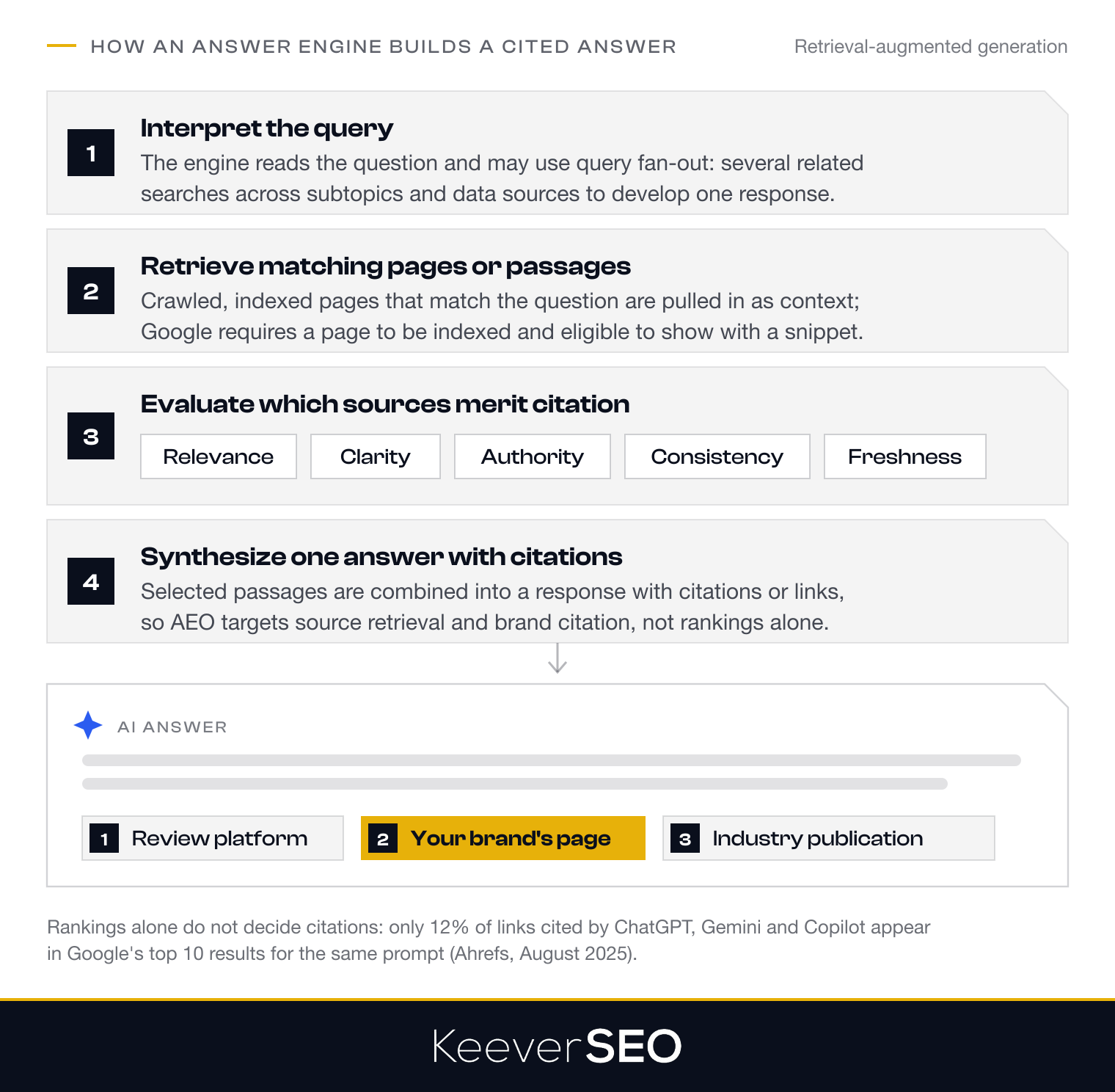
Answer engines interpret a query, retrieve relevant pages or passages, and evaluate their relevance and reliability. Answer engines then synthesize the selected sources into a response with citations or links, so AEO targets both source retrieval and brand citation rather than rankings alone.
How Do Answer Engines Retrieve Sources for an Answer?
Answer engines retrieve sources for an answer by crawling and indexing accessible web pages, then pulling the pages or passages that match a user's question. "To be eligible to be shown as a supporting link in AI Overviews or AI Mode, a page must be indexed and eligible to be shown in Google Search with a snippet," according to Google's "AI features and your website."
The answer engine uses the retrieved passages as context for generating a response, grounding claims in source material rather than relying only on the model's stored knowledge. Google describes the technique as retrieval-augmented generation, which relies on "core Search ranking systems to retrieve relevant, up-to-date web pages," in "Google's Guide to Optimizing for Generative AI Features on Google Search" (Google Search Central, May 2026). After retrieval, the answer engine evaluates which sources and brands merit citation.
How Do Answer Engines Choose Which Brands to Cite?
Answer engines choose which brands to cite by favoring credible sources, clear brand identities, consistent information, and current content. ChatGPT Search attaches citations to retrieved web sources, and AI answers present brands based on brand association, mention frequency, and sentiment across the web.
Rankings alone do not decide AI citations: "only 12% of links cited by ChatGPT, Gemini, and Copilot appear in Google's top 10 results for the same prompt," according to "Only 12% of AI Cited URLs Rank in Google's Top 10 for the Original Prompt" by Louise Linehan, published by Ahrefs in August 2025. Independent coverage establishes a brand's authority beyond its own website, as reviews, industry publications, and comparison pages reinforce consistent details about a brand's services, credentials, and location.
Which Answer Engines Does AEO Target?
The answer engines AEO targets are four types of answer engines and answer surfaces, listed below:
- Google AI Overviews and AI Mode: summarize web information and link to supporting pages.
- ChatGPT Search: answers conversational queries using current web results and citations.
- Perplexity: retrieves web sources and presents cited answers.
- Voice assistants and featured snippets: deliver concise answers on screens or aloud.
Google AI Overviews and AI Mode
Google AI Overviews summarize answers at the top of eligible Search results and link to supporting web pages. Google AI Mode extends the experience with conversational searches, follow-up questions, and links to relevant sources. Both Google AI features "may use a 'query fan-out' technique," issuing multiple related searches across subtopics and data sources to develop a response, according to Google's "AI features and your website." Pages must be indexed and eligible to appear with a snippet to qualify as supporting links in Google's AI features.
ChatGPT Search
ChatGPT Search answers conversational questions using current information retrieved from the web. ChatGPT Search responses include citations and links to relevant sources, which lets users check supporting pages. OpenAI's "Overview of OpenAI Crawlers" identifies OAI-SearchBot as the crawler behind ChatGPT search and states that "sites that are opted out of OAI-SearchBot will not be shown in ChatGPT search answers." AEO helps brands make clear, relevant content easier for ChatGPT Search to retrieve and cite.
Perplexity
Perplexity is an AI-powered search engine that retrieves current web sources and synthesizes them into conversational answers. The Perplexity citation-first format places numbered citations alongside claims, which helps readers verify information against original sources. Perplexity's "Perplexity Crawlers" documentation describes PerplexityBot as "designed to surface and link websites in search results on Perplexity," and unlike a conventional search results page, Perplexity combines information from multiple sources instead of listing links.
Voice Assistants and Featured Snippets
Voice assistants and featured snippets are the original answer surfaces that shaped AEO. Google places a concise webpage extract above or alongside standard search listings when the passage answers a question directly. Voice assistants read one selected answer aloud, especially during mobile searches, instead of presenting a list of links. Clear, self-contained passages give search systems a direct answer to select or cite.
Why Does Answer Engine Optimization Matter?
Answer engine optimization matters because AI-generated answers now resolve a growing share of searches without sending users to websites. "In the first four months of 2026, a whopping 68.01% of Google searches ended without a click," according to "In 2026, Less than One Third of Google Searches Still Send a Click" by Rand Fishkin, published by SparkToro in June 2026. AI answers reach a mass audience, since "AI Overviews now has over 2 billion monthly users across more than 200 countries and territories and 40 languages," Sundar Pichai said in Alphabet's Q2 2025 earnings remarks, published by Google in July 2025.
As zero-click searches grow, brand visibility depends less on website visits alone and more on whether answer engines mention or cite a brand. The shift from clicks to AI answers changes how brands earn visibility in search results.
How Does the Shift From Clicks to AI Answers Affect Brand Visibility?
The shift from clicks to AI answers affects brand visibility by reducing clicks to organic search results, which makes brand mentions inside answers a separate measure of visibility. Pew Research Center found that users who encountered an AI summary clicked a traditional search result in 8% of visits, compared with 15% when no summary appeared, and clicked links inside AI summaries in just 1% of visits, according to "Google users are less likely to click on links when an AI summary appears in the results" by Athena Chapekis and Anna Lieb, July 2025.
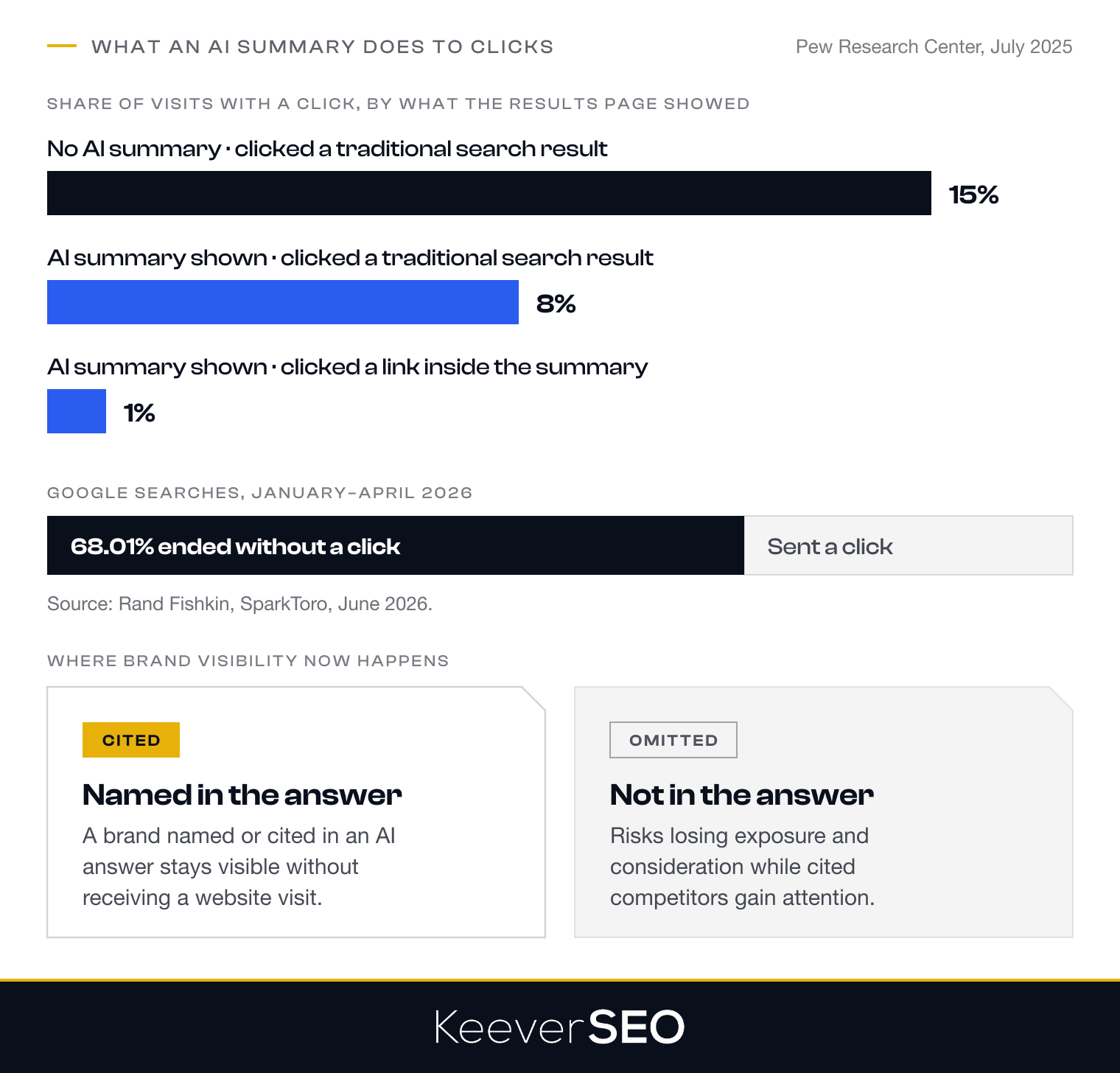
A brand named or cited in an AI answer stays visible without receiving a website visit. A brand omitted from the answer risks losing exposure and consideration while cited competitors gain attention.
What Are the Best Practices for Answer Engine Optimization?
The best practices for answer engine optimization rest on three pillars: clear content, pages accessible to crawlers, and brand authority supported across trusted sources. Structure content around customer questions, provide direct answers, and use concise passages that answer engines can interpret and cite.
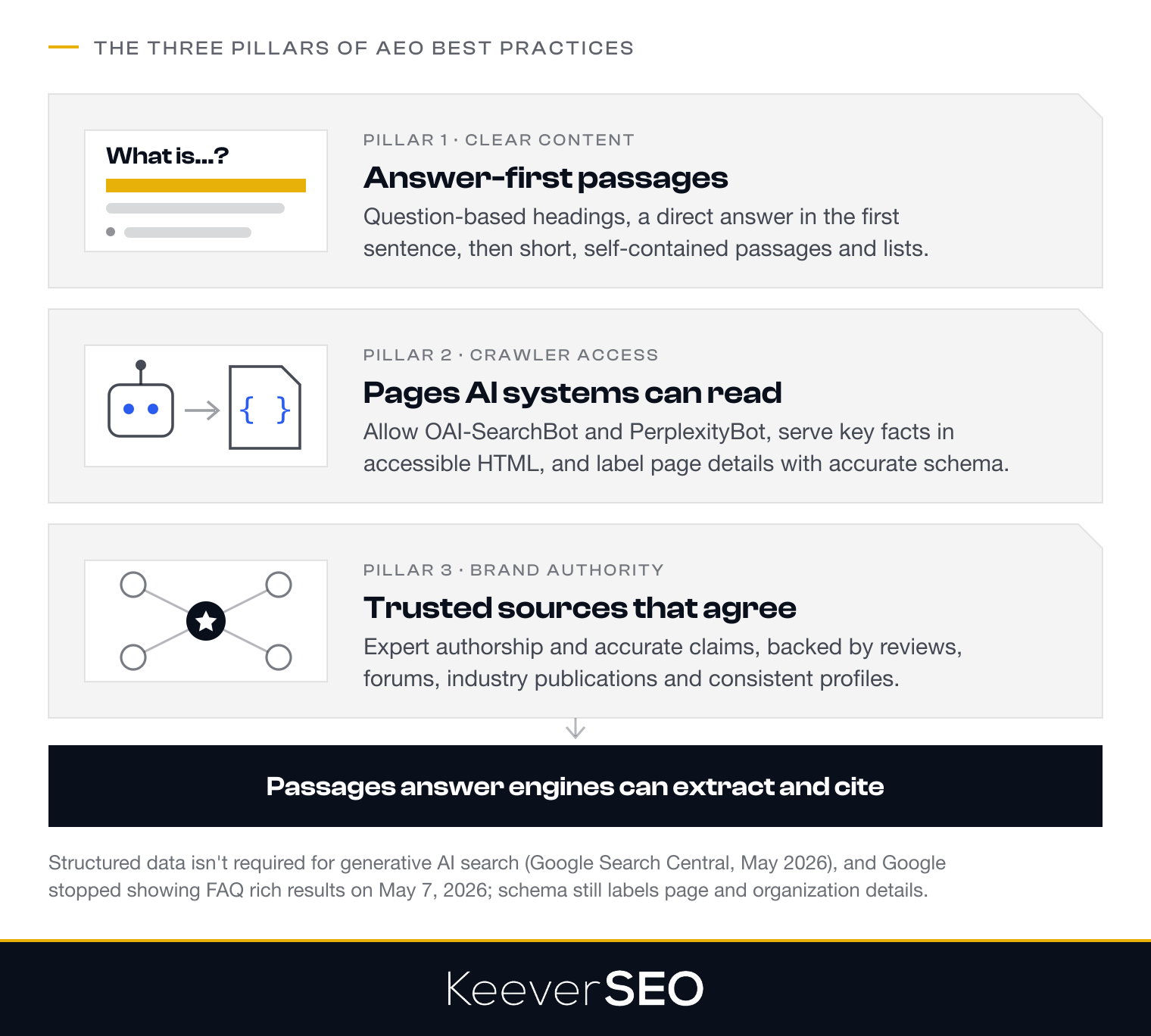
Technical access helps AI systems read page content, while accurate structured data clarifies page and organization details. Build authority through expert information, customer reviews, reputable publications, and consistent brand mentions across the web.
How Should Content Be Structured for Answer Extraction?
Content should be structured for answer extraction with question-based headings that match the queries people ask. Place a direct answer in the first sentence beneath each heading, then add relevant context or examples.
Keep each passage short, self-contained, and clear without surrounding text. Bullet lists group facts and tables organize comparisons, so answer engines can scan and extract information accurately.
How Do Schema Markup and Crawler Access Help AI Read a Page?
Schema markup and crawler access help AI read a page by labeling page topics, content types, and organization details and by letting AI systems retrieve the page at all. FAQPage schema describes question-and-answer content, Article schema identifies editorial pages, and Organization schema clarifies publisher or business information. "Structured data isn't required for generative AI search, and there's no special schema.org markup you need to add," according to "Google's Guide to Optimizing for Generative AI Features on Google Search," published by Google Search Central in May 2026, and Google stopped showing FAQ rich results on May 7, 2026.
Crawler access lets search and AI systems retrieve important pages and resources. Site owners should check robots.txt rules for crawlers such as OAI-SearchBot and PerplexityBot, serve key information in accessible HTML, and avoid placing core content behind JavaScript that crawlers cannot render, following Google's "Understand JavaScript SEO Basics" guidance. The proposed llms.txt file offers a curated map of site content, but llms.txt remains a community proposal, and Google Search ignores llms.txt files.
How Do Authority and Brand Mentions Build Trust With Answer Engines?
Authority and brand mentions build trust with answer engines by showing whether a business is credible, relevant, and consistently represented. Clear expert authorship, firsthand experience, accurate claims, and transparent business details support Google's E-E-A-T principles of experience, expertise, authoritativeness, and trustworthiness, and Google's "Creating helpful, reliable, people-first content" states that "of these aspects, trust is most important."
Third-party platforms dominate AI citations: "Reddit and Wikipedia are still among the top cited domains across the LLMs as of October 2025," according to "The Most-Cited Domains in AI: A 3-Month Study" by Luke Harsel, published by Semrush in November 2025. Reviews, forums, industry publications, comparison pages, and consistent directory profiles strengthen the evidence connecting a business to its services.
How Do You Measure Answer Engine Optimization Success?
To measure answer engine optimization success, track a consistent set of customer prompts across Google AI Overviews, ChatGPT Search, and Perplexity. Record whether each answer mentions or cites your brand or recommends a competitor, and note the cited source, position, sentiment, and date. Repeating the same prompts over time reveals changes more reliably than checking individual responses.
Classic rank reports and organic-click data miss brand visibility inside AI answers, especially when users get answers without visiting websites. Measure citation frequency, share of voice, brand sentiment, and AI referral traffic alongside traditional search performance.
Which AEO Metrics Replace Rankings and Clicks?
The AEO metrics that replace rankings and clicks show how often answer engines cite, mention, describe, and send traffic to a brand. The main AEO metrics are listed below:
- Citation frequency: How often answer engines cite the brand's website or other owned content.
- Share of voice in AI answers: The brand's proportion of mentions or citations compared with competitors.
- Brand mention sentiment: Whether AI answers describe the brand positively, negatively, or neutrally, and whether the description is accurate.
- AI referral traffic: Visits, conversions, and revenue from AI platforms and cited links.
Is Answer Engine Optimization Worth It for Local Service Businesses?
Yes, answer engine optimization is worth it for local service businesses, because customers now ask AI tools for nearby providers, service options, and recommendations. Use of ChatGPT and other generative AI tools for local recommendations rose "from 6% last year to 45%," according to the "Local Consumer Review Survey 2026" by Rosie Murphy, published by BrightLocal in February 2026. AEO builds on local SEO through accurate business profiles, strong reviews, clear service and location pages, and direct answers to "near me" questions.
Local businesses gain more from AEO when they strengthen existing local search information rather than replace it. A business needs outside help when it lacks visibility for important service questions, when competitors appear in AI answers instead, or when its team cannot manage content, structured data, and third-party citations.
When Should a Business Hire an Answer Engine Optimization Agency?
A business should hire an answer engine optimization agency when AI answers omit its core services or cite competitors instead. An AEO agency audits visibility across platforms such as ChatGPT, Perplexity, and Google AI Overviews, then identifies gaps in content, schema, crawl access, and third-party citations.
Outside support pays off when an in-house team lacks the time or skills to manage AEO tasks and track results. Before hiring, request a baseline audit, per-platform reporting, and a clear methodology, because no agency can guarantee placement in AI answers.
How Does Keever SEO's Answer Engine Optimization Service Get Businesses Cited in AI Answers?
Keever SEO's answer engine optimization service gets businesses cited in AI answers by starting with an AI visibility audit across platforms such as ChatGPT, Perplexity, Gemini, and Google AI Overviews. The AI SEO agency audit maps priority customer questions, compares brand citations with competitors, and identifies content, technical, and authority gaps.
Keever SEO then creates answer-first content, implements schema, checks crawler access, and builds citations through relevant publications, directories, forums, and communities. Ongoing share-of-voice reporting tracks brand mentions, citation frequency, sentiment, and AI referral traffic.
Which Answer Engine Optimization Strategies Work Best in 2026?
The answer engine optimization strategies that work best in 2026 combine question mapping, answer-first content, technical accessibility, and credible brand signals. Map high-intent buyer questions across Google AI Overviews, AI Mode, ChatGPT Search, and Perplexity, then create clear pages that answer each question directly. Support the pages with crawlable content, accurate schema, original evidence, and consistent third-party brand mentions. Track citations and brand visibility by prompt, prioritizing questions with strong business relevance and stable answers.
Which AEO Techniques Raise Citation Rates?
The AEO techniques that raise citation rates are answer-first passages, original research, and credible third-party mentions. Clear headings and scannable lists help answer engines identify relevant facts, while named statistics and firsthand data give sources concrete information to attribute. Reviews, expert publications, forums, and industry coverage corroborate a brand's credentials.
How Do You Optimize Content to Appear on Answer Engines?
To optimize content to appear on answer engines, place a clear, direct response to the target question near the beginning of the page. Use question-based headings, concise self-contained passages, and lists or tables to organize supporting facts for extraction.
Which AEO Tools Track AI Visibility?
The AEO tools that track AI visibility are platforms that monitor how a brand appears across prompts in ChatGPT, Gemini, Perplexity, and Google AI search features. AI visibility tools measure citations, brand mentions, answer prominence, sentiment, and share of voice, and identify the pages and third-party sources cited.
How Does Answer Engine Optimization Compare With GEO and SEO?
Answer engine optimization compares with GEO and SEO as overlapping disciplines that stress different outcomes. AEO structures content for extraction as a direct answer and brand citation, while GEO focuses on brand inclusion in AI-generated responses.
Traditional SEO improves crawling, indexing, organic rankings, and clicks. AEO and GEO build on those foundations by improving how answer engines interpret and reference a brand, and the distinction raises two questions: whether AEO differs from GEO, and whether AEO replaces traditional SEO.
Is AEO the Same as Generative Engine Optimization?
AEO is not exactly the same as generative engine optimization, although AEO and GEO overlap substantially and both describe improving a brand's visibility in AI-powered search. AEO stresses earning extracted answers and citations, while GEO stresses inclusion in AI-generated responses.
Does AEO Replace Traditional SEO?
No, answer engine optimization does not replace traditional SEO, because answer engines retrieve information from discoverable, crawlable, and indexed pages. Google states that "optimizing for generative AI search is optimizing for the search experience, and thus still SEO," according to "Google's Guide to Optimizing for Generative AI Features on Google Search" (Google Search Central, May 2026), and AEO builds on SEO foundations by structuring content for extraction and citation in AI answers.
Where Is Answer Engine Optimization Heading Next?
Answer engine optimization is heading toward agentic, multimodal search, where AI systems research questions, compare sources, and help users complete tasks. AI Mode adoption is accelerating: "Since expanding AI Mode globally last October, we've surpassed 1 billion monthly active users," Sundar Pichai said in "Alphabet earnings call Q2 2026: Sundar Pichai remarks," published by Google in July 2026. Google's own guidance now tells site owners to "stay informed about emerging technologies that allow AI agents to interact with your site, such as browser agents and new protocols."
AEO measurement is shifting beyond rankings and website sessions toward citation frequency, source inclusion, brand visibility, and AI referral outcomes. Google Search Console now offers a Generative AI performance report for content in Google's generative AI features, according to "Google's Guide to Optimizing for Generative AI Features on Google Search," while consistent industry-wide measurement standards for other answer engines remain under development.
Why Is Answer Engine Optimization Now Part of Every Search Strategy?
Answer engine optimization is now part of every search strategy because AI-generated answers shape how people find information. Traditional SEO remains the foundation, while brand mentions and citations add visibility beyond rankings and clicks. A complete search strategy combines crawlable pages, direct-answer content, structured data, trusted brand mentions, and measurement across AI search platforms. AEO structures content so search and AI engines extract it as the answer and cite the brand behind it.