An SEO agency improves a business’s visibility in search engines by auditing, optimizing, and marketing its website to bring more organic traffic and leads. As a specialist firm, an SEO agency plans and manages search engine optimization for clients, while a single SEO consultant usually advises on particular SEO needs. What do SEO agencies do? SEO agencies combine technical audits, keyword research, content and on-page optimization, link building, local SEO, and performance reporting. What does an SEO agency do first? An SEO agency usually spends its first 90 days learning the business, auditing its website, setting priorities, and making initial improvements. Monthly agency work can include content planning, technical fixes, local listing management, link acquisition, and reports on rankings, traffic, and leads. Full-service, local, and specialist agencies assign work to strategists, technical SEO specialists, writers, outreach specialists, analysts, and account managers. Businesses hire agencies to build sustained organic visibility, and results vary by business, market, and campaign. For local service businesses, agency work can connect Google Business Profile improvements and service-area content with calls, bookings, and reviews. The sections below explain when to hire an agency, what Keever SEO offers, and how to assess agency selection, benefits, costs, timelines, freelancers, and in-house teams. In short, what does an SEO firm do? An SEO firm coordinates technical, content, and authority work as an ongoing service, which is the core definition of an SEO agency.
What Is an SEO Agency?
An SEO agency is a specialist firm that plans and manages search engine optimization for clients. The work of an SEO agency improves a website’s visibility in unpaid search results through technical updates, keyword research, content optimization, link building, and performance reporting. What is an SEO company? An SEO company is an alternative name for an SEO agency, so the SEO company definition describes a firm that manages the same services for businesses. In the plural, the SEO companies meaning extends to every firm that helps clients earn organic traffic. The question “what is SEO service provider” has a short answer: an SEO service provider delivers SEO work as a managed service. Details about SEO company services usually cover strategy, implementation, and measurement.
How Is an SEO Agency Different From an SEO Consultant?
An SEO agency differs from an SEO consultant in team size, service range, and work delivery. An agency team brings specialists in technical SEO, content, link building, local SEO, and analytics to plan and execute a broader program. What does a SEO consultant do? An SEO consultant usually works independently, diagnosing individual issues and recommending strategy or fixes. Some consultants implement changes, while others guide the client’s internal team; an agency assigns execution across its specialists.
What Does an SEO Agency Do for a Business?
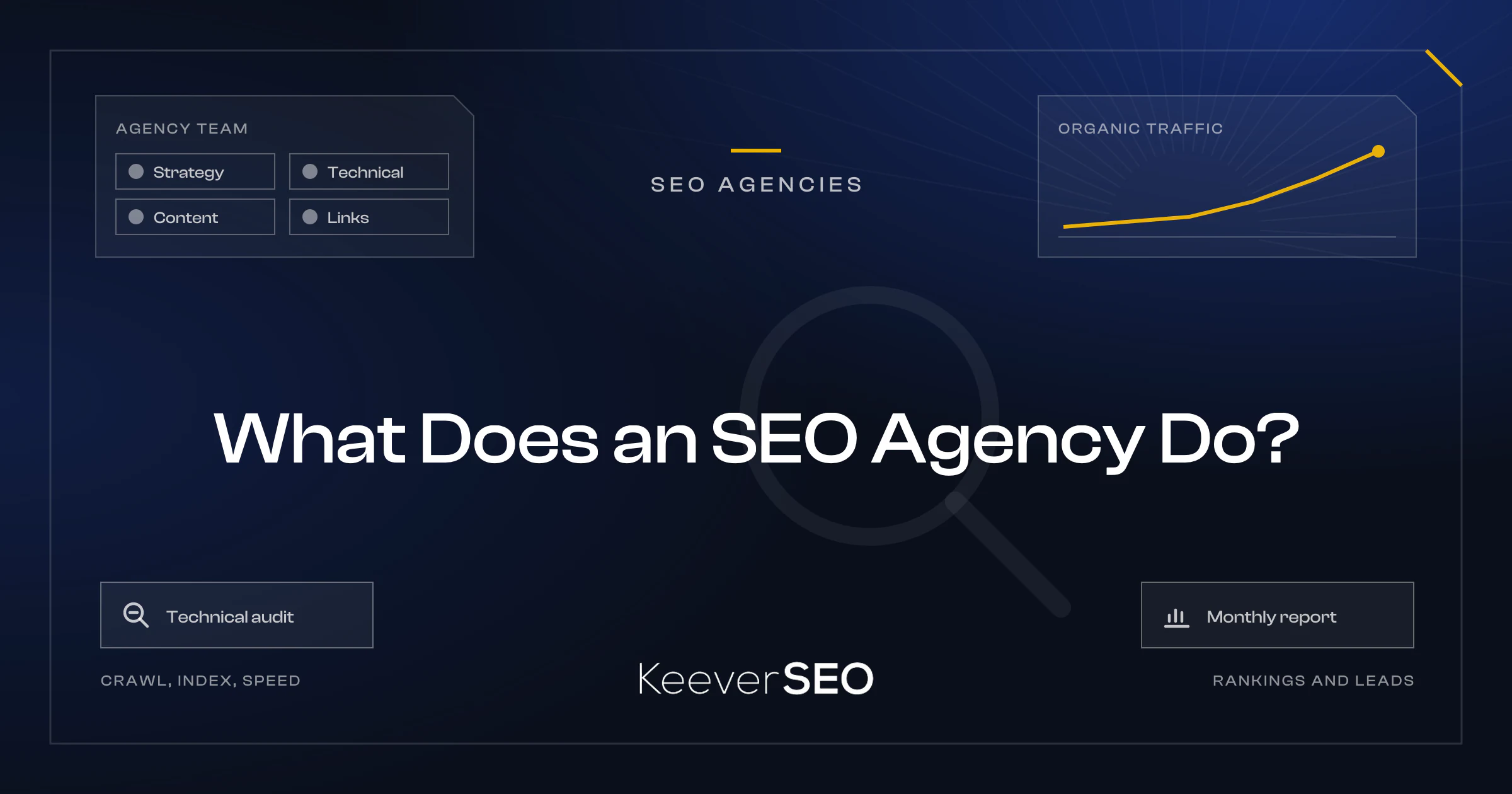
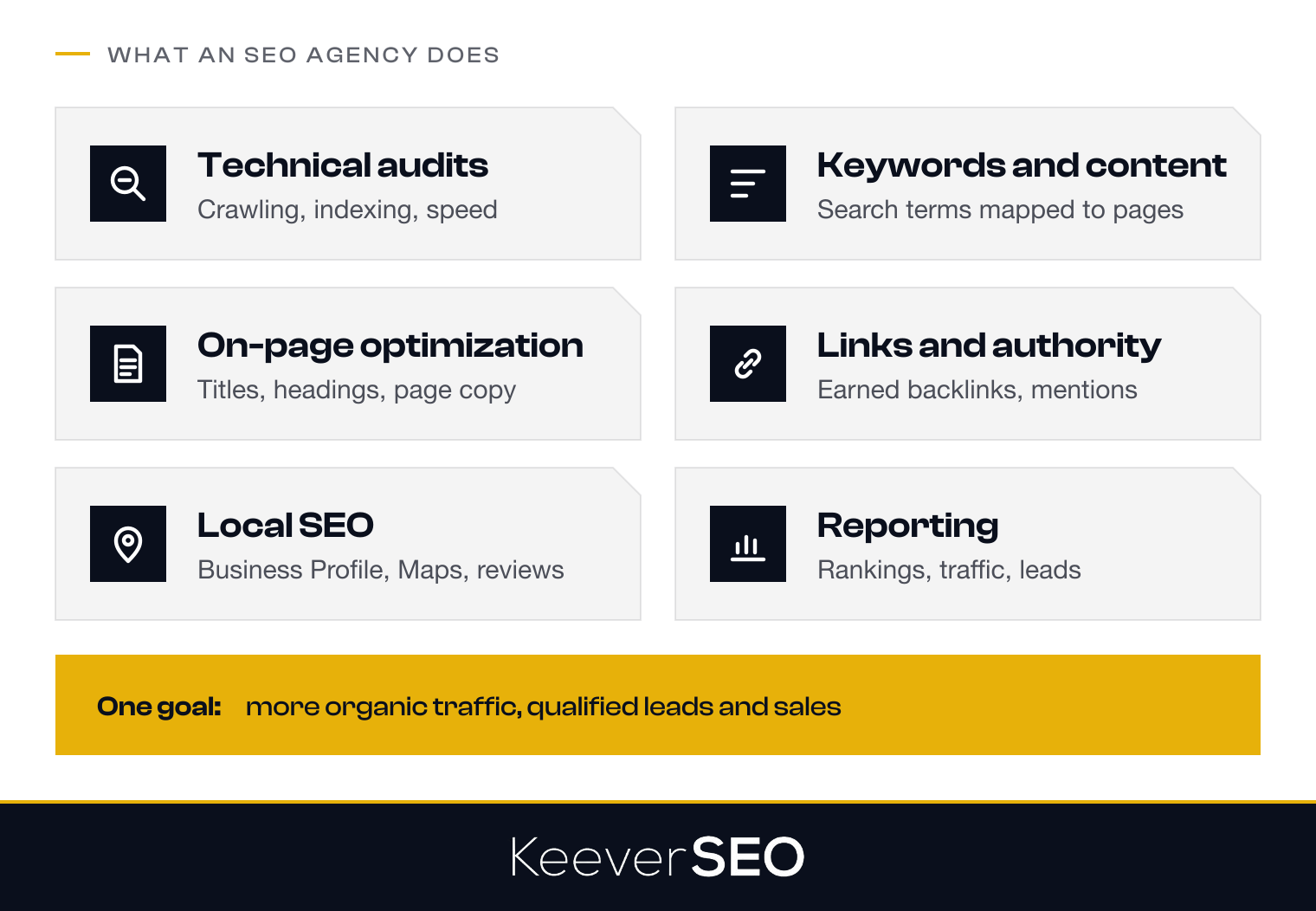
An SEO agency helps a business improve search visibility, attract relevant organic traffic, and generate leads. What do SEO companies do to reach those goals? SEO companies coordinate technical improvements, keyword research, content planning, on-page optimization, link building, local SEO, and performance reporting around business goals, a scope that matches the services listed in "Do you need an SEO?" by Google Search Central, from reviews of site content or structure to keyword research and content development. What does an SEO company do beyond improving rankings? SEO services help search engines crawl and understand a website while making its pages more useful to visitors, which is the short answer to “what do SEO services do.” Agencies measure progress through rankings, organic traffic, and leads, then adjust their work as search performance and business needs change. The six services start with a technical SEO audit, which identifies website issues that can limit crawling, indexing, and search performance.
Running Technical SEO Audits
An SEO agency runs a technical SEO audit to find website problems that limit crawling, indexing, or search visibility. Agency auditors combine crawling software, Google Search Console, server-response checks, and manual reviews to inspect robots.txt rules, XML sitemaps, status codes, redirects, canonical tags, internal links, duplicate pages, and accidental noindex directives. The technical SEO audit evaluates mobile usability, page speed, Core Web Vitals, HTTPS, JavaScript-rendered content, image accessibility, and structured data. Audit findings are ranked by their likely effect on visibility and user experience, and the SEO agency turns them into an action plan; meeting Google’s technical requirements does not guarantee indexing.
Researching Keywords and Planning Content
An SEO agency researches keywords by studying the search terms and questions potential customers use. The keyword research team evaluates each keyword by relevance, search intent, competition, search demand, and business value, using sources such as Google Search Console, competitor pages, customer questions, and sales conversations. Priority keywords are mapped to existing pages or new content, including service pages, product pages, comparison guides, and educational articles. A content plan connects related topics through internal links and uses natural language to answer searchers’ needs rather than repeating keywords unnaturally.
Optimizing On-Page Elements
An SEO agency improves on-page factors by aligning each page’s content and HTML with search intent. Agency specialists refine title tags, meta descriptions, headings, URLs, and page copy so visitors and search engines can understand the page’s subject. On-page SEO work can strengthen internal links with descriptive anchor text, add useful alternative text to images, and improve content structure and readability. On-page updates help search engines interpret related pages and help visitors find relevant information.
Building Links and Off-Page Authority
An SEO agency builds links and off-page authority by earning backlinks and brand mentions from relevant, reputable websites. Agencies use useful content, digital PR, expert contributions, partnerships, and legitimate outreach to help strengthen a business’s reputation and support its search visibility. Natural anchor text gives readers and search engines context about linked pages. A responsible link-building strategy prioritizes relevance and credibility over link volume. Agencies monitor new and lost backlinks, referring domains, and target pages, while avoiding paid link schemes and other manipulative practices; Google Search Central classifies buying or selling links for ranking purposes as link spam in "Spam policies for Google web search."
Managing Local SEO and Google Business Profiles
An SEO agency manages local SEO to help nearby customers find a business in Google Search and Maps. The local SEO team updates the Google Business Profile with accurate business categories, services, hours, contact details, photos, and service areas, then checks that business information matches across the website and online directories. Local SEO work includes targeting service-and-location keywords, improving relevant website pages, and managing a compliant process for requesting and responding to genuine customer reviews. Agency reports track local rankings, profile interactions, calls, form submissions, and bookings; accurate profile details and positive reviews can support local visibility, but "There's no way to request or pay for a better local ranking on Google," according to "Tips to improve your local ranking on Google" by Google Business Profile Help.
Reporting Rankings and Leads
An SEO agency reports keyword rankings, organic traffic, and leads to show how search visibility supports business results. Agency reports commonly track impressions, clicks, click-through rate, average position, landing pages, and changes over time, the same metrics that Search Console Help defines in "What are impressions, position, and clicks?", with click-through rate calculated as clicks divided by impressions. Lead reports connect organic visits to measurable actions, such as form submissions, calls, bookings, and purchases. Agency analysts use analytics, call tracking, and CRM records to assess lead quality and explain progress, changes, and planned work.
How Does an SEO Agency Work With a Client?
An SEO agency works with a client through onboarding, strategy, implementation, and regular reporting. During onboarding, the agency team learns the business goals, target customers, priority services, and competitors. The client provides access to Google Search Console, analytics, the website, and, when relevant, its Google Business Profile. Agency strategists review the website and establish baseline measures for organic traffic, rankings, leads, backlinks, and technical health. The SEO agency then builds a prioritized plan for technical fixes, keyword targeting, content, on-page improvements, and link building. The client and agency agree on responsibilities, approval steps, communication, and performance measures. Each month, the SEO agency reviews results, completes approved work, checks tracking, and sets new priorities. Monthly reports describe completed tasks, traffic and ranking changes, leads, technical progress, and planned work. The first three months establish the baseline, address priority issues, and begin the SEO strategy.
What Happens in the First 90 Days With an SEO Agency?
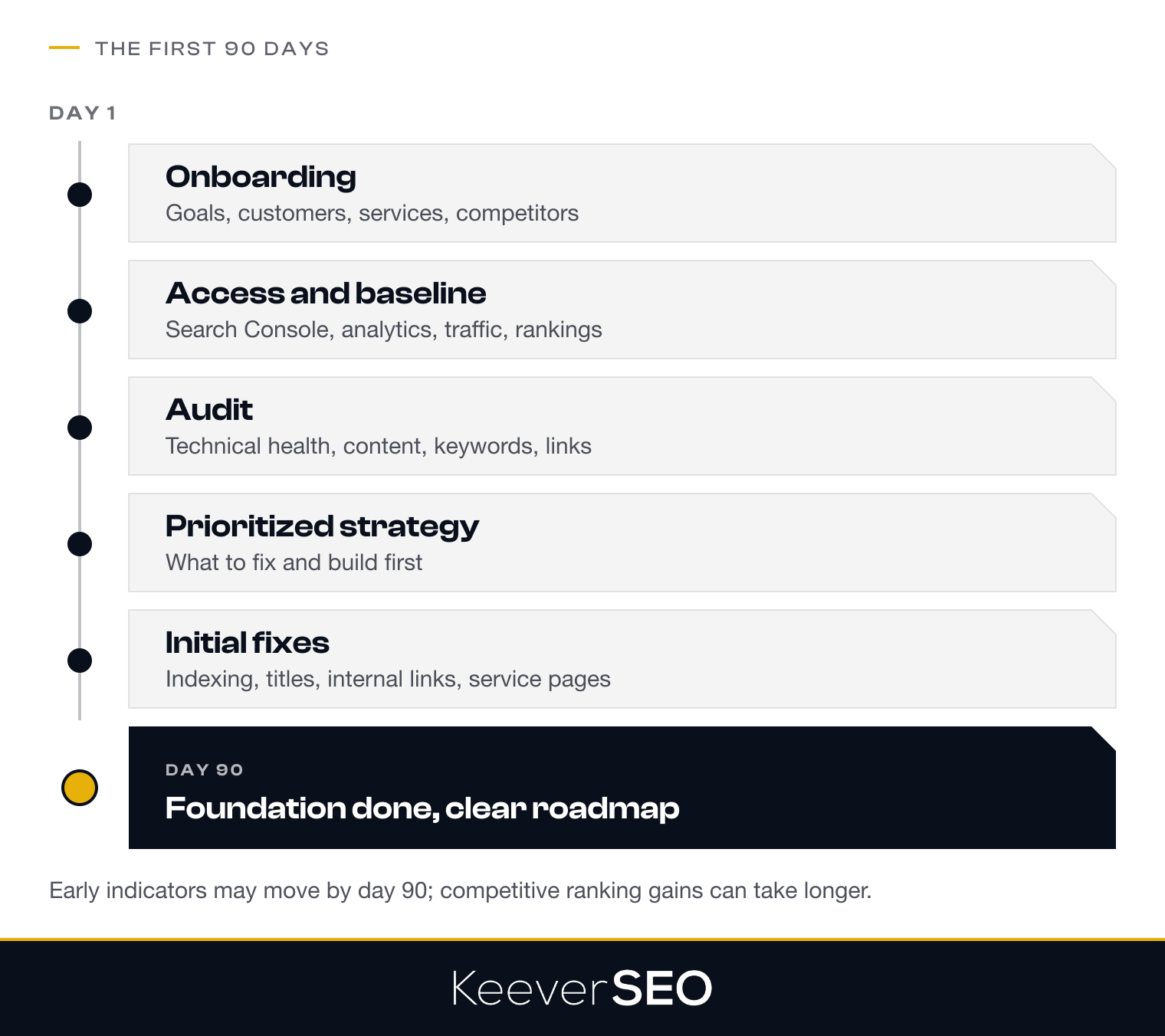
The first 90 days with an SEO agency establish the foundation for long-term search growth. During onboarding, the agency team learns about the business, customers, services, locations, competitors, and lead goals. Agency staff secure access to the website, analytics, and Google Search Console, then record baseline traffic, rankings, impressions, and conversions. The SEO agency then audits technical health, website content, keywords, competitors, and backlinks before building a prioritized strategy. Initial fixes may address indexing errors, redirects, page titles, internal links, mobile performance, and priority service pages. At day 90, the client should have completed foundational work and a clear roadmap; early indicators may improve, while competitive ranking gains can take longer.
Which Deliverables Does an SEO Agency Send Each Month?
An SEO agency sends monthly deliverables that document completed work, search performance, and upcoming priorities. The monthly SEO deliverables, the practical answer to “what does SEO services include,” are listed below:
- Performance report: Organic clicks, impressions, keyword rankings, traffic, leads, and conversions.
- Completed work summary: Technical fixes, on-page updates, and internal-link changes, with links to affected pages.
- Content and link updates: New or refreshed pages, target topics, and backlinks or mentions earned through outreach.
- Next-month plan: Prioritized SEO tasks, unresolved issues, and planned content or optimization work.
What Types of SEO Agencies Are There?
The types of SEO agencies are full-service SEO agencies, local SEO agencies, and specialist SEO agencies. Full-service agencies manage a broad range of SEO services, local agencies focus on visibility in defined geographic areas, and specialist agencies concentrate on a particular industry or SEO discipline. The right agency type depends on a business’s goals, audience, and internal capabilities. Full-service SEO agencies offer the broadest range of support, beginning with technical, content, and authority-building work under one engagement.
Full-Service SEO Agencies
A full-service SEO agency manages multiple search engine optimization services under one coordinated strategy. Full-service SEO services can include technical audits and fixes, keyword research, content planning and creation, on-page optimization, internal linking, local SEO, link building, digital PR, analytics, and performance reporting. Full-service specialists coordinate technical, content, and authority-building work, then measure progress through rankings, organic traffic, qualified leads, and conversions. The full-service model suits businesses that want broad SEO support without coordinating several vendors or maintaining an in-house team.
Local SEO Agencies
A local SEO agency improves a business’s visibility in location-based searches on Google Search and Google Maps. Local SEO agencies support businesses with physical locations or defined service areas by optimizing local keywords and managing Google Business Profiles. Local SEO work can include correcting business details, selecting relevant categories, adding services and photos, and updating hours and service areas. Local agencies may manage citations and reviews, build local links, and create city or service-area pages that help nearby customers find and contact a business.
Specialist SEO Agencies
A specialist SEO agency focuses on a single SEO discipline, industry, audience, or website platform. Technical SEO agencies improve crawling, indexing, site speed, architecture, and structured data, while e-commerce SEO agencies optimize product pages, category pages, filters, and product schema for platforms such as Shopify and Magento. Businesses hire specialist SEO agencies for defined challenges that require focused skills, such as enterprise SEO, international SEO, JavaScript-heavy websites, or content for a niche industry. A specialist agency provides a customized strategy, but its narrower services may require coordination with an in-house team or other providers.
Who Works Inside an SEO Agency?
An SEO agency assigns campaign work to specialists in strategy, technical optimization, content, links, and reporting. Smaller firms combine roles, while larger agencies usually assign each function to a dedicated team member, and the main roles inside an SEO agency are listed below:
- SEO strategist: What does an SEO strategist do? An SEO strategist sets campaign priorities, selects target keywords, and aligns SEO work with business goals.
- SEO expert: What does an SEO expert do? An SEO expert carries out search optimization, such as improving page content, titles, metadata, and internal links.
- Technical SEO specialist: A technical SEO specialist resolves crawl, indexing, site speed, mobile usability, and structured data issues.
- Content writer or editor: A content writer creates and improves pages based on keyword research, content briefs, and search intent.
- Link-building specialist: A link-building specialist researches outreach opportunities and earns relevant backlinks from reputable websites.
- SEO analyst: An SEO analyst monitors rankings, organic traffic, conversions, and technical performance, then reports findings.
- Local SEO specialist: A local SEO specialist improves local search visibility through business listings, Google Business Profiles, and location-focused keywords.
- SEO account manager: What does an SEO account manager do? An SEO account manager coordinates the agency team, manages client communication, and explains campaign progress.
Why Is an SEO Agency Important for a Business?
An SEO agency is important for a business because organic search connects the business with customers who search online for its products or services. A 2019 BrightEdge Research study, "Organic Share of Traffic Increases to 53%," found that organic search drives 53% of all trackable website traffic, up from 51% in 2014, which shows why search visibility can support a business’s marketing reach. SEO agency services combine technical improvements, keyword research, useful content, local search optimization, and link building. Ongoing agency work helps a business address search changes, attract qualified visitors, and measure whether organic traffic produces leads and sales.
What Are Examples of SEO Agency Work?
Examples of SEO agency work include measurable outcomes and concrete website improvements. Published agency case studies report gains in organic traffic and leads, but results vary by business and campaign. An SEO agency might find crawl errors, research customer search terms, and build a plan for service pages. Agency specialists can then improve title tags and headings, resolve slow-loading pages, earn relevant backlinks, and track changes in organic visits, calls, and form submissions.
What Does an SEO Agency Do for Local Service Businesses?
An SEO agency helps local service businesses appear when nearby customers search for services such as plumbing, electrical work, or cleaning. Agency work on the Google Business Profile covers accurate categories, contact details, hours, services, photos, and service areas. Local SEO agencies create useful service-area pages, support requests for genuine customer reviews, and help businesses respond to feedback. Call and booking tracking connects local search visibility with phone inquiries, appointment requests, and other leads.
When Should a Business Hire an SEO Agency?
A business should hire an SEO agency when organic search can generate qualified leads or sales, but its team lacks the time or skills to manage SEO consistently. Stagnant rankings, declining organic traffic, unresolved technical issues, inconsistent content, or stronger competitors can signal a need for outside support. An SEO agency can support a website redesign, market expansion, or new location launch. The business should have a clear offer, a defined audience, conversion tracking, and capacity to implement recommendations because SEO requires sustained work rather than quick results.
What Does Keever SEO Do as an SEO Agency?
As an SEO agency, Keever SEO provides search engine optimization for U.S. local service businesses. Each Keever SEO audit assesses website health, Google Business Profile visibility, keyword gaps, backlinks, and local rankings to set campaign priorities. The Keever SEO team manages local listings, service and location page content, and geographically relevant link building. Monthly Keever SEO reports track organic traffic, rankings, map-pack visibility, calls, form submissions, and other search-generated leads.
What Should You Know Before Hiring an SEO Agency?
Before hiring an SEO agency, you should know your goals, the work included, how the agency measures progress, and who will perform the work. Ask for relevant case studies, a first-90-day plan, reporting details, realistic timelines, and confirmation that your business retains ownership of its website, data, and accounts. A reliable SEO agency explains its pricing, recommendations, and expected results without guaranteeing rankings or promising quick fixes. The questions below cover how to choose an agency, the benefits of hiring one, typical costs, and the time SEO can take to show results.
How Do You Choose the Best SEO Agency?
To choose the best SEO agency, look for relevant industry experience, credible case studies, and a strategy built around your business goals. Compare each agency’s technical skill, communication, pricing, contract terms, monthly deliverables, and reporting on rankings and leads. Ask who will handle the work and how the agency follows search-engine guidelines; avoid providers that guarantee rankings or conceal their methods.
What Are the Benefits of Hiring an SEO Agency?
The benefits of hiring an SEO agency start with access to specialists in technical SEO, content, link building, and analytics. Agency teams provide consistent optimization and performance reporting, while in-house staff focus on core operations and track organic traffic, leads, and conversions.
How Much Does an SEO Agency Cost?
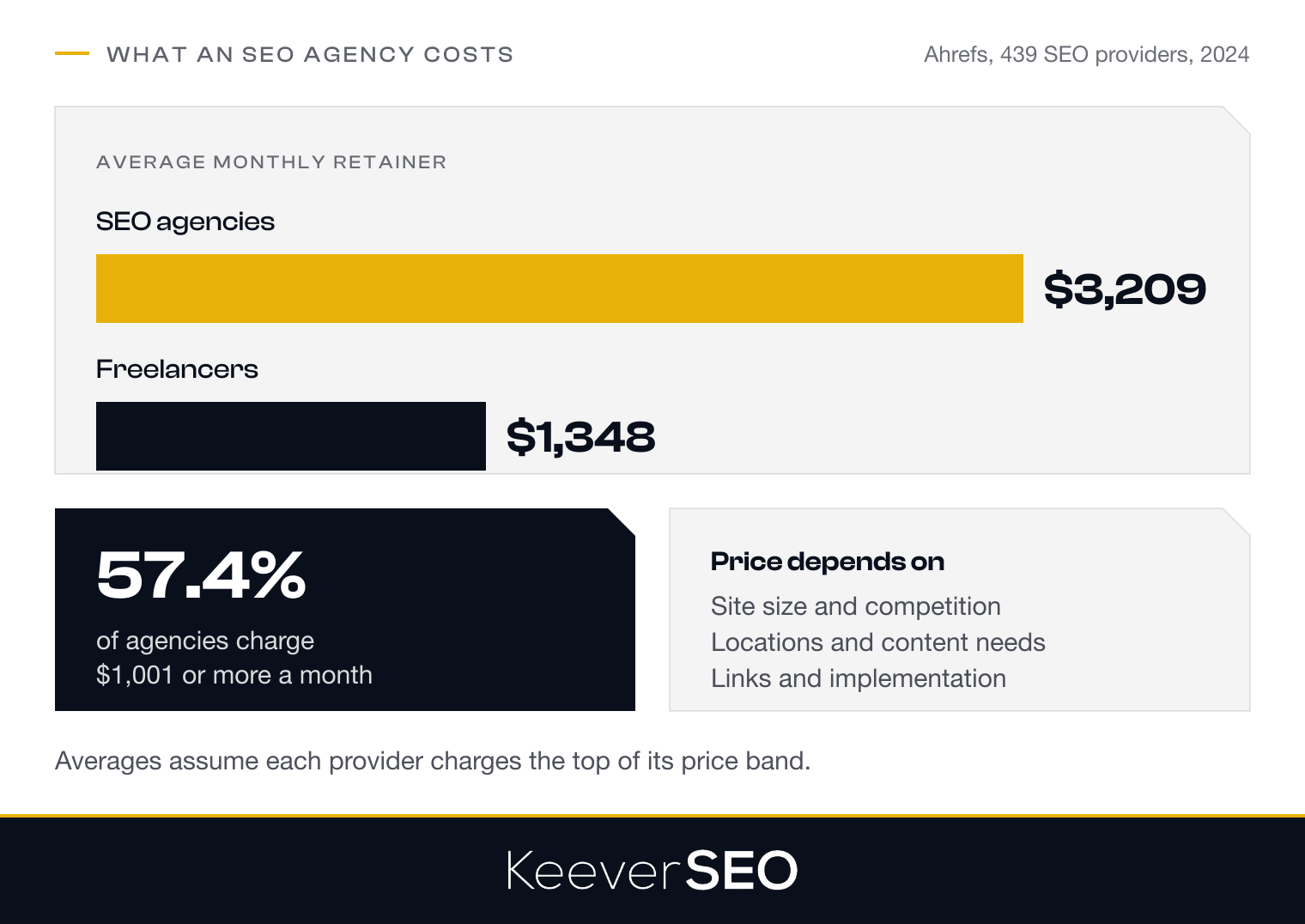
An SEO agency costs from about $500 to several thousand dollars per month: agencies charge $3,209 per month on average, and 57.4% of SEO agencies charge $1,001 or more per month, according to "SEO Pricing: How Much Does SEO Cost? 439 People Polled" by Joshua Hardwick, Ahrefs, August 2024. Monthly pricing depends on website size, market competition, target locations, content and link-building needs, agency experience, and implementation support.
How Long Does an SEO Agency Take to Show Results?
An SEO agency usually takes four to twelve months to show noticeable business results, while early signs such as indexing, impressions, and ranking movement can appear sooner. Google’s Maile Ohye said that "in most cases, SEOs need four months to a year to help your business first implement improvements and then see potential benefit," as reported in "Google: Give SEOs 4-12 Months To See Positive Ranking Benefits" by Barry Schwartz, Search Engine Roundtable, February 2017. Competition, website condition, and campaign scope affect the timeline.
Is an SEO Agency the Right Way to Get SEO Help?
Yes, an SEO agency is the right way to get SEO help for a business that needs ongoing work across technical SEO, content, local search, and link building. The right option depends on the business’s goals, budget, available time, and how complex the website is. A freelancer can handle a focused project, while an in-house team provides dedicated control and closer daily coordination. A business with a simple website can manage basic SEO independently, but self-managed SEO requires time and ongoing learning.
How Does an SEO Agency Compare With a Freelancer?
An SEO agency assigns a team to strategy, technical SEO, content, link building, and reporting, while a freelancer handles the work personally. A 2024 Ahrefs survey of 439 SEO providers found that freelancers charge $1,348 per month on average, compared with $3,209 for agencies. Freelancers offer direct communication, making them a practical fit for focused projects; agencies suit complex campaigns that need broader skills and ongoing capacity.
How Does an SEO Agency Compare With an In-House Team?
An SEO agency provides a business with specialists in technical SEO, content, link building, and analytics without requiring full-time hires. An in-house SEO team offers closer brand knowledge, direct control, and faster coordination, but requires salaries, benefits, tools, and ongoing staff development; Indeed reports an average base salary of $83,004 for an SEO specialist in the United States in "SEO specialist salary in United States," updated November 2026. Many businesses combine both models, using internal staff for priorities and an agency for specialist support or extra capacity.
Can You Do SEO Yourself Without an Agency?
Yes, a business can handle basic SEO without an agency, especially when its website is small and competition is low. Owners can research keywords, improve page titles and navigation, publish useful content, submit a sitemap, and monitor results with Google Search Console. Self-managed SEO requires ongoing time, while complex technical issues and link building usually require specialist support.
What Does a Good SEO Agency Do That a Bad One Does Not?
A good SEO agency builds transparent, sustainable search improvements around a business’s goals. A good agency explains its technical fixes, content strategy, and link-building work, then measures qualified traffic, leads, calls, and revenue. A bad agency may promise guaranteed rankings, hide its methods, or use keyword stuffing and low-quality links, even though "No one can guarantee a #1 ranking on Google," as Google Search Central warns in "Do you need an SEO?" What do SEO companies really do? A reputable SEO company applies search engine guidelines, reports progress in plain terms, and adjusts its strategy as results change. The difference is that a good SEO agency improves visibility through documented, useful work, while a bad one risks the business’s search performance with shortcuts.