To choose the best SEO agency, set your goals and budget, shortlist agencies with proven results in your industry and location, then vet their strategy, reporting, pricing, and contract terms before signing. The best SEO agency is the one whose relevant experience, sound methods, clear communication, and fair terms match your business goals, not the one with the biggest promises. Knowing how to choose the best SEO agency starts before contacting agencies: decide which outcomes, services, locations, budget, and internal resources matter most. The agency comparison then follows nine steps: build a shortlist; check industry and location experience; review case studies; examine strategy; assess technical SEO; check content and link-building methods; confirm reporting; compare pricing and contracts; and score agencies side by side. The hiring questions cover who will manage your account, what the first 90 days will deliver, who owns your content and data, and whether the agency serves direct competitors. Rule out providers that guarantee rankings, hide their methods, use manipulative links, or impose unclear terms; compare local and national agencies, then confirm onboarding, tracking, audits, and reporting after signing. Local businesses should assess Map Pack results and service-area experience, while specialist agencies suit complex industries; Keever SEO may fit businesses that want local SEO, industry experience, transparent reporting, and defined contract terms. The guide then compares agency benefits, costs, timelines, freelancers, and in-house teams. The first section explains what makes an SEO agency the best choice for your business, the starting point for learning how to choose an SEO agency and how to choose the best SEO company.
What Makes an SEO Agency the Best Choice for Your Business?
The best choice of SEO agency for your business is the one that matches its experience, methods, communication, and contract terms to your business goals. Strong agencies explain their strategy in plain terms, use ethical SEO practices, and show verifiable results for businesses with similar needs. Learning how to choose a good SEO company means comparing its case studies, client references, reporting, and proposed scope of work. A suitable SEO partner connects SEO activities to outcomes such as qualified leads, sales, bookings, or revenue, rather than focusing only on rankings or traffic. How to pick a good SEO company comes down to whether the agency's approach fits your goals, budget, and team.
What Should You Decide Before Talking to an SEO Agency?
Before talking to an SEO agency, you should decide your goals, success measures, target market, and available resources.
- Set your business goals: Specify whether SEO should increase qualified leads, sales, bookings, revenue, or visibility.
- Choose success metrics: Select KPIs such as organic conversions, calls, bookings, or revenue, and record current figures as a baseline.
- Define your target market and scope: Identify the services, products, locations, and SEO support your business needs.
- Set your budget and expectations: Establish a spending range, timeline, team responsibilities, and capacity for content or website updates.
With those decisions in place, compare agencies through the nine steps below.
How Do You Choose the Best SEO Agency?
You choose the best SEO agency by comparing providers through nine steps. Build a shortlist, check industry and location experience, review case studies, and assess each agency’s strategy. Then examine technical SEO, content and link-building methods, reporting, pricing, and contract terms before comparing agencies side by side. The same nine steps apply when choosing SEO company support of any size, whether the question is how to pick an SEO company, how to pick an SEO agency, or how to choose an SEO firm for a single location. A business working out how to choose SEO services company options, or how to choose SEO company partners in general, starts with a shortlist of providers that match its goals.
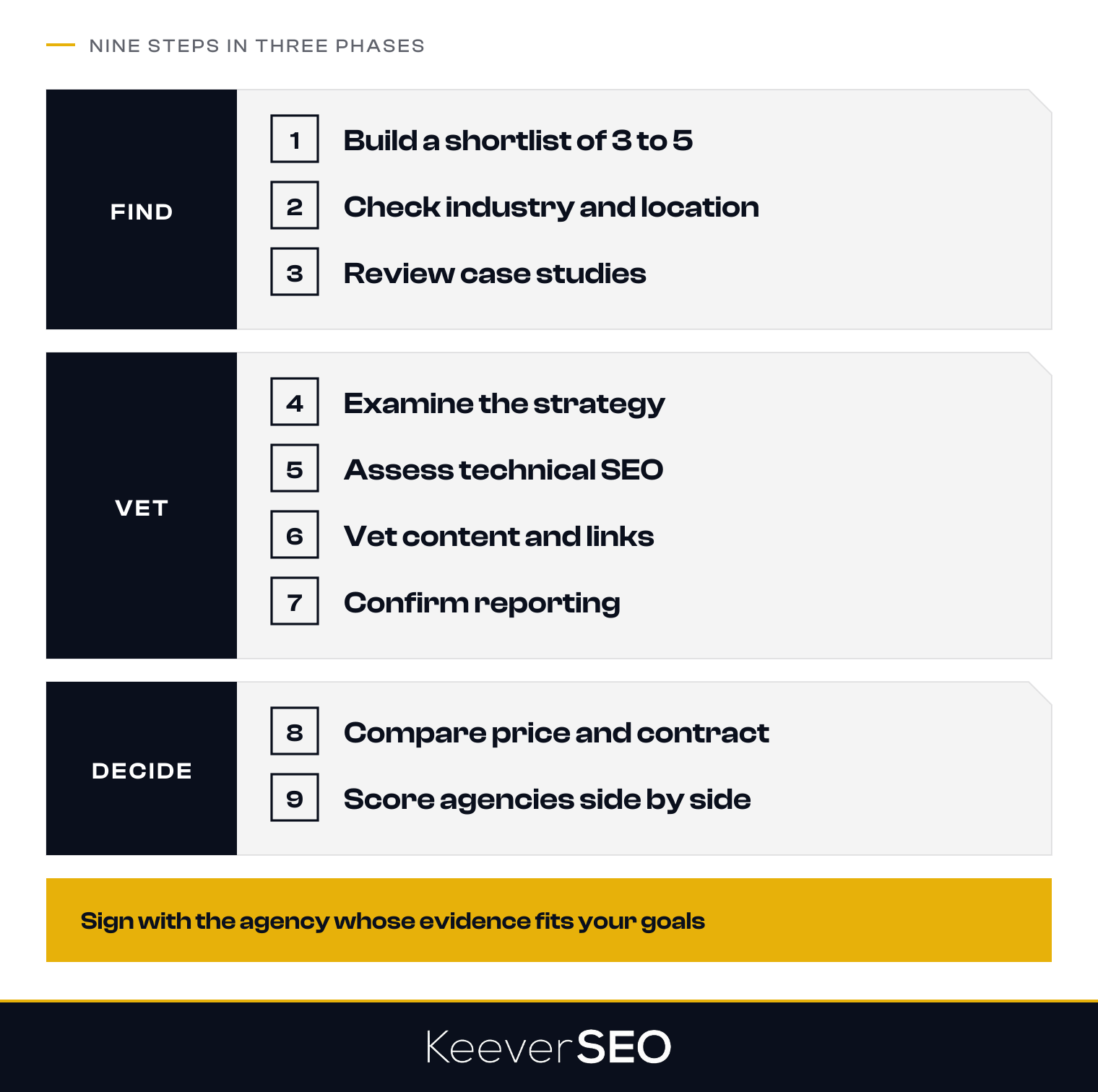
1. Build a Shortlist of SEO Agencies
To build a shortlist of SEO agencies, gather names from referrals, organic search results, and independent review platforms. Ask business owners in your industry or area for recommendations, then search for agencies using terms such as “SEO agency” plus your city or industry. Check detailed reviews on platforms such as Clutch, G2, and Google Business Profiles. Look for consistent client feedback, relevant experience, and thoughtful responses to complaints. A shortlist of three to five agencies keeps the comparison of their work and approach manageable.
2. Check Experience in Your Industry and Location
To check experience in your industry and location, ask whether the SEO agency has worked with clients in your industry and market. Request examples involving similar services, customers, sales cycles, and competitors, then verify the results rather than relying on client logos. For local SEO, request evidence from your city or service area and ask what work produced those results. Relevant local search experience may include Google Business Profile optimization, local landing pages, review management, citations, and locally relevant links. Experience in both your industry and your location shows how to choose an SEO company for your business with confidence.
3. Review Case Studies and Client Results
To review case studies and client results, look for measurable results, clear timelines, and a record of work completed. Strong case studies show starting figures alongside outcomes such as organic traffic, qualified leads, calls, sales, or revenue. Ask whether SEO alone produced the gains or whether redesigns, paid advertising, or seasonal demand contributed. Request references from current or former clients with similar business sizes, industries, markets, and goals. Those client references can describe communication, delivered work, results timelines, and whether improvements lasted.
4. Ask How the Agency Builds Its SEO Strategy
To learn how an agency builds its SEO strategy, ask it to start from an audit of your website and a clear definition of your business goals. Ask the agency to explain how its audit will identify technical issues, content gaps, and backlink concerns, then review its keyword and competitor research. A sound SEO strategy turns audit findings into a prioritized plan, not a generic task list. Ask which actions come first, who will implement them, and how each action supports goals such as qualified leads, bookings, sales, or revenue.
5. Check the Agency's Technical SEO Approach
To check an agency's technical SEO approach, confirm that it audits crawlability, indexation, site structure, page speed, mobile usability, redirects, and structured data. Ask whether the agency will implement site changes or provide developer-ready recommendations for your team. A strong technical SEO approach ranks fixes by expected impact and implementation effort, addressing indexation blockers and major crawl errors first. Confirm how the agency will coordinate with your developer, document approvals and deadlines, and test completed changes.
6. Check the Agency's Content and Link-Building Methods
To check an agency's content and link-building methods, ask who researches, writes, edits, and approves your content. A reliable SEO agency creates accurate, original pages that answer customer questions and support your business goals, following the guidance in "Creating helpful, reliable, people-first content" by Google Search Central. Ask how the agency earns backlinks and request examples of placements or outreach. Avoid agencies that buy links to manipulate rankings, use automated link-building services, operate private blog networks, or publish low-quality guest posts at scale. Google Search Central defines link spam as creating links "primarily for the purpose of manipulating search rankings" and names buying or selling links for ranking purposes and using automated programs or services to create links as examples in "Spam policies for Google web search."
7. Confirm How the Agency Reports Results
To confirm how the agency reports results, ask the SEO agency for monthly reports and a sample report before signing. Each SEO report should explain completed work, changes in organic clicks and impressions, keyword rankings, landing-page performance, leads, calls, sales, and conversion rates. Confirm that the agency connects SEO activity to your business goals and gives you access to Google Search Console, Google Analytics, and relevant CRM or call-tracking data. Direct data access lets you verify results independently and retain your records if the agency relationship ends.
8. Compare Pricing Models and Contract Terms
To compare pricing models and contract terms, match each SEO agency’s price against its written deliverables and contract terms. Monthly retainers suit ongoing SEO work, while project fees suit defined tasks such as an audit or site migration. A 2024 Ahrefs survey of 439 SEO providers, "SEO Pricing: How Much Does SEO Cost? 439 People Polled" by Joshua Hardwick, found that 78.2% charge a monthly retainer and 48.9% offer per-project pricing. Before signing, confirm the fee, deliverables, contract length, renewal terms, notice period, and cancellation fees. Check who owns the website content, analytics data, accounts, tracking setups, and completed work after the contract ends.
9. Compare Your Shortlisted Agencies Side by Side
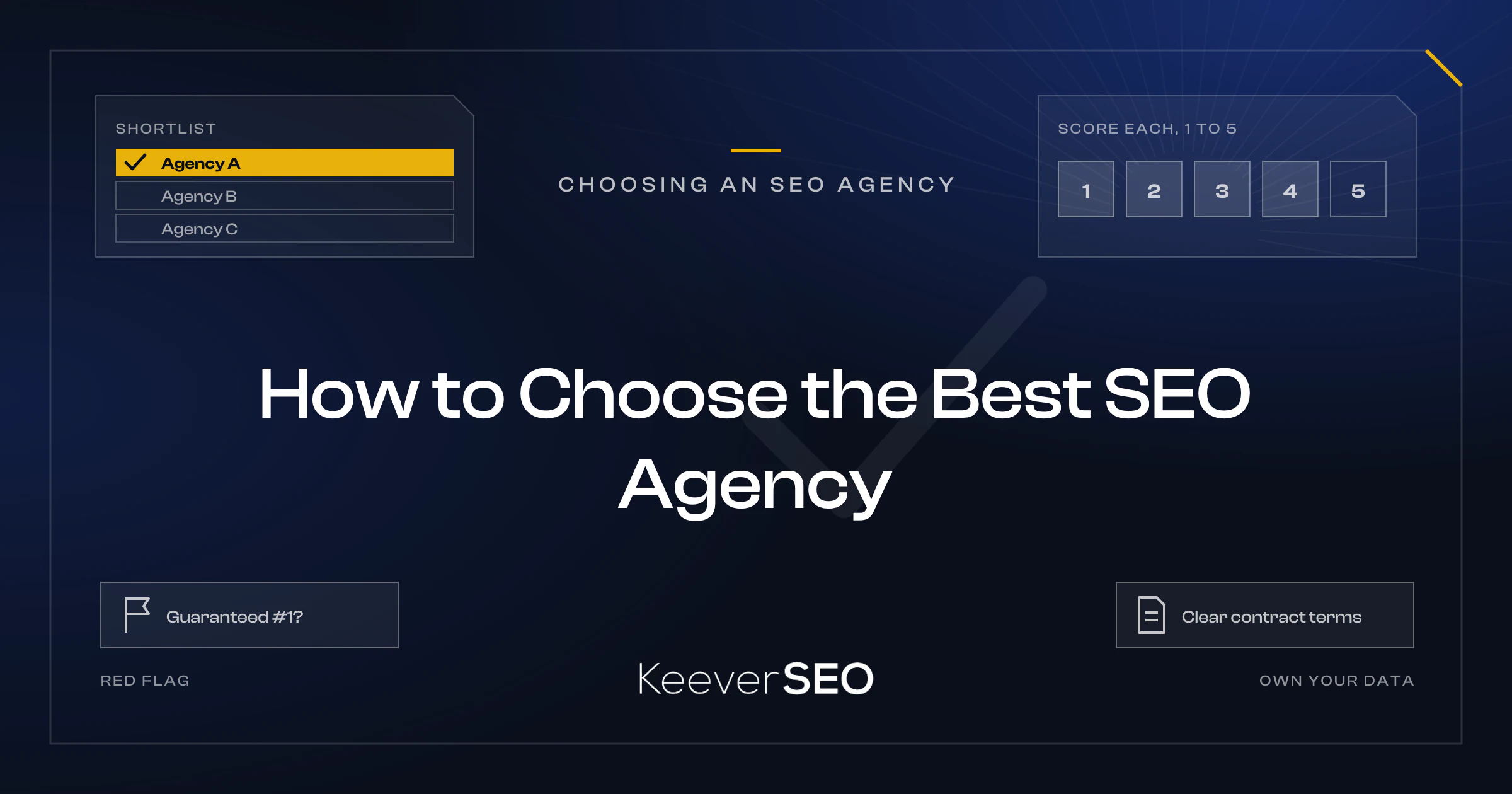
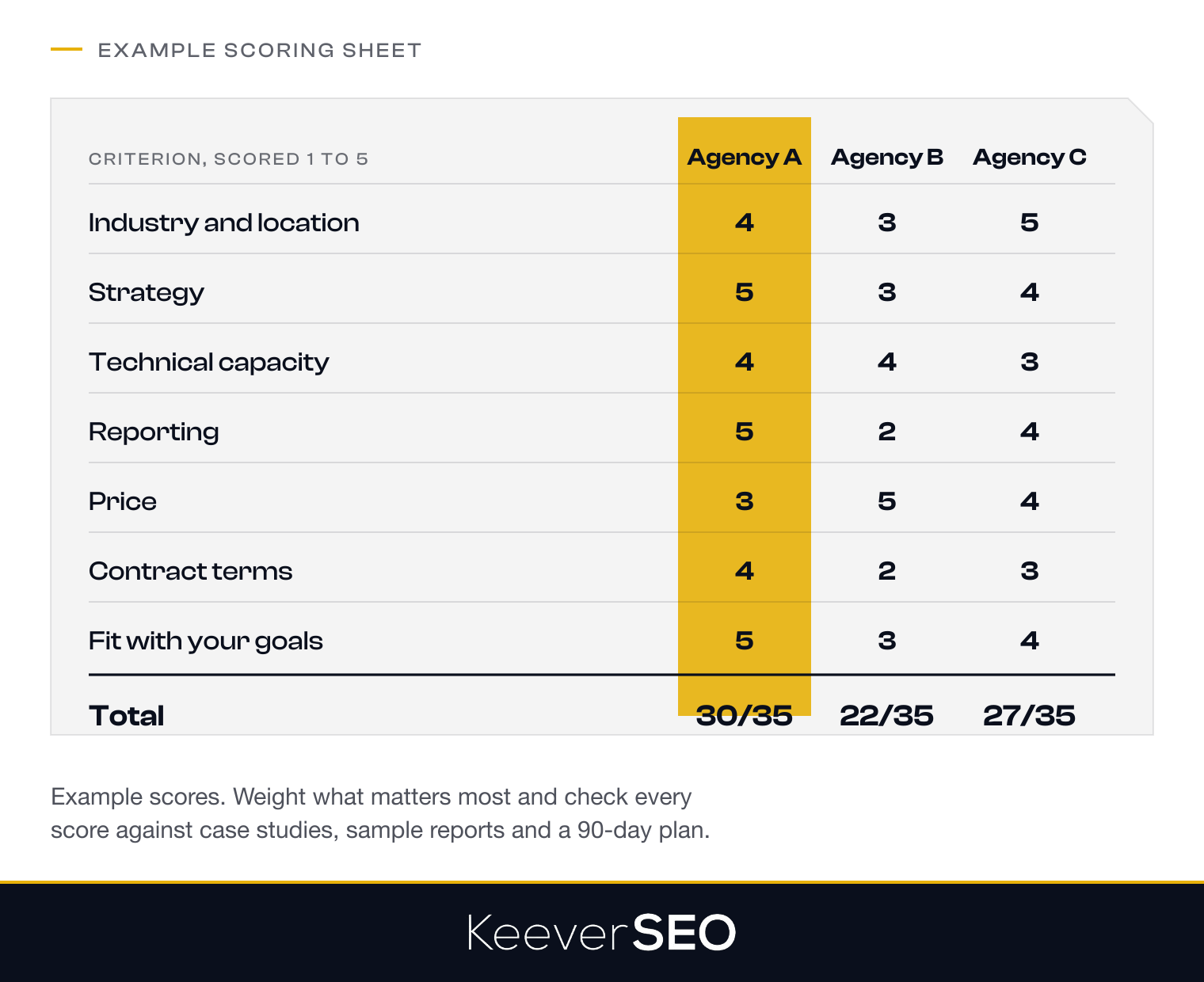
To compare your shortlisted agencies side by side, use one scoring sheet and the same criteria for every SEO agency. Rate each agency from 1 to 5 for industry and location experience, strategy, technical capacity, reporting, price, contract terms, and fit with your goals. Weight the criteria that matter most to your business. Review each score against evidence, such as case studies, sample reports, and a proposed 90-day plan. A high score alone does not confirm the right choice if methods, capacity, or expected business outcomes remain unclear. The side-by-side comparison then shows which questions each agency should answer before you sign.
Which Questions Should You Ask an SEO Agency Before Hiring?
The questions you should ask an SEO agency before hiring are four: “Who will work on my account?”, “What will you deliver in the first 90 days?”, “Who owns the website content and data?”, and “Do you work with my direct competitors?” Clear answers reveal the agency’s team structure, early deliverables, ownership policies, and potential conflicts. Compare each agency’s answers and request written details before signing. Detailed responses help you assess communication, accountability, and whether the agency’s working arrangements fit your business.
Who Will Work on My Account?
The people who will work on your account are the specialists the SEO agency names to manage it day to day. Confirm who handles strategy, technical SEO, content, link building, reporting, and client communication, and ask to speak with the people doing the work. A reliable agency identifies its primary contact, explains whether specialists are employees or contractors, and clarifies how many accounts each person manages. Ask who covers the account if a team member leaves, and agree on communication frequency, response times, and an escalation contact before signing.
What Will You Deliver in the First 90 Days?
In the first 90 days, a credible SEO agency should deliver a performance baseline, a website audit, keyword and competitor research, and a written roadmap during the first month. The roadmap should connect prioritized work, assigned responsibilities, and measurement targets to your business goals. During months two and three, the agency should begin agreed technical fixes, improve priority pages, and develop content or local SEO work where relevant. Regular reports should show completed work, impressions, clicks, tracked leads, outstanding issues, and next steps; major ranking gains are not guaranteed within 90 days.
Who Owns the Website Content and Data?
Your business should own the website content, SEO work product, analytics data, and accounts created or collected during the engagement. The contract should assign ownership of pages, articles, images, metadata, keyword research, reports, tracking history, and other assets your business pays for. Keep administrative control of your domain, website, hosting, Google Analytics, Google Search Console, Tag Manager, and business profiles. Require the agency to provide usable files, credentials, reports, and historical data when the contract ends, while allowing it to retain pre-existing tools, templates, and internal processes.
Do You Work With My Direct Competitors?
Yes, an SEO agency may serve businesses in the same broad industry, but clients targeting the same customers, services, and geographic area can raise conflict-of-interest concerns. Ask whether the agency works with direct competitors and how it protects confidential information and separates account teams, strategies, and content. Define “competitor” by service category and location in the contract. Include terms for conflict disclosure, confidentiality, account separation, and any exclusivity agreement, including its duration. An agency that avoids a clear answer on competitors shows a warning sign.
Which Red Flags Should Rule Out an SEO Agency?
The red flags that should rule out an SEO agency point to unreliable methods, hidden terms, or weak protection for your business, and they surface in the agency’s proposal, sales claims, references, and contract. The red flags to check before hiring are listed below:
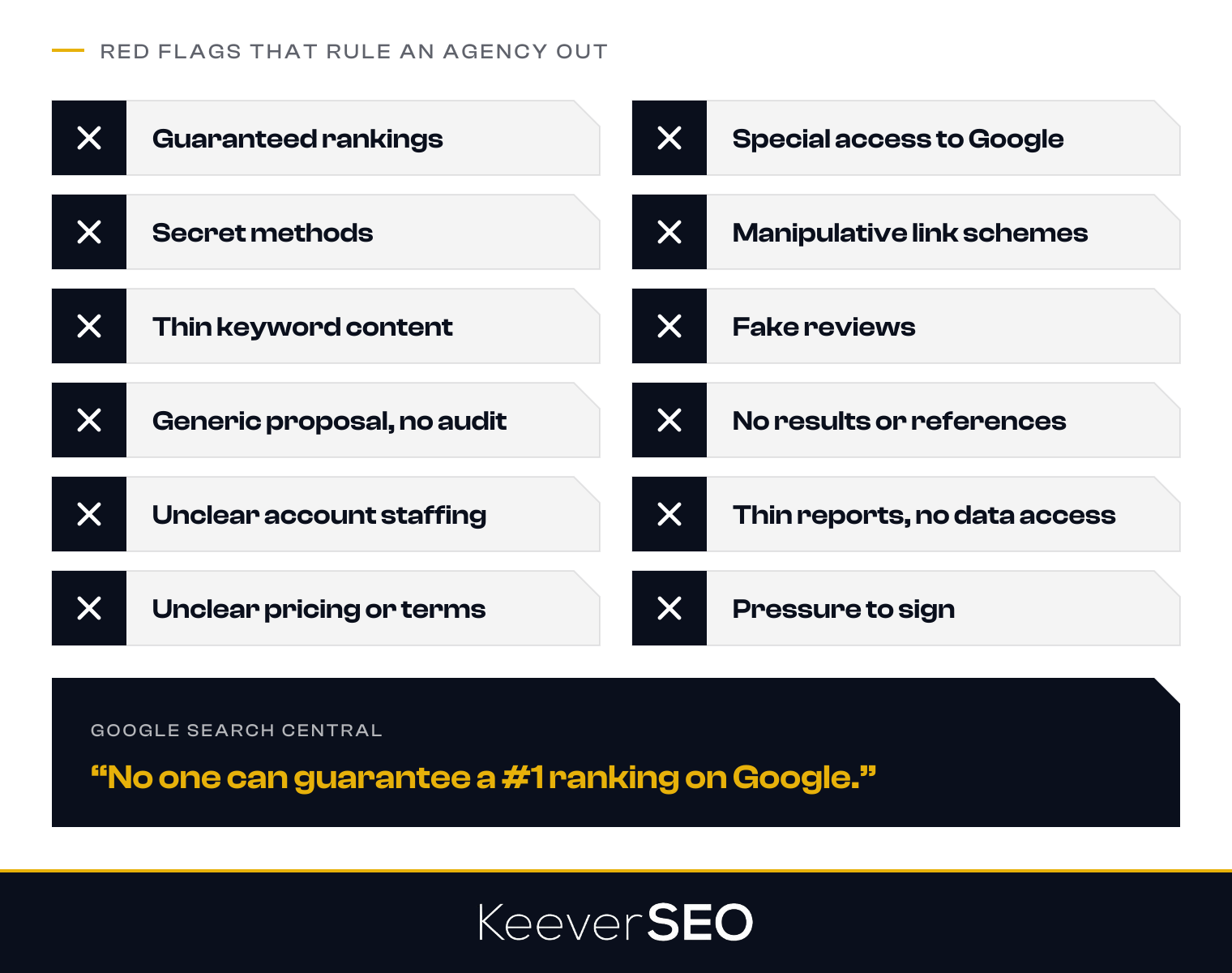
- Guaranteed rankings: An agency cannot control Google’s ranking systems or promise a set position by a fixed date.
- Claims of special access to Google: No SEO provider can offer preferred treatment, insider ranking access, or a guaranteed priority submission.
- Secret or unexplained methods: A credible agency explains its audits, technical work, content production, and link-building practices in plain terms.
- Manipulative link schemes or required links: Paid followed links, private link networks, automated backlinks, and mass directory submissions can violate search engine guidelines, and no SEO provider should require a client to link to its site as a condition of service. Google Search Central states the rule in "Do you need an SEO?": "You should never have to link to an SEO."
- Keyword-focused low-quality content: Hundreds of thin articles or near-duplicate location pages may target search terms without helping customers.
- Fake reviews or misleading business details: An agency should not buy reviews, fabricate customer experiences, or add irrelevant keywords to a business name.
- Generic proposals without an audit: An agency should review your website, search visibility, competitors, and goals before proposing concrete work, and the proposal should address your market, website, services, and business objectives rather than repeat the same package for every client.
- No verifiable results or references: Ask for measurable case studies, client references, timelines, and results from businesses similar to yours.
- Unclear account staffing: The agency should identify who will manage your account and who will complete strategy, technical, content, and outreach work.
- Thin reports or restricted data access: Useful reports connect organic visibility to qualified visits, calls, form submissions, bookings, or sales, and your business should retain ownership and administrator access to its website, domain, Google Business Profile, Analytics, and Search Console.
- Unclear pricing or contract terms: Watch for hidden fees, undefined deliverables, long lock-in periods, steep cancellation penalties, or unclear ownership of completed work.
- Pressure to sign or unsolicited promises: A trustworthy agency allows time to compare proposals, verify references, and review contract terms, while cold outreach that guarantees rankings or claims urgent problems without a meaningful review deserves careful scrutiny.
Ranking guarantees are among the most recognizable warning signs, so the next section explains why a first-page promise deserves particular scrutiny.
Is a Guaranteed First-Page Ranking a Red Flag?
Yes, a guaranteed first-page ranking is a red flag because an SEO agency cannot control Google’s search results. "No one can guarantee a #1 ranking on Google," according to "Do you need an SEO?", the Google Search Central guide to hiring an SEO. A trustworthy SEO agency explains its strategy, sets measurable goals, and reports progress without promising a fixed position. A ranking guarantee is a reason to question the agency’s methods and move on.
Should You Choose a Local or a National SEO Agency?
You should choose a local SEO agency when your business serves one city or a defined service area. Local agencies may understand nearby competitors, search behavior, Google Business Profile optimization, reviews, citations, and Map Pack visibility. When considering how to choose a local SEO company, check for results in your market and clear tracking of calls, bookings, and other local leads. You should choose a national SEO agency when your business targets customers across multiple states or needs support for a large website, ecommerce store, franchise, or many locations. National agencies may offer broader teams and resources, while local market knowledge can vary. The best choice depends on relevant experience, strategy, reporting, budget, and contract terms, not the agency’s location or size alone. Knowing how to choose the best local SEO company or a national provider means comparing case studies, defined deliverables, communication, and proven results for businesses with goals like yours.
What Should Happen After You Sign With an SEO Agency?
After you sign with an SEO agency, onboarding should begin, responsibilities should be confirmed, and measurable goals should be set. The steps to establish a clear working plan are listed below:
- Schedule a kickoff meeting to confirm business goals, target services, locations, contacts, and communication.
- Grant secure access to Google Analytics, Google Search Console, Google Business Profile, and your website platform while retaining account ownership.
- Record baseline rankings, organic traffic, calls, leads, sales, and agreed key performance indicators.
- Request an initial SEO audit and a prioritized 90-day roadmap with deliverables, owners, and deadlines.
- Confirm approval requirements, reporting frequency, and progress-review dates before implementation begins.
How Should a Local Service Business Choose an SEO Agency?
A local service business should choose an SEO agency with proven Map Pack results and experience serving similar locations. Ask how the agency improves Google Business Profile visibility, service-area pages, reviews, citations, and location-relevant content. The right local SEO agency tracks calls, form submissions, and bookings alongside rankings and organic traffic. Request reporting that connects Map Pack visibility across your service area with qualified leads and completed appointments.
When Does an Industry-Specialist SEO Agency Make Sense?
An industry-specialist SEO agency makes sense when a business operates in a regulated, technical, or highly competitive market. A specialist SEO agency may understand industry terminology, customer search behavior, compliance requirements, and the steps that turn visits into customers. Learning how to choose a dental SEO company starts with a review of the company's experience with local patient searches, Google Business Profile optimization, and healthcare content. For anyone deciding how to choose an ecommerce SEO agency, the agency should show work with product categories, product variations, structured data, and revenue tracking. Knowing how to choose the right technical SEO agency depends on its experience with crawling, indexing, site speed, migrations, JavaScript, and site architecture. Compare relevant case studies and measurable results against your business size, platform, location, and goals.
Why Do Local Service Businesses Choose Keever SEO as Their SEO Agency?
Local service businesses choose Keever SEO as their SEO agency for its local-first SEO focus, which supports Google Business Profile optimization, local citations, location pages, reviews, and Map Pack visibility. Keever SEO serves local service sectors such as home services, legal, healthcare, automotive, real estate, and contractors. Keever SEO sends a monthly report that starts with leads and conversions, then covers Google Business Profile activity such as calls and directions, visibility for priority services and cities, work completed, and next priorities. Month-to-month terms with no long-term contract and no setup fee give businesses flexibility to adjust or scale services.
What Should You Know About SEO Agencies Before Choosing One?
Before choosing an SEO agency, you should know the service’s scope, cost, and expected timeline. SEO agency work combines strategy, technical improvements, content, authority building, and performance measurement. The three questions below explain the benefits of hiring an agency, typical SEO costs in the USA, and how long SEO can take to produce results. Those answers help you compare proposals and assess whether an agency’s services, reporting, and terms fit your business goals.
What Are the Benefits of Hiring an SEO Agency?
The benefits of hiring an SEO agency are access to specialized SEO skills, professional tools, and a structured search strategy without building an in-house team. An experienced SEO agency can improve organic visibility, attract qualified website traffic, and track progress through metrics such as conversions and organic growth.
How Much Does SEO Cost in the USA?
SEO in the USA costs at least $1,000 per month with most providers, and agency retainers average about $3,200 per month, depending on competition, location, and campaign scope. Most SEO providers in the US and Canada (79.1%) charge at least $1,001 per month, and agencies charge $3,209 per month on average, according to "SEO Pricing: How Much Does SEO Cost? 439 People Polled" by Joshua Hardwick, Ahrefs, August 2024.
How Long Does SEO Take to Work?
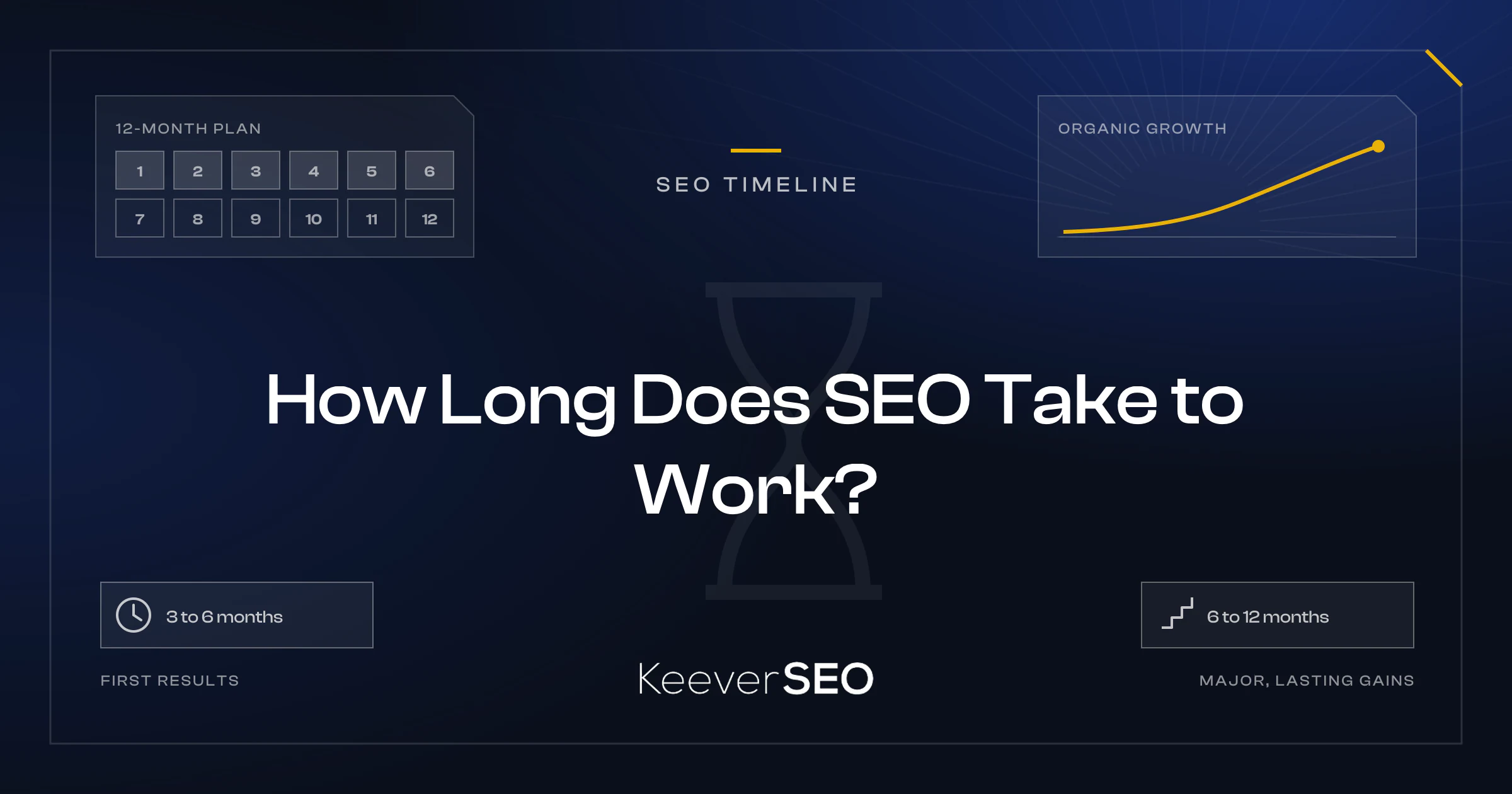
SEO takes about four months to a year to produce meaningful results, depending on competition, website history, technical condition, and implementation speed. Google’s Maile Ohye said in the 2017 video "How to hire an SEO" that in most cases SEOs need four months to a year to help a business first implement improvements and then see potential benefit, as Barry Schwartz reported in "Google: Give SEOs 4-12 Months To See Positive Ranking Benefits," Search Engine Roundtable, February 2017.
Is an SEO Agency Better Than a Freelancer or an In-House Team?
An SEO agency is better than a freelancer or an in-house team for businesses that need coordinated skills in technical SEO, content, link acquisition, and reporting without hiring several specialists. A freelancer can fit a focused project or small budget, while an in-house team offers closer day-to-day control. The right option depends on your goals, budget, workload, and internal resources. The comparisons below explain how an SEO agency differs from a freelancer and an in-house team.
How Does an SEO Agency Compare With a Freelancer?
An SEO agency compares with a freelancer as a coordinated team for technical SEO, content, link building, analytics, and strategy, while a freelancer usually offers individual skills. Agencies suit campaigns that need several services and ongoing capacity; freelancers suit smaller budgets or well-defined projects.
How Does an SEO Agency Compare With an In-House Team?
An SEO agency compares with an in-house team by providing specialists, established processes, and professional tools without requiring several full-time hires. An in-house SEO team develops deeper brand knowledge and gives the business more direct control over daily priorities, but requires ongoing salary, benefits, training, and software costs. Many businesses choose an agency for broad skill coverage and flexible capacity, or an in-house team for continuous involvement in complex products and decisions.
How Do You Know You Chose the Best SEO Agency?
You know you chose the best SEO agency when its work matches the agreed strategy, deliverables, and business goals. A clear audit, prioritized plan, responsive team, and regular reports should explain completed work and measure qualified traffic, leads, calls, or conversions. The right SEO company follows search engine guidelines, gives you access to campaign data, and explains changes when results require new priorities. Knowing how to choose the right SEO company, and how to choose the right SEO agency for a long engagement, means checking those signs against its promises and contract terms throughout the engagement. Those signs return the decision to the process of choosing the best SEO agency: compare its experience, methods, communication, reporting, and terms with your goals.