The most effective ways to improve your SEO ranking run from creating helpful content with topical depth and optimizing on-page SEO to earning authoritative backlinks. Improving SEO ranking means raising your website's visibility in search results for targeted queries, and the ranking itself rests on content relevance, authority signals like quality backlinks, user experience metrics, and technical site health.
The workflow runs in nine steps. Audit current rankings first, establishing baseline positions and surfacing the weak points. Research keywords and match them to search intent, favoring low-competition and long-tail terms. Optimize on-page SEO for priority pages, from title tags and meta descriptions to header hierarchy. Create helpful content with topical depth that demonstrates experience, expertise, authoritativeness, and trustworthiness (E-E-A-T). Strengthen internal links and consolidate pages so authority flows where it should. Fix technical SEO and the mobile experience, covering crawl and index controls, mobile-first design, and page speed. Optimize rich media and search result visibility with structured data and snippet targeting. Earn relevant authoritative backlinks through outreach and digital PR, and close the loop by tracking results and refining the strategy in Google Search Console and Analytics.
Google determines ranking through content relevance, authority, E-E-A-T, user experience, and technical signals. Improvements get measured in Search Console and Analytics through impressions, clicks, and conversions, and results arrive over weeks to months depending on site size, competition, and content quality. Specialist or agency help earns its place on the complex work, technical audits, local SEO, ecommerce SEO, and international SEO, and as AI search evolves, the approach adjusts while staying anchored to relevance, authority, user experience, and technical excellence.
1. Audit Current SEO Rankings
Auditing current SEO rankings is the foundational step in improving your SEO ranking. The audit establishes baseline positions for important pages and keywords, showing where each stands in results today. Reviewing the page indexing report and inspecting key URLs exposes the crawl and indexing problems that suppress visibility, and the same pass surfaces underperforming pages and overlapping content competing for the same terms.
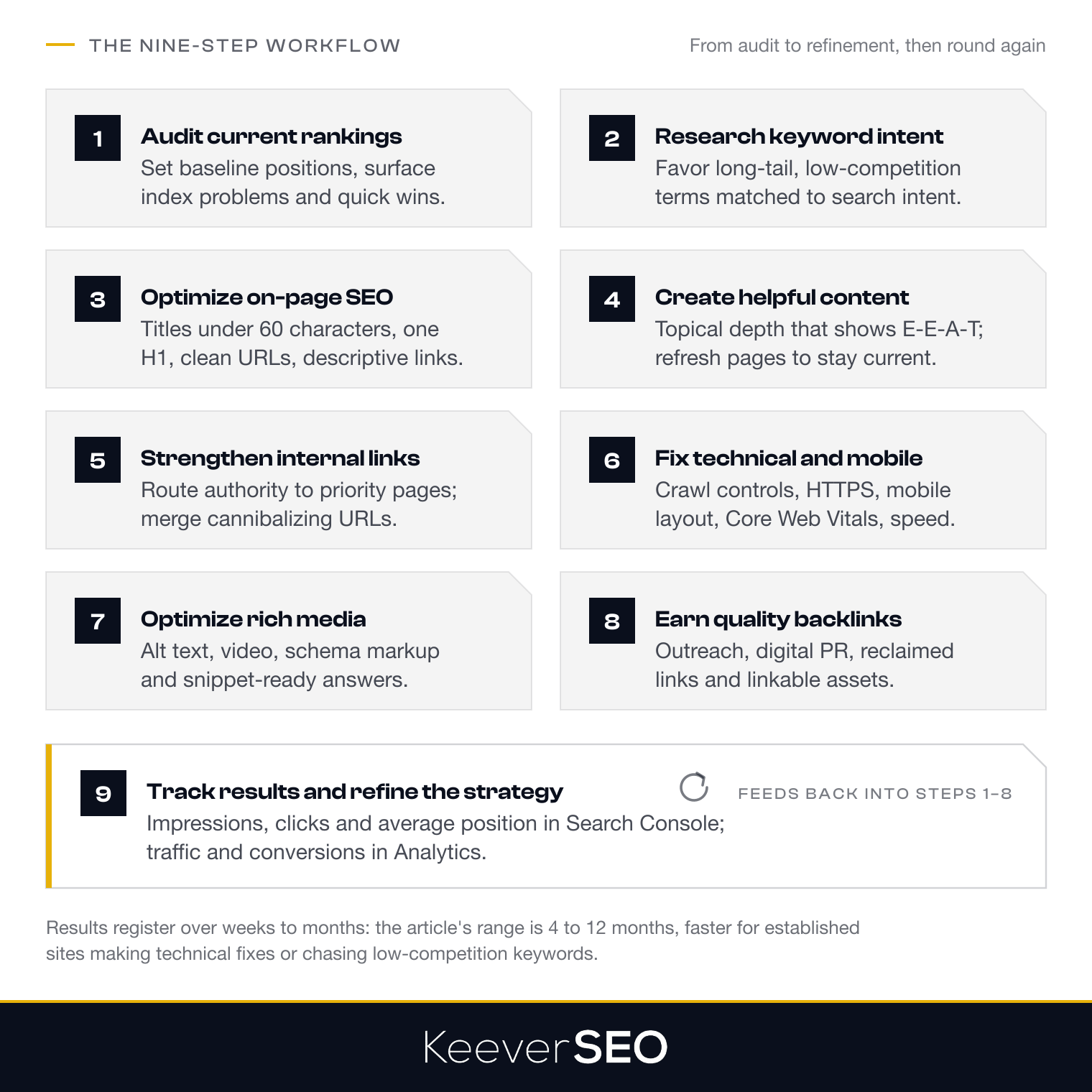
Google Search Console and Google Analytics carry the audit. Search Console shows which URLs miss the index and why, while Analytics reveals what visitors do after arriving. Pages sitting on page two or three of results mark the quick wins, where modest improvements move rankings fastest, and overlapping pages targeting one keyword mark the consolidation work that concentrates authority on a single contender.
The audit findings set the optimization priorities: which pages need technical fixes first, and where the content gaps against competitors sit. The priorities then feed the next step, targeting keywords matched to the site's strongest pages and highest-impression opportunities.
2. Research Keywords and Match Search Intent
Researching keywords and matching search intent turns the audit's priorities into targets. The research starts with low-competition and long-tail keywords suited to the site's strength: long-tail terms of three or more words carry less competition and more qualified traffic. Tools like SEMrush and Ahrefs build the keyword list, competitor analysis exposes the content gaps worth filling, and monthly search volume checks confirm enough demand to justify the investment, balancing volume against competition for the best return.
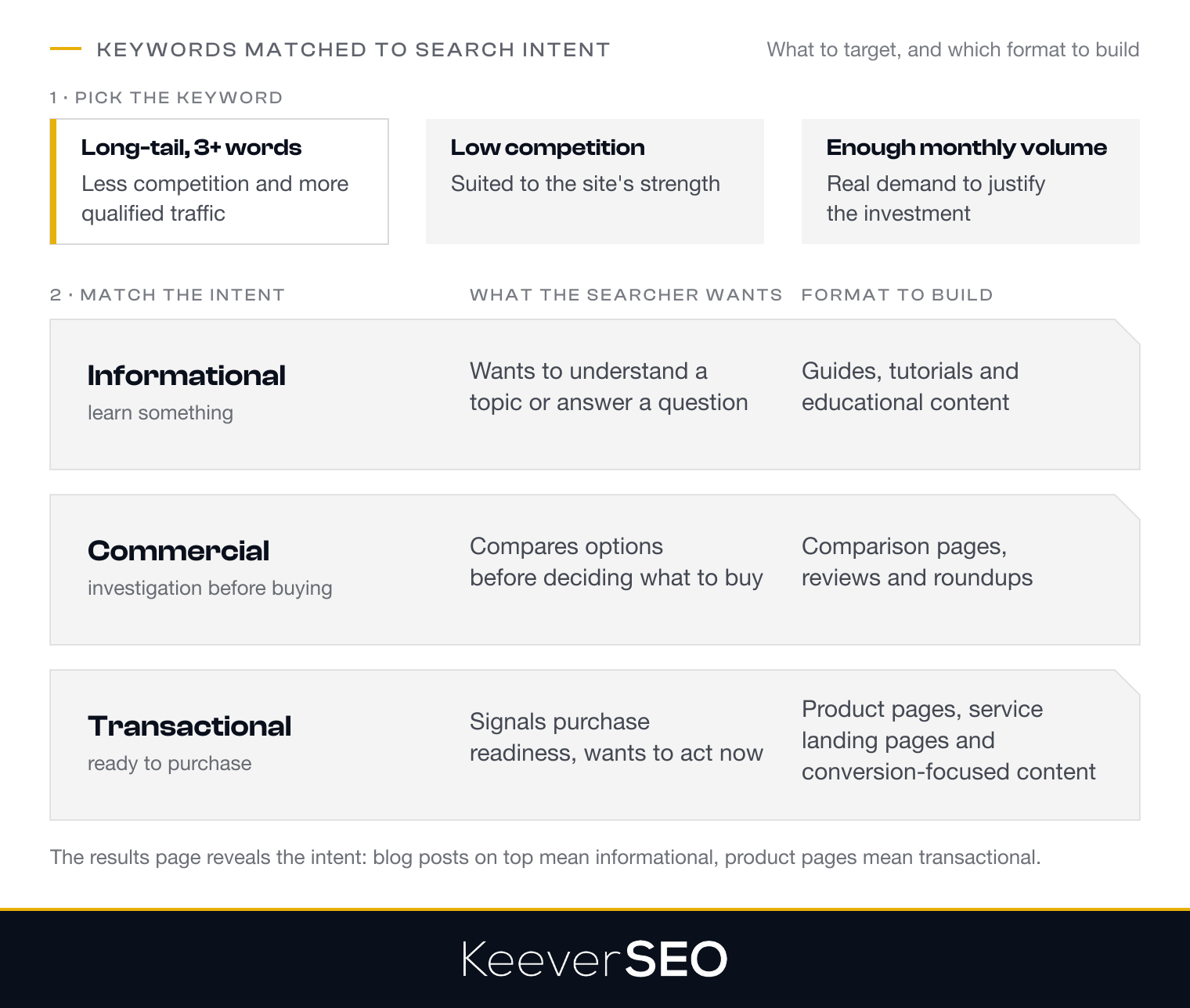
Matching each keyword to its intent decides the content format. Informational queries call for guides, tutorials, and educational content. Commercial investigation, where users compare before buying, calls for comparison pages, reviews, and roundups. Transactional keywords signal purchase readiness and call for product pages, service landing pages, and conversion-focused content. The results page itself reveals the intent: blog posts on top mean informational, product pages mean transactional. A keyword list mapped to intent and page type gives every term the format searchers expect and Google rewards, and it points at the priority pages the on-page work should reach first.
3. Optimize On-Page SEO for Priority Pages
Optimizing on-page SEO for priority pages sharpens the signals search engines and users read directly. Title tags come first: a distinct, descriptive title per page with the target keyword near the front, held under 60 characters so results display it whole. Meta descriptions of 150-160 characters summarize the page and earn the click, feeding engagement even without a direct ranking role.
Header hierarchy structures the content: one H1 carrying the primary keyword, with H2 and H3 subheadings working in semantic and related terms naturally. The URL stays short, descriptive, and keyword-aware, hyphen-separated and free of parameters and session IDs. Keyword placement follows the reading path, title, H1, first paragraph, at least one subheading, then naturally through the body, with readability outranking density at every decision.
Descriptive anchor text on internal links tells users and engines what each target page covers, never "click here." Semantic keywords, the synonyms and related concepts around the main topic, round out the page's topical depth and match the entity-level language patterns Google's systems parse. A priority page optimized across all of it communicates its topic cleanly while reading well to the person who clicked.
4. Create Helpful Content With Topical Depth
Creating helpful content with topical depth carries more ranking weight than any other single step. The content must demonstrate experience, expertise, authoritativeness, and trustworthiness (E-E-A-T): original material with expert input and complete topic coverage, the standard Google's Search Quality Rater Guidelines set for content reflecting genuine knowledge and first-hand experience. Long-form treatment that works through a subject signals authority and gives searchers more, while clear headings, short paragraphs, and accessible language keep it readable.
Content freshness protects the rankings the depth earns. A steady publishing cadence for new material pairs with systematic refreshes of existing pages, updated statistics, current examples, expanded sections answering new user questions, because Google's systems favor content that stays current, above all where facts move. A content calendar balancing new articles against strategic updates keeps both sides funded, and format range, how-to guides, case studies, comparisons, expert interviews, proves the depth across the whole subject area. Once the authoritative content stands, internal linking distributes its authority outward.
5. Strengthen Internal Links and Consolidate Pages
Strengthening internal links and consolidating pages moves authority to the pages that need it. Internal links carry ranking power from high-performing pages to targets, and they teach search engines the site's structure along the way; Google's "Search Engine Optimization (SEO) Starter Guide" treats internal links and their anchor text as the signals search engines read for site structure and page relationships. Authoritative pages linking to target pages with descriptive anchor text add topical relevance and user guidance in the same stroke.
Consolidation attacks keyword cannibalization: similar pages merge into one stronger URL with duplicates redirected, concentrating the ranking signals on the best candidate. Broken links get fixed in the same pass, since dead paths interrupt crawl flow and user trust together.
The result is a clean link structure where authority flows without leaks, priority pages sit well-connected, and search engines index the content that matters, the platform the technical work then reinforces.
6. Fix Technical SEO and Mobile Experience
Fixing technical SEO and the mobile experience keeps the site crawlable, indexable, and fast. Crawl and index controls come first: robots.txt, XML sitemaps, canonical tags, and noindex directives, all pointed the same direction. HTTPS is non-negotiable, a confirmed ranking signal and the baseline of user trust.
Mobile-first design decides the ranked experience, since Google indexes and ranks from the mobile version: responsive layout, touch-friendly navigation, readable text. Core Web Vitals set the performance bar, Largest Contentful Paint (LCP) within 2.5 seconds, Interaction to Next Paint (INP) under 200 milliseconds, and Cumulative Layout Shift (CLS) below 0.1, the thresholds Google's own guidelines define for a good experience.
Page speed work closes the step: a Content Delivery Network (CDN) serving assets near the user, minified JavaScript and CSS, images compressed in modern formats like WebP, and lazy-loading on off-screen content. The gains stack, better rankings, better retention, lower bounce, each reinforcing the rest; the Google-commissioned Deloitte study "Milliseconds Make Millions" found even a 0.1-second mobile speed gain lifted retail conversions by 8.4%.
7. Optimize Rich Media and Search Result Visibility
Optimizing rich media and search result visibility raises how the content appears on the results page, not just where:
- Image optimization: descriptive alt text that tells engines what each image shows, with compression in formats like WebP holding quality at lower weight.
- Video content: videos hosted on platforms like YouTube and embedded on-site, with keyword-aware titles, descriptions, and transcripts that make the content crawlable.
- Schema markup: structured data that qualifies pages for rich results, from snippets to knowledge panels, and sharpens how Google reads the content.
- Featured snippets: content formatted to answer common questions directly, in concise definitions, lists, and tables, chasing the top of a click curve where position decides most clicks, as First Page Sage's click-through-rate research documents.
- Click-worthy titles and meta descriptions: accurate, keyword-bearing, with a pull toward the click; the click-through gains feed positive engagement signals even where descriptions carry no direct ranking weight.
Worked together, the five levers lift visibility and click-through at once, turning existing rankings into more traffic.
8. Earn Relevant Authoritative Backlinks
Earning relevant authoritative backlinks raises the authority signal that separates well-optimized pages from ranking pages. Outreach leads the work: pitching content and expert input to relevant sites, answering journalist queries through HARO and digital PR, and building the relationships that produce editorial links. The authority payoff is documented, with Backlinko's analysis of 11.8 million search results finding the #1 result carries on average 3.8 times more backlinks than the positions below it.
Reclamation runs beside outreach. Competitor backlink analysis exposes the sites already linking to rivals and open to a stronger resource, broken-backlink reclaim offers working replacements for dead links, and unlinked brand mentions convert into links with a single ask. Statistic pages, original data, and other linkable assets round out the program, giving publishers a reason to cite the site without being asked.
Every link earned through those channels adds authority the site did not have before, and the tracking step then verifies what the new authority does in the rankings.
9. Track Results and Refine Your SEO Strategy
Tracking results and refining your SEO strategy closes the loop on every step before it. Rank tracking, impressions, clicks, and average position in Google Search Console show whether visibility is moving, read through the Performance report filtered by query, page, and date range.
Google Analytics adds the business layer: organic traffic, session duration, bounce rates, and conversion rates, the numbers that tie rankings to outcomes. KPI selection matches the goal, impressions for awareness, conversions for lead generation, engaged sessions for content sites.
Refinement runs on the deltas against the baseline. Pages gaining impressions without clicks need sharper titles and meta descriptions; pages gaining clicks without conversions need content and call-to-action work. Each finding routes back into the earlier steps, keeping the whole SEO program aligned with business goals and compounding.
How Does Google Determine Your SEO Ranking in Search Results?
Google determines your SEO ranking through signals that weigh relevance and quality together. The primary factors are relevance, authority, and links, joined by E-E-A-T (Experience, Expertise, Authoritativeness, and Trustworthiness). Relevance reads whether content matches search intent and language; authority builds through quality backlinks from trusted domains. RankBrain and user experience signals, from click-through to dwell time, feed the evaluation, and a secure, crawlable site structure keeps the content reachable for indexing at all.
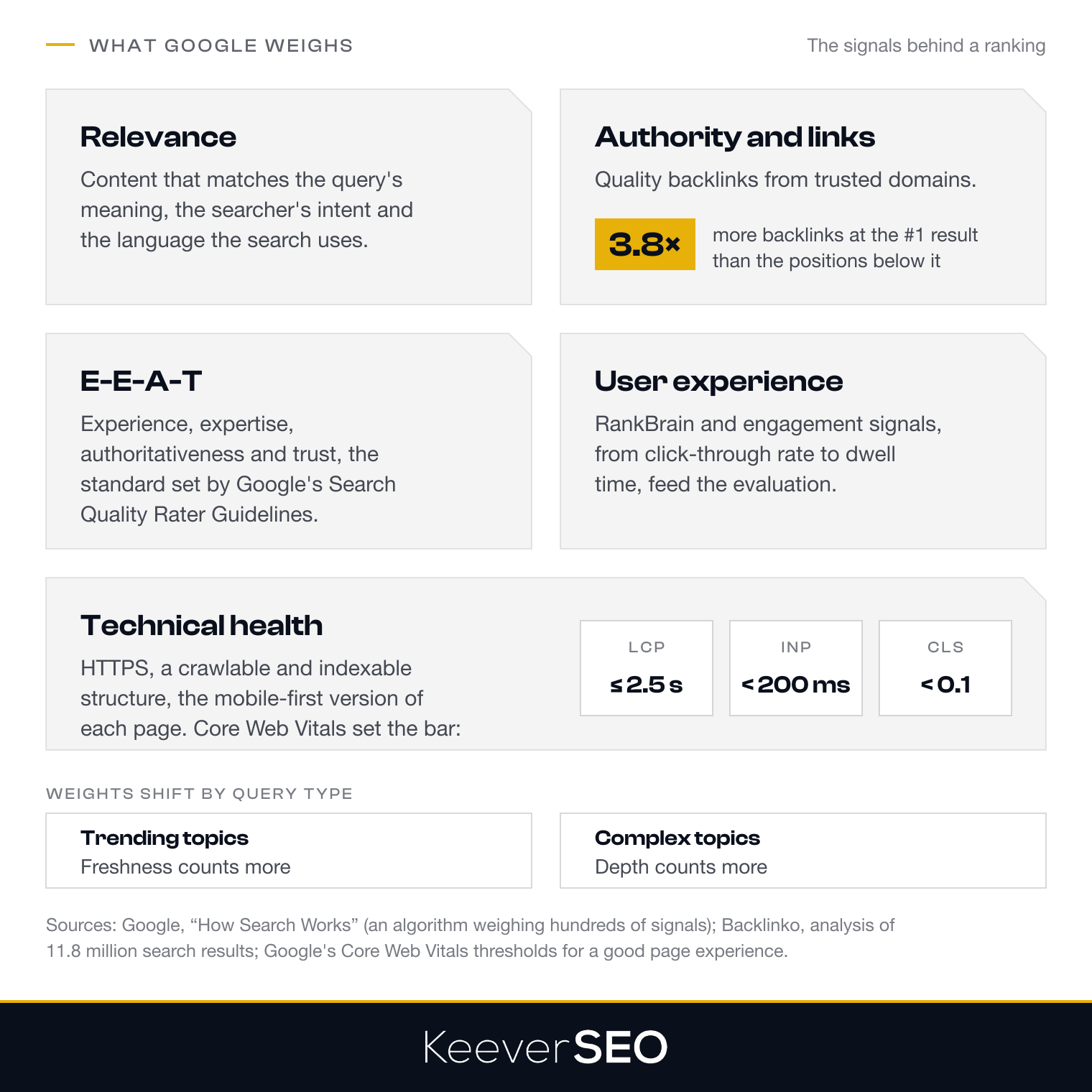
Google's "How Search Works" ranking documentation describes an algorithm weighing hundreds of signals, query meaning, content quality, and usability among them, with the weights shifting by query type: freshness counts more on trending topics, depth more on complex ones. The moving weights all serve one target, the most helpful, reliable result for each search.
How Should SEO Ranking Improvements Be Measured With Search Console and Analytics?
SEO ranking improvements should be measured with Google Search Console and Google Analytics together, visibility in one, business impact in the other. Search Console tracks average position for target keywords, total impressions, and click-through rate, with the Performance report filtered by query, page, and date range exposing the upward trends.
Analytics measures organic traffic volume, engagement from bounce rate to time on page, and above all the conversions and goal completions that tie rankings to revenue. KPI choice follows the objective: impressions and traffic growth for brand awareness, conversion rate and assisted conversions for lead generation, engaged sessions and pages per session for content sites. Cross-referencing Search Console positions with Analytics traffic confirms rising rankings convert into visitors, and segmenting by landing page shows which optimized pages deliver most.
How Long Do SEO Ranking Improvements Take?
SEO ranking improvements take roughly 4 to 12 months to show measurable results. The timeframe follows the site's current authority, the competitiveness of the target keywords, and the depth of the optimization work, and Google's own SEO Starter Guide sets the expectation that changes need weeks to months to register in rankings. New websites and competitive industries sit at the top of the range, while established sites making technical fixes or chasing low-competition keywords move faster.
What Is Keyword Research for SEO Rankings?
Keyword research for SEO rankings is the identification and analysis of the search terms users type into engines. The work covers selecting low-competition and long-tail keywords, analyzing which terms drive traffic to competitors, and checking search volume so every chosen keyword carries real demand. Intent matching completes it: each keyword classified as informational, commercial, or transactional and mapped to the fitting page format. Keywords aligned with intent and behavior let the content meet audience needs and rank for the searches that matter.
What Is On-Page SEO for Better Rankings?
On-page SEO for better rankings is the optimization of individual pages, their content and HTML source, to rank higher and attract more relevant traffic. The core work places target keywords strategically in URLs, title tags, and headings while holding readability, and optimizes the metadata, title metadata for the result headline, description metadata for the summary beneath. Descriptive, keyword-aware anchor text on internal links and a logical header hierarchy organize the content for engines and readers together, and the combination decides how well each page ranks for its target phrases.
What Is Helpful, Authoritative Content for SEO Rankings?
Helpful, authoritative content for SEO rankings is content that demonstrates experience, expertise, authoritativeness, and trustworthiness (E-E-A-T) while answering the need behind the search. The content comes from knowledgeable authors, carries original findings or expert input, and covers its topic with accuracy and depth. Regular updates hold the relevance and freshness that signal continued value, and the writing balances human readability with strategic keyword placement, always putting user satisfaction ahead of search-engine maneuvering.
What Is Technical SEO for Website Rankings?
Technical SEO for website rankings is the optimization of a website's infrastructure so search engines crawl, index, and render it efficiently. The toolkit spans robots.txt files, XML sitemaps, and canonical tags controlling access and categorization, HTTPS protocols signaling trust and protecting data, and mobile-first design keeping the site responsive and fast on every device. Core Web Vitals, Largest Contentful Paint and Cumulative Layout Shift among them, measure the page experience, while CDNs and compressed images carry the speed. Together the layers let search engines read and rank the site's content as intended.
When Should a Business Get Help With SEO Ranking Improvements?
A business should get help with SEO ranking improvements when in-house efforts stop being enough to diagnose drops or resolve technical problems. The trigger points: a site needing full audits, advanced keyword strategy, or content planning beyond internal capability; crawl and indexing problems; Core Web Vitals work; authoritative link building. Expansion into local, ecommerce, or international markets raises the bar further, and when internal teams cannot execute the clear priorities, external specialists accelerate the progress the strategy depends on.
Which SEO Tasks Need Specialist Expertise?
The SEO tasks that need specialist expertise are listed below:
- Technical SEO audits: advanced site-architecture, server, and indexing work, diagnosing crawlability, indexation, and canonical issues.
- Structured data and schema implementation: JSON-LD and schema markup precise enough to protect rich results.
- Advanced link-building campaigns: outreach strategy and publisher relationships that earn high-quality backlinks.
- International and multilingual SEO: hreflang configuration, country-level domains, and local search behavior.
- Ecommerce SEO: product schema, faceted navigation, and duplicate-content control across large catalogs.
- Core Web Vitals optimization: front-end work balancing speed, render efficiency, and functionality.
- Content strategy and topical authority planning: pillar-cluster architectures aligned with semantic search and intent.
Any of the seven signals work beyond routine optimization, and the technical side starts with knowing what an audit must find.
Which Technical Issues Need an SEO Audit?
The technical issues that need an SEO audit are listed below:
- Crawl errors and blocked resources: pages unreachable through misconfigured robots.txt, server errors, or blocked CSS and JavaScript.
- Indexing problems: XML sitemap faults, missing or wrong canonical tags, and stray noindex directives.
- Site speed and Core Web Vitals: slow loads and failing Largest Contentful Paint (LCP) or Cumulative Layout Shift (CLS) scores.
- Mobile responsiveness: pages that break on mobile devices under mobile-first indexing.
- HTTPS and security issues: missing SSL certificates and mixed-content warnings eroding trust.
- Broken links and redirects: 404s, redirect chains, and loops burning crawl budget.
- Duplicate content: matching content across pages splitting signals and confusing engines.
- Structured data errors: broken schema markup forfeiting rich results.
An audit across the eight areas restores crawlability, indexing, and the ranking foundation they carry.
Which Competitive Keywords Need Link-Building Support?
The competitive keywords that need link-building support are listed below:
- High-difficulty commercial keywords: high-volume terms demanding strong backlink profiles to challenge established competitors.
- Industry head terms: core business and category terms where link equity decides who outranks the domain leaders.
- Competitor-dominated keywords: terms rivals hold through superior backlinks, waiting on targeted campaigns.
- YMYL topics: health, finance, and legal keywords where authoritative backlinks carry the trust signal.
- Featured snippet targets: page-one keywords missing the snippet, where added authority can close the gap.
- New content in saturated niches: fresh pages against aged competitor content, needing links to catch up.
- Product comparison keywords: commercial-investigation queries drawing heavy competition.
- Long-tail derivatives of competitive terms: keywords inheriting competitive parents, where link support accelerates the climb.
How Can an SEO Agency Improve Business Rankings?
An SEO agency improves business rankings by running audits, optimization, content, and authority building as one program. Our SEO specialists work through detailed audits that expose technical barriers and keyword opportunities, on-page optimization, technical fixes, and structured data for cleaner indexing, plus content strategy aligned with E-E-A-T and outreach that earns authoritative backlinks. The combined work raises organic visibility and pulls qualified traffic in.
Continuous monitoring through Google Search Console and Analytics lets us adjust strategy against algorithm updates and competitive shifts, while our command of the complex layers, international coordination, local SEO upkeep, keeps the improvements compounding. The coordinated program delivers measurable results faster than fragmented in-house effort can.
How Can Local SEO Improve Rankings?
Local SEO improves rankings by optimizing a business's presence for its geographic market. The primary levers are a fully optimized Google Business Profile, consistent local citations, and strong customer reviews. A complete profile, business name, address, phone number (NAP), categories, hours, photos, and steady updates, anchors local visibility across local results and Google Maps, while consistent citations in directories like Yelp reinforce the location signals and positive reviews carry trust and ranking weight together.
Geo-targeted on-page signals finish the work: location keywords in title tags, headers, and content, dedicated location pages for multi-location businesses, and LocalBusiness schema markup declaring the geography to search engines. Whitespark's Local Search Ranking Factors survey puts Google Business Profile signals, reviews, and on-page optimization at the center of local rankings, with proximity, review quality, and citation consistency deciding who lands in the local pack.
How Should Ecommerce Pages Improve SEO Rankings?
Ecommerce pages should improve SEO rankings through product-page optimization, category and faceted structure, and distinct product content. Every product page carries its own title, detailed description, and optimized images, with Product schema qualifying pages for rich results showing price and availability directly in search.
Site structure carries the rest: category pages connecting logically to subcategories and products, so users and crawlers move efficiently, and faceted navigation managed with canonical tags so filter combinations never flood the index with duplicates. Product content written beyond the manufacturer's description gives search engines something original to rank, the differentiation the whole category page structure feeds.
How Can International SEO Improve Rankings?
International SEO improves rankings by getting the right language and country version of each page in front of each market. hreflang tags carry the core signal, declaring the language and regional variants so the correct version ranks per market and duplicates never collide. Country and language targeting runs through the domain structure, country-code TLDs, subdomains, or subdirectories, marking the geographic focus for search engines.
Localization runs past translation: culturally localized content, local currency and payment methods, region-focused product ranges, all matched to regional search intent. Local hosting or CDNs lift page speed per region, and country-level citations and backlinks from authoritative local domains strengthen each market's authority, raising visibility market by market.
How Should You Continue to Improve SEO Rankings as AI Search Evolves?
You should continue to improve SEO rankings as AI search evolves by adding Answer Engine Optimization (AEO) and Generative Engine Optimization (GEO) on top of unchanged fundamentals. The new layers chase visibility in AI Overviews, ChatGPT citations, and platforms like Perplexity, while relevant content, authoritative backlinks, strong technical SEO, and user focus keep carrying the base.
The AI-facing work structures content to answer questions concisely up top with depth below, keeps schema markup clean enough for AI engines to parse, and builds topical authority across related subjects so generative models cite the site as a trusted source. The AI systems lean on pages already ranking well organically, which keeps traditional SEO the entry ticket, and the goal never changes: the most helpful, authoritative answer to the searcher's query, in a technically sound, discoverable format.