The best AEO strategies for 2026 are auditing AI visibility, creating answer-first content, implementing schema and preserving crawler access, strengthening entity and E-E-A-T signals, earning brand mentions, and tracking citations. An AEO strategy is a plan that helps a brand become an extracted and cited answer in Google AI Overviews, ChatGPT, Perplexity, and other answer engines. The twelve strategies cover auditing brand visibility, mapping customer questions, answering directly, structuring pages with clear headings, implementing schema, enabling crawler access, strengthening entities and E-E-A-T, earning mentions, publishing original data, refreshing content, and tracking citations and share of voice.
The AEO strategies were selected for their relevance to answer extraction, trust, measurable visibility, and practical effort relative to impact. Effective AEO makes answers easier to extract, strengthens citation trust, and tracks visibility over time, and unlike traditional SEO, AEO prioritizes cited answers, prompt clusters, and third-party mentions alongside rankings and links. Common AEO mistakes include blocking crawlers, burying answers, publishing empty FAQs, ignoring off-site mentions, leaving content stale, and measuring rankings alone. Local service businesses should start with a brand audit, answer-first service pages, LocalBusiness schema, and customer reviews, and an agency helps when technical implementation or ongoing monitoring exceeds internal capacity.
Supporting techniques include passage-level optimization, comparison pages, and prompt-specific landing pages, while tracking tools measure prompts, citations, and share of voice. AEO execution varies across Google AI Overviews, ChatGPT, and Perplexity, but clear answers, accessible evidence, fresh content, and brand authority should remain useful beyond 2026. The complete strategy set begins with an audit of how answer engines describe your brand today.
1. Audit How Answer Engines Describe Your Brand Today
An AEO brand audit shows how ChatGPT, Perplexity, and Google AI Overviews describe your business. Ask each answer engine the same buyer-focused questions, such as "Who are the best [service] providers in [location]?" Record whether the engine mentions your brand, links to your website, or cites a different source.
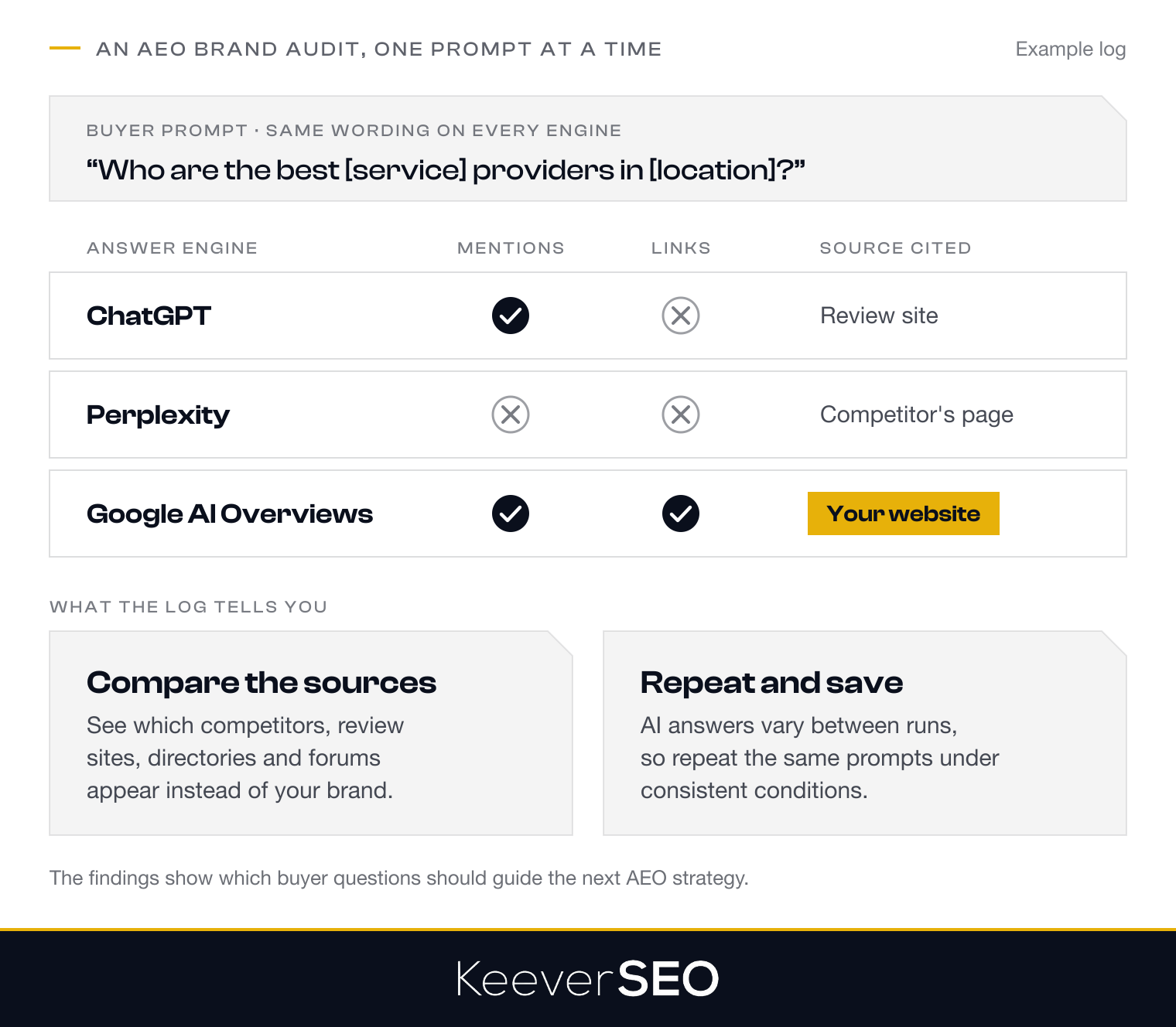
Compare the answers to identify which competitors, review sites, directories, forums, and other sources appear instead. Repeat the same prompts under consistent conditions and save the responses, since AI answers vary between runs. The audit findings reveal which buyer questions should guide your next AEO strategy.
2. Map the Questions and Prompts Your Customers Ask AI
Question mapping identifies the buyer questions that answer engines receive about each service. Gather customer wording from Google's People Also Ask results, sales calls, support conversations, and relevant forums.
Group related questions into prompt clusters for each service, such as pricing, suitability, process, timing, and comparisons. Prioritize the prompt clusters by customer demand and business relevance, then answer each priority question directly.
3. Lead Every Section With a Direct Answer
Leading every section with a direct answer means opening each AEO content section with a sentence that answers its heading. Short, self-contained passages help answer engines identify and extract the right information.
Add supporting details, examples, and evidence after the answer. Each passage stays focused on one idea so readers and answer engines can follow it independently.
4. Structure Pages With Clear Headings, Lists, and Tables
Clear headings, lists, and tables structure pages so answer engines can identify and extract the right information. Use question-based headings, one H1 for the page topic, and a logical H2 and H3 hierarchy to organize supporting points, in line with Google's "SEO Starter Guide," which advises site owners to "provide headings to help users navigate your pages."
Bullet lists group related facts, numbered lists present steps in order, and tables compare attributes. Keep each list item and table cell concise and self-contained so answer engines interpret the information accurately, and use the formats wherever they make content easier to scan.
5. Implement Comprehensive Schema Markup for AEO
Full schema markup for AEO describes page content, organization details, and local business information in JSON-LD. Add the relevant types, such as FAQPage for question-and-answer pages, HowTo for instructions, Article for editorial content, Organization for brand details, and LocalBusiness for location-based services. Keep each markup field consistent with information visible on the page.
Validate JSON-LD with Google's Rich Results Test and check deployed URLs in Search Console. "Structured data isn't required for generative AI search, and there's no special schema.org markup you need to add," according to "Google's Guide to Optimizing for Generative AI Features on Google Search," published by Google Search Central in May 2026, though accurate markup still supports rich result eligibility. Google stopped showing FAQ rich results on May 7, 2026, and How-to rich results in September 2023, so FAQPage and HowTo markup now serve machine readability rather than a Google rich result.
6. Keep AI Crawlers Able to Access and Render Your Pages
Keeping AI crawlers able to access and render your pages is the precondition for answer engines to retrieve and cite them. Check robots.txt, firewall rules, and security settings for Googlebot, PerplexityBot, and OpenAI's OAI-SearchBot. OpenAI's "Overview of OpenAI Crawlers" states that "sites that are opted out of OAI-SearchBot will not be shown in ChatGPT search answers," while GPTBot governs model-training access, and Perplexity's "Perplexity Crawlers" documentation describes PerplexityBot as "designed to surface and link websites in search results on Perplexity."
Publish important page text in server-rendered HTML rather than relying only on JavaScript, and keep pages fast and accessible without user interaction. The proposed llms.txt convention does not replace crawlable pages or correct crawler settings, and Google Search ignores llms.txt files entirely.
7. Optimize for Entities and Semantic Relevance
Optimizing for entities and semantic relevance helps answer engines identify a brand, its services, its locations, and its relationship to customer questions. Name the business, products, specialties, service areas, certifications, and customer types explicitly, then describe relevant attributes such as pricing models and use cases.
Keep brand facts consistent across the website, business profiles, and review platforms. Organization schema connects a business with authoritative profiles through accurate sameAs links, as the sameAs property in Google's "Organization Schema Markup" documentation shows, which clarifies the brand's identity.
8. Demonstrate E-E-A-T With First-Hand Experience and Evidence
AEO content demonstrates E-E-A-T through identifiable authors, relevant credentials, first-hand examples, and verifiable evidence. Author bios, documented case studies, product testing, cited data, and plain explanations of research methods help readers evaluate the content's experience and subject knowledge.
Transparent business information strengthens trust in a brand's AEO content, so publish accurate contact details, ownership information, and disclosure policies. Google's "Creating helpful, reliable, people-first content" describes experience, expertise, authoritativeness, and trustworthiness as E-E-A-T and states that "of these aspects, trust is most important."
9. Earn Brand Mentions Across Reviews, Forums, and Social Platforms
Brands earn stronger AEO visibility when credible third-party sources discuss their products, services, and know-how. Digital PR, customer reviews, helpful Reddit and industry-forum answers, and informative social videos create independent references that answer engines use when assessing brand relevance and reputation.
Pew Research Center found that Wikipedia, YouTube, and Reddit accounted for 15% of the sources listed in Google's AI summaries, according to "Google users are less likely to click on links when an AI summary appears in the results" by Athena Chapekis and Anna Lieb, July 2025. A 2025 Semrush study, "The Most-Cited Domains in AI: A 3-Month Study," reported that "Reddit and Wikipedia are still among the top cited domains across the LLMs as of October 2025." Brands should earn accurate, useful mentions across trusted platforms rather than publish repetitive promotional posts.
10. Publish Original Data and Resource Pages
Original data and resource pages give answer engines distinctive facts to cite. Publish proprietary surveys, industry benchmarks, anonymized customer analyses, controlled tests, and recurring research reports, which matches Google's question in "Creating helpful, reliable, people-first content": "Does the content provide original information, reporting, research, or analysis?"
Present each finding with its dataset, sample size, methodology, collection date, and responsible organization. Concise results, tables, and glossaries help readers and answer engines find definitions, figures, and supporting evidence.
11. Refresh AEO Content on a Fixed Schedule
Refreshing AEO content on a fixed schedule keeps facts accurate and citation-ready. Review important pages every quarter, and check commercial or fast-changing topics more frequently. Update statistics, prices, product details, regulations, examples, sources, and visible update dates when the information changes.
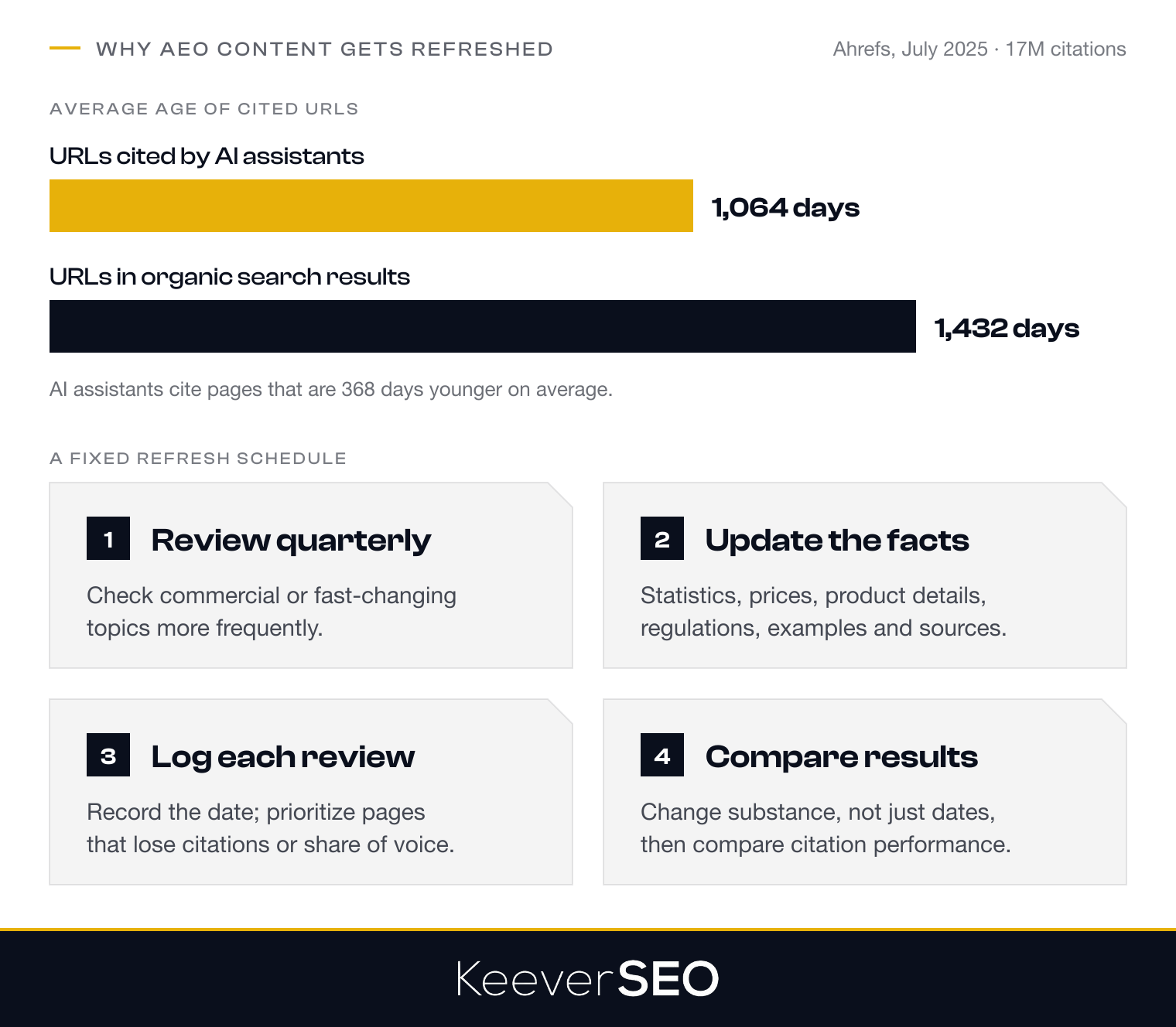
Prioritize pages that lose citations or share of voice, and record each review date. AI assistants favor recent pages, since "the average age of URLs cited by AI assistants is 1064 days, compared to 1432 days for URLs in organic SERPs," according to the Ahrefs study "New Study: AI Assistants Prefer to Cite 'Fresher' Content (17 Million Citations Analyzed)" by Ryan Law, July 2025. Change substantive information rather than updating dates alone, then compare citation performance before and after each refresh.
12. Track AI Citations and Share of Voice
Tracking AI citations and share of voice starts with running the same customer prompts across Google AI Overviews, ChatGPT, and Perplexity on a fixed schedule. Record whether each answer mentions your brand, which sources it cites, and how prominently competitors appear.
Citation share compares how often your pages receive citations with competitor pages across the same prompts. Connect AI visibility reports with analytics to measure referral sessions and conversions from AI traffic, and report citation frequency, share of voice, brand mention sentiment, AI referral sessions, and conversions each month.
Which AEO Metrics Should You Report Each Month?
The AEO metrics to report each month measure visibility, brand perception, and business outcomes across a consistent set of prompts. The five monthly AEO metrics are listed below:
- Citation frequency: How often answer engines cite your website or mention your brand.
- AI share of voice: Your brand's citations or mentions compared with competitors.
- Brand mention sentiment: The tone and accuracy of AI-generated references to your brand.
- AI referral sessions: Visits from AI platforms, measured by source and landing page where available.
- Conversions from AI traffic: Leads, purchases, revenue, and assisted conversions from AI-referred visitors.
How Were These AEO Strategies Selected?
The AEO strategies were selected from recurring AEO guidance on answer-first content, crawlability, trust signals, original data, and citation tracking. The selection prioritizes tactics that improve answer extraction and raise the likelihood of brand citations. The selection balances expected impact against effort, favoring practical content updates before resource-intensive authority campaigns. The selection method leads to three criteria: answer extraction, trust signals, and measurable AI visibility.
Which Criteria Make an AEO Strategy Effective in 2026?
The criteria that make an AEO strategy effective in 2026 are three tests: answer extraction, trust signals, and measurability. Answer extraction requires clear headings, direct responses, concise passages, and accessible page content. Trust signals come from accurate information, transparent authorship, first-hand evidence, and consistent brand facts. Measurability requires tracking citations, brand mentions, and AI referral traffic across a consistent set of prompts.
Does the Strategy Make Answers Easier to Extract?
Yes, an effective AEO strategy makes answers easier for answer engines to identify, extract, and present. Direct answers, question-based headings, concise passages, and clear lists help AI systems select useful content for generated responses.
Does the Strategy Strengthen Trust Signals for Citation?
Yes, an effective AEO strategy strengthens trust signals for citation through qualified authors, first-hand evidence, transparent business details, and reliable sources. Google treats trust as the most important part of E-E-A-T and states that "E-E-A-T itself isn't a specific ranking factor," according to "Creating helpful, reliable, people-first content" from Google Search Central.
Can the Strategy Be Measured in AI Visibility?
Yes, an effective AEO strategy can be measured in AI visibility by tracking a consistent prompt set, citation frequency, brand mentions, competitor share of voice, and AI referral traffic. Monthly comparisons show whether content changes improve citations and bring visitors who convert.
How Does an AEO Strategy Differ From a Traditional SEO Strategy?
An AEO strategy differs from a traditional SEO strategy because AEO helps answer engines extract and cite a brand's information, while traditional SEO aims to rank pages in search results. SEO measures rankings, impressions, and organic clicks, and AEO measures citations, brand mentions, and visibility across prompt clusters.
Traditional SEO organizes content around keywords and builds authority through backlinks. AEO targets complete answers to customer prompts and strengthens trust through third-party brand mentions, reviews, and other reliable sources. Google's AI search features still rely on core SEO fundamentals, so AEO complements rather than replaces SEO.
Which AEO Mistakes Should You Avoid in 2026?
The AEO mistakes to avoid in 2026 reduce a brand's chances of appearing in AI-generated answers and citations, and the most common ones involve crawler access, answer structure, content quality, and incomplete measurement. The main AEO mistakes are listed below:
- Blocking AI crawlers: Review robots.txt, firewalls, and CDN rules so relevant answer-engine crawlers can access public pages. "To be eligible to be shown as a supporting link in AI Overviews or AI Mode, a page must be indexed and eligible to be shown in Google Search with a snippet," according to Google's "AI features and your website" documentation.
- Burying the answer: Put the direct response near the beginning of each section, because long introductions obscure the information readers and answer engines need.
- Publishing FAQ blocks without real answers: Write a complete response under each question, since empty, generic, or repetitive FAQ entries add little and do not help answer engines interpret the page.
- Treating schema as a substitute for useful content: Use structured data to describe accurate, visible page information, not to compensate for weak content, because Google requires no special schema for its generative AI features.
- Ignoring off-site brand mentions: Build a credible presence through relevant reviews, community discussions, digital PR, and independent references, since answer engines draw on sources beyond a brand's own website.
- Leaving AEO content stale: Review pages on a set schedule and update outdated prices, statistics, service areas, and recommendations to keep pages useful and credible.
- Measuring only traditional rankings: Track AI citations, brand mentions, competitor visibility, referral sessions, and conversions alongside search positions, because ranking reports alone cannot show whether answer engines cite or recommend a brand.
Which AEO Strategies Should Local Service Businesses Prioritize First?
The AEO strategies local service businesses should prioritize first are an AI visibility audit, answer-first service pages, accurate LocalBusiness schema, and genuine customer reviews. The audit checks whether Google AI Overviews, ChatGPT, and Perplexity cite the business for local buyer questions or feature competitors instead.
Service pages should answer practical questions about pricing, availability, service areas, and processes. LocalBusiness schema should carry accurate business details, while review management encourages honest feedback and helpful responses. An agency becomes useful when the local priorities require technical implementation or ongoing execution.
When Does an AEO Strategy Need an Agency to Execute It?
An AEO strategy needs an agency to execute it when the in-house team lacks the time or skills to manage ongoing optimization. Agency support coordinates AI visibility audits, customer prompt mapping, answer-first content, and recurring citation tracking.
Technical schema implementation and crawler access often call for specialist support, especially when teams need to test structured data and page rendering. An AEO agency tracks citations across a fixed prompt set, compares competitor visibility, and reports AI referral traffic and conversions over time.
How Does Keever SEO Build and Execute AEO Strategies for Service Businesses?
Keever SEO builds and executes AEO strategies for service businesses through an AI visibility audit, question mapping, and answer-first content. The AI search SEO agency audit checks brand mentions and citations across ChatGPT, Perplexity, Gemini, and Google AI Overviews, then identifies competitors, citation gaps, and priority topics.
Keever SEO organizes customer questions by service, structures pages with direct answers, and improves retrievability with schema markup and entity optimization. Citation building across relevant directories, review platforms, forums, Reddit, and industry publications supports each strategy, while monthly reporting tracks AI mentions, citations, and share of voice.
Which AEO Techniques and Tools Support These Strategies?
The AEO techniques and tools that support the strategies split into two groups: techniques refine how each strategy is executed, and tools measure whether the work improves visibility in AI-generated answers. Passage-level optimization shapes execution, and AI visibility tools track prompts, citations, and share of voice, as the sections below explain.
Which Answer Engine Optimization Techniques Go Beyond These 12 Strategies?
The answer engine optimization techniques that go beyond the 12 strategies are passage-level optimization, comparison pages, and prompt-specific landing pages. Passage-level optimization makes each section self-contained, answers one query, and provides supporting evidence. Comparison pages state a verdict early and use clear tables, while prompt-specific landing pages answer a distinct customer question or use case.
Which AEO Tools Track Strategy Results?
The AEO tools that track strategy results are AI visibility platforms that run fixed prompts across ChatGPT, Perplexity, Gemini, and Google AI Overviews. AI visibility tools record brand mentions, cited URLs, citation frequency, sentiment, competitor visibility, and share of voice, and connect AI visibility with referral traffic and conversions.
How Do AEO Strategies Change Across AI Platforms?
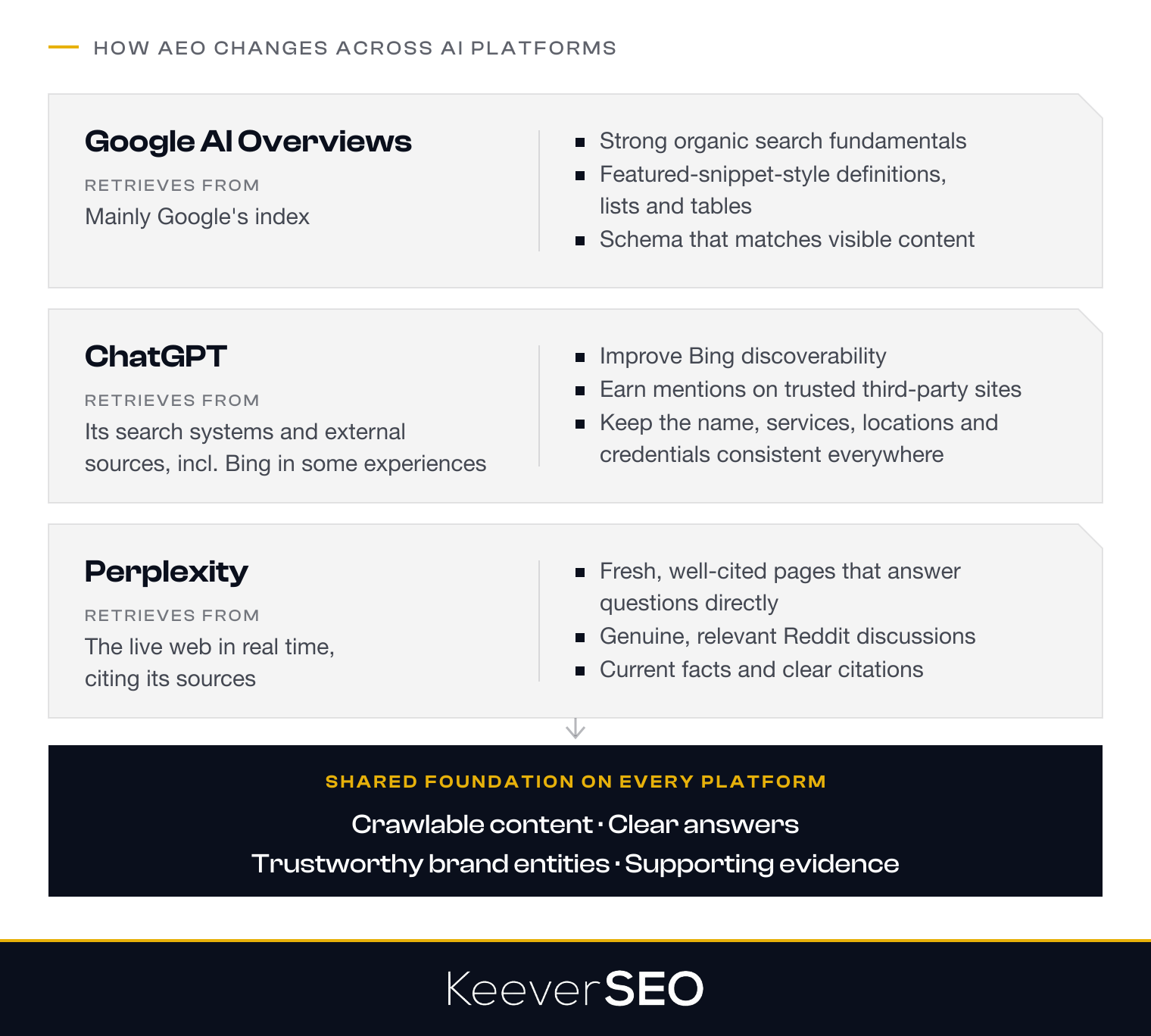
AEO strategies change across AI platforms because each platform retrieves information differently, even though all of them share a foundation of crawlable content, clear answers, trustworthy brand entities, and supporting evidence. Google AI Overviews relies mainly on Google's index, so strong organic visibility and helpful, well-structured pages support inclusion. ChatGPT draws on its search systems and external sources, including Bing in some experiences, which makes consistent brand facts and trusted third-party mentions useful. Perplexity searches the web in real time and cites sources, so fresh, well-supported pages and relevant community discussions improve visibility.
How Do You Apply AEO Strategies to Google AI Overviews?
To apply AEO strategies to Google AI Overviews, publish helpful, indexable pages with strong organic search fundamentals and clear answers to target questions. Use featured-snippet-style definitions, lists, and tables, then add accurate schema that matches visible content, keeping in mind that "there are no additional requirements to appear in AI Overviews or AI Mode, nor other special optimizations necessary," according to Google's "AI features and your website."
How Do You Apply AEO Strategies to ChatGPT?
To apply AEO strategies to ChatGPT, improve Bing discoverability, earn brand mentions on trusted third-party sites, and keep the brand's facts clear and consistent. Align the business name, services, locations, and credentials across the website, directories, reviews, and industry publications. ChatGPT cites web sources, so accurate, up-to-date information helps the platform identify and describe the brand reliably.
How Do You Apply AEO Strategies to Perplexity?
To apply AEO strategies to Perplexity, publish fresh, well-cited pages that answer questions directly, since the platform searches the live web and cites source material. Genuine, relevant Reddit discussions add third-party context, while current facts and clear citations make pages easier for Perplexity to evaluate and reference.
Which AEO Strategies Will Matter Most Beyond 2026?
The AEO strategies that will matter most beyond 2026 are structured answers, multimodal content, accessible business information, and sustained brand authority. Agentic search interprets complex requests and takes actions, while multimodal search connects text with images, video, and other formats.
Google's conversational search is growing fast: "Since expanding AI Mode globally last October, we've surpassed 1 billion monthly active users," Sundar Pichai said in "Alphabet earnings call Q2 2026: Sundar Pichai remarks," published by Google in July 2026. Clear facts, useful original evidence, and trusted mentions across independent sources give answer engines consistent information to evaluate and cite.
Which AEO Strategy Should You Start With in 2026?
The AEO strategy to start with in 2026 is a brand and AI visibility audit that shows how answer engines describe your business. Ask ChatGPT, Perplexity, and Google AI Overviews the questions your customers ask, then record whether each platform cites your brand and which competitors or sources appear instead. Use the audit findings to identify gaps in content, brand facts, and third-party mentions. The audit gives your full set of AEO strategies and tips for 2026 a clear starting point.