To rank your website in AI search engines, make it accessible to AI crawlers, structure it for extraction, publish fact-dense original content, and earn mentions on sites you do not own. Ranking in AI search means having your pages retrieved, facts cited, or brand mentioned in answers from Google AI Overviews, ChatGPT, Perplexity, and Claude. AI search engines interpret prompts, retrieve relevant passages, and synthesize answers from selected sources.
A small group of websites earns many citations because those sites combine authority, broad topic coverage, clear brand information, and repeated mentions across independent channels. Strong Google rankings can improve citation chances, especially in Google AI Overviews, but rankings do not guarantee citations. Small websites can rank through focused niche coverage, original data, and community mentions, and decisions about blocking AI crawlers should distinguish search crawlers from training crawlers.
The ten steps cover crawler access, semantic HTML, page speed, connected schema, topic clusters, fact-dense content, original data, use-case and comparison pages, off-site mentions, and tracking. Local service businesses should prioritize core service pages, location pages, and pricing and process FAQs, while larger sites, technical crawler problems, competitive markets, or thin capacity for mention building can warrant expert help. The guide compares approaches for Google AI Overviews, ChatGPT, Perplexity, and Claude, then explains how consistent brand facts, reviews, and relevant pages support AI recommendations. The first section below defines what ranking in AI search engines means.
What Does It Mean to Rank in AI Search Engines?
Ranking in AI search engines means having a website retrieved as a relevant source, cited in an answer, or mentioned as a recommended brand. Google AI Overviews, ChatGPT, Perplexity, and Claude can use website information when generating responses.
Traditional search ranking places pages in a list of links. AI search engines retrieve relevant pages or passages, then use selected information to form an answer, so visibility depends on whether a system uses or cites the website's information.
How Do AI Search Engines Choose Which Websites to Cite?
AI search engines choose which websites to cite by interpreting the prompt, retrieving relevant pages, and selecting passages that support an answer. Some systems expand a prompt into related sub-questions, then assess candidate passages for relevance, clarity, and source reliability.
The AI search engine synthesizes selected passages into a response and cites sources that support its claims. An answer cites only a small share of retrieved pages, so authority, topic coverage, and repeated independent mentions help explain why a few websites win most AI citations.
Why Do a Few Websites Win Most AI Citations?
A few websites win most AI citations because authority, detailed topic coverage, and repeated external mentions make those sites familiar sources. Strong coverage gives AI search engines relevant passages for more prompts, while mentions across reputable publications, directories, reviews, and communities reinforce a website's credibility.
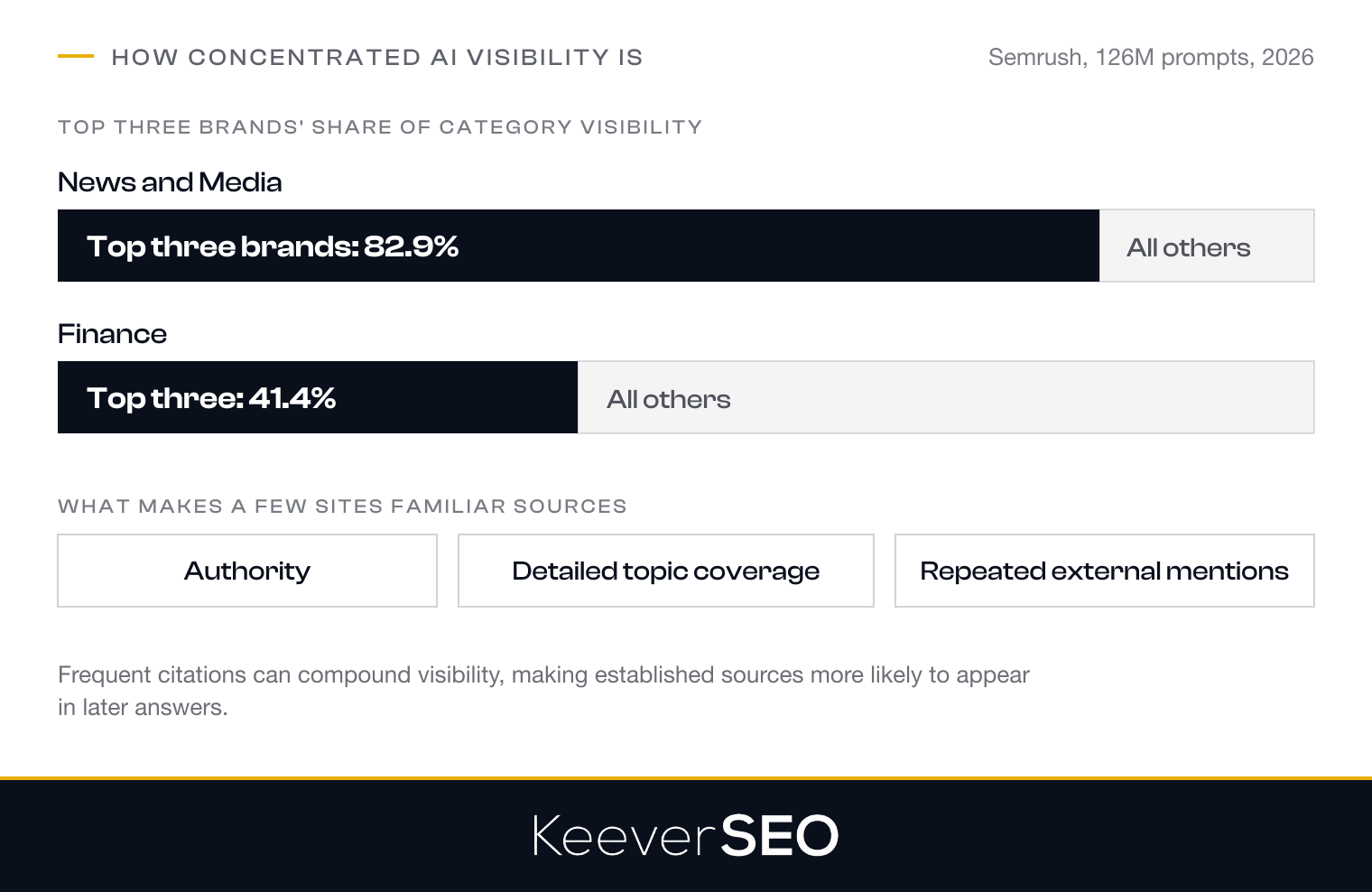
Concentration varies by category: "the three most visible brands accounted for 82.9% of total category visibility" in News and Media, while the top three held 41.4% in Finance, according to the Semrush press release "Semrush Releases Expanded 2026 AI Visibility Index, Analyzing 126 Million AI Search Prompts," June 2026. Frequent citations can compound visibility by making established sources more likely to appear in later answers.
How Do You Rank Your Website in AI Search Engines?
To rank your website in AI search engines, improve crawler access, page structure, site speed, structured data, and topic coverage. Publish direct, fact-dense content, add original research, create use-case and comparison pages, earn mentions on independent websites, and track AI citations.
The ten steps move from technical access to content quality, external authority, and measurement. Ranking begins by allowing AI crawlers to reach and retrieve your website.
1. Let AI Crawlers Access Your Website
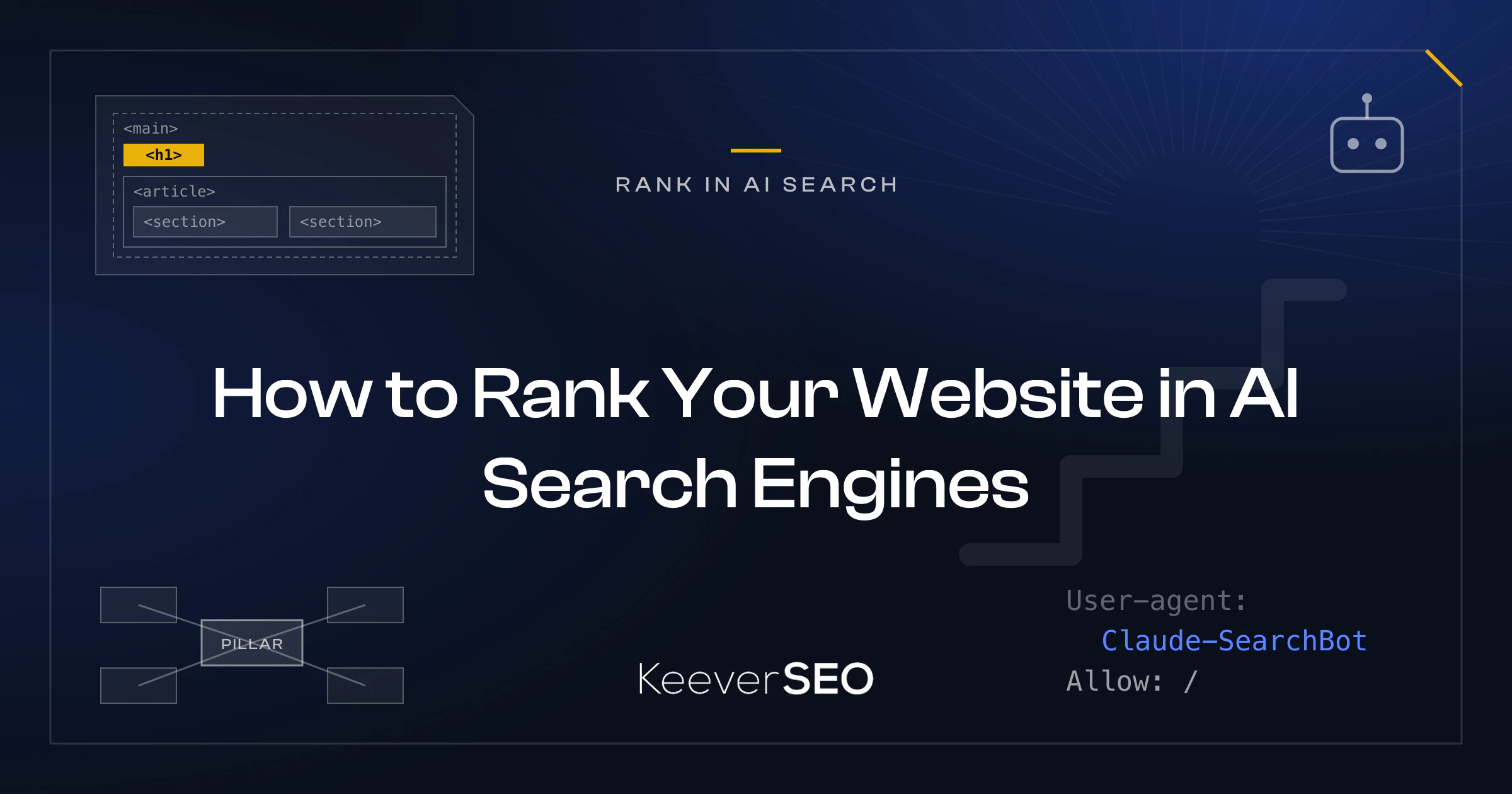
Letting AI crawlers access your website comes first, because crawlers must reach your important pages before AI search engines can retrieve them. Allow relevant crawler user agents in robots.txt and configure firewall, CDN, and bot-protection rules so those crawlers can access public content.
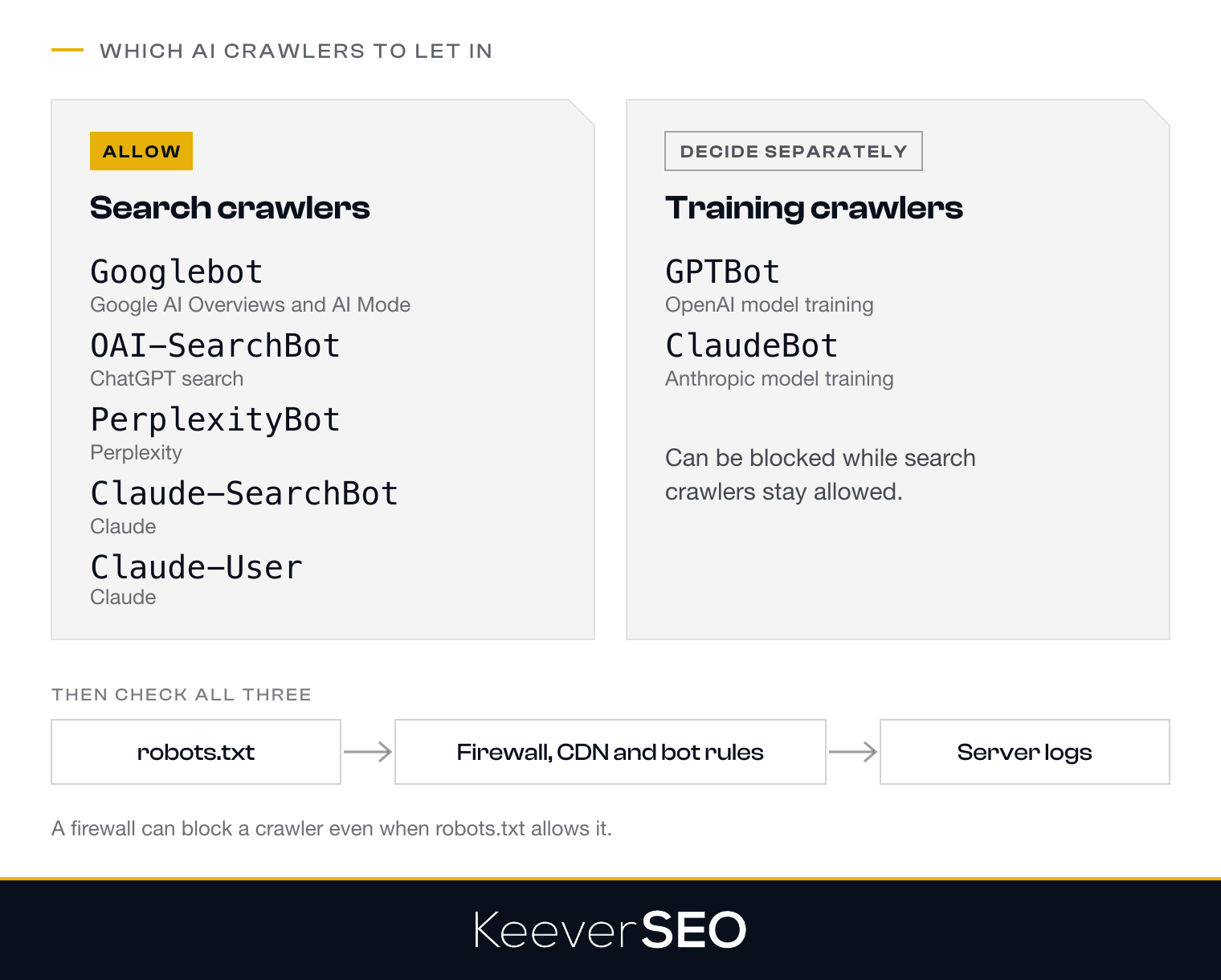
The relevant user agents include Googlebot, PerplexityBot, OAI-SearchBot for ChatGPT search, and Claude-SearchBot and Claude-User for Claude. GPTBot and ClaudeBot relate to model training, so decide separately whether to permit them. Check server logs and published crawler IP ranges, because firewalls can block access even when robots.txt allows a crawler.
2. Use Semantic HTML and Fragment-Friendly Page Structure
Semantic HTML and a fragment-friendly page structure help AI search engines interpret a website's content. Use tags such as <main>, <article>, and <section> to identify page regions and separate distinct topics.
A clear heading hierarchy shows AI systems how page sections relate. Use one <h1> for the page title, <h2> headings for main topics, and <h3> headings for related subtopics. Write each section as a focused passage that answers one question for readers, though "there's no requirement to break your content into tiny pieces for AI to better understand it," according to "Google's Guide to Optimizing for Generative AI Features on Google Search," published by Google Search Central in May 2026.
3. Speed Up Server Response and Core Web Vitals
Speeding up server response and Core Web Vitals helps AI search engines retrieve website content reliably. Reduce timeouts and redirect chains, and return the page's main content in a successful response. Server-rendered or statically rendered HTML places content in the initial response, which helps crawlers that execute JavaScript inconsistently.
Core Web Vitals measure loading speed, responsiveness, and visual stability. Aim for a Largest Contentful Paint of 2.5 seconds or less, an Interaction to Next Paint below 200 milliseconds, and a Cumulative Layout Shift of 0.1 or less at the 75th percentile. The targets support usability and reliable retrieval, but they do not guarantee AI search citations.
4. Add Schema Markup That Connects Your Entities
Schema markup that connects your entities gives search systems structured information about your organization, products, services, and articles. Add Organization schema for your business, Product or Service schema to relevant service pages, and Article or BlogPosting schema to editorial pages. Google's "Introduction to structured data markup in Google Search" states that "Google uses structured data that it finds on the web to understand the content of the page."
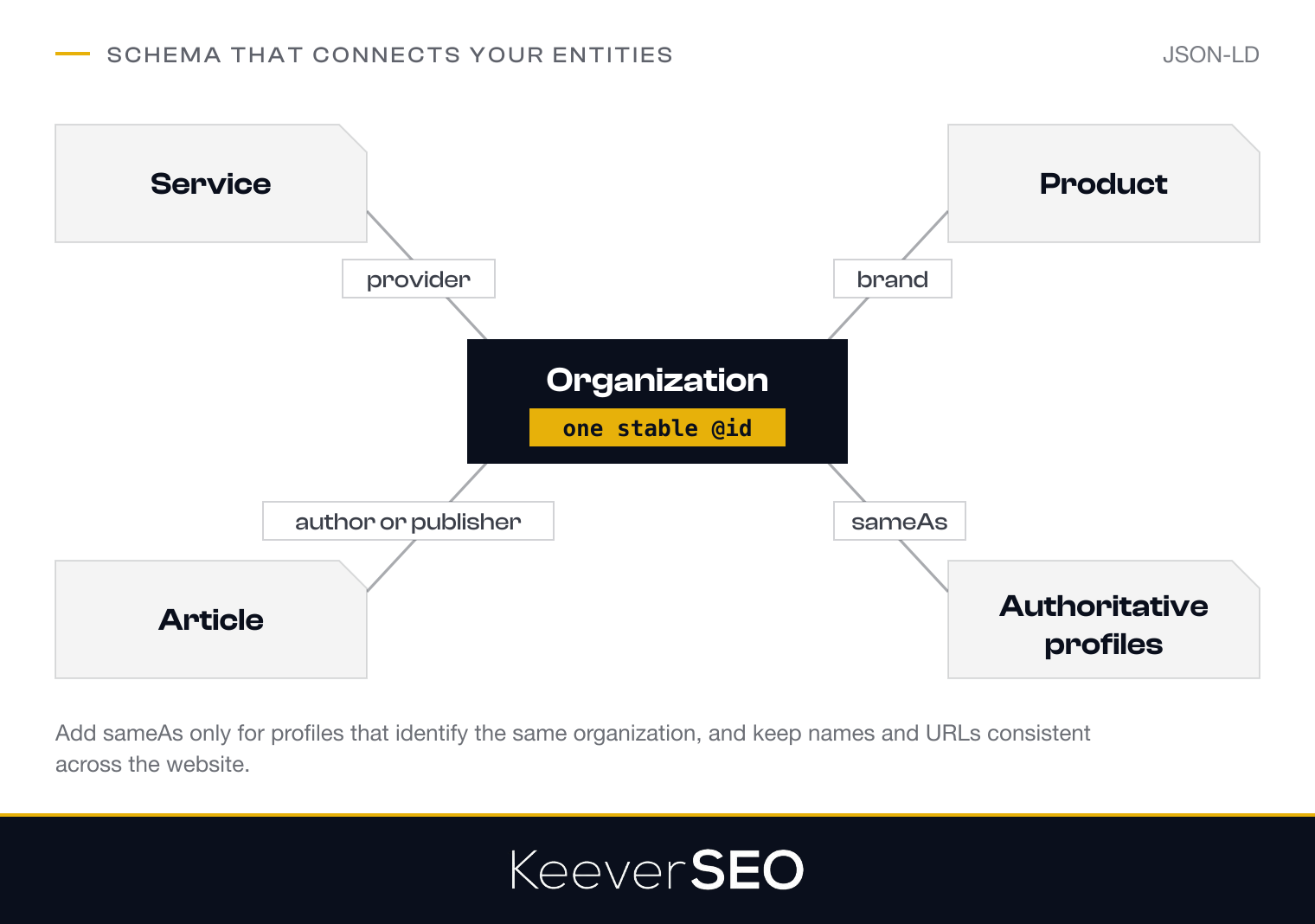
Use JSON-LD to describe each entity, then connect related records with consistent identifiers. Assign the organization a stable @id and reference that identifier as the provider, brand, author, or publisher where appropriate. Add sameAs links only to authoritative profiles that identify the same organization, and keep names and URLs consistent across your website.
5. Build Topic Clusters That Cover Every Fan-Out Question
Topic clusters that cover every fan-out question help a website rank in AI search engines by connecting a pillar page with focused supporting pages. A pillar page explains the main subject, while cluster pages answer related sub-questions, long-tail queries, and use cases.
Map the fan-out questions users ask after their primary query, then create a useful page for each important question. Link each supporting page to the pillar page, and link related cluster pages with descriptive anchor text when the connection helps readers. Avoid mass-producing pages, because Google's generative AI guide states that creating separate content for fan-out variations "primarily to manipulate rankings or generative AI responses in Google Search violates Google's scaled content abuse spam policy."
6. Write Fact-Dense, Answer-First Content
Fact-dense, answer-first content raises a website's chances of being retrieved and cited in AI search engines. Place the direct answer beneath each relevant heading, then support it with concrete facts, definitions, examples, or sources.
Keep each section focused on one question and readable on its own. Short paragraphs, descriptive headings, and concise lists help AI systems extract relevant passages, while filler and vague claims weaken clarity.
7. Publish Original Data and Information Gain
Publishing original data and information gain helps a website rank in AI search engines by giving AI systems distinct evidence to retrieve and cite. Surveys, industry benchmarks, customer case studies, controlled tests, and analyses of company datasets can reveal findings that consensus sources do not provide.
Describe the sample, methodology, dates, and caveats so readers and AI systems can assess each finding. Present results plainly, with charts or tables when they clarify the evidence. Google's "Creating helpful, reliable, people-first content" asks whether "the content provide[s] original information, reporting, research, or analysis" rather than repeating existing sources.
8. Create Pages for Every Use Case and Comparison
Pages for every use case and comparison help AI search engines match your website to recommendation prompts. A use-case page explains how a product or service serves a defined audience, such as emergency plumbing for landlords or accounting software for nonprofits. Describe the relevant requirements, benefits, trade-offs, processes, expected outcomes, and supporting evidence.
Comparison and alternatives pages explain differences in features, pricing factors, ideal users, and trade-offs. Organize each page around real customer questions, use descriptive headings, and give direct answers. Avoid thin pages that only replace a location or keyword, because each page should provide useful, audience-focused information that AI systems can retrieve as a complete passage.
9. Earn Mentions on Non-Owned Channels and Communities
Mentions on non-owned channels and communities help AI search engines identify and cite your business. Earn coverage through digital PR by sharing original research, useful benchmarks, expert commentary, or company data with journalists and industry publishers. Maintain accurate profiles on relevant review platforms and industry directories, and encourage customers to leave genuine, detailed reviews.
Answer questions on Reddit and relevant forums with useful information, disclose your affiliation, and mention your business only when it fits the discussion. Prioritize authoritative, industry-relevant sources over large volumes of low-quality listings, and keep your business name, services, location, and other main facts consistent across channels. A reliable off-site information trail helps AI systems retrieve and synthesize your brand in recommendations and comparisons.
10. Track Where AI Search Engines Mention Your Brand
Tracking where AI search engines mention your brand shows whether Google AI Overviews, ChatGPT, Perplexity, and Claude name your business or cite your website. Run a fixed set of non-branded prompts on a set schedule across each platform, covering informational, comparison, recommendation, and use-case searches. Record brand mentions, cited pages, recommendations, and competitor appearances.
Measure citation share by comparing how frequently your domain appears as a cited source against competitors. Track results by engine, topic, and search intent, and note which URLs receive citations. Monitor AI referral visits and conversions in analytics, and use the Generative AI performance report in Google Search Console for Google's generative AI features.
Do Google Rankings Help a Website Rank in AI Search?
Yes, Google rankings help a website rank in AI search, especially in Google AI Overviews, but they do not guarantee citations. A March 2026 Ahrefs study by Louise Linehan, "Update: 38% of AI Overview Citations Pull From The Top 10," found that "37.9% of URLs cited in AI Overviews also appeared within the first 10 blocks," with 31.2% from positions 11 to 100 and 31.0% from beyond the top 100. The Ahrefs data shows that AI systems reach well beyond the top results, so direct relevance and usefulness count too. Google SEO provides a foundation for AI visibility, while clear, answer-focused content improves a page's fit for generated answers.
Can Small Websites Rank in AI Search Engines?
Yes, small websites can rank in AI search engines through focused niche coverage, original data, and relevant community mentions. AI search engines have no simple site-size threshold and cite smaller sites when pages are accessible, useful, and closely match a user's question. Profound's 2026 analysis of 11.84 billion citations, "Where do AI citations come from?" by Jasman Singh, found that "the biggest source of AI citations isn't the press or Reddit or YouTube; rather, it is a long tail of company websites." Surveys, case studies, and first-hand findings give a specialized website evidence that broader sources lack, though competition means citations are never guaranteed.
Should You Block AI Crawlers From Your Website?
No, you should not block every AI crawler if you want your website to appear in AI search results. Search crawlers such as OAI-SearchBot and Claude-SearchBot retrieve pages for search, while GPTBot and ClaudeBot relate to model training, according to OpenAI's "Overview of OpenAI Crawlers" and Anthropic's "Does Anthropic crawl data from the web, and how can site owners block the crawler?" Website owners can block training crawlers while allowing search crawlers in robots.txt and firewall rules. Google's AI features follow standard Googlebot controls, and robots.txt does not protect private content.
Which Pages Should a Local Service Business Rank in AI Search First?
The pages a local service business should rank in AI search first are core service pages, followed by useful location or service-area pages. Each service page should explain the work, customers served, coverage area, expected timeline, qualifications, and next step.
Location pages should describe places where the business operates and include local evidence, such as completed projects or customer reviews. Pricing, process, and FAQ content should answer questions about costs, timing, preparation, and payment, with links to relevant service pages.
When Should You Get Help to Rank a Website in AI Search Engines?
You should get help to rank a website in AI search engines when crawler access, indexing, or technical configuration prevents search engines from finding main pages. Large websites, complex site structures, and competitive markets may need coordinated technical fixes, wider content coverage, and credible mentions beyond the company's own website.
Businesses with thin capacity for digital PR, review generation, directory listings, or community participation can use experienced support to manage ongoing work. A useful engagement starts with a technical and content audit, then prioritizes fixes, and no provider can guarantee citations in AI-generated answers.
How Does Keever SEO's AI Optimization Service Rank Service Businesses in AI Search Engines?
Keever SEO's AI optimization service ranks service businesses in AI search engines by making them easier to retrieve and cite. The AI ranking SEO company service checks crawler access, adds structured schema markup, and organizes service information into clear, answer-first content.
Keever SEO builds visibility beyond a company website through reviews, directories, digital PR, Reddit discussions, and industry mentions. The service tracks brand citations, sentiment, and share of voice across platforms such as ChatGPT, Gemini, Perplexity, and Google AI Overviews.
How Do You Rank on Each AI Search Engine?
To rank on each AI search engine, make your website crawlable, well structured, authoritative, and useful. The same core practices support visibility in Google AI Overviews, ChatGPT, Perplexity, and Claude, but each platform retrieves and evaluates sources differently. A strong result on one engine does not guarantee a citation on a different engine, and the sections below explain the practical priorities for each platform.
How Do You Rank in Google AI Overviews?
To rank in Google AI Overviews, build organic visibility, cover related fan-out questions, and provide direct answers in clear sections. Google's "AI features and your website" states that "there are no additional requirements to appear in AI Overviews or AI Mode, nor other special optimizations necessary," and strong organic rankings do not guarantee an AI Overview citation.
How Do You Rank in ChatGPT?
To rank in ChatGPT, make your pages discoverable through Bing and allow OpenAI's OAI-SearchBot to crawl them. Trusted mentions on reputable websites and directories strengthen your brand's visibility. Clear, consistent facts about your services, locations, and customers help ChatGPT identify your business.
How Do You Rank in Perplexity?
To rank in Perplexity, publish fresh, well-cited pages that answer the user's question early and present clear, concrete facts. Credible reviews, industry publications, and useful contributions in Reddit discussions and relevant forums reinforce your brand's visibility in Perplexity's web results.
How Do You Get Mentioned in Claude?
To get mentioned in Claude, allow Anthropic's search-related crawlers, Claude-SearchBot and Claude-User, to access your website. Brave Search was added as an Anthropic subprocessor when Claude web search launched in March 2025, according to the TechCrunch report "Anthropic appears to be using Brave to power web search for its Claude chatbot," so strong visibility in web search indexes supports retrieval. Reputable reviews, industry directories, editorial coverage, and relevant community mentions give Claude additional information about your brand and reputation.
How Do You Get Recommended by AI Assistants?
To get recommended by AI assistants, keep your public facts consistent and matched to the user's needs. Keep the business name, services, service area, contact details, pricing, and credentials accurate across the website, directories, and review platforms.
Genuine customer reviews and trusted third-party mentions provide independent evidence about a business. Comparison pages, alternatives pages, and use-case pages explain which customers, needs, and budgets the business serves best.
What Is the Fastest Way to Start Ranking in AI Search Engines?
The fastest way to start ranking in AI search engines is to allow search crawlers and improve pages that already rank. Check robots.txt rules, firewall settings, page status codes, and rendering so AI search crawlers can retrieve your content.
Rewrite strong pages with direct answers near the beginning, clear headings, verifiable facts, and concise passages. Crawler access and answer-first updates provide a practical starting point for the full process of ranking your website in AI search engines.