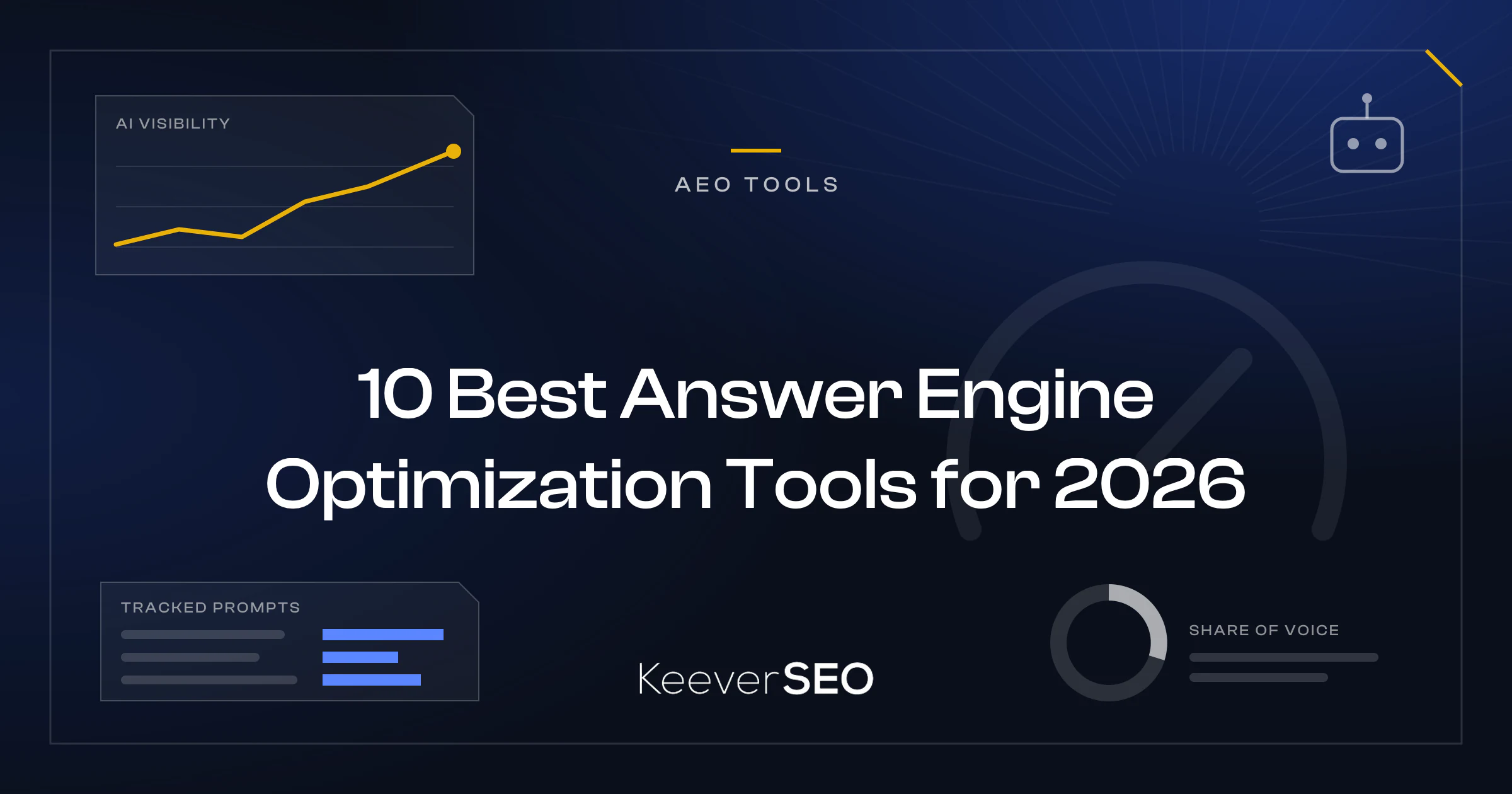
The best answer engine optimization tools for 2026 are Profound, Semrush AI Toolkit, Ahrefs Brand Radar, Peec AI, Scrunch AI, AthenaHQ, Otterly.ai, SE Ranking, Conductor, and Frase. An AEO tool is software that tracks how answer engines mention and cite a brand, then helps teams improve that visibility. The ranked tools suit different needs, from enterprise tracking to content planning, as listed below:
- Profound: enterprise, multi-engine visibility tracking.
- Semrush AI Toolkit: AI visibility tracking for existing Semrush teams.
- Ahrefs Brand Radar: large-scale brand-mention and competitor research.
- Peec AI: multilingual and multi-country prompt tracking.
- Scrunch AI: AI crawler analytics and enterprise AEO.
- AthenaHQ: visibility tracking paired with content recommendations.
- Otterly.ai: affordable AI Overview and chatbot answer monitoring.
- SE Ranking: combined SEO rank tracking and AI visibility.
- Conductor: enterprise content workflows with AI visibility data.
- Frase: question research and answer-focused content briefs.
The ranking considers engine coverage, prompt and citation depth, reporting, usability, workflow support, and price. AEO tools track prompts and citations, attribute AI-referred traffic, analyze AI crawler activity, and guide content optimization. Unlike SEO rank tracking, AEO tracking measures brand mentions and citations across changing answers, rather than fixed keyword positions. Free tiers, AI visibility graders, and manual prompt checks offer basic monitoring, but they restrict prompt volume, engine coverage, history, or exports. Published plans start at $29 per month for entry-level tracking and run from about $100 to $500 per month for mid-market tools, while enterprise pricing requires a custom quote.
Teams should avoid tracking too few prompts, treating one run as conclusive, buying enterprise software prematurely, or collecting data without acting on it. Local service businesses can start with an affordable tracker or a free grader and recurring manual checks, and a managed AEO service suits businesses that need content, schema, and citation improvements implemented. GEO tracking tools, supporting SEO platforms, and answer-first content techniques complete a broader AEO program. The ranked list begins with Profound, the strongest fit here for enterprise, multi-engine AI visibility tracking.
1. Profound — Best Enterprise Platform for Multi-Engine AI Visibility Tracking
Profound is the best enterprise platform for multi-engine AI visibility tracking because it monitors brand mentions, citations, prompts, and competitor visibility across answer engines. Its supported platforms include ChatGPT, Gemini, and Google AI Overviews, and its Enterprise plan tracks "up to 9 Answer Engines."
Profound suits large marketing, SEO, communications, and public-relations teams that need detailed reporting, regional tracking, and security controls such as SSO/SAML and SOC 2 compliance. Its main weakness is cost visibility: Profound's pricing page offers a free trial of "50 prompts run daily for 7 days" and a custom Enterprise plan, with no self-serve paid price published.
2. Semrush AI Toolkit — Best for Teams Already Running SEO in Semrush
Semrush AI Toolkit is the best fit for teams already running SEO in Semrush because AI visibility sits beside their existing data. The toolkit tracks brand visibility across ChatGPT, Google AI Overviews, Google AI Mode, and Gemini, and it reports brand mentions, citations, share of voice, sentiment, competitor comparisons, and related prompts.
The toolkit suits SEO and marketing teams that already use Semrush for keyword research, rank tracking, technical audits, and content workflows. One weakness is its prompt allowance: Semrush's Starter SEO + AI Search plan costs $199 per month, or $165.17 per month billed annually, and includes 50 prompts tracked daily, so wider tracking raises costs.
3. Ahrefs Brand Radar — Best for Large-Scale Brand Mention Data
Ahrefs Brand Radar is the best tool for large-scale brand mention data, with an index covering "519 million real prompts." The platform monitors mentions and citations across ChatGPT, Perplexity, Gemini, Microsoft Copilot, and Google AI Overviews, then compares competitor share of voice.
Large brands, agencies, and research teams can use Brand Radar to find commonly cited pages and benchmark category visibility. Ahrefs lists custom prompts from $50 per month, an AI Visibility Index at $199 per month, and $699 per month for all models. Estimated impressions and share of voice indicate modeled visibility, not actual visits or conversions.
4. Peec AI — Best for Multilingual Prompt Tracking
Peec AI is the best tool for multilingual prompt tracking because marketing teams can run the same prompts across countries and compare brand visibility by market. Peec AI tracks brand mentions, citations, sentiment, and share of voice across answer engines, including ChatGPT, Google AI Overviews, Gemini, Microsoft Copilot, and Perplexity.
Peec AI suits international agencies that manage multiple brands through separate client projects, shared reporting, and centralized billing. Peec AI's Starter plan costs $95 per month for 50 prompts and three chosen models, Pro costs $245 for 150 prompts, and Advanced costs $495 for 350 prompts.
5. Scrunch AI — Best for AI Crawler Analytics and Enterprise AEO
Scrunch AI is the best tool for AI crawler analytics and enterprise AEO because its crawler reports show which AI agents visit a website, which pages they access, and how frequently they crawl those pages. Scrunch AI tracks brand mentions, answer positions, sentiment, competitors, and citations across platforms such as ChatGPT, Claude, Gemini, Perplexity, and Google AI Overviews.
Enterprise teams can filter visibility data by prompt, topic, country, platform, and funnel stage. Scrunch AI's Core plan costs $250 per month, while enterprise pricing is custom, which makes the platform less suitable for small teams with basic monitoring needs.
6. AthenaHQ — Best for AEO-Focused Content Optimization
AthenaHQ is the best tool for AEO-focused content optimization because it pairs AI visibility tracking with content recommendations that connect citation gaps to on-page and off-page actions. The platform monitors brand mentions, citations, competitors, sources, and sentiment across ChatGPT, Perplexity, Google AI Overviews, Gemini, and Claude.
AthenaHQ suits growing marketing teams, agencies, and enterprise organizations coordinating SEO, content, and communications work. AthenaHQ's Starter plan is listed at $295 per month, with visibility across 11 models and 3,600 monthly credits, and credit-based usage can cap tracking.
7. Otterly.ai — Best for Affordable AI Overview and Answer Monitoring
Otterly.ai is the best tool for affordable AI Overview and answer monitoring, tracking brand mentions and website citations in Google AI Overviews, ChatGPT, Perplexity, and Microsoft Copilot. Otterly.ai's Lite plan is listed at $29 per month for 15 prompts, which makes it a lower-cost option for small businesses and lean marketing teams.
Otterly.ai reports competitors, sentiment, and citation changes over time. Its main weakness is that Google AI Mode, Gemini, and Claude are paid add-ons, while tracking more prompts raises the monthly cost, with Standard at $189 for 100 prompts and Premium at $489 for 400 prompts.
8. SE Ranking — Best for Combining SEO and AEO Tracking in One Platform
SE Ranking is the best tool for combining SEO and AEO tracking in one platform, bringing traditional SEO tools and AI search visibility monitoring into one dashboard. The platform tracks keyword rankings, site health, brand mentions, citations, competitors, and sentiment across supported sources such as Google AI Overviews, ChatGPT, Gemini, and Perplexity.
SE Ranking suits in-house marketing teams and agencies that manage SEO and AEO together. Its main weakness is that wider AI tracking has prompt and usage caps, while expanded research may require a separate subscription.
9. Conductor — Best for Enterprise Content and AEO Workflows
Conductor is the best tool for enterprise content and AEO workflows because it combines AI search visibility tracking with traditional SEO, website performance data, and content workflows. Its AI Search Performance features monitor brand mentions, citations, sentiment, and visibility across answer engines such as ChatGPT and Perplexity, and page-level reporting connects visibility data with traffic and engagement.
Conductor suits large content, SEO, and marketing teams that need shared reporting, governance, and workflows for improving content. Its enterprise focus, custom pricing, and heavy setup make Conductor less suitable for small businesses seeking a lightweight tracker.
10. Frase — Best for Answer-Focused Content Briefs
Frase is the best tool for answer-focused content briefs, built as a content research and optimization tool. Its question research gathers queries from Google's People Also Ask, Reddit, Quora, and answer engines, then groups questions by intent, and Frase analyzes competing pages to identify common topics, headings, and content gaps.
Content teams use Frase to plan FAQ sections, comparison pages, and other question-led articles. Its weakness is that Frase focuses on content research rather than full AI prompt and citation tracking. Frase's Starter plan costs $39 per month billed yearly, with Professional at $103 and Scale at $239.
How Were the Best Answer Engine Optimization Tools Ranked for 2026?
The best answer engine optimization tools were ranked by engine coverage, tracking depth, reporting quality, ease of use, and price. Engine coverage considered support for ChatGPT, Perplexity, Google AI Overviews, Gemini, Claude, and Microsoft Copilot. Tracking depth and reporting assessed prompt consistency, historical results, competitor and citation data, and actionable recommendations. Price and usability were weighed against each platform's features and the needs of different team sizes, and those criteria lead into the core jobs an AEO tool performs.
What Does an AEO Tool Actually Do?
An AEO tool measures how answer engines mention and cite a brand, then identifies ways to improve that visibility. Answer engine optimization software connects brand mentions, source citations, AI-referred website visits, and content opportunities.
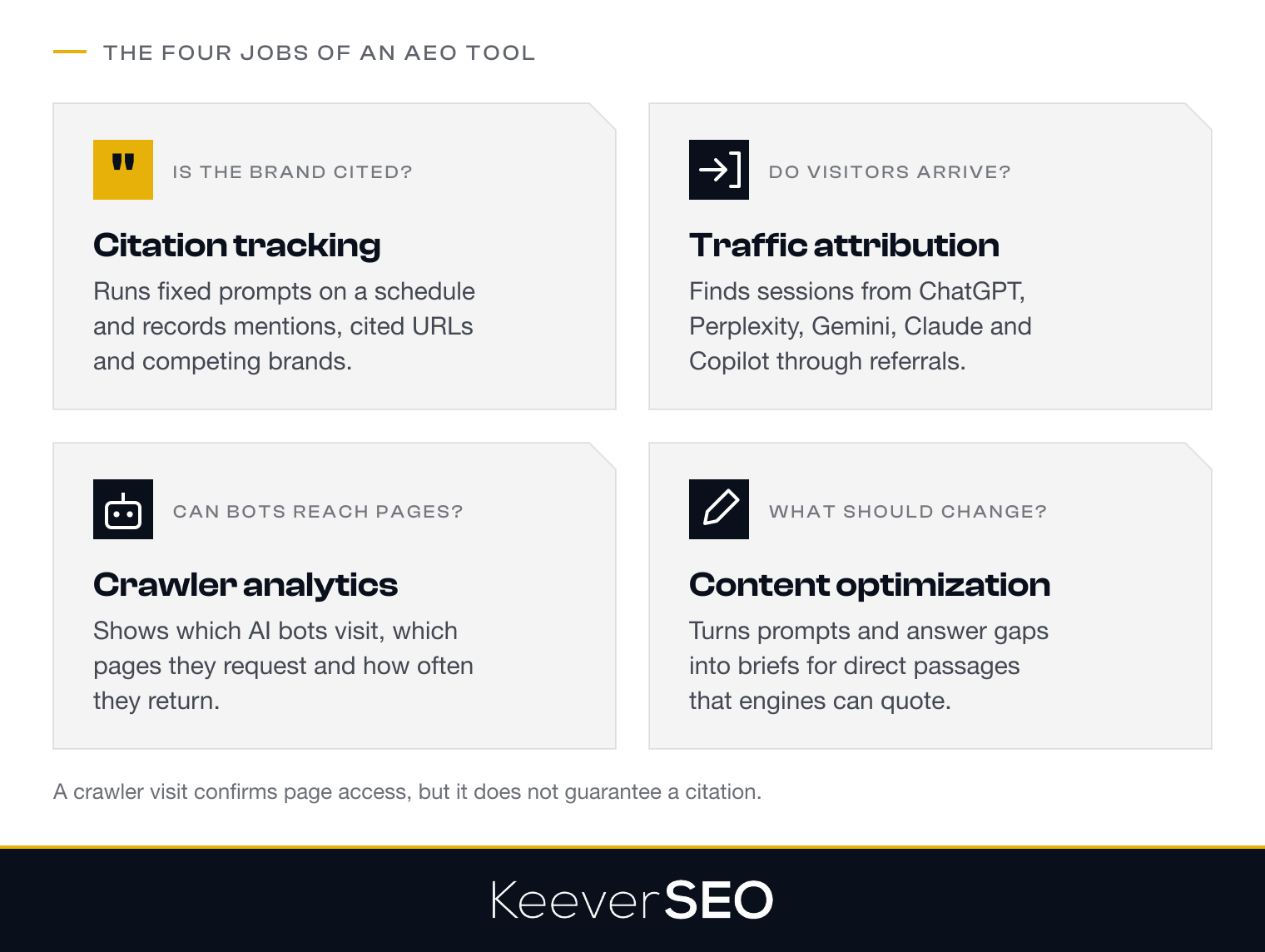
AEO tools support four related jobs: prompt and citation tracking, AI traffic attribution, AI crawler analytics, and answer-focused content optimization. Together, the four functions show whether AI platforms find a brand's pages, cite them in answers, and send visitors to the website.
Prompt and Citation Tracking
Prompt and citation tracking measures whether answer engines mention a brand and cite its pages. An AEO tool runs a fixed set of conversational prompts across engines such as ChatGPT, Perplexity, Gemini, and Google AI Overviews on a recurring schedule. The tool records brand mentions, cited URLs, competing brands, and the context or position of each appearance. Repeated runs reveal changes in citation rates and show which prompts need stronger content coverage.
AI Traffic Attribution
AI traffic attribution identifies website sessions that arrive from ChatGPT, Perplexity, Gemini, Claude, and Copilot. Analytics platforms detect referrals through source domains, UTM parameters, or custom channel groups. Teams can compare visits, engagement, and conversions by AI engine, although some mobile app referrals appear as direct traffic. AI traffic reports therefore measure trackable referrals, not every visit influenced by an AI-generated answer.
AI Crawler Analytics
AI crawler analytics records which AI bots visit a website, which pages they request, and how frequently they return. Server logs, CDN reports, and bot-management platforms capture crawler activity that standard JavaScript analytics may miss. Teams use crawler data to check whether bots such as GPTBot and OAI-SearchBot can access important pages and to find blocked URLs or repeated errors. A crawler visit confirms page access, but it does not guarantee that an AI-generated answer will cite the page.
Answer-Focused Content Optimization
Answer-focused content optimization structures pages so answer engines can extract and cite relevant information. Question research identifies customer prompts, related follow-up questions, and topics where competitors earn citations. Answer gap analysis compares those prompts with the questions and evidence covered on each page. A content brief then guides direct answers, descriptive headings, supporting sources, FAQs, and concise passages that answer engines can quote.
How Is AEO Tracking Different From SEO Rank Tracking?
AEO tracking is different from SEO rank tracking because AEO tracking measures whether an answer engine mentions or cites a brand for a given prompt, while SEO rank tracking measures a webpage's position for a target keyword in search results.
AEO tools record mentions, citations, citation share, and competitor visibility across AI answers. AI answers change between runs because models, sources, and prompt context change, so teams compare repeated results rather than relying on one response.
Are There Free Answer Engine Optimization Tools?
Yes, there are free answer engine optimization tools, including free tiers and trials, AI visibility graders such as HubSpot's AI Search Grader, and manual prompt testing. HubSpot describes its grader as "a free, one-time check that reveals what ChatGPT, Perplexity, and Gemini say about you based on their training data," so it reads model perception rather than live citations. Manual testing compares a consistent set of questions across ChatGPT, Perplexity, and Gemini, then records brand mentions and citations. Free options restrict prompts, platforms, historical tracking, automated reports, and competitor analysis.
How Much Do Answer Engine Optimization Tools Cost?
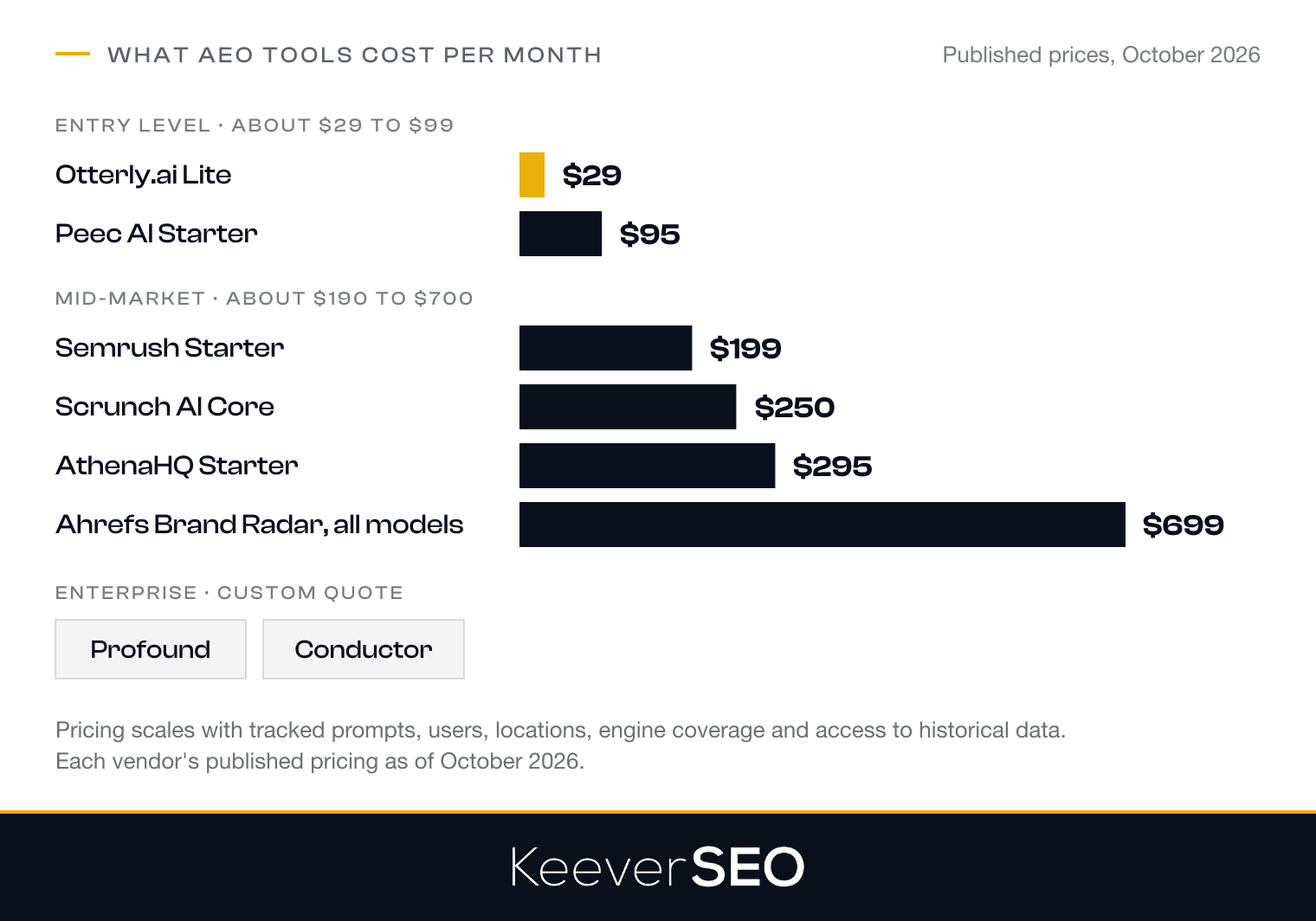
Answer engine optimization tools cost about $29 to $99 per month for entry-level monitoring, $190 to $700 per month for mid-market plans, and custom quotes for enterprise platforms. Otterly.ai's Lite plan ($29) and Peec AI's Starter plan ($95) mark the entry level, while Semrush's Starter SEO + AI Search plan ($199) and Ahrefs Brand Radar's all-models price ($699) mark the mid-market range, according to each vendor's published pricing as of October 2026. Pricing scales with tracked prompts, users, locations, engine coverage, and access to historical data.
Which AEO Tool Mistakes Should You Avoid?
The AEO tool mistakes to avoid reduce tracking accuracy and waste budget. The main mistakes are listed below:
- Tracking too few prompts or only branded queries
- Treating one AI answer run as a final result
- Buying enterprise software before lower-cost options meet reporting needs
- Collecting visibility data without improving content, technical access, or trusted mentions
Which AEO Tool Fits a Local Service Business Budget?
The AEO tool that fits a local service business budget is Otterly.ai's Lite plan, for a business that needs recurring AI visibility tracking at low cost. The plan is listed at $29 per month for 15 prompts across ChatGPT, Google AI Overviews, Perplexity, and Microsoft Copilot.
A business with only a few important pages can start with a free AI visibility grader and manual prompt checks in ChatGPT, Perplexity, and Gemini. The free approach provides a basic snapshot, while a paid tracker supplies recurring data for service, location, and competitor prompts.
When Is a Managed AEO Service Better Than an AEO Tool?
A managed AEO service is better than an AEO tool when a business needs implementation alongside visibility measurement. An AEO tool reports brand mentions, citations, competitors, and visibility gaps, while an internal team must carry out the recommended work.
A managed service uses those findings to improve answer-focused content, implement or correct schema markup, and strengthen third-party mentions and citations. Businesses with thin content, SEO, or development capacity can use a managed service to turn AEO data into ongoing optimization.
How Does Keever SEO Use AEO Tools to Track and Grow Client Citations?
Keever SEO uses AEO tools to track and grow client citations by monitoring each client's priority prompts across ChatGPT, Perplexity, Gemini, and Google AI Overviews. The AI citation SEO agency team tracks brand mentions, citations, cited URLs, competitors, sentiment, and share of voice.
Keever SEO prepares monthly citation reports that compare results with baseline performance and identify prompts with missing citations. The team uses those findings to update answer-focused content, headings, schema markup, internal links, entity signals, and AI crawler access, then monitors whether the changes improve citations and referral traffic.
Which Tools Track Generative Engine Optimization?
The tools that track generative engine optimization are most answer engine optimization tools, because both disciplines measure brand visibility in AI-generated answers. Profound, Semrush AI Toolkit, Ahrefs Brand Radar, Peec AI, Scrunch AI, AthenaHQ, Otterly.ai, SE Ranking, and Conductor report varying combinations of brand mentions, citations, cited pages, competitor share of voice, sentiment, and prompt visibility. Enterprise platforms may add AI crawler activity, source attribution, location-based tracking, and AI-referred sessions. GEO data sits alongside traditional SEO metrics, including rankings, clicks, and organic traffic.
Which Metrics Should GEO Tracking Report?
The metrics GEO tracking should report are brand mention rate, citation share, sentiment, and LLM referral traffic. Brand mention rate measures how frequently AI answers name a brand, citation share compares its website citations with competitors, sentiment classifies descriptions as positive, neutral, or negative, and LLM referral traffic records visits from AI platforms such as ChatGPT and Perplexity.
Which SEO Tools Complement Answer Engine Optimization Tools?
The SEO tools that complement answer engine optimization tools are keyword research tools, rank trackers, technical crawlers, and Google Search Console. Keyword research tools identify questions, topics, entities, and search demand for AEO prompt sets and content priorities. Rank-tracking platforms compare standard search positions with answer-engine visibility, and technical SEO crawlers detect crawl, indexing, rendering, and structured-data issues that can block content access. Google Search Console reports queries, pages, impressions, clicks, and countries, while URL Inspection provides page-level crawl and indexing details.
How Do AEO Tools Support Each AEO Technique?
AEO tools support each AEO technique by showing which prompts lack brand mentions and which competitors or sources receive citations. Prompt gaps and citation patterns help teams decide whether to create a page, update content, clarify structure, add schema, or build third-party coverage. Teams can compare the same prompts before and after targeted edits to identify changes linked to stronger citation visibility.
Which Answer Engine Optimization Tool Should You Choose in 2026?
The answer engine optimization tool you should choose in 2026 depends on team size, budget, and tracking needs. Enterprise teams can compare Profound and Conductor for broad AI visibility reporting, teams already using an SEO platform may prefer Semrush AI Toolkit or SE Ranking, and smaller teams can start with an affordable tracker such as Otterly.ai.
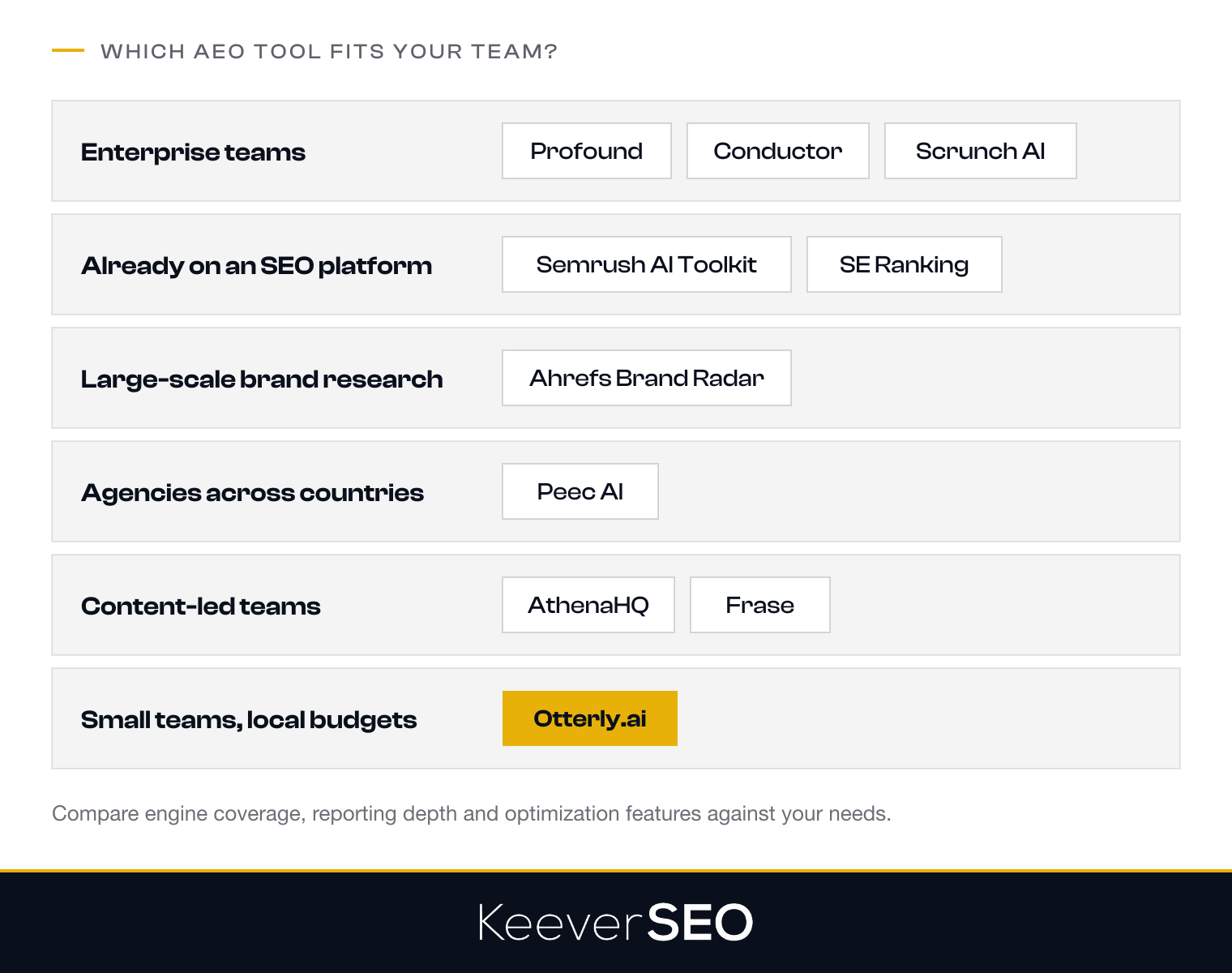
Agencies tracking multiple countries can consider Peec AI for multilingual prompt monitoring. Compare engine coverage, reporting depth, and optimization features against your needs, then use the ranked list of the best answer engine optimization tools for 2026 to choose a suitable platform.