Comparing AI search engines shows that SearchGPT, now ChatGPT Search, suits everyday questions, Perplexity suits cited research, Gemini and Google AI Mode suit Google users, and Copilot, Claude, Brave Search, and You.com serve more focused needs. An AI search engine retrieves web sources and generates a direct answer, with citations in most products. The engine interprets a question, finds relevant information, and synthesizes a response that users can verify or test through follow-up questions.
The comparison covers ChatGPT Search, Perplexity, Google AI Mode and Gemini, Microsoft Copilot, Claude, Brave Search, and You.com. The main differences between them are source citations, real-time web access, free and paid plans, and privacy. Perplexity fits source-heavy research, ChatGPT Search works well for broader everyday questions, and free options such as Perplexity and Google AI Mode suit different needs and access caps.
Local businesses should focus on visibility in Google AI results, ChatGPT, and Perplexity, while clear business facts, useful content, reviews, and accessible pages support discovery across engines. The sections below compare use cases, research quality, ranking factors, market share, and answer accuracy. The at-a-glance table opens the comparison with each engine's strengths, citations, web access, and plans.
How Do the Top AI Search Engines Compare at a Glance?
The top AI search engines compare as follows: SearchGPT (now ChatGPT Search) suits everyday questions, Perplexity suits cited research, Google AI Mode and Gemini fit Google users, and Copilot, Claude, Brave Search, and You.com serve more focused needs.
| Engine | Best For | Source Citations | Real-Time Web Access | Free Plan | Paid Plan Price |
|---|---|---|---|---|---|
| SearchGPT (ChatGPT Search) | Everyday questions, planning, and general assistance | Inline links and cited sources when search is used | Yes, through ChatGPT Search | Yes, with usage limits | Go: $8/month, Plus: $20/month, Pro: from $100/month |
| Perplexity | Source-heavy research and fact-finding | Numbered source links in citation-first answers | Yes, web search is central to the product | Yes, with limits on some features | Pro: $17/month billed annually, Max: $200/month |
| Google AI Mode and Gemini | Google Search and Google services users | Supporting links appear with AI responses | Yes, through Google Search and Gemini web features | Yes, with usage limits | Google AI Plus: $4.99/month, AI Pro: $19.99/month, AI Ultra: from $99.99/month |
| Microsoft Copilot | Bing search and Microsoft productivity users | Source links in web-grounded answers | Yes, through Bing and connected services | Yes | Microsoft 365 Premium: $19.99/month |
| Claude | Long-document analysis, writing, and complex reasoning | Citations on web search responses | Yes, on all plans | Yes, with usage limits | Pro: $20/month or $17/month billed annually, Max: $100/month, Ultra: $200/month |
| Brave Search | Privacy-focused search and independent indexing | AI answers provide source links | Yes, through Brave's search index | Yes | Varies by feature and region |
| You.com | Selectable AI models and specialized search modes | Source links vary by mode | Yes, through web-connected AI search | Yes, with limits | Varies by plan and billing cycle |
Plan prices come from each vendor's official pricing page as of October 2026 and can change.
What Is an AI Search Engine?
An AI search engine is a tool that retrieves information from web sources and generates a direct answer. Unlike a traditional search engine, which presents ranked links, an AI search engine synthesizes relevant information and may cite the sources behind its response.
AI search engines use natural-language processing to interpret questions and connect users with relevant web information. Users can ask follow-up questions, refine a search, or test related topics while the system retains the conversation's context.
How Does an AI Search Engine Work?
An AI search engine works by interpreting a question, retrieving relevant web pages, and synthesizing their information into an answer. Complex questions can prompt multiple searches, which helps the engine gather evidence from several sources.
The language model organizes retrieved evidence into a direct response and links claims to source pages. Inline links or numbered citations help readers check the original information.
Which AI Search Engines Are Compared?
The AI search engines compared are seven options across six profiles. ChatGPT Search represents conversational web search, while Perplexity represents citation-first research. Google AI Mode and Gemini represent Google's search and assistant products, and Microsoft Copilot represents Bing-powered search with Microsoft 365 integration. Claude represents web search paired with long-document reasoning, while Brave Search and You.com represent independent indexing, privacy options, and configurable AI search modes.
SearchGPT (ChatGPT Search)
SearchGPT (ChatGPT Search) began as "a temporary prototype of new AI search features" that OpenAI announced in "SearchGPT Prototype" in July 2024, and OpenAI brought it into ChatGPT with "Introducing ChatGPT search" on October 31, 2024. The tool retrieves current web information, links relevant sources, and supports follow-up questions within a continuing conversation.
ChatGPT Search suits everyday questions that need current information, such as news, local recommendations, and practical planning. Users can open source links or the Sources panel to check supporting material, since generated answers and citations can contain errors.
Perplexity
Perplexity is an AI search engine designed for current, source-backed research. Perplexity retrieves web pages in real time, synthesizes information from multiple sources, and places inline citations beside its answers so readers can check the original material.
Perplexity Pro Search conducts broader, multi-step research across web sources, academic papers, and forums, then organizes findings into a detailed response. Perplexity suits research, market analysis, and news questions where source transparency matters, and its free plan offers core search while Pro adds higher usage caps, file uploads, and access to advanced models.
Google AI Mode and Gemini
Google AI Mode and Gemini are Google's two AI search products, with AI Mode providing conversational, source-linked answers inside Google Search. Powered by Gemini models, AI Mode investigates complex questions through related searches, helpful web links, and follow-up questions, which makes it useful for in-depth research within Google.
Gemini is Google's broader multimodal AI assistant for research, writing, coding, image interpretation, and document summaries. Google AI Mode suits exploratory web searches, while Gemini suits tasks involving text, images, audio, and uploaded documents.
Microsoft Copilot
Microsoft Copilot is Microsoft's AI assistant for web search and workplace tasks. When web search is on, Copilot uses Bing to retrieve sources and can provide citations or links with its answers.
Copilot connects with Microsoft 365 apps such as Word, Excel, PowerPoint, Outlook, and Teams. Depending on the account and license, Copilot can use authorized work emails, files, chats, and meetings, which makes it useful for drafting documents, summarizing communications, and analyzing workplace information.
Claude
Claude is an AI assistant for long-document analysis and complex research. When web search is on, Claude retrieves current sources, and "every response includes citations, so you can easily verify sources yourself," according to Anthropic's "Enable and use web search" help article.
Claude's large context window supports analysis of research papers, contracts, and reports. Claude suits users who need structured reasoning across lengthy documents, while its paid Research feature can investigate a topic through multiple searches.
Brave Search and You.com
Brave Search and You.com are independent alternatives: Brave Search uses its own web index and provides AI Answers that summarize search results with source links. Ask Brave supports follow-up questions and wider research, which makes Brave useful for private web search and verifiable AI summaries.
You.com offers AI modes for quick answers, in-depth research, and specialized assistance. You.com suits users who want to choose how an AI search tool researches and presents information.
What Are the Key Differences Between AI Search Engines?
The key differences between AI search engines are source citations, real-time web access, free and paid plans, and privacy controls. Perplexity centers on cited answers, while ChatGPT Search combines web results with conversational responses, and each service sets its own search caps, subscription features, and data policies.
How Do AI Search Engines Differ in Source Citations?
AI search engines differ in source citations by how consistently they cite sources and display links. Perplexity places numbered references throughout its answers, while ChatGPT Search may show inline citations and a separate Sources panel when web search informs its response.
Google AI Mode, Microsoft Copilot, and Claude link to supporting sources in web-grounded answers, while responses without web search may show few or no citations. Citations help readers trace claims to webpages, but they do not confirm that an answer is accurate, so users should verify important details against the linked sources.
How Do AI Search Engines Differ in Real-Time Web Access?
AI search engines differ in real-time web access by whether they retrieve current web pages or answer from training data. ChatGPT Search can search the web automatically or when users select Search, while Perplexity retrieves web sources for queries and Google AI Mode connects answers to current information.
Live web retrieval helps answer questions about news, prices, schedules, laws, and availability. Models answering without web search rely on training data, which may not reflect recent changes, and cited sources still need checking because current pages can be incomplete or inaccurate.
How Do AI Search Engines Differ in Free and Paid Plans?
AI search engines differ in free and paid plans through caps on searches, messages, model access, file uploads, and research tools. Paid individual plans center on about $20 per month, although pricing and included features vary by provider.
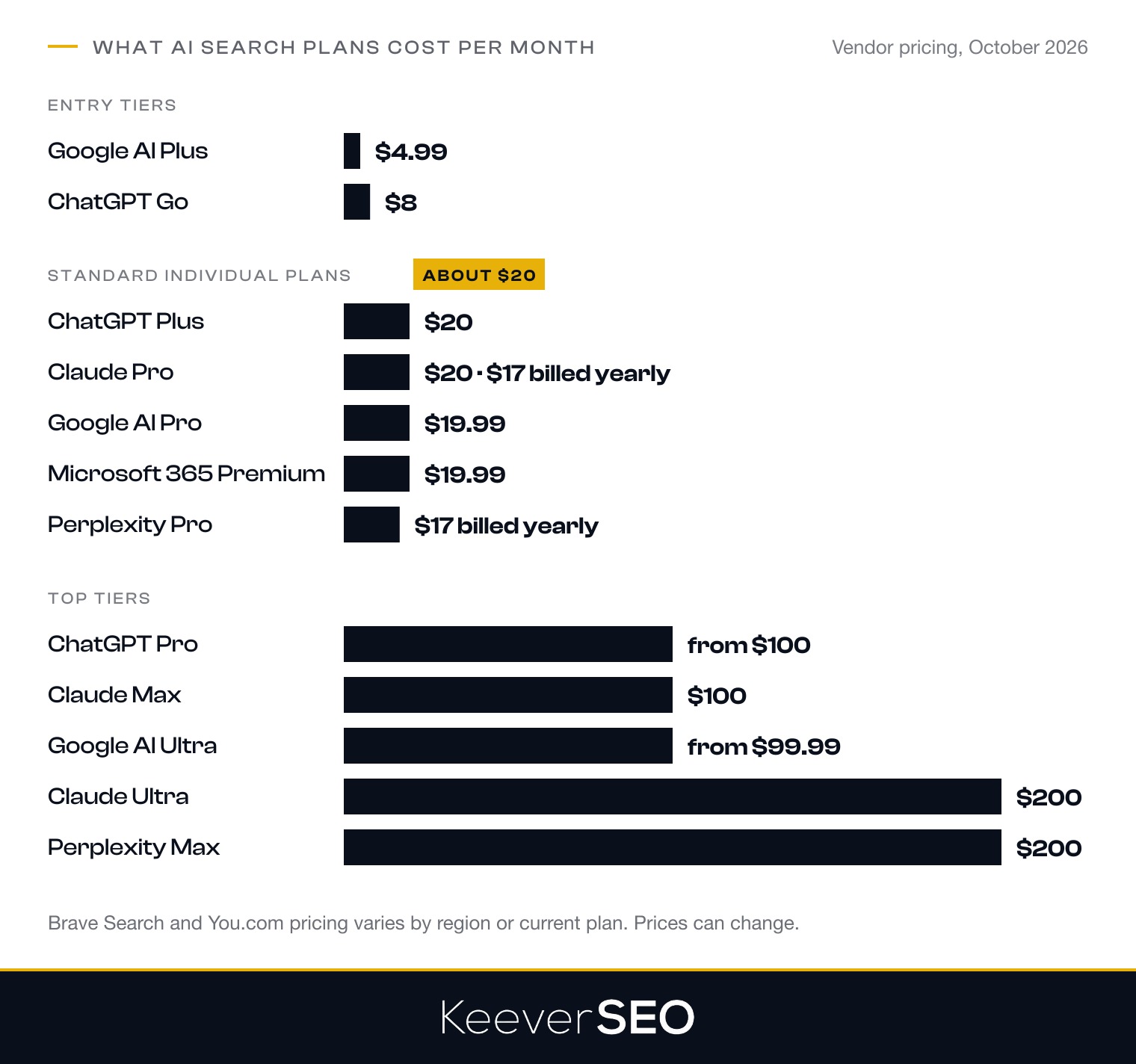
ChatGPT Plus costs $20 per month, Perplexity Pro costs $17 per month billed annually, and Google AI Pro and Microsoft 365 Premium each cost $19.99 per month, according to each vendor's pricing page as of October 2026. Claude Pro costs $20 per month, or $17 per month with an annual subscription. Higher tiers include ChatGPT Pro from $100, Claude Max at $100 and Ultra at $200, Google AI Ultra from $99.99, and Perplexity Max at $200. Brave Search and You.com pricing varies by region or current plan.
How Do AI Search Engines Differ in Privacy?
AI search engines differ in privacy by how they retain queries, use conversations for model training, and protect business data. OpenAI's "Data controls in ChatGPT" states that "on personal workspaces with ChatGPT Free, Plus, or Pro, data sharing is enabled by default," with an opt-out setting, and Perplexity's "Data Collection at Perplexity" states that "for Free, Perplexity Pro and Perplexity Max users, AI Data Retention is enabled by default," while "Perplexity Enterprise data is never used for AI training purposes." Google's "Gemini Apps Privacy Hub" states that "your activity is auto-deleted after 18 months" by default and that a subset of chats goes to human reviewers.
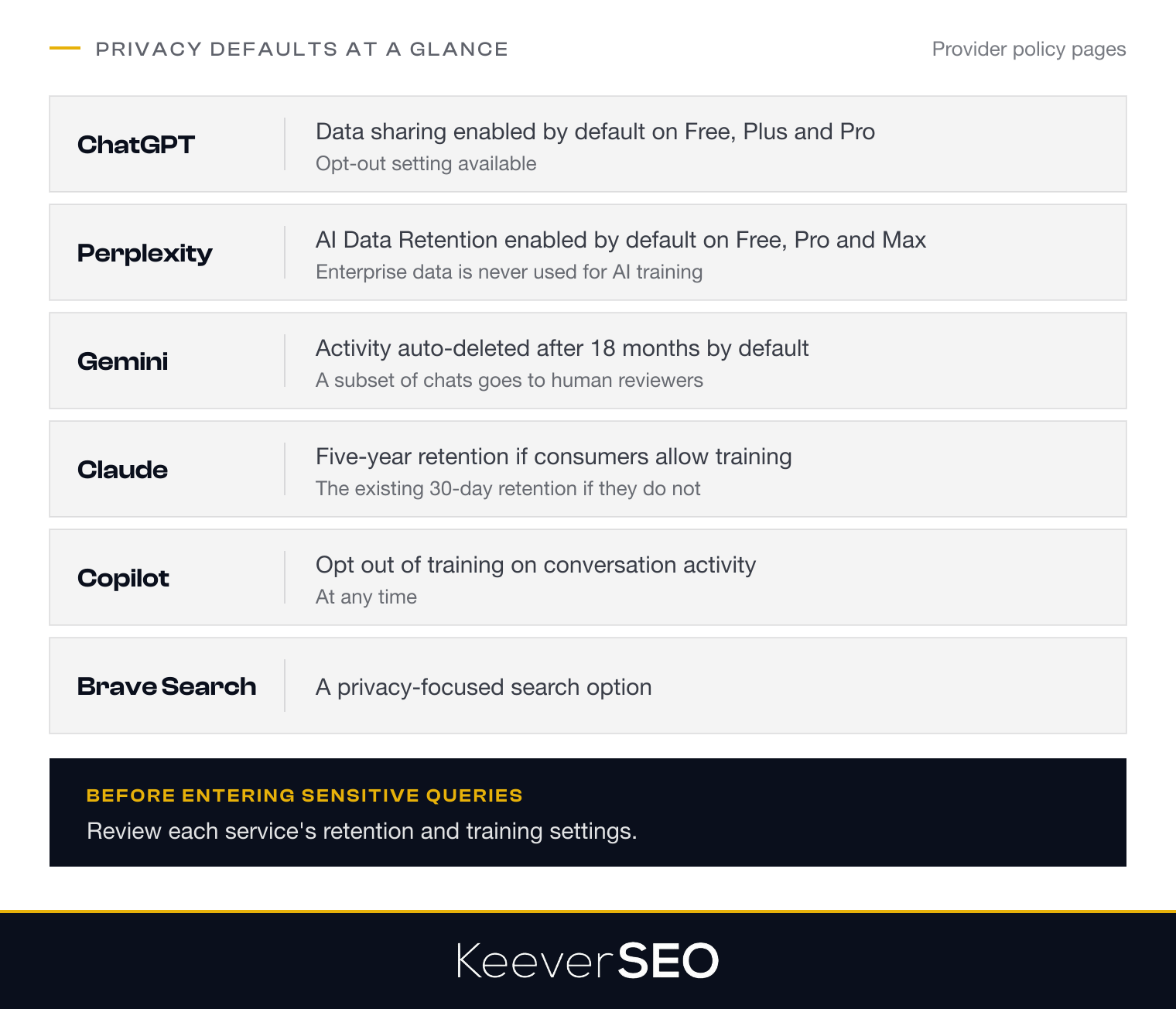
Anthropic's "Updates to Consumer Terms and Privacy Policy" (August 2025) gives Claude consumers a choice: five-year retention if they allow training, or the existing 30-day retention if they do not. Microsoft's "Microsoft Copilot privacy controls" states that "you can opt out of using your conversation activity for model training at any time." Brave Search offers a privacy-focused option, and people handling confidential information should review each service's retention and training settings before entering sensitive queries.
Is SearchGPT or Perplexity Better for Research?
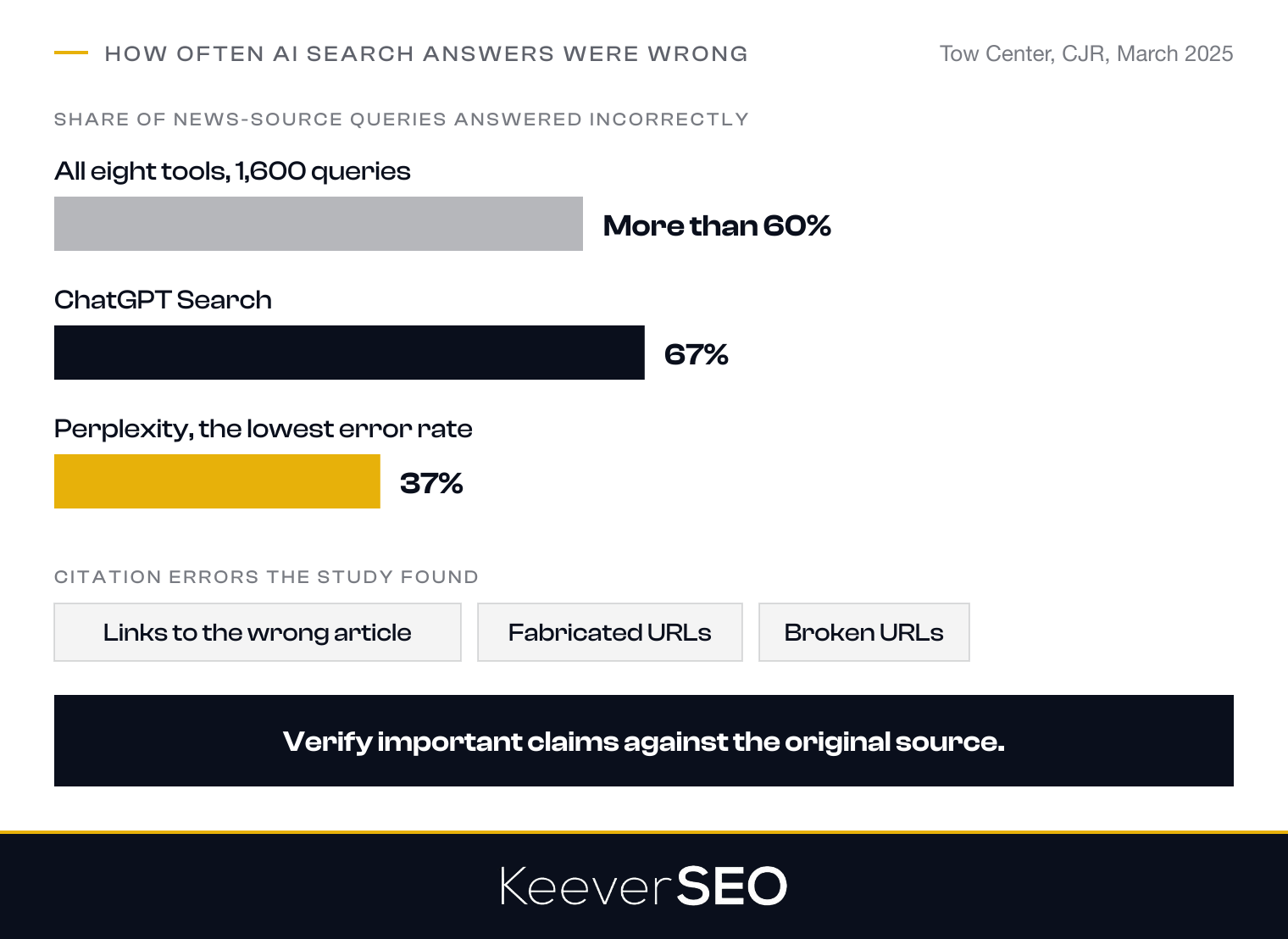
Perplexity is better than SearchGPT for source-heavy research, because Perplexity organizes answers around real-time web sources and numbered citations. SearchGPT, now ChatGPT Search, suits broader everyday questions because it supports conversational follow-ups and keeps context across a discussion. Independent testing gives Perplexity a modest edge on citation accuracy too, since the Tow Center found 37% of its news queries answered incorrectly, against 67% for ChatGPT Search.
Which AI Search Engine Is Best for Each Use Case?
The best AI search engine for each use case depends on the task and the tools you already use. The best match for each use case is listed below:
- Everyday questions: ChatGPT Search
- Cited research: Perplexity
- Google users: Google AI Mode and Gemini
- Microsoft 365 work: Microsoft Copilot
- Long-document analysis: Claude
- Privacy-focused search: Brave Search
What Is the Best Free AI Search Engine?
The best free AI search engine for research is Perplexity, because its free plan provides cited answers. ChatGPT Search suits everyday questions, with free web search and capped access to advanced tools. Google Search's AI features offer a different free option, although availability and usage caps vary by country, query, and account, and Claude's free plan includes web search too.
Which AI Search Engines Should a Local Business Show Up In?
The AI search engines a local business should show up in are Google AI Overviews and AI Mode, ChatGPT, and Perplexity. Google connects AI search answers with local business information, while ChatGPT and Perplexity help customers find, compare, and evaluate nearby services.
BrightLocal's "Local Consumer Review Survey 2026" by Rosie Murphy (February 2026) reports that "use of ChatGPT and other generative AI tools for local recommendations has grown rapidly, rising from 6% last year to 45% and becoming the third most popular source of business recommendations."
How Can a Business Become Visible Across Every AI Search Engine?
A business can become visible across every AI search engine by publishing consistent, verifiable facts about its name, address, phone number, services, hours, and service areas. Keep business details aligned across the website, Google Business Profile, directories, review platforms, and industry sites, then publish direct answers to customer questions about costs, timelines, and local services.
Genuine customer reviews, reputable third-party mentions, and local citations strengthen trust signals. Allow major search crawlers to access important pages, and present main information as crawlable text. "To be eligible to be shown as a supporting link in AI Overviews or AI Mode, a page must be indexed and eligible to be shown in Google Search with a snippet," according to Google's "AI features and your website," and OpenAI's "Overview of OpenAI Crawlers" identifies OAI-SearchBot as the crawler for ChatGPT search.
How Does Keever SEO's AI Optimization Service Get Businesses Recommended by AI Search Engines?
Keever SEO's AI optimization service gets businesses recommended by AI search engines by improving visibility across ChatGPT Search, Perplexity, Gemini, Google AI Overviews, and other AI answer engines. The AI SEO company service begins with a visibility audit that checks brand mentions, citations, competitor presence, and gaps across priority prompts.
Keever SEO then strengthens technical SEO, entity information, structured data, and answer-first content so AI systems can interpret and cite business details. Relevant directories, review platforms, and community mentions build external authority, while ongoing tracking monitors citations, brand mentions, and share of voice across engines to guide updates.
How Do You Rank in Each AI Search Engine?
To rank in each AI search engine, publish clear, useful pages, maintain consistent business facts, and earn credible third-party mentions. Shared SEO foundations help, but ChatGPT, Perplexity, and Claude use different search indexes and retrieval systems. ChatGPT visibility benefits from Bing discoverability and clear entity information, while Perplexity favors fresh, well-supported pages and Claude relies on accessible sources. The sections below explain how to improve visibility in ChatGPT, Perplexity, and Claude.
How Do You Rank in ChatGPT?
To rank in ChatGPT, allow OpenAI's OAI-SearchBot to crawl your pages and maintain Bing visibility, which supports some search contexts. Build trusted mentions across reputable websites, directories, and reviews, and keep business facts such as name, address, and services clear and consistent, since crawl access makes pages eligible but does not guarantee inclusion.
How Do You Rank in Perplexity?
To rank in Perplexity, publish fresh, well-cited pages with clear answers to common questions. Perplexity searches the web in real time, so publish current information, identify authors, and support claims with verifiable sources.
Allow PerplexityBot to crawl your website, and earn relevant mentions from reputable community, industry, and review sites.
How Do You Get Mentioned in Claude?
To get mentioned in Claude, allow relevant Anthropic crawlers, including Claude-User and Claude-SearchBot, to access your content. Brave Search visibility is a sensible check, because Anthropic listed Brave Search as a subprocessor when Claude web search launched in March 2025, although Anthropic's product pages do not name its current provider. Clear business details, positive reviews, and credible third-party mentions provide further evidence for Claude's answers.
Which AI Search Engines Hold the Most Market Share?
The AI search engines that hold the most market share are ChatGPT and Gemini, with the size of each lead depending on the dataset. Statcounter's September 2026 AI chatbot data gives ChatGPT 80.47%, Gemini 10.94%, Perplexity 5.84%, Microsoft Copilot 1.78%, and Claude 0.95% worldwide. Similarweb reports a closer race in generative AI web visits, with ChatGPT falling from about 76% in June 2025 to roughly 53% by May 2026, according to "AI Search Stats 2026: Market Share, Referral, and Citation Data," July 2026. The two datasets measure different things, so rankings differ across methods.
How Accurate Are AI Search Engine Answers?
AI search engine answers were incorrect in more than 60% of 1,600 news-source queries in a 2025 Columbia University Tow Center study of eight tools, and Perplexity had the lowest error rate at 37%, according to "AI Search Has a Citation Problem," published by the Columbia Journalism Review in March 2025. The study found citation errors, including links to the wrong article and fabricated or broken URLs, so readers should verify important claims against the original source.
Which AI Search Engine Should You Use?
The AI search engine you should use depends on the task: Perplexity suits research because it searches the web in real time and presents numbered citations. SearchGPT, now ChatGPT Search, suits everyday questions with conversational answers and current web links, while Google AI Mode fits users who already rely on Google Search.
No single universal ranking exists. Comparing AI search engines helps match research depth, conversational support, and Google integration to your needs.