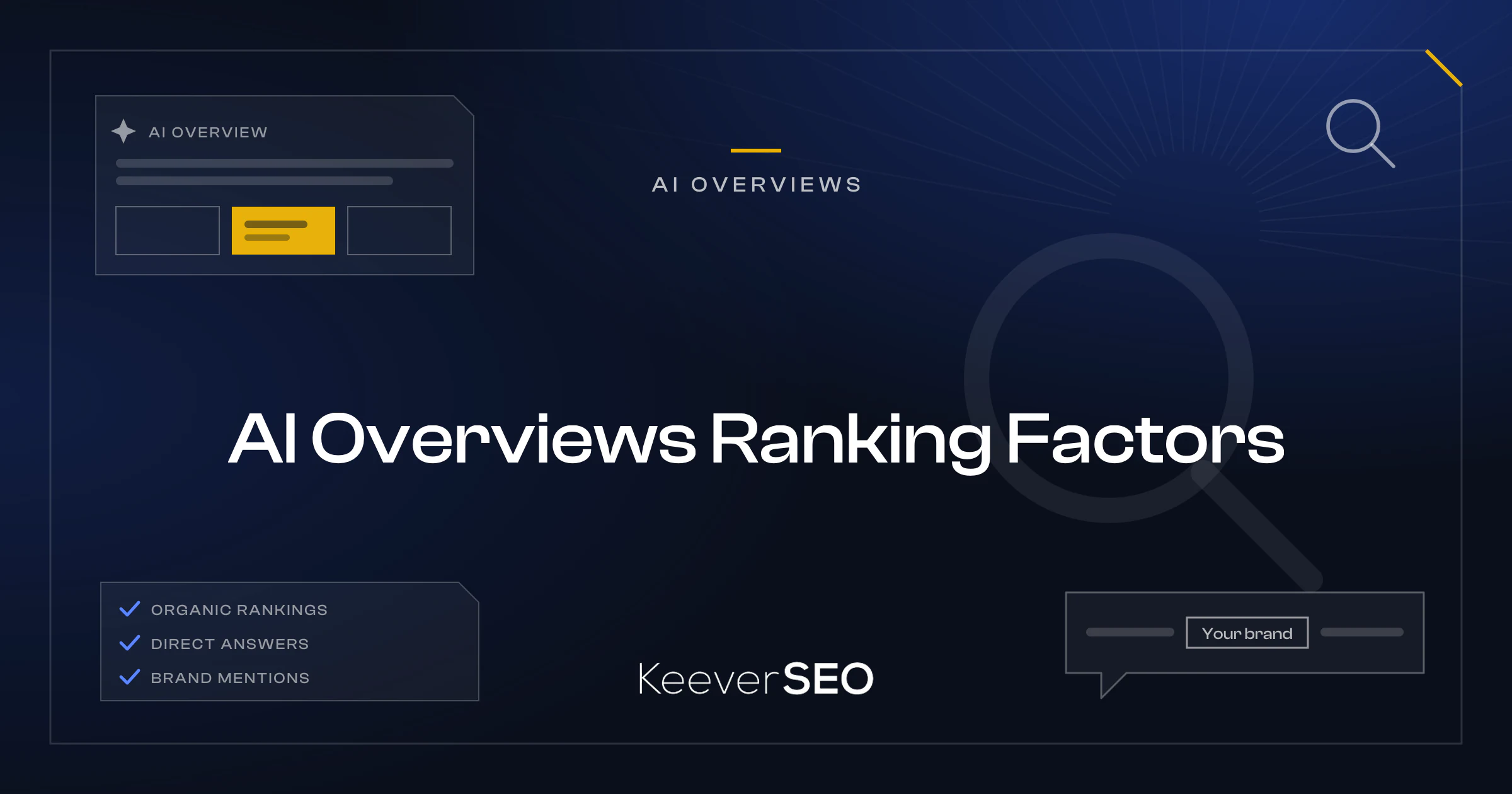
AI Overviews ranking factors are the signals Google uses to select pages for citation, led by organic rankings for the query and related fan-out queries, direct self-contained answers, and brand mentions across the web. Google retrieves relevant pages and passages, then uses query fan-out to run related searches and widen the set of potential sources. The main factors are organic rankings, direct answers, brand mentions, verifiable facts and original data, extractable formatting, crawl access and matching schema, topical authority, freshness, and long-tail query alignment. Citation research shows a real overlap between AI citations and organic visibility, while pages outside the top positions still appear.
Brand mentions can strengthen citation visibility, but no reliable evidence shows that mentions always outweigh backlinks, and backlinks still support the organic rankings that feed AI Overviews. A page does not need to rank first, and Google Search ignores llms.txt files. AI Overviews share organic SEO foundations, including relevance and authority, while adding weight to answer extraction, fan-out query coverage, and brand visibility. Track visibility by checking target queries, recording cited URLs, using rank trackers with AI Overview reporting, and reviewing Search Console data. Local service businesses should optimize useful informational pages, while competitive markets or thin content and technical capacity can make professional support worthwhile. Sections on how AI Overviews work, their cited sources and traffic effects, step-by-step optimization, and broader GEO factors provide further context.
The factor list connects directly to Google's source-selection process: Google retrieves relevant pages, selects useful passages, and grounds generated summaries in cited sources. The next section explains how Google chooses those sources before examining how query fan-out expands the citation pool.
How Does Google Choose Sources for AI Overviews?
Google chooses sources for AI Overviews from pages in its Search index that can support the response. Google's AI features retrieve relevant content, select useful passages, and cite pages that substantiate the generated summary. "To be eligible to be shown as a supporting link in AI Overviews or AI Mode, a page must be indexed and eligible to be shown in Google Search with a snippet," according to Google's "AI features and your website," which adds that "there are no additional technical requirements."
Google grounds an AI Overview in information from its cited pages rather than relying on one page alone. The selected passages provide evidence and context for the summary, while citation links direct users to supporting sources.
Query fan-out can broaden source selection by prompting related searches across subtopics. Pages that answer those related queries can therefore qualify for citations, as the next section explains.
How Does Query Fan-Out Shape AI Overview Citations?
Query fan-out shapes AI Overview citations by expanding one search query into related sub-queries covering connected topics, questions, and user needs. Google can use results from those searches to build a broader set of potential sources for an AI Overview.
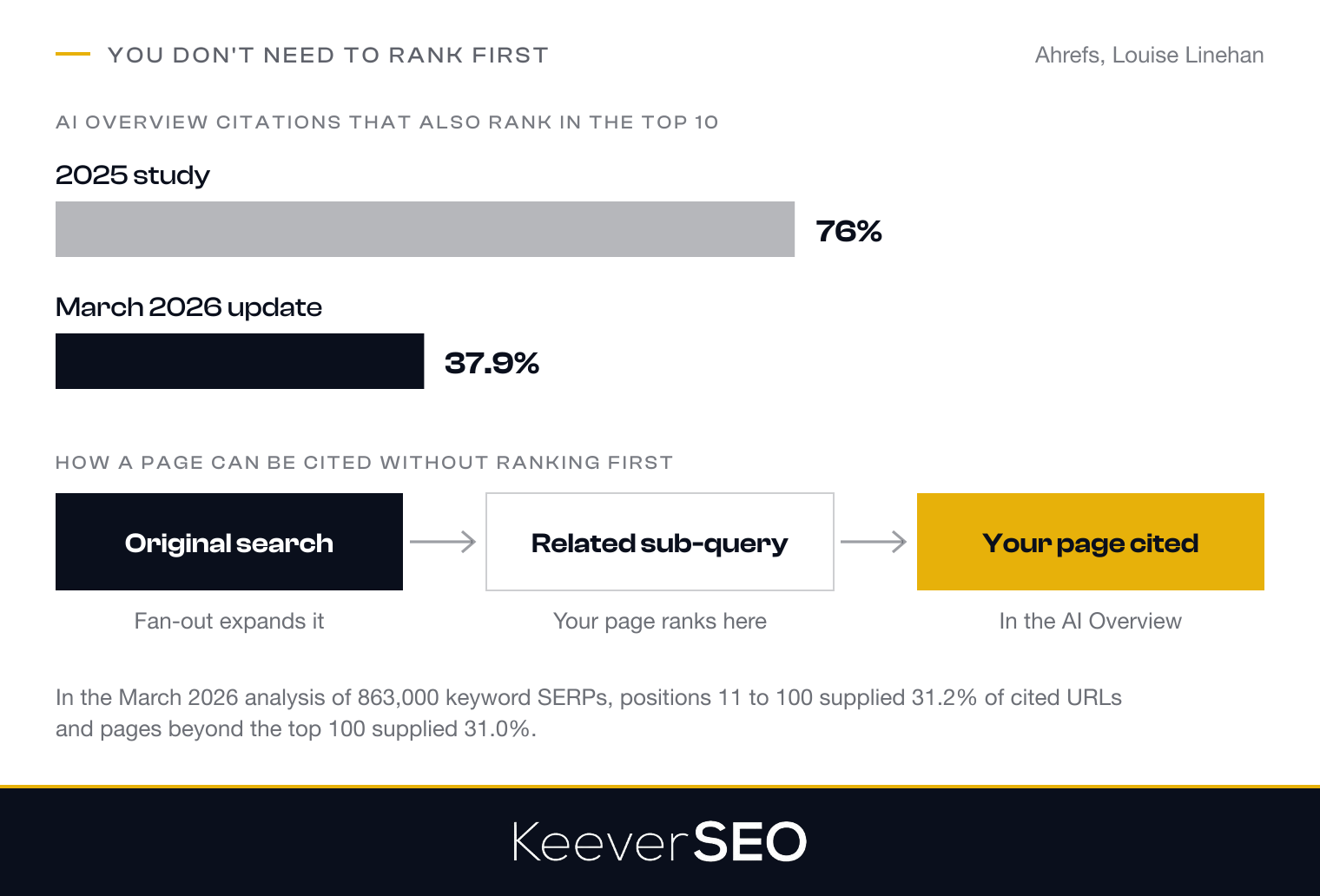
A page can earn a citation by ranking for a relevant sub-query, even when it does not rank prominently for the original query. Pages that answer the main question and related follow-up questions give Google more relevant passages to select.
What Are the Main AI Overviews Ranking Factors?
The main AI Overviews ranking factors are organic rankings for the original query and related fan-out queries, direct self-contained answers, and brand mentions across trusted websites. Google's systems retrieve relevant pages, identify useful passages, and cite sources that support an AI-generated summary.
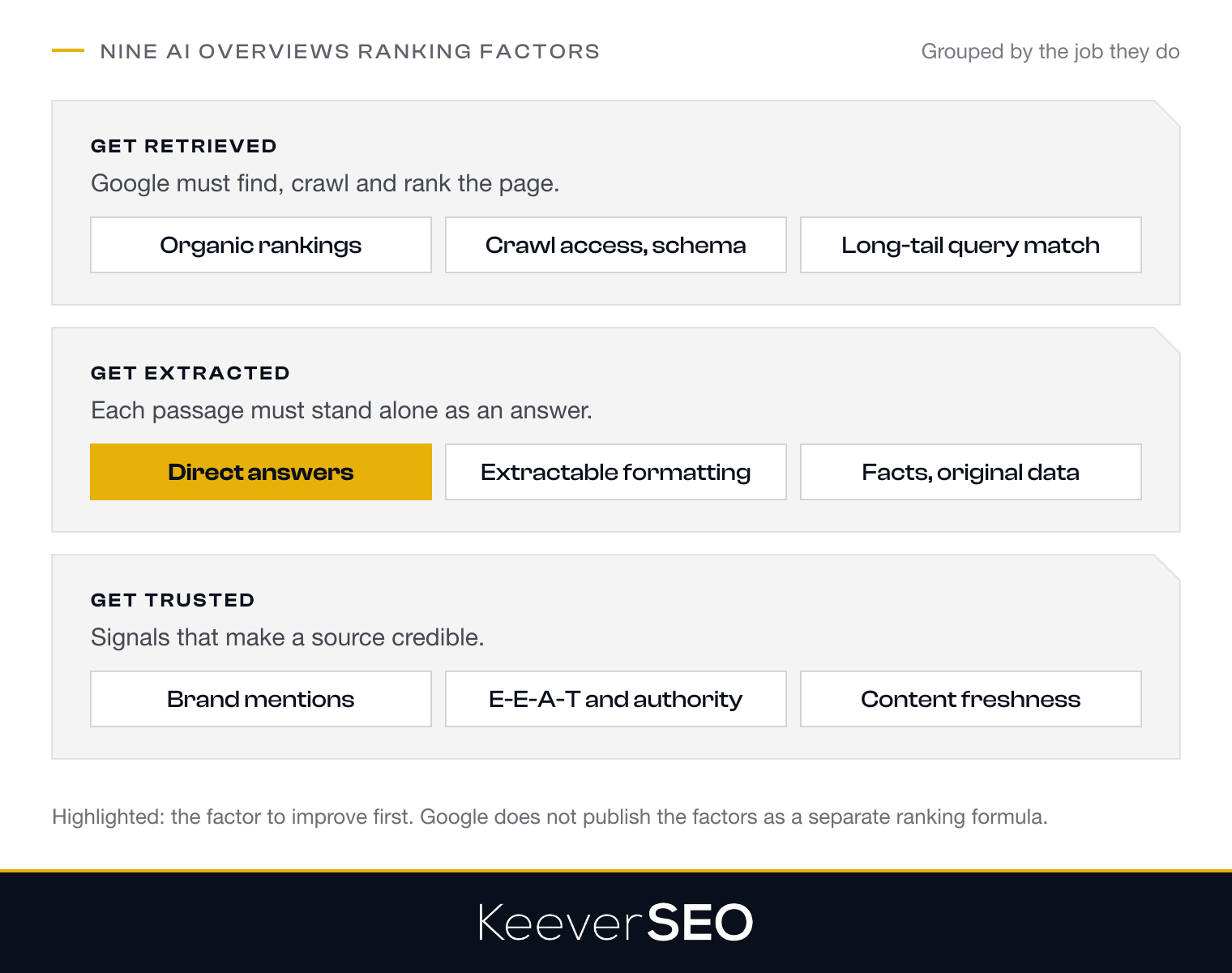
Nine practical factors shape citation potential: organic rankings, direct answers, brand mentions, verifiable facts and original data, extractable formatting, schema and crawl access, topical authority, freshness, and long-tail query relevance. Google does not publish the factors as a separate ranking formula.
Organic Rankings for the Query and Its Fan-Out Queries
Organic rankings for the query and its fan-out queries give pages more opportunities to appear in AI Overviews. Google can cite a page that ranks for the original search or a related sub-query, even when the page does not rank highly for the original search. A March 2026 Ahrefs study by Louise Linehan, "Update: 38% of AI Overview Citations Pull From The Top 10," found that "37.9% of URLs cited in AI Overviews also appeared within the first 10 blocks," down from the 76% Ahrefs reported in 2025. Organic visibility supports citation chances, but it does not guarantee inclusion.
Direct, Self-Contained Answers
Direct, self-contained answers give Google concise passages that remain clear when extracted from a page. An answer-first paragraph states the subject and responds to the question immediately. Supporting sentences add definitions, context, or qualifications without making the answer depend on earlier text. Clear passages help Google interpret page content for potential inclusion in an AI Overview.
Brand Mentions Across the Web
Brand mentions across the web can raise a brand's chances of appearing in AI Overviews when trusted third-party websites repeat them. Relevant mentions in news coverage, industry publications, and expert resources establish a brand's familiarity around a topic, even when those mentions lack backlinks. "Brand web mentions show the strongest correlation (0.664) with AI Overview brand visibility," compared with 0.218 for backlinks, according to "An Analysis of AI Overview Brand Visibility Factors (75K Brands Studied)" by Louise Linehan, published by Ahrefs in May 2025, although correlation does not prove that mentions cause citations.
Facts, Statistics, and Original Data
Facts, statistics, and original data give an AI Overview concrete claims to cite. First-party measurements, survey results, case studies, and original research provide evidence beyond generic summaries. Clear dates, methods, sources, and context help readers and search systems interpret each figure accurately. Google Search Central states in "Google's Guide to Optimizing for Generative AI Features on Google Search" (May 2026) that creating non-commodity content "will likely influence your website's presence in generative AI search in the long run more than any of the other suggestions in this guide."
Structured, Extractable Page Formatting
Structured, extractable page formatting helps readers and search systems identify relevant answers. Use question-based headings, then place a direct, self-contained answer in a short paragraph. Lists organize steps and main points, while tables clarify comparisons and grouped facts. Clear formatting improves readability and extractability, but it does not guarantee an AI Overview citation.
Schema Markup and Crawl Access
Schema markup and crawl access help Google interpret and retrieve eligible pages, but they do not guarantee an AI Overview citation. Googlebot must access the page, and the page must provide indexable, renderable content that can appear in Search. Google's generative AI guide confirms that "structured data isn't required for generative AI search, and there's no special schema.org markup you need to add." Structured data should accurately describe visible page content and follow Google's "General Structured Data Guidelines."
Topical Authority and E-E-A-T
Topical authority and E-E-A-T come from covering a subject and its related questions in connected, thorough pages. Author credentials strengthen that coverage when writers show relevant experience, explain claims accurately, and cite credible sources. Google treats E-E-A-T (experience, expertise, authoritativeness, and trustworthiness) as a quality framework, and "E-E-A-T itself isn't a specific ranking factor," according to Google's "Creating helpful, reliable, people-first content." Clear authorship, reliable references, and accurate business information help readers assess trust and make relevant pages stronger candidates for AI Overview citations.
Content Freshness
Content freshness describes how accurately a page reflects current information, rather than how recently its date changed. Refresh pages for time-sensitive queries by checking figures, examples, recommendations, and references against current sources. Display a clear publication or "Last updated" date, and change the date only after making meaningful updates. Scheduled content updates keep pages relevant as facts and trends change, although the July 2025 Ahrefs study "New Study: AI Assistants Prefer to Cite 'Fresher' Content (17 Million Citations Analyzed)" found that "Google's AI Overviews and organic search results are the most likely to cite older pages" among the platforms it studied.
Long-Tail Informational Query Match
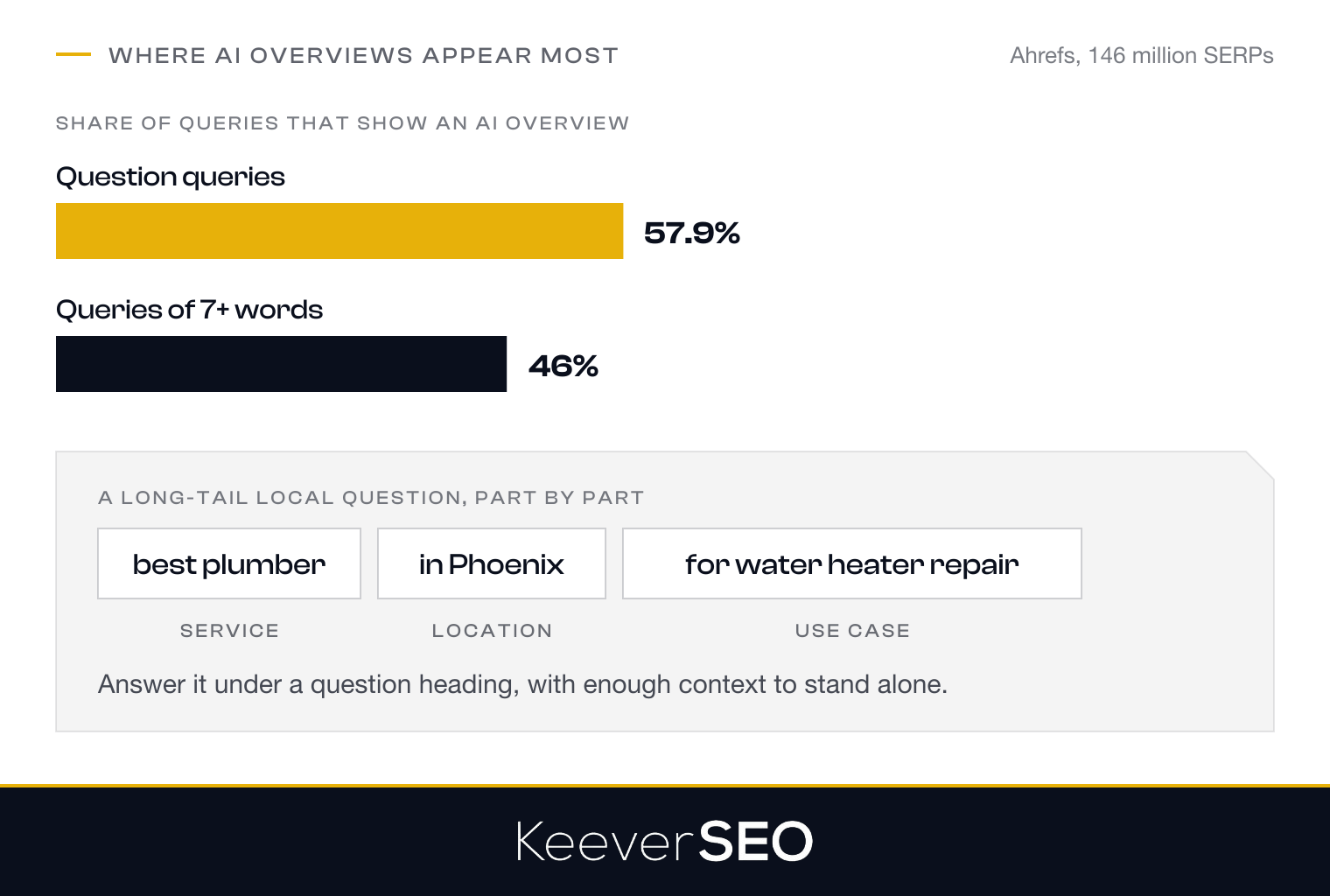
Long-tail informational query match matters because AI Overviews appear frequently for detailed questions that need synthesized explanations. A November 2025 Ahrefs study by Ryan Law and Xibeijia Guan, "What Triggers AI Overviews? 86 Factors and 146 Million SERPs Analyzed," found that "AIOs appear on 46% of 7+ word queries" and "for 57.9% of all question queries." Pages can target those searches with question-based headings, direct answers, and relevant details such as location, cost, use case, or timeframe. Long-tail content works best when each passage provides enough context to stand alone.
Do Brand Mentions Outweigh Backlinks for AI Overviews?
Yes, brand mentions outweigh backlinks in correlation with AI Overview visibility: the Ahrefs analysis of 75,000 brands reported 0.664 for web mentions and 0.218 for backlinks. Those figures show association, not proof that mentions cause citations or outweigh every other signal. Backlinks still support organic rankings, which help pages qualify for AI Overview citations.
Do You Need to Rank Number One to Appear in an AI Overview?
No, you do not need to rank number one to appear in an AI Overview. Google can cite pages beyond the top organic result, including pages that rank for related fan-out queries. Ahrefs' March 2026 analysis of 863,000 keyword SERPs found that positions 11 to 100 supplied 31.2% of cited URLs and pages beyond the top 100 supplied 31.0%. Higher organic rankings can improve citation chances, but ranking position alone does not determine inclusion.
Does llms.txt Help a Page Appear in AI Overviews?
No, llms.txt does not help a page appear in AI Overviews, because Google's generative AI guide states that "you don't need to create new machine readable files, AI text files, markup, or Markdown to appear in Google Search" and that "Google Search ignores them." Site owners should prioritize crawlable, indexable pages with useful content and clear structure.
How Do AI Overviews Ranking Factors Differ From Organic Ranking Factors?
AI Overviews ranking factors differ from organic ranking factors mainly in their added weight on extractable passages, while both share SEO foundations such as query relevance, crawlability, content quality, authority, and trust. Google uses its Search index and ranking systems to find useful pages for both organic results and AI Overviews.
AI Overviews add weight to passages that provide clear, self-contained answers. Extractable formatting, credible brand mentions, and coverage of related fan-out queries help Google identify pages for individual parts of a generated response.
How Do You Track AI Overviews Visibility?
To track AI Overviews visibility, check target queries, record cited pages, and compare search performance over time. The main AI Overviews tracking steps are listed below:
- Check target queries in Google Search and note whether an AI Overview appears.
- Record cited URLs, competing sources, organic positions, dates, countries, languages, and devices.
- Use an AI Overview capable rank tracker to monitor citations and changes over time.
- Review the Generative AI performance report in Google Search Console alongside total impressions and clicks.
Should Local Service Businesses Optimize for AI Overviews?
Yes, local service businesses should optimize for AI Overviews, because Google can show generated answers above the Map Pack and organic results for research-oriented local searches. Queries such as "best plumber in Phoenix for water heater repair" may trigger an Overview, while traditional service-and-location searches can still show the Local Pack.
AI Overviews optimization should support, not replace, local SEO. Service businesses should maintain accurate Google Business Profile details, strong location pages, customer reviews, and trusted third-party mentions. Clear answers about pricing, service options, timelines, and service areas help Google identify relevant information.
When Do AI Overviews Ranking Factors Need Professional Optimization?
AI Overviews ranking factors need professional optimization when a service business competes in a crowded market, has weak organic rankings, or lacks trusted brand mentions across the web. Those gaps can restrict the pages and authority signals Google considers for AI Overview citations.
An experienced SEO professional can improve crawl access, organic rankings, answer-first content, schema markup, and brand visibility. Professional support helps most when an in-house team lacks the time or skills to maintain content, technical SEO, and citation tracking.
How Does Keever SEO Strengthen AI Overviews Ranking Factors for Service Businesses?
Keever SEO strengthens AI Overviews ranking factors for service businesses by combining organic SEO with answer-focused content optimization. The AI Overviews SEO agency work improves service-page rankings and organizes content around customer questions, with concise passages that remain clear when Google extracts them for an AI-generated answer.
Keever SEO builds brand mentions across relevant publications, forums, and websites, and implements suitable LocalBusiness schema. Technical checks support crawler access, while scheduled content updates keep service details current and help track AI citations over time.
How Do Google AI Overviews Work Beyond Ranking Factors?
Google AI Overviews work as generative summaries that appear within Google Search when an overview can help answer a query. Google combines information from its search systems and relevant web pages to provide a concise response with links to supporting sources. Users can expand an overview, open cited links, or ask follow-up questions in AI Mode where available. AI Overviews can contain errors, so users should verify important information with reliable sources.
Which Sources Do Google AI Overviews Cite Most Often?
The sources Google AI Overviews cite most often are relevant pages from Google's search index, alongside forum discussions and video platforms such as Reddit and YouTube. Peec AI's analysis of 30 million sources, "Top domains cited by AI search: Analysis based on 30M sources" (March 2026), ranks YouTube, Reddit, Facebook, LinkedIn, and Medium as the top five domains in US AI Overviews. Domain shares differ widely between studies, so treat any single percentage with care.
How Do AI Overviews Affect Website Traffic?
AI Overviews affect website traffic by reducing clicks to both cited and uncited websites, because users can find answers directly in Google Search. Pew Research Center found that users clicked a traditional result in 8% of visits when an AI summary appeared, compared with 15% without one, and clicked links within the summary in 1% of visits, according to "Google users are less likely to click on links when an AI summary appears in the results" by Athena Chapekis and Anna Lieb, July 2025. Ahrefs reported a 58% lower average click-through rate for the top-ranking page in "Update: AI Overviews Reduce Clicks by 58%" by Ryan Law, February 2026.
How Do You Rank in Google AI Overviews Step by Step?
To rank in Google AI Overviews step by step, improve a page's organic rankings for the main query and related fan-out searches through relevant content, internal links, and sound technical SEO. Next, cover related sub-queries and write direct, self-contained answers under clear question headings. Build credible brand mentions on relevant third-party sites and support claims with verifiable facts or original data. Use short paragraphs, lists, or tables, while maintaining crawl access, accurate schema, topical authority, and fresh information. Then check target queries, record cited pages, review AI Overview reports in rank trackers, and compare Search Console data over time.
How Do AI Overviews Factors Compare With GEO Ranking Factors?
AI Overviews factors compare with GEO ranking factors as a narrower set: AI Overviews factors guide Google's systems in retrieving and citing relevant pages from its search index, while GEO ranking factors address visibility across multiple AI platforms. Semantic completeness, clear entities, and quotable answers support citation across different systems, and both approaches value relevance, authority, freshness, and structured content.
Which AI Overviews Ranking Factor Should You Improve First?
The AI Overviews ranking factor to improve first is direct, self-contained answers on pages that already rank for the target query or a related fan-out query. Lead with a concise response under a clear heading, then provide relevant details and evidence.
Answer-first content makes useful passages easier for Google to identify, while the broader AI Overviews ranking factors cover organic visibility, brand mentions, original data, crawl access, topical authority, freshness, and query relevance.